


Search results
Search for "interfaces" in Full Text gives 471 result(s) in Beilstein Journal of Nanotechnology. Showing first 200.
Impact of fluorination on interface energetics and growth of pentacene on Ag(111)
Beilstein J. Nanotechnol. 2020, 11, 1361–1370, doi:10.3762/bjnano.11.120
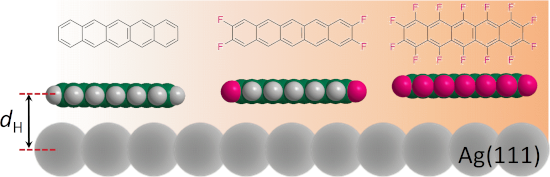
- . Keywords: decoupling; fluorination; metal–organic interfaces; organic pi-conjugated molecules; X-ray standing wave technique; Introduction The performance of organic (opto)electronic devices is strongly affected by the energy level alignment at the various interfaces in such devices [1][2][3
- ]. Fluorination is a viable way to change the ionization energies (IEs) of organic semiconductor thin films [4][5][6], which are an important parameter for energy level alignment [7][8]. Moreover, at organic–metal interfaces, fluorination is believed to decrease the coupling strength between the substrate and the
- adsorbate [9][10][11]. However, at such interfaces, vertical adsorption heights [12][13], interface dipoles (vacuum level shifts) [9][14] and consequently the energy level alignment [15][16][17] are affected by fluorination. Furthermore, fluorination can change the molecular multilayer growth [18][19][20


Controlling the proximity effect in a Co/Nb multilayer: the properties of electronic transport
Beilstein J. Nanotechnol. 2020, 11, 1336–1345, doi:10.3762/bjnano.11.118
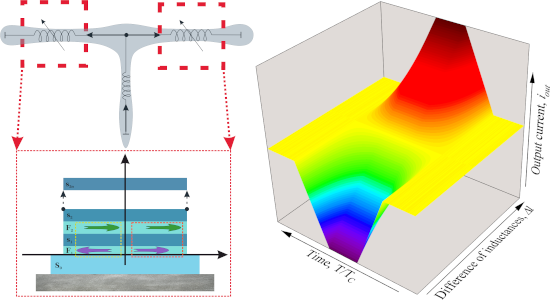
- Usadel equations [22], using the Kupriyanov–Lukichev boundary conditions [23][24], at the S/F interfaces. Here, Gp,q and Φp,q are normal and anomalous Green’s functions, respectively, and ω = πT(2n + 1) is the Matsubara frequency. In addition, where H is the exchange energy in the F-layer, p and q are



Effect of localized helium ion irradiation on the performance of synthetic monolayer MoS2 field-effect transistors
Beilstein J. Nanotechnol. 2020, 11, 1329–1335, doi:10.3762/bjnano.11.117
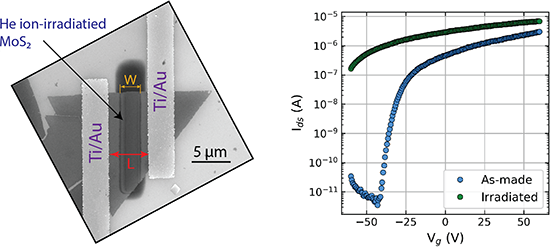
- this paper, we investigate the effect of the defect population on the performance of MoS2 FETs via varying the area of ion irradiation in the FET channel. We also examine the performance of devices upon irradiation of one of the electrical contact interfaces. Experimental Monolayer MoS2 samples were
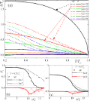
- in each pair a single electrode interface was also irradiated. SEM images in Figure 3a show the irradiated channel areas colored in green and the non-irradiated MoS2 channel areas in red, on example devices in the high IR regime. In all three IR regimes, allowing one of the electrode–MoS2 interfaces


Role of redox-active axial ligands of metal porphyrins adsorbed at solid–liquid interfaces in a liquid-STM setup
Beilstein J. Nanotechnol. 2020, 11, 1264–1271, doi:10.3762/bjnano.11.110
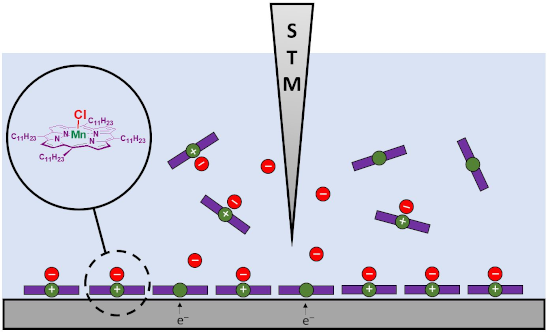
- , Albert-Einstein-Straße 25, 18059 Rostock, Germany 10.3762/bjnano.11.110 Abstract In a liquid-STM setup environment, the redox behavior of manganese porphyrins was studied at various solid–liquid interfaces. In the presence of a solution of Mn(III)Cl porphyrins in 1-phenyloctane, which was placed at a
- and 2.03, respectively. A different dielectric constant may lead to a different potential decay at the interfaces, which in turn may influence the reaction rates. However, since the difference in dielectric constant between the two solvents is small, we propose the first explanation as being more


Proximity effect in [Nb(1.5 nm)/Fe(x)]10/Nb(50 nm) superconductor/ferromagnet heterostructures
Beilstein J. Nanotechnol. 2020, 11, 1254–1263, doi:10.3762/bjnano.11.109
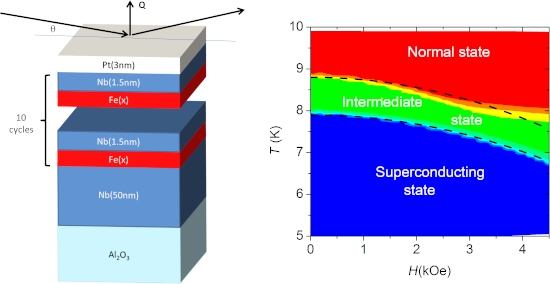
- phenomena are π–Josephson junctions [4][5][6][7] with a π-phase difference of superconducting correlations between two neighboring interfaces, long-range triplet superconductivity [8][9][10][11][12][13][14][15][16] generated in S/F systems with a non-collinear (NC) magnetic configuration of the F system
- , respectively. Reflectometry data analysis To study the quality of layers and interfaces in a layered structure reflectometry techniques (X-ray or neutron) can be used. Using these methods, a reflectivity curve R(Q) is measured as a function of momentum transfer Q = 4πsin(θ)/λ. In the kinematical approximation
- to know the resistivity of all layers in z direction as well as the interfaces resistances. This will require additional experiments on simpler systems and/or with current applied normal to the surface. However, the following arguments allow us to say that the value of λ is comparable to the


![[Graphic 13]](/bjnano/content/inline/2190-4286-11-109-i17.svg?max-width=637&scale=1.18182) ) substrate, (b) the Pt cap layer, and the Nb buffer layer grown at...
) substrate, (b) the Pt cap layer, and the Nb buffer layer grown at...


![[Graphic 16]](/bjnano/content/inline/2190-4286-11-109-i20.svg?max-width=637&scale=1.18182) (T) for the samples s4 (black) and s3 (red) in the vicinity of the superconducting transition m...
(T) for the samples s4 (black) and s3 (red) in the vicinity of the superconducting transition m...
Hybridization vs decoupling: influence of an h-BN interlayer on the physical properties of a lander-type molecule on Ni(111)
Beilstein J. Nanotechnol. 2020, 11, 1168–1177, doi:10.3762/bjnano.11.101
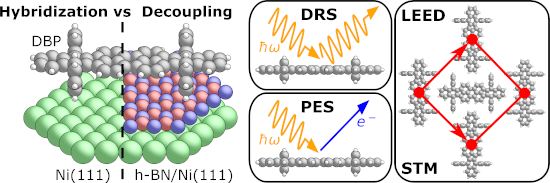
- n-type contact for future molecular electronic devices. Keywords: buried interface; decoupling; hexagonal boron nitride; hybridization; tetraphenyldibenzoperiflanthene (DBP); two-dimensional materials; Introduction The interfaces between organic molecules and metal contacts play a crucial role in


Three-dimensional solvation structure of ethanol on carbonate minerals
Beilstein J. Nanotechnol. 2020, 11, 891–898, doi:10.3762/bjnano.11.74
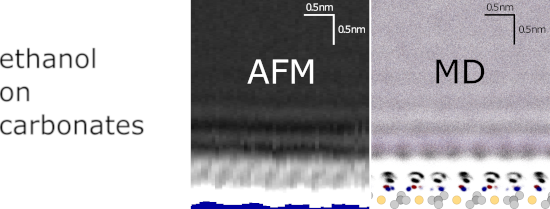
- surfaces interact with a large variety of organic molecules, which can result in surface restructuring. This process is decisive for the formation of biominerals. With the development of 3D atomic force microscopy (AFM) it is now possible to image solid–liquid interfaces with unprecedented molecular
- -resolution 3D atomic force microscopy (AFM) [1], the hydration structure of many interfaces has been studied, including the aqueous interface of mica [2] calcite [3][4] dolomite [5][6] and organic crystals [7]. However, while the majority of 3D AFM works have concentrated on water, comparatively fewer
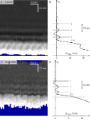
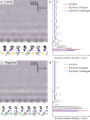
- distance is in good agreement with the above-cited previous calculations of ethanol interfaces. Moreover, observing no order in the upper layers fits well to the MD simulations from previous theoretical studies, which do not indicate significant lateral order in the layers above the first layer for the

A Josephson junction based on a highly disordered superconductor/low-resistivity normal metal bilayer
Beilstein J. Nanotechnol. 2020, 11, 858–865, doi:10.3762/bjnano.11.71
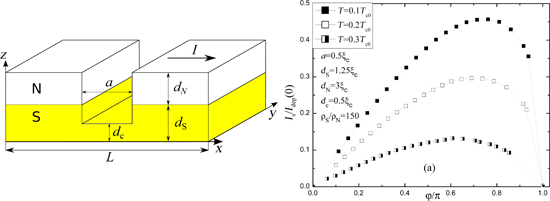
- equation, Here, js is the superconducting current density, which is determined by the following expression: where ρ is the residual resistivity of the corresponding layer. At the SN-interface we use a boundary condition similar to Equation 4, and for the interfaces with the vacuum we use dϕ/dn = 0. At the


Hexagonal boron nitride: a review of the emerging material platform for single-photon sources and the spin–photon interface
Beilstein J. Nanotechnol. 2020, 11, 740–769, doi:10.3762/bjnano.11.61
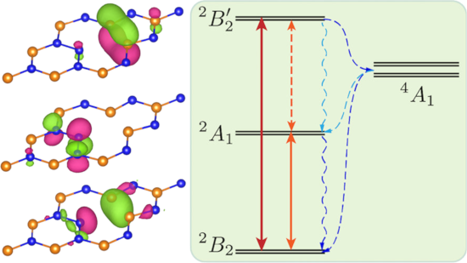
- spin–photon interfaces for remote spin–photon entanglement with available nuclear spins as ancilla qubits for quantum memory [11][12]. These include the nitrogen-vacancy (NV) center in diamond [13], the silicon-vacancy center in diamond [14][15][16], the germanium-vacancy center in diamond [17], the




Quantitative determination of the interaction potential between two surfaces using frequency-modulated atomic force microscopy
Beilstein J. Nanotechnol. 2020, 11, 729–739, doi:10.3762/bjnano.11.60
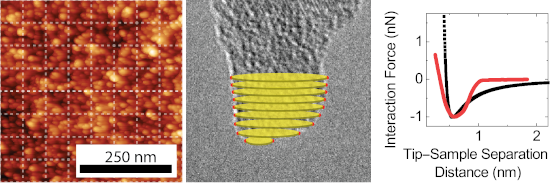
- even in atomistic simulations of solid interfaces, does not accurately capture the interactions between silicon and diamond surfaces. More specifically, if we observe the mismatch in the repulsive force component, assuming that the attractive force component follows a z−3 dependency, we see that the LJ


Effect of substitutional defects on resonant tunneling diodes based on armchair graphene and boron nitride nanoribbons lateral heterojunctions
Beilstein J. Nanotechnol. 2020, 11, 688–694, doi:10.3762/bjnano.11.56
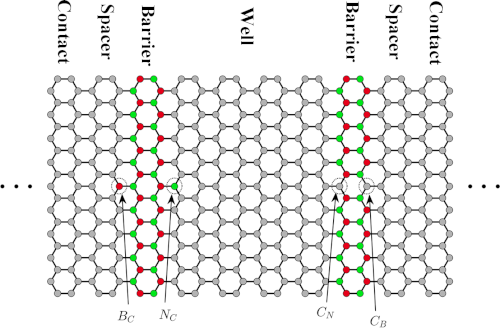
- performance of RTDs based on Gr/hBN heterojunctions [26][27][28][29][30][31][32][33]. Formation energy calculations have revealed that point defects occur preferentially at the interfaces of graphene and hBN domains rather than in the middle of these domains, and that substitutional defects are dominant [30
- considers the interfaces of the Gr/hBN regions are parallel to the transport direction so that there are no bandgap variations in the transport direction. Since the electron transport is in zigzag direction, spin-polarized transport calculations are utilized. Instead, in the study presented here, the
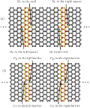
- the interfaces of RTD based on AGNR/ABNNR heterojunctions. Carbon, boron and nitrogen atoms are depicted in grey, red and yellow, respectively. Effect of substitutional defects on the energy bandstructure of 19-AGNR and 19-ABNNR. Carbon, boron and nitrogen atoms are depicted in grey, red and yellow



Observation of unexpected uniaxial magnetic anisotropy in La2/3Sr1/3MnO3 films by a BaTiO3 overlayer in an artificial multiferroic bilayer
Beilstein J. Nanotechnol. 2020, 11, 651–661, doi:10.3762/bjnano.11.51
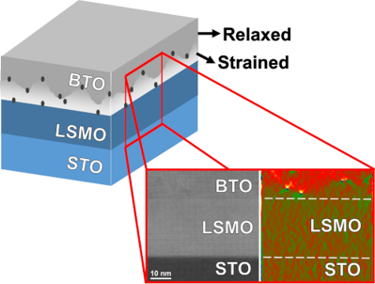
- HAADF-STEM image for a BTO/LSMO bilayer grown on STO substrate, where we can identify both BTO/LSMO and LSMO/STO interfaces. The insets correspond to high-magnification HAADF-STEM images to highlight the flat atomic sharp interfaces. By means of GPA method on the HAADF images, it is possible to display
- strain maps reflect homogeneous and dislocation-free STO and LSMO layers, and a BTO layer with several linear defects, most of which are concentrated close to the BTO/LSMO interfaces. Misfit dislocation-free epitaxial growth of LSMO films under (001)-oriented STO substrates is expected and widely
- a quantitative strain analysis, profiles of εxx and εzz extracted from the GPA maps are plotted in Figure 5d and Figure 5e. These profiles are traced perpendicular to the interfaces, along two zones: Through a horizontal misfit dislocation (Profile 1) and through a dislocation-free region (Profile 2



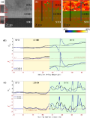
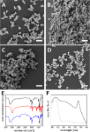
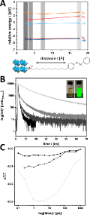
Interfacial charge transfer processes in 2D and 3D semiconducting hybrid perovskites: azobenzene as photoswitchable ligand
Beilstein J. Nanotechnol. 2020, 11, 466–479, doi:10.3762/bjnano.11.38
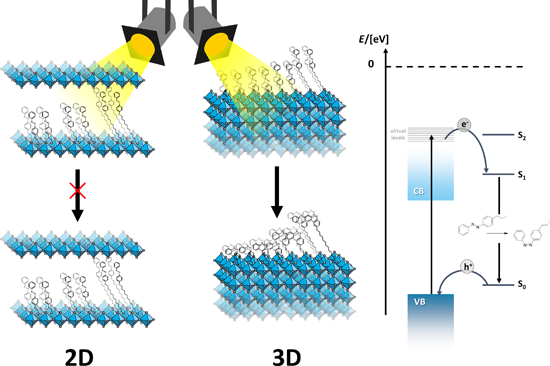
- of studies on semiconductor particles ligands or capping agents are used that bind to the surface of the particles covering them with an electrically insulating shell. Since the transport of charge carriers and/or energy across interfaces is desirable for a variety of applications, the use of π
- -conjugated ligands becomes increasingly interesting. Among them are compounds that react to external stimuli. Molecular switches in particular are fascinating because the properties of the interfaces can be potentially adjusted as required. However, there is debate about how the properties of such special
- ; organic–inorganic hybrid materials; particle synthesis; semiconductors; transport across interfaces; Introduction Recently the class of hybrid perovskites attracted great attention in materials chemistry and physics [1][2][3]. In addition to an outstanding performance in photovoltaics, a peculiar feature




Implementation of data-cube pump–probe KPFM on organic solar cells
Beilstein J. Nanotechnol. 2020, 11, 323–337, doi:10.3762/bjnano.11.24
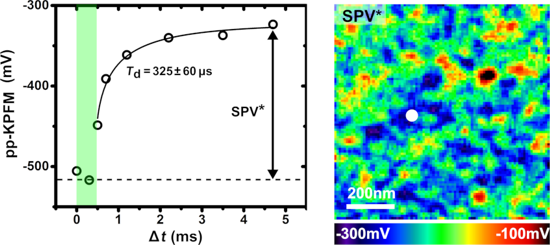
- approximation, this effect can be understood by assuming that there are no permanent charges in the “dark” (i.e., unilluminated) state of the organic layer considered as an undoped semiconductor. In “real” samples trapped carriers and electrostatic dipoles at the donor–acceptor interfaces contribute to the
- global electrostatic landscape probed by KPFM in the dark state [20]. The photocharging dynamics can be understood as follows. After exciton splitting and dissociation of the charge transfer states at the D–A interfaces, the photogenerated carriers experience a drift-diffusion limited by the carrier
- mobility [21]. Internal electric fields due to band bending at the D–A interfaces and at the organic/substrate interface play a key role in this process. In an open-circuit configuration occurring in KPFM experiments, the charges will move until the internal electric fields are compensated. Then the charge




Anomalous current–voltage characteristics of SFIFS Josephson junctions with weak ferromagnetic interlayers
Beilstein J. Nanotechnol. 2020, 11, 252–262, doi:10.3762/bjnano.11.19
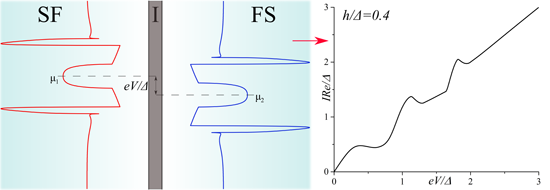
- , with thicknesses df1 and df2. The system contains three interfaces: two S/F (superconductor/ferromagnet) boundaries and one tunnel F-I-F interface. Each of these interfaces is described by the dimensionless parameter γBj = RBjσn/ξn (j = 0, 1, 2), which is proportional to the resistance RBj across the
- characteristic decay length of the real part of the pair wave function in the ferromagnet, ξf1, which we introduce later in Equation 13 and Equation 14. We assume that the S/F interfaces are not magnetically active. We also neglect the nonequilibrium effects [89][90][91] and use the Matsubara Green’s functions
- technique, which has been developed to describe many-body systems in equilibrium at finite temperature [92]. In our model the tunneling barrier is located between two F layers at x = 0 (Figure 1), whereas the other interfaces at x = −df1 and x = df2 are identical and transparent. This case corresponds to


Nanosecond resistive switching in Ag/AgI/PtIr nanojunctions
Beilstein J. Nanotechnol. 2020, 11, 92–100, doi:10.3762/bjnano.11.9
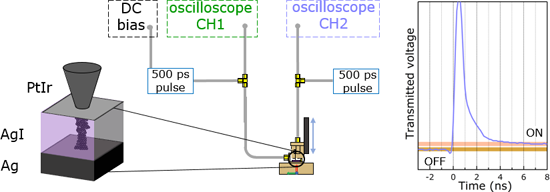
- Budapest, Hungary Department of Physics, University of Konstanz, Universitätstrasse 10, D-78464 Konstanz, Germany Empa, Swiss Federal Laboratories for Materials Science and Technology, Transport at Nanoscale Interfaces Laboratory, Überlandstrasse 129, CH-8600 Dübendorf, Switzerland Wigner Research Centre
- ][27] have been promoted in terms of the “atomic switch” by K. Terabe et al. utilizing Ag2S as the ionic conductor medium [28]. The roles of the matrix, the electrode, and their interfaces in the filament formation have been extensively investigated covering a broad range of materials systems [4


An investigation on the drag reduction performance of bioinspired pipeline surfaces with transverse microgrooves
Beilstein J. Nanotechnol. 2020, 11, 24–40, doi:10.3762/bjnano.11.3
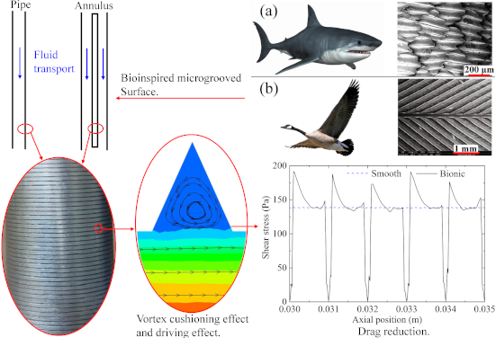
- friction between two liquid interfaces in the bionic pipe flow. In addition, extra frictional drag formed between the vortexes and grooved wall, whose direction was the same as the flow direction. This resulted in the frictional drag having a ‘driving’ effect on the fluid flow. As such, the reduction of


Advanced hybrid nanomaterials
Beilstein J. Nanotechnol. 2019, 10, 2563–2567, doi:10.3762/bjnano.10.247

- improved or even completely new properties. This has been called a Lego©-like approach to materials synthesis [18]. The main issue in this approach is to monitor and control interactions between different bricks and to understand the physico-chemical mechanisms involved at the interfaces between the
- critical importance of interfaces. In the current issue, from “simple” to more elaborated, we here observe the importance of the polyol method, the non-hydrolytic or colloidal approach, and ordered mesopore templating techniques. In “Tailoring the magnetic properties of cobalt ferrite nanoparticles using
Mobility of charge carriers in self-assembled monolayers
Beilstein J. Nanotechnol. 2019, 10, 2449–2458, doi:10.3762/bjnano.10.235
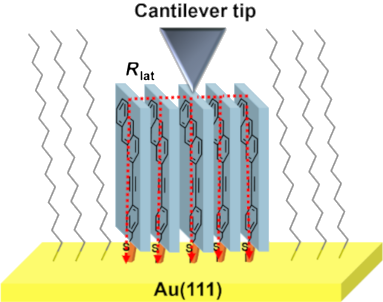
- Zhihua Fu Tatjana Ladnorg Hartmut Gliemann Alexander Welle Asif Bashir Michael Rohwerder Qiang Zhang Bjorn Schupbach Andreas Terfort Christof Woll Institute of Functional Interfaces (IFG), Karlsruhe Institute of Technology (KIT), Campus Nord, 76344 Eggenstein-Leopoldshafen, Germany Max-Planck


Semitransparent Sb2S3 thin film solar cells by ultrasonic spray pyrolysis for use in solar windows
Beilstein J. Nanotechnol. 2019, 10, 2396–2409, doi:10.3762/bjnano.10.230
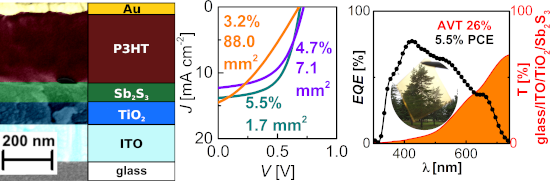
- solar cells favorable for light conversion under cloud cover. It is clear that the key to further increase the efficiency, area-scalability, and durability of opaque and semitransparent Sb2S3 solar cells lies in tuning of the layers and interfaces of the ETM/Sb2S3/HTM stack. Considering the potential



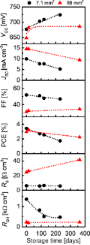
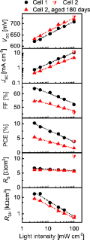
Deterministic placement of ultra-bright near-infrared color centers in arrays of silicon carbide micropillars
Beilstein J. Nanotechnol. 2019, 10, 2383–2395, doi:10.3762/bjnano.10.229
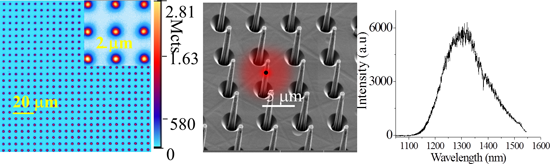
- systems for quantum devices such as single-photon sources and spin–photon interfaces for quantum interconnects [1][2][3]. Points defects or color centers in SiC are considered as alternative candidates for quantum applications such as solid-state quantum bits [4][5], spin–photon interfaces [6], single
- defined position in the micropillars, rather than at a random location, for the most extensively studied emitters in SiC useful for spin–photon interfaces. The micropillars, although not yet optimized for an optimal collection of specific color centres, are yielding an ultra-bright emission beneficial for
- height of 0.9 μm in which the emitters are localized ca. 450 nm from the top. This design could improve the VSi and VSiVC SPSs collection efficiencies [4][5][8] for spin–photon interfaces and quantum network applications [1]. Finally, we have enhanced by a factor of up to 7 the emission of NCVSi in SiC


Design and facile synthesis of defect-rich C-MoS2/rGO nanosheets for enhanced lithium–sulfur battery performance
Beilstein J. Nanotechnol. 2019, 10, 2251–2260, doi:10.3762/bjnano.10.217
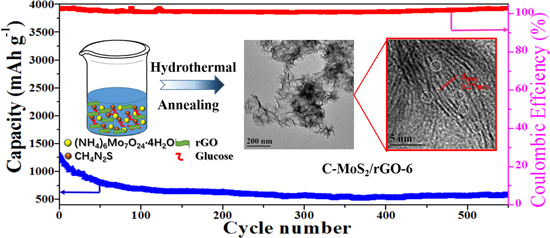
- suggest the existence of electronic interactions between amorphous carbon and MoS2, which implies the establishment of coupling interfaces [40]. This interaction not only improves the rate of catalytic polysulfide conversion but also effectively utilizes the conductivity of carbon, which is the goal of


Nontoxic pyrite iron sulfide nanocrystals as second electron acceptor in PTB7:PC71BM-based organic photovoltaic cells
Beilstein J. Nanotechnol. 2019, 10, 2238–2250, doi:10.3762/bjnano.10.216
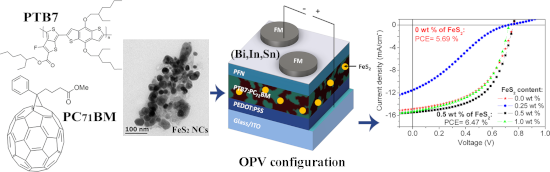
- significant difference in the electrical parameters of the OPVs with 0.5% and 1.0% (Table S2). As shown in Figure 6a, the OPVs with 0.25 wt % of FeS2 exhibit an S-shaped J–V curve, that could arise from charge recombination or accumulation resulting from poor charge transport between the OPV interfaces, and


Ultrathin Ni1−xCoxS2 nanoflakes as high energy density electrode materials for asymmetric supercapacitors
Beilstein J. Nanotechnol. 2019, 10, 2207–2216, doi:10.3762/bjnano.10.213
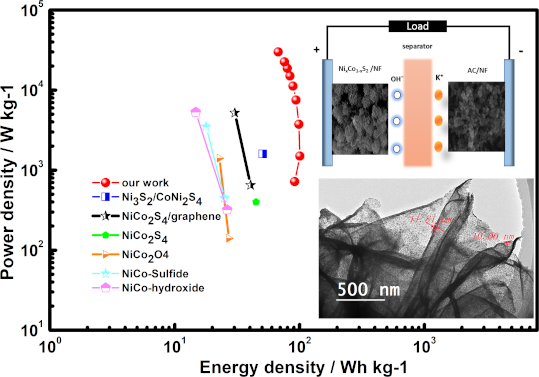
- ]. Currently, carbon-based electrical double-layer capacitors (EDLCs) are commercially available, but they exhibit only a low energy density because of physical charge storage processes due to the adsorption/desorption of ions at the electrode–electrolyte interfaces [3]. These drawbacks have hindered further


Microbubbles decorated with dendronized magnetic nanoparticles for biomedical imaging: effective stabilization via fluorous interactions
Beilstein J. Nanotechnol. 2019, 10, 2103–2115, doi:10.3762/bjnano.10.205
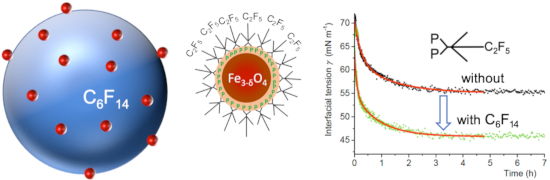
- interactions published to date are restricted to liquid/liquid and solid/liquid interfaces [41][42]. In contrast, the potential of fluorocarbon gases to develop attractive fluorous interactions at the gas/water interface has only recently been demonstrated [38]. It is noteworthy that the interactions between





