


Search results
Search for "separation" in Full Text gives 802 result(s) in Beilstein Journal of Nanotechnology. Showing first 200.
Metal-organic framework-based nanomaterials as opto-electrochemical sensors for the detection of antibiotics and hormones: A review
Beilstein J. Nanotechnol. 2023, 14, 631–673, doi:10.3762/bjnano.14.52
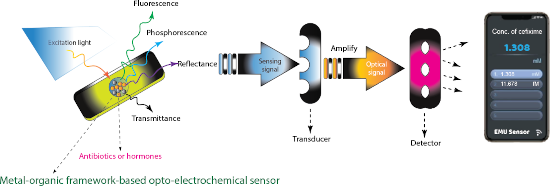
- , multistep separation procedure. A fluorescence polarisation immunoassay, which does not require a separation step, is one development that has been made to get around this restriction [22]. Furthermore, chromatographic techniques such as thin-layer chromatography (TLC), liquid chromatography-coupled mass
- limited resources. Additionally, the mobile phase utilized in the separation of antibiotics and hormones affects the chromatography’s ability to detect substances [23]. The advantages of SERS are its rapid detection time, affordable detection cost, and ease of use. It also has a number of drawbacks, such
- redox reaction during the electron deactivation process. For effective quenching, a complex driven by either hydrophobic, van der Waals, or π–π-stacking interactions is generated between the electron donor and the electron acceptor with a separation on a sub-nanometre length scale. The complexation of


Titania nanoparticles for photocatalytic degradation of ethanol under simulated solar light
Beilstein J. Nanotechnol. 2023, 14, 616–630, doi:10.3762/bjnano.14.51
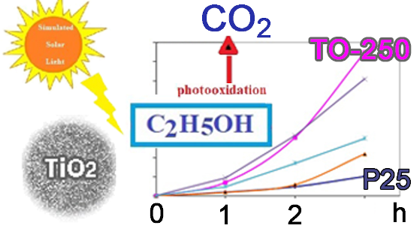
- differences could promote the fabrication of new devices with higher efficiency in electron–hole separation [33]. There are a lot of methods to obtain TiO2 powder, from chemical reactions in solvents [34][35][36] to simple oxidation at high temperatures [37]. Every method has its particular yield and




On the use of Raman spectroscopy to characterize mass-produced graphene nanoplatelets
Beilstein J. Nanotechnol. 2023, 14, 509–521, doi:10.3762/bjnano.14.42
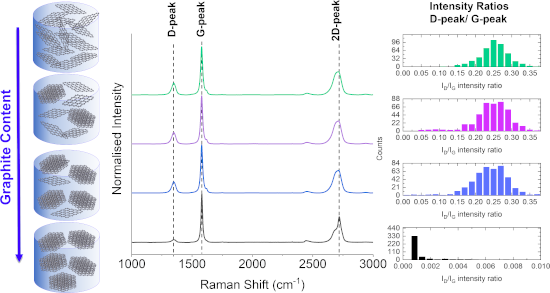
- separation of unexfoliated materials. In this work we assess these metrics when applied to non-ideal samples, where unexfoliated graphite has been deliberately added to the exfoliated material. We demonstrate that previously published metrics, when applied to averaged spectra, do not allow the presence of
- ]. Again, it is not clear if the same metrics can be applied to measurements performed on bulk material, where flakes are restacked or reaggregated. As many GNP products are produced through top-down manufacturing methods, which typically have a GNP yield of less than 100%, there is often a separation step
- of GNP material is prepared through careful separation of unexfoliated material. Then, the observed changes for an averaged Raman spectrum are investigated while adding small amounts of graphite to the GNP sample. We then evaluate the ability of previously published metrics to identify the presence


Conjugated photothermal materials and structure design for solar steam generation
Beilstein J. Nanotechnol. 2023, 14, 454–466, doi:10.3762/bjnano.14.36
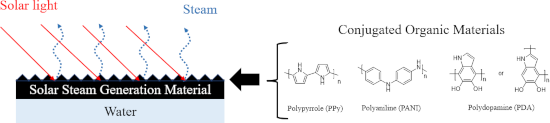
- membranes with hydrophobic photothermal material particles. Over the past years, various types of SSG membranes have been studied [37][39][45][54][56][57]. These SSG membranes can be applied to, for example, seawater desalination and photocatalytic degradation by utilizing the photothermal and separation


Plasmonic nanotechnology for photothermal applications – an evaluation
Beilstein J. Nanotechnol. 2023, 14, 380–419, doi:10.3762/bjnano.14.33




Polymer nanoparticles from low-energy nanoemulsions for biomedical applications
Beilstein J. Nanotechnol. 2023, 14, 339–350, doi:10.3762/bjnano.14.29
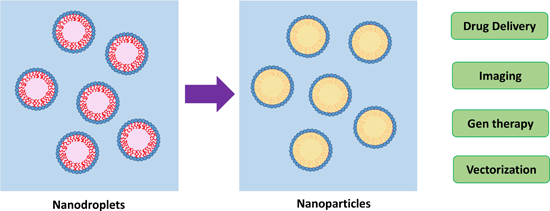
- liquid phase. They are out-of-equilibrium nanocolloids in which phase separation is expected from thermodynamics, but is delayed by the presence of surfactants adsorbed on the droplets surface. Accordingly, nanoemulsion formation depends on the way the sample is prepared, for example, on the order of




Bismuth-based nanostructured photocatalysts for the remediation of antibiotics and organic dyes
Beilstein J. Nanotechnol. 2023, 14, 291–321, doi:10.3762/bjnano.14.26
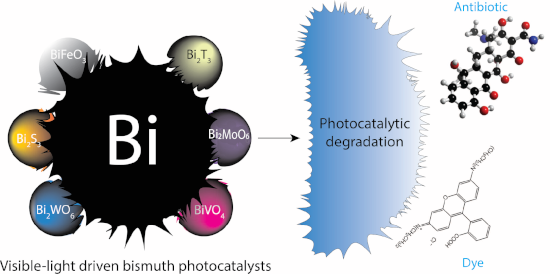
- treat contaminated water and wastewater, including adsorption, bioremediation, precipitation, electrocoagulation, filtration, membrane separation, flocculation, centrifugation, advanced oxidation processes based on photocatalysis, and chemical coagulation [4][5][6][7][8][9][10][11]. Each of these
- carrier separation, high photo-transporter mobility, appropriate physical and chemical properties, sufficient band alignment to meet the kinetic requirements of the target reaction, and anti-corrosion stability in reactive environments [18][19][20]. Figure 1 depicts the mechanism of the photocatalyst. In
- surface charge, low carrier density, small electron effective mass, long electron mean free path, and extremely low band overlap energy, bismuth can transition from a semimetal to a semiconductor by shrinking its crystallite size [25][71][72][73][74][75][76][77]. To hasten the separation of photogenerated


Biocatalytic synthesis and ordered self-assembly of silica nanoparticles via a silica-binding peptide
Beilstein J. Nanotechnol. 2023, 14, 280–290, doi:10.3762/bjnano.14.25
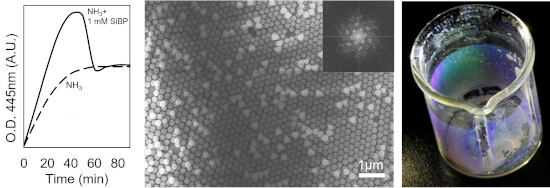
- methods for manufacturing ordered structures of nanoparticles is an ongoing challenge. Ordered structures of SiO2 nanoparticles have gained increased attention due to the great potential they offer in filtering, separation, drug delivery, optics, electronics, and catalysis. Biomolecules, such as peptides
- gained increased attention due to the great potential they offer in filtering, separation, drug delivery, optics, electronics, and catalysis [1][2][3][4][5]. Nanoparticles with ordered 3D structures, such as supra-particles or super lattices, can possess properties that are not observed in the bulk




A distributed active patch antenna model of a Josephson oscillator
Beilstein J. Nanotechnol. 2023, 14, 151–164, doi:10.3762/bjnano.14.16
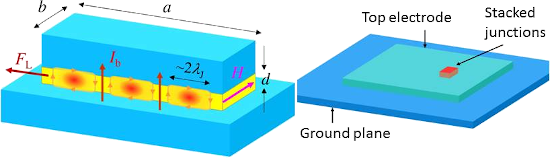
- . The array factor takes into account the interference of electromagnetic fields from the two slots in the far field. It depends on the separation between the slots, a, the relative phase shift, β, and the direction (φ,Θ). Since radiation from a patch antenna is induced by magnetic current lines, it is


Formation of nanoflowers: Au and Ni silicide cores surrounded by SiOx branches
Beilstein J. Nanotechnol. 2023, 14, 133–140, doi:10.3762/bjnano.14.14
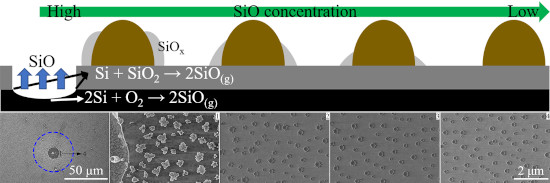
- between the positions of pure Au and Ni since only one main reflex should be observed when the two elements are completely mixed [20][23][25]. The annealing temperatures are above the miscibility gap [23][50]. Thus, the partial mixing comes from the phase separation of Au and Ni during cooling [25
- interdiffusion of Au, Ni, and Si. Au/Si phase separation occurs during cooling [3][55], and Ni silicide may remain stable down to room temperature [41][42][43][44][45][46], finally forming particles with two contrasts. Besides, Ni may also diffuse into the Si substrate, leading to the formation of the Ni


Intermodal coupling spectroscopy of mechanical modes in microcantilevers
Beilstein J. Nanotechnol. 2023, 14, 123–132, doi:10.3762/bjnano.14.13
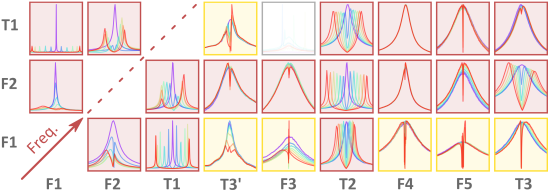
- –T3, which has a regime transition. Inset: Coupling rates determined from linewidth changes or eigenmode separation against half the linewidth of cavity mode T3. (b) Matrix showing the coupling rates of all mode combinations. Contoured squares represent combinations between flexural modes only. (c


Characterisation of a micrometer-scale active plasmonic element by means of complementary computational and experimental methods
Beilstein J. Nanotechnol. 2023, 14, 110–122, doi:10.3762/bjnano.14.12
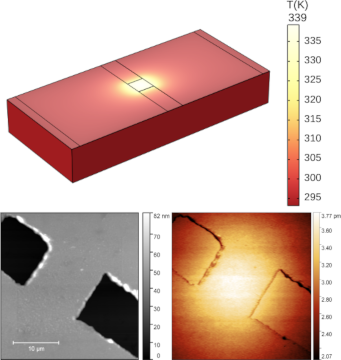
- ] investigated the effects of gap size using a fine tunable mechanical separation as a means to control the intensity of a travelling SPP on silver. In contrast, in the present work, the modulation of the device’s response is obtained through changes in the optical constants via electrical signals. It is well




Two-step single-reactor synthesis of oleic acid- or undecylenic acid-stabilized magnetic nanoparticles by thermal decomposition
Beilstein J. Nanotechnol. 2023, 14, 11–22, doi:10.3762/bjnano.14.2
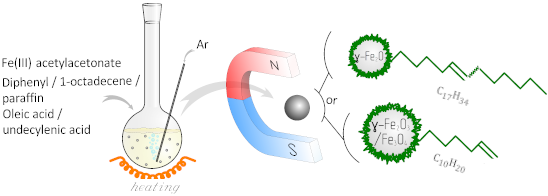
- purchased from Merck KGaA (Darmstadt, Germany). Oleic acid (OA, 98%) was bought from Lachema (Brno, Czech Republic). For magnetic separation, a permanent cylindrical neodymium magnet (NdFeB; 45 × 15 mm), with an induction on the surface of 1.2 T, was used. To characterize the size, morphology, hydrodynamic
- -octadecene. The stirring was continued for 30 min. The resulting reaction mass was transferred into a 250 mL reactor equipped with a mechanical stirrer and washed five times with propanone (150 mL each time) followed by nanoparticle deposition by magnetic separation on a NdFeB magnet under argon. The


Observation of collective excitation of surface plasmon resonances in large Josephson junction arrays
Beilstein J. Nanotechnol. 2022, 13, 1578–1588, doi:10.3762/bjnano.13.132
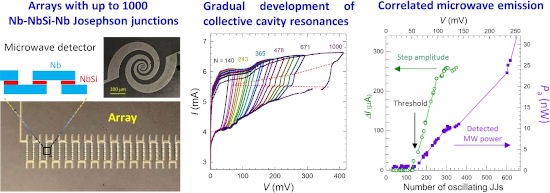
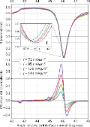
- found in [9][34][36][37]. The meander array (Figure 1a) has seven identical (vertical) sections with N = 1000 JJs in each and with an overall size in the vertical direction of 6.25 mm. Each section consists of 125 horizontal segments with a length of 230 μm, a width of 10 μm, and a separation of 40 μm
- (Figure 1c) contains five straight sections (lines) with N = 332 JJs in each. The spacing between the lines is 6 μm. Sizes and separation of the JJs is the same as for the meander array. The two outermost lines in the linear array and all seven sections of the meander array can be measured independently
- steps with small separation in voltage. The linear array, Figure 1d, exhibits several evenly spaced steps. The I–V characteristics are hysteretic, with the retrapping current being significantly smaller than the switching current. The hysteresis leads to a metastability, which allows for the observation




Single-step extraction of small-diameter single-walled carbon nanotubes in the presence of riboflavin
Beilstein J. Nanotechnol. 2022, 13, 1564–1571, doi:10.3762/bjnano.13.130
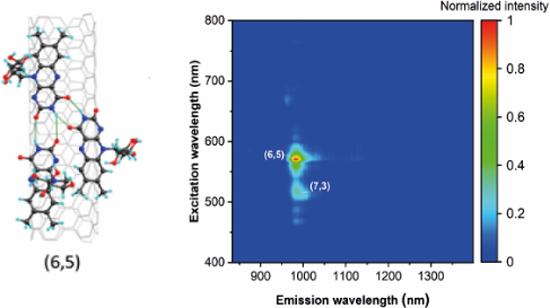
- facilitate chirality separation. Conventional surfactants such as sodium dodecyl sulfate (SDS) and sodium deoxycholate (DOC), as well as polyethylene glycol-based compositions, are used to obtain high-quality dispersions of individual SWCNTs [3][4][5][10]. Although given surfactants show exemplary
- performance in both individualization and chirality separation of carbon nanotubes, excessive surfactant concentrations are usually required for their complete individualization [2][8][11]. Such excess subsequently introduces an additional step of surfactant removal to recover the SWCNTs in a pristine state
- solubilize SWCNTs, no data on chirality separation of SWCNTs using pure aqueous riboflavin is available to date. Here, we report the dispersion of single-walled carbon nanotubes by aqueous riboflavin solution to extract a small-diameter fraction of SWCNTs from polydisperse samples by highly-efficient single


Photoelectrochemical water oxidation over TiO2 nanotubes modified with MoS2 and g-C3N4
Beilstein J. Nanotechnol. 2022, 13, 1541–1550, doi:10.3762/bjnano.13.127
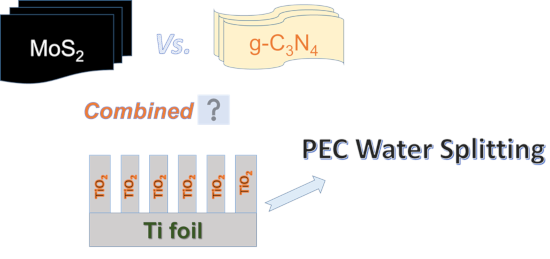
- light, which can be explained as follows: The photocurrent density of MoS2/TNAs promptly increased because of the efficient separation of the e−–h+ pairs at the interfaces between TNAs and MoS2 [58] and the rapid transfer of the photo-induced electrons from MoS2 to the TNAs electrode [59]. This result


A TiO2@MWCNTs nanocomposite photoanode for solar-driven water splitting
Beilstein J. Nanotechnol. 2022, 13, 1520–1530, doi:10.3762/bjnano.13.125
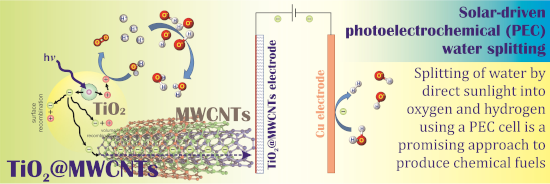
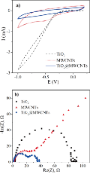
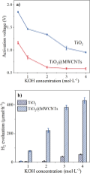
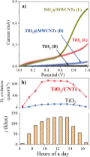
- been developed to increase the absorption of visible solar light [6][7]. Notably, carbon nanotubes (CNTs) are a promising material for visible-light absorption [8]. A combination of TiO2 with CNTs can effectively enhance the separation of e−/h+ pairs based on the high electric conductivity of CNTs



In search of cytotoxic selectivity on cancer cells with biogenically synthesized Ag/AgCl nanoparticles
Beilstein J. Nanotechnol. 2022, 13, 1505–1519, doi:10.3762/bjnano.13.124
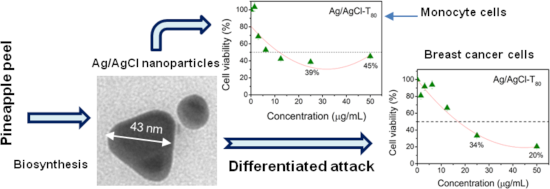
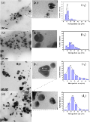
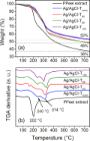
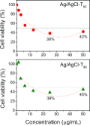
- crystallite size as a function of temperature is more noticeable for Ag than for AgCl, where an increasing trend in Ag crystallite size is observed up to 80 °C. It is speculated that at this temperature, the separation of salt ions and the interaction with reducing biological compounds are favorable, which





Coherent amplification of radiation from two phase-locked Josephson junction arrays
Beilstein J. Nanotechnol. 2022, 13, 1445–1457, doi:10.3762/bjnano.13.119
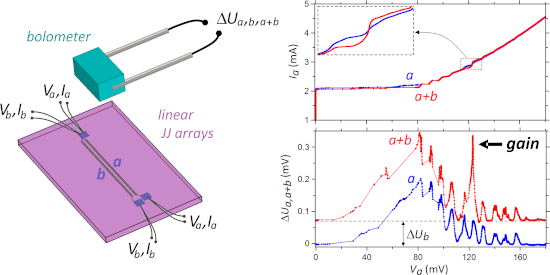
- .13.119 Abstract We analyze experimentally and theoretically mutual phase locking and electromagnetic interaction between two linear arrays with a large number of Josephson junctions. Arrays with different separation, either on the same chip or on two separate substrates are studied. We observe a large
- substrate with the thickness 0.38 mm. It contains three closely located straight strips with a separation of only 4 μm. Each strip has the length L = 5 mm and the width w = 14 μm and contains 332 JJs distributed uniformly along the strip. The junction area is 8 × 8 μm2. Contact electrodes are connected to
- significantly larger separation of 238 μm between the adjacent linear arrays. In total, it contains 17 similar lines with 380 JJs and a total length of L = 5.7 mm. The junction area is 6 × 6 μm2. Below, we will show data for the case when the rightmost “array-a” is biased with a variable dc current and the


LED-light-activated photocatalytic performance of metal-free carbon-modified hexagonal boron nitride towards degradation of methylene blue and phenol
Beilstein J. Nanotechnol. 2022, 13, 1380–1392, doi:10.3762/bjnano.13.114
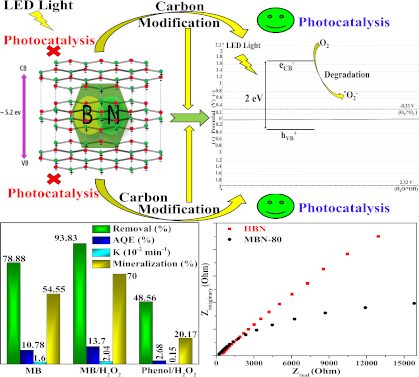
- variation in the structural morphology results in development of multiple active sites that ensure adsorption and effective charge transfer [10]. On the other hand, HBN has been utilised as a support material in the formation of heterojunctions owing to its large surface area and separation of charge
- . The mechanistic insights on the transfer and separation of charge carriers along with the photodegradation performance and reactive oxygen species (ROS) trapping have been enunciated in detail. The apparent quantum efficiency (AQE) further substantiated the potential of MBN to be used as a visible
- attributed to the unpaired electrons. The MBN-80 sample shows the highest EPR spin intensity, meaning greater concentration of unpaired electrons along with higher electron delocalization which are highly favourable towards enhanced separation and generation of charge carriers [26][27]. Additionally, surface



Dry under water: air retaining properties of large-scale elastomer foils covered with mushroom-shaped surface microstructures
Beilstein J. Nanotechnol. 2022, 13, 1370–1379, doi:10.3762/bjnano.13.113
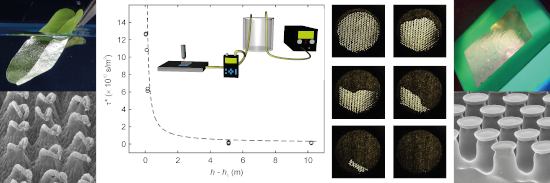
- Effect, the capability to keep a stable air layer when submerged under water. Such air layers are of great importance, e.g., for drag reduction (passive air lubrication), antifouling, sensor applications or oil–water separation. Some biological models, e.g., the floating fern Salvinia or the backswimmer


Recent trends in Bi-based nanomaterials: challenges, fabrication, enhancement techniques, and environmental applications
Beilstein J. Nanotechnol. 2022, 13, 1316–1336, doi:10.3762/bjnano.13.109
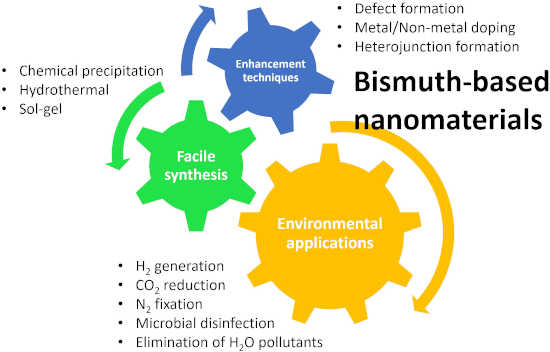
- environmental restoration and energy conversion is photocatalysis powered by solar light. Traditional photocatalysts have limited practical uses due to inadequate light absorption, charge separation, and unknown reaction mechanisms. Discovering new visible-light photocatalysts and investigating their
- thanks to the significant charge carrier dispersion provided by hybrid orbitals involving the Bi 6s orbital, as seen in Figure 2. Photoinduced electron–hole separation and charge carrier transfer in Bi-based materials are facilitated by a unique layered structure that creates an IEF. A magnetic field is
- pollutants such as tetracycline hydrochloride, bisphenol A (BPA), and RhB was used to measure the photocatalytic activity of the bismuth oxyiodides. The activity decreased in the sequence Bi4O5I2–Bi5O7I > Bi4O5I2 > BiOI, which is linked to charge separation efficiency and band structure. Engineered Bi




Laser-processed antiadhesive bionic combs for handling nanofibers inspired by nanostructures on the legs of cribellate spiders
Beilstein J. Nanotechnol. 2022, 13, 1268–1283, doi:10.3762/bjnano.13.105
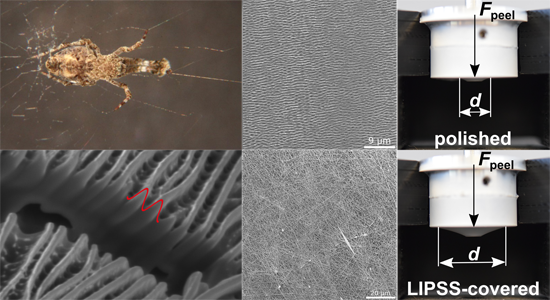
- of tearing or generally damaging the nonwoven at separation from a target or a tool. As one can imagine, even small damages of the nonwoven during production could lead to severe problems in the application. Refinement and consequent application of the theoretical model described here might help to
- inter-line separation of Δ = 5 µm. The linear laser beam polarization was kept parallel to the scan direction. Immediately after laser processing, the samples were cleaned for 5 min in acetone in an ultrasonic bath and stored in a desiccator. Figure 10 indicates the presence of the LIPSS at the entire







Roll-to-roll fabrication of superhydrophobic pads covered with nanofur for the efficient clean-up of oil spills
Beilstein J. Nanotechnol. 2022, 13, 1228–1239, doi:10.3762/bjnano.13.102
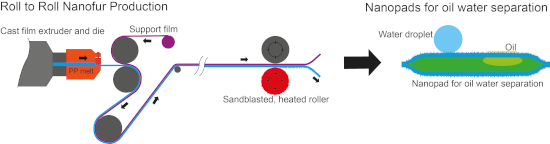
- . These are well-suited for the cleanup of small oil spills. Keywords: hot embossing; lotus effect; nanofur; nanopads; oil spill cleanup; oil water separation; roll-to-roll; R2R; superhydrophobicity; Introduction Self-cleaning surfaces utilizing the famous lotus effect have gained significant importance
- for commercial applications. Furthermore, we demonstrate the subsequent processing of the thin polymeric nanofur into an exemplary product, namely so-called nanopads. These are an aid for the efficient cleaning of oil spills due to the efficient oil–water separation ability of nanofur [23]. The
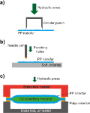
- hot-embossing machine [31]. (The videos in Supporting Information File 3 and Supporting Information File 4 show the capability of oil–water separation of nanofur.) Once contaminated with oil, the contact angle with water decreases to below 90°. This makes sense since the contact angle is now




Design of surface nanostructures for chirality sensing based on quartz crystal microbalance
Beilstein J. Nanotechnol. 2022, 13, 1201–1219, doi:10.3762/bjnano.13.100
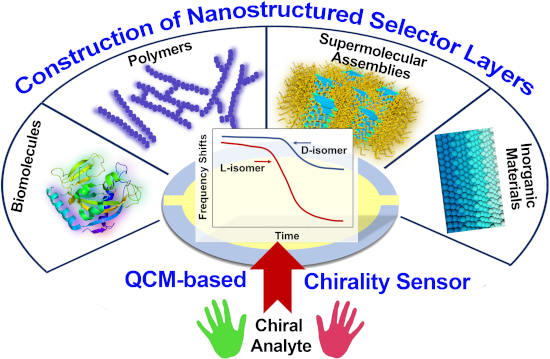
- industry, detection and separation of enantiomers are essential for their safe usage. With appropriate detectors and transduction signals, various analysis instruments and techniques have been used for chirality detection or chiral separation. They include circular dichroism (CD) [9], nuclear magnetic
- intensive attention in various applications and also show great potential for selective separation and sensing applications [55]. Through adjusting building blockings, sensing hosts of supermolecular structures with different channel sizes, shapes, and functional sites could be fabricated, which provides
- -butyldimethylsilyl)-β-cyclodextrin (Ac-β-CD). Combined with gas chromatography analysis, chiral separation factors could be estimated. Et-β-CD showed a more sensitive QCM response to R-limonene. It was also found that a higher chiral recognition factor was gained at the lowest limonene concentration due to more





