


Search results
Search for "substrate" in Full Text gives 1420 result(s) in Beilstein Journal of Nanotechnology. Showing first 200.
Interaction of graphene oxide with tannic acid: computational modeling and toxicity mitigation in C. elegans
Beilstein J. Nanotechnol. 2024, 15, 1297–1311, doi:10.3762/bjnano.15.105
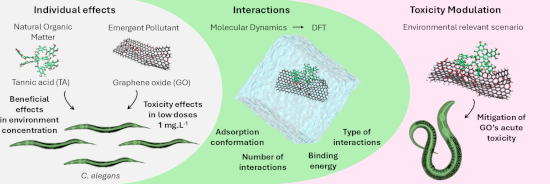
- mg·L−1 TA. Then, to avoid salt interference, the suspension was washed three times with deionized water and dripped on mica substrate. The incubation procedure was repeated for spectroscopy analysis. For Raman and FTIR analysis, the suspensions were dried using the speed-vacuum method at room
- temperature; for XPS, the suspensions were dripped on a silicon substrate. Computational methods MD simulations of interactions between TA and the GO surface were performed in LAMMPS, applying ReaxFF reactive force field [72]. MD simulations were conducted under constant pressure (P) and temperature (T), the


New design of operational MEMS bridges for measurements of properties of FEBID-based nanostructures
Beilstein J. Nanotechnol. 2024, 15, 1273–1282, doi:10.3762/bjnano.15.103
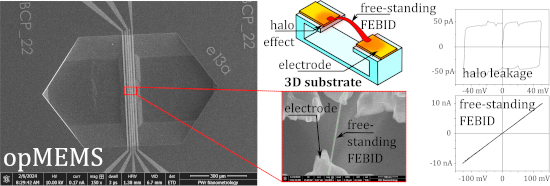
- nanomodification. Finally, we show results of resistance measurements of a free-standing FEBID nanostructure deposited across the RoI of a LiS-embedded opMEMS bridge. Materials and Methods Design of opMEMS bridges The opMEMS were fabricated on an undoped ⟨110⟩ silicon substrate on which a 40 nm silicon nitride
- thermal expansion multiphysics module. The following constraints were imposed: no displacement and no heat sink on the substrate surfaces. Heat sources were defined on the actuation paths as temperature sources of alternating temperatures. The heat source temperature was 293 K (given by the experimental
- only for the visual assessment of the shape and dimensions of a structure, but also for the observation of movement and deflection of an opMEMS. At the same time, the ion beam allows for local doping of the substrate and anisotropic milling. The NanoLab 600i also provides three gas injection systems


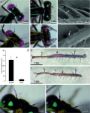
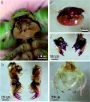
Functional morphology of cleaning devices in the damselfly Ischnura elegans (Odonata, Coenagrionidae)
Beilstein J. Nanotechnol. 2024, 15, 1260–1272, doi:10.3762/bjnano.15.102

- hairs, while the soft tips ensure effective contact between the attachment system and the substrate. Similarly, the material gradient in grooming devices may enhance adhesion to foreign materials for grooming body surfaces. The soft tip and soft lateral cuticular lamina adapt to various surface


The role of a tantalum interlayer in enhancing the properties of Fe3O4 thin films
Beilstein J. Nanotechnol. 2024, 15, 1253–1259, doi:10.3762/bjnano.15.101

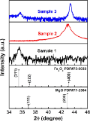
- process [14][15]. The impact of substrate temperature, annealing temperature, gas flow rate, and thickness on enhancing the characteristics of Fe3O4 thin films has been examined [15][16][17][18]. The substrates play a crucial role in directing the growth and enhancing the quality of the crystal, resulting
- [21]. Hong and coworkers deposited Fe3O4 films on a MgO substrate, which exhibited a change in the direction of Fe3O4 crystal formation. The directions (222), (400), and (440) of the Fe3O4 peak matched, respectively, the (111), (100), and (110) orientations of the MgO substrate [22]. In addition
- , Zhang et al. successfully applied a layer of Fe3O4(001) on a MgO(001) substrate. The resulting material exhibited saturation magnetization and magnetic moment values of 407 ± 5 emu/cm3 (3.26 ± 0.04 μB/(f.u.)) and 3.31 ± 0.15 μB/(f.u.), respectively [23]. This paper addresses the deposition of Fe3O4 thin


Dual-functionalized architecture enables stable and tumor cell-specific SiO2NPs in complex biological fluids
Beilstein J. Nanotechnol. 2024, 15, 1238–1252, doi:10.3762/bjnano.15.100
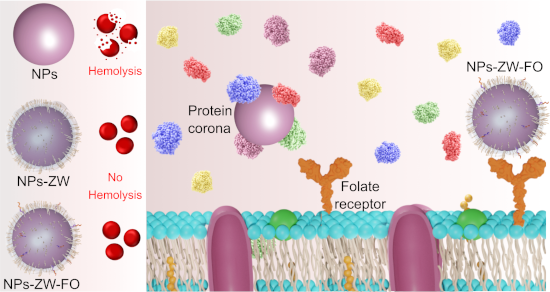
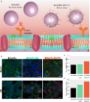
- ), SiO2NPs-ZW-NH2 (with ZW + APTES), and SiO2NPs-ZW-FO (with ZW + APTES + folate). Characterization of SiO2NPs Scanning electron microscopy (SEM) micrographs were obtained in a high-resolution FEI Inspect F50 microscope. A NP suspension (7 μL) was deposited directly onto a copper substrate, dried, and
- a chemiluminescent solution (Clarity™ Western ECL Substrate – 1705060, Bio-Rad) for 5 min. Antibody to β-actin (AC-15, Novus) was used as an endogenous control for all samples. To assess the internalization of NPs, HaCat and KB cells were cultured in a 96-well plate (1 × 10⁴ cells/well) for 24 h


Quantum-to-classical modeling of monolayer Ge2Se2 and its application in photovoltaic devices
Beilstein J. Nanotechnol. 2024, 15, 1153–1169, doi:10.3762/bjnano.15.94
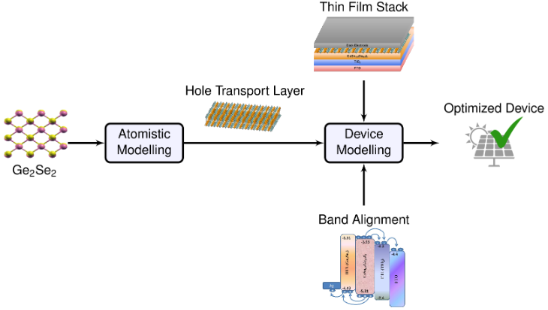
- coating between the absorber and substrate/electrodes in the design of solar cells. Device Modeling The high carrier mobility, optimum bandgap, and suitable optical characteristics of monolayer Ge2Se2 as discussed in the previous section, further motivated us to design a photovoltaic solar cell using




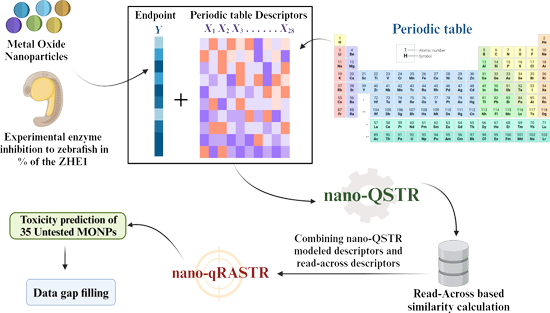
Introducing third-generation periodic table descriptors for nano-qRASTR modeling of zebrafish toxicity of metal oxide nanoparticles
Beilstein J. Nanotechnol. 2024, 15, 1142–1152, doi:10.3762/bjnano.15.93
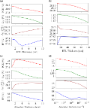
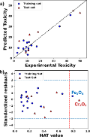
- ), suggesting that nanomaterials composed of atoms with larger radii are associated with a decrease in %EIzebrafish. A larger atomic radius might indicate weaker bonding and less effective interaction with the enzyme or its substrate, leading to less enzyme inhibition. This could be due to the diffuse nature of


Photocatalytic methane oxidation over a TiO2/SiNWs p–n junction catalyst at room temperature
Beilstein J. Nanotechnol. 2024, 15, 1132–1141, doi:10.3762/bjnano.15.92
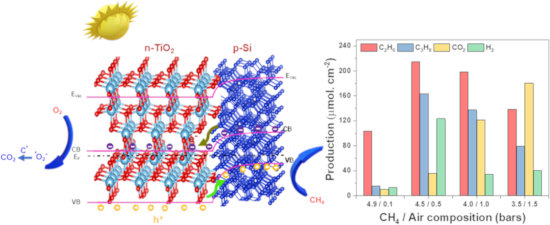
- tools is extremely essential and important [37][38][39]. Herein, we constructed a robust p–n junction catalyst by atomic layer deposition (ALD) of TiO2 thin films on a p-type SiNW substrate for enhancing the photocatalytic efficiency in CH4 oxidation. Pristine p-Si wafers have limited surface area and
- (0.1 M), HF (50 wt %) and H2O (2:1:2 vol %) was prepared and kept at 56 °C for 20 min. The clean Si substrate was rapidly immersed in the etching medium and etched by the Ag+ ions for 25 min to obtain 4 µm long SiNWs. Afterwards, remaining Ag on the Si surface was removed using HNO3 (63 wt %) for 10
- min. The etched p-Si NWs substrate was eventually washed with DI water and dried under N2 flow, as shown in Figure 9. Second, the as-prepared SiNWs sample was transferred to the chamber of an ALD system (R200 Advanced Picosun, 2013) for TiO2 thin film deposition. The TiO2 thin film deposition was


Local work function on graphene nanoribbons
Beilstein J. Nanotechnol. 2024, 15, 1125–1131, doi:10.3762/bjnano.15.91
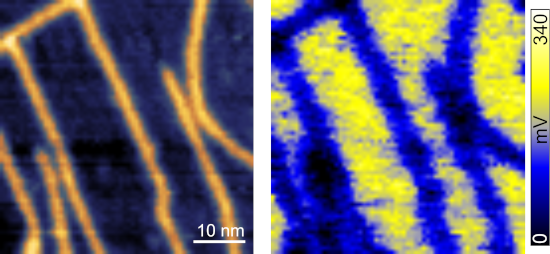
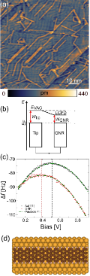
- difference (LCPD) between a probe tip and a surface, related to the work function. Here we use this technique to map the LCPD of graphene nanoribbons grown on a Au(111) substrate. The LCPD data shows charge transfer between the graphene nanoribbons and the gold substrate. Our results are corroborated with
- opening a size-dependent energy gap [6][9]. As in graphene, the Fermi level of GNRs is also strongly influenced by charge transfer between the substrate and the GNR [10], again related to differences in the work function. Here, we take the work function as a local property influenced by local charge, that
- electronic properties, a suitable method to study the charge transfer, that is, the local work function, between a GNR and a metal substrate at the atomic scale is needed. In general, as detailed above, the local work function can provide evidence for structural, electronic, and chemical variations at

![[Graphic 1]](/bjnano/content/inline/2190-4286-15-91-i4.svg?max-width=637&scale=1.18182)
Direct electron beam writing of silver using a β-diketonate precursor: first insights
Beilstein J. Nanotechnol. 2024, 15, 1117–1124, doi:10.3762/bjnano.15.90

- varying compositions of the deposit and internal inhomogeneities such as the formation of a layered structure consisting of a pure silver layer at the interface to the substrate covered by a deposit layer with low silver content. Imaging after the deposition process revealed morphological changes such as
- fragmentation of adsorbed precursor molecules on a substrate [5][6][7][8][9]. The precursor is typically supplied in gaseous phase. Exploiting the different complex pathways in electron-induced chemistry (such as formation of unstable intermediates and thermal assistance in adsorption and desorption) and the
- , which lead to the pronounced deposition of halos. In addition, all require relatively high substrate temperatures (well above 100 °C) in order to avoid condensation. Hence, thermal effects are expected to play an important role in deposit shape evolution with the enhanced desorption rates contributing


Unveiling the potential of alginate-based nanomaterials in sensing technology and smart delivery applications
Beilstein J. Nanotechnol. 2024, 15, 1077–1104, doi:10.3762/bjnano.15.88

- catalytic and enzymatic peroxidase mimicking activity was synthesized via self-assembly. The decorated Fe3O4@AMALG12@Ag was incorporated into an agarose hydrogel structure, and o-phenylenediamine (OPD) was used as a peroxidase substrate to detect H2O2 calorimetrically (Figure 6). The solid kit demonstrated
- -linking agent to form a gel-like solution. Then, glucose oxidase is incorporated into the alginate mixture. Next, the mixture is sonicated to evenly distribute the alginate-based nanoparticles in an aqueous solution. Once the nanoparticles are formed, they can be immobilized onto a substrate or electrode


Effect of wavelength and liquid on formation of Ag, Au, Ag/Au nanoparticles via picosecond laser ablation and SERS-based detection of DMMP
Beilstein J. Nanotechnol. 2024, 15, 1054–1069, doi:10.3762/bjnano.15.86

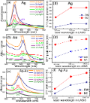
- Raman device to identify various hazardous chemicals (malachite green, methyl salicylate, and thiram). The stability of the substrates was also systematically investigated by determining the decay percentages in the SERS signals over 60 days. The optimized SERS substrate was subsequently employed to
- media [27][28][29]. The SERS substrate efficiency mainly depends on the material, size, and shape of the NPs. Recent terrorist activities involving explosives and chemical warfare agents highlight the urgent need for sensitive and selective chemical sensors. These sensors must be using low power and be
- ], pesticides on vegetables, dals [42], fruit surfaces [43], and explosives on rough surfaces [44][45]. In the last few years, our group has been continuously working on developing a flexible SERS substrate for the detection of various types of hazardous molecules: aggregated Ag and Au NPs on filter paper [46


Interface properties of nanostructured carbon-coated biological implants: an overview
Beilstein J. Nanotechnol. 2024, 15, 1041–1053, doi:10.3762/bjnano.15.85
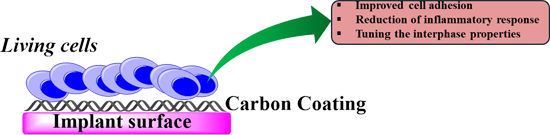
- deposition (PVD), and in situ formation through laser treatments. CVD offers several advantageous features such as a high degree of control over the deposition process. CVD involves the deposition of a thin film of material onto a substrate through homogeneous or heterogeneous reactions [79]. Homogeneous
- , and they are classified according to the power sources used for the process (i.e., plasma-, direct current-, radiofrequency-, and ion beam-assisted coatings) [85]. All PVD processes are based on a vacuum chamber containing the material to be deposited, known as target, and the chosen substrate onto
- which the deposition occurs. During electron beam evaporation, an electron beam is used to vaporize the target material, while during sputtering, a high-energy ion beam is used to bombard the target. In both cases, atoms are ejected from the target and subsequently condense onto the substrate. The



Bolometric IR photoresponse based on a 3D micro-nano integrated CNT architecture
Beilstein J. Nanotechnol. 2024, 15, 1030–1040, doi:10.3762/bjnano.15.84
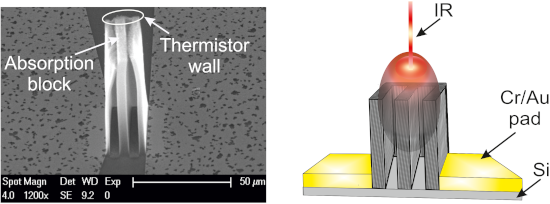
- is the bias current, R is the resistance of the bolometer, α = (dR/dT)/R is the TCR, η is the absorption efficiency, G is the thermal conductance to the substrate, ω is the angular modulation frequency, τ = 1/(2πfcut−off) is the time constant of the detector, and fcut−off is the frequency at 70
- . Simultaneously, emphasis will be placed on the effective conversion of heat into electrical signal, which is the most critical effect contributing to the overall success of non-cryogenic IR microbolometer and thermal detector design [11]. Experimental The process started with cleaning a silicon substrate with a
- 600 nm thick thermally oxidized SiO2 layer. The wafer was p-type and lightly boron-doped (Si-Mat, Silicon Materials). The substrate was thoroughly cleaned to remove impurities and contaminants to provide an ideal condition for CNT growth. Subsequently, an essential 30 nm aluminum oxide (AlOx) layer


Recent progress on field-effect transistor-based biosensors: device perspective
Beilstein J. Nanotechnol. 2024, 15, 977–994, doi:10.3762/bjnano.15.80
- . Figure 7 shows the 3D representation of an SRG JL FET-based biosensor. One type of doping concentration was added to the silicon channel, source, and drain region. A surrounding cavity was created between the oxide and the gate metal. This structure utilizes a silicon-based substrate with SiO2 as an




Effects of cutting tool geometry on material removal of a gradient nanograined CoCrNi medium entropy alloy
Beilstein J. Nanotechnol. 2024, 15, 925–940, doi:10.3762/bjnano.15.76
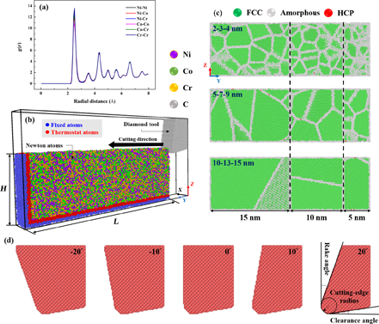
- damage is limited to a shallow layer at the surface. Since thermal energy is generated in the high grain boundary density, the temperature of the contact zone between the substrate and the cutting tool increases as the GNG size decreases. The cutting chips removed from the GNG CoCrNi MEA substrates will
- was calculated, as shown in Figure 2g. Grooves are formed as the material is removed by the tip of the cutting tool sliding across the substrate surface. Material removal is observed through the motion of atoms accumulated in front of the tool [21]. Furthermore, the atoms are unevenly distributed on
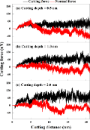
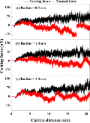
- by the tool and push the atoms of the smaller grains behind to move. Moreover, the shear strain of the sample in Figure 4d even extends to the uncut part of the substrate, which can explain why the cutting force of this sample increases in the later stages of cutting. The sample in Figure 4e exhibits








Water-assisted purification during electron beam-induced deposition of platinum and gold
Beilstein J. Nanotechnol. 2024, 15, 884–896, doi:10.3762/bjnano.15.73
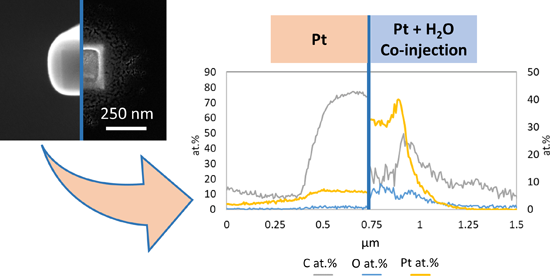
- ) is a nanofabrication technique that allows for the direct writing of three-dimensional nanostructures [1][2][3]. In FEBID, a gaseous precursor, often an organometallic compound, is injected in the vacuum chamber of a scanning electron microscope (SEM), adsorbed on a substrate, and dissociated by a
- accessible in purification during deposition since the amount of intact MeCpPtMe3 molecules adsorbed to the substrate should be larger. Similarly, the protonation of an acetylacetonate ligand to form acetylacetone causes the formation of a much weaker metal–ligand interaction. Such an acetylacetonate ligand
- the deposition are the precursor supply, the primary beam energy and current, and the patterning strategy. The deposits are built through consecutive electron beam spot exposures of the precursor molecules adsorbed on the substrate. The shape of the deposit is defined as an area containing an array of



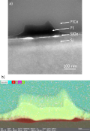


The effect of age on the attachment ability of stick insects (Phasmatodea)
Beilstein J. Nanotechnol. 2024, 15, 867–883, doi:10.3762/bjnano.15.72

- sign of ageing is the loss of locomotory functions due to neuronal disorders or tissue wear. Soft and pliable attachment pads on the tarsi of insects adapt to the substrate texture to maximize their real contact area and, thereby, generate attachment during locomotion. In the majority of stick insects
- area with the substrate. Keywords: adhesion; attachment pads; friction; locomotion; morphology; material properties; wear; Introduction Ageing inexorably affects most living organisms, does not exclude insects, and makes different organs or tissues susceptible to wear or fatigue of material [1
- different attachment mechanisms evolved in insects, namely, hairy pads consisting of flexible setae, which adapt to the surface topography, and smooth pads possessing a soft and deformable cuticle to comply with the substrate profile [9]. Both pad types, hairy and smooth, aim to maximize contact area with


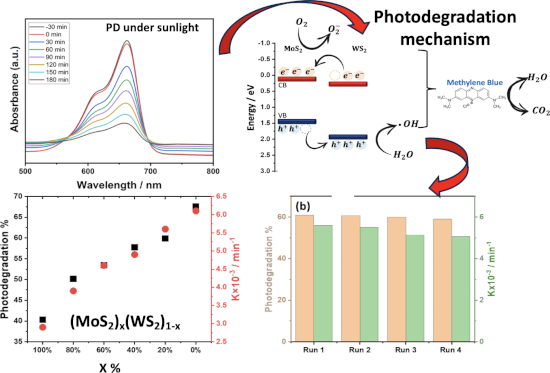
Intermixing of MoS2 and WS2 photocatalysts toward methylene blue photodegradation
Beilstein J. Nanotechnol. 2024, 15, 817–829, doi:10.3762/bjnano.15.68
- additional peaks observed in all XRD diagrams at ≈37° and ≈69° positions are due to the silicon substrate. The X-ray photoelectron spectroscopy (XPS) survey scans and high-resolution scans for all samples are presented in Figure 3a–j. All XPS analyses were first calibrated using the C 1s peak of carbon at


Synthesis of silver–palladium Janus nanoparticles using co-sputtering of independent sources: experimental and theorical study
Beilstein J. Nanotechnol. 2024, 15, 808–816, doi:10.3762/bjnano.15.67
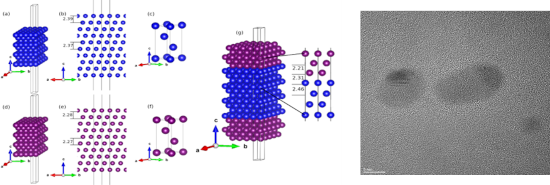
- to 2.46 and 2.21 Å at the Ag and Pd sides, respectively (Figure 6g). Far from the interface, toward the Ag slab, a bulk-like interplanar distance is recovered. On the Pd side, the distance is 2.21 Å, 0.06 Å lower than that of pure Pd because of the lattice modification imposed by the Ag substrate. In




Electron-induced ligand loss from iron tetracarbonyl methyl acrylate
Beilstein J. Nanotechnol. 2024, 15, 797–807, doi:10.3762/bjnano.15.66
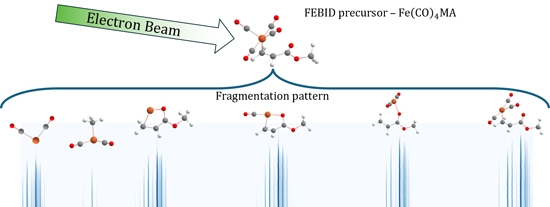
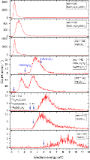
- represents perhaps the “cleanest” approach since it probes the reaction of one precursor molecule with at most one electron, without environmental influences (e.g., precursor–precursor or precursor–substrate effects). The possibility of making iron nanostructures is important mainly because of their magnetic



Exploring surface charge dynamics: implications for AFM height measurements in 2D materials
Beilstein J. Nanotechnol. 2024, 15, 767–780, doi:10.3762/bjnano.15.64
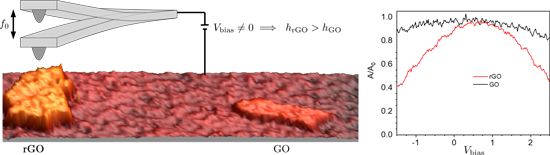
- -deposited on an insulating substrate. Measurements on these two materials, which exhibit very different properties in terms of hydrophilicity and conductivity, allowed us to clarify the most relevant factors of the problem and how they affect the apparent height measured with AM-AFM. This has enabled us to
- and/or rGO in Milli-Q type-I water (MQ water) were utilized. A drop of these dispersions was cast onto highly doped p-type silicon (1–10 Ω·cm, Siltronix) with a 300 nm SiO2 layer thermally grown on top. Before deposition, the substrate underwent a thorough cleaning process, which involved rinsing with
- ethanol and MQ water. Subsequently, the substrate was exposed to UV/ozone for 15 min to eliminate organic contaminants and promote the hydrophilicity of the SiO2 surface. GO (Graphenea), was employed without further treatment, while rGO was obtained through chemical reduction using hydrazine hydrate (50


Effect of repeating hydrothermal growth processes and rapid thermal annealing on CuO thin film properties
Beilstein J. Nanotechnol. 2024, 15, 743–754, doi:10.3762/bjnano.15.62
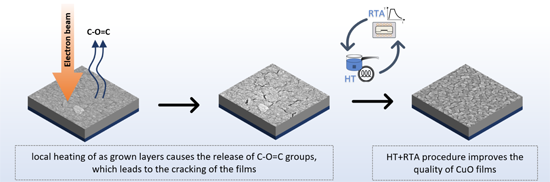
- (Chempur) with a concentration of Cu(II) ions of 1 mM was prepared. The mixture was then precipitated by adding NaOH until a pH of 6.5 was attained. Subsequently, the so-prepared solution along with the substrate was placed in a reaction vessel and uniformly heated utilizing an induction cooker (heating
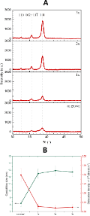
- the parameters. These factors included single film thickness, substrate type and atmosphere, temperature, and time of annealing along with the number of repetitions of HT+RTA cycles, which is the focus of this study. The most favorable results, that is, layers with the highest level of continuity and
- . When analyzing the height profiles, it is observed that in the 1× samples, the height differences are comparable to the average thickness of the film. It suggests that some of the visible discontinuities extend all the way to the substrate. In contrast, for triply sequenced films, although the




Level set simulation of focused ion beam sputtering of a multilayer substrate
Beilstein J. Nanotechnol. 2024, 15, 733–742, doi:10.3762/bjnano.15.61
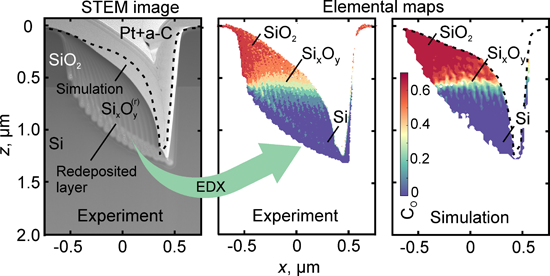
- processing was simulated using the level set method and experimentally studied by milling a silicon dioxide layer covering a crystalline silicon substrate. The simulation took into account the redeposition of atoms simultaneously sputtered from both layers of the sample as well as the influence of
- ; multilayer substrate; silicon; silicon dioxide; sputtering; Introduction The focused ion beam (FIB) technique is an effective method for surface nanostructuring. It is based on the local removal of material by sputtering with a narrow beam of, typically, gallium ions. This feature of the FIB method makes it
- possible to deterministically produce a nanoscale topography on the surface of almost any substrate [1]. FIB milling was originally established in semiconductor technology [2] and materials science applications [3]. Now it is increasingly used for fabrication of complex micro- and nanoscale structures and

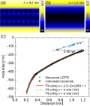
![[Graphic 55]](/bjnano/content/inline/2190-4286-15-61-i68.svg?max-width=637&scale=1.18182)


Reduced subthreshold swing in a vertical tunnel FET using a low-work-function live metal strip and a low-k material at the drain
Beilstein J. Nanotechnol. 2024, 15, 713–718, doi:10.3762/bjnano.15.59
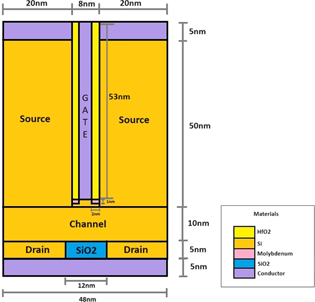
- to reduce gate oxide leakage are high-k materials. The device’s ability to keep a charge is increased by using high-k materials, which also aids in downsizing. HfO2 is compatible with a silicon substrate and possesses a high dielectric constant (ε ≈ 25), a large bandgap (5.68 eV), band offsets with





