Search results
Search for "modeling" in Full Text gives 337 result(s) in Beilstein Journal of Nanotechnology. Showing first 200.
Mo-doped boron nitride monolayer as a promising single-atom electrocatalyst for CO2 conversion
Beilstein J. Nanotechnol. 2019, 10, 540–548, doi:10.3762/bjnano.10.55
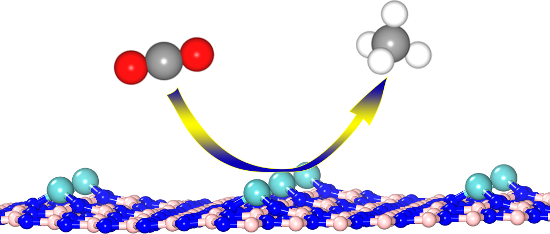
- electrocatalyst for nitrogen fixation with a very small overpotential of only 0.19 V. In addition, through molecular dynamics modeling, they demonstrated that Mo-doped BN synthesized in acidic conditions is stable at high temperature (500 K) [45]. In our previous reports, we have studied BN nanomaterials used as


Mechanical and thermodynamic properties of Aβ42, Aβ40, and α-synuclein fibrils: a coarse-grained method to complement experimental studies
Beilstein J. Nanotechnol. 2019, 10, 500–513, doi:10.3762/bjnano.10.51
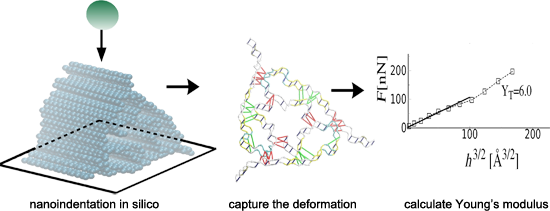
- use it as a reference for comparing the indentation values we obtained to the experimental ones, although we remark that our molecular modeling can adapt further anisotropic mechanical models, envisioned within force microscopy techniques. Biological fibrils are well-known biomaterials of practical
- tool for the modeling of the nanoindentation process. It is worth noting that we prevent any possible adhesion between the indenter and the fibril by placing a divergent interaction between the tip and the Cα atom, and hence other models [58][60] with such features are not considered. Moreover we chose


Gold nanoparticles embedded in a polymer as a 3D-printable dichroic nanocomposite material
Beilstein J. Nanotechnol. 2019, 10, 442–447, doi:10.3762/bjnano.10.43
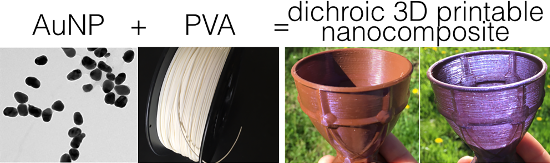
- standard off-the-shelf fused deposition modeling (FDM) 3D printer. We chose to use polyvinyl alcohol (PVA) as the nanoparticle carrier, because it is one of the most used 3D printing materials, it is water soluble, thus mixable with the AuNPs without the need to change solvents, and because it is known



Electromagnetic analysis of the lasing thresholds of hybrid plasmon modes of a silver tube nanolaser with active core and active shell
Beilstein J. Nanotechnol. 2019, 10, 294–304, doi:10.3762/bjnano.10.28
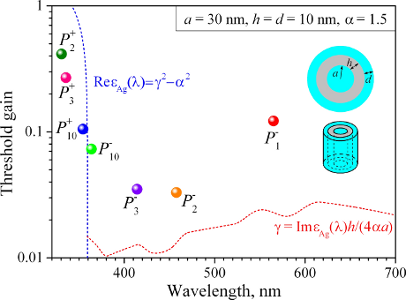
- 2RD, UK 10.3762/bjnano.10.28 Abstract Results from the electromagnetic modeling of the threshold conditions of hybrid plasmon modes of a laser based on a silver nanotube with an active core and covered with an active shell are presented. We study the modes of such a nanolaser that have their emission
- of publications have dealt with the modeling of nanolasers based on metal nanoparticles and nanowires equipped with active cores or shells [4][5][6][7][8][9]. Note that in [4], the authors studied the effect of a metal tube on the lowest-order modes of the active core while the presence of the


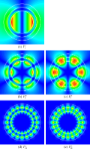
![[Graphic 29]](/bjnano/content/inline/2190-4286-10-28-i46.svg?max-width=637&scale=1.18182) λ = 565.03...
λ = 565.03...

![[Graphic 36]](/bjnano/content/inline/2190-4286-10-28-i53.svg?max-width=637&scale=1.18182) ...
...


Removal of toxic heavy metals from river water samples using a porous silica surface modified with a new β-ketoenolic host
Beilstein J. Nanotechnol. 2019, 10, 262–273, doi:10.3762/bjnano.10.25
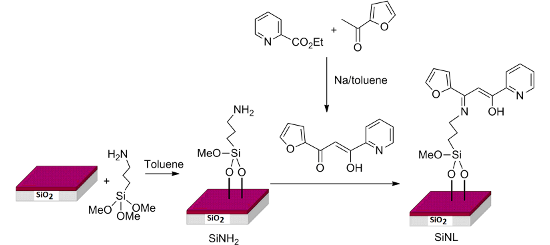
- [61][62][63], a phenomenon which could be attributed to the complexation reaction. Effect of initial concentration in metal and isotherm modeling. A detailed concentration study was conducted, and isotherm studies were carried out to interpret the metal retention by our system. Figure 8 highlights the
- ). This indicates that the adsorption of metal ions occurs by a monolayer formation in the same limited number of adsorption sites on a homogeneous adsorbent surface. Thermodynamic modeling. The influence of temperature on the adsorption of Zn(II), Pb(II), Cd(II) and Cu(II) ions onto SiNL was evaluated


Interaction of Te and Se interlayers with Ag or Au nanofilms in sandwich structures
Beilstein J. Nanotechnol. 2019, 10, 238–246, doi:10.3762/bjnano.10.22
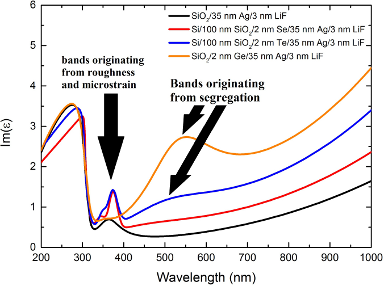
- fitted for the samples without wetting films, and then fixed for all other samples. The wetting films/metal and metal/LiF interface roughness were left as fitting parameters. More information about XRR modeling can be found in [40] and references therein. The wide-angle X-ray diffraction (XRD


Enhancement of X-ray emission from nanocolloidal gold suspensions under double-pulse excitation
Beilstein J. Nanotechnol. 2018, 9, 2609–2617, doi:10.3762/bjnano.9.242
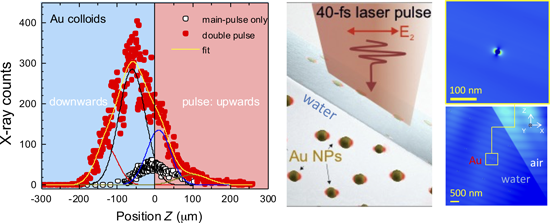
- simulated in the following using the finite-difference time-domain (FDTD) method (Lumerical). Figure 5 shows the light-intensity distributions around gold nanoparticles modeling different stages of excitation from initial gold nanoparticles towards the formation of ENZ plasma around them. The absorption


Au–Si plasmonic platforms: synthesis, structure and FDTD simulations
Beilstein J. Nanotechnol. 2018, 9, 2599–2608, doi:10.3762/bjnano.9.241
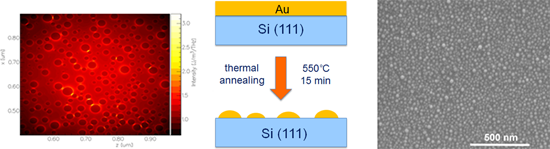
- as to analyze the experimental data. The flexible interface allowed for a quite convenient modeling of the studied system. Here, in order to obtain the actual arrangement and size of nanoislands, a supporting software has been written that reads the SEM image, finds contours of nanoislands and
- the simulated systems. For metals in an oscillating external field, this function depends on the oscillation frequency, and its proper modeling is a very important step in the simulation process. In our case, the dielectric functions of gold [26] and silicon [27] were fitted to the Lorentz model [28



Effective sensor properties and sensitivity considerations of a dynamic co-resonantly coupled cantilever sensor
Beilstein J. Nanotechnol. 2018, 9, 2546–2560, doi:10.3762/bjnano.9.237
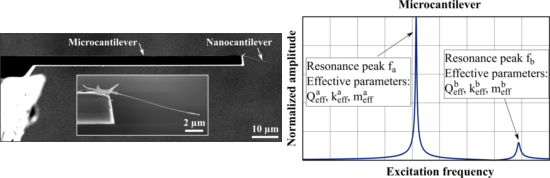
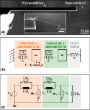
- behaviour it is crucial to derive a description for these effective sensor properties. Results: By modeling the co-resonantly coupled system as a coupled harmonic oscillator and using electromechanical analogies, analytical expressions for the effective sensor properties have been derived and discussed. To


![[Graphic 7]](/bjnano/content/inline/2190-4286-9-237-i43.svg?max-width=637&scale=1.18182) ...
...


Adhesive contact of rough brushes
Beilstein J. Nanotechnol. 2018, 9, 2405–2412, doi:10.3762/bjnano.9.225
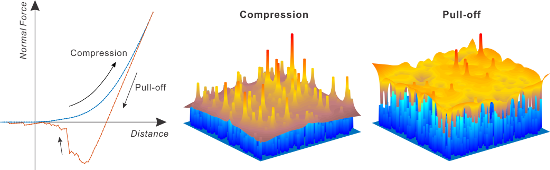
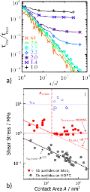
- ]. Modeling Model description and main governing parameters We consider a square brush – a rigid body consisting of a large number of cylindrical pillars filling a square area of A0 = L × L in contact with an elastic half-space with an example shown in Figure 1. All pillars had the same radius, α = 0.01L. The


SERS active Ag–SiO2 nanoparticles obtained by laser ablation of silver in colloidal silica
Beilstein J. Nanotechnol. 2018, 9, 2396–2404, doi:10.3762/bjnano.9.224
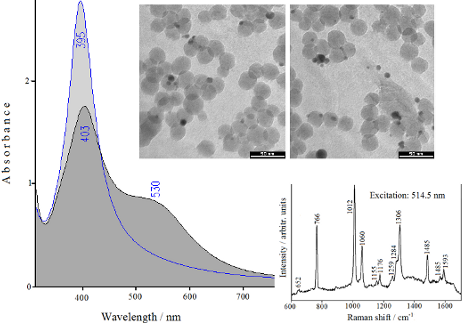
- , 41125 Modena, Italy Center for Molecular Modeling, Ghent University, Technologiepark 903, 9052 Zwijnaarde, Belgium 10.3762/bjnano.9.224 Abstract Highly stable Ag–SiO2 nanoparticle composites were first obtained by laser ablation of a silver target in an aqueous colloidal dispersion of silica and


Magnetism and magnetoresistance of single Ni–Cu alloy nanowires
Beilstein J. Nanotechnol. 2018, 9, 2345–2355, doi:10.3762/bjnano.9.219
- modeling. It has been theoretically proven that the proposed methodology can be applied over a large range of nanowire diameters if the measurement geometry is suitably chosen. Keywords: nanowires; magnetic properties; magnetoresistance; Introduction Nowadays, due to the continuous search for new
- ferromagnetic Ni–Cu alloy nanowire is the simplicity of tuning magnetic parameters through composition and morphology of the nanowire as well as the suitability for micromagnetic modeling of the magnetic behavior. However, the main disadvantage is the difficult experimental magnetic characterization due to the
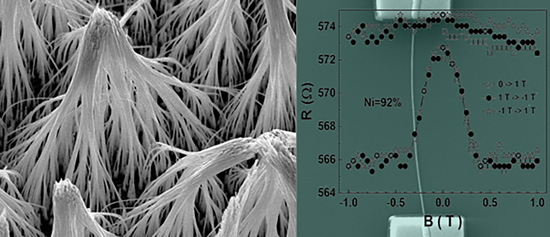
- magnetic hysteresis loops derived from magnetoresistance measurements and the associated micromagnetic modeling. Results and Discussion SEM micrographs of arrays of Ni–Cu alloy nanowires show that the nanowires obtained at all four different electrodeposition potentials have a regular cylindrical shape


Performance analysis of rigorous coupled-wave analysis and its integration in a coupled modeling approach for optical simulation of complete heterojunction silicon solar cells
Beilstein J. Nanotechnol. 2018, 9, 2315–2329, doi:10.3762/bjnano.9.216
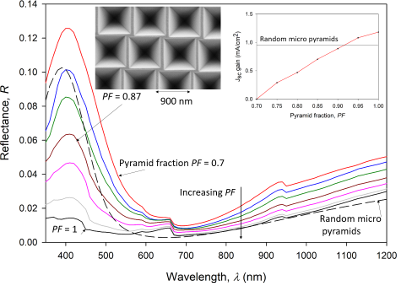
- with microtextures, and for simulations of complete HJ Si cells, we propose a coupled modeling approach (CMA), where the RCWA is coupled with raytracing and the transfer matrix method. By means of CMA and nanotexture optimization, we show the possible benefits of nanotextures at the front interface of
- interface, although the considered structure did not show an improvement over the pyramidal textures. Keywords: coupled modeling approach; heterojunction; RCWA; silicon; solar cells; Introduction Light management techniques can be applied to increase the short-circuit current density and consequently the
- modeling techniques have been used in simulations of solar cells [11][12][13][14], and among them, rigorous coupled-wave analysis (RCWA) has been employed for the optical simulation of thin film or wafer-based solar cells with various textures [2][3][15][16][17]. However, its applicability, limitations and


Optimization of the optical coupling in nanowire-based integrated photonic platforms by FDTD simulation
Beilstein J. Nanotechnol. 2018, 9, 2248–2254, doi:10.3762/bjnano.9.209
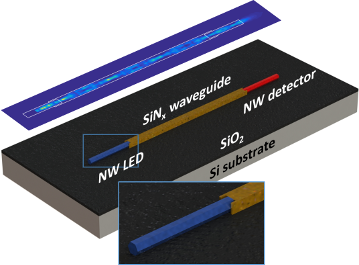
- design reported in the literature with a coupling efficiency of only 8.7%, we propose an optimized photonic platform with efficiency reaching 65.5%. Keywords: FDTD modeling; nanowire LED; nitride nanowires; photonic integrated circuit; photonic platform; SiN/InGaN co-integration; visible light


Lead-free hybrid perovskites for photovoltaics
Beilstein J. Nanotechnol. 2018, 9, 2209–2235, doi:10.3762/bjnano.9.207


Recent highlights in nanoscale and mesoscale friction
Beilstein J. Nanotechnol. 2018, 9, 1995–2014, doi:10.3762/bjnano.9.190
- surface-force balance and an impressive evidence of layering effects on friction was demonstrated [114]. RTILs are being also investigated as additives in liquid lubrication [115]. Modeling has investigated the role of the molecular shape of the ions [116][117] and the layer-by-layer squeeze-out
- standard phenomenological theories of frictional interfaces, which are essential for modeling macroscopic frictional dynamics, are not yet fully linked to the atomistic processes and interfacial geometries at the atomistic scales. Bridging over the widely separated time and length scales by establishing
- quantitative connections between small-scale processes and macroscopically observed phenomena is a major challenge of current tribology in particular, and, more in general, of materials modeling [196][197][198][199][200]. A first line of ongoing research efforts focuses on enriching the descriptions of


The role of the Ge mole fraction in improving the performance of a nanoscale junctionless tunneling FET: concept and scaling capability
Beilstein J. Nanotechnol. 2018, 9, 1856–1862, doi:10.3762/bjnano.9.177
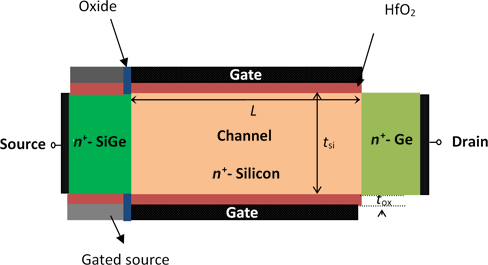
- Figure 1, L is the channel length, tch refers to the channel thickness, Nd is the doping concentration of the channel, and Ls and Ld denote the extension lengths of source and drain, respectively. The accurate modeling of the nanoscale DG-HJ-JL TFET requires taking into account quantum-confinement
- effects, which lead to some modeling bottlenecks associated with the models of the carrier density gradient. Furthermore, since the investigated transistor is considered as a quantum mechanical device, complicated systems of equations resulted from the necessity of considering the band-to-band quantum
- tunneling effects. These nonlinear equations impose many mathematical difficulties, which complicate the analytical modeling of the nanoscale device performance. Numerical approaches are used to deal with the above outlined problems. The ATLAS 2D device simulator using the S-PISCES module has emerged



Increasing the performance of a superconducting spin valve using a Heusler alloy
Beilstein J. Nanotechnol. 2018, 9, 1764–1769, doi:10.3762/bjnano.9.167
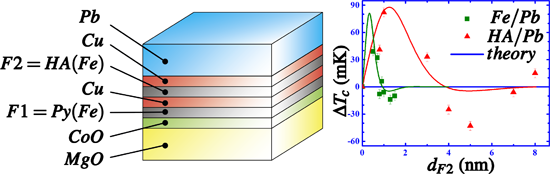
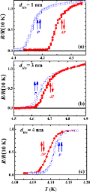
- present the results of theoretical modeling. Parameters used for fitting of the theory to the experimental results [17]. Supporting Information Supporting Information File 250: Fabrication of the SSV heterostructures. Acknowledgements A. K. gratefully acknowledges the Leibniz - DAAD Fellowship. Ya. F

![[Graphic 4]](/bjnano/content/inline/2190-4286-9-167-i9.svg?max-width=637&scale=1.18182) on the thickness of layer F2, dF2 in the SSV heterostructures AFM/F1/N1/F2/N2/S. Tri...
on the thickness of layer F2, dF2 in the SSV heterostructures AFM/F1/N1/F2/N2/S. Tri...
Josephson effect in junctions of conventional and topological superconductors
Beilstein J. Nanotechnol. 2018, 9, 1659–1676, doi:10.3762/bjnano.9.158
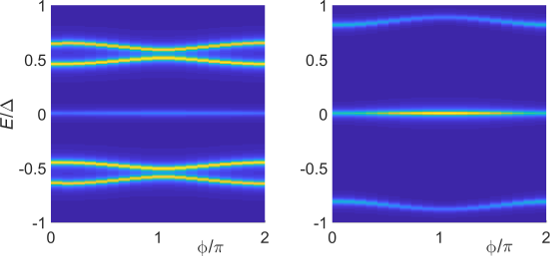
- spinful nanowire model of [2][3] for modeling the TS wire is that the angle between the local Zeeman field B and the MBS spin polarization does not have to be introduced as phenomenological parameter but instead results from the calculation [43]. It is thus interesting to study the Josephson current in S
- kept when modeling the TS wire. However, we will also hint at how one can treat the general case. For the two S leads, boundary fermion fields are contained in Nambu spinors as in Equation 6, where their bGF follows with the Nambu matrix g(ω) in Equation 6 as We again use Pauli matrices τx,y,z and


![[Graphic 75]](/bjnano/content/inline/2190-4286-9-158-i137.svg?max-width=637&scale=1.18182) = 1 in Figure 6, for different bulk Zeeman fields Vx (in meV) near the crit...
= 1 in Figure 6, for different bulk Zeeman fields Vx (in meV) near the crit...


Robust topological phase in proximitized core–shell nanowires coupled to multiple superconductors
Beilstein J. Nanotechnol. 2018, 9, 1512–1526, doi:10.3762/bjnano.9.142
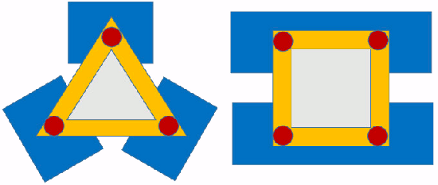
- superconducting phases a more detailed modeling of the hybrid structure (possibly, at the microscopic level) is necessary. To corroborate our findings regarding the effect of a phase difference, we consider the square wire corresponding to the phase diagram shown in Figure 5 coupled to four separate


![[Graphic 30]](/bjnano/content/inline/2190-4286-9-142-i36.svg?max-width=637&scale=1.18182) ) = 0 and
) = 0 and ![[Graphic 31]](/bjnano/content/inline/2190-4286-9-142-i37.svg?max-width=637&scale=1.18182) = 0. The white areas are t...
= 0. The white areas are t...


![[Graphic 40]](/bjnano/content/inline/2190-4286-9-142-i46.svg?max-width=637&scale=1.18182) ) ≠ 0 and
) ≠ 0 and ![[Graphic 41]](/bjnano/content/inline/2190-4286-9-142-i47.svg?max-width=637&scale=1.18182) = 0. The white areas are topol...
= 0. The white areas are topol...

![[Graphic 50]](/bjnano/content/inline/2190-4286-9-142-i56.svg?max-width=637&scale=1.18182) ) ≠ 0 and
) ≠ 0 and ![[Graphic 51]](/bjnano/content/inline/2190-4286-9-142-i57.svg?max-width=637&scale=1.18182) 1 = 0,
1 = 0, ![[Graphic 52]](/bjnano/content/inline/2190-4286-9-142-i58.svg?max-width=637&scale=1.18182) 3 = π/2,
3 = π/2, ![[Graphic 53]](/bjnano/content/inline/2190-4286-9-142-i59.svg?max-width=637&scale=1.18182) 5 = −π/2. T...
5 = −π/2. T...

![[Graphic 65]](/bjnano/content/inline/2190-4286-9-142-i71.svg?max-width=637&scale=1.18182) ) ≠ 0 and
) ≠ 0 and ![[Graphic 66]](/bjnano/content/inline/2190-4286-9-142-i72.svg?max-width=637&scale=1.18182) 1 = π/2,
1 = π/2, ![[Graphic 67]](/bjnano/content/inline/2190-4286-9-142-i73.svg?max-width=637&scale=1.18182) 3 = −π/2,
3 = −π/2, ![[Graphic 68]](/bjnano/content/inline/2190-4286-9-142-i74.svg?max-width=637&scale=1.18182) 5 = π/2, and ...
5 = π/2, and ...


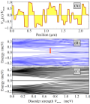
![[Graphic 79]](/bjnano/content/inline/2190-4286-9-142-i85.svg?max-width=637&scale=1.18182) = 3 of a triangular wi...
= 3 of a triangular wi...


Nanoporous silicon nitride-based membranes of controlled pore size, shape and areal density: Fabrication as well as electrophoretic and molecular filtering characterization
Beilstein J. Nanotechnol. 2018, 9, 1390–1398, doi:10.3762/bjnano.9.131
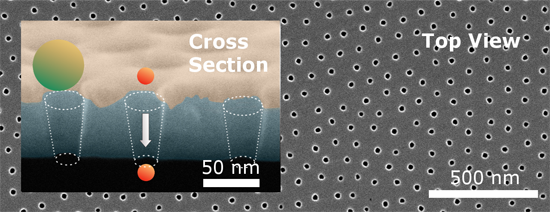
- membranes can be explained by modeling the membrane as a parallel connection of N nanopores (experimentally: N ≈ 107) leading to a total resistance of: where Rpore is the resistance of a single nanopore. Its value was successfully approximated by neglecting the influence of surface charges on the pore wall


Electrostatically actuated encased cantilevers
Beilstein J. Nanotechnol. 2018, 9, 1381–1389, doi:10.3762/bjnano.9.130
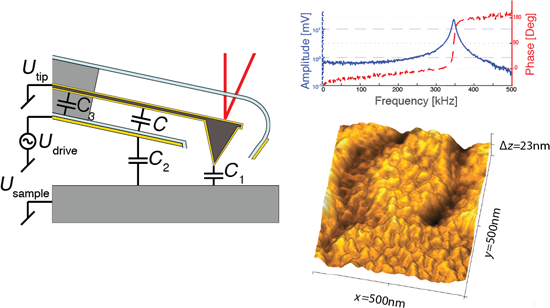
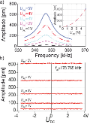
- experimentally determined amplitude can be expressed as = 101 pm V−2|Udc − UCPD|Uac. A comparison with modeled results is given in section Modeling. We demonstrate imaging capability in air using electrostatic excitation in Figure 3c. A 3D rendering of the recorded topography shows copper grains evaporated onto
- deflection is given by yexp = −1.48 pm V−2 (Udc − UCPD)2. Modeling Despite the complex geometry of our drive electrode, we demonstrate that a simple parallel plate capacitor model can accurately describe the observed static deflection and oscillation amplitudes. After geometrical modeling of the capacitance
- gradient, we compute the expected deflection and amplitudes for static, harmonic and sub-harmonic excitation and compare them to our experimental results. Geometric modeling of the capacitance gradient Figure 6 shows a schematic of the longitudinal (Figure 6a) and transverse (Figure 6b) cross section of




Disorder-induced suppression of the zero-bias conductance peak splitting in topological superconducting nanowires
Beilstein J. Nanotechnol. 2018, 9, 1358–1369, doi:10.3762/bjnano.9.128
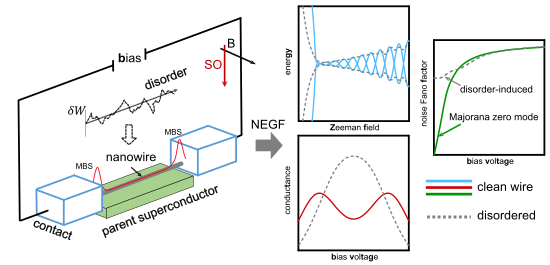
- symmetric lead-wire coupling strength ΓL = ΓR = 0.3 meV. The bias voltage V across the whole device will shift the chemical potential μL(μR) in the leads to ±V/2. In modeling the disorder effect on the quantum transport in mesoscopic devices, the numerical results need to be averaged over enough random


![[Graphic 20]](/bjnano/content/inline/2190-4286-9-128-i39.svg?max-width=637&scale=1.18182) (das...
(das...


Chemistry for electron-induced nanofabrication
Beilstein J. Nanotechnol. 2018, 9, 1317–1320, doi:10.3762/bjnano.9.124

- deposits. Modeling by different types of simulations is also an important approach to gain a deeper understanding and hopefully better control over FEBID processes. The quality of a deposit depends not only on the chemical properties and processes mentioned so far but also on precursor adsorption states
Formation mechanisms of boron oxide films fabricated by large-area electron beam-induced deposition of trimethyl borate
Beilstein J. Nanotechnol. 2018, 9, 1282–1287, doi:10.3762/bjnano.9.120
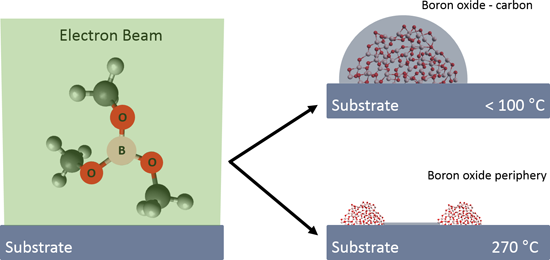
- previous studies of TEOS. This knowledge is critical for optimization of precursor chemistry in other materials systems and for future modeling efforts. Experimental EBID experiments were performed on a silicon substrate (100, n-type, P-doped, native oxide surface, MTI Corporation) with TMB precursor