


Search results
Search for "quartz" in Full Text gives 415 result(s) in Beilstein Journal of Nanotechnology. Showing first 200.
Correlation of surface-enhanced Raman scattering (SERS) with the surface density of gold nanoparticles: evaluation of the critical number of SERS tags for a detectable signal
Beilstein J. Nanotechnol. 2019, 10, 1016–1023, doi:10.3762/bjnano.10.102
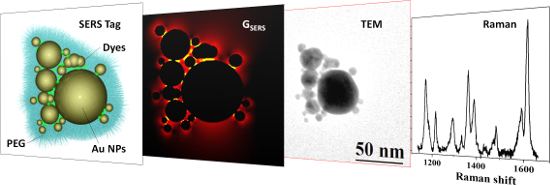
- serves to prevent particle agglomeration after drying the drop [42]. Characterization UV–visible spectroscopy was performed with a Varian Cary 5 spectrometer in 2 mm optical path length quartz cells. The AuNP concentration was estimated from UV–visible spectra and the application of Mie theory, as


Direct growth of few-layer graphene on AlN-based resonators for high-sensitivity gravimetric biosensors
Beilstein J. Nanotechnol. 2019, 10, 975–984, doi:10.3762/bjnano.10.98
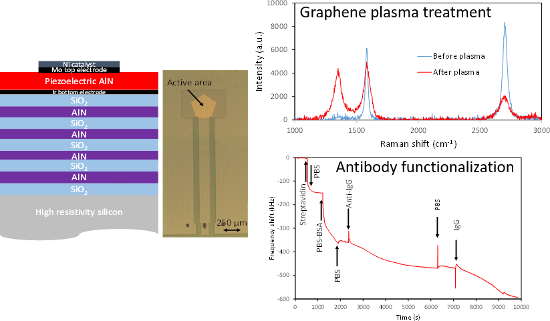
- quartz crystal microbalances (QCMs), and can be configured in sensor arrays and integrated (on-wafer or in-package) along with their driving electronics and microfluidic arrangements, offering compact and inexpensive measurement systems [5][6]. Among the wide variety of thin-film resonators exploiting


Synthesis of MnO2–CuO–Fe2O3/CNTs catalysts: low-temperature SCR activity and formation mechanism
Beilstein J. Nanotechnol. 2019, 10, 848–855, doi:10.3762/bjnano.10.85
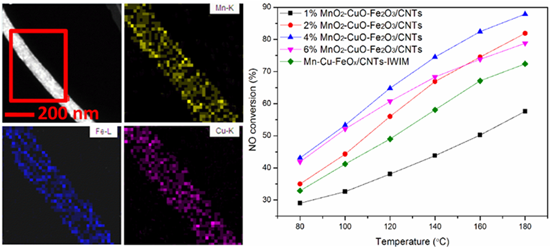
- on a Thermo Scientific ESCALAB 250 spectrometer equipped with a dual Al/Mg anode (0.6 eV resolution). Catalytic activity The SCR activity tests were carried out in a fixed-bed quartz reactor using 0.15 g catalyst in each test. The reaction gas consisted of [O2] = 5%, [NO] = [NH3] = 400 ppm, balanced




An iridescent film of porous anodic aluminum oxide with alternatingly electrodeposited Cu and SiO2 nanoparticles
Beilstein J. Nanotechnol. 2019, 10, 735–745, doi:10.3762/bjnano.10.73
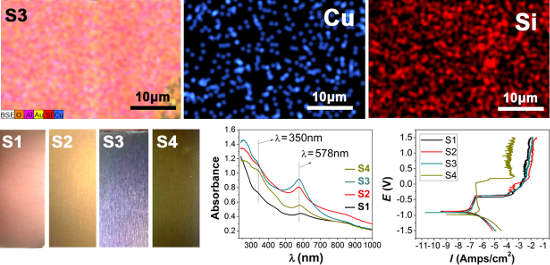
- -area, ordered interference-enabled colored films with uniform structural colors on the surface of inorganic nanoparticles (NPs) that had been prepared to bear surface charges [28]. On the substrates of quartz glass, PET and PP, twenty cycles of the assembly of a SiO2 film led to the formation of dark


Ultrathin hydrophobic films based on the metal organic framework UiO-66-COOH(Zr)
Beilstein J. Nanotechnol. 2019, 10, 654–665, doi:10.3762/bjnano.10.65
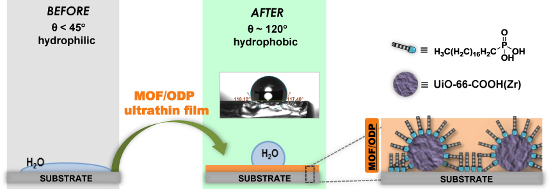
- OPD/MOF ultrathin films have been fabricated onto glass, calcium fluoride, quartz crystal microbalance (QCM), Si(100) substrates and mica and characterized using scanning electron microscopy (SEM), Fourier transform infrared spectroscopy (FTIR), X-ray diffraction (XRD), atomic force microscopy (AFM
- that were further characterized. CO2 adsorption studies In order to study the effect of the surfactant on the adsorption capacity of the MOF sMPs, CO2 adsorption studies were performed using the quartz crystal microbalance (QCM)-based setup described in the experimental section. Drop-cast films of the


Direct observation of the CVD growth of monolayer MoS2 using in situ optical spectroscopy
Beilstein J. Nanotechnol. 2019, 10, 557–564, doi:10.3762/bjnano.10.57
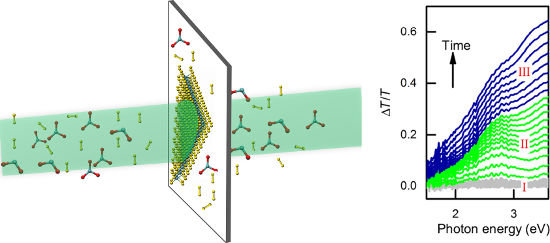
- the MoO3 thin films were formed on the substrate surfaces. Actually, we attribute the observed DTS signal to the absorption of the MoO3 thin films which were deposited on the inner surface of the quartz window at the end of the furnace tube. Since the quartz was maintained close to room temperature
- , it is reasonable to assume that a small amount of the MoO3 molecules carried by the Ar flow from upstream may be deposited on the inner surface of this quartz window. The deposition rate of the MoO3 on the inner surface of the quartz window should be proportional to the product of in which, is the
- concentration of MoO3 molecule above the MoO3 source which depends exponentially on the source temperature The coefficient p accounts for the transportation efficiency of MoO3 molecules from the source to the inner surface of the quartz window. Although the coefficient p has been minimized, it was not, however


Ceria/polymer nanocontainers for high-performance encapsulation of fluorophores
Beilstein J. Nanotechnol. 2019, 10, 522–530, doi:10.3762/bjnano.10.53
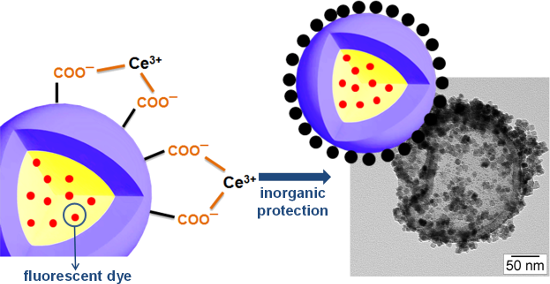
- from the closed flask was transferred to a quartz cuvette under ambient conditions for further fluorescence measurements. As observed in Figure 5, the fluorescence efficiency of this sample is enhanced when compared to the sample prepared under ambient conditions, which is explained by the decrease of


Ultraviolet patterns of flowers revealed in polymer replica – caused by surface architecture
Beilstein J. Nanotechnol. 2019, 10, 459–466, doi:10.3762/bjnano.10.45
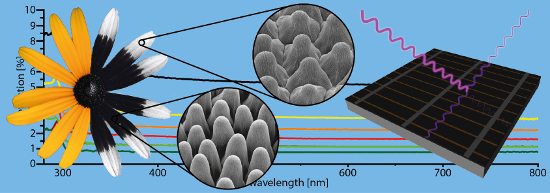
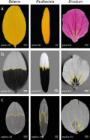
- under environmental conditions. Both cameras were equipped with a UV-Nikkor 105 mm quartz objective (Nikon), an IR-neutralization filter (NG 52D, Optik Makario, Mönchengladbach, Germany) and a UV-transmission filter (SP2 400UV 52D, Optik Makario, Mönchengladbach, Deutschland) to eliminate wavelengths in


Improving control of carbide-derived carbon microstructure by immobilization of a transition-metal catalyst within the shell of carbide/carbon core–shell structures
Beilstein J. Nanotechnol. 2019, 10, 419–427, doi:10.3762/bjnano.10.41
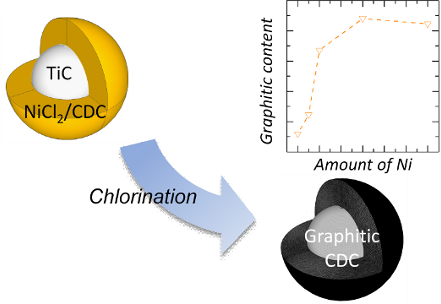
- shell, was reported previously in detail [15]. Briefly, a vertical quartz tube reactor (di = 0.034 m, l = 1 m) was employed to perform partial chlorination of carbide to carbon. About 1 g of TiC powder was loaded on the top of a quartz frit of a quartz tube. The reactor was then placed in an isothermal


Biocompatible organic–inorganic hybrid materials based on nucleobases and titanium developed by molecular layer deposition
Beilstein J. Nanotechnol. 2019, 10, 399–411, doi:10.3762/bjnano.10.39
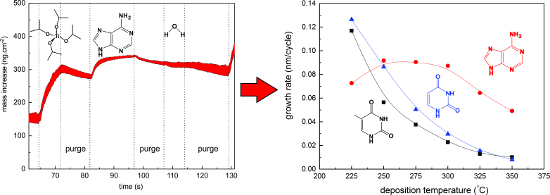
- .; Eidet, J. R. J. Biomed. Mater. Res., Part A 2018, 106, 3090–3098. doi:10.1002/jbm.a.36499]. The growth was followed by in situ quartz crystal microbalance (QCM) measurements and all systems exhibited atomic layer deposition (ALD) type of growth. The adenine system has an ALD temperature window between
- precleaned single crystal substrates cut from Si(100) wafers. The growth dynamics were investigated in situ by a quartz crystal microbalance (QCM) using a Maxtek TM400 unit and homemade crystal holders. A change in resonance frequency of the crystal is linearly proportional to the mass of the deposited film




Integration of LaMnO3+δ films on platinized silicon substrates for resistive switching applications by PI-MOCVD
Beilstein J. Nanotechnol. 2019, 10, 389–398, doi:10.3762/bjnano.10.38
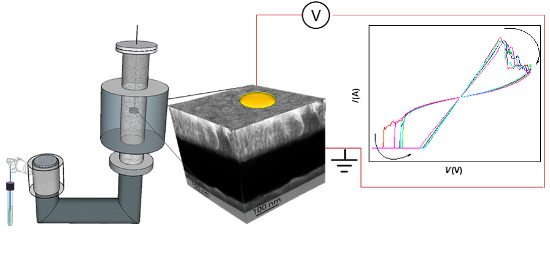
- , maximizing the flux of carried precursor. The deposition temperature inside the main chamber (a hot-wall quartz reactor heated by an external furnace) ranged from 500 to 750 °C. The substrates used were 1 cm × 1 cm chips cut from a Pt (150 nm)/TiO2 (40 nm)/SiO2 (500 nm)/Si (111) wafer (VinKarola Instruments




Sub-wavelength waveguide properties of 1D and surface-functionalized SnO2 nanostructures of various morphologies
Beilstein J. Nanotechnol. 2019, 10, 379–388, doi:10.3762/bjnano.10.37
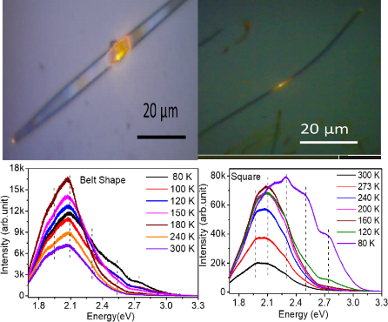
- . Experimental One-dimensional SnO2 NWs of different morphology were grown in a horizontal quartz tube furnace by using catalytic vapor–liquid–solid (VLS) and self-catalytic vapor–solid (VS) methods. In both the cases, the synthesized SnO2 QDs of diameter 2.4 nm were used as a precursor material. The synthesis
- in the direction of the carrier gas flow (Ar). The horizontal quartz tube furnace was initially evacuated to a pressure of 2.0 × 10⁻³ mbar by using a rotary pump and then filled with commercial Ar gas (99.9%). The temperature profiles are shown in the Supporting Information File 1 (Figure S1a). In
- Information Temperature profiles of the horizontal quartz tube furnace for catalytic VLS growth and non-catalytic VS growth. FESEM image of the as-grown nanobelts in the crucible. Gaussian fitting of the PL curves recorded at 80 K for all three types of NWs. Moreover, Gaussian fitting of the PL curves of


Interaction of Te and Se interlayers with Ag or Au nanofilms in sandwich structures
Beilstein J. Nanotechnol. 2019, 10, 238–246, doi:10.3762/bjnano.10.22
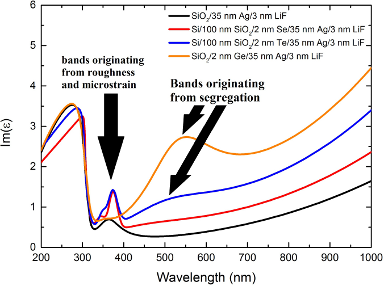
- average deposition rate of 5 Å/s, while silver and gold films were evaporated at an average deposition rate of 2 Å/s. LiF was evaporated at an average deposition rate of 1 Å/s. The deposition rate and total film thickness were monitored by two quartz weights inside the deposition chamber. Then, the film


Mechanism of silica–lysozyme composite formation unravelled by in situ fast SAXS
Beilstein J. Nanotechnol. 2019, 10, 182–197, doi:10.3762/bjnano.10.17
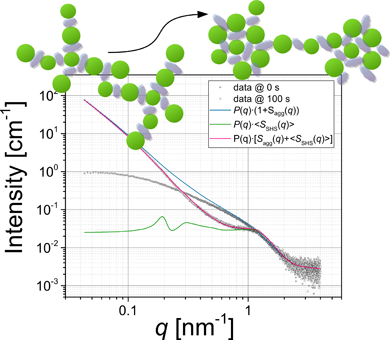
- -through cell with embedded quartz capillary (ID 1.7 mm, wall thickness 50 µm; aligned with the X-ray beam) using a peristaltic pump (Gilson MiniPuls 3, flow ca. 500 mL/min; tubing: ID 2 mm, total length 2 m; reactor-to-cell-distance: 0.7 m of tubing). All experiments were conducted at 21 °C. Once a SAXS



New micro/mesoporous nanocomposite material from low-cost sources for the efficient removal of aromatic and pathogenic pollutants from water
Beilstein J. Nanotechnol. 2019, 10, 119–131, doi:10.3762/bjnano.10.11
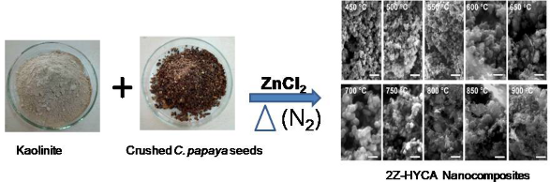
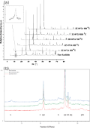
- , dehydroxylation of kaolinite occurs, which causes the reflections of kaolinite to disappear (for example, at 12.35° and 20.34°, 2θ, JCPDF 98-008-7771). In the absence of the reflections of kaolinite, the remaining reflections of quartz (JCPDF 98-008-9277 at 2θ values of 20.83°, 26.61°, 36.49°, 39.43°, 50.08°, etc
- 750 °C for one hour. The originally used raw kaolinite is composed of kaolinite (k), quartz (qtz) and feldspar (microcline (kfs) and plagioclase (plg)) and small amounts of illite (il, JCPDF 98-009-0144) and anatase (TiO2, JCPDF 98-009-6946, at 2θ values of 25.29°). As already mentioned, the kaolinite
- heated at 550 °C and 2Z-HYCA prepared at 750 °C. k = K-feldspat (microcline), il = illite, qtz = quartz, plg = plagioclase, ghn = gahnite. 29Si, 27Al and 13C CP-MAS-NMR spectra of 2Z-HYCA calcined at 650 °C. *Rotation side bands of ethylene carbon. SEM images showing the growth pattern of 2Z-HYCA




Surface plasmon resonance enhancement of photoluminescence intensity and bioimaging application of gold nanorod@CdSe/ZnS quantum dots
Beilstein J. Nanotechnol. 2019, 10, 22–31, doi:10.3762/bjnano.10.3
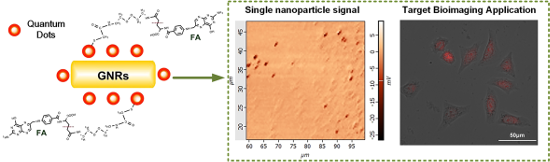
- measured with an FLS980 spectrometer (Edinburgh instruments, UK). The morphology and size of the GNRs and QDs were obtained with an FEI Tecnai G2 F20 S-TWIN TEM operating at an accelerating voltage of 200 kV, and the samples were loaded into a quartz cell for the measurements. The TEM specimens were


Investigation of CVD graphene as-grown on Cu foil using simultaneous scanning tunneling/atomic force microscopy
Beilstein J. Nanotechnol. 2018, 9, 2953–2959, doi:10.3762/bjnano.9.274
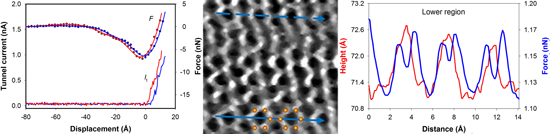
- temperature, the Ar flow was stopped and the H2 flow was reduced while CH4 was let in to the quartz tube as the carbon source. As-grown samples, as well as graphene crsytals transferred on to dielectric substrates were investigated by optical microscopy and scanning electron microscopy (SEM). Raman spectra


Contactless photomagnetoelectric investigations of 2D semiconductors
Beilstein J. Nanotechnol. 2018, 9, 2741–2749, doi:10.3762/bjnano.9.256
- . The radiation intensity was changed using neutral density filters (UV-NIR-FILTER-250-2000 nm, quartz glass substrate, Oriel). The intensity was monitored using a Hamamatsu S3399 photodiode whose short-circuit current was measured using an EG&G 5110 lock-in amplifier. The time dependence of the

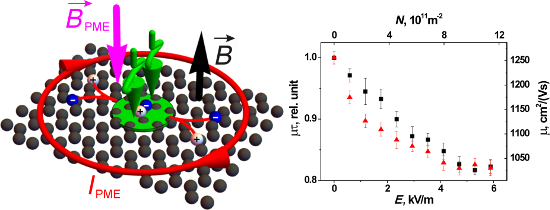
![[Graphic 1]](/bjnano/content/inline/2190-4286-9-256-i2.svg?max-width=637&scale=1.18182) evoked by the PME circulating current in a point-illuminated 2D...
evoked by the PME circulating current in a point-illuminated 2D...

![[Graphic 7]](/bjnano/content/inline/2190-4286-9-256-i8.svg?max-width=637&scale=1.18182) vs the illumination intensity for differe...
vs the illumination intensity for differe...

![[Graphic 15]](/bjnano/content/inline/2190-4286-9-256-i16.svg?max-width=637&scale=1.18182) vs the carrier lifetime for different values ...
vs the carrier lifetime for different values ...


Oriented zinc oxide nanorods: A novel saturable absorber for lasers in the near-infrared
Beilstein J. Nanotechnol. 2018, 9, 2730–2740, doi:10.3762/bjnano.9.255
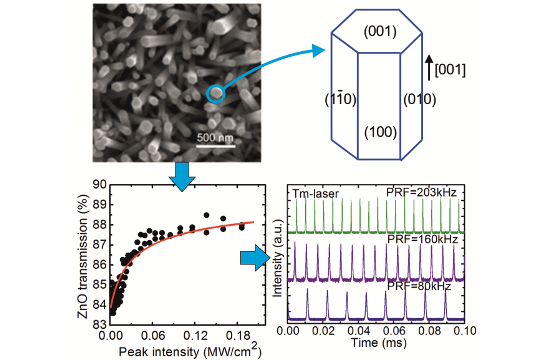
- under ns-laser excitation [23]. This effect was ascribed to the defects promoted by the Mn2+ doping. Some studies revealed reverse saturable absorption (optical limiting) in ZnO thin films and NRs [24]. Zhu et al. studied ultrafast saturable absorption of multiwalled carbon nanotubes (MWCNTs) on quartz



Impact of the anodization time on the photocatalytic activity of TiO2 nanotubes
Beilstein J. Nanotechnol. 2018, 9, 2628–2643, doi:10.3762/bjnano.9.244
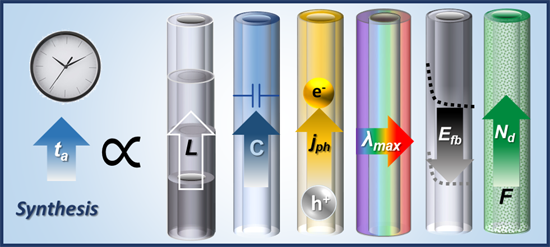
- of their specific systems [27][60][61]. A similar approach was used to evaluate the PEC properties of the TNTs. For this purpose, the electrodes were illuminated in a cell with quartz window while performing LSV using the same pretreatment of 10 s polarization. The photocurrent, jph, is then obtained
- photoelectrocatalytic system used to perform the experiments. Briefly, a 20 mg/mL MB solution in the electrolyte was irradiated in a three-electrode electrochemical cell with a quartz window. An electrolyte/electrode (EE) configuration was used with a distance between the working electrode and the quartz cell (optical
- pass) of 1 cm. The MB dissolution was recirculated using a peristaltic pump to a standard quartz cuvette where the absorbance at 638 nm was measured in situ. In a typical experiment, a fixed ratio of 12.5:1 (volume/area) was used for all the samples while a potential bias of 1 V/(Ag|AgCl) was applied


Au–Si plasmonic platforms: synthesis, structure and FDTD simulations
Beilstein J. Nanotechnol. 2018, 9, 2599–2608, doi:10.3762/bjnano.9.241
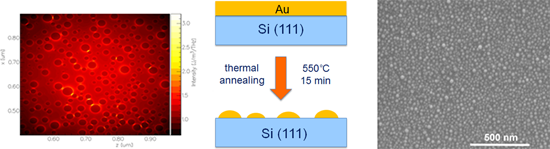
- ) under pure Ar plasma conditions (Argon, Air Products 99.999%). The Au target had 99.99% purity, the rate of Au layer deposition was about 0.4 nm·s−1 and the incident power was 32 W. The thickness of the films was measured in situ by a quartz crystal microbalance. The films were subsequently annealed at



Improved catalytic combustion of methane using CuO nanobelts with predominantly (001) surfaces
Beilstein J. Nanotechnol. 2018, 9, 2526–2532, doi:10.3762/bjnano.9.235
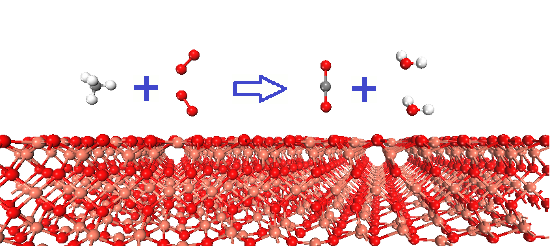
- get CuO NBs [23]. Methane catalytic oxidation test Methane catalytic oxidation experiments were carried out in a fixed-bed reactor (U-shaped quartz tube) with an inner diameter of 6 mm at atmospheric pressure. 35 mg of the catalysts was loaded into the reactor and supported by quartz wool. A mixed


Non-agglomerated silicon–organic nanoparticles and their nanocomplexes with oligonucleotides: synthesis and properties
Beilstein J. Nanotechnol. 2018, 9, 2516–2525, doi:10.3762/bjnano.9.234
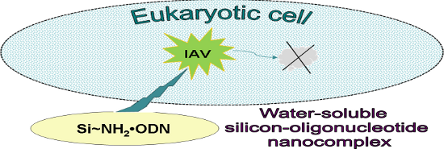
- . The spectrum was recorded with absorption compensation relative to water in the range 11000–54000 cm−1 in a quartz cuvette with an optical path length of 1 mm (Figure 2b). The size and zeta potential values of Si–NH2 and Si–NH2·ODN were measured at 5–50 mM concentration (for Si) in physiological


SERS active Ag–SiO2 nanoparticles obtained by laser ablation of silver in colloidal silica
Beilstein J. Nanotechnol. 2018, 9, 2396–2404, doi:10.3762/bjnano.9.224
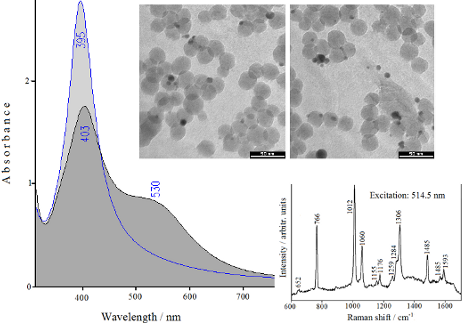
- power meter (model 362; Scientech, Boulder, CO, USA) giving ≈5% accuracy in the 300–1000 nm spectral range. FT-SERS measurements were collected with a Fourier transform Raman spectrometer (Bruker Optics, Model MultiRam), equipped with a broad range quartz beamsplitter, an air-cooled Nd:YAG laser


Nanotribology
Beilstein J. Nanotechnol. 2018, 9, 2330–2331, doi:10.3762/bjnano.9.217

- techniques for materials characterization are those typical of surface science (e.g., X-ray diffraction, SEM, TEM, XPS and Raman spectroscopy), more specific to nanotribology are nanoindenters, nanotribometers, quartz force microbalance and especially atomic force microscopy (AFM), which, without a doubt



