Search results
Search for "surface morphology" in Full Text gives 273 result(s) in Beilstein Journal of Nanotechnology. Showing first 200.
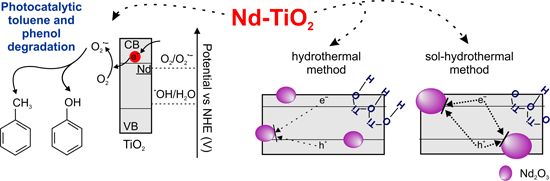
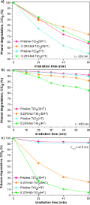
Influence of the preparation method on the photocatalytic activity of Nd-modified TiO2
Beilstein J. Nanotechnol. 2018, 9, 447–459, doi:10.3762/bjnano.9.43
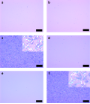
- of Ti–O–Nd bonds probably restricts direct contact between TiO2 crystallites and stabilizes the anatase phase and crystallite growth [25][35]. Morphology Surface morphology of the obtained photocatalysts was studied using scanning electron microscopy (SEM). Figure 2 shows a SEM image of pristine TiO2




Facile synthesis of ZnFe2O4 photocatalysts for decolourization of organic dyes under solar irradiation
Beilstein J. Nanotechnol. 2018, 9, 436–446, doi:10.3762/bjnano.9.42
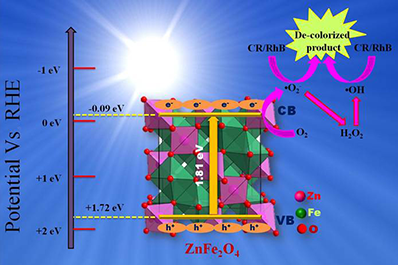
- microscopy (FESEM) provides surface morphology and topography of the prepared materials. Figure 2 shows the surface topography of ZFO-500. The sample consists of agglomerated nanoparticles with smooth surface. The agglomeration of ZFO-500 is accompanied with the formation of small crystallites [28]. TEM The


Photocatalytic and adsorption properties of TiO2-pillared montmorillonite obtained by hydrothermally activated intercalation of titanium polyhydroxo complexes
Beilstein J. Nanotechnol. 2018, 9, 364–378, doi:10.3762/bjnano.9.36
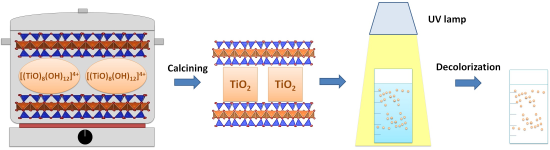
- surface morphology was performed using an IEK-2 scanning electron microscope (Zeiss SUPRA 50VP, Germany) by coating a conductive layer of iridium. Elemental analysis of the surface was carried out on a VEGA 3 SBH scanning electron microscope integrated with a Bruker energy-dispersive microanalyzer




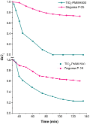


Bombyx mori silk/titania/gold hybrid materials for photocatalytic water splitting: combining renewable raw materials with clean fuels
Beilstein J. Nanotechnol. 2018, 9, 187–204, doi:10.3762/bjnano.9.21
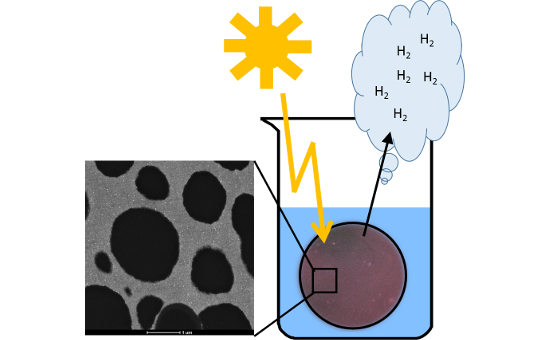
- opening of the surface of the samples to some extent. As a result, TPS_Au2.5 partially exhibits a macroporous structure and an inhomogeneous surface morphology with smaller particles located on the surface, similar to the Au-free sample TPS. Again smaller holes are visible around the larger holes
- magnification the sample surface has a grainy appearance but higher magnification images show that the materials consist of tightly connected spherical nanoparticles with significant open volume. The particles have a diameter of ca. 1.5 µm and appear to be composed of smaller particles. The surface morphology




Atomic layer deposition and properties of ZrO2/Fe2O3 thin films
Beilstein J. Nanotechnol. 2018, 9, 119–128, doi:10.3762/bjnano.9.14
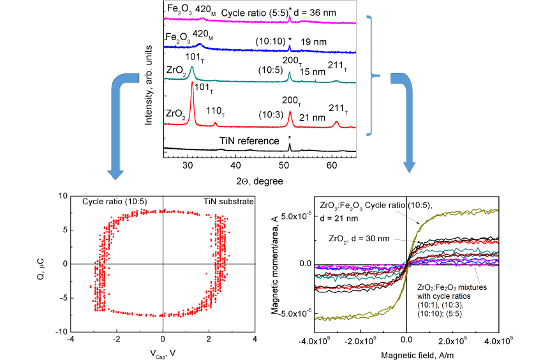
- modelling of samples in the range of 300–1000 nm. An X-ray fluorescence (XRF) spectrometer (Rigaku, ZSX 400) with the software program ZSX (version 5.55) was used to evaluate the elemental composition of the films. The surface morphology of the films and a cross-section of an ALD coated stack were evaluated


Gas-sensing behaviour of ZnO/diamond nanostructures
Beilstein J. Nanotechnol. 2018, 9, 22–29, doi:10.3762/bjnano.9.4
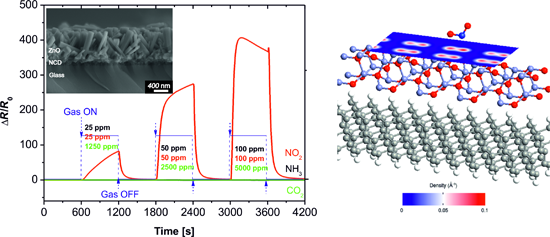
- ), nitrogen dioxide (NO2) and ammonia (NH3) at different concentrations at a temperature of 150 °C. The constant gas flow of 100 mL/min was maintained during all the measurements. Results and Discussion Materials characterization and gas sensing Figure 2a shows a top-view SEM surface morphology image of the
- resistance (sensor response) occurs in the presence of NO2, while negligible responses are detected during exposure to NH3 and CO2. In contrast to the NCD sensor, the sensor device based on ZnO nanorods acts as an n-type semiconductor [10]. Figure 2c shows a typical top-view SEM surface morphology image of
- ) ZnO nanorods combined with NCD thin layer. SEM surface morphology and corresponding plot of sensor response as a function of the time at a fixed temperature of 150 °C: (a,b) NCD thin film, (c,d) ZnO nanorods, (e,f) hybrid ZnO NRs/NCD-coated sensor substrate with Au/Ti IDE. (a) Raman spectra and (b) X


PTFE-based microreactor system for the continuous synthesis of full-visible-spectrum emitting cesium lead halide perovskite nanocrystals
Beilstein J. Nanotechnol. 2017, 8, 2521–2529, doi:10.3762/bjnano.8.252
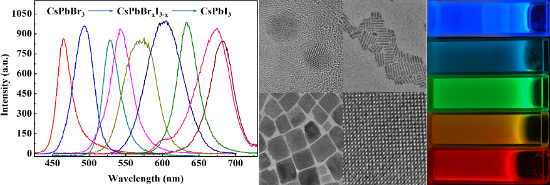
- . The difference in the surface morphology is likely due to the orientation dependence of the specific surface energy on the fraction of halogen elements, since the growth orientation of a crystal is controlled by the minimization of total surface energy. X-ray diffraction (XRD) was used to characterize


Au nanostructure fabrication by pulsed laser deposition in open air: Influence of the deposition geometry
Beilstein J. Nanotechnol. 2017, 8, 2438–2445, doi:10.3762/bjnano.8.242
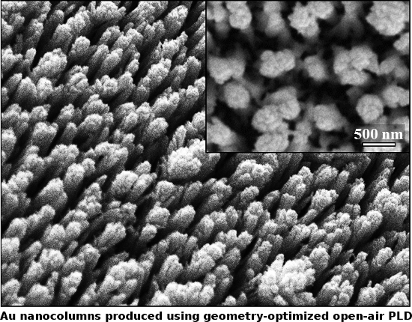
- nanoparticles and nanoaggregates produced in the ablated plasma at atmospheric pressure led to the formation of chain-like nanostructures on the substrate. The dependence of the surface morphology of the samples on the deposition geometry used in the experimental set up was studied. Nanocolumns of different
- properties [1][2], which are not observed in their bulk counterparts. Moreover, the strong dependence of the physical and chemical properties of these structures on their surface morphology makes them very attractive for a wide range of applications [3][4][5][6][7][8][9]. Initially, the nanofabrication
- in the field, the influence of the deposition geometry of PLD in open air on the surface morphology of the structures produced has yet to be thoroughly studied. The nanostructures produced by laser deposition in air are still being investigated to establish their physical properties and possibilities


Comparing postdeposition reactions of electrons and radicals with Pt nanostructures created by focused electron beam induced deposition
Beilstein J. Nanotechnol. 2017, 8, 2410–2424, doi:10.3762/bjnano.8.240
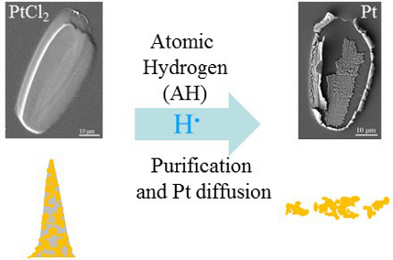
- . Consistent with the EDS data shown in Figure 2, all of the chlorine atoms have again been removed. However, although the shape of the deposit remains unchanged, the surface morphology has changed significantly, with a large amount of granularity and increased porosity, giving it a honeycombed appearance




Increasing the stability of DNA nanostructure templates by atomic layer deposition of Al2O3 and its application in imprinting lithography
Beilstein J. Nanotechnol. 2017, 8, 2363–2375, doi:10.3762/bjnano.8.236
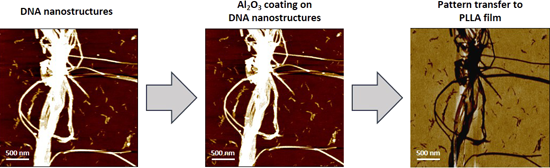
- replication to PLLA stamps (Figure 3a–g and Figure S2a–f, Supporting Information File 1). As the AFM images indicate, the surface morphology of the DNA template was still well maintained after the 1st pattern transfer (Figure 3c and Figure S2b, Supporting Information File 1), showing that the stability of the
- these results prove that the protective Al2O3 film successfully preserves the surface morphology of the complex DNA origami triangle nanostructures. After the replication process, triangular trenches resembling the shape of the DNA origami triangles were formed on the PLLA films (Figure 6c). Compared to
- ca. 2 nm or ca. 5 nm thick Al2O3 layers. Finally, we investigated how the surface morphology of the DNA nanostructures was influenced as the thickness of the protective Al2O3 film was further increased. We coated both the DNA nanotube (Figure S10a,b, Supporting Information File 1) and the DNA origami



Expanding the molecular-ruler process through vapor deposition of hexadecanethiol
Beilstein J. Nanotechnol. 2017, 8, 2339–2344, doi:10.3762/bjnano.8.233
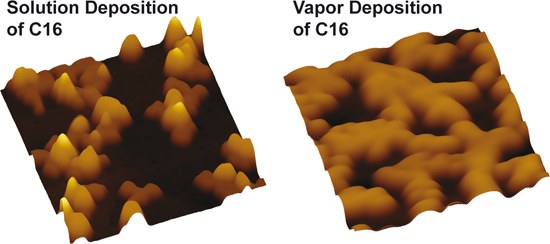
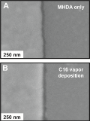
- attributed to C16 molecules bound to a MHDA monolayer via cupric ions. The morphology of these islands is consistent with previous AFM topographic images of solution-deposited Cu-ligated MHDA-C16 bilayers [27]. This surface morphology results in a RMS roughness of 3.2 ± 0.5 nm, which is considerably larger
- variations in the surface morphology of the Cu-ligated MHDA-C16 bilayers, it seems that the solution deposition of C16 is not suitable for use in the molecular-ruler process, and specifically for producing nanogaps with reproducible uniformity. To overcome this limitation, the vapor deposition of C16 is
- height of these protruding islands (3.6 ± 0.2 nm) is consistent with the least-protruding C16 islands of the Cu-ligated MHDA-C16 bilayers formed via solution deposition. Protruding islands of greater thicknesses are not observed. The surface morphology of the Cu-ligated MHDA-C16 bilayer formed via vapor
Tailoring the nanoscale morphology of HKUST-1 thin films via codeposition and seeded growth
Beilstein J. Nanotechnol. 2017, 8, 2307–2314, doi:10.3762/bjnano.8.230
- characterize samples, investigating surface morphology, surface roughness, and film thickness. Results and Discussion For this study of codeposition and seeded surMOF film growth, the MOF was anchored to the substrate by a SAM of 16-mercaptohexadecanoic acid (MHDA), which was formed on a thermally deposited
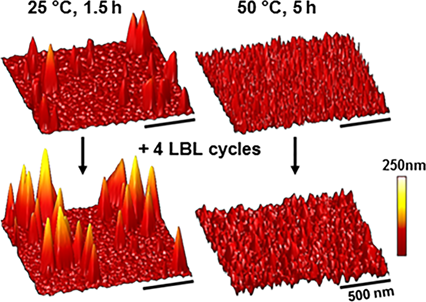
- surface coverage with larger particles relative to the 48 h sample. Quantitative analysis of AFM images showed that the roughness of the 1.5 h sample was four times that of the 48 h sample. While this type of control of surface morphology has potential, the time requirements for the smooth film could be
- (b) on SAM-coated Au surfaces. Additional layers of HKUST-1 were added to these codeposited samples via layer-by-layer (LBL) deposition. The subsequent surface morphology was imaged (c,d) and the previous surface morphology was maintained. Data regarding the roughness (R) for the image shown here and


High-stress study of bioinspired multifunctional PEDOT:PSS/nanoclay nanocomposites using AFM, SEM and numerical simulation
Beilstein J. Nanotechnol. 2017, 8, 2069–2082, doi:10.3762/bjnano.8.207
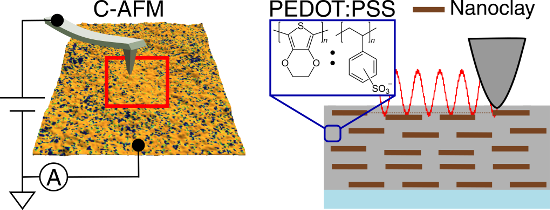
- dimensions and geometry of the tip. Nevertheless, the measured nanoclay dimensions are in both cases near the expected range (25 ± 4 nm [11]). Composite materials based on nanoclays have a distinctive fractured surface morphology. One way of verifying the layered structure of the nanocomposites is to image


Systematic control of α-Fe2O3 crystal growth direction for improved electrochemical performance of lithium-ion battery anodes
Beilstein J. Nanotechnol. 2017, 8, 2032–2044, doi:10.3762/bjnano.8.204
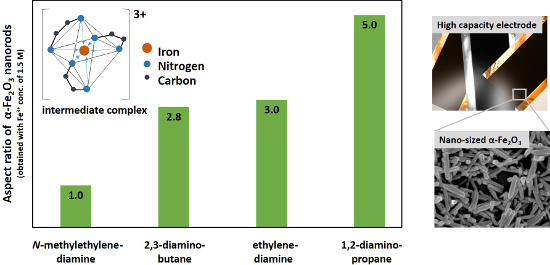
- -methylethylenediamine (95%, Sigma-Aldrich) instead of 1,2-diaminopropane. X-ray diffraction (XRD) analysis was performed on a Shimadzu XRD-6000 diffractometer operating at 40 kV and 40 mA using Cu Kα radiation (λ = 0.154 nm) with a copper target and a nickel filter. The surface morphology and microstructure of the


Advances and challenges in the field of plasma polymer nanoparticles
Beilstein J. Nanotechnol. 2017, 8, 2002–2014, doi:10.3762/bjnano.8.200
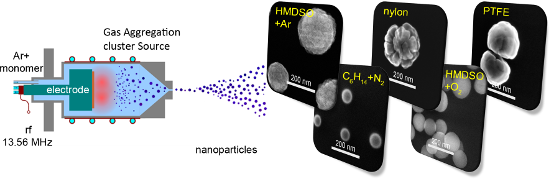
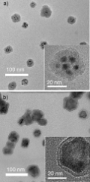
- preserve the initial surface morphology. Certain applications however may require control over the structure in a broader range covering both nanometer and micrometer scales. Plasma polymer NPs may be useful for this purpose as well, especially if glancing angle deposition (GLAD) is considered. Evaporative
- columns inclined towards the direction of the deposition. Obviously, the porosity of the coatings is greatly increased when it is deposited over the preseeded NPs. This approach also offers the possibility to combine different materials, and hence, to independently tune the surface morphology and the


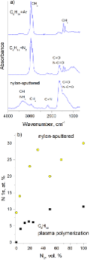
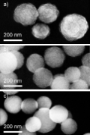


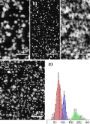
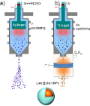


Bi-layer sandwich film for antibacterial catheters
Beilstein J. Nanotechnol. 2017, 8, 1982–2001, doi:10.3762/bjnano.8.199


Intercalation of Si between MoS2 layers
Beilstein J. Nanotechnol. 2017, 8, 1952–1960, doi:10.3762/bjnano.8.196
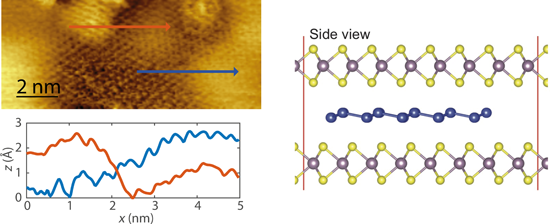
- intrinsic defects, which are visible as dark depressions as indicated by the arrow in Figure 1a. These defects are most probably caused by vacancies or interstitials and have been found to exhibit a metal-like behavior [42][43]. Upon the deposition of 0.2 monolayers of Si, the surface morphology converts to


Growth and characterization of textured well-faceted ZnO on planar Si(100), planar Si(111), and textured Si(100) substrates for solar cell applications
Beilstein J. Nanotechnol. 2017, 8, 1939–1945, doi:10.3762/bjnano.8.194
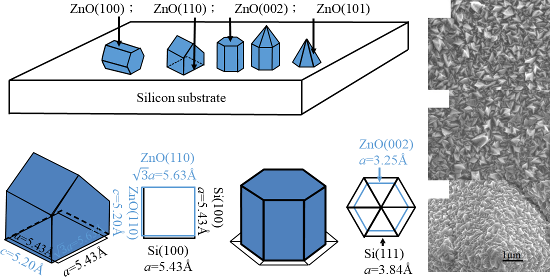
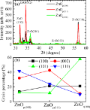
- the ZnO(002), which closely match the textured silicon surface as well. As a result, the planar Si(100) substrate will favor ZnO(110) crystallization, while the planar Si(111) substrate will favor Zn(002). The surface morphology of the ZnO film on planar Si(100) substrate will have more ridge-like
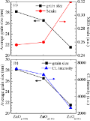
- -sized texture of the Si substrate has a limited contribution. Discussion The main grain orientation, surface morphology, AFM surface roughness (Rq) from AFM, average grain size (D), strain (ε), and CL intensity of samples ZnOp(100), ZnOp(111), and ZnOt(100) are shown in Table 1. The results clearly
- of the samples ZnOp(100), ZnOp(111), and ZnOt(100) were investigated with a high-resolution XRD (Bede D1). The surface morphology was revealed by atomic force microscopy (Park Systems, XE-70) operating in non-contact mode using a silicon tip of curvature less than 10 nm. Scanning electron microscope

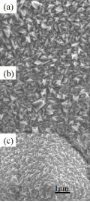


![[Graphic 2]](/bjnano/content/inline/2190-4286-8-194-i4.png?max-width=637&scale=1.18182) × lattice constant a) by 5.20 Å (l...
× lattice constant a) by 5.20 Å (l...


Freestanding graphene/MnO2 cathodes for Li-ion batteries
Beilstein J. Nanotechnol. 2017, 8, 1932–1938, doi:10.3762/bjnano.8.193
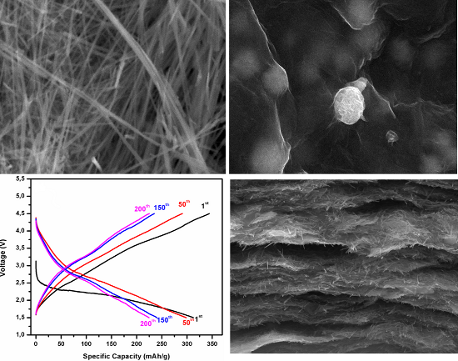
- cycle life. Surface morphology of (a) α-MnO2, (b) β-MnO2, (c) γ-MnO2, (d) graphene/α-MnO2, (e) graphene/β-MnO2, and (f) graphene/γ-MnO2 freestanding cathodes. Cross-sectional SEM images of (a) graphene/α-MnO2, (b) graphene/β-MnO2, and (c) graphene/γ-MnO2 freestanding cathodes. XRD patterns of (a) α-MnO2


Synthesis and catalytic application of magnetic Co–Cu nanowires
Beilstein J. Nanotechnol. 2017, 8, 1769–1773, doi:10.3762/bjnano.8.178
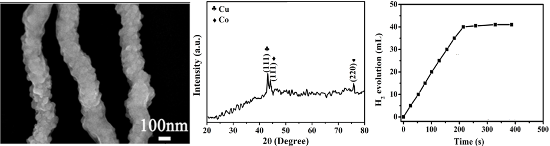
- field resulted in intense aggregation of products, which was found to be a limitation for catalytic applications. The SEM and TEM images exhibiting the surface morphology of bimetallic Co–Cu nanowires at different magnification are given in Figure 2. It was obvious that bimetallic Co–Cu nanowires were


Process-specific mechanisms of vertically oriented graphene growth in plasmas
Beilstein J. Nanotechnol. 2017, 8, 1658–1670, doi:10.3762/bjnano.8.166
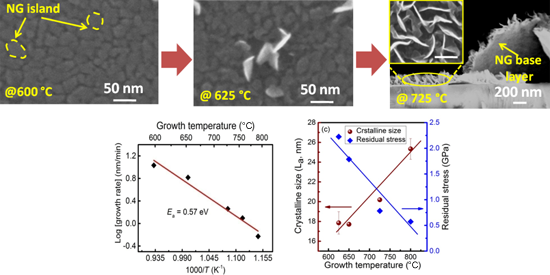
- explained by surface morphology, intersheet spacing, chemical structure, oxygen functionality and crystallinity [62]. The in-depth analysis of the CA behavior is outside the scope of this paper. The near-superhydrophobic behavior most likely originates from the effects of the improved crystallinity and


Oxidative stabilization of polyacrylonitrile nanofibers and carbon nanofibers containing graphene oxide (GO): a spectroscopic and electrochemical study
Beilstein J. Nanotechnol. 2017, 8, 1616–1628, doi:10.3762/bjnano.8.161
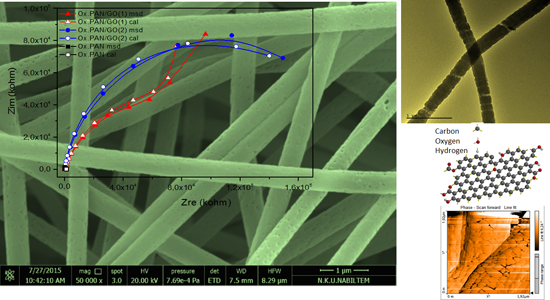
- width, 190 kHz resonance frequency and 48 N/m force constant. Surface morphology of the nanofibers was observed with scanning electron microscopy (SEM) at Namık Kemal University and transmission electron microscopy (TEM). Fiber diameters were measured within electron micrographs from a population


A nanocomplex of C60 fullerene with cisplatin: design, characterization and toxicity
Beilstein J. Nanotechnol. 2017, 8, 1494–1501, doi:10.3762/bjnano.8.149
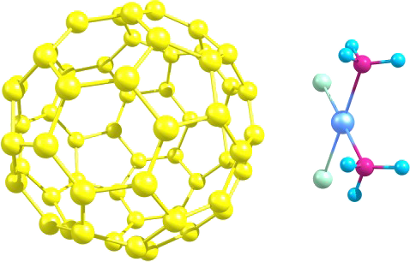
- cell in disposable cuvettes. The Smoluchowski approximation was used to convert the electrophoretic mobility to the zeta potential. AFM study The surface morphology of the particles was examined using atomic force microscopy (AFM). AFM images were collected using an Integra Spectra microscope (NTMDT



Development of a nitrogen-doped 2D material for tribological applications in the boundary-lubrication regime
Beilstein J. Nanotechnol. 2017, 8, 1476–1483, doi:10.3762/bjnano.8.147
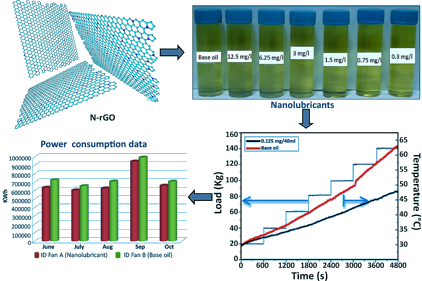
- the range of 2θ = 5° to 2θ = 90° using a Rigaku X-ray diffractometer. Raman scattering spectra of graphite, GO and N-rGO were collected by using a WITec Raman spectrometer equipped with Nd:YAG laser (λ = 532 nm). The surface morphology of the sample was analyzed by using field-emission scanning


Formation of ferromagnetic molecular thin films from blends by annealing
Beilstein J. Nanotechnol. 2017, 8, 1469–1475, doi:10.3762/bjnano.8.146
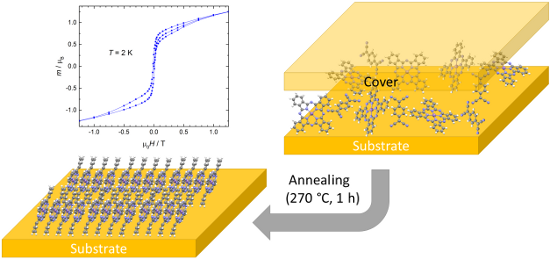
- 60 °C by blending the MnPc film with TCNQ in the starting films deposited at room temperature. Optical microscopy and X-ray diffraction (XRD) are used to identify the phase transition by investigation of the surface morphology and the structure of the films, while FTIR spectroscopy provides
- vacancies in the mixed films generate sufficient free volume around the MnPc molecules for a rearrangement to the thermodynamically stable β-phase (Figure 1c), which normally forms above 300 °C [7][8]. Film morphology, structure and composition Optical micrographs in Figure 2 reveal the surface morphology
- for one hour (Figure 2b) does not affect the surface morphology. However, increasing the temperature to 330 °C and covering the films (Figure 2c) leads to the formation of larger crystallites. Similar results are obtained for the mixed films (Figure 2d–f), although annealing at a temperature of 270 °C