


Search results
Search for "gain" in Full Text gives 466 result(s) in Beilstein Journal of Nanotechnology. Showing first 200.
Geometrical optimisation of core–shell nanowire arrays for enhanced absorption in thin crystalline silicon heterojunction solar cells
Beilstein J. Nanotechnol. 2019, 10, 322–331, doi:10.3762/bjnano.10.31
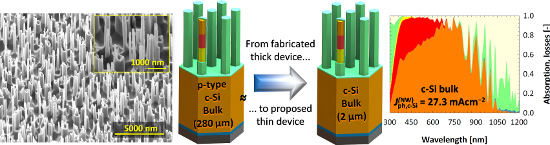
- = 450 nm) can be mainly explained by a better in-coupling of light, promoted by the nanostructure array at the front side. Lower parasitic absorption at the front side can also explain the improvement. This results in a net gain in photocurrent density of 0.30 mAcm−2. At longer wavelengths, scattering
- uniformity. Measured (a) EQE and (b) IQE of the best nanowire heterojunction solar cell (NW) and of the flat heterojunction reference (FLAT). The blue and red areas in (a) indicate the net current gain of the NW structure with respect to the FLAT counterpart at short and long wavelengths, respectively, while


Electromagnetic analysis of the lasing thresholds of hybrid plasmon modes of a silver tube nanolaser with active core and active shell
Beilstein J. Nanotechnol. 2019, 10, 294–304, doi:10.3762/bjnano.10.28
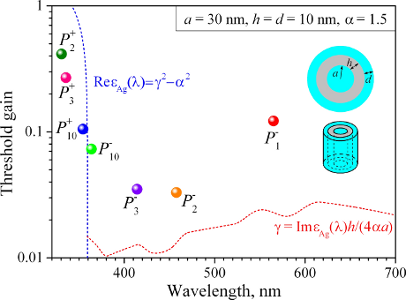
- with the gain in the active region. Then the emission wavelength and the associated threshold gain can be viewed as parts of two-component eigenvalues, each corresponding to a certain mode. In the configuration considered, potentially there are three types of modes that can lase: the hybrid localized
- surface plasmon (HLSP) modes of the metal tube, the core modes, and the shell modes. The latter two types can be kept off the visible range in thin enough configurations. Keeping this in mind, we focus on the HLSP modes and study how their threshold gain values change with variations in the geometrical
- parameters of the nanotube, the core, and the shell. It is found that essentially a single-mode laser can be designed on the difference-type HLSP mode of the azimuth order m = 1, shining in the orange or red spectral region. Furthermore, the threshold values of gain for similar HLSP modes of order m = 2 and


![[Graphic 29]](/bjnano/content/inline/2190-4286-10-28-i46.svg?max-width=637&scale=1.18182) λ = 565.03...
λ = 565.03...

![[Graphic 36]](/bjnano/content/inline/2190-4286-10-28-i53.svg?max-width=637&scale=1.18182) ...
...


Pull-off and friction forces of micropatterned elastomers on soft substrates: the effects of pattern length scale and stiffness
Beilstein J. Nanotechnol. 2019, 10, 79–94, doi:10.3762/bjnano.10.8
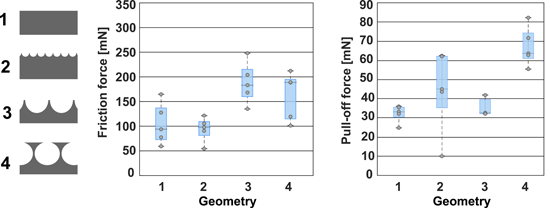
- is dominated by surface-tension effects, whereas for larger features, surface-tension effects are balanced by elasticity [25]. Summarizing, whereas for rigid substrates, adhesive micropatterns have been designed to gain a low Eeff, it remains to be investigated whether this design approach should
- also be followed for adhesive micropatterns used on soft substrates. In order to gain insight into this question, we investigated the pull-off and friction forces of adhesive micropatterns on soft substrates as a function of the geometry and feature size of the micropattern, and the stiffness of both


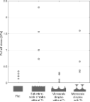

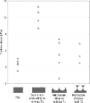


A comparison of tarsal morphology and traction force in the two burying beetles Nicrophorus nepalensis and Nicrophorus vespilloides (Coleoptera, Silphidae)
Beilstein J. Nanotechnol. 2019, 10, 47–61, doi:10.3762/bjnano.10.5
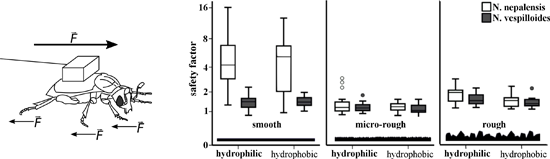
- Stork [8]. For each species, four males and four females were examined. The diameters of some claw tips were also measured to gain further information on the effect of the claws. Preparation of test surfaces and contact angle measurements Traction-force experiments In order to investigate the effect of




Electrolyte tuning in dye-sensitized solar cells with N-heterocyclic carbene (NHC) iron(II) sensitizers
Beilstein J. Nanotechnol. 2018, 9, 3069–3078, doi:10.3762/bjnano.9.285
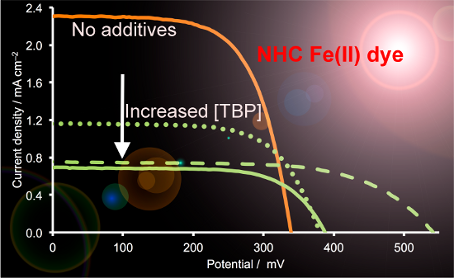
- little change in VOC or the fill factor, and results in a gain in global efficiency. A further gain is observed upon changing the ionic liquid with values of JSC in the order E4 > E2 > E1 ≈ E3 (Figure 2, Table 2 and Supporting Information File 1, Table S1). The use of EMIMPF in electrolyte E4 enhances
- mV (no TBP) to 541 mV (0.5 M TBP). However, this gain is not sufficient to enhance the global efficiency which drops from 0.51% to 0.26% (Table 4). The trends are reproduced for duplicate DSCs (Table S2, Supporting Information File 1). Electrochemical impedance spectroscopy (EIS) Electrochemical
- . Figure S3 (Supporting Information File 1) shows the trend in overall efficiencies which were the result of a general gain in VOC (Figure S4, Supporting Information File 1) compensating for the general decrease in JSC over time (Figure S5, Supporting Information File 1). Conclusion We have shown that the



Investigation of CVD graphene as-grown on Cu foil using simultaneous scanning tunneling/atomic force microscopy
Beilstein J. Nanotechnol. 2018, 9, 2953–2959, doi:10.3762/bjnano.9.274
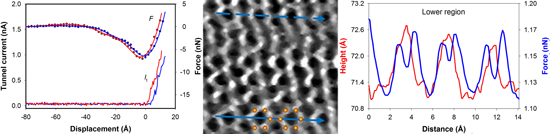
- the three missing atoms at low temperature (4.89 K) with AFM using an STM/AFM setup they developed [7]. However, not all of the six carbon atoms could be observed with STM in that study. In this work, using a simultaneous STM/AFM working with sub-angstrom oscillation amplitudes we intended to gain


Layered calcium phenylphosphonate: a hybrid material for a new generation of nanofillers
Beilstein J. Nanotechnol. 2018, 9, 2906–2915, doi:10.3762/bjnano.9.269
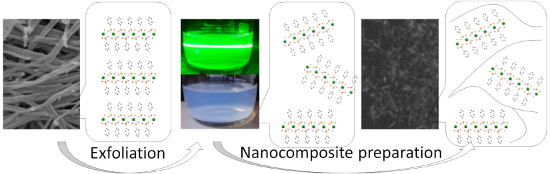
- ; nanofiller; polymer filler; Introduction The idea to combine materials with different properties to create a composite that benefits from a synergistic effect and to gain better and novel materials by this way is a very old concept. The reinforcement of a polymer matrix with inorganic fillers with the aim


Site-controlled formation of single Si nanocrystals in a buried SiO2 matrix using ion beam mixing
Beilstein J. Nanotechnol. 2018, 9, 2883–2892, doi:10.3762/bjnano.9.267
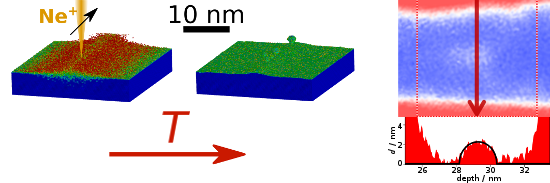
- + or Ne+ ion beam mixing of Si into a buried SiO2 layer followed by thermally activated phase separation. Binary collision approximation and kinetic Monte Carlo methods are conducted to gain atomistic insight into the influence of relevant experimental parameters on the Si NC formation process. Energy
- the cross sectional EFTEM image. A combination of the binary collision approximation (BCA) method using TRIDYN [26] and kMC simulations [27] was used to gain atomistic insight into the observed NC formation and its dependence on the layer thicknesses, the irradiation conditions and the thermal


Charged particle single nanometre manufacturing
Beilstein J. Nanotechnol. 2018, 9, 2855–2882, doi:10.3762/bjnano.9.266
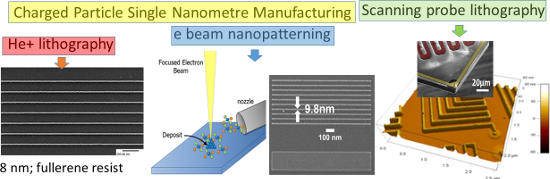
- ratio of what are usually very shallow structures. They carried out preliminary experiments to gain understanding with sub-10 nm EBID masks, using hydrogen bromide (HBr), chlorine (Cl2), chlorine and boron trichloride (BCl3/Cl2) and fluorine chemistries (SF6/C4F8). The quality of the etching process is


Oriented zinc oxide nanorods: A novel saturable absorber for lasers in the near-infrared
Beilstein J. Nanotechnol. 2018, 9, 2730–2740, doi:10.3762/bjnano.9.255
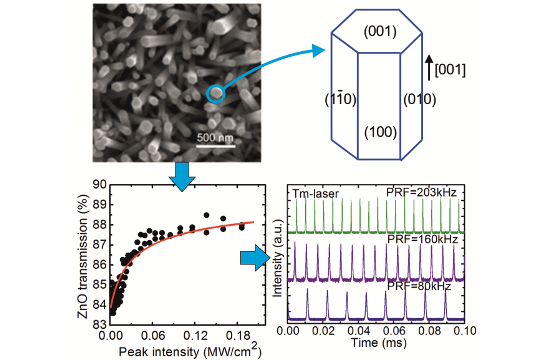
- following pulse characteristics: energy, E = 10 pJ (the laser beam was attenuated), duration, Δτ = 2 ps, and repetition frequency 58.15 MHz. The laser beam was focused to a spot size 2wL of 92 μm with a Rayleigh length of 6.23 mm. Laser set-up As a gain material, monoclinic double tungstate crystals, KLu
- a fiber-coupled laser diode (an InGaAs one, emitting at ≈0.978 µm, for the Yb laser, and an AlGaAs one, emitting at ≈0.802 µm, for the Tm laser). The polarization of the laser emission was linear, E || Nm, naturally selected by the anisotropy of the gain. More details about the laser set-up can be



Low cost tips for tip-enhanced Raman spectroscopy fabricated by two-step electrochemical etching of 125 µm diameter gold wires
Beilstein J. Nanotechnol. 2018, 9, 2718–2729, doi:10.3762/bjnano.9.254
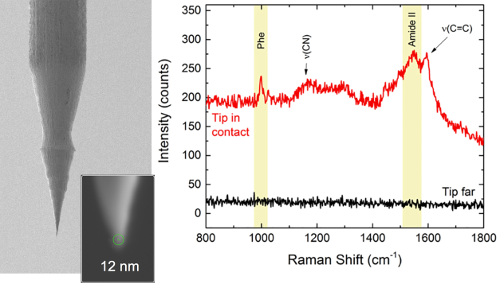
- chemical and structural information of Raman spectroscopy with the large signal gain provided by plasmonic resonances in metal tips and the high spatial resolution mapping offered by scanning probe microscopy [1][2][3][4][5]. In TERS, sharp metallic (or metallized) tips act as optical nanoantennas [6][7


Disorder in H+-irradiated HOPG: effect of impinging energy and dose on Raman D-band splitting and surface topography
Beilstein J. Nanotechnol. 2018, 9, 2708–2717, doi:10.3762/bjnano.9.253
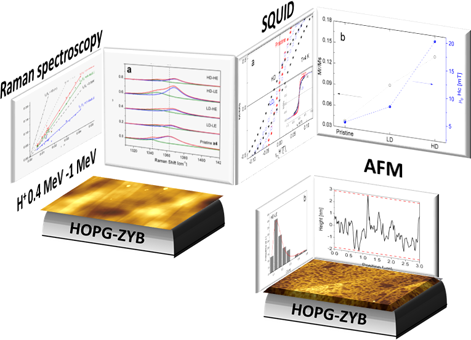
- technique to characterize different samples and gain new insights on the splitting of the D band into two components (D1 and D2), trying to correlate this feature of the vibrational spectrum with the impinging energy and dose. An increased ID2/IG ratio in comparison with ID1/IG was observed in the
- techniques is advantageous in order to gain a better insight into the origin of defects. Atomic force microscopy (AFM) can help to reveal an increase in the graphene/graphite surface roughness, which has been correlated with the disorder generated by increasing hydrogen irradiation doses [21][22][23


Nanoantenna structures for the detection of phonons in nanocrystals
Beilstein J. Nanotechnol. 2018, 9, 2646–2656, doi:10.3762/bjnano.9.246
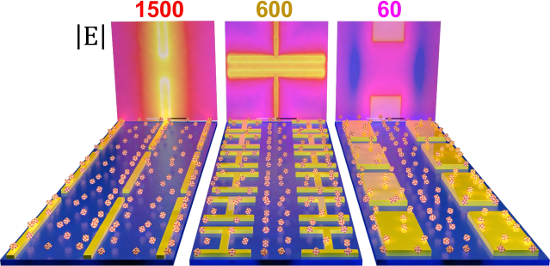
- , the H-shaped antennas exhibit a maximal gain of 175% relative to that of the linear antennas. Figure 4 illustrates the computed surface E-field distribution for three different types of antenna arrays optimized for the LSPR frequency of 190 cm−1 and fabricated in this work to compare their efficiency
- the higher gain (175%) for the H-shaped nanoantennas relative to that of the linear ones. The reason for such a discrepancy between the theoretical expectations and experimental data is most likely explained by lower areal density of the NC located in the gap between the cross-arms of the H-shaped


Effective sensor properties and sensitivity considerations of a dynamic co-resonantly coupled cantilever sensor
Beilstein J. Nanotechnol. 2018, 9, 2546–2560, doi:10.3762/bjnano.9.237
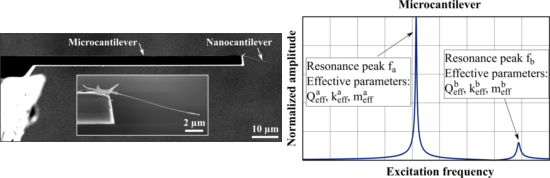
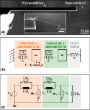
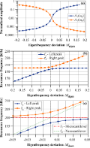
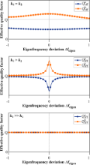
- subsystem’s characteristics. These effective properties give insight into the amount of sensitivity of the nanocantilever that can be accessed and, consequently, into the sensitivity gain associated with the co-resonance. In order to design sensors based on the co-resonant principle and predict their
- potential sensitivity (gain) and detectability capabilities before sensor fabrication in a fast and easy way, even for large parameter spaces. So far, such an analysis of a co-resonantly coupled sensor was only possible with numerical methods and even then only with very limited capability to include and
- using Equation 4 for each resonance peak based on the derived expressions for effective sensor properties. That furthermore allows to analyze the sensitivity gain induced by the co-resonant coupling in comparison to an individual cantilever sensor. For the exemplary values given in Table 1, the minimal


![[Graphic 7]](/bjnano/content/inline/2190-4286-9-237-i43.svg?max-width=637&scale=1.18182) ...
...


Thickness-dependent photoelectrochemical properties of a semitransparent Co3O4 photocathode
Beilstein J. Nanotechnol. 2018, 9, 2432–2442, doi:10.3762/bjnano.9.228
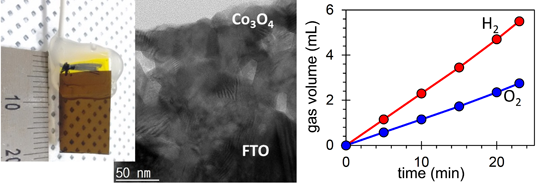
- utilization of photogenerated charges in the PEC cells. A strong thickness dependence on the photoresponse was found and showed that thicknesses of 100–170 nm are adequate to gain significant photocurrents. More interestingly, the 170 nm Co3O4 sample exhibited maximum photocurrent values in the applied




SERS active Ag–SiO2 nanoparticles obtained by laser ablation of silver in colloidal silica
Beilstein J. Nanotechnol. 2018, 9, 2396–2404, doi:10.3762/bjnano.9.224
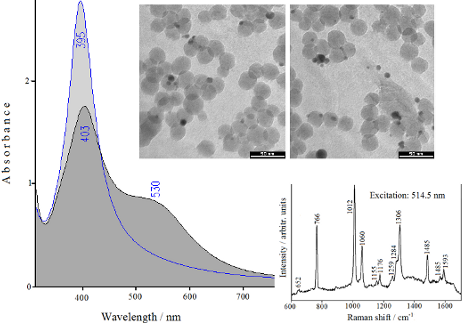
- and transmission electron microscopy (TEM). The SERS efficiency was tested by adsorption of 2,2'-bipyridine as a molecular reporter, whose SERS spectrum was interpreted by DFT, in order to gain information on the adsorbate and the interaction of the molecule with the metal surface. To our knowledge


Hydrothermal-derived carbon as a stabilizing matrix for improved cycling performance of silicon-based anodes for lithium-ion full cells
Beilstein J. Nanotechnol. 2018, 9, 2381–2395, doi:10.3762/bjnano.9.223
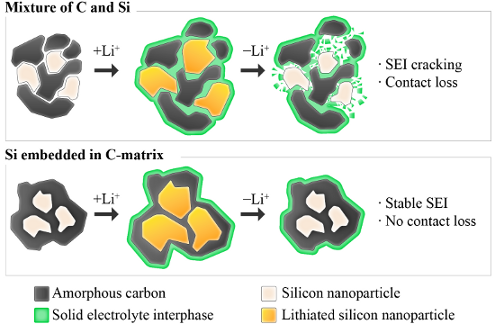
- energy gain [1][15]. In some commercial cells, Si is already added in small amounts (≤5 wt %) to the graphite anode [5]. Yet, there are several major drawbacks that have to be overcome for a successful application of Si-based anodes, i.e., the low electronic conductivity, as well as the huge volume
- remaining weight is constant. Due to the fact that the pure Si-NPs show only an insignificant weight gain up to 650 °C of ≈1%, caused by the beginning oxidation of Si and the formation of silicon dioxide, the remaining weight of the plateau for the Si/C composites can be considered as the Si content of


Performance analysis of rigorous coupled-wave analysis and its integration in a coupled modeling approach for optical simulation of complete heterojunction silicon solar cells
Beilstein J. Nanotechnol. 2018, 9, 2315–2329, doi:10.3762/bjnano.9.216
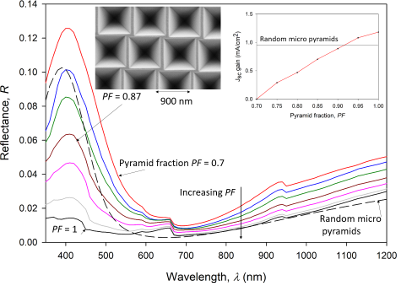
- anisotropic etching), while the thickness of ITO and a-Si:H was kept constant. In Figure 7 the effects of PF variation on reflectance and on the corresponding JSC gain are shown. The front part of the solar cell was simulated by RCWA as in previous sections. In these simulations, ten modes and 300 sublayers
- were used. We optimized the PF with respect to decreased reflectance of the front part of the cell, giving the possibility to additionally increase JSC. The presented JSC gain shows the full potential of the improved antireflection effect, where all additionally in-coupled light would be absorbed and
- transferred into photocurrent. Thus, these are the maximal potential gains related to the given PF variation. As a reference (zero gain) the structure with PF 0.7 was taken. In Figure 7a the reflectance curves are shown for the case of normal incident light. As a reference, the reflectance curve corresponding


Metal–dielectric hybrid nanoantennas for efficient frequency conversion at the anapole mode
Beilstein J. Nanotechnol. 2018, 9, 2306–2314, doi:10.3762/bjnano.9.215
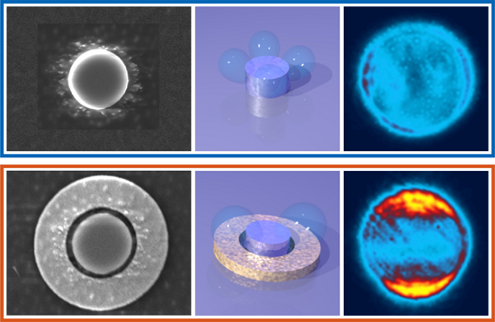
- surface integral of the Poynting vector normal to an imaginary sphere enclosing the entire structure, and the internal energy defined as the volume integral of the squared electric field inside the cylinder. To gain further insights into this behavior, in Figure 2d (2e) we show the contributions to the




Influence of the thickness of an antiferromagnetic IrMn layer on the static and dynamic magnetization of weakly coupled CoFeB/IrMn/CoFeB trilayers
Beilstein J. Nanotechnol. 2018, 9, 2198–2208, doi:10.3762/bjnano.9.206
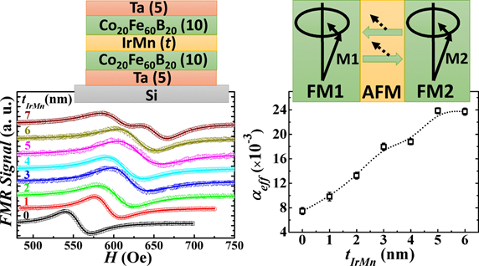
- tIrMn (compare Figure 3b and Figure 4c) further suggesting that the observed interdependence of Hk and 4πMeff has a common origin in the tIrMn-dependent interlayer exchange coupling. To gain insight into the various magnetic relaxation mechanisms in trilayers, the frequency dependence of ΔH is plotted


Spin-coated planar Sb2S3 hybrid solar cells approaching 5% efficiency
Beilstein J. Nanotechnol. 2018, 9, 2114–2124, doi:10.3762/bjnano.9.200
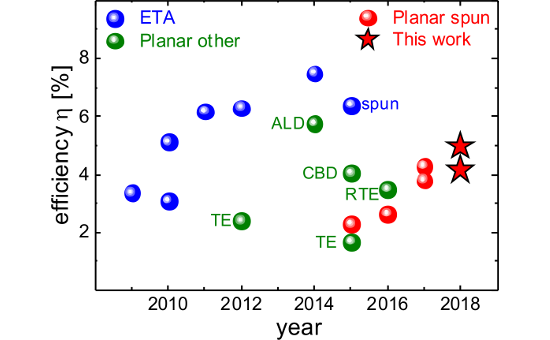
- subsequently crystallized at temperatures above the minimum crystallization temperature of 250 °C for antimony sulfide [47][48][49]. The typical crystallization temperature is 300 °C [2][6][29][31][37] while values of 330 °C [4][5][32][50] and up to 400 °C [51] are reported. To gain insights into the


Synthesis of rare-earth metal and rare-earth metal-fluoride nanoparticles in ionic liquids and propylene carbonate
Beilstein J. Nanotechnol. 2018, 9, 1881–1894, doi:10.3762/bjnano.9.180
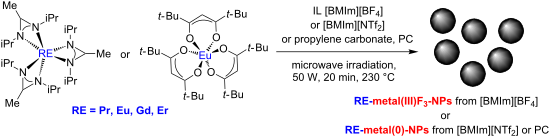
- gain increasing importance in materials science and modern chemistry [1][2][3]. Special attention has been paid to nanoscaled rare-earth metal particles [4][5][6]. In addition to the oxido and nitrido compounds, the rare-earth fluorides have interesting photo physical and electrochemical properties. An


Quantitative comparison of wideband low-latency phase-locked loop circuit designs for high-speed frequency modulation atomic force microscopy
Beilstein J. Nanotechnol. 2018, 9, 1844–1855, doi:10.3762/bjnano.9.176
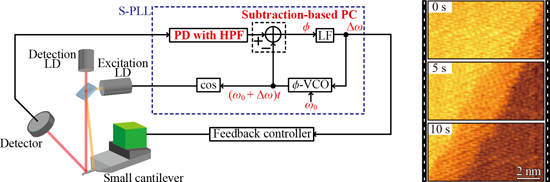
- set to 100 MHz and 100 MSPS, respectively. The design parameters of the digital filters were objectively determined using the following design guidelines to achieve fair comparison. The LPF and HPF were implemented as Butterworth filters. The gain at the stop band was restricted to less than −40 dB
- while the amplitude of the gain ripple at the pass band was held less than 0.1 dB. Taking into account the latency and resource, a second-order LPF, second-order HPF, fourth-order band-pass filter (BPF), and the 10th-order band-elimination filter (BEF) were used (see Figure 2(iii) below for the group
- bandwidth can be enhanced by increasing the LF gain. However, if the gain is too high, the phase feedback loop becomes unstable and starts to oscillate. In this experiment, we set the gain to the maximum value in the range in which the feedback loop was stable. Figure 6 depicts the waveforms of the phase



Direct AFM-based nanoscale mapping and tomography of open-circuit voltages for photovoltaics
Beilstein J. Nanotechnol. 2018, 9, 1802–1808, doi:10.3762/bjnano.9.171
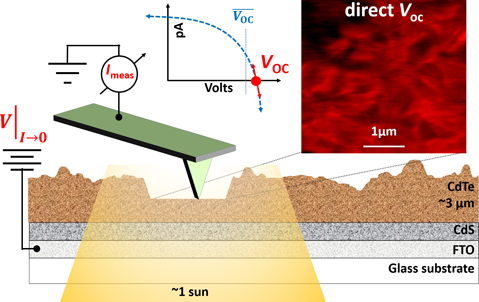
- directly with the AFM probe simultaneous to the repeated property mapping. Specific settings include a load of ca. 1 µN, a line rate of 0.5 Hz, and a low-deflection feedback gain producing near “open loop” scanning and hence an essentially planar surface milling [8]. Approximately 15 nm in depth are


Multimodal noncontact atomic force microscopy and Kelvin probe force microscopy investigations of organolead tribromide perovskite single crystals
Beilstein J. Nanotechnol. 2018, 9, 1695–1704, doi:10.3762/bjnano.9.161
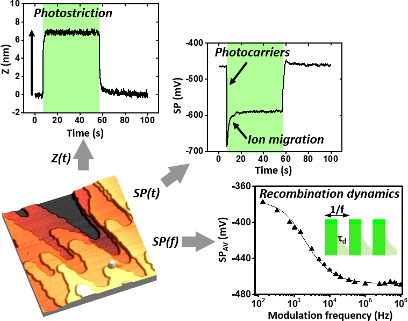
- conversion efficiencies exceeding 20% and several kinds of optoelectronic devices, including efficient light-emitting diodes [3], laser devices [4] and high-gain photodetectors [5]. Recently, Kelvin probe force microscopy (KPFM) has been used to investigate the impact of grain boundaries (GBs) on the





