Search results
Search for "low temperature" in Full Text gives 389 result(s) in Beilstein Journal of Nanotechnology. Showing first 200.
Understanding the performance and mechanism of Mg-containing oxides as support catalysts in the thermal dry reforming of methane
Beilstein J. Nanotechnol. 2018, 9, 1162–1183, doi:10.3762/bjnano.9.108
- . Rapid reactions occur between the active plasma species and catalyst precursors compared to the thermal decomposition technique. Therefore, this may encourage the rapid nucleation of the crystals under plasma treatment. The application of low temperature may result in slow crystal growth, which
- contributes to the production of a catalyst with a small particle size or high metal dispersion. Furthermore, plasma treatment has been proven to show superb performance in surface treatment and modification. Moreover, this technique is able to efficiently decompose precursors at low temperature. Greater
- on the catalyst surface. Moreover, the catalyst was of a good composition, given that the DRM process could be performed within the low temperature range of 430 °C to 470 °C. The catalyst was stable for up to 100.5 h without carbon deposition. García-Diéguez et al. [19] developed a Ni–Mg active metal






Semi-automatic spray pyrolysis deposition of thin, transparent, titania films as blocking layers for dye-sensitized and perovskite solar cells
Beilstein J. Nanotechnol. 2018, 9, 1135–1145, doi:10.3762/bjnano.9.105
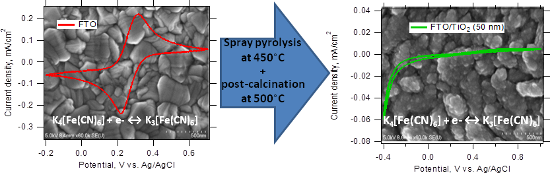
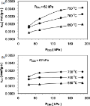
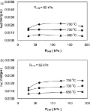
- . Without post-calcination at 500 °C, the photocurrent density is negligible. The photoresponse was similarly negligible for the deposition temperature of 300 °C (data not shown). Only after calcination at 500 °C will the low-temperature-grown films become photoactive, where the photocurrent onset was
- ). These TiO2 films exhibit the photocurrent onset at around –0.3 V but there is no plateau at larger potentials. Instead, the photocurrent increases monotonically with the applied potential. The effect of post-calcination is opposite compared to the low-temperature films deposited at 150 °C (cf. Figure 1a


Comparative study of sculptured metallic thin films deposited by oblique angle deposition at different temperatures
Beilstein J. Nanotechnol. 2018, 9, 954–962, doi:10.3762/bjnano.9.89
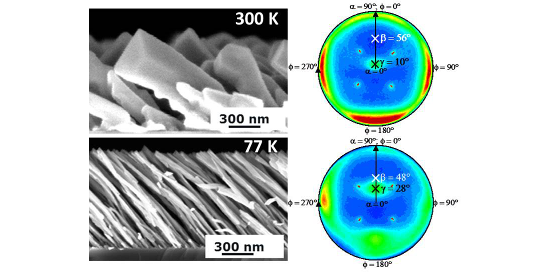
- deposition geometry at a substrate temperature of 77 K and at elevated temperatures. All tilted columns deposited at 77 K substrate temperature develop as high aspect ratio columns and therefore show a similar overall morphology. It is found that in this low temperature regime growth is dominated by



Effect of annealing treatments on CeO2 grown on TiN and Si substrates by atomic layer deposition
Beilstein J. Nanotechnol. 2018, 9, 890–899, doi:10.3762/bjnano.9.83
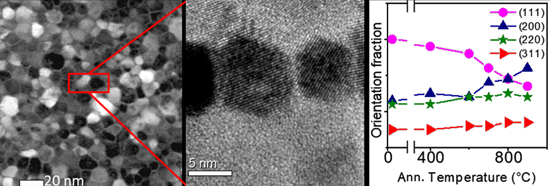
- the preferential orientation of ceria [8][9][10][11]. Further, the specific conditions of the thermal treatment (i.e., high or low temperature in reactive (O2) or inert (N2) atmosphere) can influence the formation of defects in the crystalline structure, such as grain boundaries, the crystallite


Facile chemical routes to mesoporous silver substrates for SERS analysis
Beilstein J. Nanotechnol. 2018, 9, 880–889, doi:10.3762/bjnano.9.82
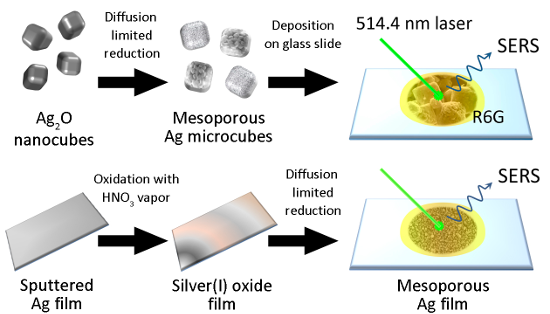
- microstructure after 110 °C sintering while fresh crack formation was revealed. In Figure 6b the film is destroyed completely, and Ag particles hardly cover half of the glass slide surface. Such low temperature melting of nanocrystalline silver is typical and was also observed for different forms of highly
- the colloid were deposited and dried one by one. The specific surface area of the samples was determined by low-temperature nitrogen adsorption with an ATX-06 analyzer (KATAKON) by the five-point Brunauer–Emmett–Teller (BET) method. The optical absorbance spectra of the films were collected using a


Facile synthesis of a ZnO–BiOI p–n nano-heterojunction with excellent visible-light photocatalytic activity
Beilstein J. Nanotechnol. 2018, 9, 789–800, doi:10.3762/bjnano.9.72
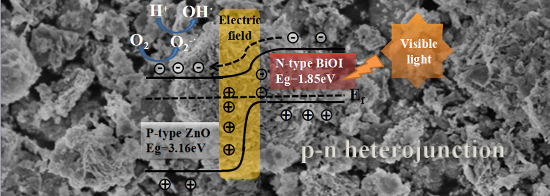
- oxide to a p-type BiOX to form a p–n heterojunction is an effective method to optimize the photocatalytic activity (summarized in Table S1, Supporting Information File 1). By now, several works have been published in this area. In 2009, Zhang et al. reported a low-temperature route to prepare TiO2/BiOI


A review of carbon-based and non-carbon-based catalyst supports for the selective catalytic reduction of nitric oxide
Beilstein J. Nanotechnol. 2018, 9, 740–761, doi:10.3762/bjnano.9.68
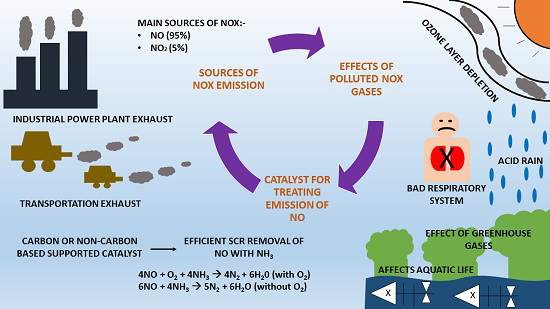
- temperature window of 150–500 °C in a diesel engine as well as the low energy consumption and economy of NH3-SCR [9]. In the literature, abundant catalysts at low temperature have been explored such as transitional metals (Mn, Cu, Ce, Fe, Co, Mo) [10][11][12][13], novel metals (Pt, Pd) [14], and metal ion
- -exchange zeolite catalysts [15]. The Mn-based catalyst is one of the most active metal oxide catalysts for high N2 selectivity at low temperature and is recognised by many researchers as a potential alternative for the common catalyst. Jin et al. [16] successfully used a Mn-based catalyst with the addition
- the carbon-based catalysts for SCR at low temperature and compared it with commercial catalysts. A good example can be seen in Chuang et al. [18], where a comparative study was made between the preparation of AC-supported Cu catalysts through impregnation, the polyol process, and microwave-heated
Perovskite-structured CaTiO3 coupled with g-C3N4 as a heterojunction photocatalyst for organic pollutant degradation
Beilstein J. Nanotechnol. 2018, 9, 671–685, doi:10.3762/bjnano.9.62
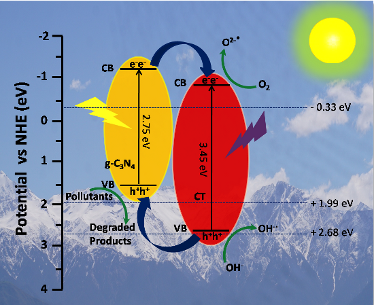
- successfully prepared by a facile low temperature mixing of g-C3N4 nanosheets and CT nanoflakes in a 1:1 ratio. The photocatalytic activity of the CTCN heterojunction photocatalyst was investigated by studying the degradation of an aqueous solution of RhB under UV, visible and sunlight irradiation conditions


Electron interactions with the heteronuclear carbonyl precursor H2FeRu3(CO)13 and comparison with HFeCo3(CO)12: from fundamental gas phase and surface science studies to focused electron beam induced deposition
Beilstein J. Nanotechnol. 2018, 9, 555–579, doi:10.3762/bjnano.9.53
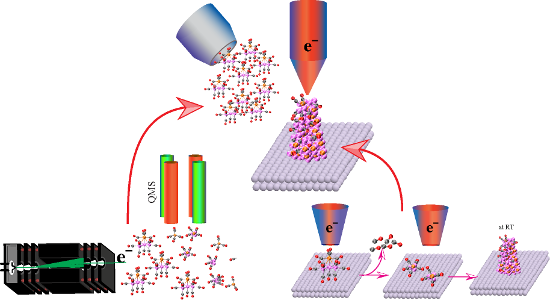
- ratio. Low temperature (≈213 K) surface science studies on thin films of H2FeRu3(CO)13 demonstrate that electron stimulated decomposition leads to significant CO desorption (average of 8–9 CO groups per molecule) to form partially decarbonylated intermediates. However, once formed these intermediates
- sufficient stability towards autocatalytic dissociation. Ru3(CO)12 has been used for FEBID in an earlier report on low temperature substrates [60]; however, the composition of the decomposition product remains unknown and FEBID using a substrate at room temperature could not replicate the earlier results


Photocatalytic and adsorption properties of TiO2-pillared montmorillonite obtained by hydrothermally activated intercalation of titanium polyhydroxo complexes
Beilstein J. Nanotechnol. 2018, 9, 364–378, doi:10.3762/bjnano.9.36
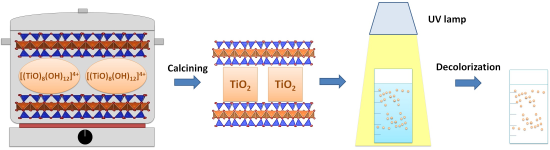
- ] describes a low-temperature method for pillaring MM using a TiO2 sol produced by hydrolyzing TiCl4 in strongly acidic medium and subsequent drying at 30–80 °C. Chen et al. [12] shows the results of pillaring MM using titanium tetra-N-butoxide hydrolyzed in HCl solution and subsequent annealing at a
- , the BET method) is many times larger than the area of its external surface (Sext = 0.5 m2/g, the Tovarov method [38]), it is reasonable to assume that TiO2 will be predominantly in the form of pillars in the interlayer space. Low-temperature nitrogen adsorption–desorption isotherms for the obtained
- . Porosimetric measurements were carried out by low-temperature nitrogen adsorption–desorption using a specific surface area and porosity analyzer ASAP 2020 (Micromeritics, USA); prior to measurements the samples were degassed at 180 °C and residual pressure of 5–10 Pa for 3.5 h. An analysis of the sample






Al2O3/TiO2 inverse opals from electrosprayed self-assembled templates
Beilstein J. Nanotechnol. 2018, 9, 216–223, doi:10.3762/bjnano.9.23
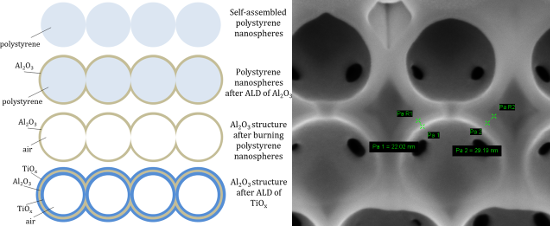
- material deposition process with the maximum temperature that the polymeric nanoparticles can sustain, which is typically below 90–100 °C. This low temperature reduces the choices of materials that have suitable optical properties for a given application [35][36]. As an example, TiO2 deposited at <150 °C
- size) or silicon dioxide nanoparticles with dimensions typically several hundreds of micrometers with a close packed, face-centered cubic, three-dimensional order. In parallel we have shown the use of Al2O3 as a good candidate for the inverse opal supporting layer regarding the low temperature
- cm2), large thickness (>17 µm) inverse opals with very good reflectivity properties in the NIR spectral region using a double layer Al2O3/TiO2 colloidal crystal created by self-assembled polystyrene nanoparticles as a template. The results achieved were accomplished using low temperature processing


Dopant-stimulated growth of GaN nanotube-like nanostructures on Si(111) by molecular beam epitaxy
Beilstein J. Nanotechnol. 2018, 9, 146–154, doi:10.3762/bjnano.9.17
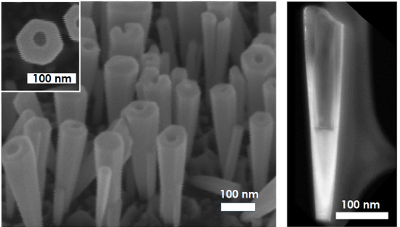
- /h on a substrate that underwent low-temperature (850 °C) annealing. It should be mentioned that in this case a silicon oxide layer covering the substrate was removed only partially or was not removed at all. This conclusion is based on the analysis of in situ reflection high-energy electron
- diffraction (RHEED) patterns: we did not observe (7 × 7) a Si surface reconstruction pattern while cooling down the substrate that was subjected to the low temperature annealing. On the contrary, when the high temperature annealing (at least 920 °С) was applied, we observed a clear (7 × 7) reconstruction
- approximate doping level for planar layers (see Table 1) is in close proximity with the doping level estimated via PL data analysis. So we conclude that the low-temperature PL is an effective noncontact method of assessing the doping level in GaN NWs. Theoretical model According to modern theoretical


Atomic layer deposition and properties of ZrO2/Fe2O3 thin films
Beilstein J. Nanotechnol. 2018, 9, 119–128, doi:10.3762/bjnano.9.14
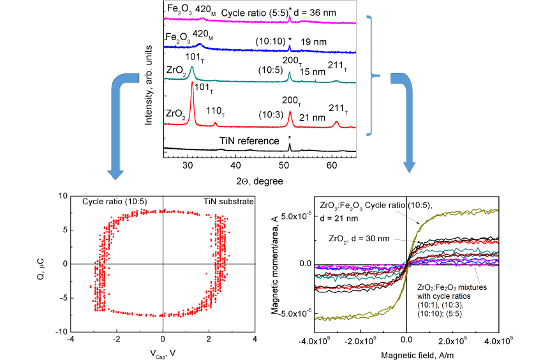
- ]. ALD growth of Fe2O3 from ferrocene and ozone is even possible at 200 °C, but at such a low temperature, the required pulse duration is very long. A maximal growth rate was achieved when ferrocene pulses were 40 s long and ozone pulses were 200 s [24]. ZrCl4 and Fe(C5H5)2 were evaporated at 161–163 °C


Electron-driven and thermal chemistry during water-assisted purification of platinum nanomaterials generated by electron beam induced deposition
Beilstein J. Nanotechnol. 2018, 9, 77–90, doi:10.3762/bjnano.9.10
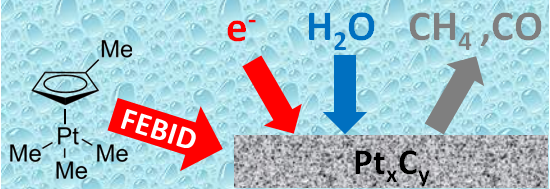
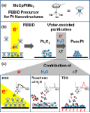
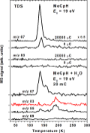
- cycles of precursor and O2 dosing, MeCpPtMe3 reacts with surface hydroxyl groups produced during a preceding O2 exposure half-cycle whereby Pt–O bonds are formed and CH4 is released [18][19]. The analogous reaction between MeCpPtMe3 and H2O does not contribute noticeably in our low temperature (105 K



Response under low-energy electron irradiation of a thin film of a potential copper precursor for focused electron beam induced deposition (FEBID)
Beilstein J. Nanotechnol. 2018, 9, 57–65, doi:10.3762/bjnano.9.8
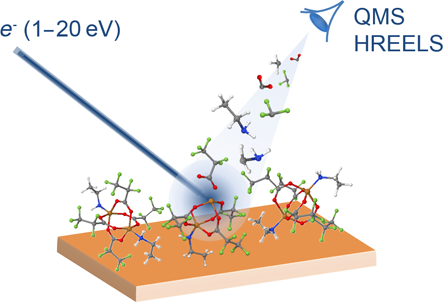
- ligands was done by heating. Spectrum g in Figure 2 was recorded under the same conditions as spectrum f, but after a mild annealing above room temperature (T = 305 K), desorption was induced, visible by a small pressure rise in the chamber during the process. Back to low temperature, spectrum g is



Transition from silicene monolayer to thin Si films on Ag(111): comparison between experimental data and Monte Carlo simulation
Beilstein J. Nanotechnol. 2018, 9, 48–56, doi:10.3762/bjnano.9.7
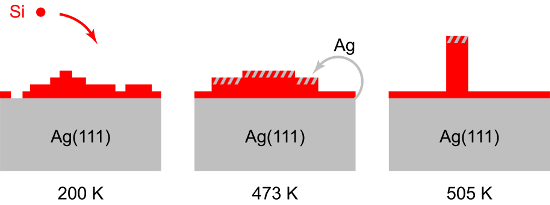
- atom electron spectroscopy [35] and deuterium exposure of the film [36], whereas opposite conclusions were obtained from STM observations after applying a bias pulse at low temperature [33]. Very recently, the existence of two different growth modes on Ag(111), depending on the substrate temperature
- , has been proposed [37][38]. At low temperature (T = 470 K), multilayer silicene would form, without Ag at the surface, whereas diamond-like growth would occur at high temperature (T = 570 K), with Ag acting as a surfactant. Thus, open questions remain on the nature of the films formed as a function of
- measurements or to the different evaporation rates used during the experiments. Conclusion The quantitative analysis of the evolution of AES intensity during Si growth at different temperatures shows that the growth mechanism is different for low temperature deposition (T = 200 K) and in the regime described
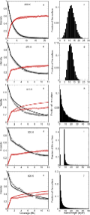

Beyond Moore’s technologies: operation principles of a superconductor alternative
Beilstein J. Nanotechnol. 2017, 8, 2689–2710, doi:10.3762/bjnano.8.269



Inelastic electron tunneling spectroscopy of difurylethene-based photochromic single-molecule junctions
Beilstein J. Nanotechnol. 2017, 8, 2606–2614, doi:10.3762/bjnano.8.261
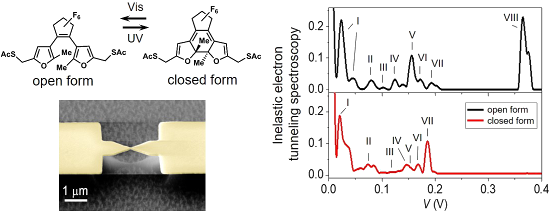
- employing O2 plasma in a reactive ion etcher to form a freestanding bridge, as shown in Figure 1a. After mounting the MCBJ sample, which is covered with C5F-ThM molecules either in the open or the closed form, charge transport measurements were performed at low temperature (4.2 K) in a custom-made vacuum


Localized growth of carbon nanotubes via lithographic fabrication of metallic deposits
Beilstein J. Nanotechnol. 2017, 8, 2592–2605, doi:10.3762/bjnano.8.260
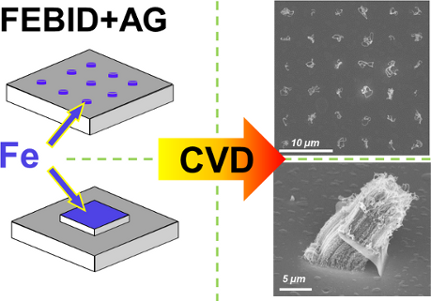
- was carried out with a precursor gas mixture of N2, H2 and C2H4 (120:120:120 sccm) at 1023 K. This temperature is even lower than the low temperature used in the case of Fe deposits on the substrate of Al2O3. Figure 10b depicts the Co-containing deposit after CVD. Obviously, the CNTs grew with high




PTFE-based microreactor system for the continuous synthesis of full-visible-spectrum emitting cesium lead halide perovskite nanocrystals
Beilstein J. Nanotechnol. 2017, 8, 2521–2529, doi:10.3762/bjnano.8.252
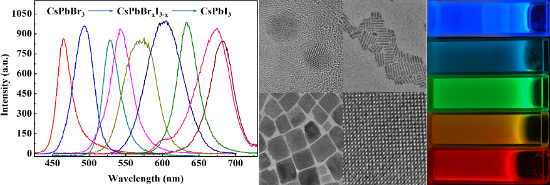
- . [20] independently demonstrated the feasibility of synthesizing CsPbX3 QDs within a few seconds at low temperature. Sun et al. [21] reported the formation of shape-controlled CsPbX3 perovskite nanocrystals of three different morphologies via the re-precipitation process at room temperature. Chen et al


Fabrication of CeO2–MOx (M = Cu, Co, Ni) composite yolk–shell nanospheres with enhanced catalytic properties for CO oxidation
Beilstein J. Nanotechnol. 2017, 8, 2425–2437, doi:10.3762/bjnano.8.241
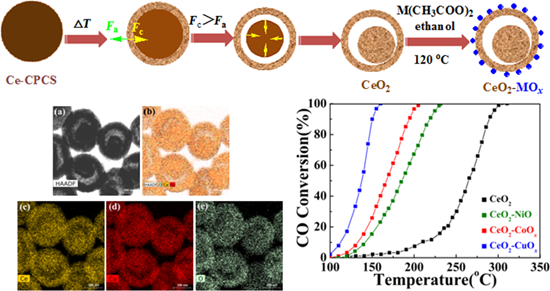
- conversion as reached at a relatively low temperature of 145 °C over the CeO2–CuOx-2 sample. Furthermore, the CeO2–CuOx catalyst is more active than the CeO2–CoOx and CeO2–NiO catalysts, indicating that the catalytic activity is correlates with the metal oxide. Additionally, this versatile synthesis approach
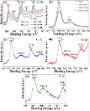
- observed. The wide low-temperature band centered at 179 °C originates from the highly dispersed CuOx clusters, while the sharp high-temperature peak located at 200 °C is due to the strong interactions in the Cu–[O]–Ce structure [13]. In general, commercial Cu2O and pure CuO synthesized using a conventional
- CeO2–CuOx-2 sample is comparable to the traditional noble-metal–CeO2 system, yielding complete CO conversion at a relatively low temperature of 145 °C. A greatly enhanced performance of the composites in CO oxidation can be attributed to the incorporation of highly-dispersed MOx onto the CeO2 surface





Comparing postdeposition reactions of electrons and radicals with Pt nanostructures created by focused electron beam induced deposition
Beilstein J. Nanotechnol. 2017, 8, 2410–2424, doi:10.3762/bjnano.8.240
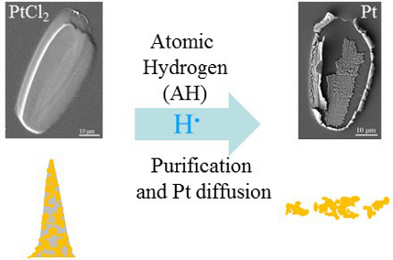
- compared to the as-deposited structure. Consequently, approaches which have been attracting increased interest are the so-called “low temperature” purification strategies, where carbon is removed at temperatures low enough to avoid changing the structure and morphology of the deposit. In FEBID purification
- degree of nanostructure resolution. Low-temperature purification can also be achieved by reactive species generated by an independent source. Botman et al. [26] treated FEBID deposits created from MeCpPtMe3 with atomic hydrogen (AH), which resulted in a decrease in carbon content (from 81 to 65 atom
- % to ≈87%). This is qualitatively consistent with our previous low-temperature UHV surface science studies on the effect of electron irradiation on 1–2 mL cis-Pt(CO)2Cl2 films [29]. Based on earlier studies [29][31] it is reasonable to assume that the purification process (PtCl2 + 2e− → Pt(s) + 2 Cl−(g




Robust procedure for creating and characterizing the atomic structure of scanning tunneling microscope tips
Beilstein J. Nanotechnol. 2017, 8, 2389–2395, doi:10.3762/bjnano.8.238
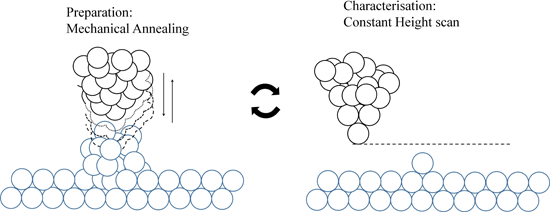
- determined ex situ in a field-ion microscope (FIM) [23][24]. However, very few studies have been made to image the tip structure in situ in STM and show its evolution upon tip preparation. Inspiration for our current approach comes from work with low-temperature STM in cryogenic vacuum [25], where the
- shape with a direct detection technique rather than studying conductance versus tip displacement or STM image contrast. Experimental The experiments were performed in a Unisoku ultra high vacuum (UHV) and low-temperature STM with a base temperature of 2 K. The in-plane (XY) scan range is set by the
- exploit the capabilities of the low-temperature STM setup for imaging the evolution of the tip structure by scanning over an isolated adatom on the surface. The obtained STM images are convolutions of the topography and electronic states of sample and tip. Lang [31] has shown theoretically using two


Changes of the absorption cross section of Si nanocrystals with temperature and distance
Beilstein J. Nanotechnol. 2017, 8, 2315–2323, doi:10.3762/bjnano.8.231
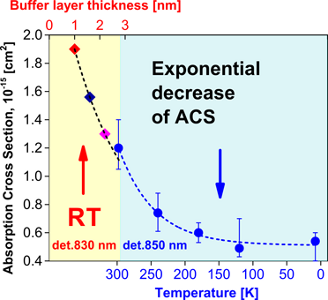
- flux. For the low-temperature experiments the samples are placed in a cryostat (Janis ST-500). Results and Discussion ACS model Let us consider the model originally presented by Kovalev et al. [13][14] and then slightly modified in our recent paper [10]. A Si NC is considered as a quasi-two-level


Modelling focused electron beam induced deposition beyond Langmuir adsorption
Beilstein J. Nanotechnol. 2017, 8, 2151–2161, doi:10.3762/bjnano.8.214
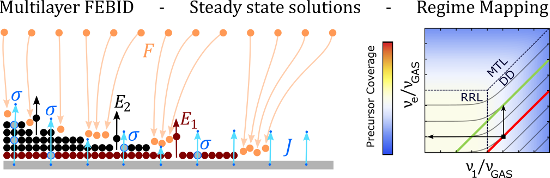
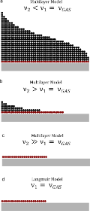
- area (see Figure 5): from v2 ≈ 104·ve at room temperature and low current (red line) to v2 ≈ 102·ve at room temperature and high current (green line, parallel to the red one). The drop in v2 when moving to cryogenic temperatures is too large to be represented in the figure; low temperature experimental
- to the estimated areas where experiments take place. These regions are estimated just as lines, and not as points, since the value for νGAS is not available. Red line: Room temperature, low current. Green line: Room temperature, high current. The low temperature, low current region takes place at
- much lower ν2 / νGAS values as those plotted in the map. Vertical arrows represent one of the possible experimental transitions in GR observed at room temperature, from low to high current. Horizontal arrows represent one of the possible GR transitions observed at low current, from room to low