Search results
Search for "sulfur" in Full Text gives 208 result(s) in Beilstein Journal of Nanotechnology. Showing first 200.
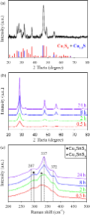
Growth evolution and phase transition from chalcocite to digenite in nanocrystalline copper sulfide: Morphological, optical and electrical properties
Beilstein J. Nanotechnol. 2014, 5, 1542–1552, doi:10.3762/bjnano.5.166
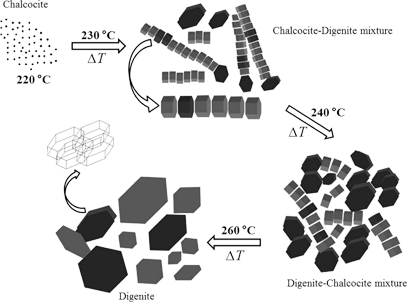
- solvent It consisted of a one-pot colloidal process previously reported by Wang et al. [15] with slight modifications. In this reaction, C2H3CuO2 was the copper precursor and C12H25SH the sulfur precursor. In brief, 1g of TOPO and 0.0488 g of C2H3CuO2 were mixed with 30 mL of C18H36 in a three-neck flask
- aqueous solution In this reaction thiourea and copper(II) sulfate pentahydrate (CuSO4·5H2O) were the sulfur and copper precursors, respectively, and the TEA ligand was an intermediary in the reaction. The synthesis proceeded as follows: A three-necked reactor containing 440 mL of deionized water was




Protein-coated pH-responsive gold nanoparticles: Microwave-assisted synthesis and surface charge-dependent anticancer activity
Beilstein J. Nanotechnol. 2014, 5, 1452–1462, doi:10.3762/bjnano.5.158
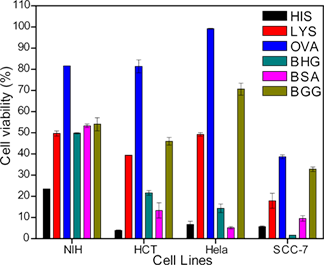
- interaction. Those AuNPs that enter the cells do not affect it more than OVA, which contains a disulfide bridge that is broken during microwave irradiation. The breaking of the disulfide bridge allows two sulfur groups to bind to the AuNPs covalently, reducing the exposure of the surface of the AuNP to the


Magnesium batteries: Current state of the art, issues and future perspectives
Beilstein J. Nanotechnol. 2014, 5, 1291–1311, doi:10.3762/bjnano.5.143


Self-organization of mesoscopic silver wires by electrochemical deposition
Beilstein J. Nanotechnol. 2014, 5, 1285–1290, doi:10.3762/bjnano.5.142
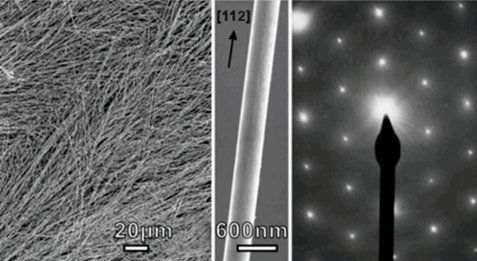
- , on which the sample has been deposited. Cobalt and iron most likely come from the pole pieces of the objective lens. Oxygen and sulfur signals are not observed. Therefore, one can conclude that the silver wires grown in the experiments presented here are chemically pure. The application of silver
- cobalt peaks were also found. Gold and carbon come from the substrate. The cobalt and iron signal comes from the pole pieces of the objective lens; no peak can be attributed to sulfur, nitrogen or oxygen, the latter demonstrating that the silver wires are not oxidized at ambient conditions in air. Auger




Purification of ethanol for highly sensitive self-assembly experiments
Beilstein J. Nanotechnol. 2014, 5, 1254–1260, doi:10.3762/bjnano.5.139
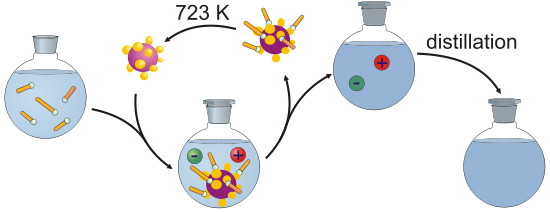
- remain within the monolayer [4]. On the other hand, ethanol is typically produced by fermentation of biomass [22]. In this process, driven by yeasts like Saccharomyces cerevisiae, a plethora of sulfur-containing compounds is produced, among them hydrogen sulfide, dimethyl sulfoxide, short-chained
- these contaminants, yet even very low concentrations of remaining sulfur-containing molecules are sufficient to cover a gold surface: To form a dense monolayer, only about 1 nmol cm−2 of surface-active molecules is needed [4]. Even highly pure commercially available ethanol, such as the one produced for
- high-performance liquid chromatography (HPLC), suffers from the drawback that the purification procedure is not specific for sulfur-containing contaminations. While these contaminations might only play a minor role in most cases of SAM formation, where thermodynamic equilibrium can be approached by

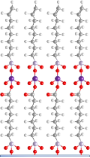
Organic and inorganic–organic thin film structures by molecular layer deposition: A review
Beilstein J. Nanotechnol. 2014, 5, 1104–1136, doi:10.3762/bjnano.5.123




Optimizing the synthesis of CdS/ZnS core/shell semiconductor nanocrystals for bioimaging applications
Beilstein J. Nanotechnol. 2014, 5, 919–926, doi:10.3762/bjnano.5.105
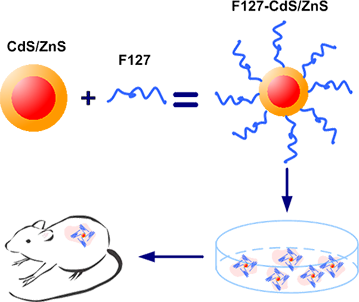
- generation of multifunction agents for clinic diagnosis and treatment. Experimental Materials Cadmium oxide (CdO, 99.9+%), oleic acid (OA, 99%), sulfur (S, 99%), zinc chloride anhydrous (ZnCl2, 98+%), sodium diethyldithiocarbamate trihydrate (Na(DDTC), 98%), were purchased from Alfa Aesar. 1-Octadecene (ODE
- drying oven at 60 °C. Finally, 1 mmol of Zn(DDTC) was added to a flask with 10 mL of OAm, and sonicated for 20 min under N2 flow. Preparation of sulfur solution The sulfur solution was prepared by reducing 1 mmol of sulfur powder with 5 mL of OAm in a flask. After degassing at room temperature for 10 min
- , the solution was heated to 100 °C under N2 flow, and the temperature was maintained for 10 min. The resulting sulfur solution was then cooled to room temperature for further application. Synthesis of CdS/ZnS core/shell QDs Synthesis of CdS/ZnS was based on a procedure reported previously [37]. The Cd


Pyrite nanoparticles as a Fenton-like reagent for in situ remediation of organic pollutants
Beilstein J. Nanotechnol. 2014, 5, 855–864, doi:10.3762/bjnano.5.97
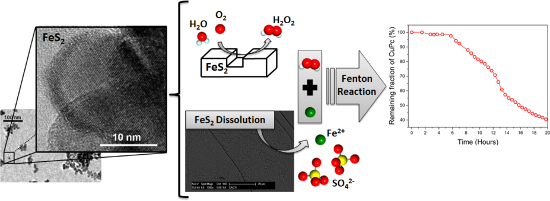
- a cheap alternative to conventional Fenton approaches for the selective oxidation of pollutant dyes. Experimental Chemicals Copper phthalocyanine-3, 4´, 4´´, 4´´´- tetrasulfonic acid tetrasodium salt (85%), oleylamine (OA, 70%), sulfur (99.99%) and toluene (99.8% anhydrous) were purchased from Sigma
- -probe controlled. Sulfur and FeCl2·4H2O were used as starting materials. Briefly, 0.4 mmol of FeCl2·4H2O were dehydrated and dissolved in 6 mL of OA under N2 atmosphere. The resulting solution was maintained at 100 °C for 1 h, until an Fe–OA complex was formed. A solution of 2.4 mmol of sulfur in 6 mL


Biomolecule-assisted synthesis of carbon nitride and sulfur-doped carbon nitride heterojunction nanosheets: An efficient heterojunction photocatalyst for photoelectrochemical applications
Beilstein J. Nanotechnol. 2014, 5, 770–777, doi:10.3762/bjnano.5.89
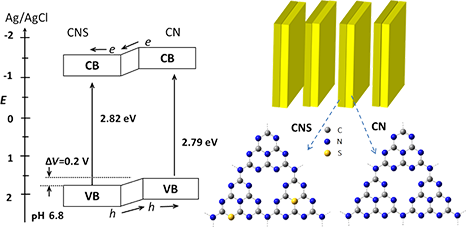
- Hua Bing Tao Hong Bin Yang Jiazang Chen Jianwei Miao Bin Liu School of Chemical and Biomedical Engineering, Nanyang Technological University, 62 Nanyang Drive, Singapore 637459, Singapore 10.3762/bjnano.5.89 Abstract A biomolecule-assisted pyrolysis method has been developed to synthesize sulfur
- -doped graphitic carbon nitride (CNS) nanosheets. During the synthesis, sulfur could be introduced as a dopant into the lattice of carbon nitride (CN). Sulfur doping changed the texture as well as relative band positions of CN. By growing CN on preformed sulfur-doped CN nanosheets, composite CN/CNS
- : graphitic carbon nitride (g-C3N4); heterojunction; photoelectrochemical; photocatalysis; sulfur doping; Introduction Over the past few years, graphitic carbon nitride (CN) has attracted significant research attention in visible-light-driven photocatalysis because of its unique physical and chemical


Resonance of graphene nanoribbons doped with nitrogen and boron: a molecular dynamics study
Beilstein J. Nanotechnol. 2014, 5, 717–725, doi:10.3762/bjnano.5.84
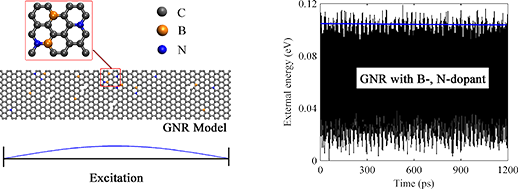
- techniques presented herein should also be applicable to graphene with other dopant elements (e.g., sulfur or silicon). (a) A perfect GNR with 3% B-dopant. (b) A perfect GNR with 1.5% B- and 1.5% N-dopant. (c) Velocity excitation profile. The regions highlighted in red in (a) and (b) represent the fixed


Magnesiothermic conversion of the silica-mineralizing golden algae Mallomonas caudata and Synura petersenii to elemental silicon with high geometric precision
Beilstein J. Nanotechnol. 2014, 5, 554–560, doi:10.3762/bjnano.5.65
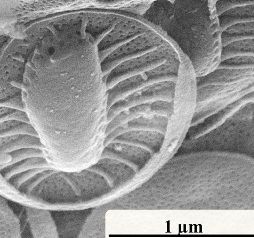
- spectroscopy (EDX) of the golden algae before the conversion are shown in Figure 4. Besides silicon, a couple of other elements were detected. The carbon and gold signals are due to the carbon sample holder and the gold sputtering, but the elements oxygen, sodium, magnesium, sulfur, calcium, and iron were


One-step synthesis of high quality kesterite Cu2ZnSnS4 nanocrystals – a hydrothermal approach
Beilstein J. Nanotechnol. 2014, 5, 438–446, doi:10.3762/bjnano.5.51
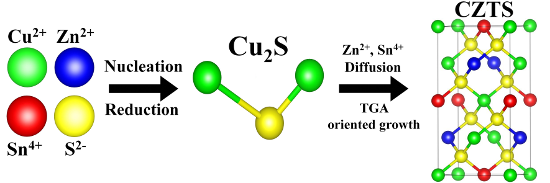
- ). The peaks of Sn 3d show binding energies at 486.35 and at 494.77 eV respectively, which is in good agreement with the value of Sn(IV). The S 2p peaks are located at 161.76 and 162.92 eV, which are consistent with the binding energy of sulfur in sulfide state of CZTS. These results are in agreement
- have a relatively high mobility which can accommodate an exchange with other metal ions at a low energy cost [28]. In addition, the crystal structure of Cu1.8S has a cubic close packing (ccp) array of sulfur ions which is similar to the arrangement of sulfur in kesterite CZTS crystal framework. Hence




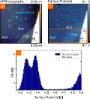
Effect of contaminations and surface preparation on the work function of single layer MoS2
Beilstein J. Nanotechnol. 2014, 5, 291–297, doi:10.3762/bjnano.5.32
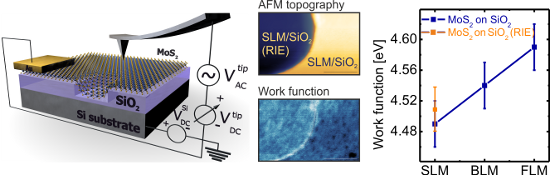
- plane of molybdenum atoms that are sandwiched between sulfur atoms. The main reason for this is the transition from an indirect (bulk MoS2) to a direct (single layer MoS2) band gap semi-conductor [5]. Single layer MoS2 has a strong photoluminescence signal [5][6][7][8][9] and other interesting




Nanoscale patterning of a self-assembled monolayer by modification of the molecule–substrate bond
Beilstein J. Nanotechnol. 2014, 5, 258–267, doi:10.3762/bjnano.5.28
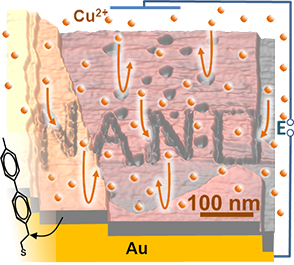
- . The local modification of the sulfur–substrate bond by intercalation of Cu at the Au–substrate interface yields a latent image, which is straightforwardly developed into a patterned binary SAM. Harnessing the significant difference in the strength of the S–Au and S–Cu bond this involves a potential


Surface assembly and nanofabrication of 1,1,1-tris(mercaptomethyl)heptadecane on Au(111) studied with time-lapse atomic force microscopy
Beilstein J. Nanotechnol. 2014, 5, 26–35, doi:10.3762/bjnano.5.3
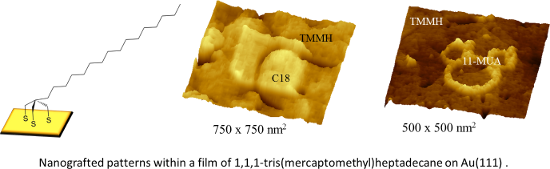
- with a side-on configuration, with the alkyl backbone aligned parallel to the substrate. It is likely that one sulfur of the tridentate molecule attaches to the surface in the initial molecular adsorption step. As time progresses, a second sulfur attached to the surface with rearrangement to a canted
- ), which likely has all three sulfur groups attached to the surface. Although we have no direct evidence of the numbers of sulfur groups attached to the substrate using AFM characterizations, the range of intermediate height measurements of Figure 2 suggest a step-wise attachment of the sulfur moieties
- nanografted patterns is shorter than that expected for an upright configuration of TMMH, likely attributable to the dilute conditions of the experiment. This may be attributable to an incomplete surface assembly of all three sulfurs of the tridentate group, with only one or two sulfur atoms attaching to the


Synthesis of indium oxi-sulfide films by atomic layer deposition: The essential role of plasma enhancement
Beilstein J. Nanotechnol. 2013, 4, 750–757, doi:10.3762/bjnano.4.85
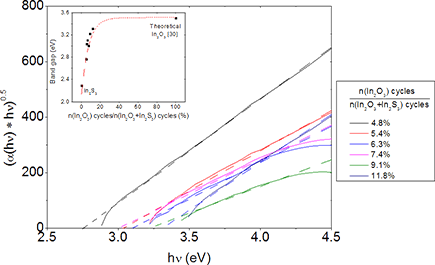
- pyrolysis technique, Maha et al. have inserted sulfur atoms in In2O3 thin films and obtained optical band gaps in the range from 3.85 to 3.96 eV [18]. Thus, based on our previous results and those studies, we became interested in adjusting the optical properties of In2S3 by incorporating oxygen atoms while
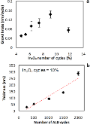
- increase with the number of In2O3 cycles during the deposition process of In2S3. The atomic ratios of oxygen, sulfur and indium determined by using EDX are presented in Table 2 and correlated to the optical band gap values. The dependence of the atomic ratio of oxygen and the optical band gap on the number
- the oxygen contained in In2(S,O)3 films is not generated from single layers of In2O3 but rather by exchange reactions as described in the previous section. Indeed, the O2 plasma can directly react with the film surface and induce an exchange reaction with surface sulfur atoms. Figure 7 presents a



AFM as an analysis tool for high-capacity sulfur cathodes for Li–S batteries
Beilstein J. Nanotechnol. 2013, 4, 611–624, doi:10.3762/bjnano.4.68
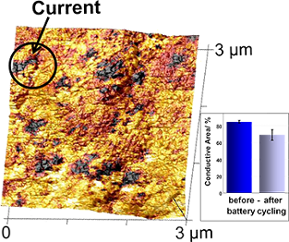
- Center, Stuttgart, Germany 10.3762/bjnano.4.68 Abstract In this work, material-sensitive atomic force microscopy (AFM) techniques were used to analyse the cathodes of lithium–sulfur batteries. A comparison of their nanoscale electrical, electrochemical, and morphological properties was performed with
- cathodes. X-ray diffraction (XRD) measurements of Li2S exposed to ambient air showed that insulating Li2S hydrolyses to insulating LiOH. This validates the significance of electrical ex-situ AFM analysis after cycling. Conductive tapping mode AFM indicated the existence of large carbon-coated sulfur
- particles. Based on the analytical findings, the first results of an optimized cathode showed a much improved discharge capacity of 800 mA·g(sulfur)−1 after 43 cycles. Keywords: conductive AFM; high capacity; lithium-sulfur batteries; material-sensitive AFM; sulfur cathode; Introduction Lithium



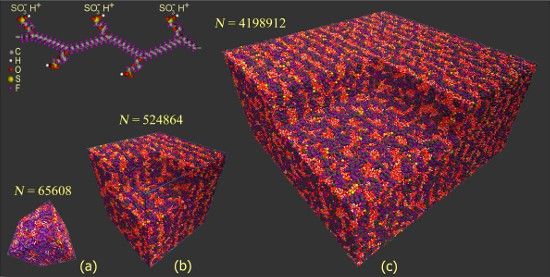
Large-scale atomistic and quantum-mechanical simulations of a Nafion membrane: Morphology, proton solvation and charge transport
Beilstein J. Nanotechnol. 2013, 4, 567–587, doi:10.3762/bjnano.4.65


Current–voltage characteristics of single-molecule diarylethene junctions measured with adjustable gold electrodes in solution
Beilstein J. Nanotechnol. 2012, 3, 798–808, doi:10.3762/bjnano.3.89
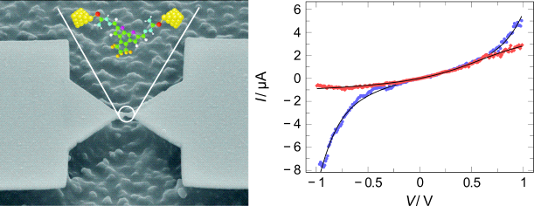
- , Germany Chemistry Department, University of Konstanz, D-78457 Konstanz, Germany 10.3762/bjnano.3.89 Abstract We report on an experimental analysis of the charge transport through sulfur-free photochromic molecular junctions. The conductance of individual molecules contacted with gold electrodes and the
- presence of sulfur atoms in the switching core. For this study we chose the recently developed class of sulfur-free diarylethenes (with proper side-arms and end-groups) in which the thiophene rings have been replaced by furans that are assumed to be less prone to unspecific binding to the metal electrodes
- molecules using the MCBJ technique in a liquid environment at room temperature. We have investigated three different diarylethene molecules with a sulfur-free switching core to reduce the possibility of unspecific binding. The conductance has been examined during repeated breaking and forming of the atomic


Nanolesions induced by heavy ions in human tissues: Experimental and theoretical studies
Beilstein J. Nanotechnol. 2012, 3, 556–563, doi:10.3762/bjnano.3.64
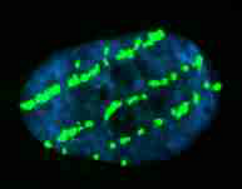
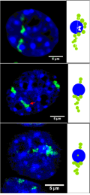
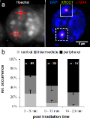
- of damage sites centrally induced within heterochromatic chromo centers. (a) The mouse embryo fibroblast (MEF) nucleus was irradiated with single sulfur ions and immunostained 5 min after irradiation. H2AX is phosphorylated and the repair protein XRCC1 accumulates at heterochromatic DSBs directly



Directed deposition of silicon nanowires using neopentasilane as precursor and gold as catalyst
Beilstein J. Nanotechnol. 2012, 3, 535–545, doi:10.3762/bjnano.3.62
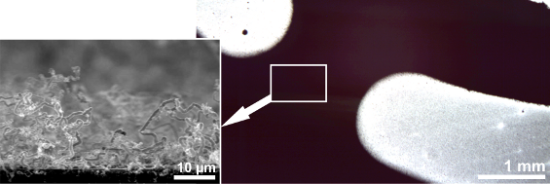
- of “liquid bright gold”, also called “porcelain gold” or “gold ink”. This material, which is formed by heating gold dust with sulfur and terpenes, was commonly used in the manufacturing and refinement process of porcelain [45]. When the tar-like material is painted onto ceramic surfaces, it can be


Functionalised zinc oxide nanowire gas sensors: Enhanced NO2 gas sensor response by chemical modification of nanowire surfaces
Beilstein J. Nanotechnol. 2012, 3, 368–377, doi:10.3762/bjnano.3.43
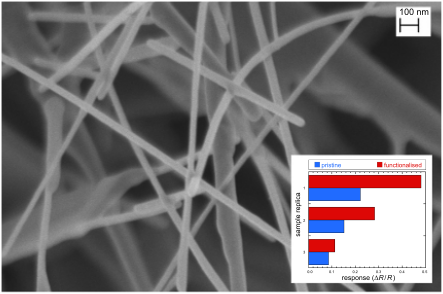
- dodecanethiol ligand and the ZnO surface could readily be distinguished at 164.4 eV with these samples, while sulfur peaks in the XPS spectrum of the unfunctionalised sensors were completely absent. Similarly THMA-functionalisation led to a multicomponent nitrogen peak, which could be fitted to the C–N bond in
- ) dodecanethiol-coated ZnO nanowire sensor; and (c) THMA-coated ZnO nanowire sensor. XPS spectra of (a) the sulfur peak of DT-functionalised ZnO NW sensor surface and (b) the amide peak of THMA-functionalised ZnO NW sensor surface. TG and DTG of (a) DT-coated and (b) THMA-coated ZnO obtained in air at 5 °C·min−1


Junction formation of Cu3BiS3 investigated by Kelvin probe force microscopy and surface photovoltage measurements
Beilstein J. Nanotechnol. 2012, 3, 277–284, doi:10.3762/bjnano.3.31
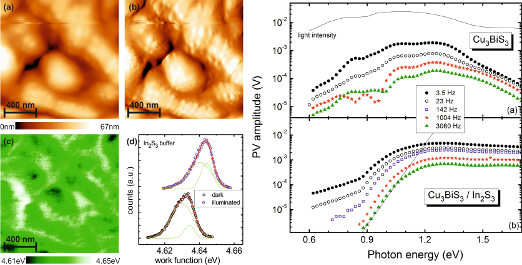
- the buffer layer on the grain boundaries was addressed, providing evidence for a diffusion of sulfur from the CdS buffer layer into the grain boundaries of the Cu(In,Ga)Se2 absorber film [15][16]. In this work we present a comparative analysis of the nanoscale optoelectronic properties of Cu3BiS3 thin
- simultaneous evaporation of Bi and S. In the second stage the Cu3BiS3 compound is formed by evaporation of Cu, in a sulfur environment, onto the BixSy layer, with the substrate temperature kept at 300 °C during the complete process [6]. Layers of Cu3BiS3 (thickness about 1 µm) were deposited on glass coated
- metallic precursors evaporated from a tungsten boat for Zn and a tantalum effusion cell for sulfur. The substrate was heated to ~250 °C. A thickness monitor (Maxtec TM-400) with a quartz-crystal sensor was used to measure the deposition rate of Zn. The thickness of the films was ~120 nm, as measured with a


Variations in the structure and reactivity of thioester functionalized self-assembled monolayers and their use for controlled surface modification
Beilstein J. Nanotechnol. 2012, 3, 213–220, doi:10.3762/bjnano.3.24
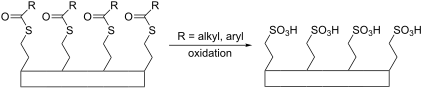
- also followed by XPS. SAMs of compounds 1 and 2 showed peaks corresponding to the expected divalent sulfur of the thioester at 163.8 ± 0.2 eV and 164.8 ± 0.2 eV in the expected 2:1 ratio (±10%), see for example Figure 4A. The additional (thiophene) sulfur in both compounds 3 and 4 leads to a broad
- for each sulfur and the expected 1:1 ratio for the two kinds of sulfurs in a single thiophene-bearing SAM show error bars of as much as 30%. Nevertheless, the XPS result confirms the presence of the thioester and thiophene sulfurs and attests to their complete disappearance (in all cases) upon
- oxidation to a sulfonic acid SAM (in which the one sulfur is at 168.2 ± 0.2 eV and 169.9 ± 0.2 eV). Finally, the photo-oxidations of the various types of thioesters were compared by using UV radiation of different wavelengths. A lamp whose output was around 254 nm was used for irradiation at shorter


When “small” terms matter: Coupled interference features in the transport properties of cross-conjugated molecules
Beilstein J. Nanotechnol. 2011, 2, 862–871, doi:10.3762/bjnano.2.95
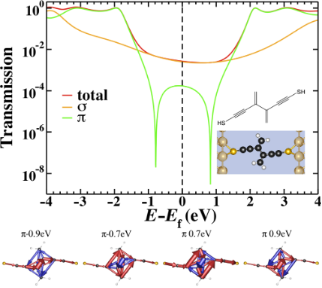
- to gold electrodes. The systems that we compare have the same underlying carbon skeleton but differ in the fact that the sulfur binding groups appear explicitly, rather than being effectively absorbed as part of the electrodes in the Hückel calculations. The gDFTB method [22][24][25] allows us to