Search results
Search for "intramolecular" in Full Text gives 1424 result(s) in Beilstein Journal of Organic Chemistry. Showing first 200.
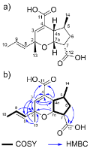
Rhodopyran, a carboxylated hexahydrocyclopenta[b]pyran from Rhodococcus
Beilstein J. Org. Chem. 2026, 22, 1107–1113, doi:10.3762/bjoc.22.89
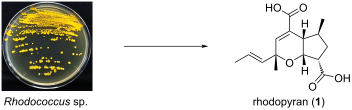
- derived from acetyl-CoA/malonyl-CoA-based metabolism. Partial reduction, dehydration, and oxidation of such an intermediate could generate an unsaturated hydroxy- or oxo-acyl precursor suitable for intramolecular ring formation. The cyclopentane ring may be formed through an intramolecular aldol- or
- Michael-type C–C cyclization, whereas closure of the pyran ring could proceed by intramolecular oxa-Michael addition or an epoxide-opening-type O-cyclization. The order of these two ring-forming events cannot be determined from the present data. An alternative catabolic contribution should also be
- metabolism, followed by partial reduction, dehydration, intramolecular aldol- or Michael-type C–C cyclization, intramolecular O-cyclization, and tailoring oxidations. Considering the oxidative and catabolic capacity of Rhodococcus, possible entry from endogenous fatty-acid β-/ω-oxidation intermediates cannot


Controlled supramolecular assemblies of luminescent tridentate cyclometalated alkynylgold(III) amphiphiles in aqueous media
Beilstein J. Org. Chem. 2026, 22, 1097–1106, doi:10.3762/bjoc.22.88
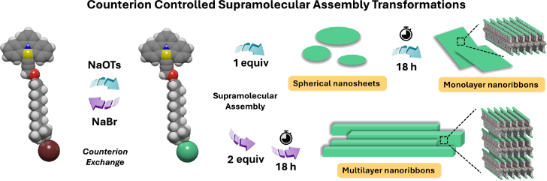
- aggregated form restrict intramolecular vibrations of the C^N^C ligand and suppress non-radiative decay pathways to activate the lower-energy emission. An essentially identical emission spectrum was observed for the methanol solution of GA at 20.0 °C (Supporting Information File 1, Figure S2b, green line) to


Rh(III)-catalyzed chelation-assisted C–H activation/annulation of 2-arylimidazolines with cyclic diazo-1,3-dicarbonyl compounds: a novel approach to tetracyclic annulated derivatives of 2,3-dihydroimidazo[2,1-a]isoquinoline
Beilstein J. Org. Chem. 2026, 22, 997–1003, doi:10.3762/bjoc.22.78
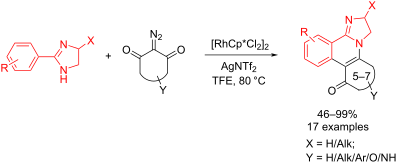
- protodemetallation that delivers CAr-alkylated intermediate F and regenerates the active catalytic species. The target tetraheterocyclic product 4 is formed after intramolecular condensation between the carbonyl group and the imidazoline nitrogen of intermediate F. To support this mechanism experimentally, we have


Electrochemical reduction of unsaturated carbon–carbon bonds via 3d transition-metal catalysis
Beilstein J. Org. Chem. 2026, 22, 955–981, doi:10.3762/bjoc.22.75
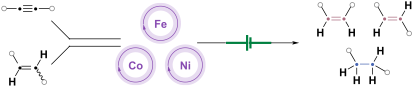
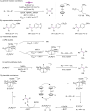
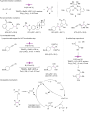
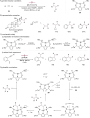
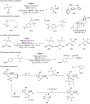
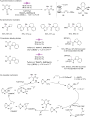
- of alkynes (Scheme 6C, i). An intramolecular radical trapping experiment employing enynes further corroborated the involvement of a vinyl radical intermediate, as evidenced by the formation of cyclized products via C–C bond formation followed by hydrogen abstraction (Scheme 6C, ii). Mechanistic
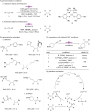
- concentration, strongly supporting an intramolecular HAT event as the kinetically controlling step. In situ generation and characterization of (DHP)Ni intermediates are consistent with the involvement of a reduced, formal Ni(I) species as a key catalytic entry point (Scheme 11C, i). Moreover, radical-probe








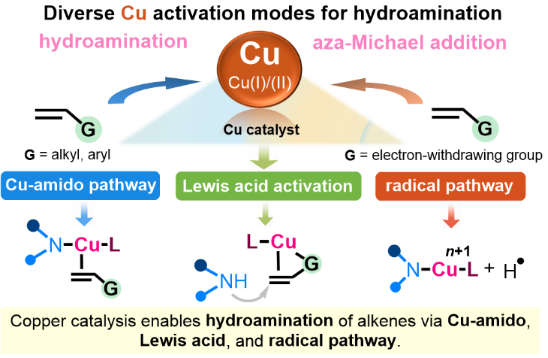
Recent advances in copper-catalyzed direct hydroamination of alkenes with (hetero)aromatic amines
Beilstein J. Org. Chem. 2026, 22, 925–947, doi:10.3762/bjoc.22.73
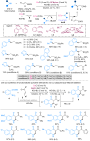
- carbonyl compounds 5 to form the β-amino ketone intermediates, which subsequently underwent base-mediated intramolecular cyclization using KOt-Bu and air oxidation of the resulting 2,3-dihydro-4(1H)-quinolinone intermediates 7 in the presence of HCl to yield functionalized quinolin-4(1H)-one derivatives 6
- generating and activating Michael acceptors within a single catalytic manifold. Building upon the simple Lewis acid-catalyzed aza-Michael additions described in Scheme 8, copper-catalysis has been successfully extended to cascade processes, where the initial conjugate addition is followed by intramolecular
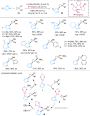
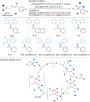
- transformation, the chiral Pybox-diPh/Cu(OTf)2·C6H6 complex initially promoted imine formation followed by asymmetric alkynylation, generating the α,β-unsaturated ester intermediate 23. Subsequent treatment with LiHMDS (lithium bis(trimethylsilyl)amide) induced base-promoted intramolecular aza-Michael







Palladium-catalyzed benzocyclization reactions of quinoline-2-carboxamides via sequential C–H/N–H functionalization
Beilstein J. Org. Chem. 2026, 22, 905–914, doi:10.3762/bjoc.22.71
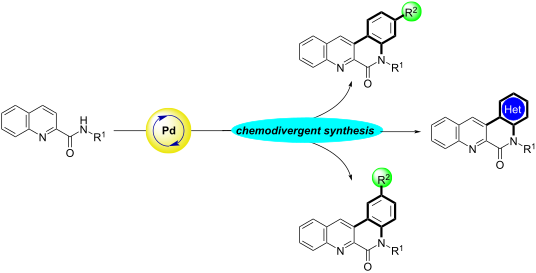
- allow facile preparation of aromatic amines (Scheme 1c) [28][29][30][31]. In general, intramolecular C–H arylation reactions in the presence of a transition-metal catalyst have been reported extensively in recent years. These reactions enable an efficient formation of fused-ring systems [32][33][34][35
- ]. Additionally, intramolecular C–H arylation reactions with N-heteroaromatics can be used to synthesize various functional molecules that serve as ligands for metal extraction [36][37][38][39][40][41]. Our group developed a cyclization reaction for the intramolecular C–H arylation with N-heterocycles, such as
- indicated that the anticipated C–H and N–H intermolecular–intramolecular coupling reactions occurred. When PdCl2(PPh3)2 was used instead of Pd(OAc)2 as a catalyst in the absence of PPh3, 3aa was afforded in 10% yield (Table 1, entry 2). When Pd(OCOCF3)2 was used as the catalyst, the desired product was




Cascade transformation of 2-(diazoacetyl)-2H-azirines to 2-aroyl-3-hydroxy-1H-pyrroles via condensation with aromatic aldehydes
Beilstein J. Org. Chem. 2026, 22, 897–904, doi:10.3762/bjoc.22.70
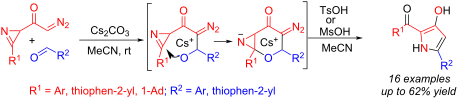
- with aromatic aldehydes does not result in the formation of an azirinyl-substituted β-hydroxy-α-diazocarbonyl compound, but is accompanied by a tandem intramolecular cyclization involving the hydroxy group and the C=N bond of the azirine to form a bicyclic intermediate, a 4-diazo-2-oxa-7-azabicyclo
- reaction of 2-(diazoacetyl)-2H-azirines 1 with aromatic aldehydes 2, which does not terminate in condensation to form an azirinyl-substituted β-hydroxy-α-diazocarbonyl compound 3, but is accompanied by a tandem intramolecular cyclization involving the hydroxy group and the azirine C=N bond to form a
- , which was confirmed by DFT calculations at the B3LYP-D3/6-311+G(d,p) level of theory with a SMD solvent model for MeCN. According to the calculations, the aziridine ring of protonated intermediate D readily opens to form the more stable cation E. The intramolecular H-shift leading to the ammonium cation


Diastereodivergent electrophilic trapping of α-boryl lithium derivatives
Beilstein J. Org. Chem. 2026, 22, 882–887, doi:10.3762/bjoc.22.68
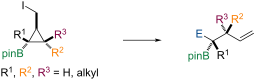
- moderate yields with good diastereoselectivity. Reaction with cyclohexanone led to partial elimination, which proceeded to completion upon warming the reaction mixture to room temperature, affording the bora-Wittig product 6j in moderate yield [39]. Furthermore, an intramolecular reaction was investigated


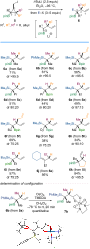


The trans-influence in gold chemistry from a catalytic perspective
Beilstein J. Org. Chem. 2026, 22, 838–856, doi:10.3762/bjoc.22.66
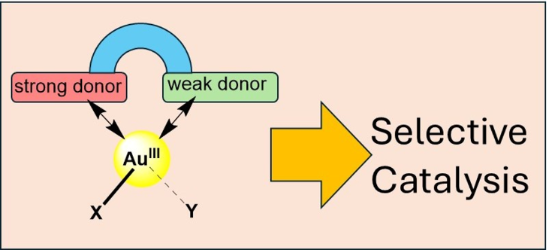
- detected. Only one of the AcFO ligands undergoes insertion. The observed product could be formed either by an intramolecular migratory pathway, or by an outer-sphere nucleophilic attack by AcFO− on a coordinated ethylene ligand. DFT studies eliminated the intramolecular migratory pathway as uncompetitive


Unsymmetrical sulfoxides with sterically hindered catechol fragment: synthesis, structure, electrochemical properties, and antiradical activity
Beilstein J. Org. Chem. 2026, 22, 828–837, doi:10.3762/bjoc.22.65
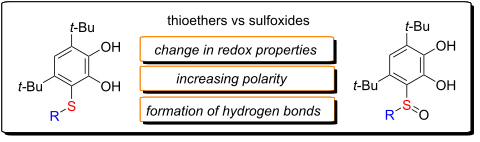
- °, depending on the nature of the substituent. The hydroxy group at the second position participates in the formation of an intramolecular H-bond with the oxygen atom of the sulfoxide group (Figure 1), and the second OH group forms an intermolecular contact with the SO group of the neighboring molecule (Table
- adamantyl substituent at the sulfur atom, no pronounced effect of the S=O group on the Epox1 value is displayed. This behavior may be explained by a compensatory effect arising from the formation of intramolecular O–H···O=S hydrogen bonds, which results in a partial shift of electron density from the
- sterically hindered o-benzoquinones. The obtained data differ from the spectral pattern characteristic of o-benzoquinone thioethers (λmax = 490–505 nm) [23][51][52][53] and indicate the absence of intramolecular charge transfer between the thioether group and the o-benzoquinone fragment. Based on


Synthesis and structural elucidation of a novel bis-spirooxindole from isatin and ethylenediamine
Beilstein J. Org. Chem. 2026, 22, 813–820, doi:10.3762/bjoc.22.63
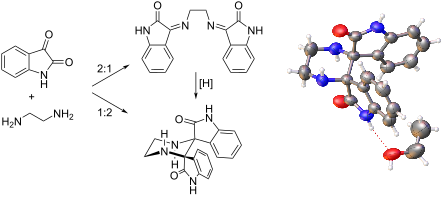
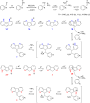
- its formation. Indeed, when 24 was treated with either sodium borohydride or sodium cyanoborohydride in methanol, compound 25 was obtained as the sole isolable product (Scheme 4c). These experiments demonstrate that 25 can arise from 24 through an initial imine reduction followed by intramolecular C–C


Knoevenagel condensation of 4,5- and 1,8-diazafluorenes
Beilstein J. Org. Chem. 2026, 22, 803–812, doi:10.3762/bjoc.22.62
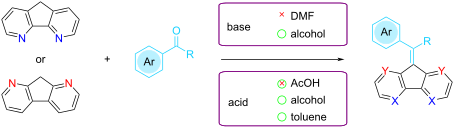
- the protonation and subsequent addition of a nucleophile (H2O) an intramolecular rearrangement facilitated by the proximity of a neighboring nitrogen atom (in position 1 or 8) occurred (see Scheme 3). Elimination of the aldehyde leads to the formation of 1,8-diazafluorene (2), which can be oxidized
- additionally due to C–H···π intramolecular interactions: φ1 = 106.8(2)° (N3–C13–C12–C5) and φ2 = 99.6(2)° (N4–C18–C12–C5) (Figure 2a). The molecules of 4,5-DPDAF are packed into stacks due to π-stacking interactions between diazafluorenes which are stabilized by C–H···N interactions between pyridine and




Rongalite addition to dienones: diastereoselectivity in cyclic sulfone synthesis; stereochemical rationalization and prospects as a general conjugate nucleophile
Beilstein J. Org. Chem. 2026, 22, 742–752, doi:10.3762/bjoc.22.56

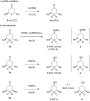
- donors [47] or, given the high solubility of Rongalite in water, phase-transfer catalysis [48]. Our earlier results indicate that tolerance of steric effects is greater in reactions with doubly electrophilic substrates that render the second conjugate addition intramolecular, justifying our choice of




Synthesis of heterocycles based on azomethine ylides from α-amino acids (or amines) and carbonyl compounds
Beilstein J. Org. Chem. 2026, 22, 705–741, doi:10.3762/bjoc.22.55
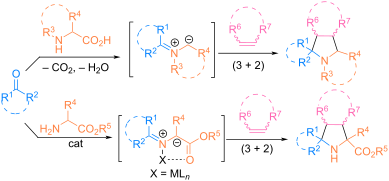
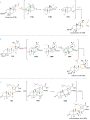
- reactions proceed with high stereoselectivity, providing products with eleven chiral carbon atoms in three steps. In 2018, Zhang and co-workers presented a sequential process based on a combination of inter- and intramolecular (3 + 2) cycloaddition reactions to prepare highly fused heterocyclic systems
- -alkylmaleimides 63, with the formation of cycloadducts 68. Next, without isolating the intermediate product 68, the resulting reaction mixture was used for the intramolecular (3 + 2) cycloaddition step with alkynes 69 and alkenes 70, which led to the formation of cycloadducts 71 and 72 with high
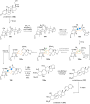
- work by Grigg's group investigated intramolecular cycloaddition at terminal double or triple bonds, leading to the formation of fused ring systems [80][81]. In a later work by Grigg's group [82], the cycloaddition of azomethine ylides obtained from aromatic aldehydes 97 and sarcosine (proline


Synthesis of depressin, cryptomeridiol and 4-epi-cryptomeridiol enabled by a terpenoid chiral pool-producing platform
Beilstein J. Org. Chem. 2026, 22, 683–690, doi:10.3762/bjoc.22.53
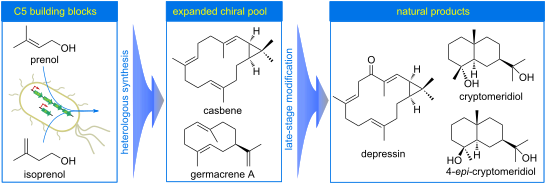
- efficient macrocyclization methods, including tetracarbonylnickel-promoted cyclization of allylic dibromide [17][18], copper-mediated intramolecular carbene–olefin cyclization [19], titanium-induced intramolecular carbonyl coupling [20], and organozinc carbenoid-mediated intramolecular cyclopropanation [21
- and 3 was reported in 1988 starting from 3-vinyl-2-cyclohexen-1-one featuring a key intramolecular aldol condensation reaction [33]. On the other hand, semisyntheses of 2 were achieved starting from related terpene products, including elemol (featuring a Hg(OAc)2-mediated oxymetallation) [34], β


Harnessing light energy with molecules
Beilstein J. Org. Chem. 2026, 22, 680–682, doi:10.3762/bjoc.22.52
- and can be potentially used at a later stage. A strong emphasis is on molecular photoswitches (photochromic molecules) that upon irradiation undergo cis/trans isomerization, intramolecular photocycloaddition, or an electrocyclic reaction. In addition, several articles describe absorption tuning by
Get a better glimpse on sequential photoreactions of trisnorbornadienes with 19F NMR spectroscopy
Beilstein J. Org. Chem. 2026, 22, 527–534, doi:10.3762/bjoc.22.38
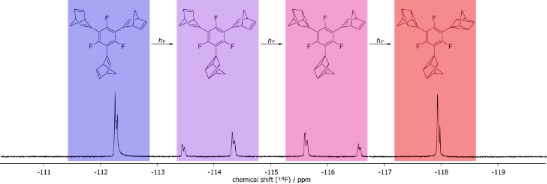
- emerging approach towards molecular solar thermal (MOST) energy storage [5][6][7][8]. In this context, norbornadienes are employed as well established photoswitches because they provide several favorable photochemical and physicochemical properties [9][10]. In a photochromic intramolecular [2 + 2


Modern synthetic pathways towards eribulin and its subunits
Beilstein J. Org. Chem. 2026, 22, 495–526, doi:10.3762/bjoc.22.37
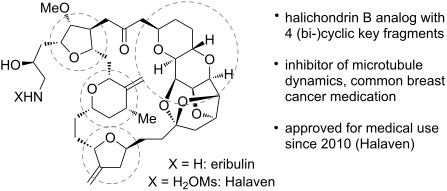
- -moiety and reprotection with (iPr)2SiHCl afforded 75. The addition of BF3·OEt2 at low temperatures induced the fluorination of the silane protecting group and a follow-up intramolecular hydride transfer (via 76). Afterwards, the introduced fluoride was substituted with Mg(OMe)2 in MeOH and the
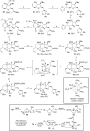
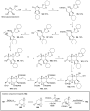
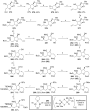
- , intramolecular ring opening of epoxide 98 and metathesis led to target 104 with high regio- and stereoselectivity. A novel approach towards C1–C10 fragment of 1 was reported by Kathravath and co-workers (Scheme 11) [87]. From ʟ-ascorbic acid (108), protection of the diol motif and treatment with H2O2, then EtI
- and further treated with Lindlar catalyst and DIBAL-H to afford the alkene and aldehyde motifs of 195, respectively. Oxime formation and oxidation yielded an intermediate nitrile oxide, which underwent an intramolecular [3 + 2]-cycloaddition with the adjacent ethene substituent towards isoxazoline 196







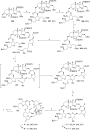

Recent advances in the stereoselective synthesis of distal biaxially chiral molecules
Beilstein J. Org. Chem. 2026, 22, 461–479, doi:10.3762/bjoc.22.34
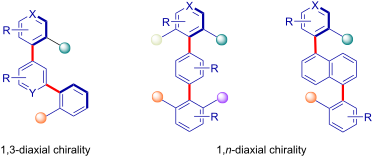
- ) intermediate, which undergoes intramolecular nucleophilic cyclization (Scheme 15) [54]. This work represents the first synthesis of a compound integrating both helical and axial stereogenic elements, and achieves high diastereoselectivity and enantioselectivity through a cinchona alkaloid-derived squaramide


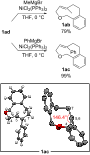
Synthesis and stereochemical analysis of dynamic planar chiral oxa[7]orthocyclophene
Beilstein J. Org. Chem. 2026, 22, 436–442, doi:10.3762/bjoc.22.30

- -substituted oxacyclophene 1ad We planned to construct the nine-membered cyclic ether skeleton of 1ad in the final step by an intramolecular Williamson etherification of haloalcohol 2 (Scheme 1). The iodine-substituted Z-alkene moiety of 2 was planned to be introduced through a trans-selective hydroiodination




Electrosynthetic access to unsymmetrical oxaza[8]helicenes with high chiral stability and strong circularly polarized luminescence (CPL)
Beilstein J. Org. Chem. 2026, 22, 372–382, doi:10.3762/bjoc.22.25
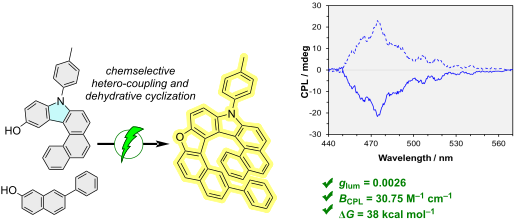
- hydrocarbons (PAHs) built from angularly annulated rings – occupy a distinctive niche because their non-planar, screw-shaped architectures generate inherent, configurational chirality [3][4][5]. This helicity originates from intramolecular steric congestion and stabilizing π–π interactions between terminal
- electrochemical arenol activations reported by Waldvogel and co-workers [46]. Subsequent intramolecular dehydrative cyclization furnishes the desired oxaza[8]helicenes 5. The oxidation-potential gap between 3 and 4 and the reactivity of Int-I thus provides a handle to control chemo- and regioselectivity




Recent advances in the cleavage of non-activated amides
Beilstein J. Org. Chem. 2026, 22, 352–369, doi:10.3762/bjoc.22.23
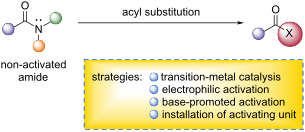
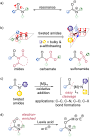
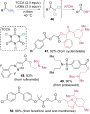
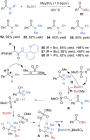
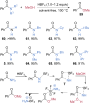
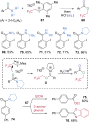
- generates a reactive intermediate I. Subsequent exchange of L1 with benzylamine enables intramolecular nucleophilic attack, leading to transamidation. Transition-metal-free electrophilic activation Since the keteniminium ion, which can be readily generated by electrophilic activation of enolizable tertiary
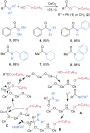
- generates the imidate-like intermediate Q. Subsequent nucleophilic attack of BuOH on the methyl group of Q leads to transition state R, accompanied by the departure of butyl methyl ether. Further attack of BuOH on the O-protonated amide, followed by an intramolecular proton transfer, furnishes transition
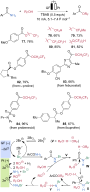
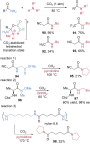
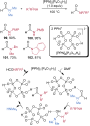
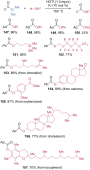
- hydrogen chloride acting as a Lewis acid, enabling nucleophilic attack by the amine to form a tetrahedral intermediate Z. Subsequent intramolecular hydrogen shift, followed by elimination of dimethylamine, affords the protonated transamidation product. In 2021, Lee et al. discovered that carbon dioxide








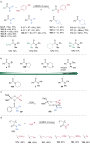


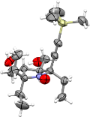
Synthesis of tricyclic fused pyrrolidine nitroxides from 2-alkynylpyrrolidine-1-oxyls
Beilstein J. Org. Chem. 2026, 22, 344–351, doi:10.3762/bjoc.22.22

- -alkynyl-substituted pyrrolidine nitroxides was studied. These nitroxides have been prepared via intramolecular Huisgen cycloaddition or intramolecular alkylation in 2-pyrazolyl derivatives prepared by Michael addition–cyclocondensation of the corresponding alkynones with hydrazine. The reduction kinetics
- often leads to formation of complex polycyclic systems [17][18][19]. In this study, we aimed to construct rigid tricyclic condensed systems with an integrated nitroxyl radical fragment from 3-substituted 2-ethynylpyrrolidine-1-oxyls. The desired tricyclic nitroxides were prepared via intramolecular
- Huisgen cycloaddition or via one-pot Michael addition–cyclocondensation reaction with hydrazine with subsequent intramolecular alkylation of the resulting pyrazoles. Results and Discussion Synthesis We have earlier reported on the synthesis of 2-alkynylpyrrolidine-1-oxyls 2a–c via addition of the




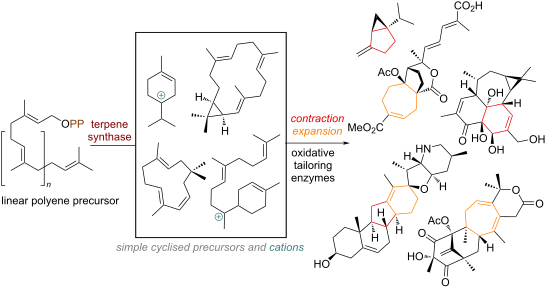
Ring contraction and ring expansion reactions in terpenoid biosynthesis and their application to total synthesis
Beilstein J. Org. Chem. 2026, 22, 289–343, doi:10.3762/bjoc.22.21
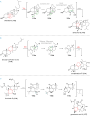
- Scheme 22A). Alternatively, one can imagine an exhaustively oxidised intermediate like 74 undergoing α-ketol rearrangement to directly deliver the hydroxy group at C-6 (acid 75) for intramolecular lactonisation towards pierisketolide A (70). In the biogenesis of euphnerin B (76) and euphomilones A (77
- isomers (128b) of the aldol addition is privileged to undergo intramolecular esterification to give alstoscholarinoid B (125). The configuration of the other isomer 128c has been reportedly isolated already in 2002 by Kuo and Chiang [182]. For alstoscholarinoid A (124) an analogous oxidative cleavage and
- (151) after elimination and a second dehydrogenation reaction. Oxidative cleavage of the newly formed 5,6-olefin towards 151a and intramolecular aldol addition furnishes rhodoterpenoid C (150). Applications of ring-size-altering reactions in the total synthesis of terpenoids Since the seminal works by






Spirobarbiturates with a pyrrolizidine moiety: synthesis, structure and biological evaluation
Beilstein J. Org. Chem. 2026, 22, 274–288, doi:10.3762/bjoc.22.20
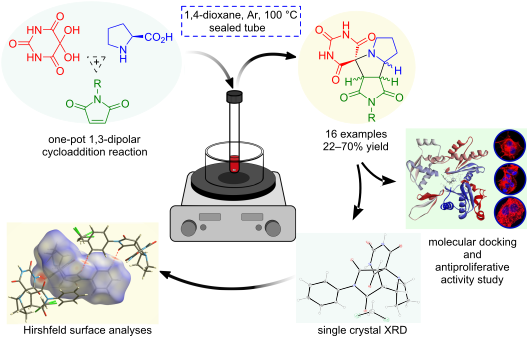
- by intramolecular cyclization to yield a lactone, which undergoes decarboxylation to produce the corresponding azomethine ylide. In our system, we propose this generated ylide reacts with N-substituted maleimides 3a–p such that the transformation predominantly proceeds via the endo-TS, leading to