


Search results
Search for "azide" in Full Text gives 496 result(s) in Beilstein Journal of Organic Chemistry. Showing first 200.
Harnessing the versatility of hydrazones through electrosynthetic oxidative transformations
Beilstein J. Org. Chem. 2024, 20, 1988–2004, doi:10.3762/bjoc.20.175
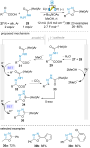
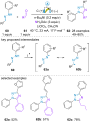
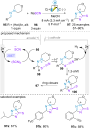
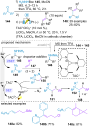
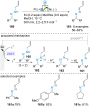
- closure to furnish the 1,2,4-triazolium 97 (Scheme 18) [65]. In the last example of this section, only one nitrogen atom of the hydrazone takes part in the cycloaddition reaction. In 2018, Zhang et al. realized the electrochemical (3 + 2)-cycloaddition of trimethylsilyl azide (102) with aldehyde-derived N
- ,N-disubstituted hydazones 101 for synthesiszing tetrazoles 103. Sodium azide could be an alternative source of azide, albeit with both slightly lower yields and Faradic efficiency. Remarkably, (hetero)aromatic as well as aliphatic aldehydes proved to be efficient. Various substituents on the N(sp3
- ) atom were well tolerated and the best result was obtained with a morpholine ring. Based on cyclic voltammetry studies, the transformation initiated with the anodic oxidation of hydrazone 101 to form highly electrophilic radical cationic species 104. Subsequent addition of azide 102 and desilylation









The Groebke–Blackburn–Bienaymé reaction in its maturity: innovation and improvements since its 21st birthday (2019–2023)
Beilstein J. Org. Chem. 2024, 20, 1839–1879, doi:10.3762/bjoc.20.162
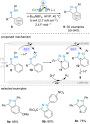
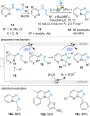
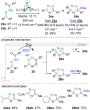
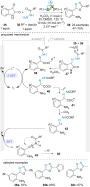
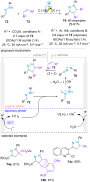
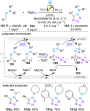
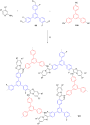
- comprising a GBB-3CR and a palladium-catalyzed azide-isocyanide coupling to generate imidazo[1,2-a]pyridine-fused 1,3-benzodiazepines 85 (Scheme 27). The GBB reaction smoothly proceeded using 2-azidobenzaldehydes 83, 2-aminopyridines and isocyanides as the precursors. The in situ-generated azides 84 were






Harnessing unprotected deactivated amines and arylglyoxals in the Ugi reaction for the synthesis of fused complex nitrogen heterocycles
Beilstein J. Org. Chem. 2024, 20, 1758–1766, doi:10.3762/bjoc.20.154
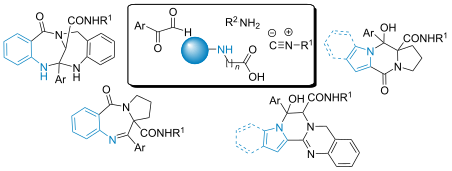
- methodology has several drawbacks, as the need to synthesise the 2-azidobenzoic acid from anthranilic acid and sodium azide, the requirement of anhydrous conditions to perform the Staudinger/aza-Wittig sequence or the generation of large quantities of triphenylphosphine oxide which needs to be removed by


Syntheses and medicinal chemistry of spiro heterocyclic steroids
Beilstein J. Org. Chem. 2024, 20, 1713–1745, doi:10.3762/bjoc.20.152
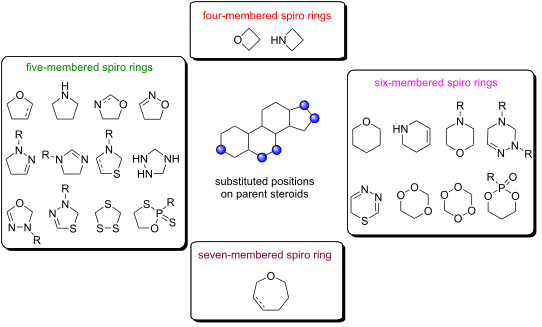
- diazo precursor. To achieve this, cholesterol was first esterificated using 2-(4-methoxyphenyl)acetic acid and DCC. The resulting arylacetic ester 12 was then reacted with 4-acetamidobenzenesulfonyl azide (p-ABSA) and DBU in anhydrous acetonitrile to yield the diazo compound 13 in 22% yield. The carbene
- epoxide was then opened by treatment with sodium azide and boric acid, yielding the azide derivative 146 in 87% from estrone. A subsequent reduction of the azide with LiAlH4 provided the aminoalcohol derivative 147 in 64% yield. Then, a chloroacetamido moiety was formed at the amino function in 51% yield


Chemo-enzymatic total synthesis: current approaches toward the integration of chemical and enzymatic transformations
Beilstein J. Org. Chem. 2024, 20, 1693–1712, doi:10.3762/bjoc.20.151
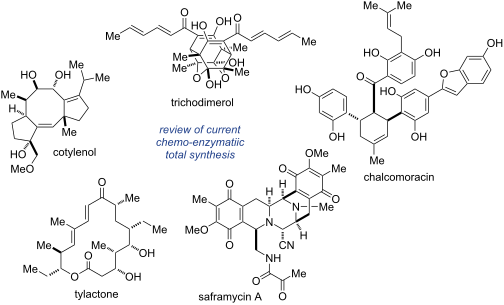
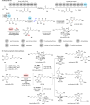
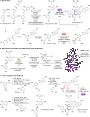
- reaction with biotin azide, which led to selective pull-down with streptavidin agarose and isolation of the probe–protein covalent complex. Proteomic analysis of the isolated proteins narrowed down the MaMO and MaDA candidates, including several berberine bridge enzyme (BBE)-like enzymes. This FAD-linked




Tetrabutylammonium iodide-catalyzed oxidative α-azidation of β-ketocarbonyl compounds using sodium azide
Beilstein J. Org. Chem. 2024, 20, 1510–1517, doi:10.3762/bjoc.20.135
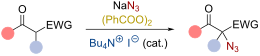
- an ammonium hypoiodite species which first facilitates the α-iodination of the pronucleophile, followed by a phase-transfer-catalyzed nucleophilic substitution by the azide. Furthermore, we also show that an analogous α-nitration by using NaNO2 under otherwise identical conditions is possible as well
- . Keywords: azidation; nitration; organocatalysis; oxidation; quaternary ammonium iodides; Introduction Organic compounds containing an azide functionality are highly valuable synthesis targets that offer considerable potential for various applications and further manipulations [1][2][3][4][5][6][7][8][9
- consequence, the synthesis of organic azides is an important task and it comes as no surprise that a variety of conceptually complementary strategies to install azide groups in organic molecules have been reported [1][2][3][4][5][6][7][8]. α-Azido carbonyl derivatives are especially interesting targets which


Synthesis of cyclic β-1,6-oligosaccharides from glucosamine monomers by electrochemical polyglycosylation
Beilstein J. Org. Chem. 2024, 20, 1421–1427, doi:10.3762/bjoc.20.124

- formation of larger cyclic oligosaccharides. Electrochemical polyglycosylation of 2-azido-2-deoxy-substituted thioglycoside monomers Based on the results shown in Table 1 and Scheme 3, we changed the substituent in position C-2 of the thioglycoside monomer from PhthN to azide, which has no neighboring group


Synthesis of substituted triazole–pyrazole hybrids using triazenylpyrazole precursors
Beilstein J. Org. Chem. 2024, 20, 1396–1404, doi:10.3762/bjoc.20.121
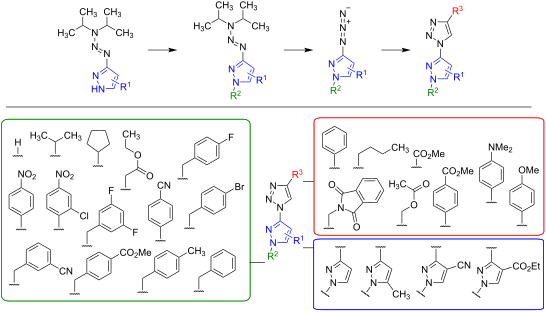
- the triazole unit via a copper-catalyzed azide–alkyne cycloaddition. The developed methodology was used to synthesize a library of over fifty new multi-substituted pyrazole–triazole hybrids. We also demonstrate a one-pot strategy that renders the isolation of potentially hazardous azides obsolete. In
- addition, the compatibility of the method with solid-phase synthesis is shown exemplarily. Keywords: azide; click reaction; CuAAC; pyrazole; triazene; triazole; Introduction Nitrogen-containing heterocycles are central scaffolds in medicinal chemistry and are incorporated in most small-molecule drugs [1
- cholerae [13], show antimicrobial properties [14], and can act as P2X7 antagonists, a receptor involved in neuroinflammation and depression [15]. Pyrazolyltriazoles are most easily obtained via the copper-catalyzed azide–alkyne cycloaddition (CuAAC) from pyrazolyl azides (7 and 8). These are usually




The Ugi4CR as effective tool to access promising anticancer isatin-based α-acetamide carboxamide oxindole hybrids
Beilstein J. Org. Chem. 2024, 20, 1213–1220, doi:10.3762/bjoc.20.104
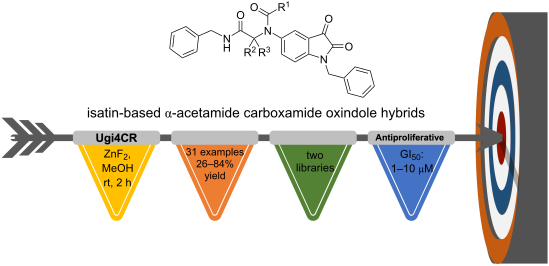
- and Figure 2). Like the oxindole scaffold, 1,2,3-triazole is also considered a privileged unit in drug discovery since compounds having this structure have a broad spectrum of biological activities, and have been widely used to create anticancer drug candidates [24][25]. The copper-catalyzed azide
- into the scaffold. Benzyl azide (6), obtained using a previously reported procedure [27], was used in the CuAAC reaction. The α-acetamide carboxamide 1,2,3-triazole oxindole hybrid 7 was easily obtained in 61% yield using Cu(OAc)2 as catalyst, ascorbic acid, DMF as solvent, and microwave reaction




Synthesis of 1,4-azaphosphinine nucleosides and evaluation as inhibitors of human cytidine deaminase and APOBEC3A
Beilstein J. Org. Chem. 2024, 20, 1088–1098, doi:10.3762/bjoc.20.96
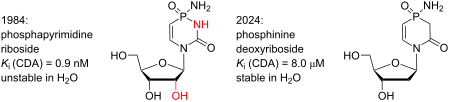
- combination of both. Difficulties in the Hilbert–Johnson reaction and the low yield observed for nucleoside 14 prompted us to use an alternative option for the synthesis of the target nucleosides based on the assembly of a nucleobase on the 2-deoxyribofuranos-1-yl scaffold. Hydrogenation of azide 15 [69


Innovative synthesis of drug-like molecules using tetrazole as core building blocks
Beilstein J. Org. Chem. 2024, 20, 950–958, doi:10.3762/bjoc.20.85
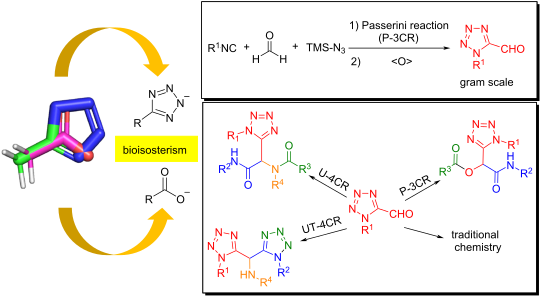
- use in MCRs to access diverse molecular scaffolds. To do that, we first developed an efficient and scalable MCR-based route of the building blocks, in order to provide useful quantities by utilizing diverse isocyanides, azide and paraformaldehyde. Then, this novel tetrazole building block was used in
- be a challenging substrate for MCRs and this was also the case for the synthesis of oxo-tetrazoles via a Passerini tetrazole reaction [19]. In a model reaction, we investigated benzyl isocyanide (1 equiv), paraformaldehyde (2 equiv) and trimethylsilyl azide (1 equiv) as easily available substrates
- . Trimethylsilyl azide is considered as a safe replacement of metal azides. We started the solvent optimization with MeOH and H2O as solvent system at room temperature, however, it did not yield any product even after 3 days (Table 1, entry 1). The use of DMF to improve the solubility of the paraformaldehyde solid




One-pot Ugi-azide and Heck reactions for the synthesis of heterocyclic systems containing tetrazole and 1,2,3,4-tetrahydroisoquinoline
Beilstein J. Org. Chem. 2024, 20, 912–920, doi:10.3762/bjoc.20.81
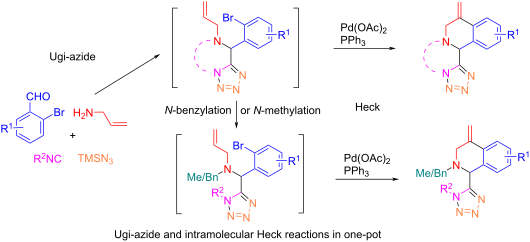
- Chemistry and Center for Green Chemistry, University of Massachusetts Boston, 100 Morrissey Blvd, Boston, MA 02125, USA 10.3762/bjoc.20.81 Abstract A new method for the synthesis of heterocyclic systems containing tetrazole and tetrahydroisoquinoline is developed via the performance of one-pot Ugi-azide
- and Heck cyclization reactions. The integration of the multicomponent and post-condensation reactions in one-pot maximizes the pot-, atom-, and step-economy (PASE). Keywords: Heck reaction; one-pot; tetrahydroisoquinoline; tetrazolo-pyrazino[2,1-a]isoquinolin-6(5H)-ones; tetrazole; Ugi-azide reaction
- highly diverse peptidic structures A with up to four points of substitution (Scheme 1) [26][27]. By replacing the carboxylic acid with a nucleophilic azide reagent XN3 (generally TMSN3), the Ugi-azide four-component reaction (UA-4CR) of an aldehyde, amine, isocyanide, and azide gives 1,5-disubstituted 1H


(Bio)isosteres of ortho- and meta-substituted benzenes
Beilstein J. Org. Chem. 2024, 20, 859–890, doi:10.3762/bjoc.20.78
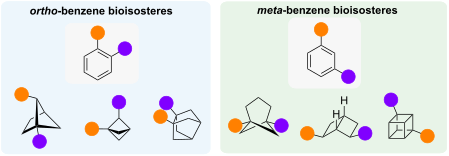
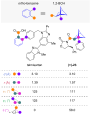
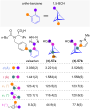
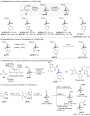
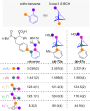
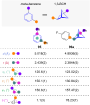
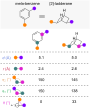
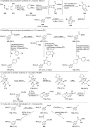
- -containing 2-oxa-1,4-BCH 110b via Mykhailiuk’s synthesis [59]. 2-Oxa-1,4-BCH 110f, which contained a bridgehead ester in addition to the pendant primary iodide, was found to be a versatile synthetic intermediate. Substitution of the primary iodide with acetate or azide led to alcohol 111 and amine 113














Synthesis of new representatives of A3B-type carboranylporphyrins based on meso-tetra(pentafluorophenyl)porphyrin transformations
Beilstein J. Org. Chem. 2024, 20, 767–776, doi:10.3762/bjoc.20.70
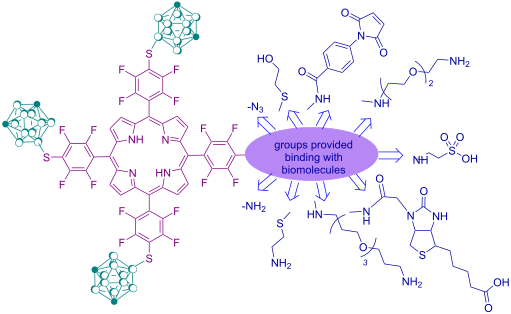
- single pentafluorophenyl ring was prepared through the regioselective nucleophilic aromatic substitution reaction of the p-fluorine atoms in 5,10,15,20-tetrakis(pentafluorophenyl)porphyrin with 9-mercapto-m-carborane. The reaction of this porphyrin with sodium azide led to the selective substitution of
- the p-fluorine atom in the pentafluorophenyl substituent with an azide functionality which upon reduction with SnCl2 resulted in the formation of the corresponding porphyrin with an amino group. Pentafluorophenyl-substituted A3B-porphyrins were studied and transformed to thiol and amino-substituted
- ][17][18][19][20][21][22][23][24][25][26][27]. In order to prepare boronated PSs of A3B-type the employed synthetic strategy included the preparation of monoazido-substituted tris(pentafluorophenyl)porphyrin 2 by the reaction of porphyrin 1 with sodium azide (molar ratio 1:1.9) in DMF at ambient


SOMOphilic alkyne vs radical-polar crossover approaches: The full story of the azido-alkynylation of alkenes
Beilstein J. Org. Chem. 2024, 20, 701–713, doi:10.3762/bjoc.20.64
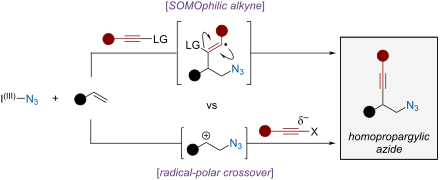
- high yield (72%) of the homopropargylic azide was reached. Full insights are given about the factors that were essential for the success of the optimization process. Keywords: alkyne; azide; hypervalent iodine; photoredox; trifluoroborate salt; Introduction Homopropargylic azides are important
- building blocks bearing two of the most versatile functional groups, allowing a rich panel of functionalization. They have been used as intermediates in numerous syntheses to access bioactive compounds [1][2][3][4] or materials [5][6][7]. In addition, azide reduction affords homopropargylic amines, which
- and substitution with azide ions to produce the desired homopropargylic azide. However, this approach gives only access to products bearing the alkyne at the least substituted position. To the best of our knowledge, no general strategy has been employed to access the other regioisomer possessing a


Regioselective quinazoline C2 modifications through the azide–tetrazole tautomeric equilibrium
Beilstein J. Org. Chem. 2024, 20, 675–683, doi:10.3762/bjoc.20.61
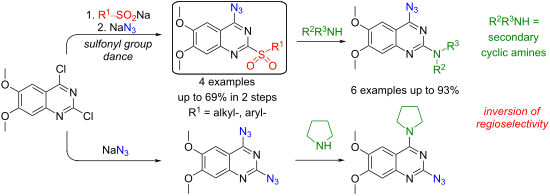
- , Latvia Latvian Institute of Organic Synthesis, Aizkraukles Str. 21, Riga, LV-1006, Latvia 10.3762/bjoc.20.61 Abstract 2-Chloro-4-sulfonylquinazolines undergo functional group swap when treated with an azide nucleophile: 1) the azide replaces the sulfonyl group at the C4 position; 2) the intrinsic azide
- , which is present in pharmaceutically active substances. The methodology application is showcased by transforming the obtained 4-azido-6,7-dimethoxy-2-sulfonylquinazolines into the α1-adrenoceptor blockers terazosin and prazosin by further C2-selective SNAr reaction and azide reduction. Keywords
- : aromatic nucleophilic substitution; azide–tetrazole equilibrium; 4-azido-2-sulfonylquinazolines; quinazolines; sulfonyl group dance; Introduction The quinazoline core is a privileged structure with a wide range of applications. Quinazoline derivatives exhibit a broad spectrum of biological activities


Synthesis and biological profile of 2,3-dihydro[1,3]thiazolo[4,5-b]pyridines, a novel class of acyl-ACP thioesterase inhibitors
Beilstein J. Org. Chem. 2024, 20, 540–551, doi:10.3762/bjoc.20.46
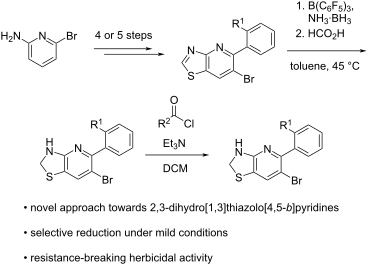
- -ynylcarbamoyl)-1,3-dioxolane-2-carboxamide [3] and FAM azide, 5-isomer (Broadpharm BP-22544, San Diego, CA) by click chemistry [29] and was purified by flash column chromatography on silica gel. Preemergence efficacy of 2,3-dihydro[1,3]thiazolo[4,5-b]pyridine-based FAT inhibitors 7b, 7c, and 13b as well as


Development of a chemical scaffold for inhibiting nonribosomal peptide synthetases in live bacterial cells
Beilstein J. Org. Chem. 2024, 20, 445–451, doi:10.3762/bjoc.20.39
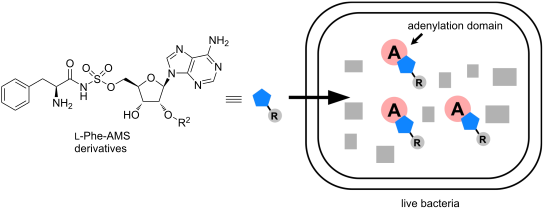
- benzophenone moiety in probe 3. The samples were then reacted with TAMRA-N3 (structure shown in Figure S4, Supporting Information File 1) under copper(I)-catalyzed azide–alkyne cycloaddition conditions [21] and subjected to sodium dodecyl sulfate-polyacrylamide gel electrophoresis coupled with in-gel
- are treated with a TAMRA-N3 under copper(I)-catalyzed azide–alkyne cycloaddition conditions, followed by SDS-PAGE coupled with in-gel fluorescence scanning. AMS, 5′-O-sulfamoyladenosine. Competitive labeling experiments of GrsA using probe 3 in the presence of ʟ-Phe-AMS inhibitors. (A) Labeling of


Catalytic multi-step domino and one-pot reactions
Beilstein J. Org. Chem. 2024, 20, 254–256, doi:10.3762/bjoc.20.25
- nucleophilic substitution of benzylic bromides with sodium azide and a subsequent copper(I)-catalyzed double click reaction in one pot [17]. In summary, these contributions by renowned experts demonstrate the broad diversity of impressive catalytic domino, tandem, and one-pot processes towards many valuable

Perspectives on push–pull chromophores derived from click-type [2 + 2] cycloaddition–retroelectrocyclization reactions of electron-rich alkynes and electron-deficient alkenes
Beilstein J. Org. Chem. 2024, 20, 125–154, doi:10.3762/bjoc.20.13
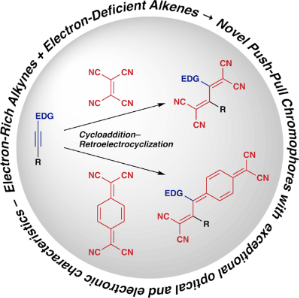
- wormlike nanoparticles. In rotaxanes, the utilization of metal–ligand bonding involving CuI is a common strategy for immobilizing a thread moiety within a macrocycle. However, the efficacy of such a bonding is compromised when catalysts are used in stoppering reactions, e.g., the copper-catalyzed azide


Photoinduced in situ generation of DNA-targeting ligands: DNA-binding and DNA-photodamaging properties of benzo[c]quinolizinium ions
Beilstein J. Org. Chem. 2024, 20, 101–117, doi:10.3762/bjoc.20.11
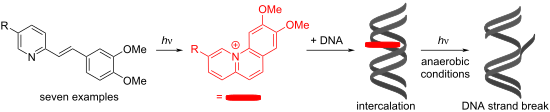
- decrease of the cleavage to 17%. It has to be noted, however, that an inhibition of DNA cleavage in the presence of NaN3 may also be induced by direct deactivation of the excited photosensitizer by the azide and not only from quenching of singlet oxygen [83]. Similar, seemingly contradictory effects of D2O





Cycloaddition reactions of heterocyclic azides with 2-cyanoacetamidines as a new route to C,N-diheteroarylcarbamidines
Beilstein J. Org. Chem. 2024, 20, 17–24, doi:10.3762/bjoc.20.3
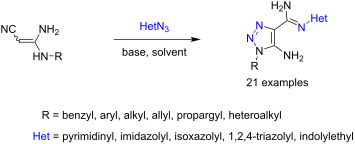
- -diaminoacrylonitriles 1 with heteroaryl azides (HetN3) 2 [16] leading to 5-amino-1,2,3-triazole-4-N-heteroarylcarbimidamides 3 (Scheme 1C). Results and Discussion Optimization of the reaction of amidine 1a with azide 2a We initiated the study by investigating a model reaction involving the cycloaddition of 3-amino-3
- solvents screened, 1,4-dioxane was found the best solvent in terms of yield of the target product, solubility of the reagents, and ease of separation of the product. Thus, the optimal conditions found were reacting amidine 1 with azide 2 in the presence of DBU in a 1:1:1 ratio in 1,4-dioxane at room
- ethyl 2-cyanoacetimidate and corresponding amines according to the literature procedure [17] and compounds 1a,c–e,h–j are commercially available. Azides 2a–d,f,g were synthesized according to the literature procedures [18][19][20][21][22][23], and azide 2e is commercially available. Preparation of



Aldiminium and 1,2,3-triazolium dithiocarboxylate zwitterions derived from cyclic (alkyl)(amino) and mesoionic carbenes
Beilstein J. Org. Chem. 2023, 19, 1947–1956, doi:10.3762/bjoc.19.145
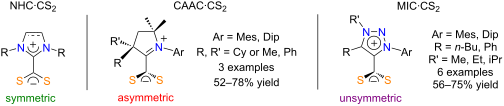
- system (G) was first investigated by Albrecht et al. in 2008 [23]. Because the heterocyclic precursors needed to prepare 1,2,3-triazol-5-ylidenes are readily available through the [3 + 2] cycloaddition of an azide and an alkyne, these compounds are currently the most popular MICs for catalytic and other
- -disubstituted-1,2,3-triazole derivatives is readily achieved via the copper(I)-catalyzed [3 + 2] cycloaddition of an azide and a terminal alkyne (CuAAC) [63][64][65]. A further alkylation of the N3 position with an alkyl halide is an equally straightforward procedure that ultimately affords a large assortment
- ). The active catalytic species for the CuAAC reaction were generated by reducing copper(II) sulfate with sodium ascorbate according to literature procedures [66][67]. 2-Azido-1,3,5-trimethylbenzene (mesityl azide) was easily synthesized in a distinct, preliminary step through the Sandmeyer reaction of


N-Boc-α-diazo glutarimide as efficient reagent for assembling N-heterocycle-glutarimide diads via Rh(II)-catalyzed N–H insertion reaction
Beilstein J. Org. Chem. 2023, 19, 1841–1848, doi:10.3762/bjoc.19.136
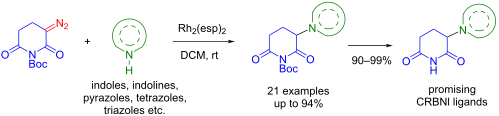
- two steps and readily entered the diazo transfer reaction with 4-nitrophenylsulfonyl azide (4-NsN3). The resulting diazo reagent 5 was produced in a high yield after undergoing straightforward chromatographic purification. The use of a Boc group at the nitrogen atom of the diazo imide significantly


Synthetic approach to 2-alkyl-4-quinolones and 2-alkyl-4-quinolone-3-carboxamides based on common β-keto amide precursors
Beilstein J. Org. Chem. 2023, 19, 1804–1810, doi:10.3762/bjoc.19.132
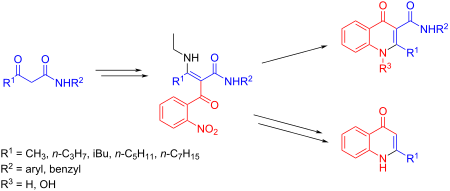
- -mediated domino reaction of chromone-3-carboxaldehydes and amines [41], Pd-catalyzed redox-neutral C–N coupling reaction of iminoquinones with electron-deficient alkenes [42], NH3 insertion into o‑haloarylynones [43], gold(III)-catalyzed azide-yne cyclization [44], Michael/Truce-Smiles rearrangement





