


Search results
Search for "ring contraction" in Full Text gives 62 result(s) in Beilstein Journal of Organic Chemistry.
A computational study of base-catalyzed reactions of cyclic 1,2-diones: cyclobutane-1,2-dione
Beilstein J. Org. Chem. 2013, 9, 594–601, doi:10.3762/bjoc.9.64
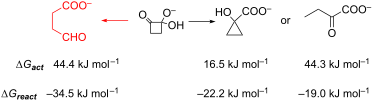
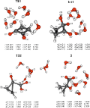
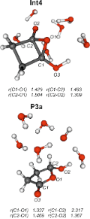
- ] leads to ring contraction, e.g., the rearrangement of cyclobutane-1,2-dione (1) to 1-hydroxycyclopropanecarboxylate (2) [5][6][7]. In contrast, cyclobut-3-ene-1,2-diones 3 react to 2-oxobut-3-enoates 4 (at least formally according to path B) [8], whereas benzocyclobutene-1,2-diones 5 lead to 2





Synthesis of 2,3-dihydronaphtho[2,3-d][1,3]thiazole-4,9-diones and 2,3-dihydroanthra[2,3-d][1,3]thiazole-4,11-diones and novel ring contraction and fusion reaction of 3H-spiro[1,3-thiazole-2,1'-cyclohexanes] into 2,3,4,5-tetrahydro-1H-carbazole-6,11-diones
Beilstein J. Org. Chem. 2013, 9, 577–584, doi:10.3762/bjoc.9.62
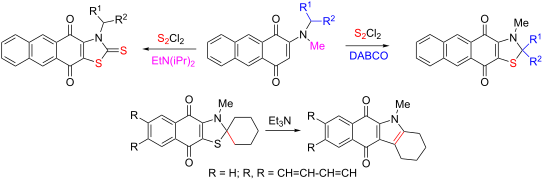
- ., ring contraction and fusion products. A plausible mechanism was proposed for the formation of the products. Keywords: anthracene-1,4-diones; 1H-carbazole-6,11-diones; fused thiazoles; fusion reaction; heterocycles; naphthoquinones; ring contraction; sulfur–nitrogen; Introduction The 1,4
- -ethyldiisopropylamine in the reaction of 2-(methylamino)anthracene-1,4-diones with sulfur monochloride was discovered and explained. 3H-Spiro(thiazol-2,1'-cyclohexanes) underwent a new ring contraction and fusion reaction resulting in the formation of tetrahydroindoles. Experimental Melting points were determined on a


Valence isomerization of cyclohepta-1,3,5-triene and its heteroelement analogues
Beilstein J. Org. Chem. 2011, 7, 1713–1721, doi:10.3762/bjoc.7.201
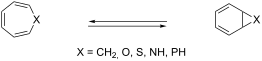
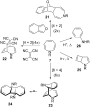
- of aromatic substrates [61][62][63][64]. In addition, also photo-oxidation of benzene creates this isomeric pair [65][66]. Depicted in Scheme 4 are the most important reactions that the parent oxepine (3) and benzene oxide (4) can undergo. Irradiation of oxepine results in ring contraction yielding 2




Use of mixed Li/K metal TMP amide (LiNK chemistry) for the synthesis of [2.2]metacyclophanes
Beilstein J. Org. Chem. 2011, 7, 1249–1254, doi:10.3762/bjoc.7.145
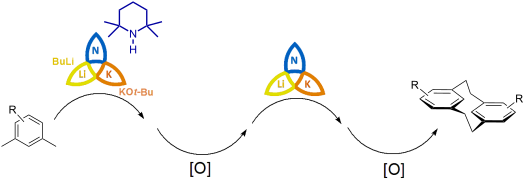
- possible explanation for this is the cumbersome methods required for their synthesis. Typical approaches have utilised Wurtz coupling, the oxidation and thermal (500–600 °C) extrusion of SO2 from dithia[3.3]cyclophanes or the photochemical ring contraction of diselena[3.3]cyclophanes [17][18][19][20][21


Recent developments in gold-catalyzed cycloaddition reactions
Beilstein J. Org. Chem. 2011, 7, 1075–1094, doi:10.3762/bjoc.7.124
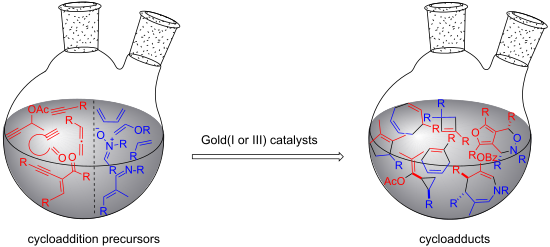
- with a gold(I) catalyst bearing a π-acceptor ligand, such as a triarylphosphite (Au8/AgSbF6, Scheme 28) [98][99][102][103]. Several experimental results as well as theoretical calculations suggest that the observed (4 + 2) cycloadducts 53 are indeed the result of a ring contraction process (1,2-alkyl
- is formed. Nonetheless, the formation of adducts 46 by a ring contraction process in intermediate XXXI cannot be fully discarded. More recently, Fürstner and coworkers have further demonstrated this type of dichotomy depending on the electronic characteristics of the ligands at gold (Figure 2) [106


Gold-catalyzed regioselective oxidation of terminal allenes: formation of α-methanesulfonyloxy methyl ketones
Beilstein J. Org. Chem. 2011, 7, 596–600, doi:10.3762/bjoc.7.69
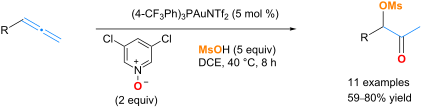
- aminoimidazoles [34], the generation of cyclopropanone–oxyallyl intermediates [35], and ring contraction [36]. Their direct synthesis from corresponding ketones can be realized via oxidation by using either CuO/MsOH [37][38] or PhI(OH)OMs [39]. However, the former method uses stoichiometric amounts of copper


Molecular rearrangements of superelectrophiles
Beilstein J. Org. Chem. 2011, 7, 346–363, doi:10.3762/bjoc.7.45
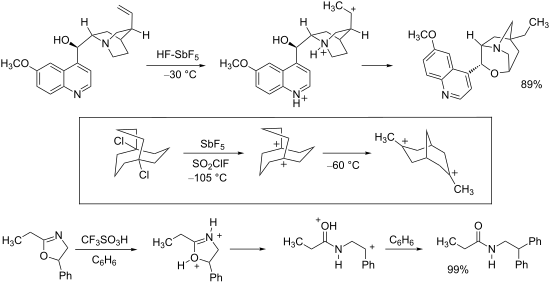
- formation of a tertiary-carbenium ion 45c which ultimately leads to the stable enone structure 47. When 2-cyclohexen-1-one (47) is reacted with HF-SbF5, a ring contraction occurs to give 3-methyl-2-cyclopenten-1-one (50, Scheme 11) [23]. This conversion involves diprotonation of 48 to give a


Reciprocal polyhedra and the Euler relationship: cage hydrocarbons, CnHn and closo-boranes [BxHx]2−
Beilstein J. Org. Chem. 2011, 7, 222–233, doi:10.3762/bjoc.7.30
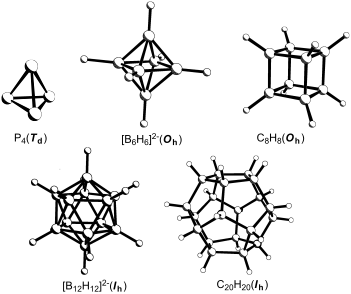
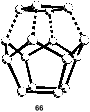
- ] (Scheme 3). Although the yield of the final photolysis step has now been improved somewhat to 15% [12], [3]prismane is still not a conveniently obtainable molecule. Cubane, C8H8, 10 The key step of Eaton's beautiful synthesis of [4]prismane (cubane, 10), shown in Scheme 4, involves the ring contraction of
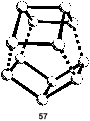
- expected it to be readily available by photolytic [2 + 2] cycloaddition of hypostrophene, 34, or by extrusion of nitrogen from either 35 or 36, as in Scheme 6 [17][18][19][20]; surprisingly, all these routes were found to be ineffective. Success was finally achieved via ring contraction of a
- manipulation led to the iodo-tosylate 39 which, in the presence of base, generated the homohypostrophene, 40; [2 + 2] cycloaddition then furnished the homopentaprismanone 41. Introduction of a bridge head bromine (with the intent of carrying out a Favorskii ring contraction) proved to be impossible. Instead it






Ene–yne cross-metathesis with ruthenium carbene catalysts
Beilstein J. Org. Chem. 2011, 7, 156–166, doi:10.3762/bjoc.7.22
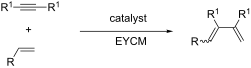
- cycloheptadienes (Scheme 15) [80]. Starting from 1,5-cyclooctadiene, EYCM also took place with terminal alkynes and the same catalyst, but with this substrate a ring contraction was observed. Conjugated cyclohexa-1,3-dienes were formed in good yields with propargylic and homopropargylic alkynes via methylene-free
- . Ring contraction resulting from EYCM of cyclooctadiene. Preparation of bicyclic products via diene-alkyne cross-metathesis. Ethylene helping effect in EYCM. Stereoselective EYCM in the presence of ethylene. Sequential ethenolysis/EYCM applied to unsaturated fatty acid esters. Sequential ethenolysis


Photocycloaddition of aromatic and aliphatic aldehydes to isoxazoles: Cycloaddition reactivity and stability studies
Beilstein J. Org. Chem. 2011, 7, 127–134, doi:10.3762/bjoc.7.18
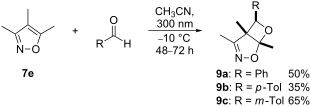
- the presence of benzaldehyde. Instead, a reaction could be observed which also occurred both in the presence of a tenfold excess of aldehyde or without any aldehyde. This reaction was identified as the intramolecular ring contraction of 7f–h to yield the corresponding azirines 8a–c (Scheme 4) [16
- . Photochemical ring contraction of isoxazoles 7f–7h. Photocycloaddition of aromatic aldehydes to di- and trimethyl isoxazoles 7d and 7e. Preparative photocycloadditions of 7e with aromatic aldehydes. T-type photochromism of isoxazole–aldehyde pairs. Reductive cleavage of the trimethylisoxazole adduct 9a



Synthesis of novel photochromic pyrans via palladium- mediated reactions
Beilstein J. Org. Chem. 2009, 5, No. 25, doi:10.3762/bjoc.5.25
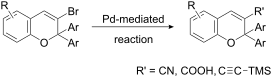
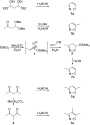
- transformations. Synthesis of the 2-bromo-3H-naphtho[2,1-b]pyran 1 and the 3-bromo-2H-1-benzopyrans 2a/b. Ring contraction observed during the cyanation approach towards the synthesis of 3. Palladium-catalyzed Sonogashira-coupling of 2-bromo-3H-naphtho[2,1-b]pyran 1. Palladium-catalyzed cyanation and


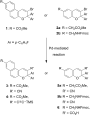


Synthesis of spiropyrans: H-abstractions in 3-cycloalkenyloxybenzopyrans
Beilstein J. Org. Chem. 2007, 3, No. 14, doi:10.1186/1860-5397-3-14
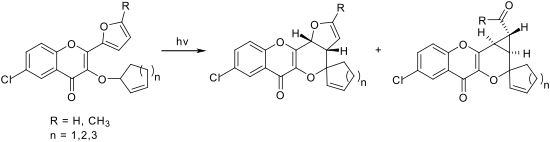
- ), followed by 1,5-H migration in 8a. [21] The spiropyrans 6 (R = H) bearing cyclopropanes are the secondary photoproducts formed as a result of the further reorganization of 5 (R = H), through a ring contraction-ring expansion mechanism. [22][23] The formation of acetylcyclopropane compound 7 (R = CH3) from





