Search results
Search for "Heck reaction" in Full Text gives 86 result(s) in Beilstein Journal of Organic Chemistry.
Intramolecular carbonickelation of alkenes
Beilstein J. Org. Chem. 2013, 9, 710–716, doi:10.3762/bjoc.9.81
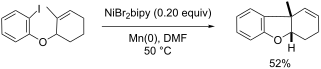
- development of palladium chemistry [4]. The catalytic cycle starts with the oxidative addition of Pd(0) to generate a σ-arylpalladium(II), then a rapid insertion of a double or triple bond takes place [5]. This method was particularly applied in the “Mizoroki–Heck reaction” [6] for the synthesis of
- competitive protonation of the fragile intermediate alkylnickel 2-Ni. While the Pd-catalyzed reductive Heck reaction promoted by a hydride generated in situ is well known [23][24], the nickel-catalyzed process is likely to occur through a radical hydrogen transfer from the DMF [20][25]. The N-allylaniline 1c


N-Heterocyclic carbene–palladium(II)-1-methylimidazole complex catalyzed Mizoroki–Heck reaction of aryl chlorides with styrenes
Beilstein J. Org. Chem. 2012, 8, 1916–1919, doi:10.3762/bjoc.8.222

- )-Im] complex 1 was found to be an effective catalyst for the Mizoroki–Heck reaction of a variety of aryl chlorides with styrenes. Both activated and deactivated aryl chlorides work well to give the corresponding coupling products in good to excellent yields by using tetrabutylammonium bromide (TBAB
- ) as the ionic liquid. Keywords: aryl chloride; Mizoroki–Heck reaction; N-heterocyclic carbene; palladium complex; synthetic method; Introduction The palladium-catalyzed reaction between organic halides and alkenes, the Mizoroki–Heck reaction, is one of the most versatile methods for the formation of
- carbon–carbon bonds [1][2][3][4][5][6][7]. Usually, in order to achieve the highest efficiency of the palladium-catalyzed Mizoroki–Heck reaction, toxic, air-sensitive and expensive phosphine ligands are introduced to facilitate the corresponding transformations [8][9]. In order to overcome the drawbacks


Palladium-catalyzed dual C–H or N–H functionalization of unfunctionalized indole derivatives with alkenes and arenes
Beilstein J. Org. Chem. 2012, 8, 1730–1746, doi:10.3762/bjoc.8.198
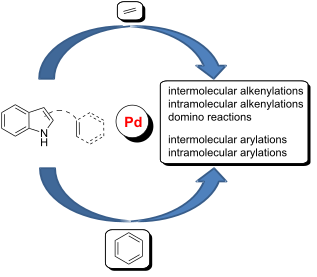
- spiro-products 17 and 18 (Scheme 13). The sole formation of the annulated indole 18 as a single diastereoisomer suggests a mechanism that is strictly closer to the classical oxidative Heck reaction (pathway B) rather than to a Wacker-type reaction (pathway A). In fact, the formation of the product 18 is


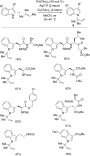


Synthesis of compounds related to the anti-migraine drug eletriptan hydrobromide
Beilstein J. Org. Chem. 2012, 8, 1400–1405, doi:10.3762/bjoc.8.162
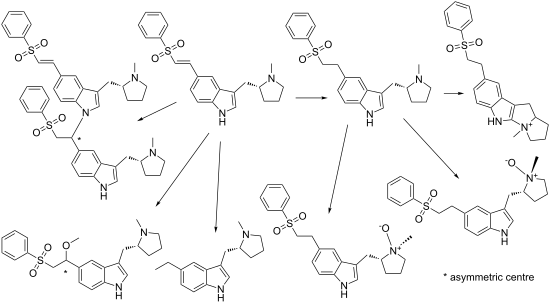
- acetate [9] this affords (R)-1-acetyl-5-[2(phenylsulfonyl)ethyenyl]-3-(N-methylpyrrolidin-2-ylmethyl)-1H-indole (12), under Heck reaction conditions. Deacetylation of (12) by using potassium carbonate affords (R)-5-[(2-phenylsulfonyl)ethenyl]-3-(N-methylpyrrolidine-2-ylmethyl)-1H-indole (13). Reduction of
- palladium on carbon (Scheme 5). The contamination of this impurity in eletriptan hydrobromide (1) was 0.10–0.20%. This impurity can be controlled by tightening up the in-process control of the N-acetyl bromoindole pyrrolidine during the Heck reaction. During the initial process development of eletriptan


Amines as key building blocks in Pd-assisted multicomponent processes
Beilstein J. Org. Chem. 2011, 7, 1387–1406, doi:10.3762/bjoc.7.163
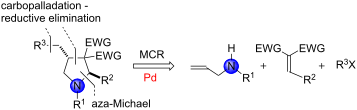
- used. A proper choice of catalyst and reaction conditions is also needed to improve the efficiency of each reaction (Scheme 18) [18]. Consecutive one-pot transformations initiated by Heck reaction and terminated by intramolecular aza–Michael addition were developed by Hanson and coworkers to access a


Evaluation of a commercial packed bed flow hydrogenator for reaction screening, optimization, and synthesis
Beilstein J. Org. Chem. 2011, 7, 1141–1149, doi:10.3762/bjoc.7.132
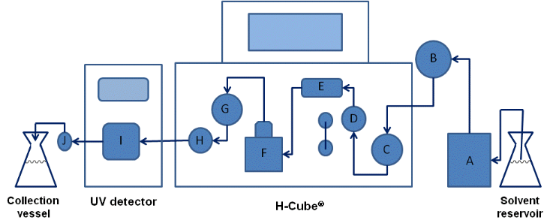
- (Figure 7). It should be noted that Kappe observed a “Pd mirror” due to soluble Pd leaching from a CatCart® during a continuous flow Mizorki–Heck reaction [24]. In comparison, the fine black precipitate seen in our wash experiment is more consistent with solid Pd/C catalyst. The experiment was repeated


Unusual behavior in the reactivity of 5-substituted-1H-tetrazoles in a resistively heated microreactor
Beilstein J. Org. Chem. 2011, 7, 503–517, doi:10.3762/bjoc.7.59
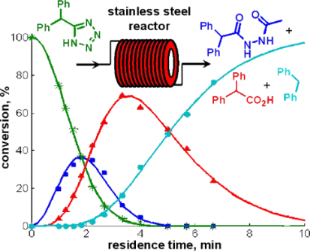
- of 1.0 mm i.d. coil) was “loaded” with Pd by processing ≈2 mL of the Mizoroki–Heck reaction mixture through the coil under reaction conditions (180 °C, 1.6 mL/min flow rate) with 1 mol % of the Pd(OAc)2 as pre-catalyst. As expected, the desired product 14 was obtained in 94% isolated yield after
- relatively low (Table 2, entries 1 and 2), significantly higher levels of Pd were found in samples derived from the Mizoroki–Heck reaction mixture (Table 2, entry 3). These results, both in terms of decreasing conversion and Pd leaching are therefore analogous to the experiments using Pd/C as a heterogeneous
- . Only renewed loading of the coil by running a Mizoroki–Heck reaction with Pd(OAc)2 or by simply processing a Pd(OAc)2 solution through the coil at elevated temperature regenerated the “palladated” stainless steel coils. Influence of pressure on reaction rate in flow reactors In the resistively heated


An overview of the key routes to the best selling 5-membered ring heterocyclic pharmaceuticals
Beilstein J. Org. Chem. 2011, 7, 442–495, doi:10.3762/bjoc.7.57
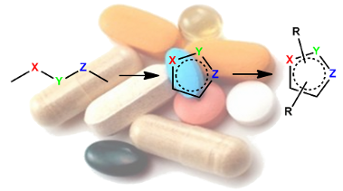
- sulfonamides, all prepared in high yields. As this route employs sulfonamide-stabilised anions the preparation and handling of unstable sulfonyl chloride intermediates is therefore circumvented (Scheme 14) [17]. An analogous Heck reaction approach has also been employed to introduce a homologous side chain as
- eletriptan (Scheme 20). A rather ingenious Mitsunobu coupling reaction has been used to create a highly functionalised substrate 96 for an intramolecular Heck reaction resulting in a very short and succinct synthesis of eletriptan and related analogues 97 [29] (Scheme 21). Interestingly, it was found that
- serotonin 5-HT3 receptor antagonist ondansetron (119, Zofran). In this synthesis a palladium-catalysed intramolecular Heck-reaction was used to build the tricyclic indole core in a short and concise sequence (Scheme 26) [35][36]. Alternatively, a direct Fischer indole synthesis between phenylmethyl





Studies on Pd/NiFe2O4 catalyzed ligand-free Suzuki reaction in aqueous phase: synthesis of biaryls, terphenyls and polyaryls
Beilstein J. Org. Chem. 2011, 7, 310–319, doi:10.3762/bjoc.7.41
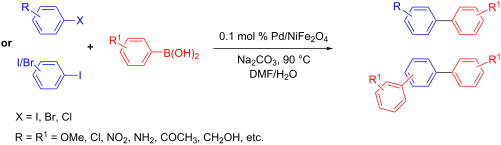
- reactions was demonstrated [40]. The most important paradigm of this reaction is the easy removal of catalyst from the reaction mixture by employing an external magnetic field. We recently reported the filtration-free magnetically separable Pd/NiFe2O4 catalyst for the Heck reaction [41]. Herein, we report

Pd-catalyzed decarboxylative Heck vinylation of 2-nitrobenzoates in the presence of CuF2
Beilstein J. Org. Chem. 2010, 6, No. 43, doi:10.3762/bjoc.6.43
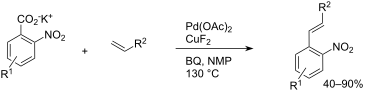
- ][18]. We developed a process in which benzoic acids are activated by esterification with electron-poor phenols with the loss of water [19]. The esters are then subjected to a decarbonylative Heck reaction to yield vinyl arenes, CO and the phenols, which can be used in further reaction cycles. In a
- related approach, the benzoic acids activated as isopropenyl esters undergo a decarbonylative Heck reaction that yields the vinyl arenes along with CO and acetone [20]. Since no base is added, only volatile by-products are generated instead of waste salts, and the amount of solvent can be minimized. Myers
- and co-workers introduced another version of the Heck reaction in 2002, in which they converted mostly electron-rich aromatic carboxylic acids and alkenes to vinyl arenes with the release of CO2 [21][22][23]. This decarboxylative Heck reaction allows the direct conversion of benzoic acids without


Mitomycins syntheses: a recent update
Beilstein J. Org. Chem. 2009, 5, No. 33, doi:10.3762/bjoc.5.33
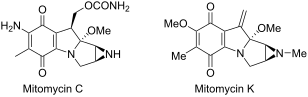
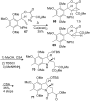
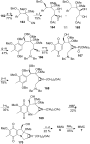
- oxidation and an intramolecular Heck reaction [149]. Exposure of the quinone 207 to sunlight triggered the formation of benzoxazole 208, which cleaved to form an intermediate iminium salt. Subsequent proton transfer gave the vinylogous carbamate 209 (Scheme 57). After oxidation of the hydroquinone to the