Search results
Search for "acetophenone" in Full Text gives 123 result(s) in Beilstein Journal of Organic Chemistry.
An investigation of the observed, but counter-intuitive, stereoselectivity noted during chiral amine synthesis via N-chiral-ketimines
Beilstein J. Org. Chem. 2013, 9, 2103–2112, doi:10.3762/bjoc.9.247
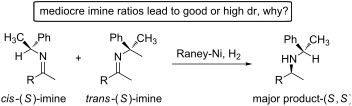
- hydrogenation catalyst or not), the cis/trans-imine ratios were found to be static in the aprotic reaction solvents we measured them in. Reduction of imines 2 The reported cis/trans ratio (5:95) for imine 2a [55][63][64], from acetophenone (1a), is very similar to our own measurement (6:94). (Regarding the
- ratio assessment is to compare the two down field quartets originating from the PEA auxiliary. See the 1H NMR data for imine 4a (Table 1) of ref [47]. Hogeveen reduced the (S)-N-phenylethylimine of acetophenone with Pd-C/H2 and recorded a 70% de. This is much lower than what we and others have observed


Raman spectroscopy as a tool for monitoring mesoscale continuous-flow organic synthesis: Equipment interface and assessment in four medicinally-relevant reactions
Beilstein J. Org. Chem. 2013, 9, 1843–1852, doi:10.3762/bjoc.9.215
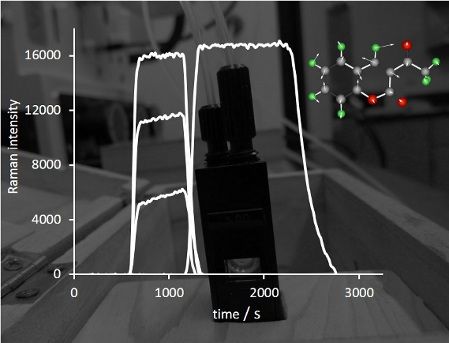
- effect on the outcome of the reaction (Table 2, entries 3 and 4). The Claisen–Schmidt condensation We moved next to study the Claisen–Schmidt condensation of benzaldehyde with acetophenone to yield chalcone (Scheme 3). Chalcones display interesting biological properties such as antioxidant, cytotoxic
- (CH), 129.74 (CH), 130.93 (CH), 133.17 (C), 134.88 (C), 141.48 (CH), 168.00 (C), 194.87 (C) [54]. Typical procedure for monitoring the Claisen–Schmidt reaction Into a 50 mL volumetric flask was added 4-fluorobenzaldehyde (1.551 g, 12.5 mmol, 1 equiv) and acetophenone (1.637 g, 12.5 mmol, 1 equiv
- = 10 s). Monitoring the conversion of benzaldehyde with acetophenone to chalcone, 3a, across a range of reaction conditions (scan time = 15 s, integration = 10 s). Monitoring the conversion of benzaldehyde, ethyl acetoacetate, and urea to 5-ethoxycarbonyl-6-methyl-4-phenyl-3,4-dihydropyrimidin-2(1H



Total synthesis of ochnaflavone
Beilstein J. Org. Chem. 2013, 9, 1346–1351, doi:10.3762/bjoc.9.152
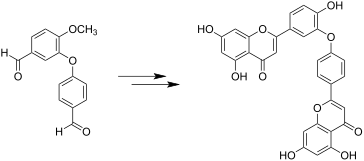
- formation of the chalcone by an aldol condensation reaction with a suitably substituted acetophenone. Selective methylation of 2,4,6-trihydroxyacetophenone with methyl iodide yielded 2'-hydroxy-4',6'-dimethoxyacetophenone (5) in moderate yield. The Claisen–Schmidt condensation of 5 with diaryl ether 4 under


Metal-free aerobic oxidations mediated by N-hydroxyphthalimide. A concise review
Beilstein J. Org. Chem. 2013, 9, 1296–1310, doi:10.3762/bjoc.9.146
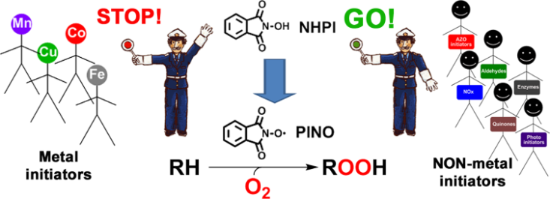
- acetophenone [33]. Among the different AQ derivatives that were tested, 1,4-diamino-2,3-dichloro-antraquinone (DADCAQ) was the most effective in terms of both conversion and selectivity of the ketone product. The potential of this catalytic system was proved by extending its application, in the absence of
- hydrocarbons, Xu and co-workers developed other redox initiators in addition to the NHPI/quinone systems previously described. In 2005 they reported the selective oxygenation of ethylbenzene to the corresponding acetophenone by means of a NHPI/o-phenanthroline-mediated organocatalytic system, in the presence
- described above led to the formation of acetophenone as the major product of ethylbenzene oxidation. A different result was achieved by Fierro et al. who, in the same year, reported the ethylbenzene oxidation to its hydroperoxide by operating in the presence of NHPI (or other NHIs, i.e., N


Amyloid-β probes: Review of structure–activity and brain-kinetics relationships
Beilstein J. Org. Chem. 2013, 9, 1012–1044, doi:10.3762/bjoc.9.116
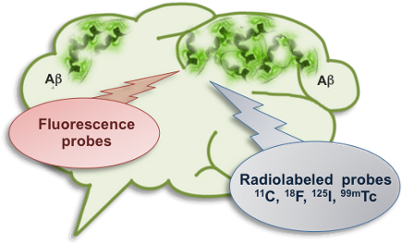
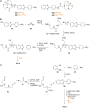
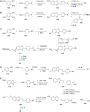
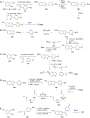
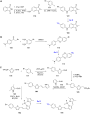
- and [11C]-labeled chalcones 19a and 19b were synthesized using similar methods, and a representative synthesis of 19a is shown (Scheme 2B). Aldol condensation between the appropriate acetophenone 22 and benzaldehyde 23 afforded the chalcone backbone, which was subsequently pegylated to give 24 and









Enantioselective reduction of ketoimines promoted by easily available (S)-proline derivatives
Beilstein J. Org. Chem. 2013, 9, 633–640, doi:10.3762/bjoc.9.71
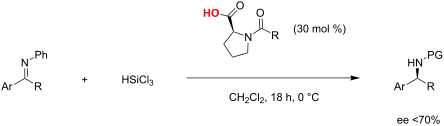
- testing the commercially available N-Boc-L-proline (1) as catalyst in the reduction of ketimines with trichlorosilane. The imines were typically prepared with a microwave-promoted reaction between acetophenone and the aromatic amine in toluene in the presence of K10 clay as activator. The first screening
- thionyl chloride under reflux for 4 hours. The catalytic efficiency of these catalysts was evaluated in the stereoselective reduction of the N-phenyl imine of acetophenone (Table 2). After running the reaction in dichloromethane at 0 °C for 18 hours, all the catalysts afforded the desired product in
- substituted imines (Table 3). Catalyst 5 showed a good chemical activity, promoting the enantioselective reduction in yields up to 88%, except when a very bulky protecting group was used (Table 3, entry 4). In the reaction of both N-Ph and N-PMP imines derived from acetophenone a discrete level of


Reactions of salicylaldehyde and enolates or their equivalents: versatile synthetic routes to chromane derivatives
Beilstein J. Org. Chem. 2012, 8, 2166–2175, doi:10.3762/bjoc.8.244

- . The enolates and their equivalents involved in the reactions discussed in this article were derived from ketones, nitroalkanes, malononitrile and α,β-unsaturated compounds. Keywords: acetophenone; chromane; enolates; malononitrile; Michael addition; salicylaldehyde; Introduction The chromane
- from acetophenone (7) has been employed by a number of chemists in the synthesis of flavans and flavones. Flavans are chromane derivatives with a C-2 phenyl substituent while flavones are chromane derivatives with a carbonyl functional group at C-4, a carbon–carbon double bond between C-2 and C-3, and
- a C-2 phenyl substituent. The synthesis of flavans and flavones generally involves treatment of acetophenone (7) with a base to give enolate 8, which undergoes a Knoevenagel condensation with salicylaldehyde (5) to yield a chalcone 9. These chalcone derivatives are then cyclized by using various


Design and synthesis of quasi-diastereomeric molecules with unchanging central, regenerating axial and switchable helical chirality via cleavage and formation of Ni(II)–O and Ni(II)–N coordination bonds
Beilstein J. Org. Chem. 2012, 8, 1920–1928, doi:10.3762/bjoc.8.223
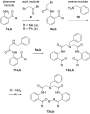
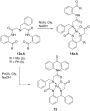
- of target complexes 19/20. It is interesting to note that the acetophenone module-derived compound 14a gave the expected enolate 16a; however, its further oxidation lead mostly to decomposition, suggesting higher instability of intermediate derivatives of type 17 and 18 [48]. Also, the benzophenone


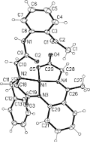

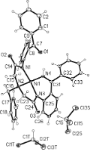
Palladium-catalyzed substitution of (coumarinyl)methyl acetates with C-, N-, and S-nucleophiles
Beilstein J. Org. Chem. 2012, 8, 1200–1207, doi:10.3762/bjoc.8.133
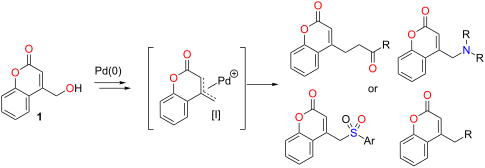
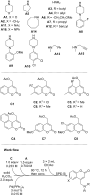
- conditions (5 mol % Pd(PPh3)4, MeCN, rt, Table 1, entry 3), a variety of enolate nucleophiles could be selectively coupled with coumarin electrophiles (Scheme 2). For example, acetone, acetophenone and 1,1,1-trimethylacetone enolates can all be generated and coupled with the coumarin electrophile



Volatile organic compounds produced by the phytopathogenic bacterium Xanthomonas campestris pv. vesicatoria 85-10
Beilstein J. Org. Chem. 2012, 8, 579–596, doi:10.3762/bjoc.8.65
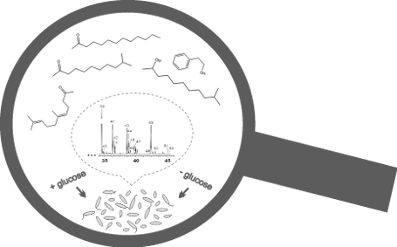
- -methylbutyl propionate (14), and the corresponding 2-methylbutyl esters 5 and 13 as well as 3-methylbutyl 3-methylbutyrate (19) could be identified. Trace amounts of benzylalcohol (18), acetophenone (20) and 2-phenylethanol (23) and its acetate (29) along with the three alkylated pyrazines 8, 16, 33 were the




Efficient and selective chemical transformations under flow conditions: The combination of supported catalysts and supercritical fluids
Beilstein J. Org. Chem. 2011, 7, 1347–1359, doi:10.3762/bjoc.7.159
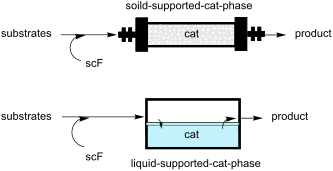
- reported by Poliakoff and Sheldon involving two sequential reactions (Scheme 8) [94]. In that case, the first step was the continuous hydrogenation of acetophenone to afford the racemic phenylethanol with Pd supported on SiO2/Al2O3 as the catalyst and scCO2 as the reaction medium (150–200 °C, 10 MPa, 1.1
- . Enantioselective hydroformylation of styrene. Enantioselective hydrovinylation of styrene. Enantioselective cyclopropanation of styrene catalyzed by supported Cu–BOX, Cu–PyOX and Rh–PyBOX catalysts. Continuous hydrogenation of acetophenone coupled with the kinetic resolution of the product. Kinetic resolution of


Photoinduced electron-transfer chemistry of the bielectrophoric N-phthaloyl derivatives of the amino acids tyrosine, histidine and tryptophan
Beilstein J. Org. Chem. 2011, 7, 518–524, doi:10.3762/bjoc.7.60
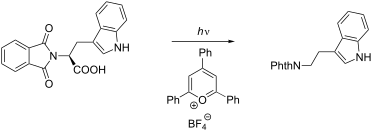
- temperature and in ethanol at low temperatures are known: Triplet acetone, acetophenone and xanthone in acetonitrile are quenched by 1 via energy transfer; the rate constant is almost diffusion-controlled and somewhat smaller for benzophenone. The sole product from the photolysis of 1 is the double hydrogen


Photocycloaddition of aromatic and aliphatic aldehydes to isoxazoles: Cycloaddition reactivity and stability studies
Beilstein J. Org. Chem. 2011, 7, 127–134, doi:10.3762/bjoc.7.18
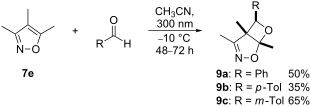
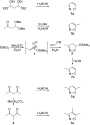
- of aci-nitroethane 1 (Scheme 1). The reaction of acetylacetaldehyde with hydroxylamine gave 7b, exclusively. 3,5-Diphenylisoxazole (7f) was prepared from acetophenone and methyl benzoate, followed by cyclization of the resulting diketone 4 with hydroxylamine. 5-Methoxy-3-phenylisoxazole (7g) and 5
- , CH3), 20.9 (1C, CH3), 12.2 (1C, CH3). 1H NMR (300 MHz, CDCl3): 3.59 (q, 1H, 3J = 7.2 Hz, CH), 2.06 (s, 6H, 2 × CH3), 1.97 (s, 3H, CH3), 1.70 (s, 1.5H, CH3), 1.19–1.16 (d, 3H, 3J = 6.9 Hz, CH3). 1,3-Diphenylpropane-1,3-dione (4). A mixture of acetophenone (30.04 g, 0.25 mol, 29.2 mL), methyl benzoate



Donor-acceptor substituted phenylethynyltriphenylenes – excited state intramolecular charge transfer, solvatochromic absorption and fluorescence emission
Beilstein J. Org. Chem. 2010, 6, 992–1001, doi:10.3762/bjoc.6.112
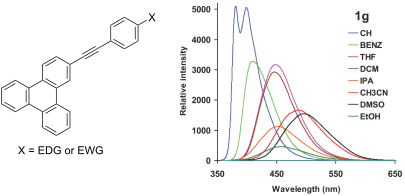
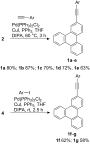
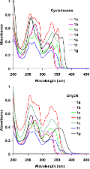
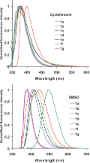
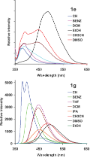
- , 354.1287. 4-(2-Triphenylenylethynyl)acetophenone (1d). The crude product was purified by column chromatography with a mixture of hexane and dichloromethane (4:1, v/v) as eluant to yield 1d as a colorless solid (0.506 g, 72%), mp 181–183 °C; IR (neat) 3067, 2218, 1669 cm−1; 1H NMR (CDCl3, 400 MHz) δH = 8.86




Systematic investigations on the reduction of 4-aryl-4-oxoesters to 1-aryl-1,4-butanediols with methanolic sodium borohydride
Beilstein J. Org. Chem. 2010, 6, 748–755, doi:10.3762/bjoc.6.94
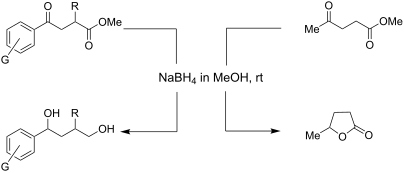
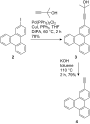
- protic polar co-solvents with different product distributions depending upon the nature of the co-solvent (Table 2). Compounds 1a, 3, acetophenone and butyrophenone were individually subjected to reduction in ether (Table 3) in the presence of MeOH (2 equiv) for a limited period of time (1 h). It was


Concise methods for the synthesis of chiral polyoxazolines and their application in asymmetric hydrosilylation
Beilstein J. Org. Chem. 2010, 6, No. 29, doi:10.3762/bjoc.6.29
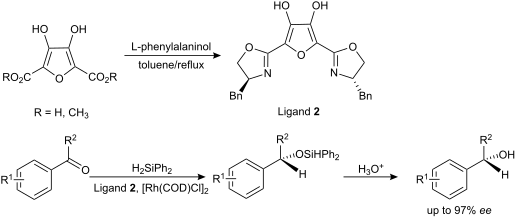
- explored (Table 2 and Table 3). The reduction of acetophenone was first examined, since this is often used as the standard ketone in investigations of asymmetric hydrosilylation. The reaction of acetophenone with diphenylsilane in the presence of polyoxazolines 1–7 and [Rh(COD)Cl]2 was studied (Table 2
- temperature was raised to −5 °C, the acetophenone disappeared completely within 72 h to afford 1-phenylethanol in a yield of 86% with 89% ee (entry 2). As the temperature was raised to room temperature, the reaction was accelerated further, but the ee was slightly lower (entry 3). Therefore, the reaction
- , exceeding that observed in either CCl4 or CH3OH (entries 2, 4 and 5). Catalyst concentrations were generally employed at 2 mol %, relative to acetophenone (entry 2), although loadings as low as 0.5 mol % could be used, a longer reaction time was required (entry 8). However, whereas a higher catalyst loading


A review of new developments in the Friedel–Crafts alkylation – From green chemistry to asymmetric catalysis
Beilstein J. Org. Chem. 2010, 6, No. 6, doi:10.3762/bjoc.6.6
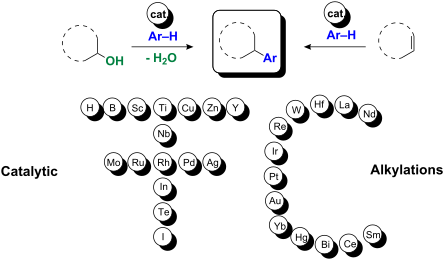
- “on water”. Reductive FC alkylation of arenes with benzaldehyde and acetophenone catalyzed by the Ir-carbene complex 33. Formal synthesis of 1,1-diarylalkanes from benzyl alcohols and styrenes. (A) Mo-catalyzed hydroarylation of styrenes and cyclohexenes. (B) Hydroalkylation–cyclization cascade


2-Phenyl- tetrahydropyrimidine- 4(1H)-ones – cyclic benzaldehyde aminals as precursors for functionalised β2-amino acids
Beilstein J. Org. Chem. 2009, 5, No. 43, doi:10.3762/bjoc.5.43

- temperature. Despite the success in condensing 3 and benzaldehyde (dimethylacetal), all attempts to condense 3 with closely related acetophenone dimethylketal did not lead to any cyclisation product. To facilitate our selective ring opening concept, the N3-nitrogen of 4 had to be protected as a carbamate


Asymmetric reactions in continuous flow
Beilstein J. Org. Chem. 2009, 5, No. 19, doi:10.3762/bjoc.5.19
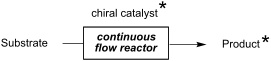
- unmodified silica lowered the activity of the catalyst system, presumably via adsorption of some of the Ru(II) catalyst. Under optimal flow conditions, the transfer hydrogenation of acetophenone in isopropanol (using a flow-reactor consisting of a column packed with a slurry of the immobilized catalyst
- ). Continuous-flow asymmetric cyclopropanation. Continuous asymmetric hydrogenation of dimethyl itaconate in scCO2. Continuous asymmetric transfer hydrogenation of acetophenone. Asymmetric epoxidation using a continuous flow membrane reactor. Enzymatic cyanohydrin formation in a microreactor. Resolution of (R/S


Part 3. Triethylborane- air: a suitable initiator for intermolecular radical additions of S-2-oxoalkyl- thionocarbonates (S-xanthates) to olefins
Beilstein J. Org. Chem. 2007, 3, No. 47, doi:10.1186/1860-5397-3-47

- consumed and only 12% of acetophenone (2b) were formed. Similarly, xanthate 3a, in the presence of olefin 12, succeeded in giving adduct 24a (47%, entry 10) accompanied by some p-methoxyacetophenone (3b) (26%). For these two substrates, comparison between experiments 7–10 showed a striking effect of the


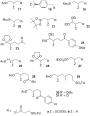

The first organocatalytic carbonyl- ene reaction: isomerisation- free C-C bond formations catalysed by H-bonding thio- ureas
Beilstein J. Org. Chem. 2007, 3, No. 24, doi:10.1186/1860-5397-3-24
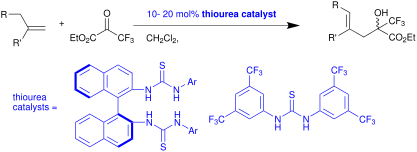
- catalyse ene reactions between α-methylstyrene and ethyl glyoxylate, trifluoro-acetophenone, or α-bromopyruvate. However, we have not had success with transition metal catalysed ketone ene reactions using these latter two substrates either. These studies reveal that the scope of the organocatalytic


A convenient catalyst system for microwave accelerated cross- coupling of a range of aryl boronic acids with aryl chlorides
Beilstein J. Org. Chem. 2007, 3, No. 18, doi:10.1186/1860-5397-3-18
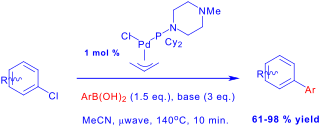
- evaluate this aspect, so we elected to investigate the effect of the boronic acid component using one aryl chloride substrate, 4-chloro-acetophenone. Representative results are compiled in Table 1. A range of boronic acids can be coupled with high conversion and good to excellent isolated yield for the


Trapping evidence for the thermal cyclization of di-(o-acetylphenyl)acetylene to 3,3'-dimethyl- 1,1'-biisobenzofuran
Beilstein J. Org. Chem. 2005, 1, No. 18, doi:10.1186/1860-5397-1-18
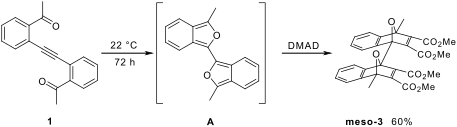
- involving Pd(PPh3)4, CuI, and Et3N in toluene gave 2'-(trimethylsilylethynyl)acetophenone as a brown oil in 99% yield (See additional data file 1 for experimental details and spectral characterization of new compounds). Deprotection of 2'-(trimethylsilylethynyl)acetophenone was accomplished by reaction with