Search results
Search for "complex formation" in Full Text gives 178 result(s) in Beilstein Journal of Organic Chemistry.
Synthetic strategies for the fluorescent labeling of epichlorohydrin-branched cyclodextrin polymers
Beilstein J. Org. Chem. 2014, 10, 3007–3018, doi:10.3762/bjoc.10.319
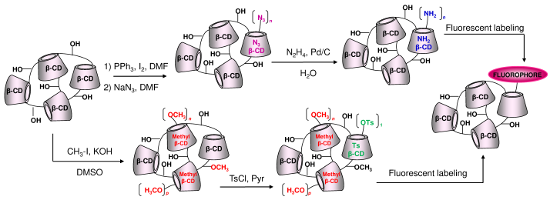
- polymeric network before the introduction of the anchoring group for the fluorescent labeling (Scheme 3). Methylated cyclodextrins have peculiar properties concerning both solubility and complex formation thus targeting a water-soluble methylated β-CD polymer with a low degree of substitution can be


A comparative study of the interactions of cationic hetarenes with quadruplex-DNA forming oligonucleotide sequences of the insulin-linked polymorphic region (ILPR)
Beilstein J. Org. Chem. 2014, 10, 2963–2974, doi:10.3762/bjoc.10.314
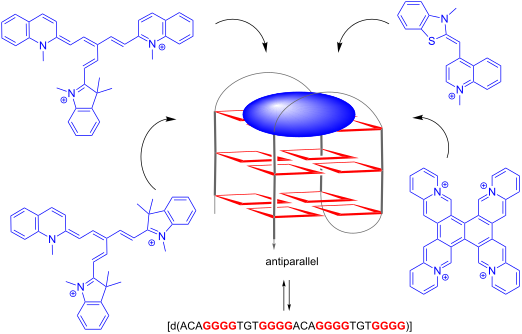
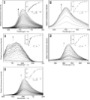
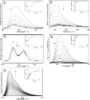
- derivative 4 with the ILPR-DNA. However, it should be noted that strong fluctuations in the Job plot of the complex formation between ligand 1e and ILPR-DNA a2, especially between XLigand = 0–0.4, indicate strong heterogeneous binding under these conditions. CD spectroscopic analysis of ligand–DNA
- structure of a2 [9][10] the induced increase may indicate a stabilization of this DNA structure upon complex formation. Moreover, a comparison with the telomeric quadruplex 22AG shows that the ligands 1d, 1e and 6 induce the same effect on the CD band of this quadruplex at 295 nm (Supporting Information
- complex formation between a2 and 1d and 1e does not lead to a significant change of the DNA structure. In the case of ligands 2, 4, 5 and 6, a negative CD band developed at 265 nm together with a weak positive band with a maximum at ca. 240 nm upon association with quadruplex a2 (Figure 8). Along with the




Synthesis and characterization of a new photoinduced switchable β-cyclodextrin dimer
Beilstein J. Org. Chem. 2014, 10, 2874–2885, doi:10.3762/bjoc.10.304
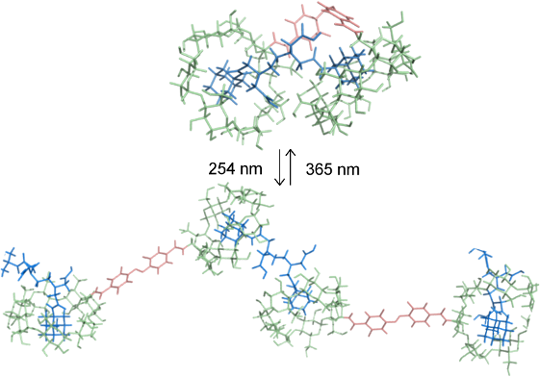
- complex formation through their wider rim with two adamantyl units belonging to two different ADAdim 4 molecules, leading to the formation of supramolecular polymers with an n:n stoichiometry. This situation has already been encountered in the complex of ADAdim 4 and a β-CD dimer bearing a terephthalic



Synthesis of modified cyclic and acyclic dextrins and comparison of their complexation ability
Beilstein J. Org. Chem. 2014, 10, 2836–2843, doi:10.3762/bjoc.10.301
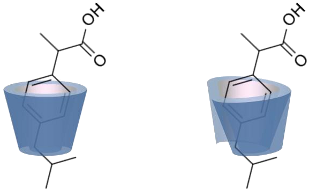
- from the three native α-, β-, and γ-cyclodextrins, respectively, are also suitable complexing agents. These maltooligomers are often considered as linear dextrins unable to form inclusion complexes [4]. Komiyama et al. found that there is complex formation but the complex forming ability of closed ring
- favorably cyclic conformation and this explains the weak complex formation contrary to the smaller-sized non-cyclic analogs (G3, G4 and G5) not showing any interaction. In another study of Bettinetti et al. G7 was found to wrap up naproxen, taking on a cyclic conformation and forming a ‘pseudo’ inclusion


A study on the inhibitory mechanism for cholesterol absorption by α-cyclodextrin administration
Beilstein J. Org. Chem. 2014, 10, 2827–2835, doi:10.3762/bjoc.10.300
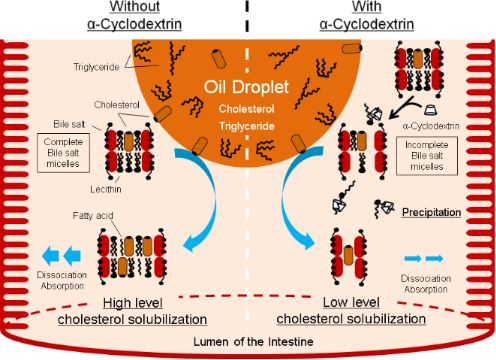
- solubility of cholesterol in the lumen of the small intestine via the precipitation of lecithin from bile salt micelles by complex formation with α-CD. It further indicates that the lecithin precipitation effect on the bile salt micelles by α-CD addition clearly differs from addition of other water-soluble


Thermal and oxidative stability of the Ocimum basilicum L. essential oil/β-cyclodextrin supramolecular system
Beilstein J. Org. Chem. 2014, 10, 2809–2820, doi:10.3762/bjoc.10.298
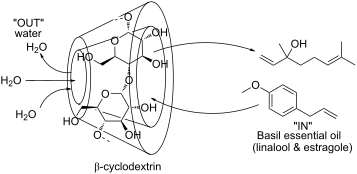
- complexation process, was 74.2%. This relatively high recovery yield for the β-CD complex can be explained by the lower water (as well as ethanol/water) solubility. The quality of the essential oil/β-CD complex formation was sustained by the morphology of the complex crystals, evaluated by scanning electron
- ][42][43][44][45]. The main compounds from O. basilicum L. essential oil, linalool and methylchavicol, have been used as guests for bicomponent encapsulation in CDs [39][41][46][47]. Linalool was encapsulated in β-CD [41] and its derivative 2-hydroxypropyl-β-CD [39] with good results and the complex
- formation was determined by thermal analysis (TG, DSC), FTIR and XRD. The quality of the encapsulation has been studied by gas chromatographic methods. Methylchavicol and other structurally related volatiles were also encapsulated in various natural CDs such as α- and β-CD, as well as in semisynthetic


Removal of volatile organic compounds using amphiphilic cyclodextrin-coated polypropylene
Beilstein J. Org. Chem. 2014, 10, 2743–2750, doi:10.3762/bjoc.10.290
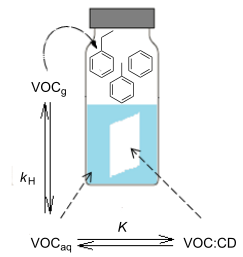
- 60/40 [21]. However, if for some reason the cavities of the ACDs are inaccessible for inclusion complex formation, it would not be cost-efficient to simply focus on obtaining the maximum coating amount. For this reason, the uptake capacity of the coating obtained from a coating solutions of ethanol
- , see Figure 1. It is known that one of the driving forces in inclusion complex formation in water between CDs (the host) and the included compound (the guest) is the hydrophobicity of the guest [7]. Hence, there is an inherent tendency towards the formation of inclusion complexes with 5 in comparison
- with 1 (see Table 2 for reference to hydrophobicity of the VOCs, represented by the log P value). Although butylbenzene (6) was expected to have the highest affinity towards the cavity due its hydrophobicity, it seems not to be as prone to complex formation as anticipated. As briefly mentioned above


Synthesis of graft polyrotaxane by simultaneous capping of backbone and grafting from rings of pseudo-polyrotaxane
Beilstein J. Org. Chem. 2014, 10, 2573–2579, doi:10.3762/bjoc.10.269
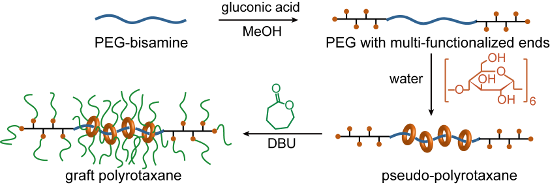
- consisting of a PEG backbone and α-CDs modified with PCL graft chains. The GPRs were readily obtained by a three-step reaction, which included the activation of the end groups of PEG, complex formation of the PEG derivative and α-CD, and simultaneous end-capping/grafting reactions. The PCL chains


Effect of cyclodextrin complexation on phenylpropanoids’ solubility and antioxidant activity
Beilstein J. Org. Chem. 2014, 10, 2322–2331, doi:10.3762/bjoc.10.241
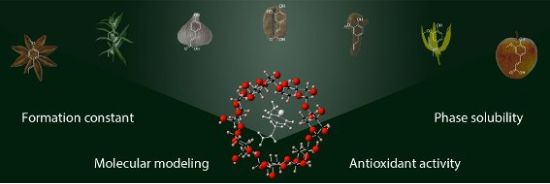
- . This result could be explained by the higher hydrophobic character of its cavity which favors inclusion complex formation [31]. It is well known that complexation with CDs depends on guest hydrophobicity (expressed by different descriptors) [32][33][34][35]. However, in our study, no clear correlation
- hydroxylation. This could explain why 1 and 2, which carry no hydroxy group, reacted little with DPPH•. The activity of 3, 4, 5, 6 and 7 was kept unchanged upon complexation with CDs. This indicated that CDs did not interfere with the active groups of these PPs during inclusion complex formation which was still


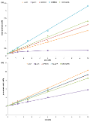


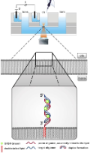
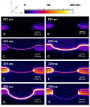
Specific DNA duplex formation at an artificial lipid bilayer: fluorescence microscopy after Sybr Green I staining
Beilstein J. Org. Chem. 2014, 10, 2307–2321, doi:10.3762/bjoc.10.240
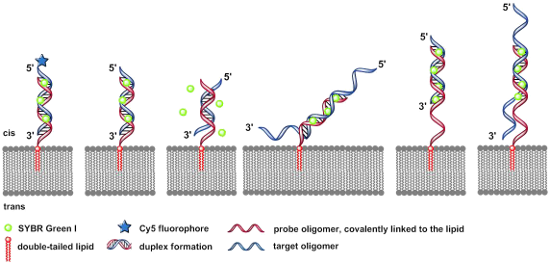
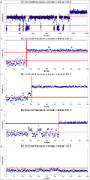
- spontaneous complex formation with the intercalating dye. Moreover, the complex between 4 and 9 as well as of Sybr Green I at the bilayer seems to be highly labile because already a single perfusion step of the cis compartment (1 min, 1.1 mL of buffer at t = 143 min) leads to an almost 90% disappearance of
- which could not be observed. It is, however, obvious that a severe disturbance of either the complex formation between the probe lipo-oligonucleotide 4 and the target nucleic acid 9 and/or the intercalation of the Sybr Green dye by the overhang take place. This might be the reason for the instability of
- as the target sequence overhang (6 bp). From Figure 10 it can be seen that in this case the ternary complex formation occurs spontaneously upon addition of a first portion of the dye solution. This is, however, not a stable situation because an incubation of only 6 min (without perfusion!) leads to a








End group functionalization of poly(ethylene glycol) with phenolphthalein: towards star-shaped polymers based on supramolecular interactions
Beilstein J. Org. Chem. 2014, 10, 2263–2269, doi:10.3762/bjoc.10.235
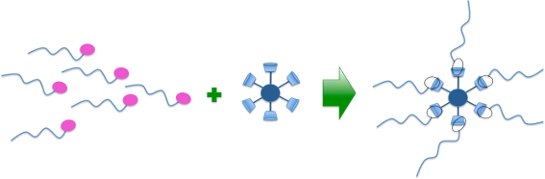
- of stable inclusion complexes was observed, representing an interesting approach towards the formation of star shaped polymers. The decolorization of a basic polymer solution caused by the complexation was of great advantage since this behavior enabled following the complex formation by UV–vis
- combination of CRP with supramolecular complex formation, e.g., by the use of cyclodextrins (CDs) [6][7][34]. The most important representatives of these cyclic oligosaccharides with respect to industrial applications consist of six (α-CD), seven (β-CD) and eight (γ-CD) glucopyranose units and have a cone
- , since this nature strongly supports the inclusion complex formation. With respect to both requirements, methoxypoly(ethylene glycol) with an average molecular weight of 350 g/mol was chosen, which should generally allow working in aqueous media while preserving the hydrophobic nature of the PP moiety


Palladium-catalysed cyclisation of alkenols: Synthesis of oxaheterocycles as core intermediates of natural compounds
Beilstein J. Org. Chem. 2014, 10, 2077–2086, doi:10.3762/bjoc.10.216
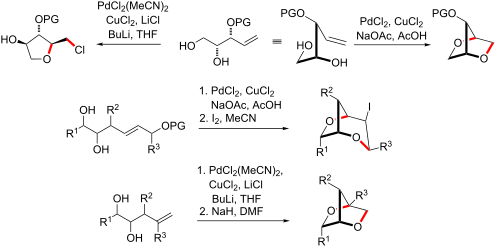
- , η3-complex formation...) which are applicable to predict the behaviour of the used substrate in the Pd-catalysed reaction, there are cases where the results of such reactions still remain on experimental findings. While the cyclisation reactions of alkenols have been relatively well described in the



Photo, thermal and chemical degradation of riboflavin
Beilstein J. Org. Chem. 2014, 10, 1999–2012, doi:10.3762/bjoc.10.208
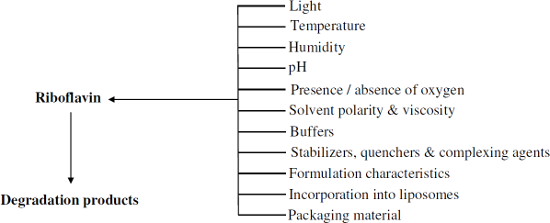
- anions such as hydrogen phosphate and sulfate (buffered solutions), tartrate, succinate and malonate (unbuffered solutions). These anions changed the mode of photodegradation of RF and caused intramolecular photoaddition via the RF-divalent anion complex formation along with the normal photolysis
- fluorescence data that showed lower fluorescence quenching by unbuffered anions as compared to that of phosphate species [30]. A much faster rate of RF photodegradation has been observed for sulfate anions than for phosphate anions (Figure 6) due to a strong complex formation, better electronegative character




Macrocyclic bis(ureas) as ligands for anion complexation
Beilstein J. Org. Chem. 2014, 10, 1834–1839, doi:10.3762/bjoc.10.193
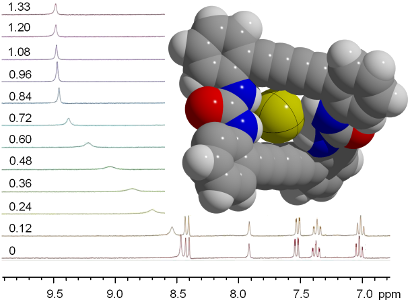
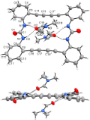
- from 2.32 to 2.25 Å. For 1, which is in pure form soluble only in DMF or DMSO, it was possible to record spectra in acetone-d6, since the solubility was highly increased by the addition of ammonium salts and subsequent complex formation. The effects on the N−H proton resonances are weaker compared with
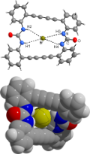
- , indicating a complex of two bis(urea) molecules and one chloride ion. For the smaller macrocyclus 1 the Job plots do not show a distinct plateau after addition of one equivalent of anion. Here, doubtless an interaction is present but apparently not a distinct host–guest complex formation. The binding
- confirmed by the Job plots for all anions except Cl−. Because the Job plot for the complex formation between 2 and nitrate shows the maximum of the curve not exactly at a molar ratio of 0.5 additional investigations via ESI mass spectrometry studies of NEt4[NO3·2] were undertaken. Signals at m/z = 515.2 and



A promising cellulose-based polyzwitterion with pH-sensitive charges
Beilstein J. Org. Chem. 2014, 10, 1549–1556, doi:10.3762/bjoc.10.159
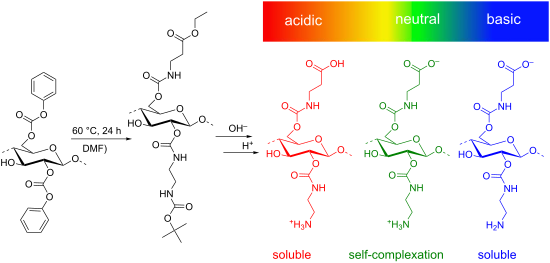
- value of 9. At lower pH values, large aggregates are formed induced by self-complexation. Polyelectrolyte complex formation with polyDADMAC A permanently charged polycation (polydiallyldimethylammonium chloride, polyDADMAC) was applied to study the formation of interpolyelectrolyte complexes. In the


Solid-phase-supported synthesis of morpholinoglycine oligonucleotide mimics
Beilstein J. Org. Chem. 2014, 10, 1151–1158, doi:10.3762/bjoc.10.115
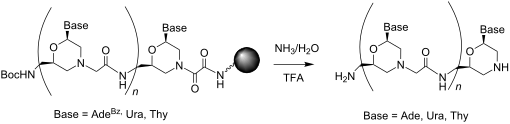
- backbone at physiological pH, stability to nucleases, and more preferable complex formation with RNA than with DNA, make them an attractive alternative in comparison to native oligonucleotides and other derivatives or analogues. Experimental General We used 5-methyluridine, O-(benzotriazol-1-yl)-N,N,N’,N



Dimerisation, rhodium complex formation and rearrangements of N-heterocyclic carbenes of indazoles
Beilstein J. Org. Chem. 2014, 10, 832–840, doi:10.3762/bjoc.10.79
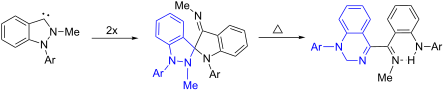
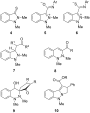
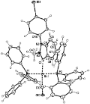
- , displacement parameters are drawn at 50% probability level. Generation of indazol-3-ylidenes. Reaction products of indazol-3-ylidenes in heterocycle synthesis. Syntheses of acridines from indazol-3-ylidenes. Dimerisation of indazol-3-ylidenes to spiro compounds. Rhodium complex formation. Rearrangement of the






Synthesis and stereochemical assignments of diastereomeric Ni(II) complexes of glycine Schiff base with (R)-2-(N-{2-[N-alkyl-N-(1-phenylethyl)amino]acetyl}amino)benzophenone; a case of configurationally stable stereogenic nitrogen
Beilstein J. Org. Chem. 2014, 10, 442–448, doi:10.3762/bjoc.10.41
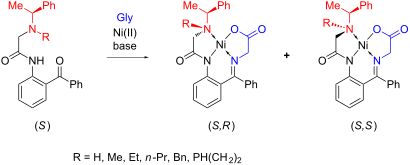
- the maximum of ~75/25 in the case of R = n-Pr and Bn groups (Table 1, entries 4 and 5). Another surprising result is that the complex(es) obtained in the reaction of NH (bearing ligand R = H) had unprecedentedly low solubility. During the complex formation reaction, the product(s) precipitated from


Physalin H from Solanum nigrum as an Hh signaling inhibitor blocks GLI1–DNA-complex formation
Beilstein J. Org. Chem. 2014, 10, 134–140, doi:10.3762/bjoc.10.10
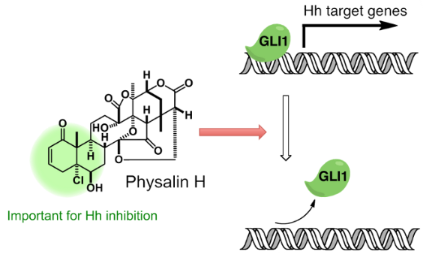
- inhibitory activity. Interestingly, physalin H (1) disrupted GLI1 binding to its DNA binding domain, while the weak inhibitor physalin G (2) did not show inhibition of GLI1-DNA complex formation. Keywords: Hedgehog inhibitor; Hedgehog signal; natural products; physalins; Solanum nigrum; Introduction
- expression of both proteins. In addition, at a concentration of 3.0 μM, physalin H (1) decreased the expression of BCL2 in DU145 cancer cells, in which Hh signaling was activated (Figure 4B). However, the expression of PTCH was only slightly affected. Inhibition of GLI1–DNA complex formation by physalin H (1
- ) Disruption of the GLI1–DNA complex in the final stage of this signaling pathway is one of the most attractive molecular mechanisms of Hh inhibitors. Recently, we reported the first small molecule, which directly inhibits the GLI1–DNA complex formation [22].GANT61, a synthetic compound, has been reported to


Novel supramolecular affinity materials based on (−)-isosteviol as molecular templates
Beilstein J. Org. Chem. 2013, 9, 2821–2833, doi:10.3762/bjoc.9.317
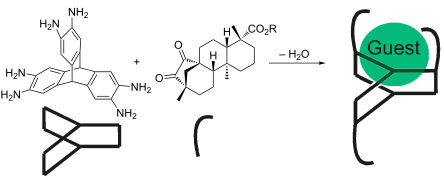
- ][34], compounds based on (−)-isosteviol have found application in various fields of synthetic chemistry [35], including the construction of tweezer-like supramolecular transporters for amino acids [36], chiral organocatalysts in aldol reactions [37], or the complex formation with aromatic compounds


Host–guest complexes of mixed glycol-bipyridine cryptands: prediction of ion selectivity by quantum chemical calculations, part V
Beilstein J. Org. Chem. 2013, 9, 1252–1268, doi:10.3762/bjoc.9.142
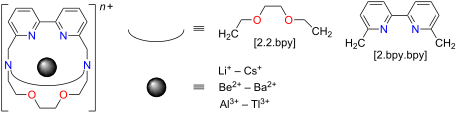
- Erlangen, Germany 10.3762/bjoc.9.142 Abstract The selectivity of the cryptands [2.2.bpy] and [2.bpy.bpy] for the endohedral complexation of alkali, alkaline-earth and earth metal ions was predicted on the basis of the DFT (B3LYP/LANL2DZp) calculated structures and complex-formation energies. The cavity


![[Graphic 2]](/bjoc/content/inline/1860-5397-9-142-i3.png?max-width=637&scale=0.295455) 2.2.bpy]+.
2.2.bpy]+.


Space filling of β-cyclodextrin and β-cyclodextrin derivatives by volatile hydrophobic guests
Beilstein J. Org. Chem. 2013, 9, 1185–1191, doi:10.3762/bjoc.9.133
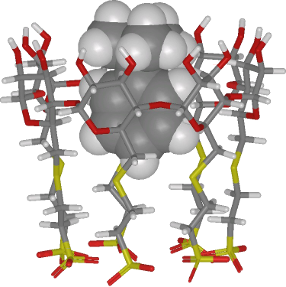
- contributor to the driving force of complex formation [15]. The accumulation of basic understanding is essential for the formulation of precise docking programs, which estimate and screen the binding of drug candidates for biological receptors [16][17]. Practical applications of native β-CD, such as drug


Simple and rapid hydrogenation of p-nitrophenol with aqueous formic acid in catalytic flow reactors
Beilstein J. Org. Chem. 2013, 9, 1156–1163, doi:10.3762/bjoc.9.129
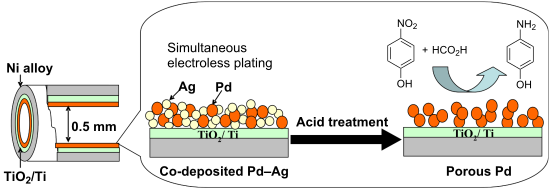
- stabilized against precipitation by complex formation with EDTA and NH3, which also controls the deposition rate of the individual metal by modifying the redox potential [33]. SEM and EDX analysis of the plated layer indicated the mixed distribution of Pd and Ag over the inner surface (Figure 1b). It has


Camera-enabled techniques for organic synthesis
Beilstein J. Org. Chem. 2013, 9, 1051–1072, doi:10.3762/bjoc.9.118

- organic and inorganic synthesis [64]. For some metal-complex formation procedures, the digital blueprint of the custom reactor was modified to incorporate a transparent port, through which the crystallisation could be recorded using a digital camera (Figure 12). This allowed the size of the crystals and


The β-cyclodextrin/benzene complex and its hydrogen bonds – a theoretical study using molecular dynamics, quantum mechanics and COSMO-RS
Beilstein J. Org. Chem. 2013, 9, 118–134, doi:10.3762/bjoc.9.15
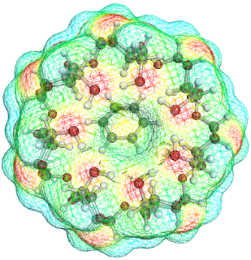
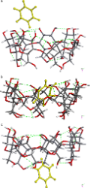
- when it was positioned vertically. The AM1 HOMO/LUMO gap of the empty β-CD with about 12 eV is lowered to about 10 eV in the complex, in agreement with data from the literature. AM1 IR spectra displayed a splitting of the O–H frequencies of cyclodextrin upon complex formation. At the BP/TZVP-DISP3
- -fluorophenol in α-CD [3]. The reactivity of aromatic guest molecules, radicals or excited states, was found to be altered because of complex formation with cyclodextrins [4]. Cyclodextrins form three types of dimers, O2/O3 to O2/O3, O2/O3 to O6, and O6 to O6. They can also associate to extended stacks in
- crystalline state or solution, with guest and solvent molecules located inside the cavities, between dimers, or in the channels next to the stacks [5]. The influence of cyclodextrin on a broad variety of molecules was reported: from changes of α-/β-sheet ratio upon complex formation of cyclodextrins with side