


Search results
Search for "copper-catalyzed" in Full Text gives 286 result(s) in Beilstein Journal of Organic Chemistry. Showing first 200.
Progress in copper-catalyzed trifluoromethylation
Beilstein J. Org. Chem. 2018, 14, 155–181, doi:10.3762/bjoc.14.11
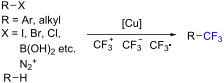
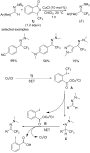
- the trifluoromethyl group (CF3) in biologically active molecules promote the development of novel methods to construct C–CF3 bonds in the past few years. Among the many methods developed, copper-catalyzed trifluoromethylation has gained enormous interest due to its high efficiency and cheapness
- trifluoromethylation reagents. Review Copper-catalyzed trifluoromethylation of aryl and alkyl halides The first example of copper-promoted perfluoroalkylation of aromatic halides was presented in a US patent 1968 [9]. Since then, the copper-catalyzed trifluoromethylation of aromatic compounds has entered a stage of
- reported by the group of Li and Duan, with sodium trifluoroacetate as the trifluoromethyl source and using Ag2O as a promoter (Scheme 5) [17]. Subsequently, Beller and co-workers [18] finished a copper-catalyzed trifluoromethylation of aryl iodides with inexpensive methyl trifluoroacetate (MTFA) (Scheme 6










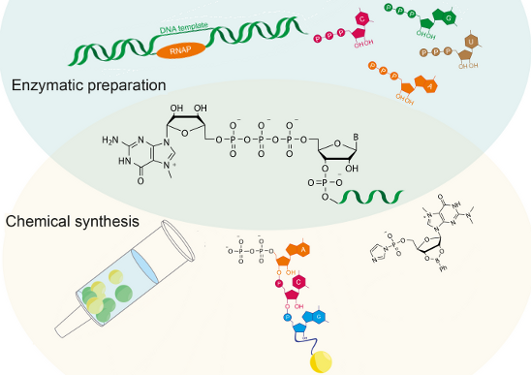
Synthetic mRNA capping
Beilstein J. Org. Chem. 2017, 13, 2819–2832, doi:10.3762/bjoc.13.274
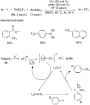
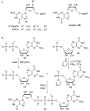
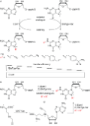
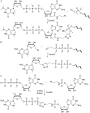
- ) followed by treatment with aqueous ammonia (rt, 3 h). Click chemistry for the preparation of capped RNA and cap analogues. (A) Preparation of capped RNA via a copper-catalyzed azide–alkyne cycloaddition (CuAAC) of an azido-modified cap analogue with a 5'-alkyne bearing RNA [120]. (B) An alkyne-modified



Recent progress in the racemic and enantioselective synthesis of monofluoroalkene-based dipeptide isosteres
Beilstein J. Org. Chem. 2017, 13, 2637–2658, doi:10.3762/bjoc.13.262
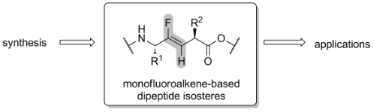
- starting from the commercially available protected chiral hydroxyl ester 75. Reduction to the aldehyde followed by coupling with bromodifluoropropene gave two diastereoisomers 76a and 76b separable by flash chromatography. Then, the copper-catalyzed defluorinative allylic alkylation using Grignard reagents
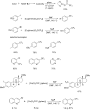
- and co-workers. Synthesis of the tripeptide Boc-Asp(OBn)-Pro-ψ[(Z)-CF=CH)-Val-CH2OH by Miller and co-workers. Copper-catalyzed synthesis of monofluoralkenes by Taguchi and co-workers. One-pot intramolecular redox reaction to access amide-type isosteres by Otaka and co-workers. Copper-mediated


Solvent-free copper-catalyzed click chemistry for the synthesis of N-heterocyclic hybrids based on quinoline and 1,2,3-triazole
Beilstein J. Org. Chem. 2017, 13, 2352–2363, doi:10.3762/bjoc.13.232
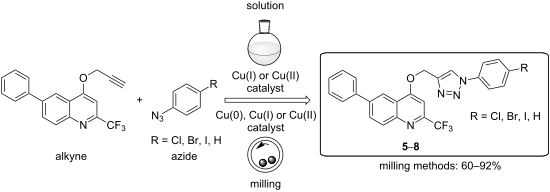
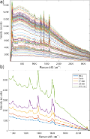
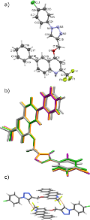
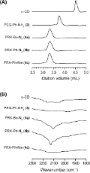
- Engineering and Technology, University of Zagreb, Marulićev trg 20, HR-10000 Zagreb, Croatia University of Zagreb, Faculty of Textile Technology, Department of Applied Chemistry, Prilaz baruna Filipovića 28a, HR-10000 Zagreb, Croatia 10.3762/bjoc.13.232 Abstract Copper-catalyzed mechanochemical click
- spin resonance (ESR) spectroscopy; in situ Raman monitoring; mechanochemistry; quinoline; solid-state click chemistry; Introduction The copper-catalyzed azide–alkyne cycloaddition (CuAAC) represents a prime example of click chemistry. Click chemistry describes “a set of near-perfect” reactions [1] for



Superstructures with cyclodextrins: Chemistry and applications IV
Beilstein J. Org. Chem. 2017, 13, 2157–2159, doi:10.3762/bjoc.13.215
- was assembled from two monosubstituted α-CD rings, α,ω-dodecamethylene diazide axis, and two bulky alkyne stoppers through a copper-catalyzed [2 + 3] cycloaddition in one step. Because of the attached gadolinium complexes, this rotaxane showed a high NMR relaxivity, making it suitable as a probe for
Mechanochemical synthesis of small organic molecules
Beilstein J. Org. Chem. 2017, 13, 1907–1931, doi:10.3762/bjoc.13.186
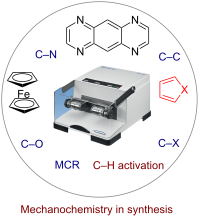
- example of a double Sonogashira reaction is shown [60]. Oxidative cross-dehydrogenative coupling Copper-catalyzed mechanochemical oxidative cross-dehydrogenative coupling (CDC) reactions [61][62][63][64][65][66] of tetrahydroisoquinolines with alkynes and indoles was reported by Su and co-workers (Scheme
- ][75][76]. In view of this, chemists have introduced alternative energy sources like, microwave, sonication, mechanomilling, etc. [12][27][77]. Su and co-workers reported a copper-catalyzed arylation of anilines using arylboronic acid under high speed ball-milling conditions. Using 1.0 equiv of Cu(OAc
- ]. Mechanochemical Suzuki reaction [56]. Mechanochemical Suzuki–Miyaura coupling by LAG [57]. Mechanochemical Heck reaction [59]. a) Sonogashira coupling under milling conditions. b) The representative example of a double Sonogashira reaction of p-iodoacetophenone with 1,4-bis-ethynyl benzene. Copper-catalyzed CDC


Mechanochemical synthesis of thioureas, ureas and guanidines
Beilstein J. Org. Chem. 2017, 13, 1828–1849, doi:10.3762/bjoc.13.178
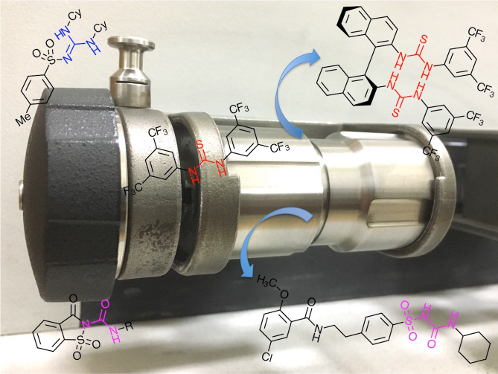
- chlorpropamide or the 2nd generation drugs like glibenclamide (Figure 1). These molecules were interesting synthetic targets for our mechanochemical approach which is based on a stoichiometric base-assisted or copper-catalyzed coupling of sulfonamides and iso(thio)cyanates [48]. For that purpose, 0.5–1 equiv of




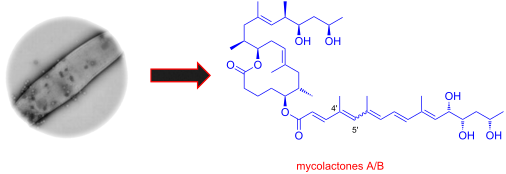
The chemistry and biology of mycolactones
Beilstein J. Org. Chem. 2017, 13, 1596–1660, doi:10.3762/bjoc.13.159









Syntheses of 3,4- and 1,4-dihydroquinazolines from 2-aminobenzylamine
Beilstein J. Org. Chem. 2017, 13, 1470–1477, doi:10.3762/bjoc.13.145
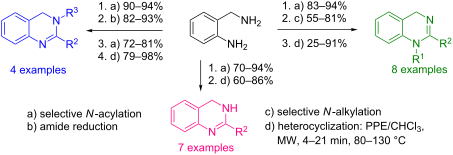
- intramolecular conjugate addition to an α,β-unsaturated ester [12][13][14][15] or copper-catalyzed annulation of N-arylamidines [41], among others [42]. Most of the already mentioned methods have been applied to the synthesis of 3,4-dihydroquinazolines. Among them, only a few were used for the preparation of 1,4


BODIPY-based fluorescent liposomes with sesquiterpene lactone trilobolide
Beilstein J. Org. Chem. 2017, 13, 1316–1324, doi:10.3762/bjoc.13.128
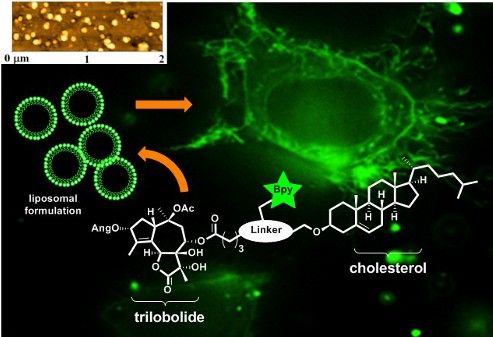
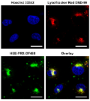
- compound is shown in Scheme 1, part B. Propargyl-ChL [35] was introduced into Huisgen copper-catalyzed 1,3-dipolar cycloaddition [36] (CuAAC) with BODIPY 3. This microwave-assisted reaction catalyzed by CuSO4·5H2O, sodium ascorbate and a catalytic amount of TBTA (tris[(1-benzyl-1H-1,2,3-triazol-4-yl)methyl




An eco-compatible strategy for the diversity-oriented synthesis of macrocycles exploiting carbohydrate-derived building blocks
Beilstein J. Org. Chem. 2017, 13, 1106–1118, doi:10.3762/bjoc.13.110
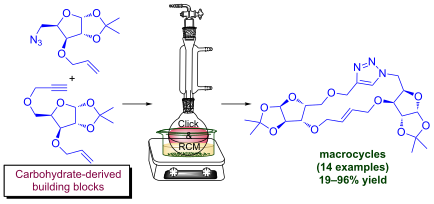
- the iterative use of readily available sugar-derived alkyne/azide–alkene building blocks coupled through copper catalyzed azide–alkyne cycloaddition (CuAAC) reaction followed by pairing of the linear cyclo-adduct using greener reaction conditions. The eco-compatibility, mild reaction conditions
- the synthesis. The cyclization of the linear precursor is usually achieved by utilizing various ring-closing reactions such as Diels–Alder reactions, [15] aldol reactions, [16] copper-catalyzed azide–alkyne cycloaddition, [17][18] macrolactonization, macrolactamizations, Staudinger ligation or
- ] glycosides and macrocyclic glycolipids [11]. Similarly, the copper-catalyzed azide–alkyne cycloaddition (CuAAC) reaction has found wide application in medicinal chemistry [33], biology [34][35], polymer chemistry [36], carbohydrates [37][38][39][40], peptides [41][42][43][44] and in materials science [45][46


Nucleophilic and electrophilic cyclization of N-alkyne-substituted pyrrole derivatives: Synthesis of pyrrolopyrazinone, pyrrolotriazinone, and pyrrolooxazinone moieties
Beilstein J. Org. Chem. 2017, 13, 825–834, doi:10.3762/bjoc.13.83
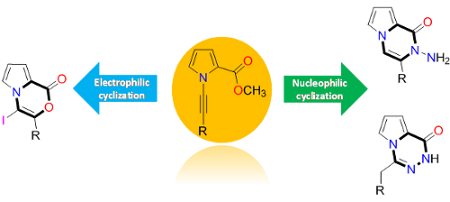
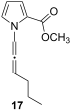
- by a copper-catalyzed cross-coupling reaction. Nucleophilic cyclization of N-alkyne-substituted methyl 1H-pyrrole-2-carboxylates with hydrazine afforded the 6-exo-dig/6-endo-dig cyclization products depending on the electronic nature of the substituents attached to the alkyne. On the other hand




Transition-metal-catalyzed synthesis of phenols and aryl thiols
Beilstein J. Org. Chem. 2017, 13, 589–611, doi:10.3762/bjoc.13.58

- phenols in water at room temperature. This catalyst can be reused many times without loss of the catalytic activity. Moreover, this catalyst could also be applied in the synthesis of anilines. 1.1.2 Copper-catalyzed hydroxylation of aryl halides: Copper catalysts are considered as economical and stable
- catalysts. However, copper catalysts often have a low catalytic activity to activate the C–Hal bond. Fortunately, along with the development of various bidentate ligands, the copper-catalyzed C–O coupling reaction has been extensively applied in the synthesis of phenols from aryl halides. However, the
- poorer efficiency of copper catalysts than that of palladium catalysts often limits the substrate scope to aryl iodides and aryl bromides. In 2009, two independent works by Taillerfer and You opened the prelude to the copper-catalyzed hydroxylation of aryl halides. The Taillefer group found that a


Pd- and Cu-catalyzed approaches in the syntheses of new cholane aminoanthraquinone pincer-like ligands
Beilstein J. Org. Chem. 2017, 13, 564–570, doi:10.3762/bjoc.13.55
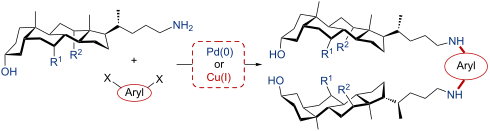
- bile acids. High yields of arylaminocholanes were achieved in copper-catalyzed reactions of aryl iodides with 24-aminocholanes, while only a classical Pd-catalyzed protocol was suitable for the cross-coupling of aminocholanes and dichloroanthraquinones. The presence of hydroxy groups in the substrates


Fast and efficient synthesis of microporous polymer nanomembranes via light-induced click reaction
Beilstein J. Org. Chem. 2017, 13, 558–563, doi:10.3762/bjoc.13.54
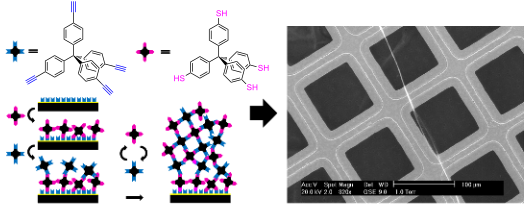
- ]. Only few examples of soluble and therefore processable CMP materials are known, all limited to linear CMPs [13][14]. To overcome the issue of low processability, recently the group of Jiang and our group introduced the interfacial synthesis using an electro-activated approach [15] and a copper
- catalyzed azide–alkyne cycloaddition (CuAAC) approach, respectively [16]. These procedures are still limited to conductive substrates or associated with long reaction times. In this work, we present a novel strategy for the LbL synthesis of CMP thin films and nanomembranes, using the light-induced and


Iodination of carbohydrate-derived 1,2-oxazines to enantiopure 5-iodo-3,6-dihydro-2H-1,2-oxazines and subsequent palladium-catalyzed cross-coupling reactions
Beilstein J. Org. Chem. 2016, 12, 2898–2905, doi:10.3762/bjoc.12.289
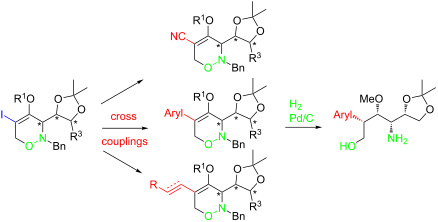
- -oxazines bearing the newly installed alkynyl group at C-5 are ideal candidates for efficient subsequent transformations. A very popular and widely applied reaction of terminal alkynes is the copper-catalyzed azide–alkyne cycloaddition, also termed as click reaction, efficiently leading to 1,4-disubstituted




Versatile synthesis of end-reactive polyrotaxanes applicable to fabrication of supramolecular biomaterials
Beilstein J. Org. Chem. 2016, 12, 2883–2892, doi:10.3762/bjoc.12.287

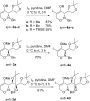
- (benzylazide: PRX-Bn-N3, phenylazide: PRX-Ph-N3,) were synthesized for functionalization via click reactions. The PRX-Bn-N3 and PRX-Ph-N3 reacted quickly and efficiently with p-(tert-butyl)phenylacetylene via copper-catalyzed click reactions. Additionally, the terminal azide groups of the PRX-Bn-N3 could be
- (Supporting Information File 1, Figure S2). These results clearly demonstrate the successful synthesis of PRXs with well-defined terminal structures. Reactivity of terminal azide groups in PRXs with alkynes via copper-catalyzed click reaction The reactivity of the terminal azide groups of 4a and 4b with
- alkynes via the copper-catalyzed click reaction was examined. In this experiment, p-(tert-butyl)phenylacetylene was utilized as the model alkyne. One equivalent of p-(tert-butyl)phenylacetylene was allowed to react with the terminal azide groups of the PRXs in the presence of CuSO4 and sodium ascorbate




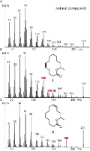
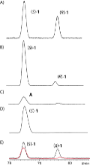
Identification, synthesis and mass spectrometry of a macrolide from the African reed frog Hyperolius cinnamomeoventris
Beilstein J. Org. Chem. 2016, 12, 2731–2738, doi:10.3762/bjoc.12.269
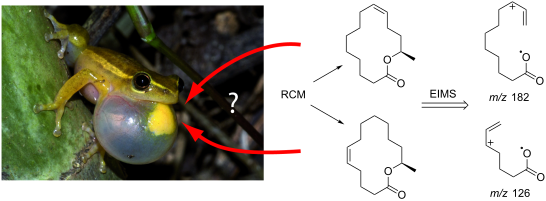
- material. After copper-catalyzed opening of the epoxide with 6-heptenylmagnesium bromide obtained from 7-bromo-1-heptene (14) and Steglich esterification with 5-hexenoic acid (16), RCM using (Z)-selective Grubbs catalyst 12 was used to synthesize macrolide (R)-1 without any isomerization. Comparison of the



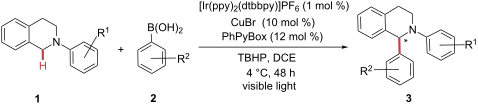
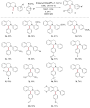
Copper-catalyzed asymmetric sp3 C–H arylation of tetrahydroisoquinoline mediated by a visible light photoredox catalyst
Beilstein J. Org. Chem. 2016, 12, 2636–2643, doi:10.3762/bjoc.12.260




Synthesis of polyhydroxylated decalins via two consecutive one-pot reactions: 1,4-addition/aldol reaction followed by RCM/syn-dihydroxylation
Beilstein J. Org. Chem. 2016, 12, 2602–2608, doi:10.3762/bjoc.12.255
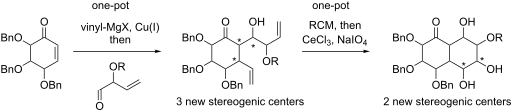
- Michal Malik Slawomir Jarosz Institute of Organic Chemistry, Polish Academy of Sciences, Kasprzaka 44/52, 01-224 Warsaw, Poland 10.3762/bjoc.12.255 Abstract Synthesis of novel polyhydroxylated derivatives of decalin is described. The presented methodology consists in a one-pot copper-catalyzed
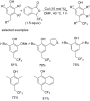
- possibility of using a copper-catalyzed one-pot 1,4-addition of vinylmagnesium bromide to sugar-derived cyclic α,β-unsaturated ketones (such as 9), followed by an aldol reaction with an optically pure derivative of but-2-enal 10 to obtain a mixture of diastereomeric dienes, such as 11 (Scheme 2). As a result
- of this transformation, three new stereogenic centers are generated. A copper-catalyzed 1,4-addition of organometallic reagents to cyclic α,β-unsaturated ketones, followed by an aldol reaction has been already used in the synthesis of complex natural products [26][27][28][29][30][31][32][33


Et3B-mediated and palladium-catalyzed direct allylation of β-dicarbonyl compounds with Morita–Baylis–Hillman alcohols
Beilstein J. Org. Chem. 2016, 12, 2402–2409, doi:10.3762/bjoc.12.234
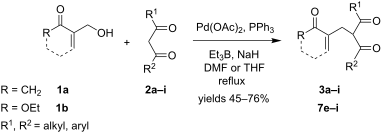
- conjugate addition of the β-keto ester carbanion onto the enone moiety (Scheme 2) [50][51]. The structure of the tricyclic compound 6j was elucidated on the basis of X-ray diffraction analysis (Figure 2). In a previous report, Alexakis and co-workers have demonstrated that copper-catalyzed conjugate


Stereo- and regioselectivity of the hetero-Diels–Alder reaction of nitroso derivatives with conjugated dienes
Beilstein J. Org. Chem. 2016, 12, 1949–1980, doi:10.3762/bjoc.12.184
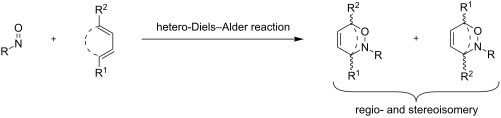
- Scheme 5). More recently, the method was extended to the mild copper-catalyzed aerobic oxidation of hydroxylamines [48][49][50]. In 2014, the Lykakis group reported the selective oxidation of various arylamines into the corresponding nitrosoarenes through polyoxometalate anions supported on mesoporous
- reagent 58 with cyclohexadiene derivative 154 led to the exclusive formation of proximal isomers 155 in moderate to good yields with ee values ≥95% (Scheme 31). The regioselectivity was opposite of that obtained in the copper-catalyzed reaction. The authors explained this by means of the proposed




Dinuclear thiazolylidene copper complex as highly active catalyst for azid–alkyne cycloadditions
Beilstein J. Org. Chem. 2016, 12, 1566–1572, doi:10.3762/bjoc.12.151
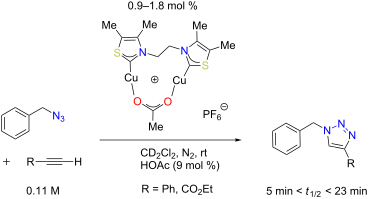
- -heterocyclic carbene, linker, sacrificial ligand, and counter ion. Keywords: catalysis; click; copper; CuAAC; N-heterocyclic carbene; thiazole; Introduction The copper-catalyzed azide–alkyne cycloaddition (CuAAC) is one of the most important “click” reactions for the facile covalent linking of two molecules


Selective bromochlorination of a homoallylic alcohol for the total synthesis of (−)-anverene
Beilstein J. Org. Chem. 2016, 12, 1361–1365, doi:10.3762/bjoc.12.129

- success in the copper-catalyzed cross coupling of an analogous dichlorotriflate [9], in our hands 2 failed to engage in productive carbon–carbon bond formation. An alternative retrosynthesis traced 1 back to bromochloroaldehyde 3, which should readily engage in standard olefination reactions. As 3 could


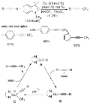
Copper-catalyzed [3 + 2] cycloaddition of (phenylethynyl)di-p-tolylstibane with organic azides
Beilstein J. Org. Chem. 2016, 12, 1309–1313, doi:10.3762/bjoc.12.123

- clarity. Two independent molecules exist in the asymmetric unit, one of them is shown. Copper-catalyzed [3 + 2] cycloaddition of 1 with organic azides 2. Reaction conditions: 1 (0.5 mmol), 2a (0.5 mmol), Cu cat. (0.025 mmol). Isolated yield are shown. Possible mechanism. Reaction of 3a with HCl, I2 and





