


Search results
Search for "photophysical properties" in Full Text gives 208 result(s) in Beilstein Journal of Organic Chemistry. Showing first 200.
Synthesis and spectroscopic properties of β-meso directly linked porphyrin–corrole hybrid compounds
Beilstein J. Org. Chem. 2018, 14, 187–193, doi:10.3762/bjoc.14.13
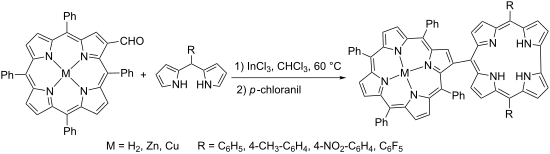
- condensation reaction of meso-substituted dipyrromethanes with β-formylated meso-tetraphenylporphyrins. Spectroscopic and photophysical properties of the new hybrid structures have been determined. Higher quantum yields of some of the synthesized hybrid compounds indicate that these compounds can be considered
- –corrole hybrid derivatives. *100 mol % of AlCl3 was used as a catalyst. Optimization of the reaction conditions. Photophysical properties of hybrid compounds. Supporting Information Supporting Information File 34: General experimental information, experimental details on the synthesis of products 4 and


Fluorescent nucleobase analogues for base–base FRET in nucleic acids: synthesis, photophysics and applications
Beilstein J. Org. Chem. 2018, 14, 114–129, doi:10.3762/bjoc.14.7
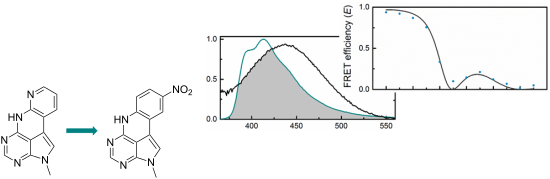
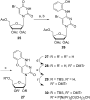
- dealing with the synthesis of the key players of base–base FRET, i.e., the base analogue donor and acceptor molecules, the second one dealing with their photophysical properties and the third one dealing with their application in studying nucleic acid-containing systems. Synthesis of fluorescent base
- protection groups is paramount as an extensive use adds additional steps as well as complexity to the synthesis. The design and synthesis of fluorescent nucleobase analogues (FBAs) add on additional challenges such as obtaining features that introduce useful photophysical properties, for example, extended
- , the oxo-analogue tCO, which Lin et al. initially prepared in 1995 [41], was re-synthesized in order to characterize its photophysical properties, using the same procedure except that p-toluoyl protecting groups rather than acetyl were used [31]. In 2009, we published the first base–base FRET system






Halogen-containing thiazole orange analogues – new fluorogenic DNA stains
Beilstein J. Org. Chem. 2017, 13, 2902–2914, doi:10.3762/bjoc.13.283
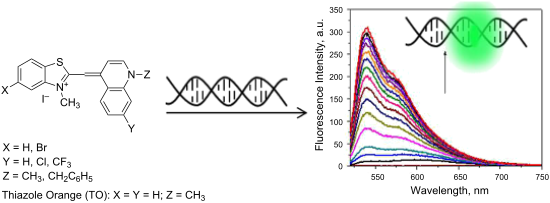
- atoms (connected directly to the chromophore or as side groups) on the molar absorptivity and the fluorescence intensity of a series of new TO analogues. Photophysical properties of a series of TO analogues that have fluoro- or trifluoromethyl groups connected to the heterocyclic end groups of the
- chromophores have been studied by Armitage and co-workers [42][43]. According to these studies the fluorination of the symmetrical [42] and unsymmetrical [43] cyanine dyes results in reduced aggregation and significantly improved the photostability and photophysical properties of the dyes. The authors [43
- for the success of the reaction because of the CH-acidity of the benzyl fragment, which otherwise leads to the possibility of side reactions if trimethylamine or other less hindered basic reagents are employed. Photophysical properties Absorption The longest wavelength absorption maxima of the studied




Pyrene–nucleobase conjugates: synthesis, oligonucleotide binding and confocal bioimaging studies
Beilstein J. Org. Chem. 2017, 13, 2521–2534, doi:10.3762/bjoc.13.249
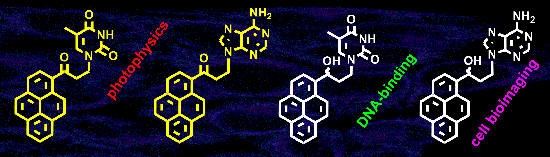
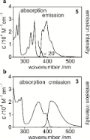
- at ambient temperature. The absorption and emission spectra of the adenine derivatives 3 and 5 are reproduced in Figure 4. The photophysical properties of 5 (Figure 4a) resemble the properties of unsubstituted pyrene [30]. In the low energy UV and blue spectral region between 250 and 400 nm, three




One-pot syntheses of blue-luminescent 4-aryl-1H-benzo[f]isoindole-1,3(2H)-diones by T3P® activation of 3-arylpropiolic acids
Beilstein J. Org. Chem. 2017, 13, 2340–2351, doi:10.3762/bjoc.13.231
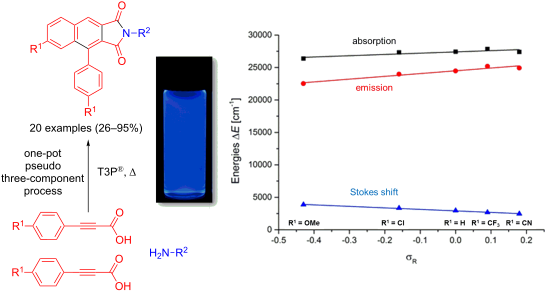
- are often prepared by condensation of acid anhydrides and amines [34]. Their applications are widespread, ranging from pharmaceutically active compounds [35] to agrochemicals [36] and fluorophores [37]. The characteristic photophysical properties of 1,8- and 2,3-naphthalene imides render the substance
- -dihydro-1H-benzo[f]isoindolyl moiety in 6 are absolutely planar. Photophysical properties The pseudo three-component synthesis of 1H-benzo[f]isoindole-1,3(2H)-diones 4 furnishes a substance library with electronically diverse substitution patterns and already upon eyesight several derivatives are
- -benzo[f]isoindole-1,3(2H)-diones 4. Variation of the amine 3 in pseudo three-component syntheses of 1H-benzo[f]isoindole-1,3(2H)-diones 4. Selected photophysical properties (absorption and emission maxima,a,b fluorescence quantum yields (Φf [53]),c and Stokes shifts Δd) of compounds 4a–g,m,n,s, 5, and 6




Synthesis and photophysical properties of novel benzophospholo[3,2-b]indole derivatives
Beilstein J. Org. Chem. 2017, 13, 2304–2309, doi:10.3762/bjoc.13.226
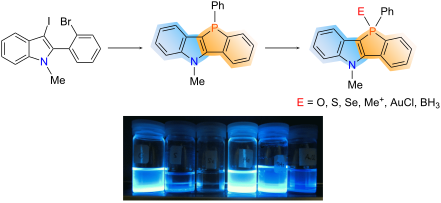
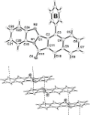
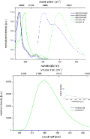
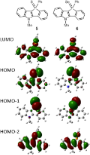
- contrast, these angles around the phosphorus atom were 291.05° for 3, and 305.46° and 304.75° for 4. These facts indicate that the nitrogen atoms are sp2-hybridized, and the phosphorus center adopts pyramidal for 3 and tetrahedral geometry for 4. The photophysical properties of the benzophospholo[3,2-b


Regioselective (thio)carbamoylation of 2,7-di-tert-butylpyrene at the 1-position with iso(thio)cyanates
Beilstein J. Org. Chem. 2017, 13, 1032–1038, doi:10.3762/bjoc.13.102
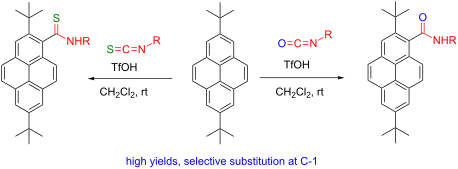
- photophysical properties [4][10][13][14][15][16][17][18][19][20], we thought it would be of interest to study its reactivity in the above reaction (and to extend its scope for isocyanates). An additional reason for such a study was the fact that thioamides (and amides) are versatile starting materials in the




Ultrasound-promoted organocatalytic enamine–azide [3 + 2] cycloaddition reactions for the synthesis of ((arylselanyl)phenyl-1H-1,2,3-triazol-4-yl)ketones
Beilstein J. Org. Chem. 2017, 13, 694–702, doi:10.3762/bjoc.13.68
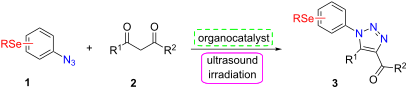
- ][40][41][42][43], photophysical properties [44][45][46][47][48][49] and interesting biological activities [50][51][52]. An interesting class of molecules are the selanyl-1,2,3-triazoles [53][54][55][56][57][58][59][60][61] which can present some biological applications. As example, 4-phenyl-1


Novel β-cyclodextrin–eosin conjugates
Beilstein J. Org. Chem. 2017, 13, 543–551, doi:10.3762/bjoc.13.52
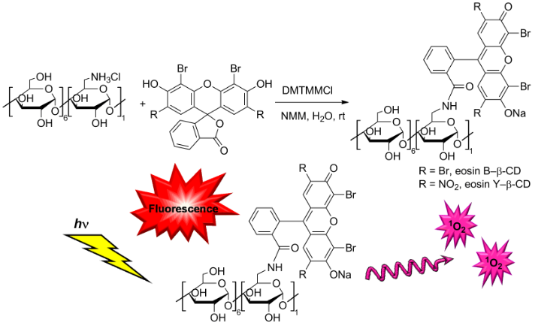
- conditions, is rather polydisperse and differently sized populations can be detected. The strong aggregation character of 4–β-CD can remarkably influence the spectroscopic and photophysical properties of the conjugate. UV–vis spectroscopic and photophysical properties of eosin–β-CD conjugates Preliminary
- preservation of the photophysical properties of the dye. In fact, this molecular hybrid exhibits satisfactory fluorescence and 1O2 photogeneration quantum yields making it a suitable candidate for biomedical research studies in the field of imaging and PDT applications. The possibility to exploit the CD cavity




Synthesis and optical properties of new 5'-aryl-substituted 2,5-bis(3-decyl-2,2'-bithiophen-5-yl)-1,3,4-oxadiazoles
Beilstein J. Org. Chem. 2017, 13, 313–322, doi:10.3762/bjoc.13.34
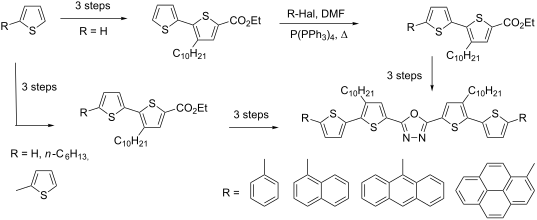
- observed in D–A–D-type conjugated molecules [28]. DFT calculations To gain a deeper understanding of the electronic and photophysical properties of the synthesized 5'-aryl-substituted 2,5-bis(3-decyl-2,2'-bithiophen-5-yl)-1,3,4-oxadiazoles we have performed quantum-chemical calculations for four


Interactions between photoacidic 3-hydroxynaphtho[1,2-b]quinolizinium and cucurbit[7]uril: Influence on acidity in the ground and excited state
Beilstein J. Org. Chem. 2017, 13, 203–212, doi:10.3762/bjoc.13.23
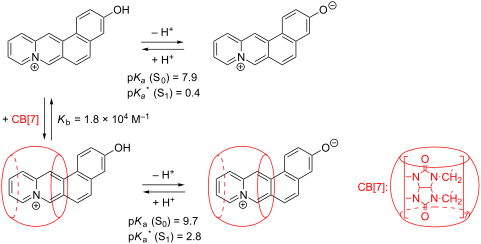
- ]. Conclusion In summary we introduced a novel quinolizinium-based photoacid whose acidity in the ground and excited state can be changed by the association with CB[7]. With this result we demonstrated that in general the acidic functionality as well as the photophysical properties of hydroxyquinolizinium


Synthesis and properties of fluorescent 4′-azulenyl-functionalized 2,2′:6′,2″-terpyridines
Beilstein J. Org. Chem. 2016, 12, 1812–1825, doi:10.3762/bjoc.12.171
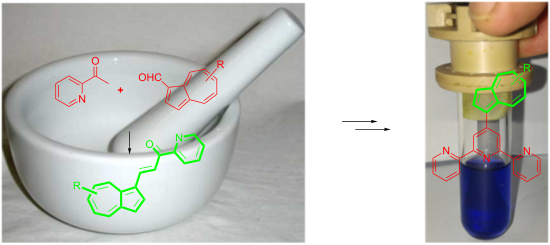
- terpyridine fragments are involved in π–π interactions (3.56–3.66 Å). The separation between the neighboring azulenyl moieties is higher than 3.85 Å. Photophysical properties The photophysical properties of the azulene-containing terpyridines, 4a and 4b have been investigated by absorption and emission


Synthesis, fluorescence properties and the promising cytotoxicity of pyrene–derived aminophosphonates
Beilstein J. Org. Chem. 2016, 12, 1229–1235, doi:10.3762/bjoc.12.117
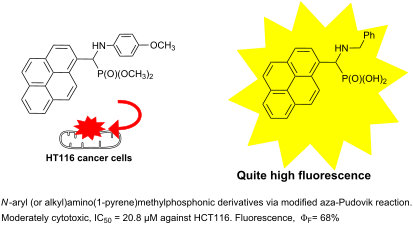
- derivatives were then selected and their biological and photophysical properties were studied. Luminescent properties of pyrenyl aminophosphonates The widespread use of pyrene derivatives as luminescent probes in biological research [24][25][26][27] prompted us to study emissive properties of the synthesized


Indenopyrans – synthesis and photoluminescence properties
Beilstein J. Org. Chem. 2016, 12, 825–834, doi:10.3762/bjoc.12.81
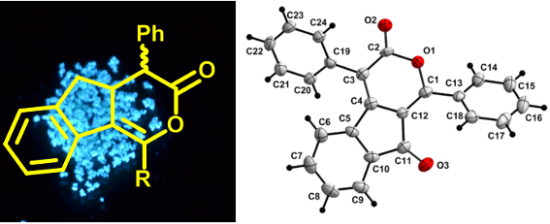
- Moltech-Anjou, University of Angers, 2 Boulevard Lavoisier 49045 Angers, France 10.3762/bjoc.12.81 Abstract New indeno[1,2-c]pyran-3-ones bearing different substituents at the pyran moiety were synthesized and their photophysical properties were investigated. In solution all compounds were found to be
- groups have been found to exhibit good solvatochromism properties and high quantum yields in the solid state why they are considered as important precursors for the fabrication of fluorescent materials [20]. Owing to their exciting photophysical properties many dicyanomethylene pyran-containing
- of dihydroindeno[1,2-c]pyran-3-ones 2 and 3 as a mixture of isomers (Scheme 1). Additionally, the corresponding phenyl-substituted compounds 2a and 3a (previously reported [30]) were synthesized to investigate the effect of an aryl substituent in position 1 on the photophysical properties of the



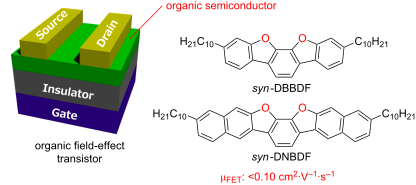
Syntheses of dibenzo[d,d']benzo[2,1-b:3,4-b']difuran derivatives and their application to organic field-effect transistors
Beilstein J. Org. Chem. 2016, 12, 805–812, doi:10.3762/bjoc.12.79
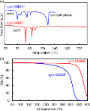
- mesophase of syn-DBBDF 5 was converted to the isotropic phase at 115 °C, while syn-DNBDF 6 did not melt below 250 °C. From the TG measurement, the temperatures of 5% weight loss (Td5) of syn-DBBDF 5 and syn-DNBDF 6 were estimated to be 272 °C and 423 °C, respectively (Figure 2b). Photophysical properties




New synthetic strategies for xanthene-dye-appended cyclodextrins
Beilstein J. Org. Chem. 2016, 12, 537–548, doi:10.3762/bjoc.12.53
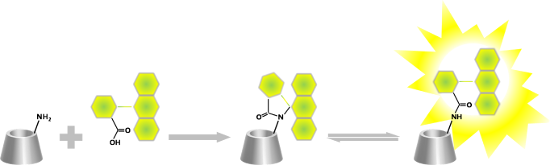
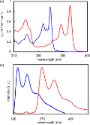
- representatives of this class are fluorescein and rhodamine (Figure 1), which have been applied as chemosensors [4] and have been widely exploited in various areas such as cell biology, microscopy, biotechnology, and ophthalmology due to their versatile photophysical properties. However, the chemical modification


Synthesis and photophysical characteristics of polyfluorene polyrotaxanes
Beilstein J. Org. Chem. 2015, 11, 2677–2688, doi:10.3762/bjoc.11.288
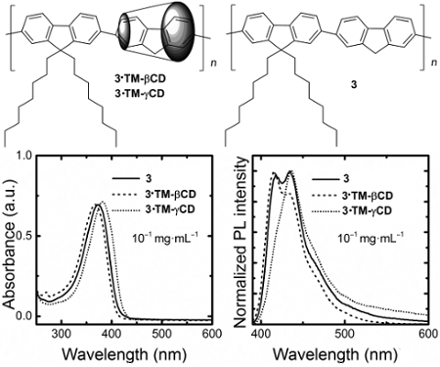
- , several types of permodified CD derivatives, such as 2,3,6-tri-O-methyl-βCD (TM-βCD) or 2,3,6-tri-O-methyl-γCD (TM-γCD) have been synthesized in the course of our investigations. With a view to better understand the influence of TM-βCD and TM-γCD encapsulations on the photophysical properties of PF, poly
- -threaded 3 counterpart, Scheme 1. Results and Discussion In continuation of our interest on the exploration of photophysical properties of PF copolymers by supramolecular encapsulation, we have performed the present study by using liphophylic CD derivatives, such as TM-βCD and TM-γCD instead native β- or


Friedel–Crafts-type reaction of pyrene with diethyl 1-(isothiocyanato)alkylphosphonates. Efficient synthesis of highly fluorescent diethyl 1-(pyrene-1-carboxamido)alkylphosphonates and 1-(pyrene-1-carboxamido)methylphosphonic acid
Beilstein J. Org. Chem. 2015, 11, 2451–2458, doi:10.3762/bjoc.11.266
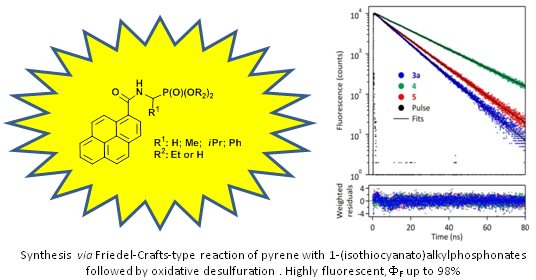
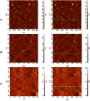
- study along with the photophysical properties of the synthesized 1-(pyrene-1-carboxamido)alkylphosphonates. Results and Discussion Syntheses The reactions performed in this work are shown in Scheme 1. We found that pyrene reacts with isothiocyanates 1a–d in the presence of trifluoromethanesulfonic acid
- isolated in 87% yield. Photophysical properties of 3a–d and 4 As expected, thioamides 2a–d were nonfluorescent (thioamide group is a well-known fluorescence quencher [31]). In contrast, the corresponding amides 3a–d showed strong fluorescence emission in solution and in the solid state. We studied the
- photophysical properties of 3a–d and 4 and, for comparison, those of N-alkylamide 5 (Figure 1). The steady-state spectroscopic data for 3a–d, 4 and 5, along with fluorescence quantum yields in chloroform solutions, are presented in Table 1 (although it was recently reported that pyrene undergoes





2-Hetaryl-1,3-tropolones based on five-membered nitrogen heterocycles: synthesis, structure and properties
Beilstein J. Org. Chem. 2015, 11, 2179–2188, doi:10.3762/bjoc.11.236
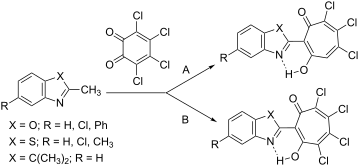
- which has attracted much attention due to the applications in various molecular probes and luminescent materials because of the remarkable photophysical properties of the ESIPT (excited state intramolecular proton transfer) chromophores [33][34]. UV-irradiation of solutions of these compounds in


![[Graphic 3]](/bjoc/content/inline/1860-5397-11-236-i8.png?max-width=637&scale=1.18182) N···H–O equilibrium in solutions of 2-hetaryl-5,6,7-trichloro- and 4,...
N···H–O equilibrium in solutions of 2-hetaryl-5,6,7-trichloro- and 4,...


Synthesis and spectroscopic properties of β-triazoloporphyrin–xanthone dyads
Beilstein J. Org. Chem. 2015, 11, 1434–1440, doi:10.3762/bjoc.11.155
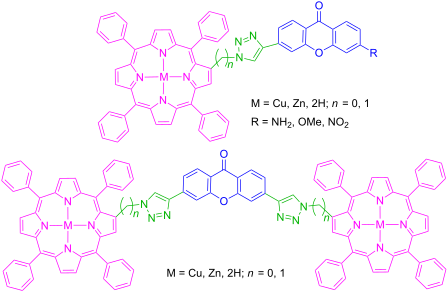
- demetalation under acidic conditions to afford the corresponding free-base porphyrins in good to excellent yields. After successful spectroscopic characterization, these porphyrins have been evaluated for their photophysical properties. The preliminary results revealed a bathochromic shift in the UV–vis and
- synthesized and evaluated for their photophysical properties. These compounds have successfully demonstrated the occurrence of an excited electron transfer from the porphyrin subunit to the attached acceptor moieties. On the other hand, some photoinduced electron transfer systems such as porphyrin


A hybrid electron donor comprising cyclopentadithiophene and dithiafulvenyl for dye-sensitized solar cells
Beilstein J. Org. Chem. 2015, 11, 1052–1059, doi:10.3762/bjoc.11.118
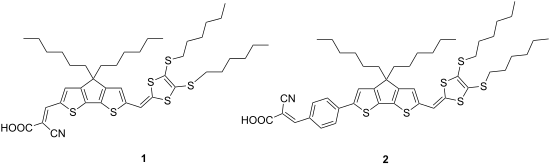
- conduction band and the dye regeneration, the corresponding electrochemical and photophysical properties were investigated. As depicted in Figure 2, cyclic voltammograms of dyes 1 and 2 in CH2Cl2 show two reversible oxidation waves. To gain additional insight into the redox processes, the cyclic voltammetry


Design, synthesis and photochemical properties of the first examples of iminosugar clusters based on fluorescent cores
Beilstein J. Org. Chem. 2015, 11, 659–667, doi:10.3762/bjoc.11.74
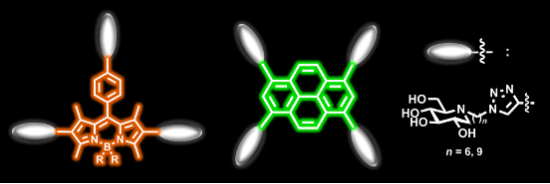
- Strasbourg, France Institut Universitaire de France, 103 Bd Saint-Michel, 75005 Paris, France 10.3762/bjoc.11.74 Abstract The synthesis and photophysical properties of the first examples of iminosugar clusters based on a BODIPY or a pyrene core are reported. The tri- and tetravalent systems designed as
- fluorophore core is naturally primordial for the design of photostable, water-soluble and biocompatible probes with the required photophysical properties. An additional challenge is that, as the central core of a multivalent system, the fluorophore structure defines also its valency, size and shape
- tetrafunctionalized at the 1, 3, 6 and 8 positions to give a suitable core for the synthesis of tetravalent clusters [53]. In addition, this fluorophore was chosen for its biological/chemical stability and its photophysical properties including high extinction coefficient with reliable fluorescence [54][55]. Another



Efficient deprotection of F-BODIPY derivatives: removal of BF2 using Brønsted acids
Beilstein J. Org. Chem. 2015, 11, 37–41, doi:10.3762/bjoc.11.6
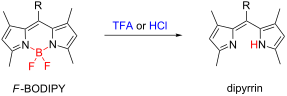
- diversifying the F-BODIPY framework [9]. F-BODIPYs are readily prepared by condensing aldehydes, acyl chlorides or anhydrides with pyrroles and trapping the resulting dipyrrin in situ with boron trifluoride [9][10][11]. F-BODIPYs are generally stable and chemically robust, with photophysical properties that


The effect of permodified cyclodextrins encapsulation on the photophysical properties of a polyfluorene with randomly distributed electron-donor and rotaxane electron-acceptor units
Beilstein J. Org. Chem. 2014, 10, 2145–2156, doi:10.3762/bjoc.10.222
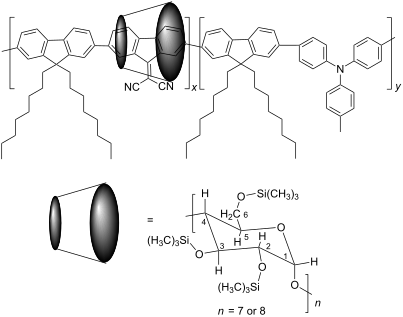
- -dioctylfluorene 3 and compared with those of the corresponding non-rotaxane 4 counterpart. Rotaxane formation results in improvements of the solubility, the thermal stability, and the photophysical properties. Polyrotaxanes 4a and 4b exhibited slightly red-shifted absorption bands with respect to the non-rotaxane
- photophysical properties of PFs we performed the present study. TMS-β-CD and TMS-γ-CD macrocyclic molecules, 1 and 2 monomers, were prepared according to previously reported procedures [13][32][33][34][35]. The chemical structure of completely persilylated compounds was confirmed by using FTIR and NMR
- surfaces. Conclusion The synthesis and photophysical properties of two conjugated polyrotaxanes containing electron-accepting units encapsulated into TMS-β-CD or TMS-γ-CD cavities and electron-donating moieties, statistically distributed into the conjugated chains of 9,9-dioctylfluorene were investigated


Photorelease of phosphates: Mild methods for protecting phosphate derivatives
Beilstein J. Org. Chem. 2014, 10, 2038–2054, doi:10.3762/bjoc.10.212
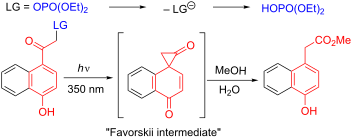
- propensity to undergo heterolytic photosolvolysis reactions, most notably o-nitrobenzyl (o-NB) [12], benzyl phenyl ketone (benzoin) [13][14], coumarin-4-ylmethyl [15], and, more recently, p-hydroxyphenacyl (pHP) [15] phosphate esters (Figure 1). While these chromophores exhibit a range of photophysical
- properties, all share a conjugated aromatic structural motif that facilitates UV–vis absorption and serves as a traceless reagents, orthogonal to common ground state deprotection processes and essentially independent of pH effects. Thus, the chromophores are particularly useful at neutral pH and no added





