Search results
Search for "conjugation" in Full Text gives 446 result(s) in Beilstein Journal of Organic Chemistry. Showing first 200.
Mono- and bithiophene-substituted diarylethene photoswitches with emissive open or closed forms
Beilstein J. Org. Chem. 2019, 15, 2344–2354, doi:10.3762/bjoc.15.227
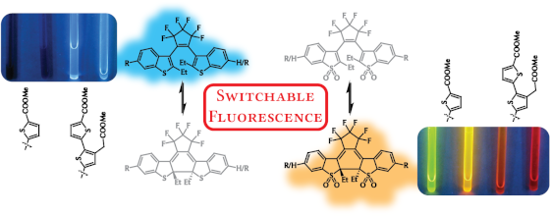
- . Oligothiophenes are highly fluorescent [6][7], and therefore, we reasoned that their incorporation into DAEs with oxidized 2-alkylbenzo[b]thiophene units might produce fluorescent open forms in addition to the intrinsic fluorescence of the closed forms. In particular, we expected that the prolonged conjugation
- , decoration of the core structures 3 and 6 (Scheme 1) with thiophene rings lowered the switching quantum yields by several orders of magnitude. It became obvious that the rate of cyclization and cycloreversion reactions decreased when the conjugation path became longer (transition from the unsubstituted core


Small anion-assisted electrochemical potential splitting in a new series of bistriarylamine derivatives: organic mixed valency across a urea bridge and zwitterionization
Beilstein J. Org. Chem. 2019, 15, 2277–2286, doi:10.3762/bjoc.15.220
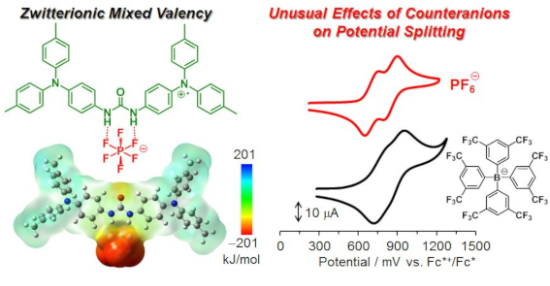
- )•+ radical cations having dithienylethene bridges [21][22]. This was achieved by a regulation of the π-conjugation length through photoinduced formation/dissociation of σ bonds in the bridge, which was accomplished with changeovers from a localized system (class I) to a moderately delocalized one (class II
- means that the π orbital of the central C=O moiety does not contribute to the π-conjugation in the HOMOs. Such HOMO properties would be understood by comparison with a well-known reference bis(NAr3) derivative MeO-TPD, in which the NAr3 units are directly connected through a σ-bond [6]. MeO-TPD shows a


Click chemistry towards thermally reversible photochromic 4,5-bisthiazolyl-1,2,3-triazoles
Beilstein J. Org. Chem. 2019, 15, 2161–2169, doi:10.3762/bjoc.15.213
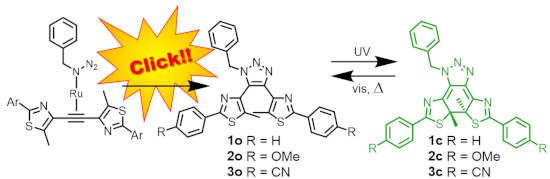
- large [6]; (3) when the substituent groups on the ring-closing carbon atoms are strongly electron-withdrawing [7]; or (4) when the dialkylamino group on the side chain [8] or a carbon atom of the conjugation system in a strained closed form [9] are protonated. Terarylenes [10][11], one of the closely
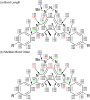
- constructing the conjugation system around the central cyclohexadiene moiety (Scheme 5). In Scheme 5a, the single bonds of 3c written in red are shorter than in the other two compounds, implying that they have a stronger double bond character. Similarly, the double bonds of 3c written in green are longer
- that the lone pair on this nitrogen atom participates in the conjugation in the molecular core more strongly than in 1c and 2c. This distinctive character of 3c originates from the electron-withdrawing cyano groups in the molecule. Data on the terminal phenyl rings in Scheme 5 do not give any



An overview of the cycloaddition chemistry of fulvenes and emerging applications
Beilstein J. Org. Chem. 2019, 15, 2113–2132, doi:10.3762/bjoc.15.209
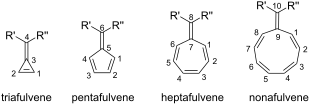
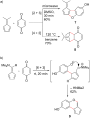
- singlet state oxygen to form similar peroxide, epoxide or epidioxide [16] derivatives, which can be isolated at room temperature (Scheme 4). An interesting physical characteristic of pentafulvene derivatives is their bright colour, which results from their cross conjugation, and varies with substitution
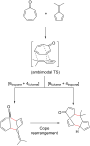
- be generated in situ from methyl(2-methylenecyclopropyl)(phenyl)sulfonium tetrafluoroborate (Scheme 13b). As pentafulvenes are the most commonly studied fulvenes, it follows that there is a great deal of literature surrounding their reactivity in cycloaddition reactions. Due to conjugation, they can





1,2,3,4-Tetrahydro-1,4,5,8-tetraazaanthracene revisited: properties and structural evidence of aromaticity loss
Beilstein J. Org. Chem. 2019, 15, 2059–2068, doi:10.3762/bjoc.15.203
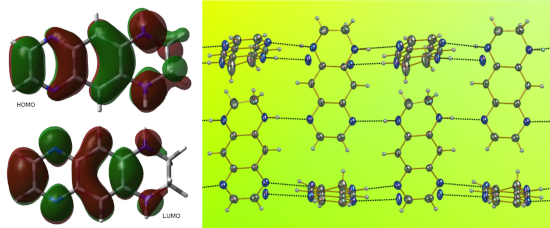
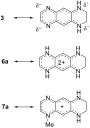
- averaged distances from 1.363 to 1.367 Å (Table 1). The C1–C2 and C4–C5 distances vary between 1.447 and 1.421 Å, respectively, indicating poor conjugation through these bonds, as a result of a partial loss of the aromaticity of the central benzene ring. This feature is confirmed also by the deviation of




Synthesis and anion binding properties of phthalimide-containing corona[6]arenes
Beilstein J. Org. Chem. 2019, 15, 1976–1983, doi:10.3762/bjoc.15.193
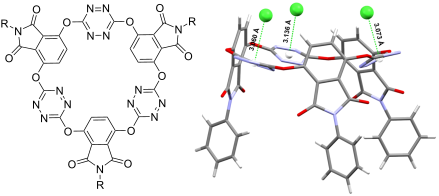
- was evident that six bridging oxygen atoms formed roughly a plane. Interestingly, three tetrazine rings are procumbent on the plane while three phthalimide units were almost perpendicular to the plane. Judging from the bond lengths, all oxygen atoms in the linking positions tended to form conjugation


Norbornadiene-functionalized triazatriangulenium and trioxatriangulenium platforms
Beilstein J. Org. Chem. 2019, 15, 1815–1821, doi:10.3762/bjoc.15.175
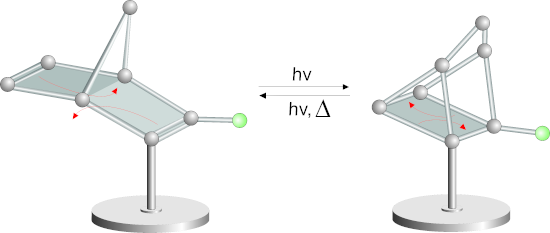
- parameter controlling the cis–trans rate acceleration of azobenzenes and not the length of the spacer [1]. A full conjugation path from the azobenzene on top through the ethynyl spacer and the platform to a bulk gold surface shortens the half-life of the metastable cis-isomer from days to seconds even
- complete conjugation path across the double bond of norbornadiene to the metal. Additionally, it is known that electron-withdrawing groups in 2 or 3 position change the triplet energy hypersurface in such a way that a triplet excited quadricyclane 1b decays into the ground state of the norbornadiene 1a [9
- ], which is a precondition for an efficient QC→NBD isomerization via our postulated non-adiabatic singlet→triplet→singlet mechanism. Results and Discussion If our proposed spin change mechanism, mediated by the conducting electrons in bulk gold were correct, interruption of the conjugation path and


A golden opportunity: benzofuranone modifications of aurones and their influence on optical properties, toxicity, and potential as dyes
Beilstein J. Org. Chem. 2019, 15, 1781–1785, doi:10.3762/bjoc.15.171
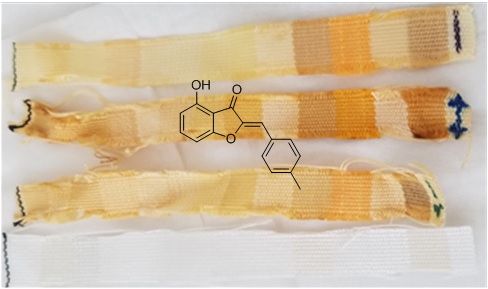
- shift of this lambda max by roughly 40 nm to around 338 nm, presumably due to their donating effect and conjugation with the carbonyl oxygen. Halogen substituents at the 6-position generally had little effect, with the exception of the most electron-withdrawing fluorine, which resulted in a slight blue
- expected due to the lack of direct conjugation with the carbonyl as well as the only modest electronic effects of alkyl, chlorine, and bromine. In general, the substituent effects are all fairly modest and result in fairly moderate changes in the extinction coefficient (although hydroxy substitution does




Synthesis, photophysical and electrochemical properties of pyridine, pyrazine and triazine-based (D–π–)2A fluorescent dyes
Beilstein J. Org. Chem. 2019, 15, 1712–1721, doi:10.3762/bjoc.15.167
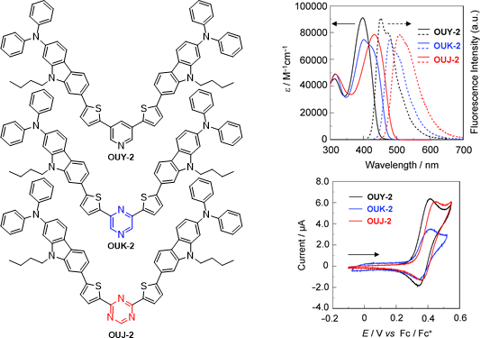
- electron-donating and electron-accepting abilities of the D and A moieties and the expansion of π conjugation, respectively, can lead to a decrease in the energy gap between the HOMO and LUMO because the highest occupied molecular orbital (HOMO) is localized over the π-conjugated system containing the D




Diazocine-functionalized TATA platforms
Beilstein J. Org. Chem. 2019, 15, 1485–1490, doi:10.3762/bjoc.15.150
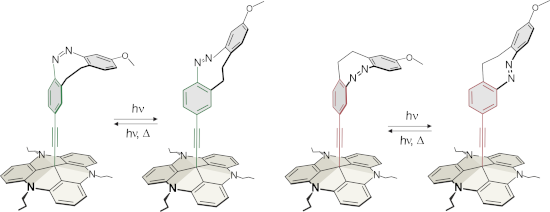
- to the trans-form, which slowly returns back to the stable cis-isomer. To investigate the thermal trans→cis isomerization as a function of the conjugation to the metal surface, we connected the acetylene spacer in meta (weak conjugation) and in para (strong conjugation) position. Both isomers form
- the metal surface [11][18]. With increasing π-conjugation from the azobenzene into the platform, and thus coupling to the gold surface, the activation barrier drops to almost zero (≈8 kJ mol−1) and the frequency factors (log A) become negative [11]. Vanishing barriers and low frequency factors are
- the azo group, providing a full π-conjugation path of the N=N unit through the ethynyl spacer into the platform. Diazocine-TATA 2 is connected in meta-position and thus interrupting conjugation [24][25]. Both diazocine-TATAs are equipped with methoxy groups, which serve as “reporter units” indicating



Introduction of an isoxazoline unit to the β-position of porphyrin via regioselective 1,3-dipolar cycloaddition reaction
Beilstein J. Org. Chem. 2019, 15, 1434–1440, doi:10.3762/bjoc.15.143
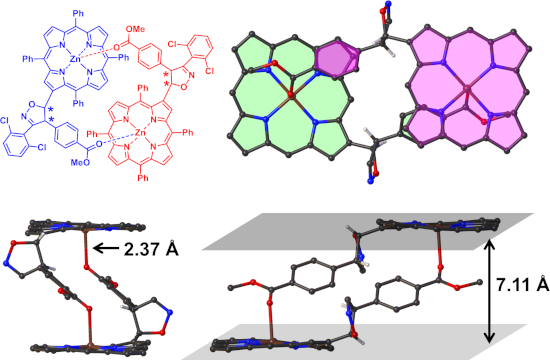
- Soret band and two weak Q bands. When compared to the spectrum of the precursor 2, a blue shift of ≈10 nm was observed in those of 3a or 3b, which may result from the loss of partial conjugation after the cycloaddition reaction between the nitrile oxides and C=C double bond. However, the substitution at


Formation of an unexpected 3,3-diphenyl-3H-indazole through a facile intramolecular [2 + 3] cycloaddition of the diazo intermediate
Beilstein J. Org. Chem. 2019, 15, 1347–1354, doi:10.3762/bjoc.15.134
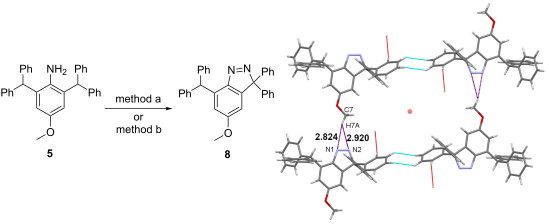
- presented in Figure 3. The crystal and refinement data are given in Table 1. The 3H-indazole 8 (–N=N–CRR–) has a break in its conjugation at the sp3 carbon atom when it is compared to the 1H-indazole isomer –NH–N=CH– that is fully conjugated with the benzo group. Therefore, the 3H-indazole isomer is higher


Steroid diversification by multicomponent reactions
Beilstein J. Org. Chem. 2019, 15, 1236–1256, doi:10.3762/bjoc.15.121
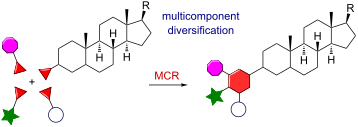
- as the conjugation of steroids to amino acids, peptides and carbohydrates. We demonstrate that steroids are available with almost all types of MCR reactive functionalities, e.g., carbonyl, carboxylic acid, alkyne, amine, isocyanide, boronic acid, etc., and that steroids are suitable starting
- supramolecular chemistry applications. Keywords: conjugation; heterocycles; macrocycles; multicomponent reactions; steroids; Review 1 Introduction The utilization of multicomponent reactions (MCRs) [1] for the derivatization of biomolecules has continuously grown over the last years. These diversity-oriented
- the steroidal nucleus, the assembly of nitrogen-heterocycles fused to the steroid-ring system, the steroid conjugation and macrocyclization, all relying on MCRs. 2 Modification of the steroidal nucleus and the side chain 2.1 Isocyanide-based MCRs 2.1.1 Steroids as carbonyl component: One of the first


Ugi reaction-derived prolyl peptide catalysts grafted on the renewable polymer polyfurfuryl alcohol for applications in heterogeneous enamine catalysis
Beilstein J. Org. Chem. 2019, 15, 1210–1216, doi:10.3762/bjoc.15.118
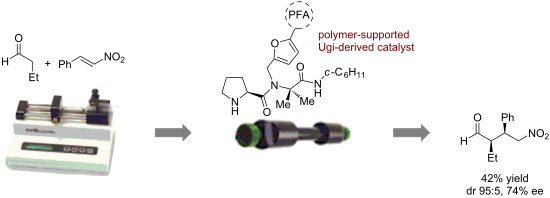
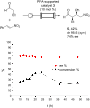
- ) – derived from a renewable resource like sugar cane biomass – for the incorporation of chiral pyrrolidine-based motifs capable to catalyze relevant asymmetric reactions. The incorporation of an organocatalyst into a polymer support requires either conjugation to the polymer or functionalization with a


Self-assembly behaviors of perylene- and naphthalene-crown macrocycle conjugates in aqueous medium
Beilstein J. Org. Chem. 2019, 15, 1203–1209, doi:10.3762/bjoc.15.117
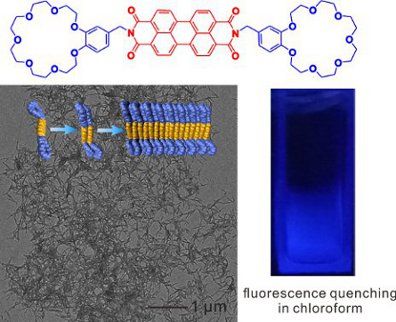
- ]. However, we recently found that benzo-21-crown-7 (B21C7) displays impressive high water solubility in comparison with other macrocyclic hosts [55]. Moreover, the conjugation of B21C7s to the well-known supramolecular BTA core leads to the observation of special topological effects on ion selectivity in


A chemically contiguous hapten approach for a heroin–fentanyl vaccine
Beilstein J. Org. Chem. 2019, 15, 1020–1031, doi:10.3762/bjoc.15.100
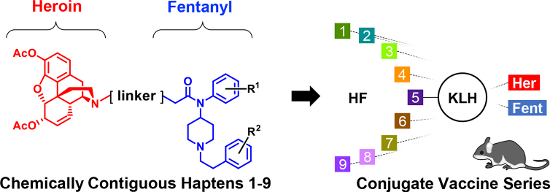
- States has necessitated the development of new strategies to treat addiction. Monoclonal antibodies and antidrug vaccines provide a tool that both aids addiction management and reduces the potential for overdose. Dual drug vaccines formulated by successive conjugation or by mixture have certain drawbacks
- two individual vaccines together (admixture vaccine) [9][10]; or 2) successive conjugation steps of one hapten and then the second to a carrier protein [11][12]. To specifically address the escalating incidence of fentanyl-contamination in heroin, we investigated the efficacy of an admixture of
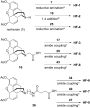
- carboxylic acids, allowing direct coupling of haptens to the carrier protein. Hapten conjugation reaction with carrier proteins BSA and KLH Test reactions on submilligram scale (0.1 mg hapten:0.1 mg BSA, 1 mg/mL protein) were performed with activated HF-1 and BSA, resulting in a moderate number of haptens




Synthesis of acylglycerol derivatives by mechanochemistry
Beilstein J. Org. Chem. 2019, 15, 811–817, doi:10.3762/bjoc.15.78
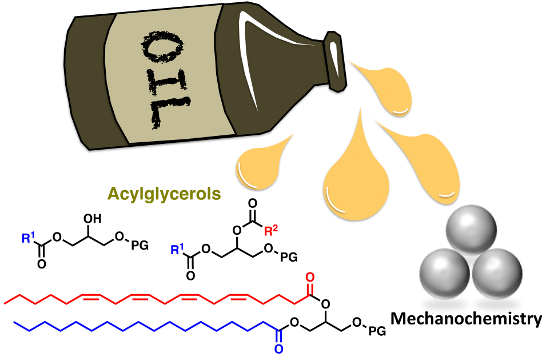
- the mechanosynthesis of DAGs 5 was established, we turned our efforts towards the conjugation of DAG 5a with 7-hydroxycoumarin (9) (Scheme 5). Initially, removal of the TBDMS protecting group of 5a was attempted by milling. However, reacting DAG 5a with a mixture of BF3·CH3CN and silica gel followed
- through acyl migration of 6a under the basic milling conditions. Subsequently, the reaction mixture containing 8a and 8a’ was milled with 7-hydroxycoumarin (9) and triethylamine to achieve the conjugation of the DAGs 8 in 53% yield after two steps (Scheme 5c). A mixture of 10a and 10a’ (10a/10a’ 72:28
- ) was separated from the unreacted starting materials, and analyzed by UV–vis spectroscopy (Figure 3). Comparison of the UV–vis spectra of 6a and 10a/10a’ showed the successful conjugation of the DAG with the coumarin moiety [47]. Conclusion The implementation of ball milling techniques has provided the


Catalyst-free assembly of giant tris(heteroaryl)methanes: synthesis of novel pharmacophoric triads and model sterically crowded tris(heteroaryl/aryl)methyl cation salts
Beilstein J. Org. Chem. 2019, 15, 642–654, doi:10.3762/bjoc.15.60
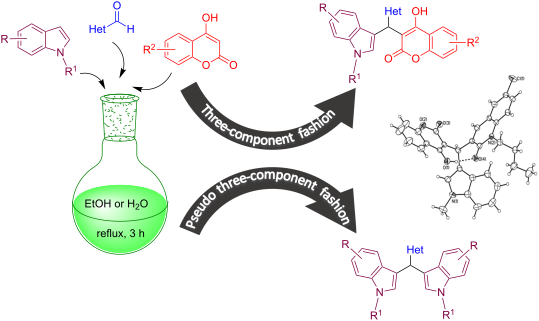
- despite significant steric crowding. Steric congestion restricts the conjugation of the carbocationic center with the aromatic/heteroaromatic substituents, as evidenced by the bond length shortenings from only 0.052 Å to 0.111 Å observed upon hydride abstraction. The optimized geometries confirm the








Design and synthesis of multivalent α-1,2-trimannose-linked bioerodible microparticles for applications in immune response studies of Leishmania major infection
Beilstein J. Org. Chem. 2019, 15, 623–632, doi:10.3762/bjoc.15.58
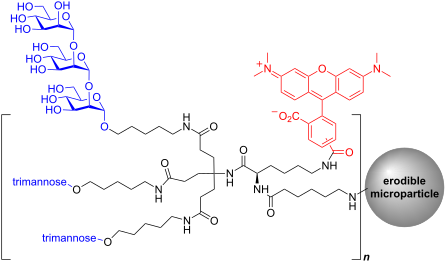
- recognition. To allow for both surface functionalization of this glycan to the bioerodible microparticles and conjugation of the fluorophore, two amine handles would be necessary (Figure 3). The design would also benefit from the development of a more efficient synthesis of the mannose oligomer sidechain
- used alkene fluorous tag [11][52][53]. The CbzF tag was also removed during global deprotection to readily provide an amine handle for conjugation to the dendrimeric core, avoiding further synthetic manipulations. Synthesis of glycodendrimer Attachment of the 5(6)-TAMRA fluorophore to the dendrimeric
- mechanisms of L. major immune suppression and evasion. The fluorescent-tagged pathogen-associated oligosaccharide probe was synthesized through orthogonal conjugation for ease of attachment to bioerodible microparticles. The PAMP carbohydrate 16 was further synthesized through iterative glycosylation and


Selectivity in multiple multicomponent reactions: types and synthetic applications
Beilstein J. Org. Chem. 2019, 15, 521–534, doi:10.3762/bjoc.15.46
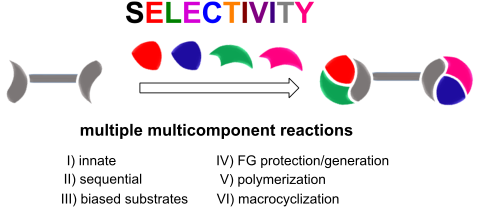
- access to a variety of structural types. On the contrary, when di(poly)functionalized substrates display conjugation between the reactive FGs, selectivity may arise. When the initial MCR adduct is less reactive than the starting material, a sequential procedure may lead to the following transformation


Convergent synthesis of the pentasaccharide repeating unit of the biofilms produced by Klebsiella pneumoniae
Beilstein J. Org. Chem. 2019, 15, 431–436, doi:10.3762/bjoc.15.37
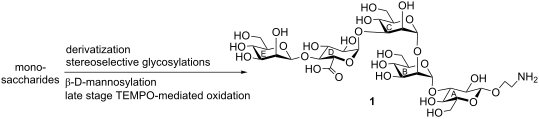
- contrast to the natural version. The synthesized molecules can be linked with appropriate functionalities for their conjugation with a protein for the preparation of glycoconjugates. Recently, Cescutti et al. [11] reported the structure of a pentasaccharide composed of D-glucose, D-mannose and D-glucuronic
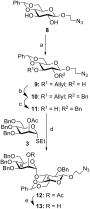
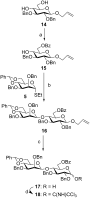
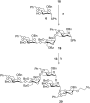
- pentasaccharide may provide ready availability of an amino functionality to expedite the conjugation of the pentasaccharide with an appropriate protein without affecting the sugar rings in the molecule [12][13]. Results and Discussion The target pentasaccharide as its 2-aminoethyl glycoside 1 was synthesized



Syntheses and chemical properties of β-nicotinamide riboside and its analogues and derivatives
Beilstein J. Org. Chem. 2019, 15, 401–430, doi:10.3762/bjoc.15.36






Sigmatropic rearrangements of cyclopropenylcarbinol derivatives. Access to diversely substituted alkylidenecyclopropanes
Beilstein J. Org. Chem. 2019, 15, 333–350, doi:10.3762/bjoc.15.29
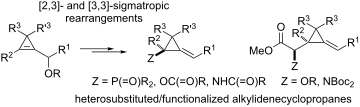
- substituent at C1. Whereas conjugation with the phenyl group (R = Ph) provides the driving force for the base-promoted isomerization of 1-benzyl-3,3-difluorocyclopropene (A’, R = Ph) into the corresponding benzylidene(gem-difluoro-cyclopropane) (B’) [18], methylene(gem-difluorocyclopropane) (B’’, R = H) is
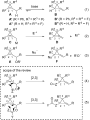
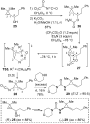
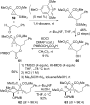
- rearrangement of 10a occurred was attributed to the relief of ring strain but also to the favorable conjugation of the olefin with the two phenyl groups (R1 = R’1 = Ph). Alkylidenecyclopropane 11a could also be obtained in similar yields (92% or 87%, respectively) by heating acetate 10a in dichloromethane at







Synthesis of a tubugi-1-toxin conjugate by a modulizable disulfide linker system with a neuropeptide Y analogue showing selectivity for hY1R-overexpressing tumor cells
Beilstein J. Org. Chem. 2019, 15, 96–105, doi:10.3762/bjoc.15.11
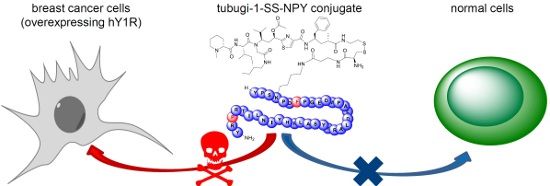
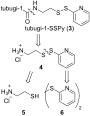
- Pharmaceuticals GmbH, Leberstr. 20, A-1110 Vienna, Austria 10.3762/bjoc.15.11 Abstract Tubugi-1 is a small cytotoxic peptide with picomolar cytotoxicity. To improve its cancer cell targeting, it was conjugated using a universal, modular disulfide derivative. This allowed conjugation to a neuropeptide-Y (NPY
- strongly hampered in its cytotoxic activity, and the peptide moiety ensures the target-specific toxin delivery toward the diseased cells, while omitting (most) healthy cells. To assess the impact of the chemical modifications due to the linker-assisted peptide–toxin conjugation and toxin liberation on the
- the target cells much lower toxicity than the cytotoxic compound tubugi-1 alone, thus opening a feasible therapeutic window for the class of tubugi toxins. In that context, a loss of tubugi-1 activity is expectable due to its chemical modification caused by the linker-based conjugation, and after




A simple and effective preparation of quercetin pentamethyl ether from quercetin
Beilstein J. Org. Chem. 2018, 14, 3112–3121, doi:10.3762/bjoc.14.291
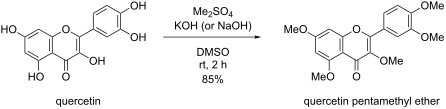
- by deprotonation of a single OH group of quercetin (2) were calculated. The deprotonation is an endothermic process in this calculation model. The most stable anion was derived from the OH group at 7 position (7-anion 2A), which is stabilized by the conjugation with the carbonyl group at 4 position
- reduced from that of the neural species (2B: −43.8°). In particular, 4'-anion 2B and 5-anion 2B are affected by conjugation between the chromenone moiety and the phenyl group (biaryl dihedral angle: −29.6° in 4'-anion 2B; −29.6° in 5-anion 2B). Change of proton affinity during the methylation reaction