Search results
Search for "emission" in Full Text gives 495 result(s) in Beilstein Journal of Organic Chemistry. Showing first 200.
Synthesis and characterization of S,N-heterotetracenes
Beilstein J. Org. Chem. 2020, 16, 2636–2644, doi:10.3762/bjoc.16.214

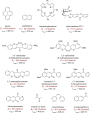
- , gradually decreases with increasing number of pyrrole rings in the heteroacenes from 3.62 eV for TTA to 3.50 eV for 33 (Figure 2, left). The SN4-heteroacenes fluoresce, if at all, only very weakly and emission maxima lay in between 356 nm for TTA and 388 nm for 22 with the most extended conjugated π-system


Water-soluble host–guest complexes between fullerenes and a sugar-functionalized tribenzotriquinacene assembling to microspheres
Beilstein J. Org. Chem. 2020, 16, 2551–2561, doi:10.3762/bjoc.16.207

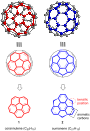
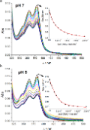
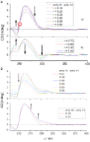
- exhibits an emission maximum peak at 329 nm upon excitation at 294 nm. This emission band is probably due to the formation of the ground-state dimer by interaction between the benzene rings upon excitation or excimer emission caused by the interaction between the aromatic rings [41][43]. As the
- concentration of the fullerenes C60 and C70 increase, the emission is significantly quenched, indicating the photoinduced energy transfer from TBTQ-(OG)6 to the fullerenes [47][48]. Molar ratio plots (see Figure S16, Supporting Information File 1) on the basis of the fluorescence titration experiments suggested


![[Graphic 2]](/bjoc/content/inline/1860-5397-16-207-i3.svg?max-width=637&scale=1.18182) C60 [TBTQ-(OG)6: 50 μM; C60: 50 μM] and (b) TBTQ-(OG)6
C60 [TBTQ-(OG)6: 50 μM; C60: 50 μM] and (b) TBTQ-(OG)6 


Synthesis of 1,4-benzothiazinones from acylpyruvic acids or furan-2,3-diones and o-aminothiophenol
Beilstein J. Org. Chem. 2020, 16, 2322–2331, doi:10.3762/bjoc.16.193
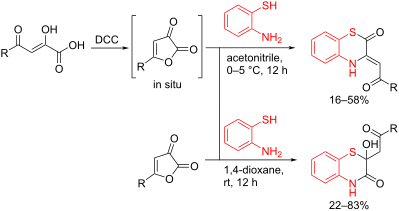
- potential Cu2+ chemosensors [14], and their BF2 chelates, as multicolor fluorescence complexes, some of which exhibited aggregation-induced emission (AIE) properties [15]. In addition, enaminones I and II proved themselves to be versatile and available building blocks for the synthesis of various



Chan–Evans–Lam N1-(het)arylation and N1-alkеnylation of 4-fluoroalkylpyrimidin-2(1H)-ones
Beilstein J. Org. Chem. 2020, 16, 2304–2313, doi:10.3762/bjoc.16.191

- pyrimidin-2(1H)-ones 5a–e exhibit fluorescence properties with emission of λmax = 490–532 nm in CH2Cl2 solution. In order to analyze the effect exerted on the Chan–Evans–Lam arylation by 4-, 5-, and 6-substituents on the pyrimidine ring and also aiming at the further functionalization of pyrimidin-2(1H)-one


Styryl-based new organic chromophores bearing free amino and azomethine groups: synthesis, photophysical, NLO, and thermal properties
Beilstein J. Org. Chem. 2020, 16, 2282–2296, doi:10.3762/bjoc.16.189
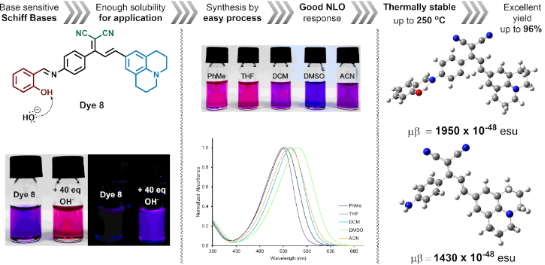
- with different polarities and showed absorption in the visible region and green-red emission with low quantum yields. The absorption and the emission maxima were shifted bathocromically by increasing the solvent’s polarity. However, there was no correlation with the polarity parameters of the solvents
- comprising of electron-donating and accepting groups in a donor–π–acceptor (D–π–A) system. The dyes exhibit strong absorption and emission properties in solution and in the solid state [1][2][3]. One important feature of these molecules is an exceptional polarizability which is a crucial criterion for NLO
- ][12][13][14]. Among dyestuffs classes, the push-pull fluorescent dyes are renowned to own such special behaviors. The push-pull dyes generate higher charge delocalization upon excitation, thus enhance both polarizability and fluorescence emission [12][13][14][18]. The charge delocalization upon


The B & B approach: Ball-milling conjugation of dextran with phenylboronic acid (PBA)-functionalized BODIPY
Beilstein J. Org. Chem. 2020, 16, 2272–2281, doi:10.3762/bjoc.16.188
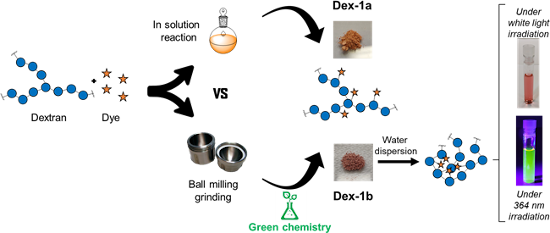
- conjugate (milled reaction) compared to a 0.61% w/w of 1 in the Dex-1a conjugate (conventional solution reaction) was obtained. The loading of 1 in both conjugates was also confirmed by inductively coupled plasma atomic emission spectroscopy (ICP-AES) analysis which showed in Dex-1b a boron content roughly
- emission bands were at λem = 524 nm (λexc = 380 nm) and λem = 523 nm (λexc = 460 nm, see Supporting Information File 1, Figure S2). Then, a Stokes shift of 16 nm could be appreciated in agreement with data previously reported for PBA-BODIPY (1) [26][35]. Dynamic light scattering (DLS) measurements were
- assemblies of the conjugate Dex-1b a simple experiment with pyrene was conducted. It is well known that the fluorescence spectrum of pyrene is very sensitive to the polarity of the environment [37]. Indeed, the ratio (I1/I3) between the first (I1 = 372 nm) and the third bands (I3 = 383 nm) in the emission


Tools for generating and analyzing glycan microarray data
Beilstein J. Org. Chem. 2020, 16, 2260–2271, doi:10.3762/bjoc.16.187
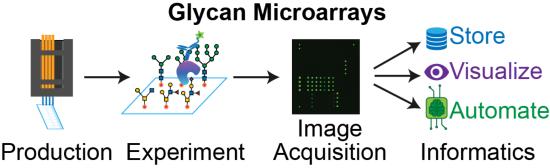
- on detecting reagents (e.g., labeled GBP, antibody or streptavidin). The emission wavelength of the fluorophore determines the filter used by the scanner before the intensities are measured by a photomultiplier tube (PMT) or by CCD camera. Currently, CCD camera systems are less sensitive as compared


Synthetic approaches to bowl-shaped π-conjugated sumanene and its congeners
Beilstein J. Org. Chem. 2020, 16, 2212–2259, doi:10.3762/bjoc.16.186

- reaction yielded 92 (Scheme 21). As can be seen from the literature, pyrene-based compounds remain among the highest beautiful and fascinating classes of molecules because of their extremely characteristic (“fingerprint”) optical absorption as well as emission behavior. Keeping in mind the uniqueness of











Naphthalene diimide bis-guanidinio-carbonyl-pyrrole as a pH-switchable threading DNA intercalator
Beilstein J. Org. Chem. 2020, 16, 2201–2211, doi:10.3762/bjoc.16.185
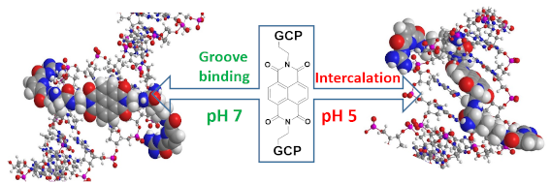
- chiral properties of the DNA or RNA helical structures [12][13], could also take advantage of induced CD spectrum (ICD) in the visible spectrum range of small achiral dyes, which they show only upon binding to DNA/RNA [14]. Moreover, with recent advances in fluorescence emission-based polarisation
- not observe any emission, neither for single dye binding to DNA, nor in crowding conditions (excess of dye over DNA binding sites) at which eventually fluorescent excimers could be formed. Interactions with DNA/RNA Because of significant differences in the protonation states of compound 4, studies





Photosensitized direct C–H fluorination and trifluoromethylation in organic synthesis
Beilstein J. Org. Chem. 2020, 16, 2151–2192, doi:10.3762/bjoc.16.183
- isotopes for positron emission tomography (PET) due to their suitable half-life (t1/2 = 110 min) and low positron energy, which allows the production of high-resolution images [23]. Therefore, radiopharmaceuticals that contain fluorine substituents are in high demand. Fluorine enhances important properties
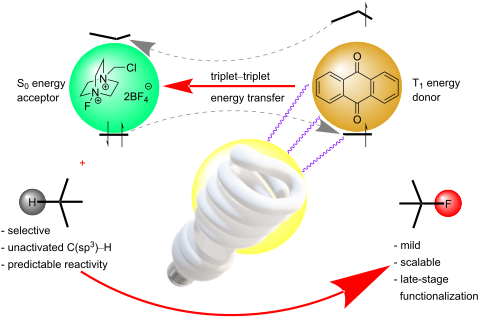
- out of reach of even the lowest emission wavelength range of the CFL bulb. Ir(ppy)3 also gave no reaction. This was interesting, considering that its triplet energy (T1 = 57.8 kcal⋅mol−1) was similar to Selectfluor® (T1 = 61.4 kcal⋅mol−1). Benzophenone (T1 = 69.1 kcal⋅mol−1) and 9-fluorenone (T1




Clustering and curation of electropherograms: an efficient method for analyzing large cohorts of capillary electrophoresis glycomic profiles for bioprocessing operations
Beilstein J. Org. Chem. 2020, 16, 2087–2099, doi:10.3762/bjoc.16.176
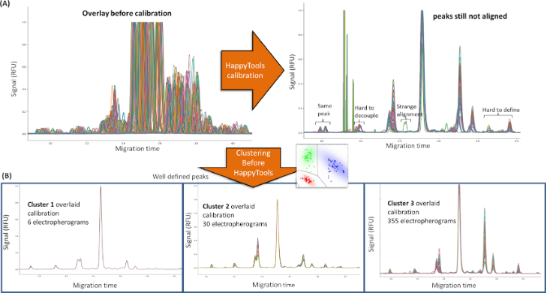
- Capillary electrophoresis of the released and APTS-labelled antibody N-glycans was performed on a CESI8000 CE instrument (Sciex) equipped with a solid state laser-induced fluorescent detector (excitation 488 nm, emission 520 nm). Separations were made across a 20 cm effective length (30 cm total length), 50


Naphthalene diimide–amino acid conjugates as novel fluorimetric and CD probes for differentiation between ds-DNA and ds-RNA
Beilstein J. Org. Chem. 2020, 16, 2032–2045, doi:10.3762/bjoc.16.170
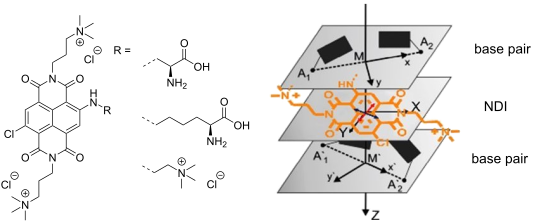
- interacted with ds-DNA/RNA by threading intercalation. Different from a reference NDI dye with identical visible range absorbance (520–540 nm) and Stokes shifts in emission (+60 nm, quantum yield > 0.2), only these amino acid–NDI conjugates showed selective fluorimetric response for GC-DNA in respect to AT(U
- both, the minor and major groove of the polynucleotide. Such bulky groups positioning requires the DNA double helix to shortly open at a binding site and close upon threading intercalator insertion. Also, the chosen NDI chromophore is characterised by easily tuneable emission wavelengths [23], and
- we took advantage of the fluorescence of 3a,b, and 5. Since suspected threading intercalation usually requires longer incubation times, the time required for reaching equilibrium was checked by repeatedly collecting emission spectra upon additions of DNA or RNA aliquots to the dye solution


Automated high-content imaging for cellular uptake, from the Schmuck cation to the latest cyclic oligochalcogenides
Beilstein J. Org. Chem. 2020, 16, 2007–2016, doi:10.3762/bjoc.16.167
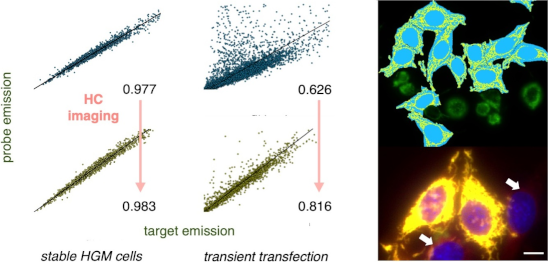
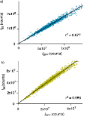
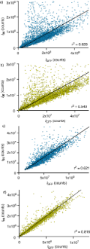
- striking even for the naked eye. A comparison of the respective images confirmed a massive off-target emission of 26 in the former, with r2 = 0.626 (Figure 10b, red, arrows) and little off-target emission in the latter, with r2 = 0.983 (Figure 7b, red, arrows). Masking of the regions with the intense GFP
- Figure 10c). This selection removed about 80% of all cells, and only the top 20% were kept for further analysis. However, applying a cell body mask to this remaining 20%, the fitting of r2 = 0.621 of the GFP and the 26 emission did not improve either (Figure 10c, cyan, including yellow and Figure 11c
- ). The inspection of the images confirmed that even the selected cells showed a significant off-target emission of 26 (Figure 10d, red, arrows). The masking of the Golgi apparatus, based on the GFP emission in the selected cells, was applied next to remove this off-target staining from 26 (Figure 11c




Controlling the stereochemistry in 2-oxo-aldehyde-derived Ugi adducts through the cinchona alkaloid-promoted electrophilic fluorination
Beilstein J. Org. Chem. 2020, 16, 1963–1973, doi:10.3762/bjoc.16.163
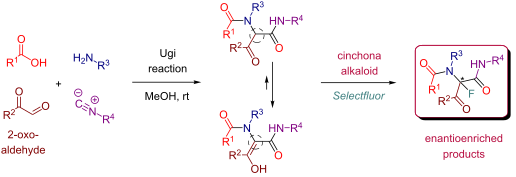
- -triggered complexation with boron trifluoride diethyl etherate. The resulting O,O-chelated boron complexes 11 turned out to be strong solid-state emitters featuring clear aggregation-induced emission (AIE) characteristics [61]. Encouraged by these results, we decided to attempt the reaction of 2-oxo


Et3N/DMSO-supported one-pot synthesis of highly fluorescent β-carboline-linked benzothiophenones via sulfur insertion and estimation of the photophysical properties
Beilstein J. Org. Chem. 2020, 16, 1740–1753, doi:10.3762/bjoc.16.146
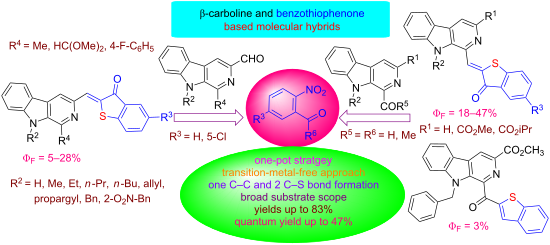
- chemosensors, ligands, and fluorescent probes. In order to investigate the fluorescence properties, compound 2bA was chosen as the model substrate for optimization of various parameters like time, concentration, and solvent. In order to obtain the maximum emission, various solvents were screened. The
- measurement of UV–vis absorption and fluorescence emission of the samples, stock solutions of 1.0 mM concentration were prepared using analytical grade CHCl3 as the solvent, and diluted to the final concentration of 4.0 μM. Next, we carefully measured the photophysical properties at room temperature including
- absorption, excitation, emission, Stokes shift, fluorescence quantum efficiency, molar extinction coefficient, and brightness. The photophysical data of the β-carboline C1 or C3-tethered benzothiophenone derivatives are summarized in Table 2, and their graphical data are depicted in Figure 3 and Figure 4


Clickable azide-functionalized bromoarylaldehydes – synthesis and photophysical characterization
Beilstein J. Org. Chem. 2020, 16, 1683–1692, doi:10.3762/bjoc.16.139
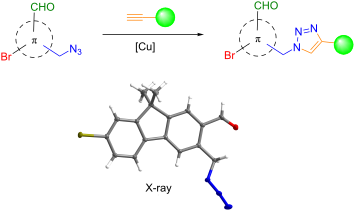
- emission behavior. Keywords: bromoarylaldehydes; click-chemistry; fluorenes; fluorescence; phosphorescence; Introduction Small organic luminophores exhibiting room-temperature phosphorescence (RTP) have attracted great attention due to promising applications in optoelectronic devices [1][2][3][4][5][6][7
- inert conditions [28] are necessary to facilitate an afterglow emission. Most phosphorescence studies are focused on metal complexes due to a strong heavy atom-induced spin-orbit coupling [29][30][31][32][33]. Considering the high price and the toxicity of many metal complexes, pure organic phosphors
- azide state and the linked triazole state, on the emission properties of these compounds (Figure 1). Results and Discussion Syntheses para- and ortho-bromobenzaldehyde 3 and 4 We initiated our synthetic investigations towards azide-functionalized para-bromobenzaldehyde 3 with a two-step sequence


Pauson–Khand reaction of fluorinated compounds
Beilstein J. Org. Chem. 2020, 16, 1662–1682, doi:10.3762/bjoc.16.138
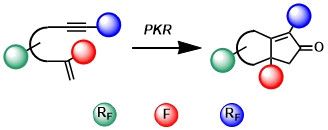
- use, fluorine-containing molecules have also found key applications in the field of medical diagnosis. Two of the most powerful imaging techniques used nowadays, positron-emission tomography (PET) and magnetic resonance imaging (MRI), are routinely carried out using fluorine-containing organic
- compounds [8][9]. The former takes advantage of the superb properties of the 18F-radioisotope as positron emitter (t1/2 = 109 min, 97% β+ emission), while the latter benefits from the excellent performance of the 19F isotope in NMR (100% natural abundance, high sensitivity, lack of endogenous background




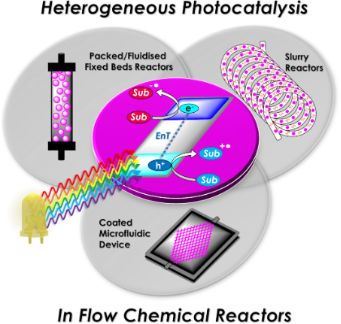
Heterogeneous photocatalysis in flow chemical reactors
Beilstein J. Org. Chem. 2020, 16, 1495–1549, doi:10.3762/bjoc.16.125










Synthesis of new fluorescent molecules having an aggregation-induced emission property derived from 4-fluoroisoxazoles
Beilstein J. Org. Chem. 2020, 16, 1411–1417, doi:10.3762/bjoc.16.117
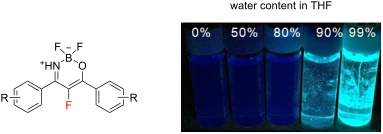
- synthesized and investigated for their photochemical properties. The introduction of a fluorine substituent into 3,5-diarylisoxazoles led to an increase of fluorescence intensity and exhibited a redshift in the emission intensity. α-Fluorinated boron ketoiminates (F-BKIs) were also synthesized via a ring
- -opening reaction of 4-fluoroisoxazoles and exhibited highly fluorescent luminescence and aggregation-induced emission (AIE), showing promise as a new fluorophore. Keywords: aggregation-induced emission; boron ketoiminates; fluorescent probe; α-fluorinated boron ketoiminates; 4-fluoroisoxazoles
- concentrated solutions by aggregation-caused quenching (ACQ) [8]. On the other hand, there are molecules that exhibit strong emission even in poor solvents or in the solid state. This property is referred to as aggregation-induced emission (AIE) and has attracted much attention in the field of fluorescence


Distinctive reactivity of N-benzylidene-[1,1'-biphenyl]-2-amines under photoredox conditions
Beilstein J. Org. Chem. 2020, 16, 1335–1342, doi:10.3762/bjoc.16.114
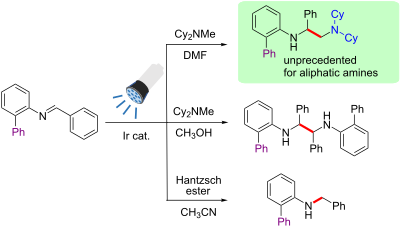
- quenched by single-electron transfer from Cy2NMe, resulting in the generation of the highly reducing [IrII] species and the radical cation A. To validate the reductive quenching pathway, we carried out Stern−Volmer quenching experiments (Figure S1, Supporting Information File 1). The emission intensity of


Development of fluorinated benzils and bisbenzils as room-temperature phosphorescent molecules
Beilstein J. Org. Chem. 2020, 16, 1154–1162, doi:10.3762/bjoc.16.102
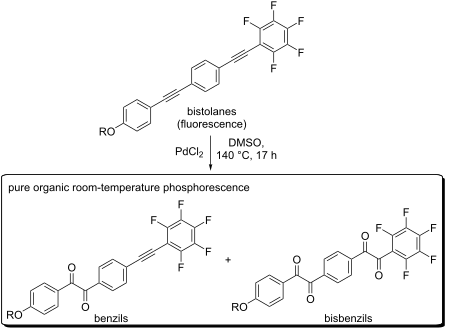
- intersystem crossing (ISC), resulting in the emission of phosphorescence [9]. Phosphorescent molecules generate two excitons (i.e., 25% S1 excitons and 75% T1 excitons) by application of an electric field, which is well known for organic light-emitting diodes. S1 excitons are converted to T1 excitons via an
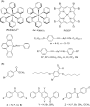
- (e.g., Ru [14], Ir [15][16], Pt [17], and Au [18][19][20][21]) (Figure 1A), and this offers a molecular design approach for phosphorescence emission. However, it is becoming necessary to explore alternatives to rare metals because of the latter’s scarcity and toxicity. Owing to recent considerable
- of the toluene solutions (1.0 × 10⁻³ M) were acquired after bubbling with N2 or O2 gas for 30 min. In general, an O2-saturated environment strongly deactivates the triplet states; thus, PL emission stems only from fluorescence. On the other hand, elimination of O2 gas from a solution by bubbling with



Synthesis and properties of quinazoline-based versatile exciplex-forming compounds
Beilstein J. Org. Chem. 2020, 16, 1142–1153, doi:10.3762/bjoc.16.101
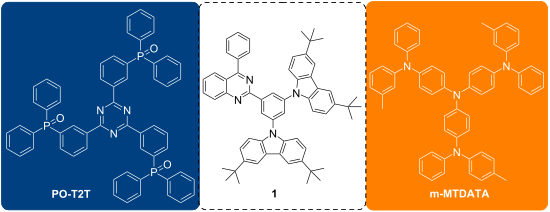
- ; quinazoline; Introduction Organic luminescent materials are extensively used in a wide range of optoelectronic devices. For the design of compounds, potentially exhibiting properties such as bipolar charge transport, delayed fluorescence or aggregation-induced emission enhancement (AIEE), a useful strategy
- properties [8]. A quinazoline-based emitter exhibiting thermally activated delayed fluorescence (TADF) was also reported [6] and green to yellow TADF OLEDs were fabricated with EQEs from 17.6 to 20.5%. The multicolor emission of a quinazoline–carbazole compound was employed in white OLEDs. White
- the derivatives 1–3 correlated with electrochemically estimated ones and with the ionization potential values discussed above. The photophysical characteristics determined from the UV–vis absorption and photoluminescence spectra are collected in Table 2. The emission spectra of diluted toluene


A smart deoxyribozyme-based fluorescent sensor for in vitro detection of androgen receptor mRNA
Beilstein J. Org. Chem. 2020, 16, 1135–1141, doi:10.3762/bjoc.16.100
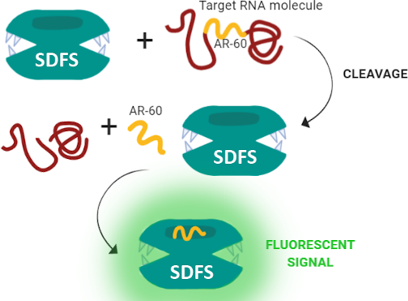
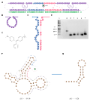
- resulting from the 60-AR_RNA cleavage. Prediction of the RNA secondary structure with the folding energy before and after cleavage was performed by MFold open source [21]. The SDFS functional activity. A–C) Emission spectra of the assembled SDFS (green line), T1–T5 chains mix without annealing (green dotted
- line indicates the threshold fluorescence value of the buffer with malachite green dye and 60-AR_RNA. Emission spectra of SDFS activity on total cellular RNA. The green line represents a spectrum of SDFS incubated with total HDPC RNA. The black line is a spectrum of SDFS incubated with total HeLa cells



Synthesis of novel multifunctional carbazole-based molecules and their thermal, electrochemical and optical properties
Beilstein J. Org. Chem. 2020, 16, 1066–1074, doi:10.3762/bjoc.16.93
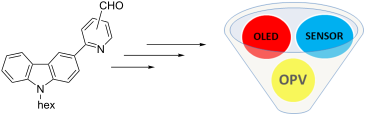
- spectroscopy, mass spectrometry, FTIR, thermogravimetric analysis, differential scanning calorimetry, cyclic voltammetry, and absorption and emission spectroscopy. Compounds 7a and 7b, both of which were amorphous solids, were stable up to 291 °C and 307 °C, respectively. Compounds 7a and 7b show three
- distinctive absorption bands: high and mid energy bands due to locally excited (LE) transitions and low energy bands due to intramolecular charge transfer (ICT) transitions. In dichloromethane solutions compounds 7a and 7b gave emission maxima at 561 nm and 482 nm with quantum efficiencies of 5.4% and 97.4
- yields (Scheme 1). Compounds 7a and 7b were fully characterised by NMR, FTIR, MS, elemental analysis, TGA, DSC, CV, and absorption and emission spectroscopy. The data are given in Supporting Information File 1. Thermal properties The thermal properties of compounds 7a and 7b were investigated by


Fluorinated phenylalanines: synthesis and pharmaceutical applications
Beilstein J. Org. Chem. 2020, 16, 1022–1050, doi:10.3762/bjoc.16.91
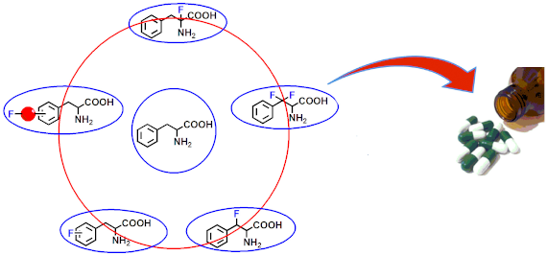
- -difluorophenylalanine derivatives 42a,b in quantitative yields [45] (Scheme 9). The radiolabeled 2-[18F]-fluoro-ʟ-phenylalanine 46 was synthesized as a promising radiopharmaceutical agent for molecular imaging by positron emission tomography (PET). The three-step synthesis of 46 started from [18F]-fluoride exchange in
- stability and substrate selectivity. 5.1. Applications of FPhe derivatives in positron emission tomography (PET) The molecular imaging technique positron emission tomography (PET) provides information on tumor metabolism, which allows for a more accurate diagnostic and therapy response in neuro-oncology
- . Synthetic protocols and strategies varied according to the position of the fluorine substituent. Also included were 18FPhe derivatives, some of which emerged as promising radiotracers in positron emission tomography (PET). Finally, it is notable that there are a significant number of FPhe derivatives which