


Search results
Search for "gold" in Full Text gives 324 result(s) in Beilstein Journal of Organic Chemistry. Showing first 200.
Self and directed assembly: people and molecules
Beilstein J. Org. Chem. 2016, 12, 391–405, doi:10.3762/bjoc.12.42

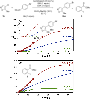
- mechanism to report saccharide binding (Figure 4). Sensei (Seiji Shinkai) then gave me my next and most important academic lesson – if you discover “gold” in one area of research you should keep on digging in that area – the hope is that you will discover a “seam of gold” leading to even more research
- achievements. This result, as far as my career goes was a Eureka moment, for which I count myself very lucky, this very simple discovery was the start of a very big “seam of gold” that has continued to fuel my research to the present day [19][20][21][22][23][24][25][26][27]. After, we discovered this simple






Optimized methods for preparation of 6I-(ω-sulfanyl-alkylene-sulfanyl)-β-cyclodextrin derivatives
Beilstein J. Org. Chem. 2016, 12, 349–352, doi:10.3762/bjoc.12.38
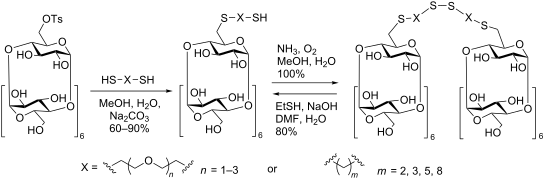
- disulfides are derivatives usable for well-defined covalent attachment of cyclodextrin to gold or polydopamine-coated solid surfaces. Keywords: cyclodextrins; disulfides; monosubstituted derivatives; thiols; Introduction Cyclodextrins (CDs) [1], cyclic oligomers of α-D-glucopyranose, are used for their
- -cyclodextrins (β-CD-S-X-SH) – which can be attached to a gold surface [9][10] or a polydopamine-coated surface [11]. It has been already described that the surface coverage of self-assembled monolayers of CD derivatives on gold depends substantially on the linker between the sulfanyl group and the CD
- the CD and the sulfanyl group. These derivatives are needed for two projects which both will study the influence of the linker length on the properties of the whole system. The first project will study the sensitivity of quartz crystal microbalances with a CD-modified gold sensor [14]; the second will


Study on the synthesis of the cyclopenta[f]indole core of raputindole A
Beilstein J. Org. Chem. 2016, 12, 334–342, doi:10.3762/bjoc.12.36

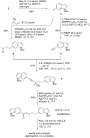
- which provided the hydrogenated tricyclic cyclopenta[f]indole core system in high yield. Keywords: gold-catalyzed reactions; heterocycles; indole alkaloids; natural products; synthesis; Introduction The raputindoles (1, raputindole A, Figure 1) from the rutaceous tree Raputia simulans Kallunki
- indoline and changing the N-protecting group significantly improved the yield for the cyclocitral adduct, but this still does not appear to be sufficient for a strategy towards raputindole A (1). Cyclization of propargylacetates. Key progress came when applying platinum and gold chemistry to




Scope and limitations of the dual-gold-catalysed hydrophenoxylation of alkynes
Beilstein J. Org. Chem. 2016, 12, 172–178, doi:10.3762/bjoc.12.19
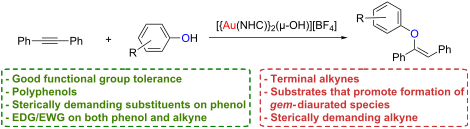
- /bjoc.12.19 Abstract Due to the synthetic advantages presented by the dual-gold-catalysed hydrophenoxylation of alkynes, a thorough study of this reaction was carried out in order to fully define the scope and limitations of the methodology. The protocol tolerates a wide range of functional groups, such
- in unsymmetrical alkynes can help to achieve high regioselectivity in the hydrophenoxylation. Keywords: cooperative catalysis; gold catalysis; hydrophenoxylation; N-heterocyclic carbene; vinyl ethers; Introduction During the last 30 years, N-heterocyclic carbenes (NHCs) have evolved from mere
- metal and main-group chemistry [10][11][12][13]. We have been interested in exploring the use of NHC ligands in transition metal complexes for the development of highly active and well-defined catalysts. One of our main interests during the last decade has been to study the use of gold–NHC species as




Copper-catalyzed intermolecular oxyamination of olefins using carboxylic acids and O-benzoylhydroxylamines
Beilstein J. Org. Chem. 2016, 12, 22–28, doi:10.3762/bjoc.12.4
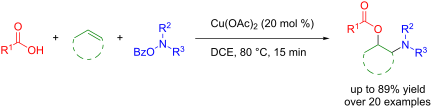
- olefins with a tethered amino or oxygen functionality has been achieved for the construction of a variety of 1,2-oxyamino products, using palladium [19][20], platinum [21], gold [22], copper [23][24][25][26], free-radical initiators [27][28][29], hypervalent iodine [30], and electrochemical oxidation [31


Pyridylidene ligand facilitates gold-catalyzed oxidative C–H arylation of heterocycles
Beilstein J. Org. Chem. 2015, 11, 2737–2746, doi:10.3762/bjoc.11.295
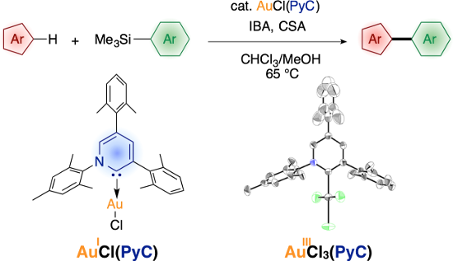
- University, Chikusa, Nagoya 464-8602, Japan 10.3762/bjoc.11.295 Abstract Triaryl-2-pyridylidene effectively facilitates the gold-catalyzed oxidative C–H arylation of heteroarenes with arylsilanes as a unique electron-donating ligand on gold. The employment of the 2-pyridylidene ligand, which is one of the
- strongest electron-donating N-heterocyclic carbenes, resulted in the rate acceleration of the C–H arylation reaction of heterocycles over conventional ligands such as triphenylphosphine and a classical N-heterocyclic carbene. In situ observation and isolation of the 2-pyridylidene-gold(III) species, as well
- as a DFT study, indicated unusual stability of gold(III) species stabilized by strong electron donation from the 2-pyridylidene ligand. Thus, the gold(I)-to-gold(III) oxidation process is thought to be facilitated by the highly electron-donating 2-pyridylidene ligand. Keywords: carbene ligand; C–H




Learning from the unexpected in life and DNA self-assembly
Beilstein J. Org. Chem. 2015, 11, 2713–2720, doi:10.3762/bjoc.11.292
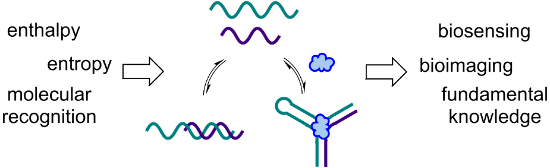
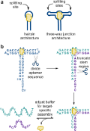
- were specifically drawn to the enzyme-linked immunosorbent assay (ELISA) that is the current gold standard in this field. As shown in Figure 3, we constructed our enzyme-linked assay by immobilizing one fragment of the split aptamer on the surface of a microplate, then adding the test sample along with




Evidencing an inner-sphere mechanism for NHC-Au(I)-catalyzed carbene-transfer reactions from ethyl diazoacetate
Beilstein J. Org. Chem. 2015, 11, 2254–2260, doi:10.3762/bjoc.11.245
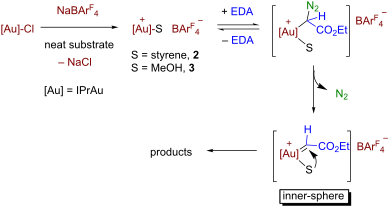
- CHCO2Et to the substrate (styrene or methanol) takes place in the coordination sphere of Au(I) by means of an inner-sphere mechanism, in contrast to the generally accepted proposal of outer-sphere mechanisms for Au(I)-catalyzed reactions. Keywords: carbene transfer; inner sphere; gold catalysis; O–H
- functionalization; olefin cyclopropanation; Introduction The discovery of the catalytic capabilities of soluble gold(I) species toward the hydration of alkynes by Teles and co-workers [1] is considered as the rising of the golden era for the use of this metal in homogeneous catalysis [2][3]. A number of
- transformations have been reported to date [4][5][6][7][8][9][10][11][12][13], most of them based on a particular feature of gold: a singular carbophilicity that enhances the electrophilic activation of multiple bonds upon coordination followed by subsequent inter- or intramolecular reaction with nucleophiles


Synthesis of constrained analogues of tryptophan
Beilstein J. Org. Chem. 2015, 11, 1997–2006, doi:10.3762/bjoc.11.216
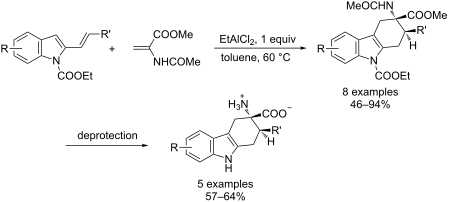
- only using copper(II) triflate as catalyst (Table 1, entry 5). Unsatisfactory results were obtained also in the presence of gold(III) and gold(I) catalysts (Table 1, entries 8 and 9). Only in the presence of a cationic gold(I) complex the diastereoisomeric cycloadducts 3a and 3'a were isolated in 20
- % overall yield and in a diastereomeric ratio of 1:1 (Table 1, entry 9). These results were quite surprising as these catalyst/solvent systems were effective in our previously reported Diels–Alder cycloadditions involving 1a as diene [18][19][20][21]. In particular, under gold catalysis excellent results in


Influence of bulky yet flexible N-heterocyclic carbene ligands in gold catalysis
Beilstein J. Org. Chem. 2015, 11, 1809–1814, doi:10.3762/bjoc.11.196
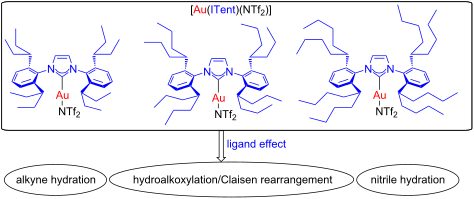
- ) complexes of the formula [Au(NHC)(NTf2)] (NHC = N-heterocyclic carbene) bearing bulky and flexible ligands have been synthesised. The ligands studied are IPent, IHept and INon which belong to the ‘ITent’ (‘Tent’ for ‘tentacular’) family of NHC derivatives. The effect of these ligands in gold-promoted
- transformations has been investigated. Keywords: catalysis; flexible and bulky ligands; gold; ligand design; N-heterocyclic carbenes; Introduction Homogeneous gold catalysis has witnessed an exponential growth in the last 15 years [1][2][3][4][5][6][7][8][9][10][11][12]. Gold complexes have been shown to be
- atoms did not have a significant impact on the properties of the ligands. Herein we report the catalytic activity of gold complexes containing the ITent ligands. Results and Discussion Synthesis of complexes We have recently reported the synthesis of [Au(ITent)Cl] and [Au(ITent)(OH)] derivatives


Preparative semiconductor photoredox catalysis: An emerging theme in organic synthesis
Beilstein J. Org. Chem. 2015, 11, 1570–1582, doi:10.3762/bjoc.11.173
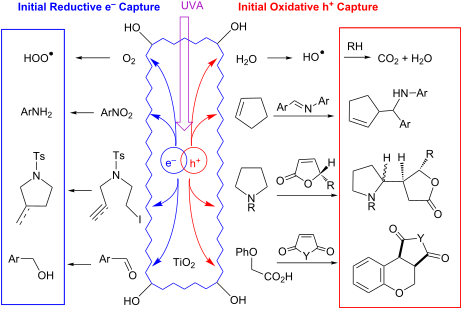
- photocatalyzed reactions Aeroxide (Evonik, formerly Degussa) P25 is the most widely employed form of TiO2 and is considered the “gold standard”. It has a relatively large surface area (≈50 m2 g−1) and consists of roughly 75% anatase and 25% rutile [13]. This combination exhibits a synergistic effect and is much







Synthesis of racemic and chiral BEDT-TTF derivatives possessing hydroxy groups and their achiral and chiral charge transfer complexes
Beilstein J. Org. Chem. 2015, 11, 1561–1569, doi:10.3762/bjoc.11.172
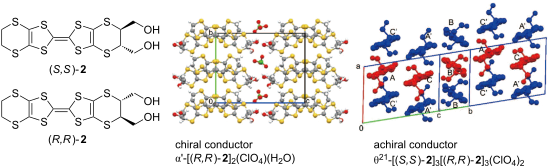
- current electrical conductivity measurement was made by the conventional four-probe method using carbon paste and gold wires. Synthesis of racemic-1 trans-5-(Hydroxymethyl)-6-methyl-5,6-dihydro[1,3]dithiolo[4,5-b][1,4]dithiine-2-thione (9). A solution of trithione 7 (1 g, 5.1 mmol, 1 equiv) and alkene 8


Cathodic hydrodimerization of nitroolefins
Beilstein J. Org. Chem. 2015, 11, 1163–1174, doi:10.3762/bjoc.11.131
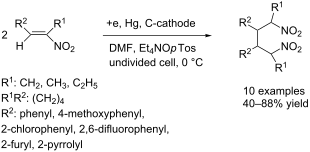
- intramolecular interactions of the nitro groups with the non-conjugated double bonds. The Ep,c of 1 and 4 measured at an amalgamated gold-wire electrode in DMF are somewhat more positive than those measured at a Pt-disc in ACN [17]. In the CV of all nitroolefins a second reduction peak appears at a potential
- substituents. Cathodic reduction of nitroalkene 1 to hydrodimer 2 and oxime 5. Preparation of the 1-aryl-2-nitroalkenes 1, 4, 8–15. Reduction potentials (Ep,c in Volt) of nitroolefins. Conditions: amalgamated gold wire, v = 0.1 V/s, 0.2 M TEA-pTos in DMF, accuracy of Ep,c = +/− 0.02V vs SCE, measured against


Single-molecule conductance of a chemically modified, π-extended tetrathiafulvalene and its charge-transfer complex with F4TCNQ
Beilstein J. Org. Chem. 2015, 11, 1068–1078, doi:10.3762/bjoc.11.120
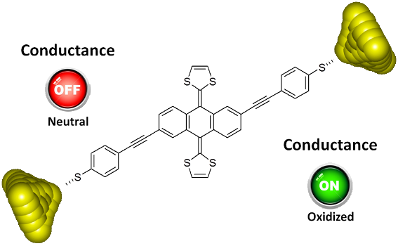
- a clean gold substrate to the solution for a period of approximately 30 min. The sample was then dried under a flow of argon and mounted inside the scanning tunneling microscope (STM). All experiments were then performed under solvent-free, ambient conditions. In order to form molecular junctions of
- compound 5, we followed the break junction technique [28]. During the experiment, the variation in conductance (G) is recorded while an STM tip is moved vertically (z) in and out of contact with a gold substrate, forming and breaking gold nanocontacts (G vs z trace). When the two gold electrodes (the STM
- . In this configuration, when separating the electrodes (larger z values), we observe conductance plateaus while the gold nanocontact or a molecular junction remains intact during the pulling. The plateaus then end abruptly when the junction is broken. Figure 3c and 3d show the 2D histograms consisting




Novel carbocationic rearrangements of 1-styrylpropargyl alcohols
Beilstein J. Org. Chem. 2015, 11, 1017–1022, doi:10.3762/bjoc.11.114
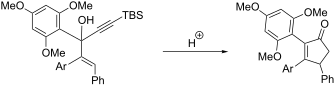
- molybdenum(VI)-catalyzed etherification of allylic alcohol with a gold(I)-catalyzed intramolecular cyclization process [5][6]. During the optimization process of this synthesis, we examined several catalysts to transform allylic alcohol 1 into ether 2, including Re2O7, which is described to efficiently


Gold-catalyzed formation of pyrrolo- and indolo-oxazin-1-one derivatives: The key structure of some marine natural products
Beilstein J. Org. Chem. 2015, 11, 897–905, doi:10.3762/bjoc.11.101

- into 3,4-dihydropyrrolo- and indolo-oxazin-1-one derivatives by a gold(III)-catalyzed cyclization reaction. Some of the products underwent TFA-catalyzed double bond isomerization and some did not. Cyclization reactions in the presence of alcohol catalyzed by Au(I) resulted in the formation of
- hemiacetals after cascade reactions. Keywords: alkyne cyclization; gold-catalyzed reaction; indolo-oxazin-1-one; marine natural products; pyrrolo-oxazin-1-one; Introduction Pyrrole-containing heterocycles are widely distributed within a large number of natural products and biologically active molecules [1
- atom-economic process using a gold-catalyzed alkyne cyclization reaction as the key step. Pyrrole and indole, bearing one (substituted) propargyl and carboxy group was initially designed as model substrate for the construction of 6 and 7. Gold-catalyzed intramolecular cyclization of enyene carboxylic


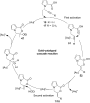
Mechanical stability of bivalent transition metal complexes analyzed by single-molecule force spectroscopy
Beilstein J. Org. Chem. 2015, 11, 817–827, doi:10.3762/bjoc.11.91
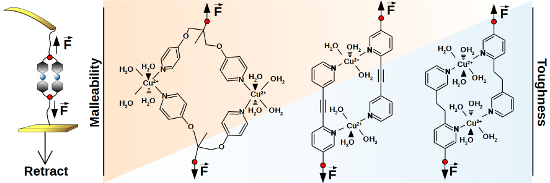
- gold coated SFM cantilever probes and surfaces using thiol chemistry (for details see Experimental section below). The interaction between gold and SH-groups is known to withstand rupture forces in the range of 1 to 2 nN [38], followed by the formation of a monoatomic gold nanowire that finally leads
- to a breakage of gold–gold bonds [39]. The rupture forces of our systems were one order of magnitude smaller, enabling repeated measurements of typically 1000 times per data point without tearing molecules off the SFM cantilever probe. The experimental setup is sketched in Figure 2a, where a bivalent
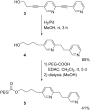
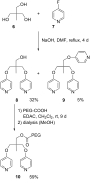
- °C). 1H NMR (CDCl3, 700 MHz) δ 6.81 (dd, J = 4.8, 1.5 Hz, 4H, 3-H, 5-H), 8.43 (dd, J = 4.8, 1.5 Hz, 4H, 2-H, 6-H) ppm. Surface films of the polymers were prepared in a similar manner as described before [27]. A droplet of a 1 mM aqueous polymer solution was applied to freshly template-stripped gold




Impact of multivalent charge presentation on peptide–nanoparticle aggregation
Beilstein J. Org. Chem. 2015, 11, 792–803, doi:10.3762/bjoc.11.89
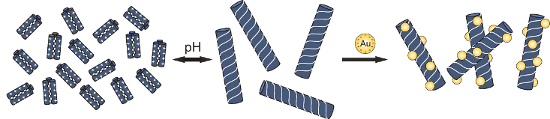
- macrostructures. Keywords: coiled-coil peptides; α-helical fibrils; controlled aggregation; gold nanoparticles; multivalency; Introduction In the past few decades metal and semiconductor nanoparticles, including gold nanoparticles, have gained much interest due to their desirable optical, magnetic, and
- electronic properties [1]. In particular, the distinct colour of gold nanoparticles is a result of the localised surface plasmon resonance (LSPR) band caused by collective electron oscillations. The LSPR induces a certain excitation band at visible wavelengths in the absorption spectrum, the position and
- published the use of coiled-coil model peptide VW05 for the reversible assembly of mercaptoundecanoic acid functionalized gold nanoparticles using electrostatic interactions [32][33]. We showed that the interaction can be repeatedly switched by adjusting the pH value. We further demonstrated that the


Orthogonal dual-modification of proteins for the engineering of multivalent protein scaffolds
Beilstein J. Org. Chem. 2015, 11, 784–791, doi:10.3762/bjoc.11.88
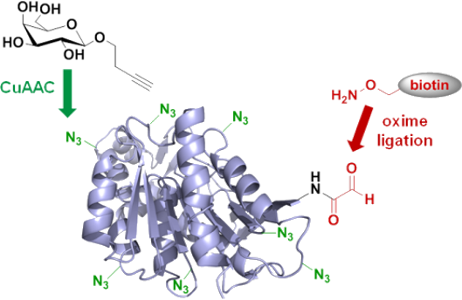
- conjugated with biotin using oxime ligation, by which the protein scaffold was immobilized on a streptavidin gold chip to monitor carbohydrate–protein binding studies by surface plasmon resonance (SPR). This immobilization strategy allowed easy handling and reproducible orientation, which are notable
- on a BiacoreX (GE Healthcare, Freiburg, Germany). Biotinylated TTL samples were coupled to streptavidin functionalized gold chips (SA-Chips, GE Healthcare, Freiburg, Germany). Before immobilization, the sensor chip was conditioned with three consecutive 1 min injections of 1 M NaCl and 50 mM NaOH


Regulation of integrin and growth factor signaling in biomaterials for osteodifferentiation
Beilstein J. Org. Chem. 2015, 11, 773–783, doi:10.3762/bjoc.11.87
- ; growth factor; integrin; osteodifferentiation; stem cells; Review Introduction Current bone grafting therapeutics do not provide satisfying solutions to the problems of non-healing bone defects. The gold-standard therapy is the grafting of autologous bone; however, it is limited by low availability as
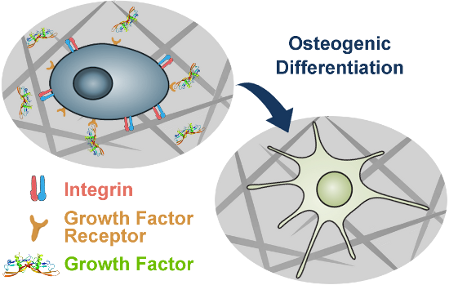
- similar size compared to individual cell receptors, thus it is possible to target receptor-driven pathways and modulate cell responses [7]. Here, the cyclic RGDfK peptides are precisely immobilized on substrates via hexagonally close-packed gold nanodot arrays prepared by block-copolymer micelle




Synthesis of multivalent carbohydrate mimetics with aminopolyol end groups and their evaluation as L-selectin inhibitors
Beilstein J. Org. Chem. 2015, 11, 638–646, doi:10.3762/bjoc.11.72
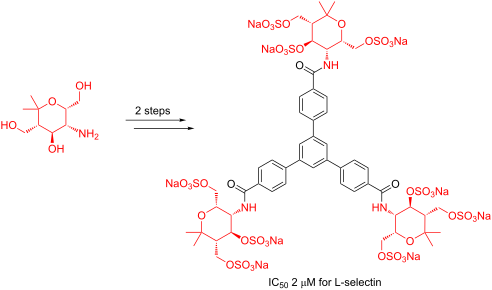
- as selectin inhibitors. There we have found that sulfated aminopyrans connected by amide bonds to gold nanoparticles are highly potent inhibitors of L- and P-selectin with IC50 values in the subnanomolar range [12][13]. These lectins are crucial in the inflammatory process [14][15][16][17][18] and


TTFs nonsymmetrically fused with alkylthiophenic moieties
Beilstein J. Org. Chem. 2015, 11, 628–637, doi:10.3762/bjoc.11.71
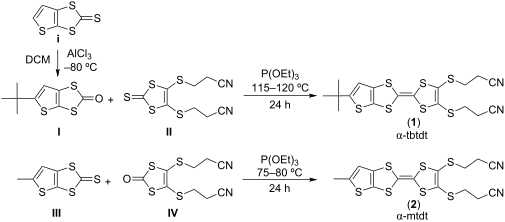
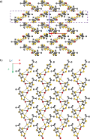
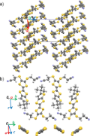
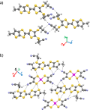
- -mtdt]+ cation is almost planar, with exception of the –(CH2)2–CN groups, that point out in the same direction (Figure 7). In both donor and acceptor units, the bond lengths are within the expected range, for monoanionic gold dithiolene complexes [21] and fully oxidised TTF donors [18], namely the Au–S





Direct access to pyrido/pyrrolo[2,1-b]quinazolin-9(1H)-ones through silver-mediated intramolecular alkyne hydroamination reactions
Beilstein J. Org. Chem. 2015, 11, 416–424, doi:10.3762/bjoc.11.47
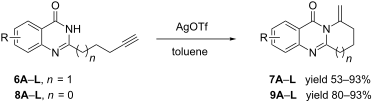
- studied for the construction of heterocycles. We have reported on a highly efficient gold/silver-catalyzed intramolecular hydroamination of terminal alkynes in water for the synthesis of fused tricyclic xanthenes [34]. On the basis of this methodology, we have also afforded two fused benzimidazoles


Functionalized branched EDOT-terthiophene copolymer films by electropolymerization and post-polymerization “click”-reactions
Beilstein J. Org. Chem. 2015, 11, 335–347, doi:10.3762/bjoc.11.39
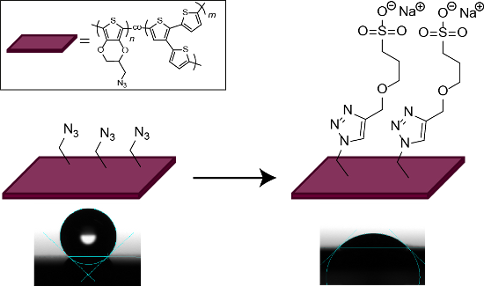
- of 100%) are displayed in blue. For comparison and to limit the influence of the film thickness all transmission spectra were normalized. While for P(EDOT-N3-co-3T)-1:1 the high intensity and a homogeneous distribution of the azide band is observed for the whole film unless the bare gold electrode is
- PGSTAT101 potentiostat (Metrohm, Germany) in a three-electrode glass cell under argon atmosphere at room temperature. The counter electrode was a Pt plate. The pseudoreference electrode consisted of AgCl-coated silver wire that was directly immersed into the electrolyte. As working electrodes, gold (50 nm
- layer)-coated Si wafers (with a 5 nm Cr adhesion layer between the Si wafer and the Au layer) or ITO-coated glass (≤50 Ω/sq, PGO, Germany) slides (approximately 1 cm2) were used. The gold working electrodes were fabricated by the physical vapor deposition of Cr and Au on rotating Si wafers. The gold







Properties of cationic monosubstituted tetraalkylammonium cyclodextrin derivatives – their stability, complexation ability in solution or when deposited on solid anionic surface
Beilstein J. Org. Chem. 2015, 11, 192–199, doi:10.3762/bjoc.11.20
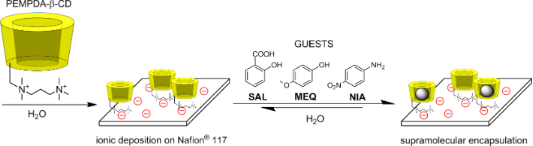
- drug formulation such as “smart” plasters or bandages capable of prolonged release of the antiseptic drug. There are several examples of deposition of CD derivatives onto a solid support in the literature. The most common immobilization method is binding of various alkylthio-CDs onto a gold surface [16
- ][17][18]. This approach offers self-assembled monolayers (SAMs) which can be utilized for derivatization of gold electrodes for the construction of electrochemical sensors [19][20] or even for the development of molecular printboards [21]. These results imply that the structure of CD derivatives





