


Search results
Search for "rhodium" in Full Text gives 198 result(s) in Beilstein Journal of Organic Chemistry.
Synthesis of fused tricyclic amines unsubstituted at the ring-junction positions by a cascade condensation, cyclization, cycloaddition then decarbonylation strategy
Beilstein J. Org. Chem. 2012, 8, 107–111, doi:10.3762/bjoc.8.11
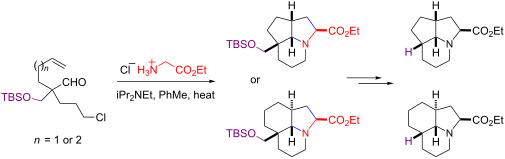
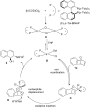
- substituent must be sufficient to allow a successful decarbonylation (in comparison with substrate 16), possibly due to the reduced ability of the amine nitrogen atom to coordinate to the rhodium complex. Conclusion The chemistry described here provides a method to prepare fused tricyclic products in which


Synthesis of highly functionalized β-aminocyclopentanecarboxylate stereoisomers by reductive ring opening reaction of isoxazolines
Beilstein J. Org. Chem. 2012, 8, 100–106, doi:10.3762/bjoc.8.10
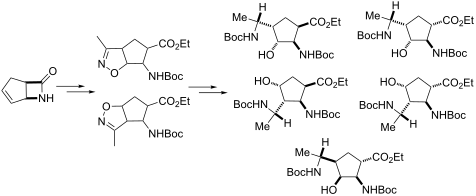
- 3). Combinations of NaBH4 (as a mild and selective reducing agent) with cobalt, nickel, iridium or rhodium halide have previously been employed for cleavage of the isoxazoline ring system, which is otherwise inert to NaBH4 without such metal halide additives [50]. Accordingly, we investigated the


Recent advances in direct C–H arylation: Methodology, selectivity and mechanism in oxazole series
Beilstein J. Org. Chem. 2011, 7, 1584–1601, doi:10.3762/bjoc.7.187
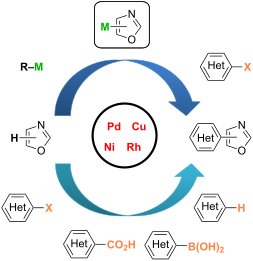
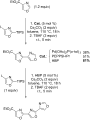
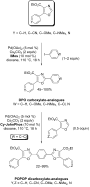
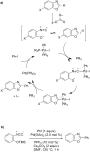
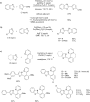
- with arylboronic acids providing the arylazolylpalladium complex, which delivers the product (Scheme 27b and Scheme 28b). Rhodium- and nickel-catalyzed direct arylation of oxazoles with halides The methodology for the Rh(I)-catalyzed direct substitutive coupling of azoles with halides was developed by
- )-catalyzed direct arylation of benzoxazole with arylboronic acids [76]; (a) procedure; (b) proposed mechanism. Ni(II)-catalyzed direct arylation of benzoxazoles with arylboronic acids under O2 [76]; (a) procedure; (b) proposed mechanism. Rhodium-catalyzed direct arylation of benzoxazole [78][79]. Ni(II






Recent developments in gold-catalyzed cycloaddition reactions
Beilstein J. Org. Chem. 2011, 7, 1075–1094, doi:10.3762/bjoc.7.124
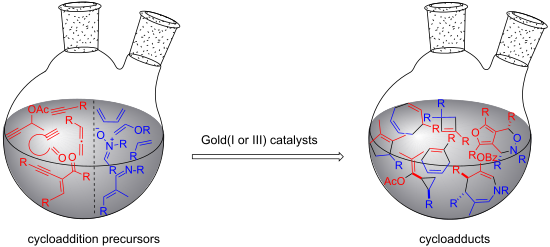
- . Although transition metal-catalyzed cycloadditions have been known since the mid-20th century, it was not until the 80s and 90s that they were recognized as versatile and powerful synthetic tools. So far, most examples of transition metal-catalyzed cycloadditions have involved the use of rhodium, ruthenium
- cycloadditions involving zwitterionic intermediates similar to I have also been developed with other transition metal catalysts such as tungsten, rhodium or platinum [32][33][34][35]. In particular, important developments were recently achieved with platinum catalysts [36][37], including the first
- transformation is somewhat related to those previously described by Doyle and by Barluenga that involved α,β-unsaturated imines and rhodium–vinyl carbenoids (Doyle) or Fischer carbenes (Barluenga). However, the stereochemical outcome of these three processes is different [78][79]. Therefore, the reactivity of


Asymmetric Au-catalyzed cycloisomerization of 1,6-enynes: An entry to bicyclo[4.1.0]heptene
Beilstein J. Org. Chem. 2011, 7, 1021–1029, doi:10.3762/bjoc.7.116
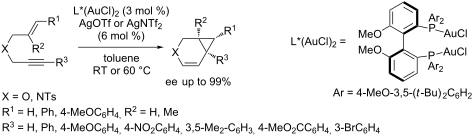
- chiral iridium catalyst [41] (Scheme 1, reaction 2). We and others recently pursued the improvement and development of this enantioselective process, by employing platinum [42][43][44], rhodium [45] or gold [46][47][48] complexes. Following our previous work with chiral gold catalysts [46], we report a
- % isolated yield respectively) resulting from 5-exo- and 6-endo cycloisomerization reactions [20][66]. Thus, the gold catalytic system cannot compete with the results obtained for the cyclizations of nitrogen-tethered enynes in the presence of iridium, platinum or rhodium catalysts [41][42][43][44][45]. The


Cationic gold(I) axially chiral biaryl bisphosphine complex-catalyzed atropselective synthesis of heterobiaryls
Beilstein J. Org. Chem. 2011, 7, 944–950, doi:10.3762/bjoc.7.105
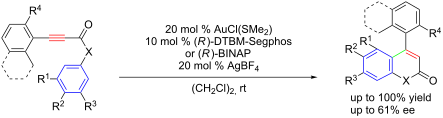
- -aryl-2-pyridones has already been achieved by rhodium catalyzed [2 + 2 + 2] cycloaddition [18], while the atropselective synthesis of 4-aryl-2-pyridones has not yet been realized. The application of this intramolecular hydroalkenylation reaction to the atropselective synthesis of 4-aryl-2-pyridones


When cyclopropenes meet gold catalysts
Beilstein J. Org. Chem. 2011, 7, 717–734, doi:10.3762/bjoc.7.82
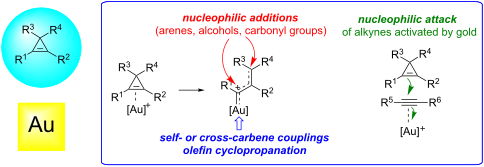
- cyclopropene for coordination to the gold catalyst (Scheme 13) [21][26]. The rearrangement of 27a to 28a (95%) had been previously reported by Müller et al. using rhodium(II) perfluorobutyrate as a catalyst (1 mol %, C6H6, reflux, 48 h) [32], whereas Padwa et al. showed that the isomerization of 27b to 28b was




Gold-catalyzed naphthalene functionalization
Beilstein J. Org. Chem. 2011, 7, 653–657, doi:10.3762/bjoc.7.77
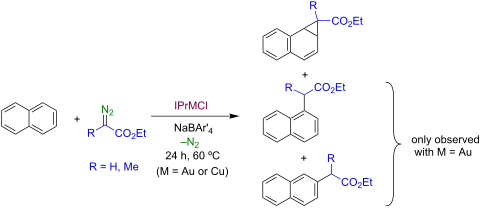
- observed with other metal-based catalysts [4][5][6]. The above transformation with rhodium-based catalysts [7][8] has also been investigated with naphthalene as a substrate. In this case, Teyssié and co-workers showed that it could be converted, using t-butyl diazoacetate, into norcaradiene type


Synthesis of cross-conjugated trienes by rhodium-catalyzed dimerization of monosubstituted allenes
Beilstein J. Org. Chem. 2011, 7, 578–581, doi:10.3762/bjoc.7.67

- Tomoya Miura Tsuneaki Biyajima Takeharu Toyoshima Masahiro Murakami Department of Synthetic Chemistry and Biological Chemistry, Kyoto University, Katsura, Kyoto 615-8510, Japan 10.3762/bjoc.7.67 Abstract A rhodium(I)/dppe catalyst promoted dimerization of monosubstituted allenes in a
- stereoselective manner to give cross-conjugated trienes, which are different from those obtained by a palladium catalyst. Keywords: allene; cross-conjugated triene; dimerization; rhodium; stereoselective; Introduction Cross-conjugated trienes, known as [3]dendralenes [1], are attractive synthetic precursors
- substituted cross-conjugated trienes 2 in high yield (Scheme 1) [21]. We report here that dimerization of monosubstituted allenes is also catalyzed by a rhodium(I)/dppe complex to form cross-conjugated trienes 3, which are different from those obtained with the palladium catalyst. Results and Discussion We


Rh(I)-catalyzed intramolecular [2 + 2 + 1] cycloaddition of allenenes: Construction of bicyclo[4.3.0]nonenones with an angular methyl group and tricyclo[6.4.0.01,5]dodecenone
Beilstein J. Org. Chem. 2011, 7, 404–409, doi:10.3762/bjoc.7.52
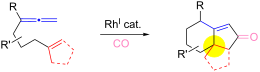
- tricyclo[6.4.0.01,5]dodecenone framework in a satisfactory yield. Keywords: allene; bicyclo[4.3.0] derivatives; carbonylative [2 + 2 + 1] cycloaddition; quaternary center construction; rhodium; Introduction The Co2(CO)8-mediated Pauson–Khand reaction (PKR) [1][2] is well recognized as a formal [2 + 2 + 1


Rh-Catalyzed rearrangement of vinylcyclopropane to 1,3-diene units attached to N-heterocycles
Beilstein J. Org. Chem. 2011, 7, 298–303, doi:10.3762/bjoc.7.39

- )-catalyzed opening of the VCP moiety embedded in an azapolycyclic system occurs at high temperature (110–130 °C) to afford the corresponding 1,3-dienes in moderate yield (34–53%). Keywords: nitrogen heterocycles; rearrangement; rhodium; small ring systems; spiro compounds; Introduction The cyclopropyl
- other interesting transformations, such as the [5 + 2] cycloadditions of vinylcyclopropanes to alkynes developed by Wender and co-workers [36][37]. It is known, that rhodium-catalyzed rearrangements of unactivated VCPs, without any functional substituent, usually afford dienes. In order to evaluate the
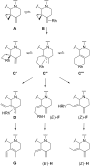
- bond to form the intermediates C which can undergo metal hydride elimination or 1,3-hydride migration to the rhodium to give, respectively, the allyl- and alkylrhodium(III) hydride complexes D and F. Metal extrusion by reductive elimination leads to the observed dienes and regeneration of the catalyst


Backbone tuning in indenylidene–ruthenium complexes bearing an unsaturated N-heterocyclic carbene
Beilstein J. Org. Chem. 2010, 6, 1120–1126, doi:10.3762/bjoc.6.128
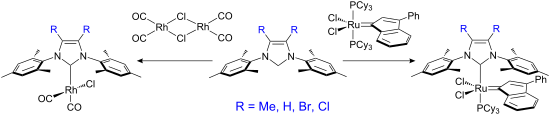
- phosphanes, and more recently, has been used to study the electronic properties of NHCs [34]. However, the high toxicity of [Ni(CO)4] encouraged the search for analogous systems using different metals to determine the TEP. One of the most popular and suitable alternatives to nickel is a rhodium carbonyl
- parameters associated with these synthetic variations. Using a rhodium carbonyl system, the electronic variations brought about by substituents on the NHC lead to the following ligand electronic donor scale: IMesMe > IMes > IMesBr > IMesCl. The size of the substituent also affects the steric hindrance of the


Recent advances in carbocupration of α-heterosubstituted alkynes
Beilstein J. Org. Chem. 2010, 6, No. 77, doi:10.3762/bjoc.6.77

- adduct 29. However, the reaction was not completely stereoselective (Scheme 13) [25]. Although not a copper-mediated transformation, the rhodium-catalyzed carbozincation of ynamides should be noted since the regioselectivities were, in general, high (>19:1), though in some cases somewhat diminished with
- Me2Zn (5:1) [26][27]. The rhodium-catalyzed annulation of ynamides with arylboron compounds containing an aldehyde or a ketone moiety have also been developed and lead to functionalized 2-amidoindenes with good levels of regioselectivity [28]. P-substituted alkynes Stereo- and regioselective


Molecular recognition of organic ammonium ions in solution using synthetic receptors
Beilstein J. Org. Chem. 2010, 6, No. 32, doi:10.3762/bjoc.6.32






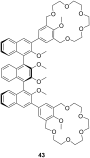


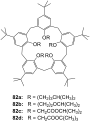


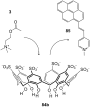


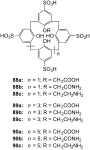


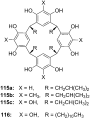
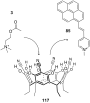


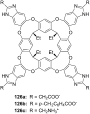


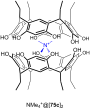


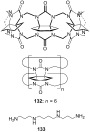


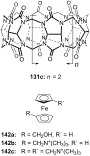


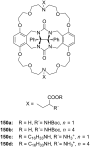
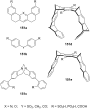


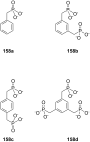

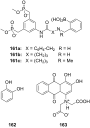


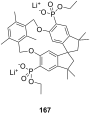
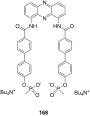

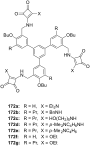
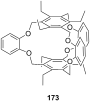


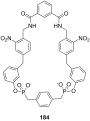


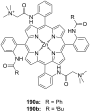


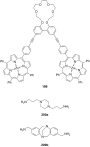


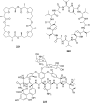


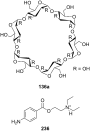
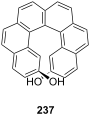




Concise methods for the synthesis of chiral polyoxazolines and their application in asymmetric hydrosilylation
Beilstein J. Org. Chem. 2010, 6, No. 29, doi:10.3762/bjoc.6.29
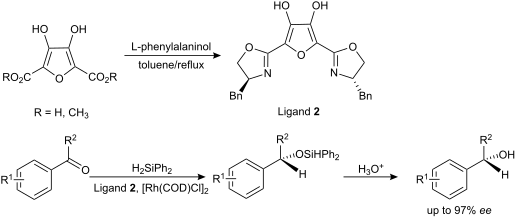
- concomitant removal of water or the alcohol produced in the reaction. The method is much simpler and more efficient in comparison to those methods reported in the literature. The compounds were used as chiral ligands in the rhodium-catalyzed asymmetric hydrosilylation of aromatic ketones, and the effects of
- the linkers and the substituents present on the oxazoline rings on the yield and enantioselectivity investigated. Compound 2 was identified as the best ligand of this family for the hydrosilylation of aromatic ketones. Keywords: aromatic ketone; hydrosilylation; polyoxazoline; rhodium; synthesis
- –7) are described, which are much simpler and more efficient in comparison to those reported in the literature. With these chiral ligands as templates, the rhodium-catalyzed asymmetric hydrosilylation of aromatic ketones was carried out. The effects of the linkers of oxazoline rings and the


Ring opening metathesis polymerization-derived block copolymers bearing chelating ligands: synthesis, metal immobilization and use in hydroformylation under micellar conditions
Beilstein J. Org. Chem. 2010, 6, No. 28, doi:10.3762/bjoc.6.28
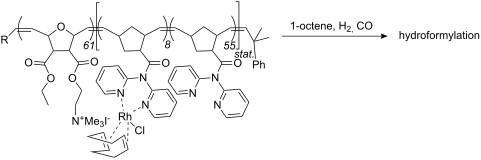
- -yl (cyclooctadiene) rhodium chloride (C1) [9] were synthesized according to the literature. exo,exo-[2-(3-Ethoxycarbonyl-7-oxabicyclo[2.2.1]hept-5-en-2-carbonyloxy)ethyl]trimethylammonium iodide (M2) exo,exo-7-Oxabicyclo[2.2.1]hept-5-ene-2,3-dicarboxylic acid mono(2-dimethylaminoethyl) ester (1): exo


Iridium-catalyzed asymmetric ring-opening reactions of oxabicyclic alkenes with secondary amine nucleophiles
Beilstein J. Org. Chem. 2009, 5, No. 53, doi:10.3762/bjoc.5.53
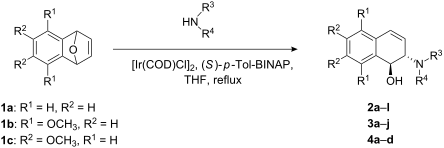
- alkenes is one of the most attractive because this reaction could potentially create two chiral centers in a single step. Pioneering work in this field was first described by Caple et al. [6] and the group of Lautens [7][8][9]. In the past decades, the group of Lautens and others reported rhodium
- -catalyzed asymmetric ring-opening of oxabenzonorbornadiene with a wide range of nucleophiles including thiols [10], phenols [11], organoboronic acids [12][13], dialkylzincs [14][15], carboxylates [16], sulfur nucleophiles [17], and various amines [18][19]. In addition to rhodium catalysts, other transition
- the desired products in moderate to good yields with good enantioselectivities. The iridium-catalyzed ARO reactions described in this article featured lower cost compared with rhodium-catalyzed ARO reactions, which provided potential applications in asymmetric synthesis of chiral building blocks. The


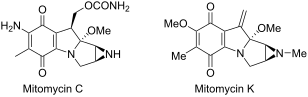
Mitomycins syntheses: a recent update
Beilstein J. Org. Chem. 2009, 5, No. 33, doi:10.3762/bjoc.5.33
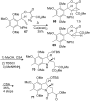
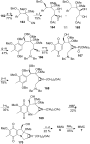
- of the indoline intermediate to the indole. The regioselectivity is in accord with the results of Adams who showed that the C–H bond with the highest electron density was the most likely to migrate during rhodium(II) mediated C–H insertion [113]. A related study assessed the possibility of






Asymmetric reactions in continuous flow
Beilstein J. Org. Chem. 2009, 5, No. 19, doi:10.3762/bjoc.5.19
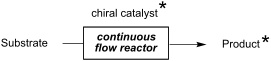
- screened for reactivity and enantioselectivity with the rhodium catalyst [Rh(COD)2]BF4 within a 3 min residence time. With this device, very low catalyst/ligand loadings were used per run (ca. 0.1 μg of Rh catalyst), providing reliably reproducible results. Reactivity in the microreactor was found to be


One-pot preparation of substituted pyrroles from α-diazocarbonyl compounds
Beilstein J. Org. Chem. 2008, 4, No. 45, doi:10.3762/bjoc.4.45
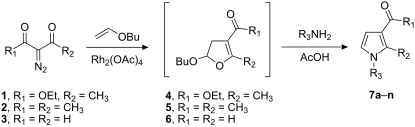
- quantity of rhodium(II) acetate in the presence of butyl vinyl ether to produce the corresponding 3-carbonyl-dihydrofurans 4–6. The rhodium catalyzed reaction of the α-diazocarbonyl compounds 1–3 was monitored by TLC chromatography. Evaporation of the solvents at the end of these reactions followed by


Synthesis of (–)-Indolizidine 167B based on domino hydroformylation/cyclization reactions
Beilstein J. Org. Chem. 2008, 4, No. 2, doi:10.1186/1860-5397-4-2
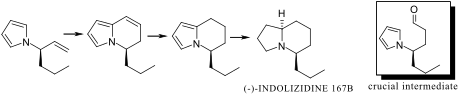
- Indolizidine 167B depicted here the construction of the bicyclic core still occurs via a pyrrolylbutanal; unlike the previous case, the aldehyde comes from rhodium-catalyzed hydroformylation of optically active (R)-3-(pyrrol-1-yl)hex-1-ene (1) (Scheme 1). The formed linear aldehyde 2a (Scheme 2), bearing an n
- reduction gives the target compound (ee 92%) (Scheme 1). The rhodium-catalyzed hydroformylation of olefins is an important industrial tool for the production of aldehydes [10][11]. During the last few years, the oxo process has been employed also in the synthesis of fine chemicals especially integrated in
- heteroaromatic olefins has a topic of our research for many years [15][16][17][18][19]; now it is the first time that the rhodium catalyzed hydroformylation is employed by us in the total synthesis of a target compound and as a key reaction in a domino process with a high number of steps. Results and Discussion



The use of silicon- based tethers for the Pauson- Khand reaction
Beilstein J. Org. Chem. 2007, 3, No. 21, doi:10.1186/1860-5397-3-21
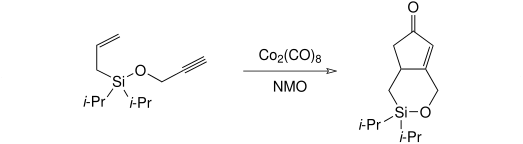
- being reacted with each of molybdenum hexacarbonyl/DMSO[21]; tungsten pentacarbonyl/THF[22]; chromium hexacarbonyl and rhodium cycloooctadiene chloride dimer/pentafluorobenzaldehyde[23][24]. None of the promoters gave any Pauson-Khand adducts, although an interesting THF-insertion adduct was obtained


Synthesis of highly substituted allenylsilanes by alkylidenation of silylketenes
Beilstein J. Org. Chem. 2005, 1, No. 5, doi:10.1186/1860-5397-1-5
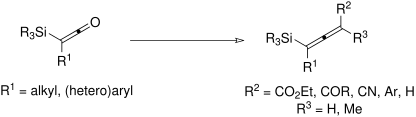
- prepared through rhodium(II)-mediated rearrangement of silylated diazoketones. Results A range of novel 1,3-disubstituted and 1,3,3-trisubstituted allenylsilanes were prepared using stabilised and semi-stabilised ylides. Alkylidenation with non-stabilised phosphorus ylides was not viable, but the use of
- functional group tolerant approach to substituted silylketenes based upon a rhodium-mediated formal Wolff rearrangement of silylated diazoketones.[23] Related photolytic approaches also hold some promise.[24][25][26][27] These methods allow access for the first time to a wide range of substituted
- our previously reported conditions for rhodium(II) octanoate-mediated rearrangement of silyl diazoketones 2,[23] which in turn were prepared by C-silylation of the parent diazoketones 3 with triethylsilyl triflate,[28] Scheme 1, Table 1. It should be noted that while the alkyl-substituted silylketenes





