


Search results
Search for "triazole" in Full Text gives 305 result(s) in Beilstein Journal of Organic Chemistry. Showing first 200.
Synthesis and application of trifluoroethoxy-substituted phthalocyanines and subphthalocyanines
Beilstein J. Org. Chem. 2017, 13, 2273–2296, doi:10.3762/bjoc.13.224
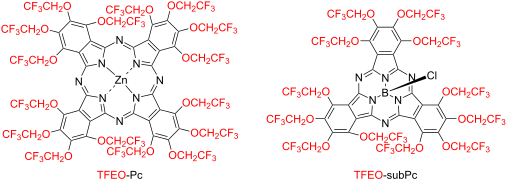
- aggregation can be suppressed due to strong repulsion by the introduction of a trifluoroethoxy group into the flexible binuclear phthalocyanine, which always adopts an open clamshell conformation. Binuclear phthalocyanines connected via a flexible triazole linker that are substituted by a tert-butyl (11) [81
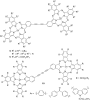
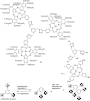
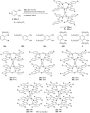
- spectra of 9 (A) and 5 (B). Structure of binuclear phthalocyanines linked by a triazole linker. Structure of trinuclear phthalocyanines linked by a triazole linker, and windmill-like molecular structure vs aggregated structure. Direction of energy transfer of phthalocyanine–fullerene conjugates. Structure








Intramolecular glycosylation
Beilstein J. Org. Chem. 2017, 13, 2028–2048, doi:10.3762/bjoc.13.201
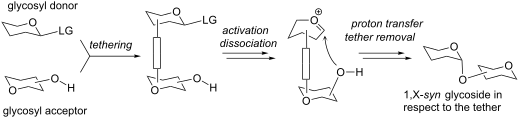
- attempt to simplify the synthesis of the non-symmetrical tethers, a highly trendy triazole-forming click chemistry was combined with rigid spacers by the Schmidt group. α,α’-Dibromo ortho- and meta-xylene-derived rigid spacers were used in this application, and this approach allowed to investigate the
- , disaccharide 48 was obtained with complete β-selectivity when the ortho-xylyl group (15-membered ring) was used, versus α/β = 1:3 selectivity in the case of the meta-xylene linked counterpart [80]. As in the previous example with the xylylene-derived linker, the triazole linker was removed under standard


Mechanochemical synthesis of small organic molecules
Beilstein J. Org. Chem. 2017, 13, 1907–1931, doi:10.3762/bjoc.13.186
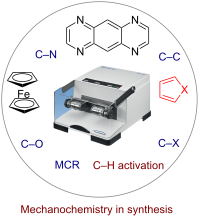
- triazole moiety (Scheme 37a) using benzyl halides, sodium azide and a terminal alkyne via an alumina-supported copper catalyst. Using 10 mol % of Cu/Al2O3, differently substituted phenyl acetylenes and aliphatic alkynes led to 70–96% yield of triazoles [152]. Phenyl boronic acids were also used to
- synthesize the triazole rings with additional 1 equiv of K2CO3 which resulted in >85% of product (Scheme 37b). Mack and co-workers reported another mechanochemical variation of “click” reaction [153][154] where they could isolate 33–90% of triazole derivatives using copper reaction vial in ball mill for 16 h


Influence of the milling parameters on the nucleophilic substitution reaction of activated β-cyclodextrins
Beilstein J. Org. Chem. 2017, 13, 1893–1899, doi:10.3762/bjoc.13.184
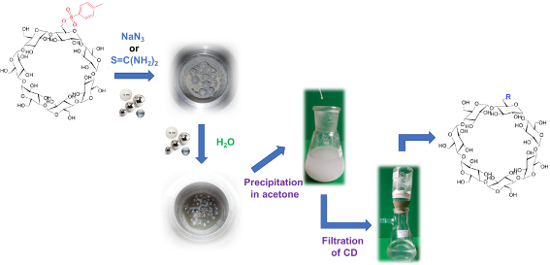
- derivative and is used in analytical chemistry as chiral stationary phase [6]. CDs functionalized with triazole substituents can be similarly prepared through click reactions involving the azido group as a dipolarophile [7], and utilized as suitable starting material to access hydroxy functionality after


The chemistry and biology of mycolactones
Beilstein J. Org. Chem. 2017, 13, 1596–1660, doi:10.3762/bjoc.13.159


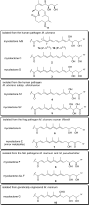


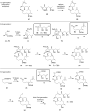


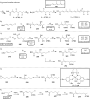


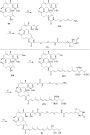

Effect of uridine protecting groups on the diastereoselectivity of uridine-derived aldehyde 5’-alkynylation
Beilstein J. Org. Chem. 2017, 13, 1533–1541, doi:10.3762/bjoc.13.153
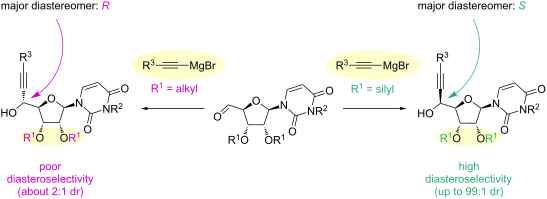
- devoted to the synthesis of new MraY inhibitors [49][50], we were interested in developing a more efficient access to 5’-ethynyluridine, a crucial building block for the further synthesis of triazole-containing compounds [49]. Intrigued by the moderate diastereomeric ratio reported for the addition or


Synthesis of oligonucleotides on a soluble support
Beilstein J. Org. Chem. 2017, 13, 1368–1387, doi:10.3762/bjoc.13.134
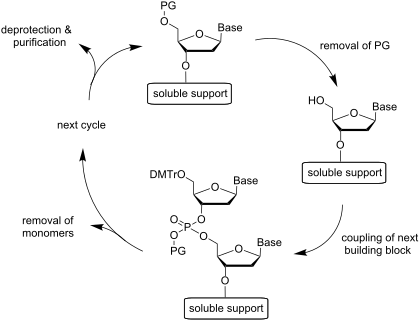
- pyridine and 2,6-lutidine using 1-(mesitylene-2-sulfonyl)-3-nitro-1,2,4-triazole (MSNT; 6 equiv) as an activator and N-methylimidazole (NMI; 10 equiv) as a nucleophilic catalyst. Each coupling was followed by precipitation/recrystallization from EtOH, capping with Ac2O in pyridine and precipitation from






Strategies toward protecting group-free glycosylation through selective activation of the anomeric center
Beilstein J. Org. Chem. 2017, 13, 1239–1279, doi:10.3762/bjoc.13.123

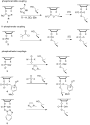
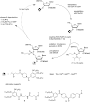
- , L-ascorbic acid and applying mild heat, the desired 1,2-trans click triazole could be obtained in good to excellent yield [85]. This reaction was shown to be very robust as not only di- and oligosaccharides can be formed (one example is shown in Scheme 28B), but also cancer-associated MUC1


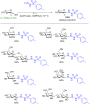
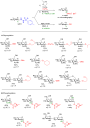


An eco-compatible strategy for the diversity-oriented synthesis of macrocycles exploiting carbohydrate-derived building blocks
Beilstein J. Org. Chem. 2017, 13, 1106–1118, doi:10.3762/bjoc.13.110
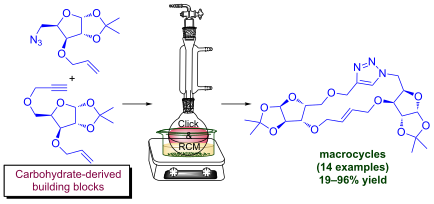
- , Himachal Pradesh, 176 061, India 10.3762/bjoc.13.110 Abstract An efficient, eco-compatible diversity-oriented synthesis (DOS) approach for the generation of library of sugar embedded macrocyclic compounds with various ring size containing 1,2,3-triazole has been developed. This concise strategy involves
- attached through Cu-catalyzed azide–alkyne cycloaddition (CuAAC) reaction (couple phase). Noteworthy, herein we utilized the CuAAC reaction as a medium for coupling different building blocks assembled iteratively to generate a 1,2,3-triazole moiety. This 1,2,3-triazole moiety linked as a spacer due to its
- ratio of integration of the terminal alkyne proton in the propargyl building block and the characteristic triazole–alkene proton in the cyclo-adducts. The click reaction proceeds under various conditions with a plenty of sources of Cu(I) [19]. We have selected copper iodide (CuI) as Cu(I) source for the


New tricks of well-known aminoazoles in isocyanide-based multicomponent reactions and antibacterial activity of the compounds synthesized
Beilstein J. Org. Chem. 2017, 13, 1050–1063, doi:10.3762/bjoc.13.104
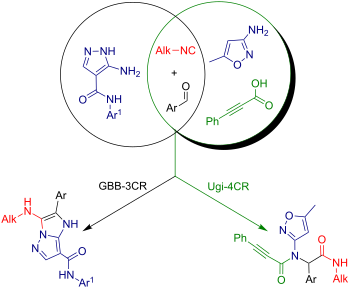
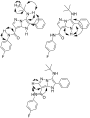
- sometimes similar to 3-amino-1,2,4-triazole that was described as a component of GBB-3CR earlier [71][72][73][74][75]. Therefore, the first type of aminoazoles studied in our work was 5-amino-N-aryl-1H-pyrazole-4-carboxamide that showed 1,3-binucleophile properties in the condensation with aromatic




Synthesis of ribavirin 2’-Me-C-nucleoside analogues
Beilstein J. Org. Chem. 2017, 13, 755–761, doi:10.3762/bjoc.13.74

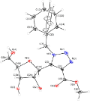
- carbon atom in the 2’-position are an indium-mediated alkynylation and a 1,3-dipolar cyclization. Keywords: alkynylation; antiviral; cancer; C-nucleosides; ribavirin; Introduction The triazole nucleoside ribavirin (RBV, Figure 1) is used for the treatment of a number of viral infections and may be
- catalytic hydrogenolysis. The latter reaction simultaneously cleaves the benzyl and isopropylidene groups affording compound 2 as a single isomer [22]. In the case of 5-(2’-deoxy-2’-methyl-2’-fluoro-β-D-ribosyl)-1,2,3-triazole-4-carboxamide (3) the synthesis was more delicate as it is necessary to
- procedures for compounds 2, 5–7, and 10–18 are covered by the Ph.D. thesis of Fanny Cosson [22]. 5-(2’-C-Methyl-β-D-ribofuranosyl)-1,2,3-triazole-4-carboxamide (2) [22]: Through the solution of compound 7 (mixture of 7a and 7b, 0.49 g, 1.1 mmol) in anhydrous methanol (14 mL) was bubbled ammonia gas for 2 h




Ultrasound-promoted organocatalytic enamine–azide [3 + 2] cycloaddition reactions for the synthesis of ((arylselanyl)phenyl-1H-1,2,3-triazol-4-yl)ketones
Beilstein J. Org. Chem. 2017, 13, 694–702, doi:10.3762/bjoc.13.68
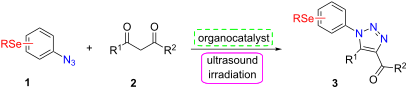
- have been used for this cycloaddition reaction [20][21][22][23][24][25][26][27][28][29]. Organocatalytic approaches based on β-enamine–azide or enolate–azide cycloadditions have been employed to synthesize 1,2,3-triazole scaffolds [30][31][32]. Depending on the organocatalyst employed, different
- -(phenylselanylmethyl)-1,2,3-triazole A (Se-TZ) demonstrated an antidepressant-like effect (Figure 1) [60]. In another example, 5-phenyl-1-(2-(phenylselanyl)phenyl)-1H-1,2,3-triazole-4-carbonitrile B (Se-TZCN) was reported to exhibit antioxidant activities in different in vitro assays (Figure 1) [36]. Selenanyl-quinone
- found to be amenable to a range of 1,3-diketones or aryl azidophenyl selenides, providing an efficient access to novel selenium-containing 1,2,3-triazole compounds in good to excellent yields, in a few minutes of reaction at room temperature. The protocol was extended to activated ketones and


Derivatives of the triaminoguanidinium ion, 5. Acylation of triaminoguanidines leading to symmetrical tris(acylamino)guanidines and mesoionic 1,2,4-triazolium-3-aminides
Beilstein J. Org. Chem. 2017, 13, 579–588, doi:10.3762/bjoc.13.57
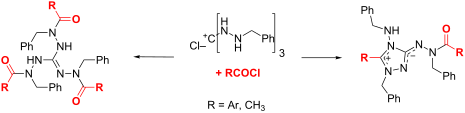
- heating yield 3-hydrazinyl-4-amino-4H-1,2,4-triazole hydrochloride (I, R = H) (Scheme 1) [13]. With the higher homologs of formic acid, the authors of that study observed the formation of resinous materials only. In a recent paper, however, evidence for the formation of the corresponding derivatives of I
- effectively with 3,4,5-trimethoxybenzoyl chloride (2b) to form the N,N’,N’’-tris(acylamino)guanidinium chloride 3 (Scheme 2). Hydrolysis of the acyl chloride is not a competitive reaction under these conditions, and formation of a 1,2,4-triazole, as observed for the reaction of 1 with formic acid at reflux
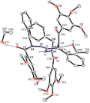
- crystal structure of salt 8b (Figure 2) shows a nearly planar core of the molecule (the triazole ring, N4, N5, N6). One face of this core is occupied by the three benzylic substituents, leaving the other face open for the chloride anion which is held in place by two N–H···Cl hydrogen bonds, one of them




Synthesis of 1-indanones with a broad range of biological activity
Beilstein J. Org. Chem. 2017, 13, 451–494, doi:10.3762/bjoc.13.48
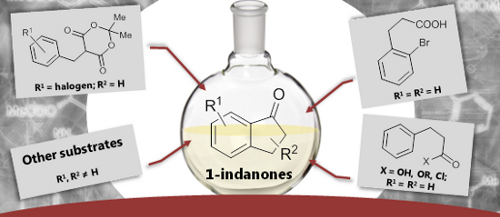
- carbene is an outstanding protocol for the synthesis of polyhydroxylated spiro- or fused 1-indanones [49]. Thus, the imidazole-based carbene catalyzed the conversion of phthalaldehydes 72 to dihydroxyspiro[indane-2,1′-isobenzofuran]-3-ones 73, whereas triazole-based carbene catalyzed the conversion of 72


Synthesis and optical properties of new 5'-aryl-substituted 2,5-bis(3-decyl-2,2'-bithiophen-5-yl)-1,3,4-oxadiazoles
Beilstein J. Org. Chem. 2017, 13, 313–322, doi:10.3762/bjoc.13.34
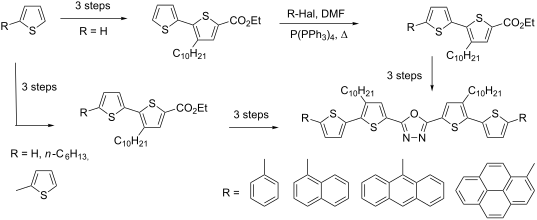
- enables the preparation of linear D–A–D compounds with one or two 1,3,4-oxadiazole [16][17][18][19], 1,3,4-thiadiazole [16][18][19][20][21][22] or 1,2,4-triazole [16][18] central rings symmetrically disubstituted with alkylbithiophene 1, 2 as well as star-shaped molecules with D–A arms 3 (Figure 1) [23


Versatile synthesis of end-reactive polyrotaxanes applicable to fabrication of supramolecular biomaterials
Beilstein J. Org. Chem. 2016, 12, 2883–2892, doi:10.3762/bjoc.12.287

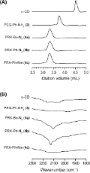
- (Scheme 2). After 60 min of reaction, 1H NMR spectra of the obtained products (5a–c) were measured (Figure 3A). In the 1H NMR spectra of 5a and 5b, the protons assignable to 1,2,3-triazole linkages are observed at 8.5 and 9.4 ppm, respectively, which were consistent with the previous report [28]. These
- , triazole). The same reaction was performed for 4b and 4c according to the above described procedure. Synthesis of water-soluble benzylazide group-terminated PRX (6) To solubilize 4a into an aqueous solutions, 2-(2-hydroxyethoxy)ethyl (HEE) groups were modified onto the threading α-CDs of 4a [28][29




New approaches to organocatalysis based on C–H and C–X bonding for electrophilic substrate activation
Beilstein J. Org. Chem. 2016, 12, 2834–2848, doi:10.3762/bjoc.12.283
- with halides (Ka ≈ 103–104 M−1 in acetone-d6). Not surprisingly, a higher number of hydrogen bonds with an anion correlated with the higher stability of the receptor/anion complex. 1,2,3-Triazole-based catalysts for the dearomatization of N-heteroarenes The Mancheno group recently explored triazole
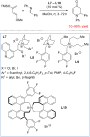
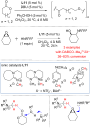
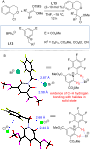
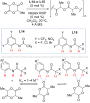
- designed and synthesized various chiral triazole-based complexes such as L2–L4 (Scheme 2) [36][37][38][39]. It was proposed that while these triazole derivatives are conformationally flexible, upon their binding to halogen anions these complexes adopt a reinforced chiral helical conformation. The resultant
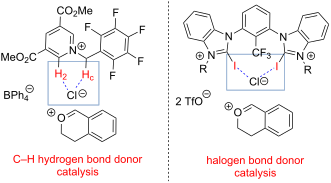
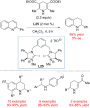
- 1,2,3-triazole, ammonium and pyridinium based catalysts. While the asymmetric transformations catalyzed by chiral 1,2,3-triazoles are now well precedented, the feasibility of asymmetric transformations promoted by other types of chiral C–H hydrogen bond donors is yet to be demonstrated. Similarly








Construction of bis-, tris- and tetrahydrazones by addition of azoalkenes to amines and ammonia
Beilstein J. Org. Chem. 2016, 12, 2471–2477, doi:10.3762/bjoc.12.241
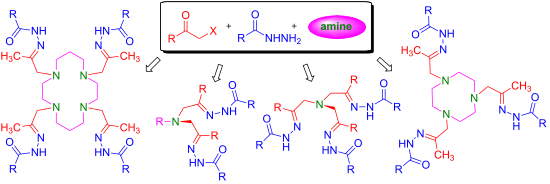
- on a support. This was demonstrated by the synthesis of a mixed triazole-hydrazone ligand 10 by CuAAC reaction of 3 with phenyl azide (Scheme 3) (for application of mixed triazole-imine ligands see [31][32][34]). Reaction of α-halogen-substituted hydrazones 1 with ammonia Addition of α-halohydrazones
- ://www.ccdc.cam.ac.uk/conts/retrieving.html (or from the CCDC, 12 Union Road, Cambridge, CB21EZ, UK; or deposit@ccdc.cam.ac.uk). Proposed approach to the synthesis of I. Synthesis of α-halogen-substituted hydrazones 1 from α-halocarbonyl compounds and acylhydrazines or carbazates. Synthesis of a mixed triazole




Synthesis and characterization of benzodithiophene and benzotriazole-based polymers for photovoltaic applications
Beilstein J. Org. Chem. 2016, 12, 1629–1637, doi:10.3762/bjoc.12.160
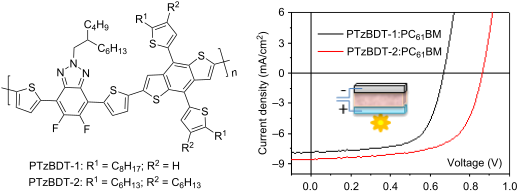
- -difluoro-2H-benzo[d][1,2,3]triazole (Tz) have attracted much attention and effectively employed in BHJ PSCs due to their intrinsic advantages, potentials and versatility [14][15]. Thanks to the desirable properties such as structural rigidity, planarity, extended π-conjugation length and favorable
- , is a moderately weak electron-deficient unit that can be easily synthesized and its properties can be finely modulated by attaching groups on the reactive nitrogen atom of the triazole ring [15][19][20]. Here we report the synthesis and characterization of two novel donor polymers, PTzBDT-1 and
- , 0.23 mmol) and 4,7-bis(5-bromothiophen-2-yl)-2-(2-butyloctyl)-5,6-difluoro-2H-benzo[d][1,2,3]triazole (3, 0.15 g, 0.23 mmol) were dissolved in toluene (10 mL) and degassed with N2 gas for 10 minutes. Pd2(dba)3 (4.2 mg, 2 mol %) and P(o-tolyl)3 (6.3 mg, 9 mol %) were added and purged with nitrogen gas


Catalytic Chan–Lam coupling using a ‘tube-in-tube’ reactor to deliver molecular oxygen as an oxidant
Beilstein J. Org. Chem. 2016, 12, 1598–1607, doi:10.3762/bjoc.12.156
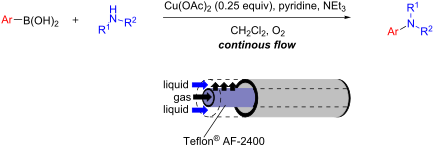
- of 26% (28, Scheme 2). It is not yet clear as to why such a low conversion and isolated yield was obtained although the reduced nucleophilicity and higher potential for coordination of the triazole to the copper catalyst might inhibit catalyst turnover and account for this. Alternatively, using 3


Dinuclear thiazolylidene copper complex as highly active catalyst for azid–alkyne cycloadditions
Beilstein J. Org. Chem. 2016, 12, 1566–1572, doi:10.3762/bjoc.12.151
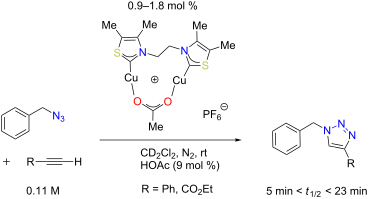
- dichloromethane at room temperature was used (Table 1 and Figure 2). Due to the highly exothermic nature of the triazole formation, a high dilution of the reaction mixture and low catalyst loadings are necessary to prevent a thermal runaway. In order to compare the catalytic activity of complex 2 with


Beta-hydroxyphosphonate ribonucleoside analogues derived from 4-substituted-1,2,3-triazoles as IMP/GMP mimics: synthesis and biological evaluation
Beilstein J. Org. Chem. 2016, 12, 1476–1486, doi:10.3762/bjoc.12.144
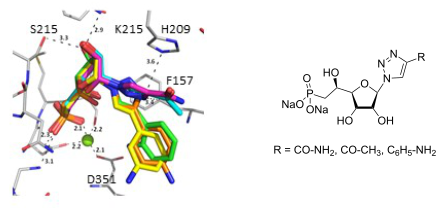
- : cancer; cN-II inhibitors; nucleotide; phosphonate; triazole; Introduction Nucleotidases are an important family of enzymes involved in the metabolism of nucleotides [1]. In particular, human cytosolic 5’-nucleotidase II (cN-II) catalyses the dephosphorylation of purine 5’-monophosphate derivatives to
- ) [7], we were interested in studying the effect of replacing the nucleobase by a 1,2,3-triazole moiety, linked to various substituents, with the aim to retain or modulate essential elements for enzyme recognition. Indeed, the assembly of the triazole ring with various substituents confers to the final
- between the anomeric proton H1 and the H4 (Figure 2). Consequently, both protons are located on the same face of the furanose ring and to the opposite face of the C4–C5 bond. The formation of the triazole ring was confirmed through the presence of a single signal of the triazolyl proton at δ = 7.94 ppm


Application of Cu(I)-catalyzed azide–alkyne cycloaddition for the design and synthesis of sequence specific probes targeting double-stranded DNA
Beilstein J. Org. Chem. 2016, 12, 1348–1360, doi:10.3762/bjoc.12.128
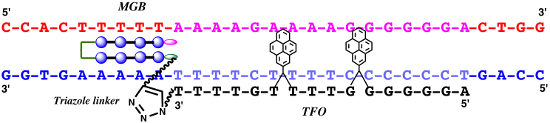
- indicate that the presence of the triazole moiety in the linker slightly perturbs the triplex formation. Conclusion Diverse bifunctional linkers of different length, hydrophobicity and flexibility for insertion of terminal azide or alkyne groups into biomolecules were synthesized and applied for


Copper-catalyzed [3 + 2] cycloaddition of (phenylethynyl)di-p-tolylstibane with organic azides
Beilstein J. Org. Chem. 2016, 12, 1309–1313, doi:10.3762/bjoc.12.123

- : cycloaddition; copper catalyst; ethynylstibane; organic azide; 1,2,3-triazole; Introduction The 1,3-dipolar azide–alkyne cycloaddition (AAC) has been effective for the synthesis of a wide variety of 1,2,3-triazoles [1]. However, this reaction has some limitations such as the requirement of high temperature and
- ) using 5 mol % of various Cu catalysts under aerobic conditions in THF at 60 °C (Table 1, entries 1–9). The results showed that CuBr was the best catalyst and gave the highest yield of the expected 5-stibano-1,2,3-triazole 3a (Table 1, entry 2). The reaction without the Cu catalyst did not afford 3a
- product (Table 1, entry 7). Heating of 5-stibano-1,2,3-triazole 3a in the presence of Cu(OAc)2 (5 mol %) under aerobic conditions in THF at 60 °C for 3 h afforded 4 in 91% yield. Furthermore, heating of 1 without 2a under the same conditions did not give the phenylacetylene and the starting compound was


Conjugate addition–enantioselective protonation reactions
Beilstein J. Org. Chem. 2016, 12, 1203–1228, doi:10.3762/bjoc.12.116
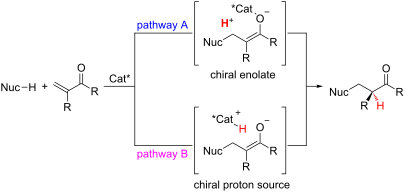
- reaction, Lou and Cheng explored the addition of various nitrogen [54], sulfur [55], and carbon nucleophiles [56][57] to α-branched vinyl ketones (Scheme 29). The nitrogen heterocycles benzotriazole (126a), triazole (126b), and 5-phenyltriazole (126c), all reacted smoothly with vinyl ketone 118. To achieve





