Search results
Search for "π-stacking" in Full Text gives 227 result(s) in Beilstein Journal of Organic Chemistry. Showing first 200.
Controlled supramolecular assemblies of luminescent tridentate cyclometalated alkynylgold(III) amphiphiles in aqueous media
Beilstein J. Org. Chem. 2026, 22, 1097–1106, doi:10.3762/bjoc.22.88
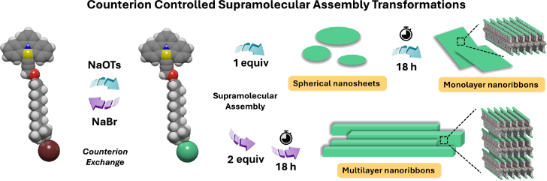
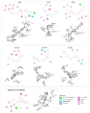
- head group area through lower hydration and additional π–π stacking and hydrophobic interactions. This shift in the packing parameter promotes anisotropic growth, enabling the transformation from disordered nanosheets into well-ordered monolayer nanoribbons and eventually multilayer nanoribbons with


Amino acid-based surfactants: sustainable synthesis and antimicrobial mechanisms
Beilstein J. Org. Chem. 2026, 22, 1067–1085, doi:10.3762/bjoc.22.85
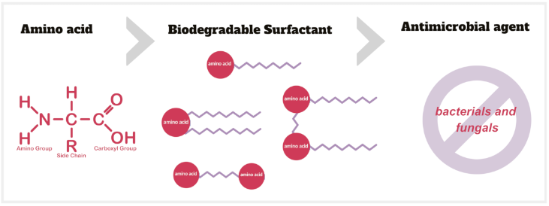
- –π stacking with membrane components, with molecular dynamics simulations confirming 2–3-fold increases in membrane residence time for aromatic variants compared to aliphatic analogs as demonstrated by molecular dynamics simulations, the non-polar side chain of phenylalanine partitions favorably


Synthesis of novel 1,2,4-oxadiazole-isoxazoline hybrids and their in silico potential with adenosine receptors
Beilstein J. Org. Chem. 2026, 22, 1033–1047, doi:10.3762/bjoc.22.82
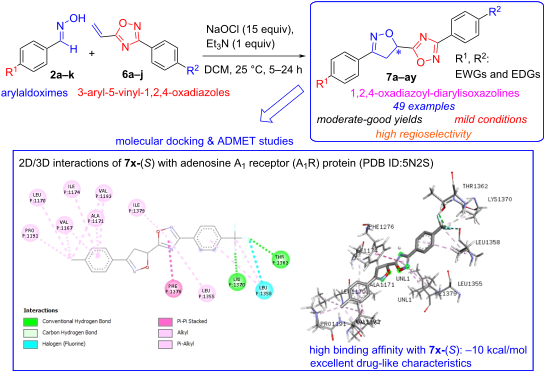
- 7x, the S-enantiomers of 7j, and the S-enantiomers of 7aw shared similar binding modes, dominated by strong alkyl, π-alkyl, and π–π stacking interactions. Specifically, the S-enantiomers of 7x and 7j formed conventional hydrogen bonds with Lys1370, whereas the R-enantiomer of 7x exhibited π–σ
- interactions with Ile1379, along with π–π stacking interactions between its oxadiazole ring and Phe1276. The S-enantiomers of 7aw engaged in π–π interactions with Tyr1376, while the R-enantiomers of 7aw and the S-enantiomers of 7ah formed C–H hydrogen bonding interactions with the Ala1341 residue. Additional
- Val1167. Its oxadiazole ring also participated in π–π stacking with Tyr1376 and alkyl interactions with Ile1379. Similarly, the CF3 group on the benzene ring of the R-enantiomer of 7aw established a halogen bond with Ser1340, together with alkyl interactions involving Ile1153, Ile1206, and Ile1344, and π


The role of spacer length and flexibility in peptide self-assembly
Beilstein J. Org. Chem. 2026, 22, 986–996, doi:10.3762/bjoc.22.77
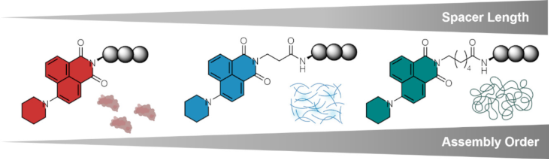
- substantial blue shifts observed for compounds 6 and 7 are consistent with excitonic H-type coupling arising from π–π-stacking interactions within ordered assemblies, as also suggested by the CD data (Supporting Information File 1, Figure S41). The magnitude of these shifts suggests the formation of


Chiral cyclopropenimine-catalyzed enantioselective Michael reactions of phenol and benzofuran-derived α,β-unsaturated pyrazolamides with benzophenone-imine of glycine esters
Beilstein J. Org. Chem. 2026, 22, 888–896, doi:10.3762/bjoc.22.69
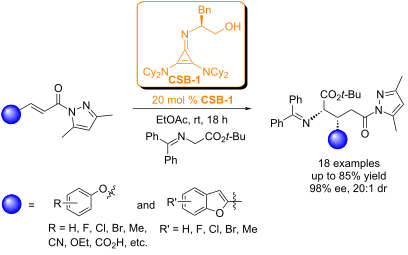
- anti-form of 6a. With mode B, the π–π stacking between benzophenone-imine 2a and the phenoxylmethyl group in 5a may enhance the ratio of this attack to produce the syn-form of 6a as major product. A mechanism for this highly enantioselective Michael addition between 2a and 5a was proposed based on
- ion pair A, which attacks β-substituted α,β-unsaturated pyrazolamide 5a to provide transition state B. Transition state B may be stabilized through an H-bonding interaction network between the two substrates and CSB-1. Additionally, π–π stacking between the two phenyl groups of 2a and 5a may also






Knoevenagel condensation of 4,5- and 1,8-diazafluorenes
Beilstein J. Org. Chem. 2026, 22, 803–812, doi:10.3762/bjoc.22.62
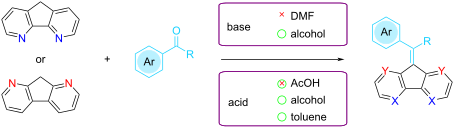
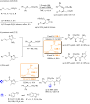
- additionally due to C–H···π intramolecular interactions: φ1 = 106.8(2)° (N3–C13–C12–C5) and φ2 = 99.6(2)° (N4–C18–C12–C5) (Figure 2a). The molecules of 4,5-DPDAF are packed into stacks due to π-stacking interactions between diazafluorenes which are stabilized by C–H···N interactions between pyridine and
- -DPDAF) where Zn is four-coordinated to the nitrogens of the diazafluorene and pyridine rings forming a positively charged cyclic dimer (Figure 2d). The dimers are arranged in a herringbone-type structure via C–H···π, C–Cl···π and π-stacking interactions between diazafluorene and pyridine (Figure 2f
- CH2Cl2 solution and b) optical absorption spectra of 4,5-DPDAF and 1,8-DPDAF in THF. Molecular structure, atom and cycle numbering of 4,5-DPDAF (a) and Zn-4,5-DPDAF (d) with anisotropic displacement ellipsoids drawn at a 50% probability level; crystal structure fragments of 4,5-DPDAF with π-stacking (b




Halogenated azobenzene acrylates: from efficient solution photoswitching to stable solid-state photochromic materials
Beilstein J. Org. Chem. 2026, 22, 782–794, doi:10.3762/bjoc.22.60
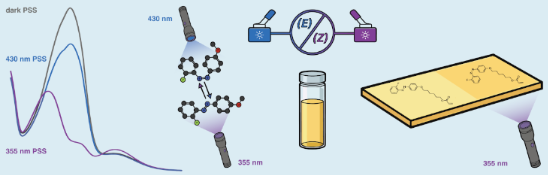
- crystallization process simultaneously suppressing the counter-effect of the long aliphatic pendant. On the other hand, when a bulky bromine atom is involved, π-stacking is probably much less efficient and only amorphous solidification dominates upon cooling. Whereas the dichloro derivative 1d is a liquid under


Design, synthesis, and biological evaluation of FXR/ASK1 dual-target modulators
Beilstein J. Org. Chem. 2026, 22, 771–781, doi:10.3762/bjoc.22.59
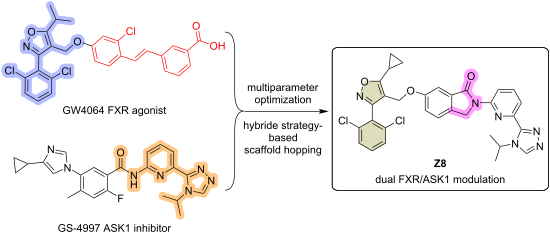
- hydrophobic pocket formed by Phe 284, Leu 287, Trp 454, and Phe 461; the dichlorophenyl moiety engages in π–π stacking with Phe 329; and the meta-positioned carboxy group forms a strong electrostatic interaction with Arg 331. The modification strategies for GW4064 are as follows: The stilbene moiety can be


Synthesis and biological evaluation of new brassinosteroid analogs with C-22 benzoate function
Beilstein J. Org. Chem. 2026, 22, 753–762, doi:10.3762/bjoc.22.57
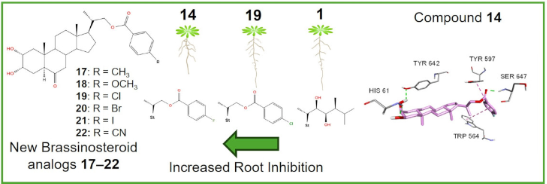
- compound 19 generates two π–π stacking interactions with Trp564 and Tyr597. Finally, there are also van der Waals interactions with residues Phe60, Phe681, Ile682, Ile706, Tyr642, Tyr599, Pro648, Ile540, Ile563, and Trp564 (Figure 4). The calculated binding energies suggest the following order of activity
- = steroidal skeleton of the structure. Binding modes of compound 19 into BRI1–BAK1 heterodimer. Hydrogen bonds are represented in green segmented lines. π–π stacking is represented by dark pink segmented lines. Hydrophobic interactions are represented by pink segmented lines. Synthesis of compounds 23–28 and


Configuration–packing synergy enabling integrated crystalline-state RTP and amorphous-state TADF
Beilstein J. Org. Chem. 2026, 22, 224–236, doi:10.3762/bjoc.22.16
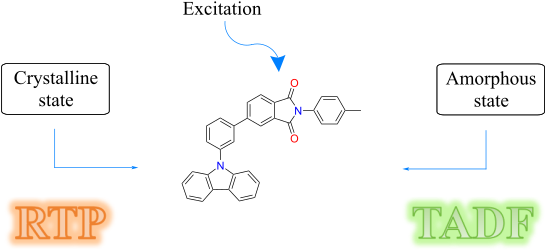
- activated delayed fluorescence (TADF). Correlating temperature-dependent lifetimes with phase characterization indicate that, in amorphous environments lacking ordered π–π stacking and rigid confinement, the small ΔEST promotes reverse intersystem crossing, yielding delayed fluorescence; whereas in powder
- states, intermolecular interactions enhance spin–orbit coupling and crystallinity suppresses nonradiative decay, thereby activating RTP. This work achieves an integrated “crystalline-state RTP–amorphous-state TADF” regulation within a single molecule. Keywords: imide; π–π stacking; room-temperature
- reasonably inferred that, in the amorphous state, intermolecular π–π stacking interactions are significantly suppressed. This suppression of π–π interactions, along with a more disordered molecular conformation and microenvironment, makes it difficult to establish effective rigid constraints necessary for


Improved synthesis and physicochemical characterization of the selective serotonin 2A receptor agonist 25CN-NBOH
Beilstein J. Org. Chem. 2026, 22, 175–184, doi:10.3762/bjoc.22.11
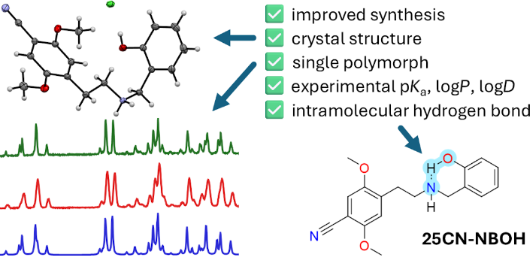
- two different chloride ions, and the phenol OH moiety interacts with another chloride ion. The triclinic crystal packing (Figure 2b) reveals alternating layers, a polar layer with the observed hydrogen bonds, and a hydrophobic layer with van-der-Waals interactions and π–π-stacking (distance 4 Å
- , oxygen atoms red, and chloride ion green. b) The crystal packing reveals alternating layers, a polar layer with hydrogen bonds (black dashed lines), and a hydrophobic layer with π–π-stacking (grey dashed lines). SCXRD and XRPD spectra of different preparations of 1·HCl. Blue: SCXRD spectrum of 1·HCl. Red


Assembly strategy for thieno[3,2-b]thiophenes via a disulfide intermediate derived from 3-nitrothiophene-2,5-dicarboxylate
Beilstein J. Org. Chem. 2025, 21, 2489–2497, doi:10.3762/bjoc.21.191
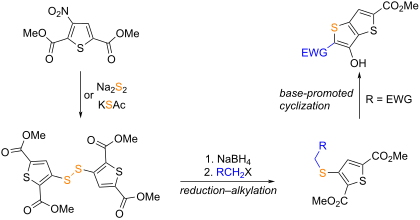
- ) derivatives are a valuable class of fused heteroaromatic compounds characterized by rigid planar π-conjugated backbones that provide narrow band gaps, high charge carrier mobility, and intermolecular π–π stacking interactions, making them particularly attractive for the design of organic materials. Indeed



The high potential of methyl laurate as a recyclable competitor to conventional toxic solvents in [3 + 2] cycloaddition reactions
Beilstein J. Org. Chem. 2025, 21, 2389–2415, doi:10.3762/bjoc.21.184
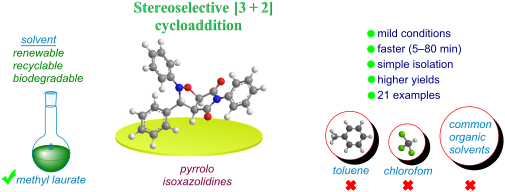
- predominance of the trans isomer can be attributed to the stabilizing of secondary orbital interactions in the endo transition state, which results in the formation of this product, in contrast to the exo transition state [53][108]. In this case, the most significant factor is the π–π interaction (π–π stacking






Insoluble methylene-bridged glycoluril dimers as sequestrants for dyes
Beilstein J. Org. Chem. 2025, 21, 2302–2314, doi:10.3762/bjoc.21.176
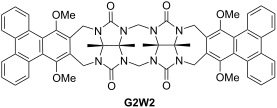
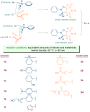
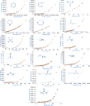
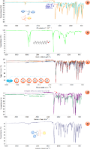
- reflects π–π stacking on the external face of G2W1 in the solid. In contrast, the bulkier and non-planar dyes (e.g., rhodamine 6G and methyl violet 6B) are less complementary to the cavity and external faces of glycoluril dimer-based receptors. Accordingly, we decided to conduct a detailed investigation
- walls within the initial dimer are co-planar with each other and the distance between the mean planes of the triphenylene sidewalls is 3.4975 Å (marked with @) which is somewhat longer than the commonly accepted π-stacking distance of 3.4 Å. The mean planes of the external triphenylene walls between the



Pathway economy in cyclization of 1,n-enynes
Beilstein J. Org. Chem. 2025, 21, 2260–2282, doi:10.3762/bjoc.21.173
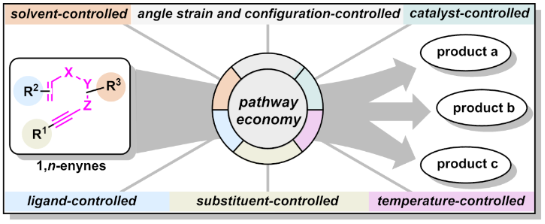
- of ortho-cyclized products 80, enabled by coordination to both the directing group and alkyne (Scheme 17, path a). However, the rigid electron-rich XPhos ligand (L2) promoted para-cyclization due to steric constraints and π–π stacking to yield dihydroquinoline derivatives 82 (Scheme 17, path b). This


Discovery of cytotoxic indolo[1,2-c]quinazoline derivatives through scaffold-based design
Beilstein J. Org. Chem. 2025, 21, 2062–2071, doi:10.3762/bjoc.21.161
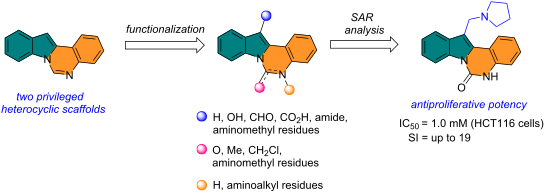
- . Such compounds can intercalate into nucleic acids, primarily through π–π stacking interactions with nitrogenous bases. The introduction of side chains with terminal amino groups enhances binding to oligonucleotides via additional ionic interactions and hydrogen bonds. The indolo[1,2-c]quinazolin-6(5H


Chiral phosphoric acid-catalyzed asymmetric synthesis of helically chiral, planarly chiral and inherently chiral molecules
Beilstein J. Org. Chem. 2025, 21, 1864–1889, doi:10.3762/bjoc.21.145
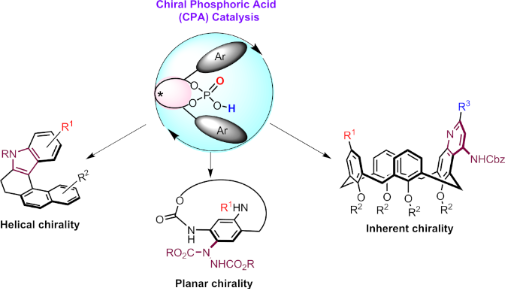
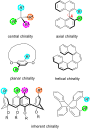
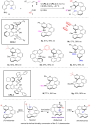
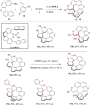
- ortho-positions. The dual hydrogen-bonding interactions were critical for this reaction, ensuring that the reaction proceeded within the chiral pocket of the CPA catalyst. Moreover, the authors proposed that the extended π-substituents at the ortho-positions of CPA could engage in π–π-stacking









Systematic pore lipophilization to enhance the efficiency of an amine-based MOF catalyst in the solvent-free Knoevenagel reaction
Beilstein J. Org. Chem. 2025, 21, 1854–1863, doi:10.3762/bjoc.21.144
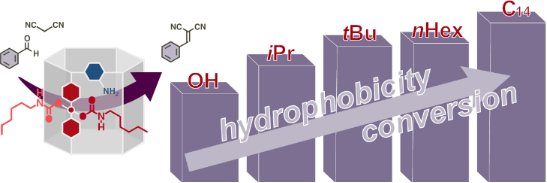
- enhance covalent and/or acid–base catalysis via any combination of non-covalent interactions (hydrogen bonding, π–π stacking, lipophilic interactions, etc) [4][5][6]. Inspired by enzymes, Nature's most efficient catalysts, chemists have long endeavored to synthesize catalytic materials in which multiple


Research progress on calixarene/pillararene-based controlled drug release systems
Beilstein J. Org. Chem. 2025, 21, 1757–1785, doi:10.3762/bjoc.21.139
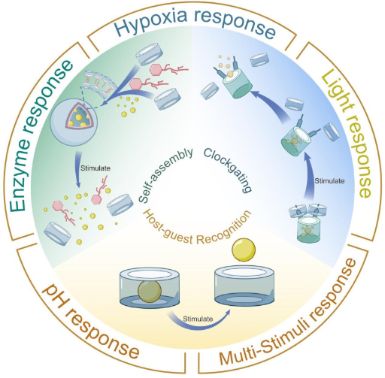
- CAs to selectively bind drugs of different sizes through hydrophobic and π–π stacking interactions and undergo targeted modifications to enhance their affinity for various guest molecules, such as choline [54], quaternary ammonium salts [55], drug molecules [56], etc. Although they generally have poor
- π–π stacking interactions [86]. Their amphiphilic nature enables these systems to enter cells efficiently through endocytosis, providing a new drug delivery approach and holding great potential in precision medicine due to their programmable and stimulus-responsive features. Additionally, PAs can be
- neutral environment (pH 7.4), deprotonated WP6 can rebind with the guest molecules. The molecular recognition mechanism of this system is based on the synergistic effect of multiple non-covalent interactions, including electrostatic attraction, hydrophobic interactions, and π–π stacking. Researchers have




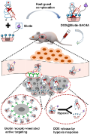


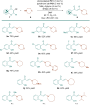
General method for the synthesis of enaminones via photocatalysis
Beilstein J. Org. Chem. 2025, 21, 1535–1543, doi:10.3762/bjoc.21.116
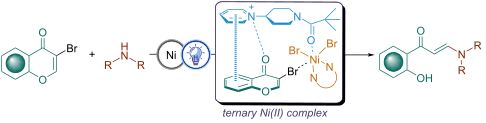
- , pseudo-octahedral Ni(II) complex [44] involving the carbonyl groups of PS1 and 7a, which is further activated on aggregation of the pyridinium salt and the chromone aromatic ring through π−π stacking. Then, PC1 was submitted to Stern–Volmer quenching experiments. Whereas no interaction occurred between




Selective monoformylation of naphthalene-fused propellanes for methylene-alternating copolymers
Beilstein J. Org. Chem. 2025, 21, 1183–1191, doi:10.3762/bjoc.21.95
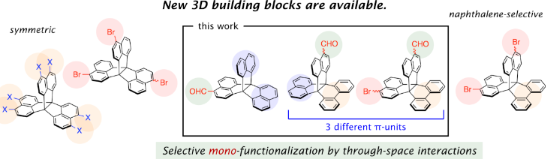
- go beyond common organic functional materials composed of rigid π-conjugated planes and flexible peripheral substituents. Because larger π-conjugated planes mostly display low solubility and dense packing due to the π–π stacking and CH–π interactions, surrounding alkyl and other flexible moieties are


Supramolecular assembly of hypervalent iodine macrocycles and alkali metals
Beilstein J. Org. Chem. 2025, 21, 1095–1103, doi:10.3762/bjoc.21.87
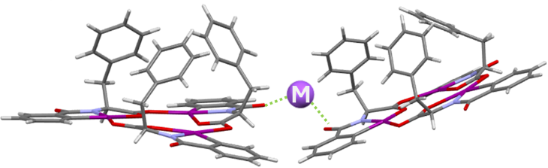
- devices or therapeutics [1], drug delivery [2], supramolecular sensing [3], purification [4], and separation [5][6]. The interactions in supramolecular assemblies are driven by well-known hydrogen-bonding, hydrophobic interactions, electrostatic interactions and π–π stacking [7][8]. The supramolecular


Salen–scandium(III) complex-catalyzed asymmetric (3 + 2) annulation of aziridines and aldehydes
Beilstein J. Org. Chem. 2025, 21, 1087–1094, doi:10.3762/bjoc.21.86
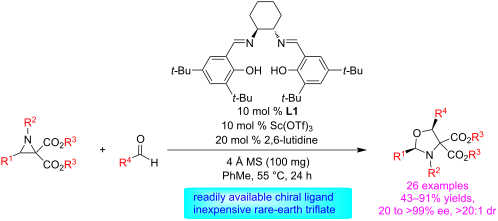
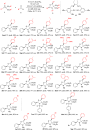
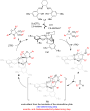
- of the catalyst for the next catalytic cycle. The electron-deficient aromatic aldehydes exhibit excellent stereoselectivity due to the π-stacking interaction between their aryl group and the electron-rich malonate group. Similar π-stacking interaction-controlled stereoselectivities were observed in



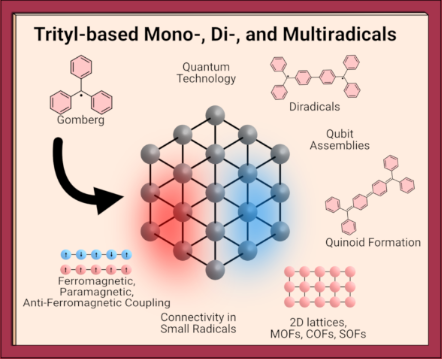
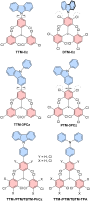
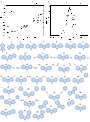
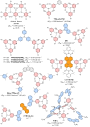
On the photoluminescence in triarylmethyl-centered mono-, di-, and multiradicals
Beilstein J. Org. Chem. 2025, 21, 964–998, doi:10.3762/bjoc.21.80









Study of tribenzo[b,d,f]azepine as donor in D–A photocatalysts
Beilstein J. Org. Chem. 2025, 21, 935–944, doi:10.3762/bjoc.21.76

- offers unique features, including twisted structures, reduced π–π stacking, and enhanced reverse intersystem crossing rates, becoming a better donor compared to fully planar compounds as carbazole (c). Similarly, 5H-dibenz[b,f]azepine (IMD, b) has been incorporated into D–A–D structures, showing