


Search results
Search for "1,4-quinones" in Full Text gives 6 result(s) in Beilstein Journal of Organic Chemistry.
Recent advances in Norrish–Yang cyclization and dicarbonyl photoredox reactions for natural product synthesis
Beilstein J. Org. Chem. 2025, 21, 2315–2333, doi:10.3762/bjoc.21.177
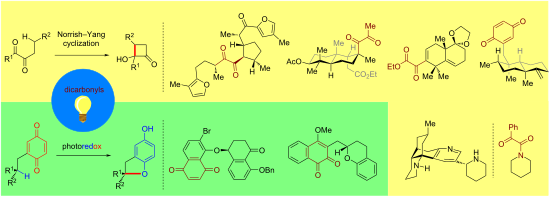
- , α-keto amides, 1,4-quinones, and 1,2-quinones in this context, have emerged as versatile substrates in Norrish–Yang cyclizations, finding widespread application in natural products synthesis. Compared to monoketones, dicarbonyls (e.g., 1,2-diketones) offer distinct advantages: (1) they generally
- -diketones, α-keto esters, α-keto amides, 1,4-quinones, and 1,2-quinones, emphasizing their unique roles in constructing diverse substructures. However, the reaction faces challenges in terms of regioselectivity and stereoselectivity, which are mainly attributed to the influence of substrate structure




Menadione: a platform and a target to valuable compounds synthesis
Beilstein J. Org. Chem. 2022, 18, 381–419, doi:10.3762/bjoc.18.43
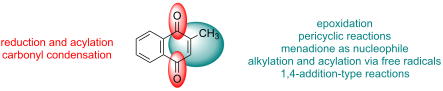
- -dimethoxyarenes is another valid synthetic approach to achieve 1,4-quinones, with the oxidative demethylation of 2-methyl-1,4-dimethoxynaphthalene (19) can be used to synthesize menadione (10). The oxidizing agents most commonly used in oxidative demethylation are cerium(IV) ammonium nitrate (CAN), and silver(II
- isomers and trans-conformers. Menadione as a nucleophile Electron-rich 1,4-naphthoquinones, such as 2-hydroxy-, 2-amino-, and 2-alkylnaphtho-1,4-quinones may react as nucleophiles. Hence, menadione (10) can act as a nucleophile in, for example, bromination reactions [127] and aldol-type reactions with


A straightforward conversion of 1,4-quinones into polycyclic pyrazoles via [3 + 2]-cycloaddition with fluorinated nitrile imines
Beilstein J. Org. Chem. 2021, 17, 1509–1517, doi:10.3762/bjoc.17.108
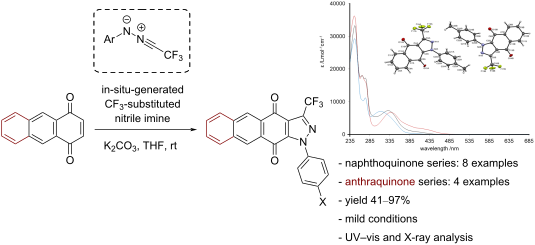
- -8057 Zurich, Switzerland Department of Physical Chemistry, Faculty of Chemistry, University of Lodz, Pomorska 163/165, 90236 Łódź, Poland 10.3762/bjoc.17.108 Abstract In-situ-generated N-aryl nitrile imines derived from trifluoroacetonitrile efficiently react with polycyclic 1,4-quinones, yielding
- naphthoquinone-derived products and low-intensity bands in the visible region (≈400 nm) for the anthraquinone series. Keywords: [3 + 2]-cycloadditions; fluorinated compounds; fused pyrazoles; N-heterocycles; nitrile imines; 1,4-quinones; Introduction The 1,4-quinone scaffold belongs to the most important
- structural motifs present in naturally occurring compounds as well as synthetic drugs and other functionalized organic molecules of great practical importance, e.g., in materials chemistry (Figure 1) [1][2][3][4]. Selective functionalization of 1,4-quinones is a challenging task in current organic synthesis


First thia-Diels–Alder reactions of thiochalcones with 1,4-quinones
Beilstein J. Org. Chem. 2018, 14, 1834–1839, doi:10.3762/bjoc.14.156
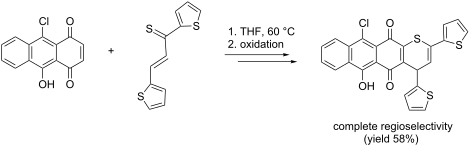
- Department of Chemistry, University of Zurich, Winterthurerstrasse 190, CH-8057 Zurich, Switzerland 10.3762/bjoc.14.156 Abstract Aryl and hetaryl thiochalcones react smoothly with 1,4-quinones in THF solution at 60 °C yielding the corresponding fused 4H-thiopyrans after spontaneous dehydrogenation of the
- regioselective manner [16][20]. In cycloaddition chemistry, 1,4-quinones are applied widely both as dipolarophiles and dienophiles. In the case of [3 + 2] cycloadditions, reactions can occur chemoselectively with either the C=O or the C=C unit [21][22][23]. On the other hand, reactions with diverse 1,3-dienes
- and heterodienes generally occur at the C=C group [24][25][26]. To the best of our knowledge, thia-Diels–Alder reactions of 1,4-quinones with thiochalcones have not yet been reported. In the present study, thia-Diels–Alder reactions of aryl and hetaryl thiochalcones with selected 1,4-quinones, such as


Design and synthesis of propellane derivatives and oxa-bowls via ring-rearrangement metathesis as a key step
Beilstein J. Org. Chem. 2015, 11, 1727–1731, doi:10.3762/bjoc.11.188
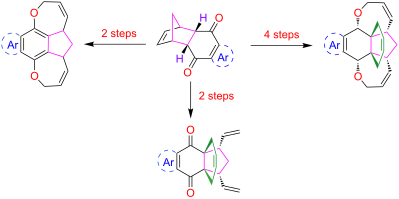
- sequence. Further, the tetraallyl compound 6 can be assembled from the C-allyl derivative 4 via reduction followed by O-allylation. The C-allyl derivative 4 may be obtained from the known DA adduct 3 by a C-allylation sequence which in turn could be prepared by the DA reaction of the corresponding 1,4
- -quinones (p-benzoquinone, 1,4-naphthoquinone or 1,4-anthraquinone) with a freshly cracked cyclopentadiene. To realize the synthetic strategy (Figure 1) to various propellane derivatives [29][30][31] and oxa-bowls, we commenced with the preparation of a known DA adduct 3a [32]. Subsequent allylation of 3a


Synthesis of 2a,8b-Dihydrocyclobuta[a]naphthalene-3,4-diones
Beilstein J. Org. Chem. 2010, 6, No. 76, doi:10.3762/bjoc.6.76
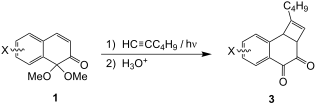
- ; quinone monoacetals; Introduction The behaviour of excited 1,2- and 1,4-quinones towards ground-state molecules differs greatly. Whereas the former typically react via H-abstraction by an excited carbonyl group [1], the latter smoothly undergo [2 + 2] cycloaddition to alkenes to afford cyclobutane-type


Other Beilstein-Institut Open Science Activities



