


Search results
Search for "anatase" in Full Text gives 112 result(s) in Beilstein Journal of Nanotechnology.
Correction: Photocatalytic antibacterial performance of TiO2 and Ag-doped TiO2 against S. aureus. P. aeruginosa and E. coli
Beilstein J. Nanotechnol. 2020, 11, 547–549, doi:10.3762/bjnano.11.43

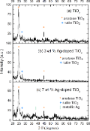
- the measured XRD pattern to powder diffraction patterns in the International Centre for Diffraction Data (ICDD) database. The characteristic peaks of the TiO2 nanoparticle sample indicate an anatase phase (2θ = 24.8°, 44.5°, compared with JCPDS file no. 00-021-1272) with some indication of a rutile
- did not cause changes in the TiO2 anatase crystalline structure and no significant high intensity peaks related to fcc Ag were observed. This can be explained as the mean silver peak can be masked by the TiO2 layer. However, by comparing the ratio of the intensity of the peaks, we can conclude that a
- relating to Ag, although very low intensity peaks related to Ag were observed for the sample calcined at 600 °C [6]. In a previous work, it was found that the intensity of the anatase peaks decreased in comparison to the rutile peaks as the annealing temperature increased; and after annealing at 800 °C
Fabrication of Ag-modified hollow titania spheres via controlled silver diffusion in Ag–TiO2 core–shell nanostructures
Beilstein J. Nanotechnol. 2020, 11, 141–146, doi:10.3762/bjnano.11.12
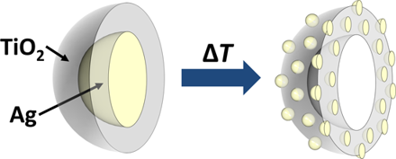
- obtained composite catalyst exhibits a synergistic effect between the anatase crystalline shell and the AuNPs as well as superb thermal and mechanical stability of the highly dispersed AuNPs. TiO2 HSs decorated with ultrasmall Ag nanocrystallites and exhibiting excellent photocatalytic properties were
- template was used in the fabrication of rattle-type HSs of Au@TiO2 using multistep template deposition and a surface-protected etching method [13], of TiO2 HSs of mixed anatase/rutile composition loaded with noble metal NPs (Au, Pt, Pd) [14], and of N-doped Ag/TiO2 HSs [15]. A hard-templating method with a



Semitransparent Sb2S3 thin film solar cells by ultrasonic spray pyrolysis for use in solar windows
Beilstein J. Nanotechnol. 2019, 10, 2396–2409, doi:10.3762/bjnano.10.230
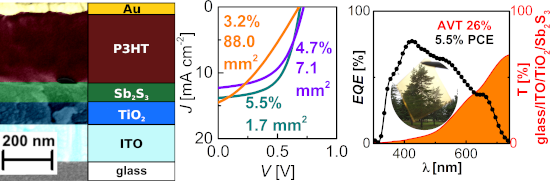
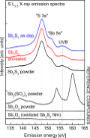
- and back contact is needed to attain an AVT in excess of 20% for the complete solar cell. As-deposited Sb2S3 layers on glass/ITO/TiO2 substrate were amorphous (Figure 1d), as only signals of anatase-TiO2 and In2O3 from the substrate were detected by X-ray diffraction (XRD). In contrast, the XRD
- annealed at 450 °C for 30 min in air to form anatase. Amorphous layers of Sb2S3 were deposited by ultrasonic spray pyrolysis in air from a solution of SbCl3 (99% w/w) and SC(NH2)2 (98% w/w), Sb/S molar ratio 1:3, dissolved in methanol (99.8% v/v), according to a previously published procedure [46]. The



Improved adsorption and degradation performance by S-doping of (001)-TiO2
Beilstein J. Nanotechnol. 2019, 10, 2116–2127, doi:10.3762/bjnano.10.206
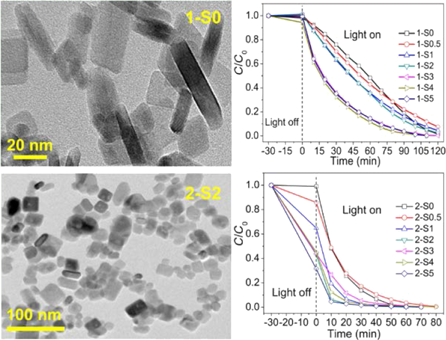
- increase in the amount of •OH and •O2− radicals. Keywords: anatase; chemical state; degradation; photocatalytic properties; S-doping; thermal chemical vapor deposition; titanium dioxide (TiO2); Introduction Anatase TiO2 with a tetragonal symmetry has widely been used for the degradation of organic
- pollutants, as well as in electrocatalysis, solar cells and self-cleaning applications. Its wide use is based on its physicochemical properties, abundance, nontoxicity, environment-friendliness and low cost [1][2][3][4][5][6][7]. The photocatalytic properties of anatase TiO2 crystals are anisotropic since
- . Wang et al. reported that TiO2 with an ideal (001) face was inert to both methanol and water, and the activity of the (001) face was only enhanced after surface reduction or reoxidation [11]. It is well known that the conduction band of anatase TiO2 is composed of the Ti 3d state and the valence band




TiO2/GO-coated functional separator to suppress polysulfide migration in lithium–sulfur batteries
Beilstein J. Nanotechnol. 2019, 10, 1726–1736, doi:10.3762/bjnano.10.168
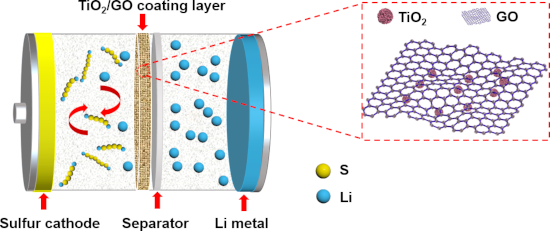
- position of the D- and G-band of the TiO2/GO composite can be ascribed to the interaction between TiO2 and GO and the formation of Ti–O–C bonds [37]. In addition, the TiO2/GO composite shows a new, weak peak at 628 cm−1 that corresponds to the Eg mode of the anatase TiO2 [38], suggesting that the TiO2 is


Novel hollow titanium dioxide nanospheres with antimicrobial activity against resistant bacteria
Beilstein J. Nanotechnol. 2019, 10, 1716–1725, doi:10.3762/bjnano.10.167
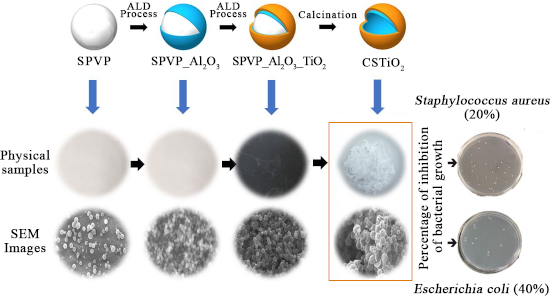
- anatase titanium dioxide crystalline structure. Thermogravimetric analysis and Fourier-transform infrared spectroscopy studies demonstrated the absence of polymer residue after the calcination process. The antimicrobial properties of the developed CSTiO2 hollow nanospheres were evaluated against different
- the nature of the samples. XRD diffractograms revealed that the calcination was an aggressive thermal treatment that resulted in an anatase TiO2 crystalline structure in the CSTiO2 sample [34][35][36]. Although previous works have mentioned that the anatase structure of TiO2 is a metastable structure
- , and can be irreversibly transformed into a stable rutile structure by heating, this process did not occur during calcination. The anatase–rutile transition occurs between 400 to 1000 °C, and it is dependent on several parameters, such as the size of the nanocrystals, impurity content, microstructure


BiOCl/TiO2/diatomite composites with enhanced visible-light photocatalytic activity for the degradation of rhodamine B
Beilstein J. Nanotechnol. 2019, 10, 1412–1422, doi:10.3762/bjnano.10.139
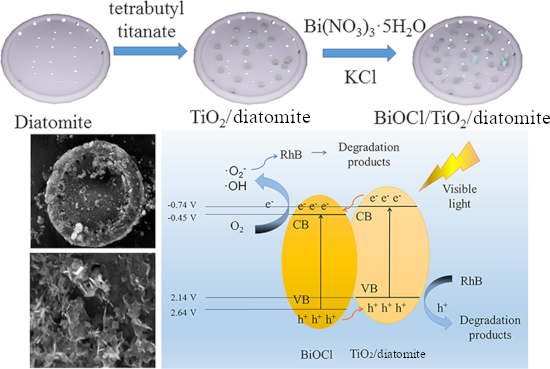
- agreement with the standard XRD data of JCPDS No.06-0249. In the pattern of TiO2/diatomite, an inconspicuous broad peak ranging from 15 to 25° shows the amorphous nature of diatomite, and other obvious peaks at 25.3°, 37.8°, 48°, 53.9° and 55.1° coincide well with anatase TiO2 (JCPDS No.21-1272). The
- change to Bi2O3, and Bi2SiO5 and Bi2Ti2O7 will be formed (Figure 1b). At the same time, TiO2 will gradually change from anatase to rutile, resulting in significant degradation of photocatalytic properties [31]. We speculate that the existence of BiOCl leads to the change of the crystal transition
- with the SEM results. The obvious lattice fringes can be observed in Figure 6b, indicating that the crystallinity of the composites is improved. The lattice fringes of 0.352 nm and 0.281 nm are matched with anatase TiO2 (101) and BiOCl (110) planes, respectively. The results show that diatomite in BTD


Photoactive nanoarchitectures based on clays incorporating TiO2 and ZnO nanoparticles
Beilstein J. Nanotechnol. 2019, 10, 1140–1156, doi:10.3762/bjnano.10.114
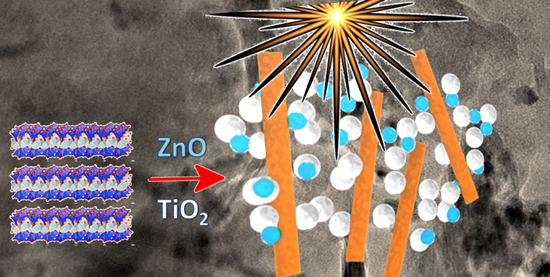
- silicates showing diverse structural arrangements and morphologies (Figure 1) with topologies able to accommodate a variety of NPs of semiconductors such as TiO2 and ZnO. TiO2 and, to a minor extent, ZnO NPs in the form of anatase and wurtzite phases (Figure 1E and 1F, respectively), are semiconducting
- the “Web of Science” (WoS) [21] around 10,000 papers have been published in the last decade in connection with the topic of TiO2 NPs used as photocatalysts, indicating the high interest in the use of these materials for this type of applications. In fact, titanium dioxide (anatase phase) can be
- other photocatalytic reactions assisted by semiconductor photocatalysts. The use of TiO2 and ZnO NPs, particularly the anatase and wurtzite phases, as heterogeneous photocatalysts attracted great attention over the last years. Atmospheric oxygen is used as oxidant to achieve complete mineralization of



Tailoring the stability/aggregation of one-dimensional TiO2(B)/titanate nanowires using surfactants
Beilstein J. Nanotechnol. 2019, 10, 1024–1037, doi:10.3762/bjnano.10.103
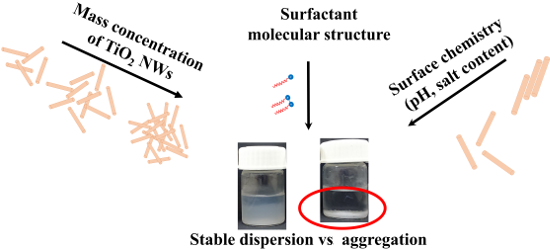
- . Keywords: 1D nanomaterials; cationic surfactants; stability; surface complexation model; titanate nanowires; Introduction Among the extensive variety of metal oxide nanomaterials, titanium dioxide nanomaterials (TNMs) (e.g., anatase, rutile, TiO2(B) and titanate) have attracted considerable attention


Novel reversibly switchable wettability of superhydrophobic–superhydrophilic surfaces induced by charge injection and heating
Beilstein J. Nanotechnol. 2019, 10, 840–847, doi:10.3762/bjnano.10.84
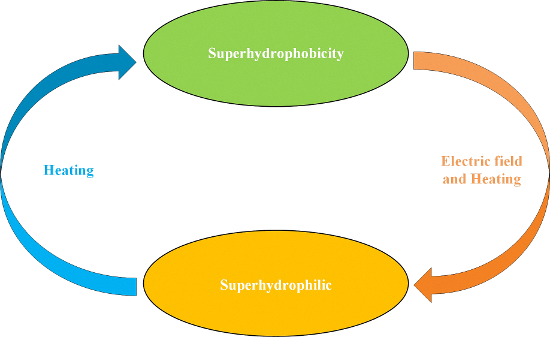
- electrophoretic deposition. The transformation of hydrogen titanate to porous TiO2 (B) and anatase-type TiO2 completed the superhydrophilic–superhydrophobic transition but the process was unidirectional and irreversible. Jiang et al. [14] prepared cotton fabrics by a three-step method that comprised cotton


An efficient electrode material for high performance solid-state hybrid supercapacitors based on a Cu/CuO/porous carbon nanofiber/TiO2 hybrid composite
Beilstein J. Nanotechnol. 2019, 10, 781–793, doi:10.3762/bjnano.10.78
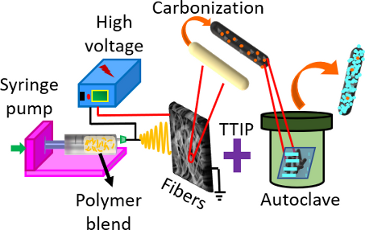
- planes of anatase TiO2 (JCPDS card # 00-001-0562) [25] and the similar crystal structure was observed in the Cu/CuO/PCNF/TiO2 composite material. Additionally, the Cu/CuO/PCNF/TiO2 composite shows (002), (101) planes of the carbon and (002), (111) planes of CuO. These results show that Cu nanoparticles
- assigned to the highly ordered graphite structure which arises due to stretching of carbon atoms bonded with sp2 bonds. TiO2 nanoparticles in the low frequency region were assigned to the E1g (148.5 cm−1), B1g (400 cm−1), A1g (517 cm−1) and Eg (638 cm−1) modes of the anatase phase respectively [26]. A
- expected to reduce the charge transfer resistance. Additionally, TiO2 has less volume expansion compared to other pseudo-capacitive materials, which provides the good cycling stability behavior to the SSHSC. Moreover, TiO2 nanoparticles with highly electrochemical active anatase phase could be ascribed to


Widening of the electroactivity potential range by composite formation – capacitive properties of TiO2/BiVO4/PEDOT:PSS electrodes in contact with an aqueous electrolyte
Beilstein J. Nanotechnol. 2019, 10, 483–493, doi:10.3762/bjnano.10.49
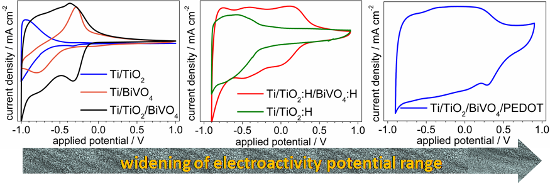
- well as the composite Ti/TiO2/BiVO4/PEDOT:PSS, are presented in Figure 2a. There are five characteristic bands for the pure crystalline anatase phase for all samples. The bands were located at 144, 198, 395, 516 and 637 cm−1 and can be described as Eg(1), Eg(2), B1g, A1g, and Eg(3) active anatase modes
- from the lattice mode. The bands at 330 and 368 cm−1, as well as 745 and 824 cm−1, can be attributed to the bending and stretching V–O vibrations, respectively [39][40]. Thus, the electrode preparation procedure leads to the formation of anatase (TiO2) and monoclinic scheelite (BiVO4) structures
- due to the very small masses of sputtered material. In the case of bare titania nanotubes, the mass of the material could be determined on the basis of calculations taking into account dimensions of the tubes and the density of anatase. However, questionable is the use of anatase density in the case




Advanced scanning probe lithography using anatase-to-rutile transition to create localized TiO2 nanorods
Beilstein J. Nanotechnol. 2019, 10, 412–418, doi:10.3762/bjnano.10.40
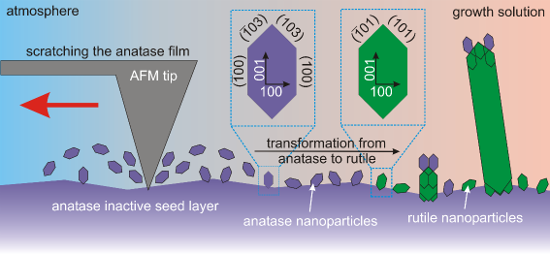
- probe lithography method in which a silicon tip, commonly used for atomic force microscopy, was pulled across an anatase TiO2 film. This process scratches the film causing tiny anatase TiO2 nanoparticles to form on the surface. According to previous reports, these anatase particles convert into rutile
- directly on polycrystalline anatase TiO2 films. The resulting nanorod arrangements are compared with similar structures obtained with conventional electron-beam lithography, which is a more expensive and laborious procedure. The method is drafted in Figure 1. A silicon tip, as it is used in a conventional
- atomic force microscope (AFM), was pulled across an anatase film. During this process, surface defects are created as well as dust that contains tiny anatase TiO2 nanoparticles. Due to the lattice mismatch between anatase and rutile, in general, rutile nanorods do not grow on anatase crystal facets. The


Biocompatible organic–inorganic hybrid materials based on nucleobases and titanium developed by molecular layer deposition
Beilstein J. Nanotechnol. 2019, 10, 399–411, doi:10.3762/bjnano.10.39
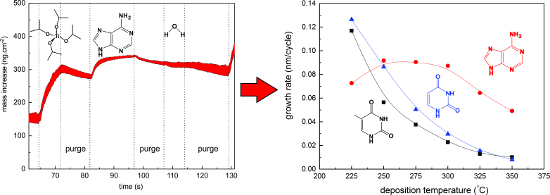
- 2.19 over the temperature range of 225 to 350 °C. The density of all the systems increased with deposition temperature from roughly 1.7 g cm−3 at 225 °C to 2.3 g cm−3 at 350 °C. For comparison, the refractive index and density of anatase TiO2 films deposited at 225 °C is 2.36 and 3.78 g cm−3
- the initial 15 minutes of immersion in water, one may question the bioactivity of these films in comparison to pure TiO2. Clearly, these films obtained a lower density, amorphous structure (except for thymine deposited at 250 °C) with porous morphology, when compared to anatase TiO2. This is verified
- by our characterization of density and index of refraction of the films, even after leaching. We have recently compared the bioactivity of these films by growth of goblet cells showing comparable cell adhesion, viability and proliferation as anatase TiO2, however, all being significantly better than




One-step nonhydrolytic sol–gel synthesis of mesoporous TiO2 phosphonate hybrid materials
Beilstein J. Nanotechnol. 2019, 10, 356–362, doi:10.3762/bjnano.10.35
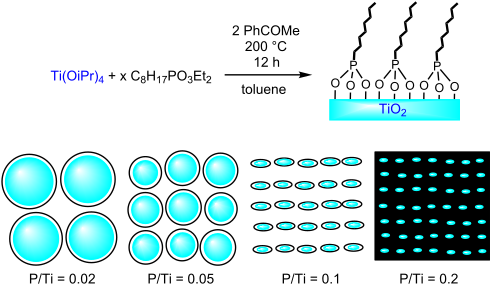
- infrared spectroscopy, Raman spectroscopy, X-ray diffraction, and nitrogen physisorption. For P/Ti ratios up to 0.1, the hybrid materials can be described as aggregated, roughly spherical, crystalline anatase nanoparticles grafted by octylphosphonate groups via Ti–O–P bonds. The crystallite size decreases
- modified by octylphosphonate units, where the octyl chains form an organic continuous matrix. Keywords: anatase; mesoporous; nonaqueous sol–gel; phosphonate; Introduction The development of porous hybrid organic–inorganic materials has been a major goal for materials scientists for more than 25 years [1
- the 10 to 35 ppm range. Similar broad resonances have been reported for TiO2–phenylphosphonate hybrid materials prepared in a two-step sol–gel process from Ti(OiPr)4 and PhPO3H2 [15], whereas the hybrid materials obtained by surface modification of anatase supports usually show narrower resonances [36


Uniform Sb2S3 optical coatings by chemical spray method
Beilstein J. Nanotechnol. 2019, 10, 198–210, doi:10.3762/bjnano.10.18
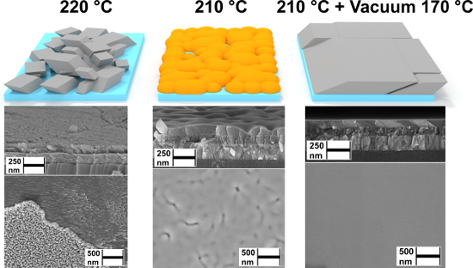
- ) samples (3-200-As-dep., 3-210-As-dep., Figure 1A; 6-200-As-dep., Figure 1B). The band centered at 145 cm−1 is a low frequency Eg vibrational mode of anatase-TiO2 [17], which is observed due to the laser beam penetrating to the substrate [12][16] through the discontinuous Sb2S3 layers. The TiO2 vibrational
- and samples containing XRD-amorphous Sb2S3 (3-200-As-dep., 3-210-As-dep., Figure 2A; 6-200-As-dep., Figure 2B) show only diffraction peaks corresponding to cubic In2O3 (2θ = 21.3°, 30.4°, 35.3°, 37.4°, 41.4°, 45.3°, ICDD PDF 03-065-3170) and anatase-TiO2 (25.3°, 48.2°, ICDD PDF 00-016-0617). The




New micro/mesoporous nanocomposite material from low-cost sources for the efficient removal of aromatic and pathogenic pollutants from water
Beilstein J. Nanotechnol. 2019, 10, 119–131, doi:10.3762/bjnano.10.11
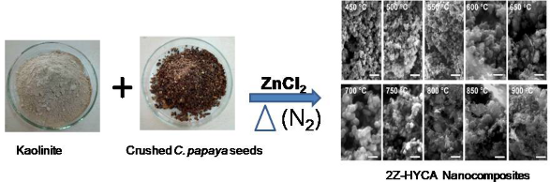
- 750 °C for one hour. The originally used raw kaolinite is composed of kaolinite (k), quartz (qtz) and feldspar (microcline (kfs) and plagioclase (plg)) and small amounts of illite (il, JCPDF 98-009-0144) and anatase (TiO2, JCPDF 98-009-6946, at 2θ values of 25.29°). As already mentioned, the kaolinite




Amorphous NixCoyP-supported TiO2 nanotube arrays as an efficient hydrogen evolution reaction electrocatalyst in acidic solution
Beilstein J. Nanotechnol. 2019, 10, 62–70, doi:10.3762/bjnano.10.6
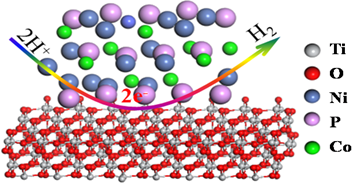
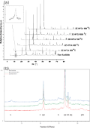
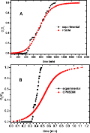
- the samples. All three samples displayed characteristic anatase TiO2 diffraction peaks of (101), (004), (200), (105), (211), (204), (116), and (215) (JCPDS card No. 21-1272) and the Ti peak at (101) [27]. No diffraction peaks related to Ni–P or NiCoP crystallites was found, illustrating that the
- anatase peak intensities. The top-view FE-SEM images of TNAs and NixCoyP/TNAs are shown in Figure 2. It is obvious that the openings of the TNAs were smooth with even wall thickness. After electrodeposition of NiCoP, the openings of sample NixCoyP/TNAs were coarse with apparent deposit attached. Figure 3
- demonstrates the TEM and HR-TEM images of NixCoyP/TNAs. The lattice spacing of 0.35 nm is ascribed to anatase TiO2 (101) plane [28], and no lattice fringe that corresponds to NiCoP can be finely resolved. Combining the XRD and SEM results, we conclude that amorphous NiCoP particles of ≈6 nm were attached to




Impact of the anodization time on the photocatalytic activity of TiO2 nanotubes
Beilstein J. Nanotechnol. 2018, 9, 2628–2643, doi:10.3762/bjnano.9.244
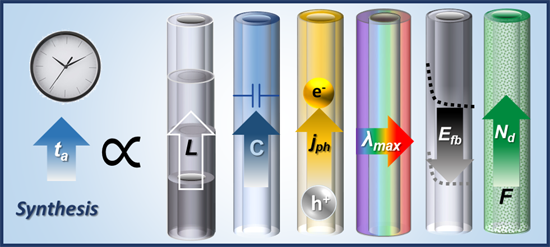
- sections. XRD The structure and crystallinity of the samples were studied by means of XRD and the diffractograms are presented in Figure 3. The Bragg–Brentano geometry was preferred for our work with thin films. After being thermally treated, all the samples exhibited the typical Bragg positions of anatase
- peak exhibits an increasing relative intensity with higher ta, surpassing that of the (101) plane, and the ratios of the peak intensities for those planes are reported in Table 2. Acevedo-Peña et al. observed an enhancement of the thermal stability in anatase nanotubes with a preferred orientation
- transport [46]. While the observed metallic Ti is attributed to the metal substrate, no significant contribution of the rutile phase was observed. The latter is also consistent with the observations of Dozzi et al., where even small amounts of F dopant atoms prevented the thermal transition from anatase to


Localized photodeposition of catalysts using nanophotonic resonances in silicon photocathodes
Beilstein J. Nanotechnol. 2018, 9, 2097–2105, doi:10.3762/bjnano.9.198
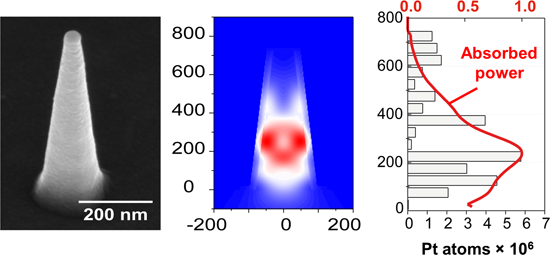
- -electrochemical performance [39][40][41]. The amorphous TiO2 layer was further annealed at 350 °C for 3 h to form crystalline anatase TiO2, which led to an improved performance. The final TiO2 layers were characterized with X-ray diffraction (XRD) (Figure S2, Supporting Information File 1) and ellipsometry
- (Figure S3, Supporting Information File 1) to verify their quality. Both the XRD pattern and optical constants (n and k values) matched the literature values for thin anatase TiO2 films [42]. The photocarrier density distribution under monochromatic illumination (532 or 638 nm) in the Si–TiO2
- . Post-annealing of the samples in a tube oven, in air, at 350 °C for 3 h with a ramp of 11 °C/min was needed for the formation of anatase TiO2 (Figure S2, Supporting Information File 1). Photo-electrochemical deposition For the deposition of platinum nanoparticles, a photo-electrochemical cell (Zahner

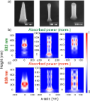

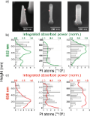
A scanning probe microscopy study of nanostructured TiO2/poly(3-hexylthiophene) hybrid heterojunctions for photovoltaic applications
Beilstein J. Nanotechnol. 2018, 9, 2087–2096, doi:10.3762/bjnano.9.197
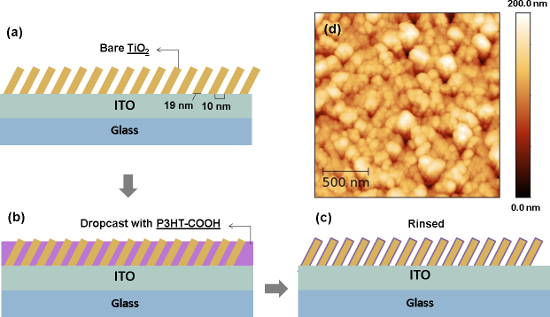
- bias, while fixing the growth temperature to 450 °C and the tilt angle between the substrate and the cathode axis to 60°. Anatase TiO2 layers with a 200 nm thick nanocolumnar morphology have been deposited on 85 nm-thick ITO-coated glass substrates (Naranjo B.V., sheet resistance of 15 Ω·sq). The


A visible-light-controlled platform for prolonged drug release based on Ag-doped TiO2 nanotubes with a hydrophobic layer
Beilstein J. Nanotechnol. 2018, 9, 1793–1801, doi:10.3762/bjnano.9.170
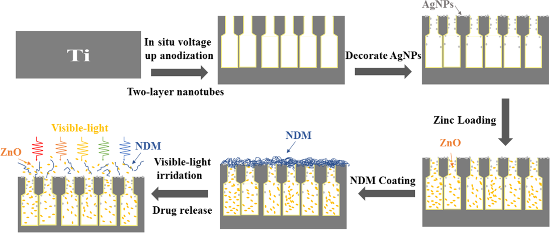
- . Only the peaks of titanium can be observed for the sample before heat treatment in Figure 2a. On the contrary, it can be observed that the peaks of anatase phase appear for the samples shown in Figure 2b while the weak peak of rutile appears at around 28.7° (marked by blue stars). The loading of Zn2
- air atmosphere to form anatase phase. Decoration with Ag nanoparticles Chemical reduction was applied to decorate the nanotubes with Ag nanoparticles (AgNPs). The annealed TNTs were soaked in 4 mL 200 mM AgNO3 for 50 min in darkness and then dipped in 6 mL 5 mM NaBH4 for another 50 min. The resulting





Controllable one-pot synthesis of uniform colloidal TiO2 particles in a mixed solvent solution for photocatalysis
Beilstein J. Nanotechnol. 2018, 9, 1715–1727, doi:10.3762/bjnano.9.163
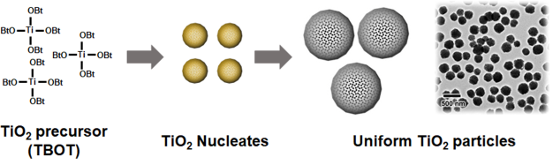
- particles. When uniform, amorphous TiO2 particles were calcined at an optimal temperature (500 °C), the final sample exhibited beneficial characteristics such as high anatase crystallinity with a mixed phase of anatase and rutile and relatively high surface area. The photocatalytic efficiency of the uniform
- TiO2 sample with high anatase crystallinity with mixed phase and high surface area was dramatically enhanced towards RhB degradation under UV–vis irradiation. We systemically discuss the relationship between the synthetic parameters in our synthesis and the properties of the final TiO2 products, as
- crystallite, which results in a charge delocalization that leads to a decreasing chance of electron–hole recombination [19]. In addition, even though the well-crystallized anatase phase is superior for photocatalysis under UV conditions due to its intrinsic properties (e.g., low recombination rate of




Sulfur-, nitrogen- and platinum-doped titania thin films with high catalytic efficiency under visible-light illumination
Beilstein J. Nanotechnol. 2018, 9, 1629–1640, doi:10.3762/bjnano.9.155
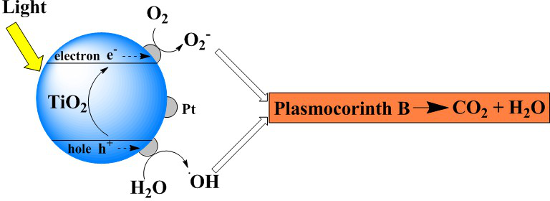
- HCl (thermal treatment at 450 °C) or H2SO4 (thermal treatment at 600 °C), S1–S5 and the structural evolution of sample S4 as a function of thermal treatment temperature are shown in Figure 2. All of the samples have one major peak at 2θ ≈ 25.3°, which corresponds to the reflections of anatase phase
- . Some patterns also show peaks at 2θ ≈ 29° and 2θ ≈ 32°, which correspond to reflections of silicon in the case of very thin films, which do not fully cover the substrate. Anatase is the only polymorphic modification of TiO2 present in the samples. Table 1 shows the average calculated crystallite size
- of anatase in the thin films, calculated with Scherrer’s formula (Equation 1), for different samples. In Equation 1, L represents the calculated crystallite size, K is a dimensionless shape factor, λ is the X-ray wavelength, β is the peak width at half the maximum intensity (FWHM) and θ is the Bragg


Light extraction efficiency enhancement of flip-chip blue light-emitting diodes by anodic aluminum oxide
Beilstein J. Nanotechnol. 2018, 9, 1602–1612, doi:10.3762/bjnano.9.152
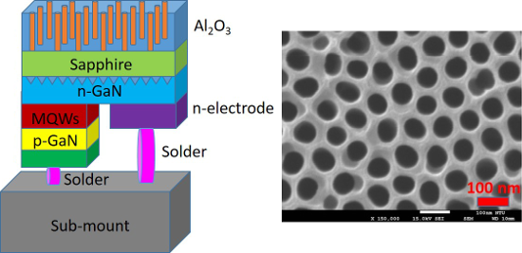
- traditional LED by producing a TiO2 microstructure array on p-GaN through dipping and rapid convective deposition and using noncrystalline TiO2 and anatase TiO2 with a diameter of 520 nm [13]. Huang et al. used Zn and Mg for ion implantation at the GZO thin layer and then adopted rapid thermal annealing to





