


Search results
Search for "mechanics" in Full Text gives 176 result(s) in Beilstein Journal of Nanotechnology.
Bending and punching characteristics of aluminum sheets using the quasi-continuum method
Beilstein J. Nanotechnol. 2022, 13, 1303–1315, doi:10.3762/bjnano.13.108
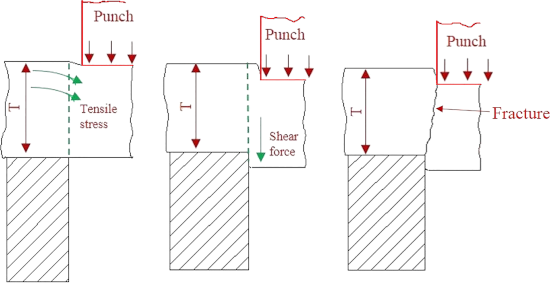
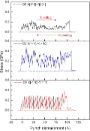
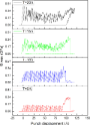
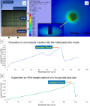
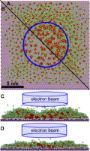
- strain distribution, and fracture strength were provided as well as the interfacial mechanics and punching characteristics of each nano-punching model. Model and Methodologies The simulation model of the nano-punching system comprises a punch and a single crystalline Al workpiece, as shown in Figure 1





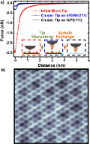
Studies of probe tip materials by atomic force microscopy: a review
Beilstein J. Nanotechnol. 2022, 13, 1256–1267, doi:10.3762/bjnano.13.104
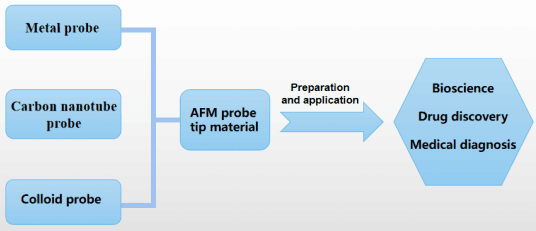
- integration for chemical or biological sensing. Large size colloidal probe Large colloidal probes are widely used to study the mechanics of samples with weaker interaction forces and local variations over a large contact range, and large CPs enable a better comparison of the results achieved in AFM compared
Influence of water contamination on the sputtering of silicon with low-energy argon ions investigated by molecular dynamics simulations
Beilstein J. Nanotechnol. 2022, 13, 986–1003, doi:10.3762/bjnano.13.86
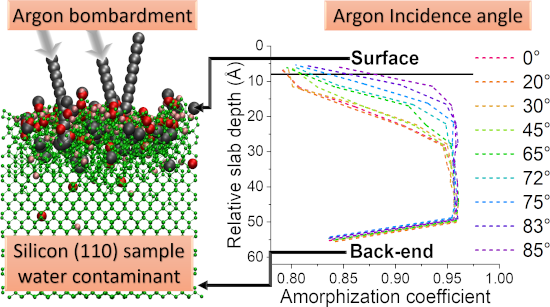
- Methods Force fields The ReaxFF force field differs from other established force fields as it aims to bridge quantum mechanics (QM) and classical MD. Quantum mechanics algorithms are limited to small-sized samples (up to a few hundreds of atoms) due to the difficulty to solve Schrödinger equations for




Fabrication and testing of polymer microneedles for transdermal drug delivery
Beilstein J. Nanotechnol. 2022, 13, 629–640, doi:10.3762/bjnano.13.55
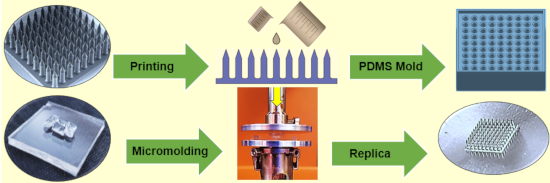
- by BD Ultra-Fine™ 4 mm Pen Needles, the SM was calculated as 4.95 (Figure 6d). The SM for both methods was above 1, indicating a sufficient safety level for skin insertions. However, SM directly depends on the MN material, its base diameter and the fillet, overall length, and the mechanics of skin



Micro- and nanotechnology in biomedical engineering for cartilage tissue regeneration in osteoarthritis
Beilstein J. Nanotechnol. 2022, 13, 363–389, doi:10.3762/bjnano.13.31
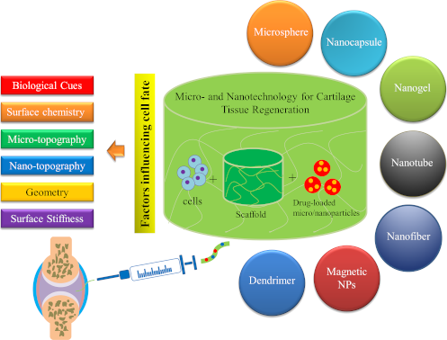
- films (nanofiber composites) coated with PLDLA nanofibers on the behavior of bovine chondrocytes [109]. The researchers observed that electrospun nanofibers supported the adhesion of cells and maintained the chondrocyte phenotype. Besides, the adhesivity and mechanics of the nanofiber-based scaffolds
- could be tuned to meet the needs of chondrocyte behavior and function. Kim et al. studied the effects of adhesivity and mechanics of electrospun nanofibers of HA on hMSC chondrogenesis [8]. They synthesized photocrosslinkable RGD (Arg-Gly-Asp)-engrafted HA for electrospinning. The RGD peptide density
- has been used to tune nanofiber adhesivity, and the intrafiber crosslink density has also been used as a parameter to calibrate nanofiber mechanics [8]. Cell spreading, proliferation, and cytoskeletal organization depended on the RGD density. Meanwhile, the expression of chondrogenic markers was


Effect of lubricants on the rotational transmission between solid-state gears
Beilstein J. Nanotechnol. 2022, 13, 54–62, doi:10.3762/bjnano.13.3
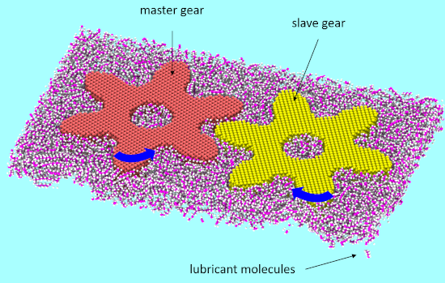
- and velocity distribution are not well defined and one has to resort to an atomistic description, for example, via molecular dynamics (MD) simulations. Also, the contact mechanics at the nanoscale is very different from the macroscopic case since specific pair interactions have to be taken into
- “Mechanics with Molecules” (MEMO, grant nr. 766864).


Sputtering onto liquids: a critical review
Beilstein J. Nanotechnol. 2022, 13, 10–53, doi:10.3762/bjnano.13.2
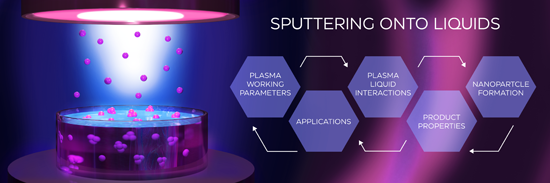
- properties to fit the targeted application in fields such as mechanics, optics, electronics, and biomaterials. Various types of coatings can be produced, from pure metals to metal oxides, nitrides, carbides, oxynitrides to metal alloys, or chemically more complex combinations such as high-entropy alloys [24
- . Phase I is a rapid increase of monomer (S2) concentration in the reaction solution. Phase II is an extremely fast nucleation process via a stepwise sequence of S2 monomer additions until the formation of nuclei having a critical size is reached. Since La Mer worked in a frame of statistical mechanics






Alteration of nanomechanical properties of pancreatic cancer cells through anticancer drug treatment revealed by atomic force microscopy
Beilstein J. Nanotechnol. 2021, 12, 1372–1379, doi:10.3762/bjnano.12.101
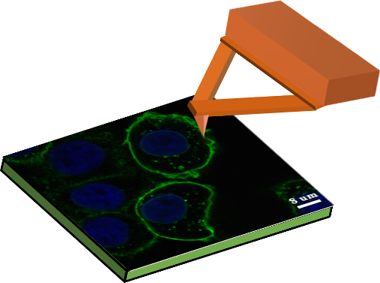
- the physical properties of HeLa cells treated by docetaxel are different from that of untreated ones [9]. Therefore, the study of drug–cell interaction regarding cellular mechanics could be an effective way for drug evaluation. Important information, including drug efficacy and safety can be obtained
- from measuring the alteration of cellular mechanics, which provides a guide for the innovation and development of anticancer drugs [11]. Atomic force microscopy (AFM) has matured into a forceful nanoscale platform for imaging biological samples and quantifying biomechanical properties of living cells
- pancreatic cancer based on the differences in Young's modulus in the early stage. The effect of anticancer drugs on the nanomechanical property of PCCs The effect of anticancer drugs on the cellular mechanics provides a new way for drug evaluation and even provides credible guidance for the innovation and


Polarity in cuticular ridge development and insect attachment on leaf surfaces of Schismatoglottis calyptrata (Araceae)
Beilstein J. Nanotechnol. 2021, 12, 1326–1338, doi:10.3762/bjnano.12.98
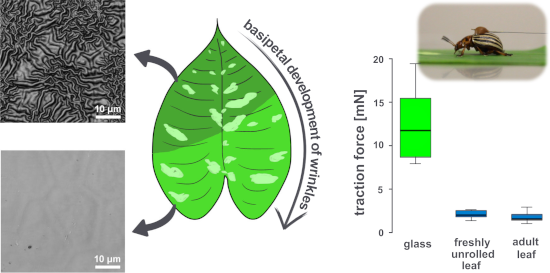
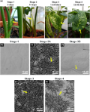
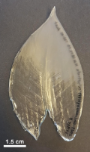
- in cuticular morphology among the various plant species or the means by which polarity is established in cuticular (ridge) development in a given species. Vice versa, the variation in the morphology of the ridges and the underlying mechanics should enable inferences to be made regarding the




A review on slip boundary conditions at the nanoscale: recent development and applications
Beilstein J. Nanotechnol. 2021, 12, 1237–1251, doi:10.3762/bjnano.12.91
- Ruifei Wang Jin Chai Bobo Luo Xiong Liu Jianting Zhang Min Wu Mingdan Wei Zhuanyue Ma Shaanxi Key Laboratory of Well Stability and Fluid & Rock Mechanics in Oil and Gas Reservoirs, College of Petroleum Engineering, Xi’an Shiyou University, 710065, China Research Institute of Exploration and
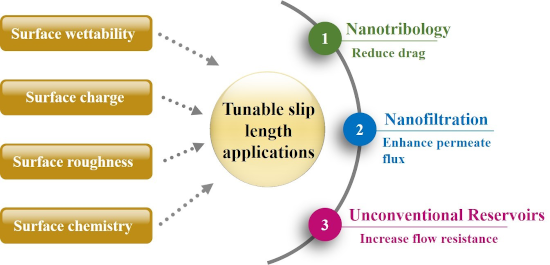
- reservoirs; Introduction A basic postulate in the study and design of macroscopic fluidic systems based on the knowledge of fluid mechanics is that the no-slip boundary condition is valid at the solid–liquid interface [1]. In the last two centuries, this no-slip boundary condition has been successfully


Irradiation-driven molecular dynamics simulation of the FEBID process for Pt(PF3)4
Beilstein J. Nanotechnol. 2021, 12, 1151–1172, doi:10.3762/bjnano.12.86
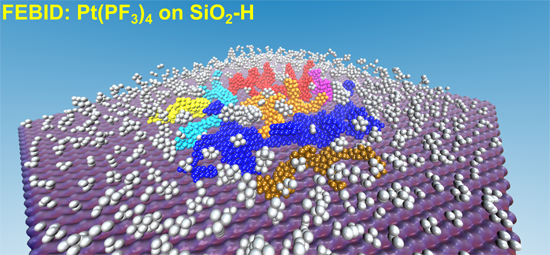
- ) are treated as random, fast, and local transformations incorporated into the classical MD framework in a stochastic manner with the probabilities elaborated on the basis of quantum mechanics [13]. Major transformations of irradiated molecular systems (e.g., molecular topology changes, redistribution








A new method for obtaining model-free viscoelastic material properties from atomic force microscopy experiments using discrete integral transform techniques
Beilstein J. Nanotechnol. 2021, 12, 1063–1077, doi:10.3762/bjnano.12.79
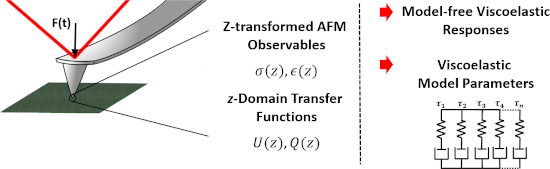
- geometry correction factor discussed above, . For this calculation Δt is a known experimental parameter, and r is chosen by the researcher. Demonstration with AFM contact mechanics So far, we have demonstrated our method for stress–strain inputs using the generalized Voigt model. However, in AFM


An overview of microneedle applications, materials, and fabrication methods
Beilstein J. Nanotechnol. 2021, 12, 1034–1046, doi:10.3762/bjnano.12.77
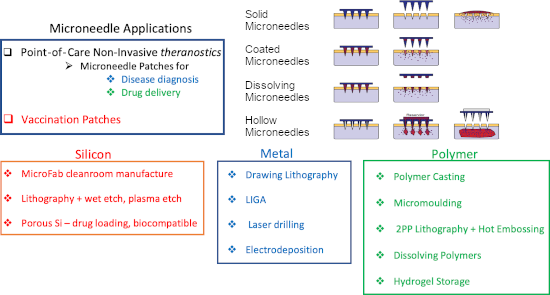
- other types of microneedle [9][10]. Table 1 is an overview of the most important metal microneedle types, identifying those which are most likely to meet the challenges of mass manufacturing with selected references. Whichever type of microneedle is used, the mechanics of skin penetration provides new


Physical constraints lead to parallel evolution of micro- and nanostructures of animal adhesive pads: a review
Beilstein J. Nanotechnol. 2021, 12, 725–743, doi:10.3762/bjnano.12.57
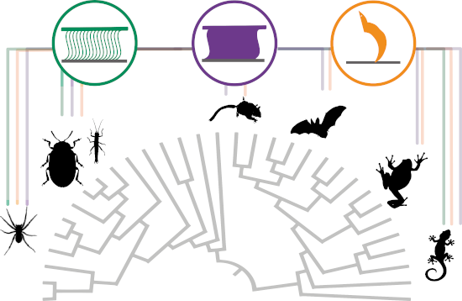
- of the same microstructures, in contrast, is a result of similar demands for adhesion in the respective habitats, which means that the physical rules of contact mechanics have a very strong influence on the adaptive evolution of the attachment structures in general. The reason is that similar AMS
- bend during contact formation with the substrate (Figure 6A and Figure 6B). The pad can, therefore, work as a damper at high-speed deformations during jumping or landing. More importantly, in terms of contact mechanics, deformability functions as a basis for replicating a complex substrate profile
- for particular functional effects. Figure 9 was reproduced from [35], “Advances in Insect Physiology: Insect Mechanics and Control.”, 1st Edition, by S. N. Gorb, Chapter “Smooth attachment devices in insects”, pages 81–116, Copyright (2008), with permission from Elsevier. This content is not subject


Molecular dynamics modeling of the influence forming process parameters on the structure and morphology of a superconducting spin valve
Beilstein J. Nanotechnol. 2020, 11, 1776–1788, doi:10.3762/bjnano.11.160
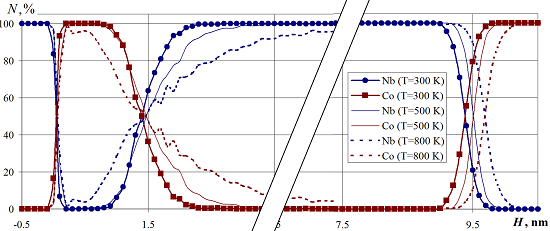
- Alexander Vakhrushev Aleksey Fedotov Vladimir Boian Roman Morari Anatolie Sidorenko Modeling and Synthesis of Technological Structures Department, Institute of Mechanics, Udmurt Federal Research Center, Ural Division, Russian Academy of Sciences, Baramzinoy 34, Izhevsk 426067, Russia


Out-of-plane surface patterning by subsurface processing of polymer substrates with focused ion beams
Beilstein J. Nanotechnol. 2020, 11, 1693–1703, doi:10.3762/bjnano.11.151
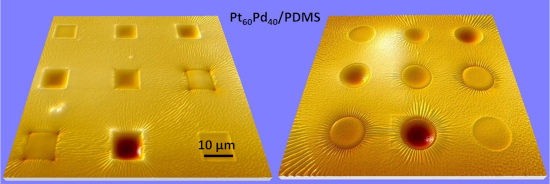
- surface elevations or depressions at the corners of the irradiated squares in Figure 7b. Considering continuum mechanics, these features are places where mechanical stress can concentrate, resulting in the enhancement of local deformations. In numerous previous studies, the occurrence of ripples (also


Self-assembly and spectroscopic fingerprints of photoactive pyrenyl tectons on hBN/Cu(111)
Beilstein J. Nanotechnol. 2020, 11, 1470–1483, doi:10.3762/bjnano.11.130
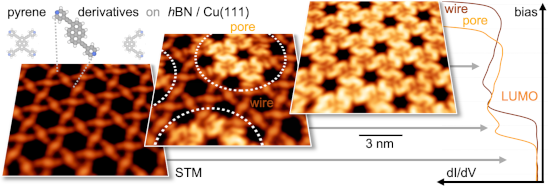
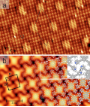
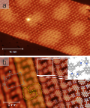
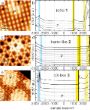
- hBN/Cu(111) and Ag(111), the separation along the unit cell vector a was clearly reduced on hBN, reflecting the minimum energy interdigitation configuration, determined by basic molecular mechanics modeling for two modules of 1 in the gas phase. Thus, we tentatively assigned the higher packing density
- ) program package [88]. The starting geometries were obtained from molecular mechanics or semiempirical models, followed by DFT geometry optimizations on unconstrained C1 symmetry. Geometry optimizations were followed by frequency calculations on the optimized structures, which confirmed the existence of




On the frequency dependence of viscoelastic material characterization with intermittent-contact dynamic atomic force microscopy: avoiding mischaracterization across large frequency ranges
Beilstein J. Nanotechnol. 2020, 11, 1409–1418, doi:10.3762/bjnano.11.125
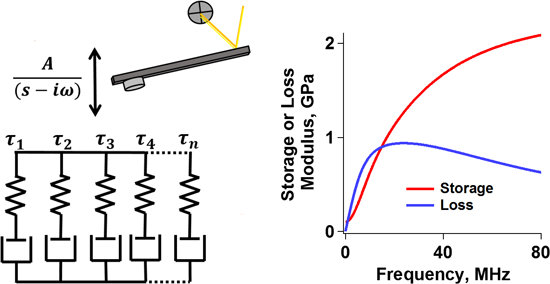
- mechanics of the sample. Clearly the ability of the cantilever to sufficiently indent the sample must be considered in order to perform an accurate viscoelastic characterization of the material. A mathematical analysis of the variables that govern the indentation in dynamic AFM methods based on dimensional


Effect of magnetic field, heat generation and absorption on nanofluid flow over a nonlinear stretching sheet
Beilstein J. Nanotechnol. 2020, 11, 976–990, doi:10.3762/bjnano.11.82
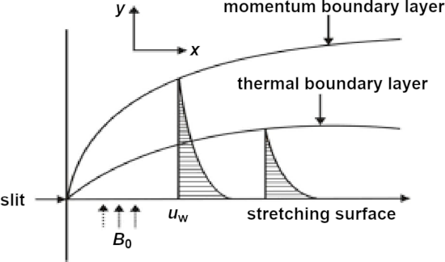
- equations, represented by Equations 10–12, are solved by using the Adam’s predictor–corrector method which is the most efficient technique in numerical analysis used to solve distinctive problems related to heat transfer, fluid mechanics, and electrical systems. The first step involves reducing the


Extracting viscoelastic material parameters using an atomic force microscope and static force spectroscopy
Beilstein J. Nanotechnol. 2020, 11, 922–937, doi:10.3762/bjnano.11.77
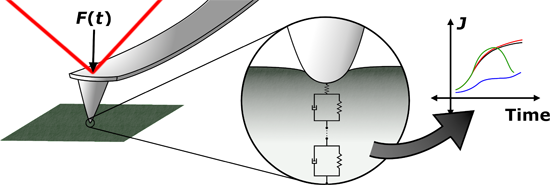
- microscopy (AFM) techniques have provided and continue to provide increasingly important insights into surface morphology, mechanics, and other critical material characteristics at the nanoscale. One attractive implementation involves extracting meaningful material properties, which demands physically
- somewhat organic. One approach is to use theoretical arguments in conjunction with continuum mechanics fundamentals, but it is most common to design more intuitive spring–dashpot linear viscoelastic mechanical models [13][14][15]. The spring–dashpot, or “mechanical equivalent” approach to linear
- for a given stress or strain excitation. The mechanical-equivalent approach is simple to explain, but can require more assumptions and some additional knowledge of the Laplace transform to derive analytical stress–strain relationships. Alternatively, continuum mechanics can be used to create more


A set of empirical equations describing the observed colours of metal–anodic aluminium oxide–Al nanostructures
Beilstein J. Nanotechnol. 2020, 11, 798–806, doi:10.3762/bjnano.11.64
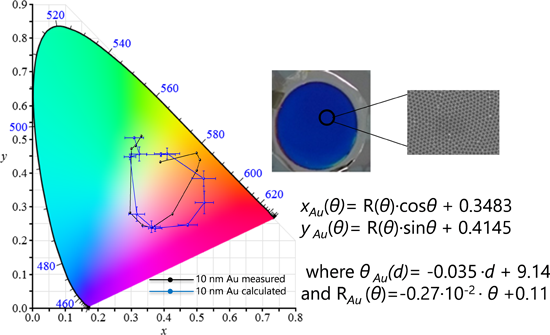
- Cristina V. Manzano Jakob J. Schwiedrzik Gerhard Burki Laszlo Petho Johann Michler Laetitia Philippe Empa, Swiss Federal Laboratories for Materials Science and Technology, Laboratory for Mechanics of Materials and Nanostructures, Feuerwerkerstrasse 39, CH-3602 Thun, Switzerland 10.3762/bjnano


Quantitative determination of the interaction potential between two surfaces using frequency-modulated atomic force microscopy
Beilstein J. Nanotechnol. 2020, 11, 729–739, doi:10.3762/bjnano.11.60
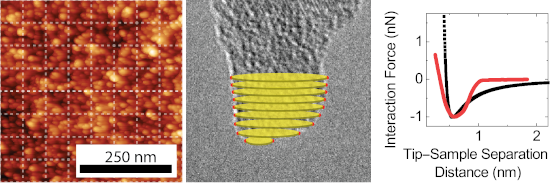
- , Pittsburgh, PA 15621, USA Department of Mechanical Engineering and Applied Mechanics, University of Pennsylvania, 220 S. 33rd Street, Philadelphia, Pennsylvania 19104, USA 10.3762/bjnano.11.60 Abstract The interaction potential between two surfaces determines the adhesive and repulsive forces between them
- . It also determines interfacial properties, such as adhesion and friction, and is a key input into mechanics models and atomistic simulations of contacts. We have developed a novel methodology to experimentally determine interaction potential parameters, given a particular potential form, using
- mechanics models [22][23][24][25] to allow better visualization of surface interactions. While useful insights can be obtained using fully atomistic simulations, such as molecular dynamics simulations or density functional theory, these techniques are impractical for describing larger contacts with a large


Current measurements in the intermittent-contact mode of atomic force microscopy using the Fourier method: a feasibility analysis
Beilstein J. Nanotechnol. 2020, 11, 453–465, doi:10.3762/bjnano.11.37
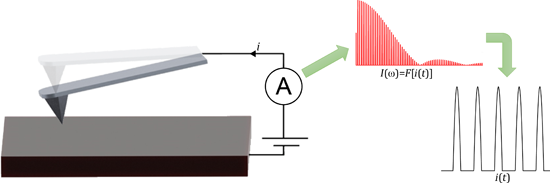
- –sample contact time would be useful in the characterization of the current profile, while, similarly, knowledge of the current as a function of time would aid in understanding the effective tip–sample contact time, which may also provide useful information regarding the mechanics of the interaction [44
- stem from the dynamics and mechanics of an intermittent-contact operation. Besides the fact that electrical contacts would be intermittent, the nature of the contact would also be time-dependent within the contact time. This is because the indentation is constantly varying. Furthermore, the




Nonclassical dynamic modeling of nano/microparticles during nanomanipulation processes
Beilstein J. Nanotechnol. 2020, 11, 147–166, doi:10.3762/bjnano.11.13
- Moharam Habibnejad Korayem Ali Asghar Farid Rouzbeh Nouhi Hefzabad Robotic Research Laboratory, Center of Excellence in Experimental Solid Mechanics and Dynamics, School of Mechanical Engineering, Iran University of Science and Technology, Narmak, Tehran, Iran Department of Mechanical Engineering
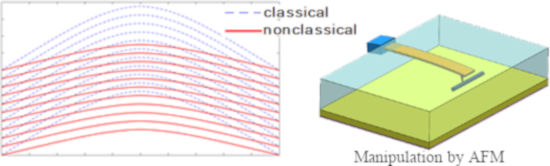
- of nanoparticles. To model this process, previous studies employed classical continuum mechanics and molecular dynamics simulations which had certain limitations; the former does not consider size effects at the nanoscale while the latter is time consuming and faces computational restrictions. To
- the substrate, along with the dominant motion mode, the nonclassical theory of continuum mechanics and a developed von Mises yield criterion are employed to investigate the dynamical behavior of a cylindrical gold nanoparticle during manipulation. Timoshenko and Euler–Bernoulli beam theories based on







The effect of heat treatment on the morphology and mobility of Au nanoparticles
Beilstein J. Nanotechnol. 2020, 11, 61–67, doi:10.3762/bjnano.11.6
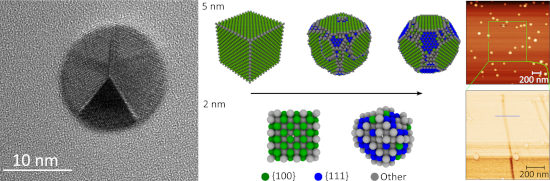
- mechanics [14][26]. The contact area of a perfect sphere can be two orders of magnitude smaller than that of a polyhedron-like NP, as was shown by Vlassov and co-workers [6]. The mobility of the Au NPs was evaluated by means of the power dissipated in tapping-mode AFM, which has previously been shown to be





