


Search results
Search for "penetration depth" in Full Text gives 130 result(s) in Beilstein Journal of Nanotechnology.
Cross-sectional Kelvin probe force microscopy on III–V epitaxial multilayer stacks: challenges and perspectives
Beilstein J. Nanotechnol. 2023, 14, 725–737, doi:10.3762/bjnano.14.59
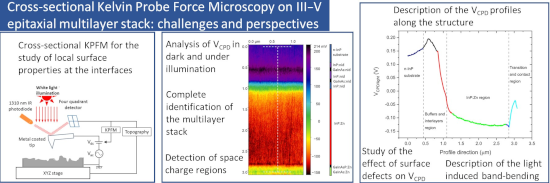
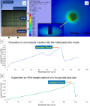
- connected to the microscope was used. The white-light wavelength range is 400 to 700 nm, and for these wavelengths the penetration depth in GaInAs ranges between 10 and 100 nm. This makes our measurements mainly sensitive to the surface states and surface band bending. Additionally, a uniform illumination


A distributed active patch antenna model of a Josephson oscillator
Beilstein J. Nanotechnol. 2023, 14, 151–164, doi:10.3762/bjnano.14.16
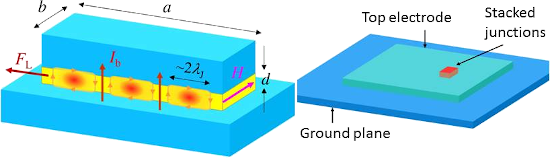
- from Josephson oscillators. Figure 1a shows a sketch of a typical FFO. It is based on a sandwich-type (overlap) JJ with the length, a ≫ λJ, much larger than the Josephson penetration depth, and both in-plane sizes much larger than the thickness of the junction interface, d ≪ b ≪ a. The in-plane
- the case of Nb/AlOx/Nb tunnel JJs, which are used in state-of-the-art FFOs [9][11]. I assume that a = 100 μm, b = 10 μm, d = 2 nm, εr = 10, d1 = d2 = 100 nm, the zero-temperature London penetration depth λL0 = 100 nm, Jc0 = 5 × 10³ (A/cm2), Ic0 = Jc0ab = 50 mA, and the characteristic voltage Ic0Rn = 1


Observation of collective excitation of surface plasmon resonances in large Josephson junction arrays
Beilstein J. Nanotechnol. 2022, 13, 1578–1588, doi:10.3762/bjnano.13.132
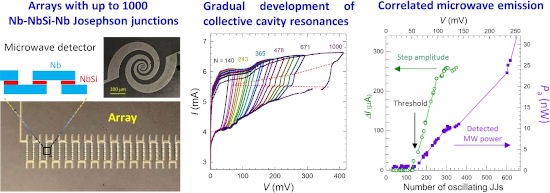
- penetration depth. This precludes direct interaction between the JJs [28]. Therefore, JJs are coupled only indirectly via common cavity modes, corresponding to the formation of standing surface plasmon waves along the electrode [34]. The standing wave imprints its order on Josephson junctions in the array
- junctions are of the overlap type and are separated by a distance of 12 μm, that is, one hundred times larger than the London penetration depth in Nb. This precludes direct interactions between them. Nevertheless, they can be effectively synchronized via the indirect coupling mechanism mediated by the




Microneedle-based ocular drug delivery systems – recent advances and challenges
Beilstein J. Nanotechnol. 2022, 13, 1167–1184, doi:10.3762/bjnano.13.98
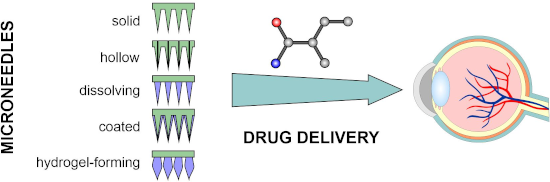
- , the obtained material revealed an appropriate mechanical strength to reach penetration depth up to 200 µm. The degree of drug penetration across human excised cornea after 24 h was assessed for the traditional suspension used for 5 min or 24 h and after 5 min of contact with the microneedles. The


Influence of water contamination on the sputtering of silicon with low-energy argon ions investigated by molecular dynamics simulations
Beilstein J. Nanotechnol. 2022, 13, 986–1003, doi:10.3762/bjnano.13.86
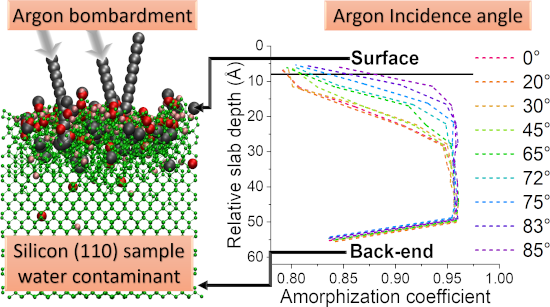
- . Description of the amorphization The two samples at several stages of the sputtering process are shown in Figure 6 to illustrate the evolution of the amorphization process. The penetration depth of argon atoms is limited to the first few lattices inside the silicon, for both the contaminated and clean samples
- milling is essential because most samples analysed in high-precision instruments are prepared using this method. This can be best achieved using low-beam energies, ideally in the sub-keV range [18], since low-energy ion beams (under 500 eV) produce a thinner amorphous layer due to their lower penetration
- depth. Investigations performed with low-energy argon ions [15][19][20] have shown that the current model describing the sputter yields and the sputtering processes (such as sputtering threshold and the amorphization process) does not fit with experimental data, leading to discrepancies that cannot be




Temperature and chemical effects on the interfacial energy between a Ga–In–Sn eutectic liquid alloy and nanoscopic asperities
Beilstein J. Nanotechnol. 2022, 13, 817–827, doi:10.3762/bjnano.13.72
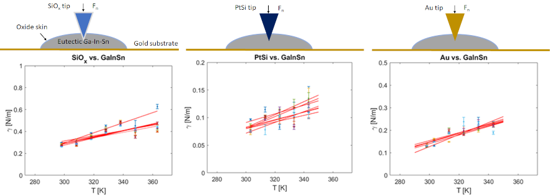
- crystallization of the oxide layer during electron beam exposition. We measured the temperature dependence of the interfacial energy between Ga–In–Sn eutectic liquid and AFM tips by dipping the AFM tips inside a Ga–In–Sn liquid drop. The penetration depth of the tips was in the order of several hundreds of
- depth values below 50 nm (see Figure 4b,c). At low penetration depth values, the contact between tip and liquid may not be intimate yet, and the observed deviation from linearity in the Fn(δ) plots may correspond to a pre-tension effect of the interface. The penetration of the tip at larger depths is
- apex of h ≈ 200 nm, which corresponds to the penetration depth of the tip into the liquid alloy. Coincidently, we determined the largest interfacial tension value at the melting point of the liquid alloy for the same tip, = 230 mN/m. The adhesion of melt residues at the SiOx tip can be attributed to



Fabrication and testing of polymer microneedles for transdermal drug delivery
Beilstein J. Nanotechnol. 2022, 13, 629–640, doi:10.3762/bjnano.13.55
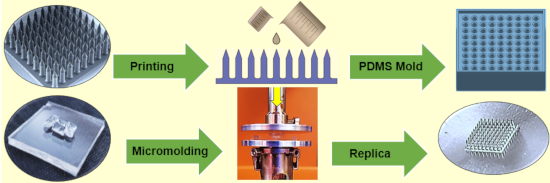
- force of the skin. Successful insertion is achieved upon reaching sufficient penetration depth and creating microchannels within the skin. However, the skin’s inherent elasticity and its irregular surface, with the tendency to fold around MN projections, result in unpredictable array penetration
- confocal laser scanning microscope (Carl Zeiss, Jena, Germany) to visualize the penetration depth and estimate the FPL for individual MN projections. The images were further analyzed using ImageJ software (U. S. National Institutes of Health, Bethesda, Maryland, USA). Measuring the force of insertion Skin



Engineered titania nanomaterials in advanced clinical applications
Beilstein J. Nanotechnol. 2022, 13, 201–218, doi:10.3762/bjnano.13.15
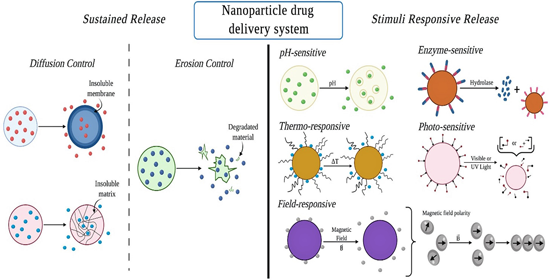
- drawback of using TiO2 as photosensitizer is the shallow penetration depth in tissues as it gets activated only by UV light; however, for deep penetration of light into tissues, the wavelength should be in the near-infrared (NIR) window (700–1100 nm) [111]. TiO2 nps can be retained in the body for more


Theranostic potential of self-luminescent branched polyethyleneimine-coated superparamagnetic iron oxide nanoparticles
Beilstein J. Nanotechnol. 2022, 13, 82–95, doi:10.3762/bjnano.13.6
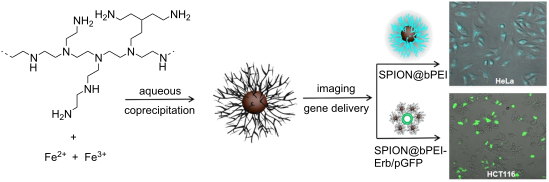
- imaging, on the other hand, has better sensitivity but suffers from limitations in the penetration depth in in vivo studies. However, it is quite successful in the preclinical research [43]. Hence, a combination of the two modalities provides many advantages. One of the approaches towards such structures




Nanoscale friction and wear of a polymer coated with graphene
Beilstein J. Nanotechnol. 2022, 13, 63–73, doi:10.3762/bjnano.13.4
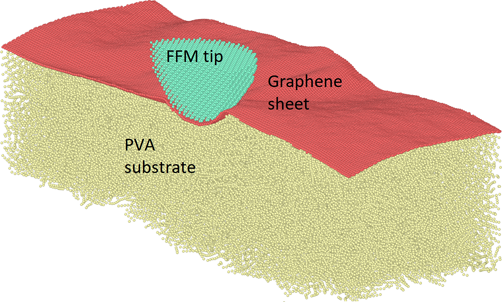
- indentation simulation with a load of 6.4 nN to determine the penetration depth after a long period of time (Figure 5). We observe only a slight increase in depth by around 1 Å between 1 and 4 ns. Thus, we consider the tip to be indented fully after 1 ns. We do note, however, that during sliding the tip sinks
- crumpled graphene sheet. The graphene layer affects the roughness and structure of the substrate. The penetration depth versus time for long indentations, and for the sliding process, for a tip with radius of 50 Å and load of 6.4 nN (4 eV/Å), on the flat graphene. The dashed line represents the time at


Nonmonotonous temperature dependence of Shapiro steps in YBCO grain boundary junctions
Beilstein J. Nanotechnol. 2021, 12, 1279–1285, doi:10.3762/bjnano.12.95
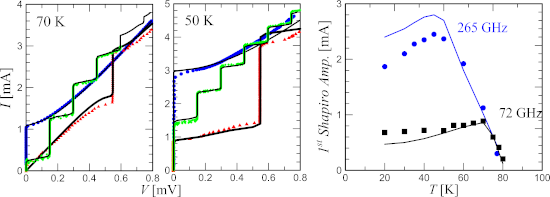
- temperature. Figure 1 also shows the change in the Josephson junction characteristic length L/λJ, where is the Josephson penetration depth, which determines the size of a fluxon in the junction. Here μ0 is the vacuum permeability, Jc is the critical current density, and d = t + 2λL is the effective magnetic
- thickness with the junction barrier thickness t = 1.5 nm and the London penetration depth λL = 250–150 nm [38]. It can be seen from the figure that, for nitrogen temperatures, the Josephson junction can generally be considered as a short JJ. With the decrease in the temperature, its characteristic dimension


In situ transport characterization of magnetic states in Nb/Co superconductor/ferromagnet heterostructures
Beilstein J. Nanotechnol. 2021, 12, 913–923, doi:10.3762/bjnano.12.68
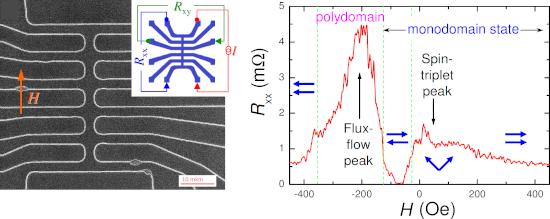
- -linear flux-flow Hall effect Resistivity in type-II superconductors with sizes larger than the London penetration depth, λ, is caused by motion of Abrikosov vortices, that is, it has a flux-flow (FF) nature [50][51][52][53]. Since our micrometer-size bridges are significantly larger than λ ≈ 100 nm of Nb


Comprehensive review on ultrasound-responsive theranostic nanomaterials: mechanisms, structures and medical applications
Beilstein J. Nanotechnol. 2021, 12, 808–862, doi:10.3762/bjnano.12.64
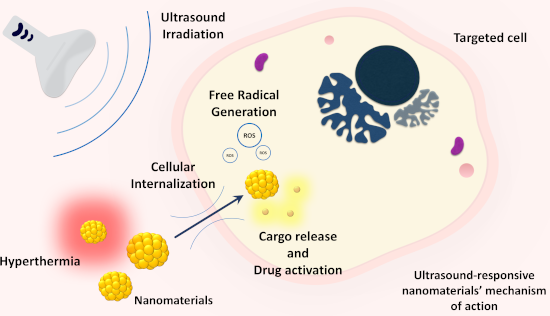
- destroyed with a high-intensity burst of US. Thus, they can locally release the loaded drugs and enhance the penetration depth of the therapeutic agents into the targeted tissue via microstreaming and ARF [72][83][126][168]. Microbubbles can improve the efficacy of gene transfection, therapeutic agents, and


A review of defect engineering, ion implantation, and nanofabrication using the helium ion microscope
Beilstein J. Nanotechnol. 2021, 12, 633–664, doi:10.3762/bjnano.12.52


The patterning toolbox FIB-o-mat: Exploiting the full potential of focused helium ions for nanofabrication
Beilstein J. Nanotechnol. 2021, 12, 304–318, doi:10.3762/bjnano.12.25
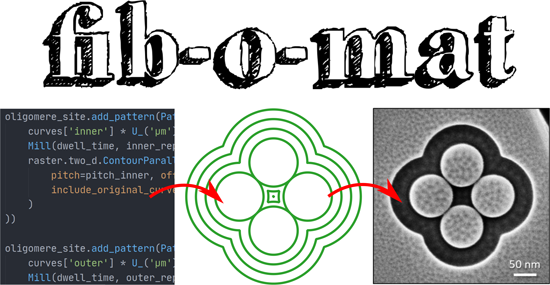
- depth of 30 keV He ions in silicon is more than five times larger than the penetration depth of Ga ions of the same energy [21]. The consequently large collision cascade may create a significant amount of heat. Even for small ion doses deformation of the manufactured structures can be observed when
- the varying crystal orientations cause a variation in the local sputter rate due to ion channeling [24]. If one of the symmetry axes of the crystal lattice is oriented along the beam direction, the ion penetration depth is larger, which, in turn, reduces the sputter rate. The resulting surface
- for focused beams of light ions are still under exploration. This is a consequence of the novelty of the technique and of several significant peculiarities in the behaviour of light ions upon interaction with a solid. First, light ions exhibit a large interaction volume in the solid. The penetration


Effect of different silica coatings on the toxicity of upconversion nanoparticles on RAW 264.7 macrophage cells
Beilstein J. Nanotechnol. 2021, 12, 35–48, doi:10.3762/bjnano.12.3
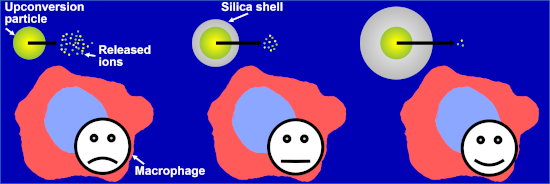
- with UCNPs avoids autofluorescence. Besides, UCNPs have further advantages for applications in life science, such as deep penetration depth, minimal photodamage, and high resistance to photobleaching [1][2][3][4][5][6][7][8][9]. Moreover, high thermal and photochemical stability, as well as high


Effect of localized helium ion irradiation on the performance of synthetic monolayer MoS2 field-effect transistors
Beilstein J. Nanotechnol. 2020, 11, 1329–1335, doi:10.3762/bjnano.11.117
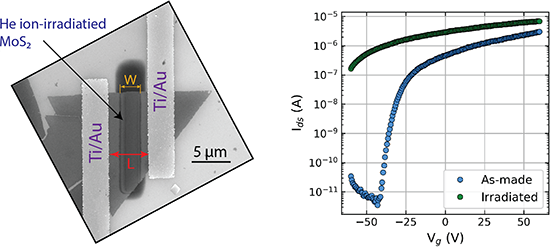
- atomic vacancy yield per each delivered ion as a function of target penetration depth on the 35 nm-Au/5 nm-Ti/0.7 nm-MoS2/285 nm-SiO2 stack [41]. As evident from Figure 3d, the sulfur sputtering yield at the Ti–MoS2 interface is very close to that of unencapsulated MoS2 [15], indicating notable damage to


Gas sorption porosimetry for the evaluation of hard carbons as anodes for Li- and Na-ion batteries
Beilstein J. Nanotechnol. 2020, 11, 1217–1229, doi:10.3762/bjnano.11.106
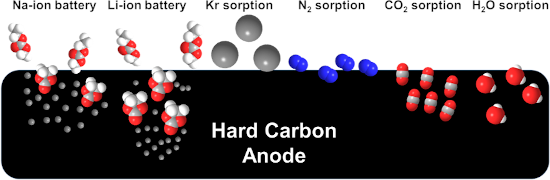
- complicated reality of HC anodes in SIBs as well as in LIBs. To improve the understanding of the porosity accessible by GSP techniques more sophisticated techniques are necessary. Especially the connectivity of pores affecting the penetration depth and electrode utilization will play a crucial role in


3D superconducting hollow nanowires with tailored diameters grown by focused He+ beam direct writing
Beilstein J. Nanotechnol. 2020, 11, 1198–1206, doi:10.3762/bjnano.11.104
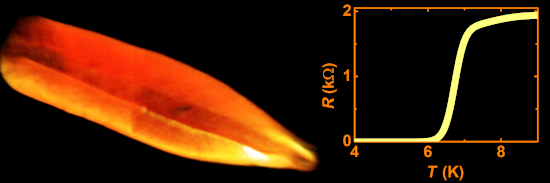
- penetration depth, λ, [38][39] ranges from 720 to 874 nm. Additionally, Jc (0.6 K, 0 T) is approx. 0.15 MA/cm2. Summarizing, the estimated superconducting parameters (Tc, µ0Hc2, Jc, ξ, λ) for these NWs (Table 2) are mostly compatible with those reported for He+ FIBID out-of-plane WC nanotubes [17



Revealing the local crystallinity of single silicon core–shell nanowires using tip-enhanced Raman spectroscopy
Beilstein J. Nanotechnol. 2020, 11, 1147–1156, doi:10.3762/bjnano.11.99
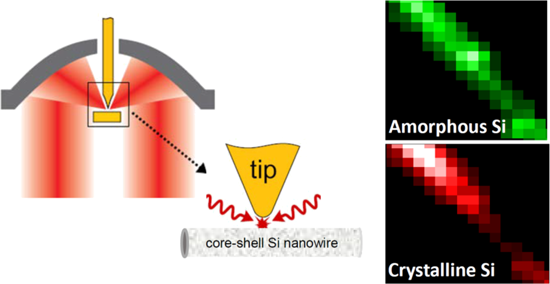
- confocal spectra, respectively. The slightly higher value of ΔΘ determined with TERS could be due to the nanometer-sized penetration depth of the near field excited at the tip apex, in contrast to the far-field laser focus. Since the SiNWs contain a c-Si core and an a-Si shell (Figure 1), the shell can be


Photothermally active nanoparticles as a promising tool for eliminating bacteria and biofilms
Beilstein J. Nanotechnol. 2020, 11, 1134–1146, doi:10.3762/bjnano.11.98
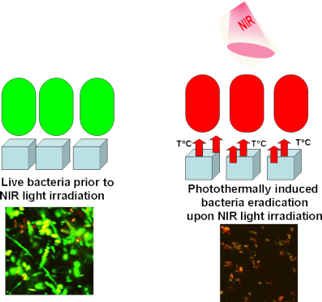
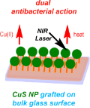
- conventional sterilization procedures that are usually time consuming and require higher temperatures. In addition, the NIR light in the so-called “bio-transparent window” (750–900 nm) is considered safe for direct in vivo application as it has a large penetration depth and does not damage normal tissue (at


A few-layer graphene/chlorin e6 hybrid nanomaterial and its application in photodynamic therapy against Candida albicans
Beilstein J. Nanotechnol. 2020, 11, 1054–1061, doi:10.3762/bjnano.11.90
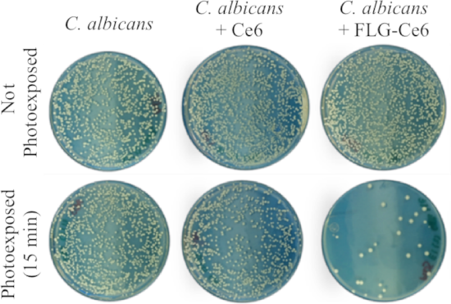
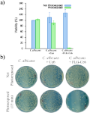
- morphology observations. The wider absorption peak in the FLG-Ce6 hybrid nanomaterial spectrum at 640 nm corresponds to the greater probability of absorbing a photon deeper into the tissue, since the penetration depth of electromagnetic radiation increases as the wavelength increases, reaching depths up to


Highly sensitive detection of estradiol by a SERS sensor based on TiO2 covered with gold nanoparticles
Beilstein J. Nanotechnol. 2020, 11, 1026–1035, doi:10.3762/bjnano.11.87
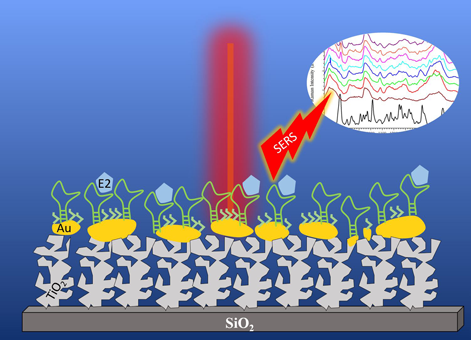
- mass of MBA (ρMBA = 1.5 g·cm−3, MMBA = 154.19 g·mol−1), the laser spot area (Aspot), and the penetration depth of the focused laser beam (which was assumed to be h =12 μm), as: where NA is the Avogadro constant. NSERS corresponds to the number of molecules adsorbed on the AuNP surface within the laser



Microwave-induced electric discharges on metal particles for the synthesis of inorganic nanomaterials under solvent-free conditions
Beilstein J. Nanotechnol. 2020, 11, 1019–1025, doi:10.3762/bjnano.11.86
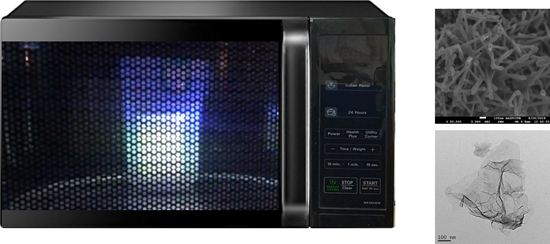
- discussion [9][11]. Bulk metals generally reflect microwaves, whereas fine metal powders or thin films can couple with microwaves (the penetration depth of microwaves in metals is 1–2 µm). This will quickly increase the temperature through conduction mechanisms, which enables the sintering of metals by using


A Josephson junction based on a highly disordered superconductor/low-resistivity normal metal bilayer
Beilstein J. Nanotechnol. 2020, 11, 858–865, doi:10.3762/bjnano.11.71
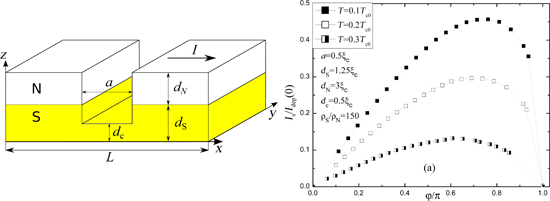
- NbN/Al, NbN/Ag and MoN/Ag bilayers. Namely, the suppression of the critical temperature of the SN bilayer is smaller while the change in magnetic field penetration depth of the SN bilayer is larger than the Usadel model predicts. Therefore, the present results should be considered only as a route for





