Search results
Search for "Pt" in Full Text gives 493 result(s) in Beilstein Journal of Nanotechnology. Showing first 200.
Direct electron beam writing of silver using a β-diketonate precursor: first insights
Beilstein J. Nanotechnol. 2024, 15, 1117–1124, doi:10.3762/bjnano.15.90

- obtained [34]. For planar deposits, similar microstructures were obtained during platinum deposition using Pt(η5-CpMe)Me3 [35] and ruthenium deposition using (EtCp)2Ru [36], both in combination with post-deposition purification employing electron beam irradiation in a water atmosphere. For the case of
- injection systems as it operates at a temperature of 80 °C, comparable to the ubiquituous Pt precursor Pt(η5-CpMe)Me3. At a required stage temperature of about 60 °C, the residence time of the molecules is long enough to realize sizable vertical growth rates and halo-free deposition for tightly focused


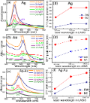
Effect of wavelength and liquid on formation of Ag, Au, Ag/Au nanoparticles via picosecond laser ablation and SERS-based detection of DMMP
Beilstein J. Nanotechnol. 2024, 15, 1054–1069, doi:10.3762/bjnano.15.86

- laser ablating Au/Fe multilayers with varying thicknesses and deposition orders. Jakobi et al. [26] reported the synthesis of Pt–Ir alloy NPs by femtosecond laser ablation of a Pt9Ir target in acetone and further utilized as PtIr electrodes. In recent years, laser-ablated NPs/NSs have gained prominent


Atomistic insights into the morphological dynamics of gold and platinum nanoparticles: MD simulations in vacuum and aqueous media
Beilstein J. Nanotechnol. 2024, 15, 995–1009, doi:10.3762/bjnano.15.81
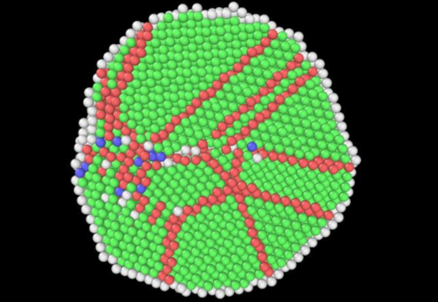
- adapting theories suitable for bulk materials to NPs; examples include the classical nucleation theory [33], phenomenological models [34][35][36], as well as molecular simulations [37][38][39][40]. A molecular dynamics (MD) study of shape transformation and melting of tetrahexahedral Pt NPs has been
- carried out by Wen et al. [41]. Wang et al. employed ab initio MD to describe the melting of icosahedral Au nanoclusters [42]. The structural and thermal stability of high-index-faceted Pt NPs was addressed by Zeng et al. [43]. Similarly, the thermal stability of unsupported Au NPs was investigated by
- clusters consisting of 1157 atoms [51]. Some light on the microscopic origin of the anisotropic growth of gold NPs has been cast via molecular dynamics simulations [52]. In a similar way, Lümmen and Kraska investigated the homogeneous nucleation and cluster growth of Pt clusters from supersaturated vapour


Water-assisted purification during electron beam-induced deposition of platinum and gold
Beilstein J. Nanotechnol. 2024, 15, 884–896, doi:10.3762/bjnano.15.73
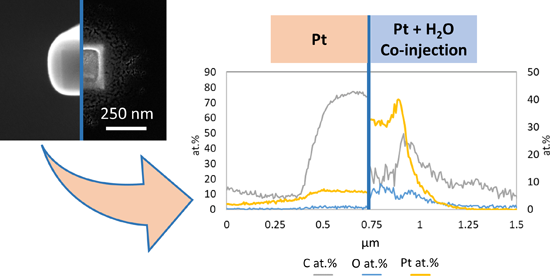
- [16]. One of the most widely used FEBID gaseous precursors is trimethyl(methylcyclopentadienyl)platinum(IV) (MeCpPtMe3), which, under standard deposition conditions, leads to the deposition of a material that consists of around 15 atom % Pt, with the rest of the material consisting of an amorphous
- carbon matrix [15][17][18]. Variation of deposition conditions [15] and post-deposition purifications [18][19][20][21] have all led to an increased Pt content in the deposits, but a straightforward method of obtaining pure material is still a challenge. However, Shawrav et al. [22] managed to deposit
- pure gold structures in a single process step using the co-injection of the precursor Au(tfac)Me2 and water. This inspired the present work, in which we aim for the direct deposition of high-purity Au and Pt nanostructures achieved through the co-injection of water and the precursors Au(acac)Me2 and


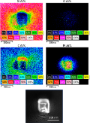

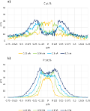
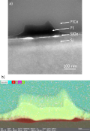


Level set simulation of focused ion beam sputtering of a multilayer substrate
Beilstein J. Nanotechnol. 2024, 15, 733–742, doi:10.3762/bjnano.15.61
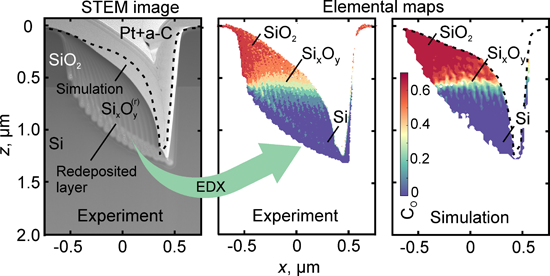
- beam workstation Helios Nanolab 650. Both types of test structures were fabricated using 30 kV accelerating voltage and an ion beam current of I = 900 pA. The chamber pressure was not higher then 10−6 mbar. A layer of platinum and amorphous carbon (Pt + a-C) was deposited onto the manufactured

![[Graphic 55]](/bjnano/content/inline/2190-4286-15-61-i68.svg?max-width=637&scale=1.18182)


Elastic modulus of β-Ga2O3 nanowires measured by resonance and three-point bending techniques
Beilstein J. Nanotechnol. 2024, 15, 704–712, doi:10.3762/bjnano.15.58
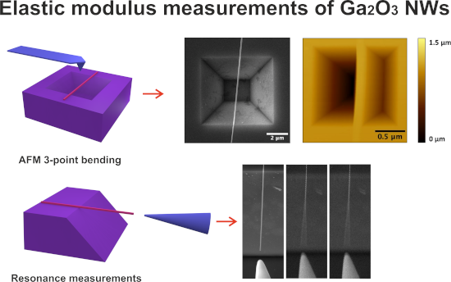
- suggests that the NW maintains a consistent horizontal alignment without deviating from a straight path throughout the observed region. Furthermore, to confirm the secure attachment of the NW to the substrate, seven NWs were “welded” to the substrate in SEM by Pt deposition using a gas injection system


Laser synthesis of nanoparticles in organic solvents – products, reactions, and perspectives
Beilstein J. Nanotechnol. 2024, 15, 638–663, doi:10.3762/bjnano.15.54
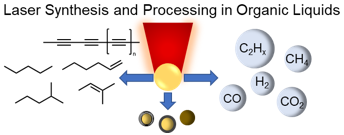
- % [68][69], while platinum surfaces are partially oxidized with 20–73% [70][92], and nickel particles are completely oxidized [70]. This was further investigated by Kalus et al., who ablated seven different metals (Au, Pt, Ag, Cu, Fe, Ti, and Al) in water while quantifying the formed hydrogen and oxygen
- Pt (and Cu) was superior compared to that of the other metals (Figure 3d,e) because of surface-catalytic reactions of the metal [51]. In summary, the total water decomposition products formed during ablation increase for less noble metals, which in turn form higher fractions of surface oxide because
- and the hydroxyl group forms the initial Au–H adduct needed for the catalytic reaction. Other alcohols, such as methanol or propanol, did not lead to carbyne formation during the experiments [139]. Condorelli et al. were able to synthesize carbon-encapsulated Pt nanoparticles by RLAL of graphite in a





Directed growth of quinacridone chains on the vicinal Ag(35 1 1) surface
Beilstein J. Nanotechnol. 2024, 15, 556–568, doi:10.3762/bjnano.15.48
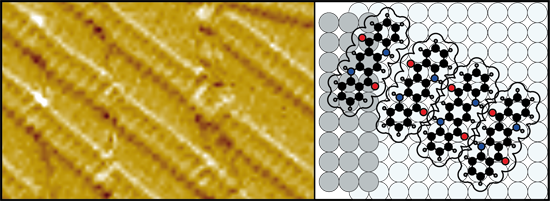
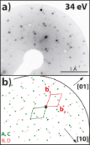
- LEED measurements were performed at 300 K with beam currents below 10 nA and electron energies (E) between 30 and 200 eV. Note that the reported diffraction patterns are distorted due to the MCP geometry. All STM images were recorded at room temperature. As a tip, we used a self-cut Pt/Ir (90:10) wire


On the additive artificial intelligence-based discovery of nanoparticle neurodegenerative disease drug delivery systems
Beilstein J. Nanotechnol. 2024, 15, 535–555, doi:10.3762/bjnano.15.47
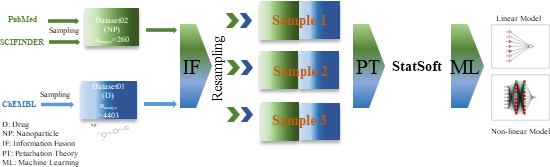
- N2D3S activity compared to assayed NDDs makes AI/ML analysis challenging. In this work, the IFPTML technique, which combines information fusion (IF), perturbation theory (PT), and machine learning (ML), was employed to address this challenge. Initially, we conducted the fusion into a unified dataset
- theory (PT) + machine learning (ML) algorithm [40]. In recent investigations, the IFPTML model has shown to be a powerful tool in molecular sciences and NDD research for the analysis of big datasets that include both structural and non-structural parameters. Application examples are drug screening
- donor atoms from P_VSA-like descriptors), Dn17 = Vxcoat (McGowan volume), Dn18 = VvdwMGcoat (van der Waals volume from McGowan volume), Dn19 = VvdwZAZcoat (van der Waals volume from the Zhao–Abraham–Zissimos equation), and Dn20 = PDIcoat (packing density index). PT data preprocessing Apart from the




Sidewall angle tuning in focused electron beam-induced processing
Beilstein J. Nanotechnol. 2024, 15, 447–456, doi:10.3762/bjnano.15.40
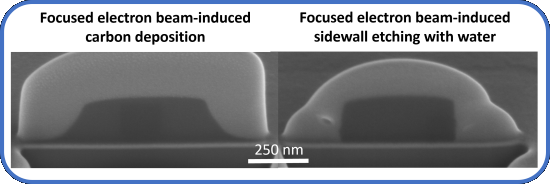
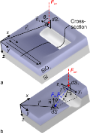
- hundred nanometres. The SE image of the resultant structure is shown in Figure 8b. The deposit was then covered with a protective layer of Pt/C as before, and a cross section was made using a FIB (Figure 8c), clearly demonstrating the creation of vertical sidewalls. Conclusion A new technique combining
- precursor flux were carefully selected, as they were found to influence the process significantly (see Supporting Information File 1, sections S2 and S3). The cross-sectional profiles were obtained by FIB milling. Deposits were first covered with a protective Pt/C cover, at least 1.5 μm thick, by FEBID from
- substrate with a 20 nm gold–palladium layer and a 5 nm titanium adhesion layer. The line was patterned in 500 passes with a dwell time of 500 µs, using a 5 keV beam and 100 pA current with a defocus of 100 nm. Prior to the FIB milling the line was covered with a protective layer of FEBID Pt/C from the




Unveiling the nature of atomic defects in graphene on a metal surface
Beilstein J. Nanotechnol. 2024, 15, 416–425, doi:10.3762/bjnano.15.37
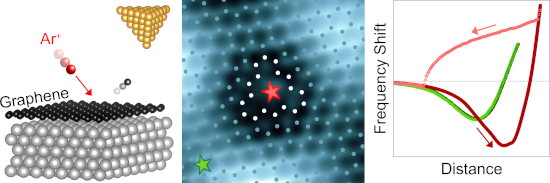
- on Pt(111) [14], and SiC() [16]. These resonances were interpreted as a collective excitation of the graphene π orbitals near the void [54], which depends on the coupling of the C atoms to the substrate surface. Therefore, the graphene–surface hybridization plays an important role in the occurrence
- of this resonance. Indeed, the resonance was not observed at all graphene defects on Pt(111). At some sites, it was quenched because of an increased interaction between the defect and the metal [55]. Therefore, the absence of a similar resonance in dI/dV spectra of graphene defects on Ir(111) may be
- due to an increased graphene–metal interaction compared with Pt(111), although both graphene–metal hybrid structures belong to the weak-hybridization regime [43]. Another rationale is the deviation of the observed defects 1 and 2 from a monatomic vacancy site, which will further be explored in the


Classification and application of metal-based nanoantioxidants in medicine and healthcare
Beilstein J. Nanotechnol. 2024, 15, 396–415, doi:10.3762/bjnano.15.36
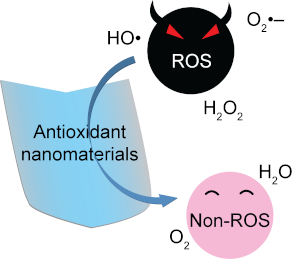
- Co-doped Fe3O4 nanozymes [108], WS2, MoSe2, WSe2 nanosheets [109], carbogenic nanozymes [110], and Pt/CeO2 nanozymes [111][112] also showed excellent RNS scavenging capability. Table 2 gives an overview of experiments using antioxidant nanomaterials for the treatment of oxidative stress-related


Controllable physicochemical properties of WOx thin films grown under glancing angle
Beilstein J. Nanotechnol. 2024, 15, 350–359, doi:10.3762/bjnano.15.31
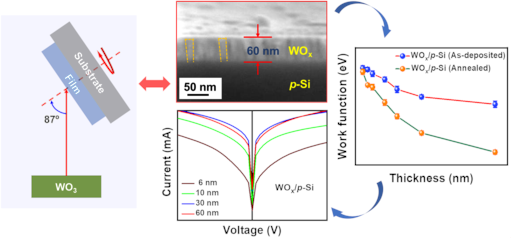
- measurements, a conductive tip (Ti/Pt coated) having a resonance frequency of approx. 70 kHz, a stiffness of approx. 2 N·m−1, and a radius of curvature of approx. 30 nm was used for KPFM measurements. To examine the uniformity in work function values of each film, different regions on the sample surface were


Exploring the relationships between physiochemical properties of nanoparticles and cell damage to combat cancer growth using simple periodic table-based descriptors
Beilstein J. Nanotechnol. 2024, 15, 297–309, doi:10.3762/bjnano.15.27
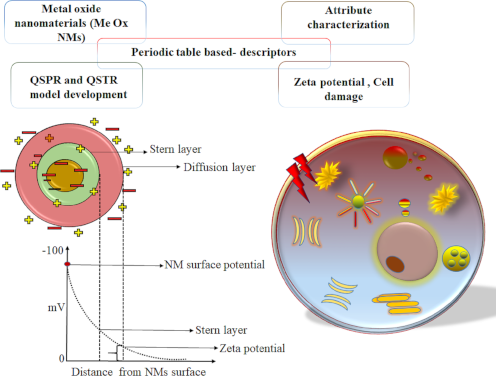
- toxicity modeling. Quantitative values of chemical features (descriptors) play a significant role in determining the target endpoint. Therefore, in this study, we have calculated periodic table-based descriptors (PT descriptors) for calculating the relevant features contributing to the respective property
- and toxicity endpoint. Physicochemical features encoding the information of MeOx NPs into PT descriptors were used to build prediction models for zeta potential and cytotoxicity (cell damage). The basic information of MeOx NPs was directly taken from the periodic table and some were calculated with
- the Elemental Descriptor Calculator software available from (https://sites.google.com/jadavpuruniversity.in/dtc-lab-software/other-dtc-lab-tools?authuser=0), termed first-generation periodic table descriptors. Also, second-generation PT descriptors were calculated using relevant formulas [28]. These


Ultrasensitive and ultrastretchable metal crack strain sensor based on helical polydimethylsiloxane
Beilstein J. Nanotechnol. 2024, 15, 270–278, doi:10.3762/bjnano.15.25
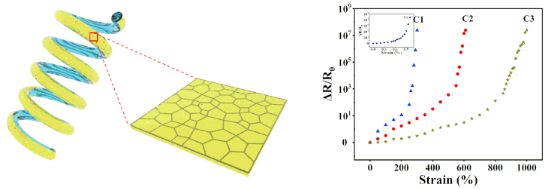
- %. Similarly, Kim et al. propose an approach incorporating a superaligned carbon nanotube sheet between a sensory metal film and an elastomer substrate, resulting in excellent and well-balanced strain sensing performance [26]. This characteristic imparts significant stretchability (ε = 100%) to the Pt crack


Vinorelbine-loaded multifunctional magnetic nanoparticles as anticancer drug delivery systems: synthesis, characterization, and in vitro release study
Beilstein J. Nanotechnol. 2024, 15, 256–269, doi:10.3762/bjnano.15.24
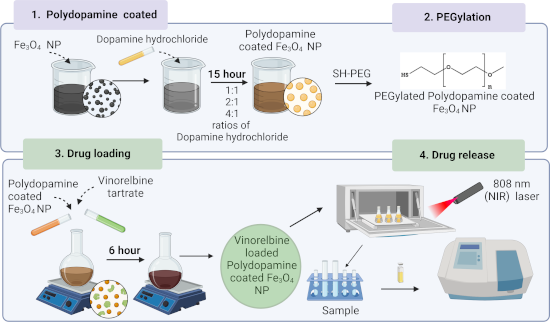
- for pH 5.5 and 7.4. Furthermore, the cumulative drug release percentages of VNB/PDA/Fe3O4 NPs prepared with different ratios were compared to investigate the effect of the PDA ratio on VNB drug release. where Pt is the percentage release at time t and P(t–1) is the previous percentage release


Design, fabrication, and characterization of kinetic-inductive force sensors for scanning probe applications
Beilstein J. Nanotechnol. 2024, 15, 242–255, doi:10.3762/bjnano.15.23
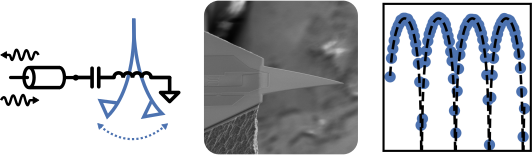
- microscopy (SPM), the tip plays a fundamental role in the achievable lateral resolution of the image. The focused electron-beam induced deposition (FEBID) [34] technique has been adapted to fabricate tips for SPM, for example, to enhance commercial platinum–iridium alloy (Pt-Ir)-coated conductive tips [35
- ], or to realize laterally grown high-aspect ratio nanopillars [36]. We realize sharp, vertically grown conductive tips at the apex of the Si-N cantilever using FEBID with a Pt precursor gas. Figure 6 shows the resulting structure. We obtain the conical shape by stacking multiple depositions with



Graphene removal by water-assisted focused electron-beam-induced etching – unveiling the dose and dwell time impact on the etch profile and topographical changes in SiO2 substrates
Beilstein J. Nanotechnol. 2024, 15, 190–198, doi:10.3762/bjnano.15.18
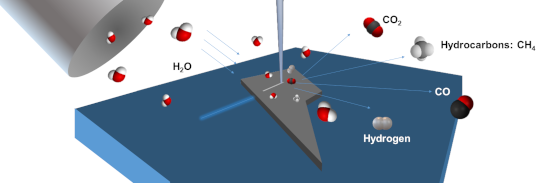
- reactions between H2O molecules and silica could occur, especially in the post-purification of granular materials composed of noble metals, such as Pt–C or Au–C which are directly deposited onto Si or SiO2 substrate. Experimental Sample preparation For this experiment, we chose mechanically exfoliated


In situ optical sub-wavelength thickness control of porous anodic aluminum oxide
Beilstein J. Nanotechnol. 2024, 15, 126–133, doi:10.3762/bjnano.15.12
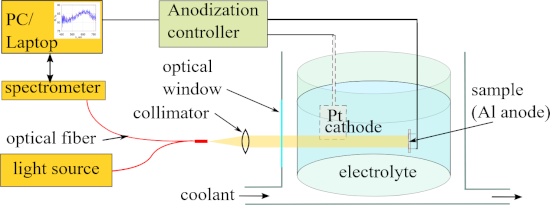
- other anodization voltages. The current flow through the Pt cathode could be established or interrupted automatically through a relay switch triggered by the thickness measurement software upon reaching the predefined threshold value. The anode current was monitored using a current-to-voltage (I/U


New application of bimetallic Ag/Pt nanoplates in a colorimetric biosensor for specific detection of E. coli in water
Beilstein J. Nanotechnol. 2024, 15, 95–103, doi:10.3762/bjnano.15.9
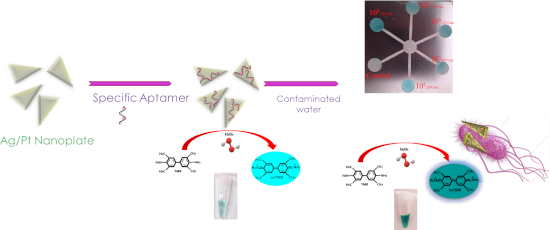
- detection is described using a silver/platinum nanoplate (Ag/Pt NPL) that interacts with an oligonucleotide aptamer as a bioreceptor. The size of the Ag/Pt NPLs was about 42 nm according to the FE-SEM images. The EDS result indicates that a thin layer of Pt ions was coated on the surface of the Ag NPLs
- . This nanobiosensor has the ability to specifically bind to E. coli, increasing the peroxidase activity of the apt-Ag/Pt NPL. Finally, the blue color of the solution in the contaminated water samples was increased in the presence of 3,3′,5,5′-tetramethylbenzidine (TMB) as a substrate and H2O2. The assay
- nanoparticles (i.e., silver nanoplates, Ag NPLs) covered with a layer of Pt atoms to improve the peroxide activity of NPLs, and use them as colorimetric biosensor materials. Metallic NPLs were employed in a variety of applications, including antibacterial activity [17][18][19], hazardous dye removal [20


Determination of the radii of coated and uncoated silicon AFM sharp tips using a height calibration standard grating and a nonlinear regression function
Beilstein J. Nanotechnol. 2023, 14, 1200–1207, doi:10.3762/bjnano.14.99
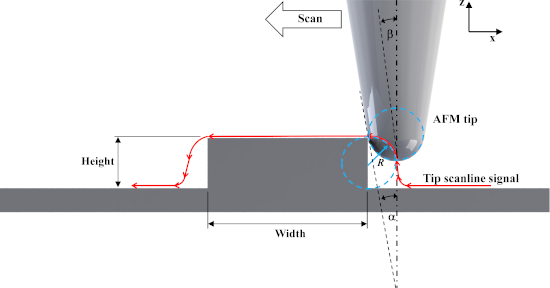
- do not know the exact values of the AFM tip radius. There are many techniques of in situ measurements for determining the actual AFM tip radius, but they are limited to uncoated tips. This paper presents an alternative and simple method to determine the radii of coated tips and an uncoated tip. Pt
- strongly depend on the geometry of the AFM tip [7][8]. For example, the Pt-coated HQ:NSC18/Pt tip (for electrical force modulation AFM probes) and the Cr/Au-coated HQ:NSC16/Cr-Au tip (for tapping mode AFM probes with long AFM cantilever) produced by MikroMasch [9] have estimated nominal tip radii lower
- . AFM Tips and Calibration Standard Grating Three types of AFM sharp tips were used, namely a Pt-coated tip (HQ:NSC18/Pt, nominal radius < 30 nm for electrical, force modulation AFM; Figure 1a), a Cr/Au-coated tip (HQ:NSC16/Cr-Au, nominal radius < 35 nm for tapping mode AFM; Figure 1b), and an uncoated


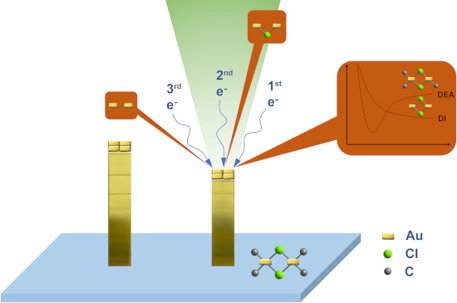
A combined gas-phase dissociative ionization, dissociative electron attachment and deposition study on the potential FEBID precursor [Au(CH3)2Cl]2
Beilstein J. Nanotechnol. 2023, 14, 1178–1199, doi:10.3762/bjnano.14.98
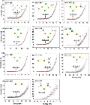
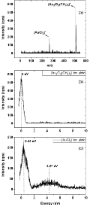
- of magnitude for DI and DEA of the FEBID precursor Co(CO)3(NO) [49][50] and Pt(PF3)4 [51], the reactive area of this monolayer is 0.15 μm2. Statistically, this implies approx. 300 reactive incidents per molecule if the cross section is assumed to stay unchanged. This is clearly not a quantitative
- , and studies on the gold(I) precursors AuXL (L = P(NMe2)3, PMe3, CNMe, CNt-Bu, P(OCH2CF3)3; X = Cl, Br, I) [52], and on Ru(CO)4I2 [31], Ru(η3-C3H5)(CO)3X (X = Cl, Br) [48][53][54], Pt(NH3)2Cl2 [55][56], and Pt(CO)2X2 (X = Cl, Br) [57][58][59][60][61] have been reported. These include post-deposition
- purification studies [62][63], thin layer exposure to electrons at approx. 500 eV [64][65], gas-phase studies under single collision condition [28][66], and FEBID under HV and UHV conditions [30][60]. Most noticeably, platinum precursors Pt(CO)2X2 (X = Cl, Br) have been studied with respect to FEBID and their



Spatial variations of conductivity of self-assembled monolayers of dodecanethiol on Au/mica and Au/Si substrates
Beilstein J. Nanotechnol. 2023, 14, 1169–1177, doi:10.3762/bjnano.14.97
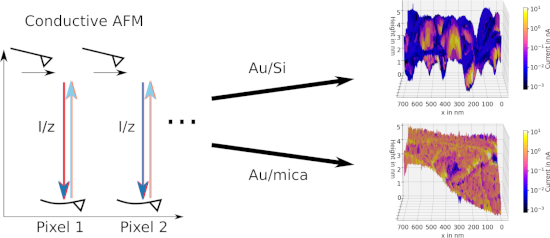
- /mica, Bruker MESP-V2 (CoCr-coated Si) probes were used, whereas, for the remaining measurements, Rocky Mountain Nanotechnology RMN-25PT300B probes with solid Pt wire as tips were used. The latter have the advantage that they do not oxidize easily and remain conductive, as there is no fragile metal


A multi-resistance wide-range calibration sample for conductive probe atomic force microscopy measurements
Beilstein J. Nanotechnol. 2023, 14, 1141–1148, doi:10.3762/bjnano.14.94
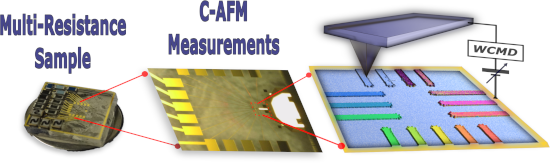
- arms would help reduce surface contamination-related issues. Consequently, measuring the lowest resistance values would become accessible using low-resistance metallic probes (e.g., Pt-coated or full bulk Pt probes). However, using such probes will require limiting the current (typically 100 µA) to


Dual-heterodyne Kelvin probe force microscopy
Beilstein J. Nanotechnol. 2023, 14, 1068–1084, doi:10.3762/bjnano.14.88
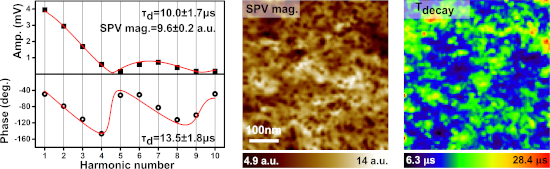
- ), driven by a Mimea scanning probe microscope (SPM) controller (SPECS-Nanonis). Topographic imaging is performed in FM mode (FM-AFM) in the attractive regime, with negative frequency shifts of a few Hz and vibration amplitudes of a few tens of nm. All experiments were performed with Pt/Ir coated silicon