


Search results
Search for "cross-linking" in Full Text gives 133 result(s) in Beilstein Journal of Nanotechnology.
Internalization mechanisms of cell-penetrating peptides
Beilstein J. Nanotechnol. 2020, 11, 101–123, doi:10.3762/bjnano.11.10
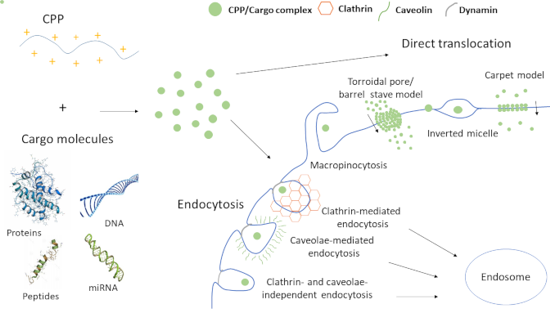
- cargo by chemical cross-linking or by cloning, followed by the expression of a CPP fusion protein. Such interactions have been seen in several CPPs such as TAT derivatives, penetratin or polyarginines [10]. It seems that covalent modification is most suitable for charge-neutral oligonucleotides such as


Simple synthesis of nanosheets of rGO and nitrogenated rGO
Beilstein J. Nanotechnol. 2020, 11, 68–75, doi:10.3762/bjnano.11.7
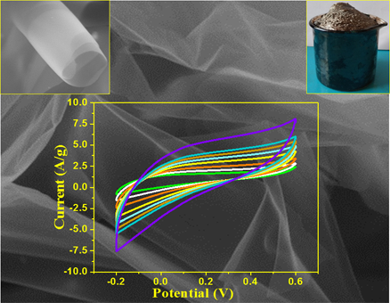
- –C–O–C– functional groups. At a temperature of 475 °C in a pre-heated muffle furnace, within a short period of time, sucrose undergoes covalent cross-linking reactions yielding the formation of C–C and C=C bonds through the removal of water and CO2. It is finally converted into a lightweight fluffy
- °. Therefore, the obtained product can be considered to be reduced graphene oxide. Similarly, glycine also undergoes a cross-linking reaction with the removal of CO2 and H2O leading to the formation of nitrogen-doped reduced graphene oxide nanosheets. For comparison we have also synthesized rGO sheets at 400


Fully amino acid-based hydrogel as potential scaffold for cell culturing and drug delivery
Beilstein J. Nanotechnol. 2019, 10, 2579–2593, doi:10.3762/bjnano.10.249
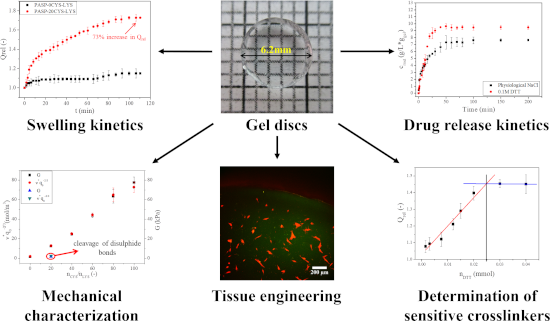
- specific chemical composition. In our previous publications, we presented the synthesis of PASP and several preparation methods of PASP-based hydrogels based on cross-linking with diaminobutane (DAB) and CYS in two-step reactions [21][22][25]. The chemical [22], swelling [13], mechanical and responsive
- this method were published previously [25][37][38]. Simultaneous cross-linking of PSI by CYS and LYS PSI was dissolved in dimethyl sulfoxide (DMSO) at a concentration of 25 wt % and mixed with the cross-linker solution, which contained cystamine dihydrochloride (CYS·2HCl) and lysine methyl ester
- dihydrochloride (LYS·2HCl) at different ratios in DMSO (Table 1). During cross-linking, the free primary amino groups of the cross-linkers react with the imide groups of the succinimide rings in a nucleophilic addition reaction (Figure 1, step 1). Dibutylamine (DBA) was added to the reaction mixture in order to


Design of a nanostructured mucoadhesive system containing curcumin for buccal application: from physicochemical to biological aspects
Beilstein J. Nanotechnol. 2019, 10, 2304–2328, doi:10.3762/bjnano.10.222
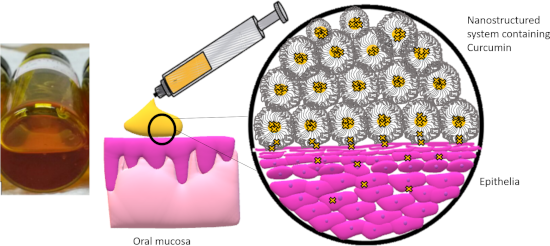
- previously for polymer blends containing P407 and other acrylic acid derivative with a similar cross-linking degree as C974P to carry hypericin [69]. In this study, the polymeric micelle relaxation due to the hydrophobic drug could explain this behavior and be related to the low yield values in the flow


Mannosylated brush copolymers based on poly(ethylene glycol) and poly(ε-caprolactone) as multivalent lectin-binding nanomaterials
Beilstein J. Nanotechnol. 2019, 10, 2192–2206, doi:10.3762/bjnano.10.212
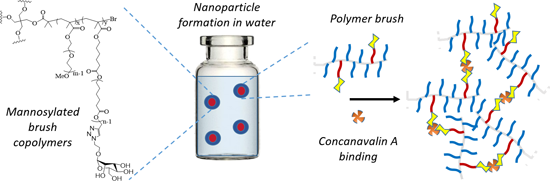
- bonds, which can indeed coordinate the copper species. Moreover, also the acetylene group can be subjected to radical addition and subsequent polymerization and cross-linking [29]. For this reason, polymerizations using PCL monomers bearing protected triple bonds were also performed [30]. However, no



Biocatalytic oligomerization-induced self-assembly of crystalline cellulose oligomers into nanoribbon networks assisted by organic solvents
Beilstein J. Nanotechnol. 2019, 10, 1778–1788, doi:10.3762/bjnano.10.173
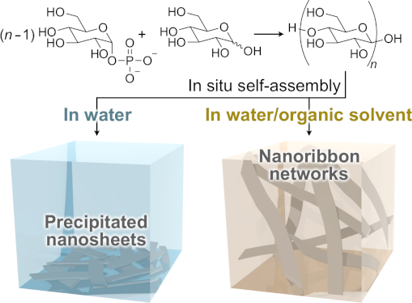
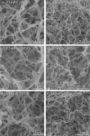
- were similar in shape to lamellar crystals of cellulose oligomers [42][52][53][54]. According to our examination, the cross-linking of the nanoribbons was apparently based on their physical contact, possibly through the hydrophobic effect and hydrogen bonding. We previously demonstrated nanoribbon





Growth dynamics and light scattering of gold nanoparticles in situ synthesized at high concentration in thin polymer films
Beilstein J. Nanotechnol. 2019, 10, 1768–1777, doi:10.3762/bjnano.10.172
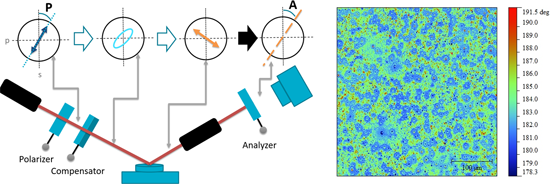
- the Au3+ ions, the annealing temperature also modifies the polymer matrix itself. It induces cross-linking mainly by interconnecting hydroxy groups of the polymer chain. This cross-linking can occur at inter- or intramolecular levels [21][22][23]. During annealing, it was also observed that the


Doxorubicin-loaded human serum albumin nanoparticles overcome transporter-mediated drug resistance in drug-adapted cancer cells
Beilstein J. Nanotechnol. 2019, 10, 1707–1715, doi:10.3762/bjnano.10.166
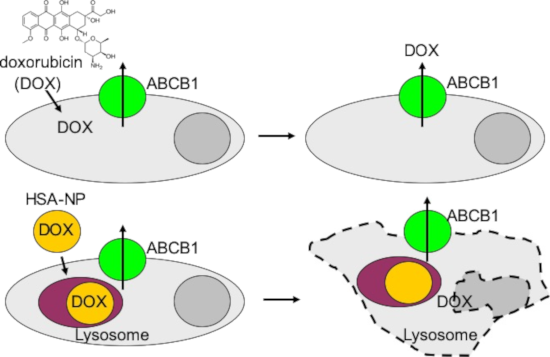
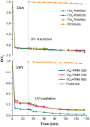
- prepared by desolvation as previously described [13][14][15][16][17]. The nanoparticles were stabilised by the cross-linking of free amino groups present in albumin. Three different nanoparticle preparations were produced using glutaraldehyde at amounts that corresponded to a theoretical cross-linking of
- 40% (HSA 40% nanoparticles), 100% (HSA 100% nanoparticles), or 200% (HSA 200% nanoparticles) of the amino groups that are available in the HSA molecules. A nonstabilised (0% cross-linking) formulation was used as a control. The resulting particle sizes and polydispersity indices are shown in Table 1
- stabilised by a 100% cross-linking degree (Figure 1). For these nanoparticles a zeta potential of −12.5 ± 1.8 mV (n = 6) was detected, indicating only a moderate stabilisation by electrostatic repulsion. While HSA (40%), HSA (100%), and HSA (200%) nanoparticles displayed similar drug loads between 152 and


Angle-dependent structural colors in a nanoscale-grating photonic crystal fabricated by reverse nanoimprint technology
Beilstein J. Nanotechnol. 2019, 10, 1211–1216, doi:10.3762/bjnano.10.120
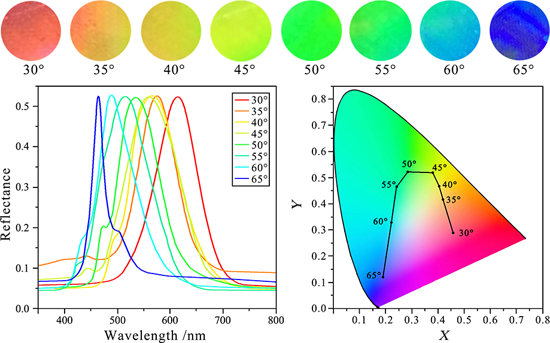
- solution was firstly poured onto the PC mould after degassing; (2) the PDMS film was fabricated through spin-coating at a speed of 500 rpm; (3) the photonic crystal was fabricated by reverse imprinting with the parameters of 0.5 MPa and 80 °C for 4 h to complete filling and cross-linking; (4) the photonic


Colloidal chemistry with patchy silica nanoparticles
Beilstein J. Nanotechnol. 2018, 9, 2989–2998, doi:10.3762/bjnano.9.278
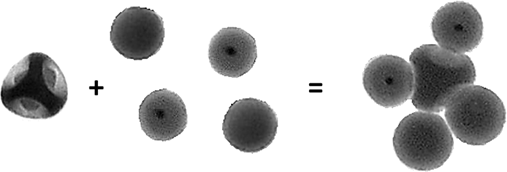
- redispersion in 20 mL DMF. We performed the amination stage by using 1013 chloromethylated patchy particles in DMF and 3 mL ethylenediamine, i.e., in large excess for minimizing cross-linking. We set the temperature at 90 °C and let the system react overnight under stirring. We washed the nanoparticles by two


Charged particle single nanometre manufacturing
Beilstein J. Nanotechnol. 2018, 9, 2855–2882, doi:10.3762/bjnano.9.266


Metal-free catalysis based on nitrogen-doped carbon nanomaterials: a photoelectron spectroscopy point of view
Beilstein J. Nanotechnol. 2018, 9, 2015–2031, doi:10.3762/bjnano.9.191
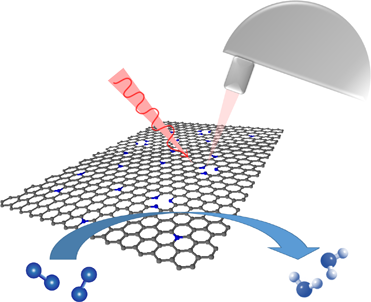
- atom %. Above this threshold cross-linking between the layers starts to occur and an sp3-coordination of carbon begins to occur [95]. At intermediate concentrations, the system is stabilized by nitrogen saturation of edges and vacancies, implicating an increasing content of pyridinic N compared to




Defect formation in multiwalled carbon nanotubes under low-energy He and Ne ion irradiation
Beilstein J. Nanotechnol. 2018, 9, 1951–1963, doi:10.3762/bjnano.9.186
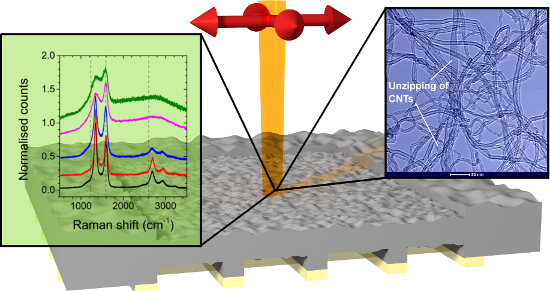
- + irradiation was used to weld MWCNTs with the objective to create electronic connections between different tubes for CNT junctions [6]. Similarly, He+ irradiation has been used to interconnect double-wall carbon nanotubes (DWCNTs) by cross-linking in order to form a multiscale-structured composite with
- structure of MWCNT is preserved indicating that the structural damage is generally low. Occasionally, in Ne+ irradiation of thin areas, some larger structures (as indicated by arrows in Figure 3D) are observed suggesting possible local unzipping or damaging of MWCNT. Cross-linking between different MWCNTs



Preparation of micro/nanopatterned gelatins crosslinked with genipin for biocompatible dental implants
Beilstein J. Nanotechnol. 2018, 9, 1735–1754, doi:10.3762/bjnano.9.165
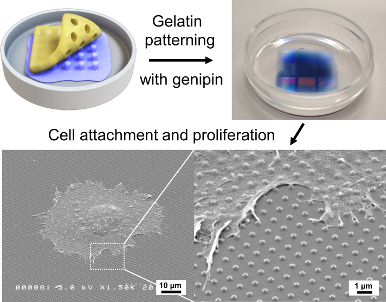
- was gently pressed onto the gelatin/genipin mixture. We found that it was important that the viscosity of the solution not be too high, as excessive cross-linking can occur (Figure 11a). In order for continuous crosslinking to occur, the mixture was incubated at 100% humidity in order to avoid drying








Nanocomposites comprised of homogeneously dispersed magnetic iron-oxide nanoparticles and poly(methyl methacrylate)
Beilstein J. Nanotechnol. 2018, 9, 1613–1622, doi:10.3762/bjnano.9.153
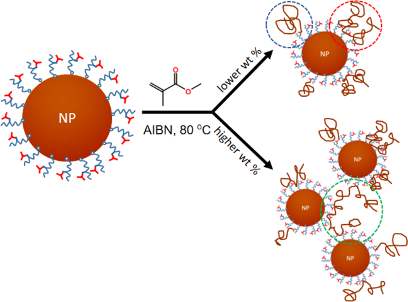
- , the last one is the most dependent on the concentration of NP-MMA and can even lead to cross-linking. The relative occurrence of this event should have a major influence on the colloidal stability of the NP-PMMA suspension and the hydrodynamic size of the NP-PMMA. The gel properties of the suspension


Closed polymer containers based on phenylboronic esters of resorcinarenes
Beilstein J. Nanotechnol. 2018, 9, 1594–1601, doi:10.3762/bjnano.9.151
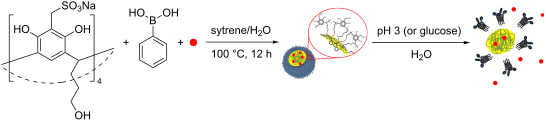
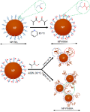
- National Research Technical University, K. Marx str. 10, Kazan 420111, Russia A. M. Butlerov Institute of Chemistry, Kazan Federal University, Kremlevskaya str. 18, Kazan 420008, Russia 10.3762/bjnano.9.151 Abstract Novel polymer nanospheres (p(SRA-B)) were prepared by cross-linking a sulfonated
- within three hours of dialysis (Table 2, Figure 4). Conclusion Closed polymer nanoparticles p(SRA-B) were successfully prepared by cross-linking sulfonated resorcinarene (SRA) with phenylboronic acid (BA). p(SRA-B) exhibits good stability over a wide range of pH (6–12). In acidic media, p(SRA-B


Evaluation of replicas manufactured in a 3D-printed nanoimprint unit
Beilstein J. Nanotechnol. 2018, 9, 1573–1581, doi:10.3762/bjnano.9.149
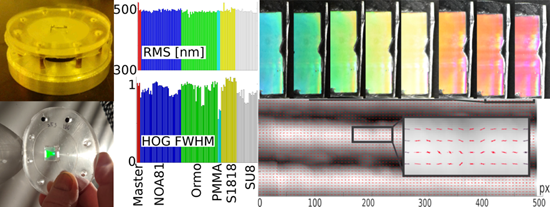
- a prebaking step prior to imprinting. Solvent complicates the manipulation of the material, yet SU8 is attractive because of its ample use for the fabrication of optical microdevices. SU8 is UV-curable and the working wavelength for cross-linking the uncured polymer is 355 nm. S1818: A positive


New 2D graphene hybrid composites as an effective base element of optical nanodevices
Beilstein J. Nanotechnol. 2018, 9, 1321–1327, doi:10.3762/bjnano.9.125
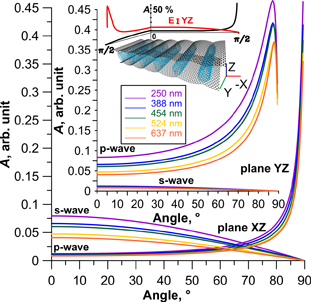
- absorbed by the film induces electron transport of 105 electrons, and the response time amounts to ca. 100 microseconds [9]. It should be noted that modern synthesis technologies for such composites have allowed us to provide “cross-linking” between CNTs and graphene during synthesis without further


Heterostuctures of 4-(chloromethyl)phenyltrichlorosilane and 5,10,15,20-tetra(4-pyridyl)-21H,23H-porphine prepared on Si(111) using particle lithography: Nanoscale characterization of the main steps of nanopatterning
Beilstein J. Nanotechnol. 2018, 9, 1211–1219, doi:10.3762/bjnano.9.112
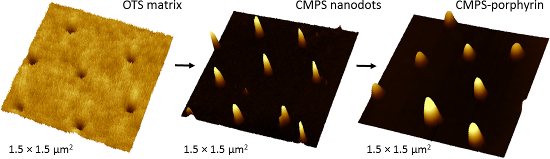
- exposed nanoholes of Si(111). Spatial confinement facilitated the growth of CMPS layers in the vertical direction, which was produced by cross-linking to form intramolecular siloxane bonds. Spatial selectivity for the preparation of heterostructures of CMPS and H2TPyP Heterostructures of CMPS-porphyrin


Photocatalytic and adsorption properties of TiO2-pillared montmorillonite obtained by hydrothermally activated intercalation of titanium polyhydroxo complexes
Beilstein J. Nanotechnol. 2018, 9, 364–378, doi:10.3762/bjnano.9.36
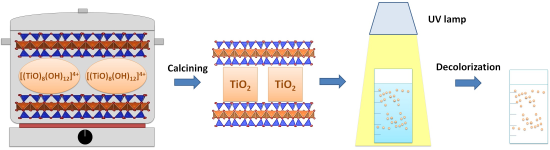
- formation of cross-links between pillars and silicate layers to give the Ti–O–Si bonds, which constrain the electron–hole recombination [55]. According to this logic, the larger the crystallites of TiO2, the greater the number of cross-linking bonds and the higher the photocatalytic activity of pillars






The nanofluidic confinement apparatus: studying confinement-dependent nanoparticle behavior and diffusion
Beilstein J. Nanotechnol. 2018, 9, 301–310, doi:10.3762/bjnano.9.30
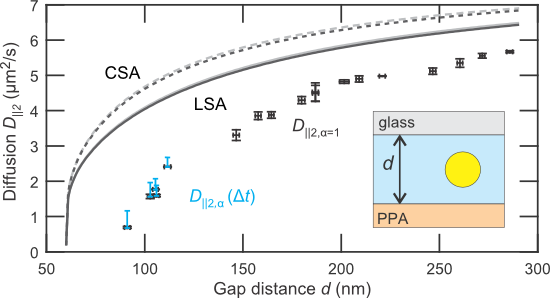
- cleaned by peeling off a polymer layer (Red First Contact, Photonic Cleaning Technologies), in a helium plasma (Piezobrush, Relyon Plasma) for 20 s and by rinsing with ultrapure water (Millipore, 18 MΩ cm). A 52 ± 1 nm thick cross-linking polymer (HM8006, JSR) was spin coated onto a silicon sample to



Humidity-dependent wound sealing in succulent leaves of Delosperma cooperi – An adaptation to seasonal drought stress
Beilstein J. Nanotechnol. 2018, 9, 175–186, doi:10.3762/bjnano.9.20
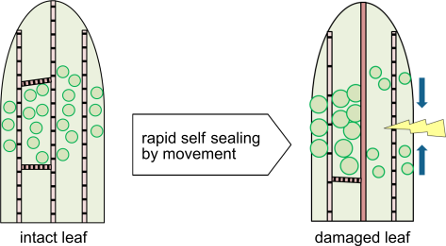
- , reversible cross-linking) are involved, a transfer to technology is especially promising. However, if biological mechanisms such as metabolism-driven modifications (e.g., biosynthesis, cell proliferation) are present, the technical application is much more difficult. A clear distinction must also be made


The role of ligands in coinage-metal nanoparticles for electronics
Beilstein J. Nanotechnol. 2017, 8, 2625–2639, doi:10.3762/bjnano.8.263
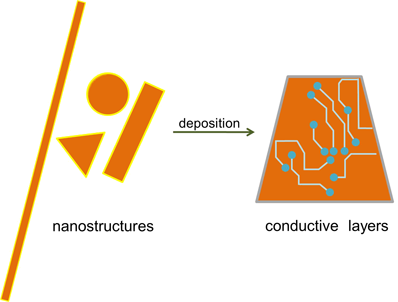
- properties of the resulting film, the morphology of particle films, and the nature of the interfaces. The effects of the ligands on sintering, cross-linking, and self-assembly of particles in electronic materials are discussed. Keywords: conductivity; inks; layers; ligands; nanoparticles; Introduction
- , and during deposition, where they may affect self-assembly, cross-linking, or sintering. The effects of ligands at all stages have implications on the electrical properties of the final particle-based materials. Finally, we review first reports on ligands in electrically conductive composites of
- by gold nanoparticles to create interconnected gold-nanoparticle assemblies with a homogeneous coverage and a film conductivity of 4.2 × 10⁻³ S/cm [118]. Cross-linking works for particles that are not prepared in liquids, too. A discontinuous film of gold was evaporated onto a mica substrate and


Amplified cross-linking efficiency of self-assembled monolayers through targeted dissociative electron attachment for the production of carbon nanomembranes
Beilstein J. Nanotechnol. 2017, 8, 2562–2571, doi:10.3762/bjnano.8.256
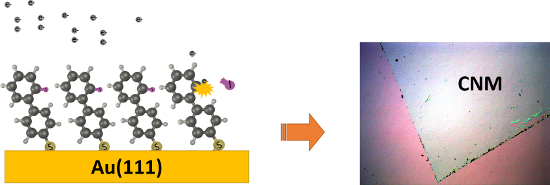
- spectroscopy (XPS), to determine whether the high relative DEA cross section for iodide loss from 2-I-BPT as compared to 2-Br-BP and 2-Cl-BP is reflected in the cross-linking efficiency of SAMs made from these materials. Such sensitization could reduce the electron dose needed for the cross-linking process and
- may thus lead to a significantly faster conversion of the respective SAMs into carbon nanomembranes (CNMs) without the need for an increased current density. XPS data support the notation that DEA sensitization may be used to achieve more efficient electron-induced cross-linking of SAMs, revealing
- more than ten times faster cross-linking of 2-I-BPT SAMs compared to those made from the other halogenated biphenyls or from native BPT at the same current density. Furthermore, the transfer of a freestanding membrane onto a TEM grid and the subsequent investigation by helium ion microscopy (HIM


Identifying the nature of surface chemical modification for directed self-assembly of block copolymers
Beilstein J. Nanotechnol. 2017, 8, 1972–1981, doi:10.3762/bjnano.8.198
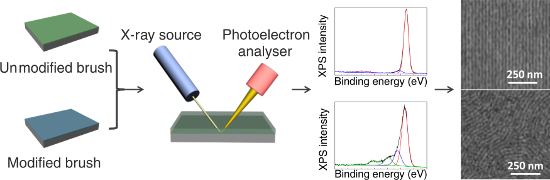
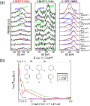
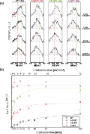
- sample (discontinuous black line), which shows a narrow peak centered at 284.4 eV, characteristic of sp2 bonding. Such increase in sp2 bonding is in line, although not a direct proof, with the cross-linking of PS due to electron beam exposure, as has been reported in the literature [22][23]. This
- promotes higher affinity to PMMA blocks. Electron beam exposure increases sp2 bonding, promoting higher affinity to PS blocks that might be explained by cross-linking of PS. In the case of parallel oxidation nanolithography, HAXPES provides experimental evidence of the existence of a substoichiometric





