Search results
Search for "nanotube" in Full Text gives 210 result(s) in Beilstein Journal of Nanotechnology. Showing first 200.
Multiwalled carbon nanotube based aromatic volatile organic compound sensor: sensitivity enhancement through 1-hexadecanethiol functionalisation
Beilstein J. Nanotechnol. 2019, 10, 2364–2373, doi:10.3762/bjnano.10.227
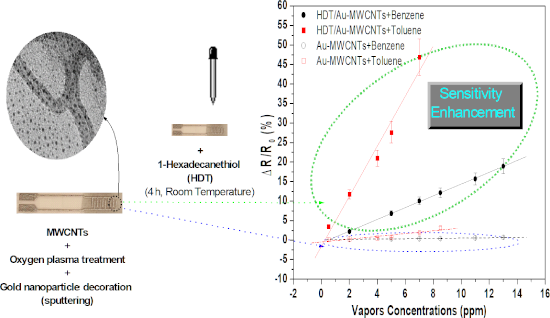
- correlated to the active sensing film/material used. Various nanomaterial-based gas sensors have been investigated to monitor the presence of aromatic VOCs. The ones mainly studied are based on metal oxides, carbon nanotubes, graphene and hybrid materials [5][6]. Carbon nanotube based gas sensors (e.g
- ., single-wall carbon nanotube (SWCNT), multiwall carbon nanotube (MWCNT), graphene, graphene oxide (GO)) present a sensitive active layer exhibiting an electrical resistance change while in contact with the target gas due to interactions at the molecular level [7][8]. These interactions, depending whether
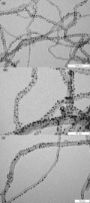
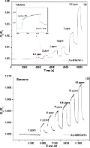
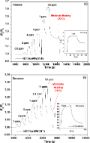
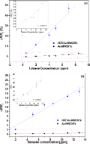
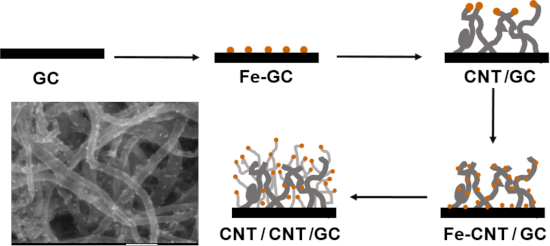
- openings efficiently [23][24]. In fact, in Figure 2a we see that CNTs with a higher number of Au nanoparticles were at the surface of the CNT mat while those showing fewer particles were deeper in the CNT film. Also, in Figure 2c, we can observe a nanotube that crosses the centre of the image where all of




Facile synthesis of carbon nanotube-supported NiO//Fe2O3 for all-solid-state supercapacitors
Beilstein J. Nanotechnol. 2019, 10, 1923–1932, doi:10.3762/bjnano.10.188
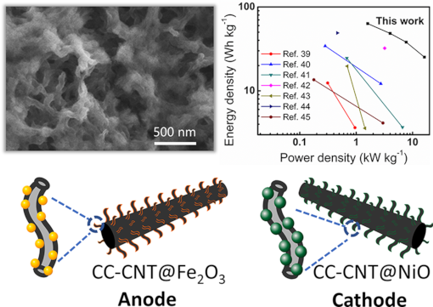
- carbon cloth–carbon nanotube@metal oxide (CC-CNT@MO) three-dimensional structures combine the high specific capacitance and rich redox sites of metal oxides with the large specific area and high electrical conductivity of carbon nanotubes. The prepared CC-CNT@Fe2O3 anode reaches a high capacity of 226


Nanoarchitectonics meets cell surface engineering: shape recognition of human cells by halloysite-doped silica cell imprints
Beilstein J. Nanotechnol. 2019, 10, 1818–1825, doi:10.3762/bjnano.10.176
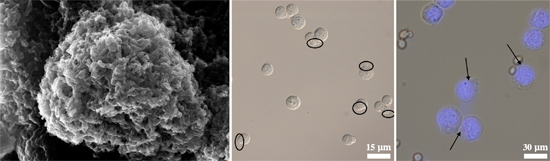
- fillers, drug-delivery vehicles and tissue engineering scaffolds [27]. Halloysite nanotubes derived from various geological deposits differ in their mesoscopic structures [28], allowing to choose the clay nanotubes most suitable for a desired application. The positively charged nanotube lumen can be


Effects of surface charge and boundary slip on time-periodic pressure-driven flow and electrokinetic energy conversion in a nanotube
Beilstein J. Nanotechnol. 2019, 10, 1628–1635, doi:10.3762/bjnano.10.158
- Economics, Hohhot, China 10.3762/bjnano.10.158 Abstract Time-periodic pressure-driven slip flow and electrokinetic energy conversion efficiency in a nanotube are studied analytically. The slip length depends on the surface charge density. Electric potential, velocity and streaming electric field are
- energy conversion in a circular nanotube are studied. To our knowledge, so far no author discussed this problem for the case of a time-periodic flow. Firstly, using the separation of variables method, the energy conversion efficiency and the analytical solutions to the governing equations are obtained
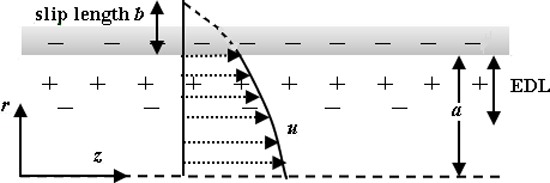
- of a symmetric binary electrolyte in a circular nanotube with surface charge-dependent slip and with radius a using a cylindrical coordinate system (r, θ, z) where the z-axis is taken to coincide with the central axis of the nanotube, as shown in Figure 1. In the present study, the radius ranges from


Chiral nanostructures self-assembled from nitrocinnamic amide amphiphiles: substituent and solvent effects
Beilstein J. Nanotechnol. 2019, 10, 1608–1617, doi:10.3762/bjnano.10.156
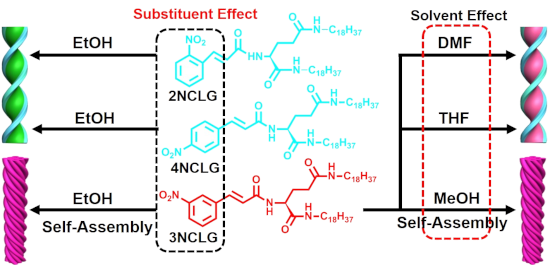
- that of those in ethanol and methanol was also related to the intermolecular hydrogen bonding. Besides, 2NCLG formed right-handed nanohelix both in DMF and THF, which is the same as in ethanol. The 4NCLG gelator formed nanotube structures both in DMF and THF, which is different from the nanohelix that




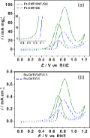
Hierarchically structured 3D carbon nanotube electrodes for electrocatalytic applications
Beilstein J. Nanotechnol. 2019, 10, 1475–1487, doi:10.3762/bjnano.10.146





Magnetic segregation effect in liquid crystals doped with carbon nanotubes
Beilstein J. Nanotechnol. 2019, 10, 1464–1474, doi:10.3762/bjnano.10.145
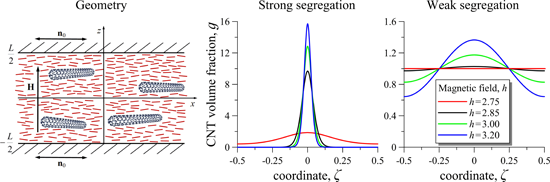
- show [28][32][33][34] that in nematic liquid crystal–carbon nanotube (NLC-CNT) mixtures additionally functionalized with ferromagnetic particles, the magneto-optical response increases in comparison with pure LC. Existing theoretical models that describe NLC-CNT suspensions are related to the mean


A biomimetic nanofluidic diode based on surface-modified polymeric carbon nitride nanotubes
Beilstein J. Nanotechnol. 2019, 10, 1316–1323, doi:10.3762/bjnano.10.130
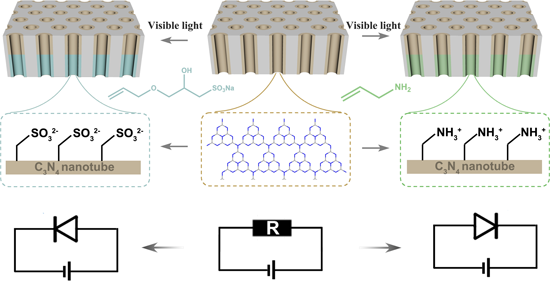
- systems and the generation of blue energy from salinity gradients [23][24]. We fabricated a carbon nitride nanotube membrane (CNNM) via an anodic aluminium oxide (AAO)-templated vapor deposition–polymerization process. Subsequently, the CNNMs were modified with 3-allyloxy-2-hydroxy-1-propanesulfonic acid
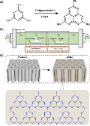
- and Discussion Fabrication of carbon nitride nanotube membrane Graphitic carbon nitride (g-CN) was chosen as it is formed from tri-s-triazine moieties interconnected via tertiary amines in a well-defined way without doping or modification, composed of only the two earth-abundant elements carbon and
- nitrogen. Moreover, it meets our requirements to fabricate negatively charged carbon nitride nanotubes and a fully condensed conjugated structure that stabilizes the π-electron system for a high charge mobility [25]. The g-CN nanotube membrane (CNNM) was fabricated through vapor deposition–polymerization


Synthesis and characterization of quaternary La(Sr)S–TaS2 misfit-layered nanotubes
Beilstein J. Nanotechnol. 2019, 10, 1112–1124, doi:10.3762/bjnano.10.111
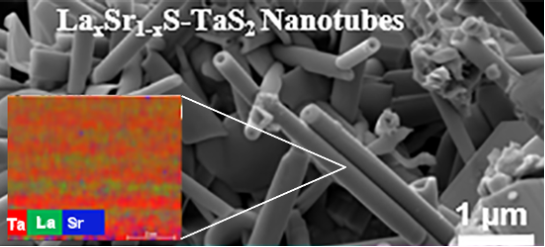
- open electrode front-illuminated CCD camera cooled to −60 °C (Syncerity, HORIBA, USA). The system utilizes an open confocal microscope (Olympus BXFM) with a spatial resolution better than 1 μm. The measurements were done with the laser beam focused on a single nanotube at a time. DFT calculations All
- left). The brighter walls and the darker hollow region are typical of a tubular morphology. The compositional map obtained from the nanotube (Figure 3 (top right)) shows that Sr is uniformly distributed in the nanotube. Elemental quantification from the EDX spectra indicates that 7–11 atom % of Sr
- substitution (93–89 atom % La) is achieved in a nanotube. The overlap of the L and Cu K lines for Ta might induce some error in quantification in the case of Ta. Also, due to the overlap of the L line for Sr and the M line for Ta, the weak Sr K line is used for mapping and quantification of Sr. Nanotubes with


Capillary force-induced superlattice variation atop a nanometer-wide graphene flake and its moiré origin studied by STM
Beilstein J. Nanotechnol. 2019, 10, 804–810, doi:10.3762/bjnano.10.80
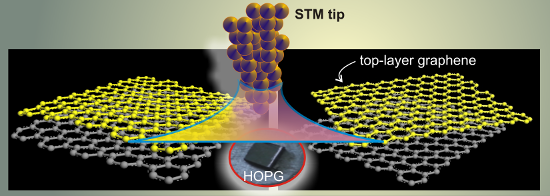
- is calculated in analogy to the energy of a collapsed carbon nanotube [17][30][49], Efold = k·a·l/2r2 where k is the curvature modulus (k = 1.4 eV for CNTs with radii smaller than 2.4 Å), a the arc length which is ≈ b = 15 nm, l the length of the curved region of 72 nm, and r the radius of curvature



Hydrophilicity and carbon chain length effects on the gas sensing properties of chemoresistive, self-assembled monolayer carbon nanotube sensors
Beilstein J. Nanotechnol. 2019, 10, 565–577, doi:10.3762/bjnano.10.58
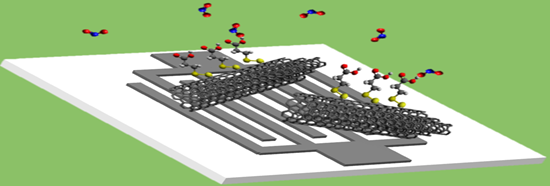
- , pristine carbon nanotubes (CNTs) present some limitations for gas sensing. For example, carbon nanotube gas sensors often suffer from slow recovery, especially when operated at room temperature, which eventually results in baseline and response drift. For that reason, it is usually necessary to heat up the
- , different carbon nanotube sensors have been reported for detecting toxic pollutants emitted from vehicle exhaust [22][23], hazardous volatile organic compounds (VOCs) [24] or chemical warfare agents (CWAs) [25][26]. Usually, these modified carbon nanotubes improve the selectivity, because the chemical
- approach, carbon nanotubes act as support and charge transport transducing elements while the recognition function is performed by grafted molecules. Two examples of this have consisted of obtaining thiol-functionalized carbon nanotube buckypapers [27] or self-assembled monolayers (SAMs) of thiol molecules


Widening of the electroactivity potential range by composite formation – capacitive properties of TiO2/BiVO4/PEDOT:PSS electrodes in contact with an aqueous electrolyte
Beilstein J. Nanotechnol. 2019, 10, 483–493, doi:10.3762/bjnano.10.49
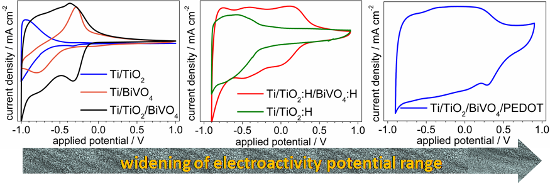
- /discharge tests were equal to jk = ja = 0.5 mA·cm−2. All values expressed by a surface containing unit are divided by the geometrical area of the electrode. Electrode preparation Titania nanotubes Titania nanotube synthesis was based on a two-stage anodization process in water/ethylene glycol (5%/95
- immersed for 12 h in 0.5 wt % aqueous solution of oxalic acid to remove the inhomogeneous layer of nanotubular TiO2. Then, the anodization procedure was repeated under the same conditions. Such a two-step procedure allows for a uniform nanotube layer to be obtained. Finally, samples were annealed at a
- . Here, we present the formation of a titania nanotube-based composite. The proposed procedure of anodization yields titania (anatase crystal structure) in the form of nanotubes. PLD was used for BiVO4 deposition on TiO2 with preservation of nanotubular morphology. An enhancement of electric-charge




Electromagnetic analysis of the lasing thresholds of hybrid plasmon modes of a silver tube nanolaser with active core and active shell
Beilstein J. Nanotechnol. 2019, 10, 294–304, doi:10.3762/bjnano.10.28
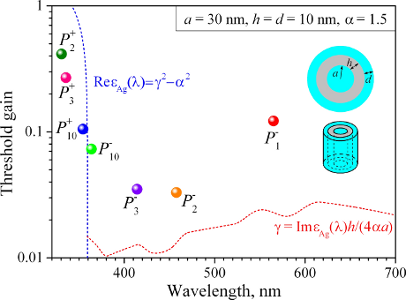
- 2RD, UK 10.3762/bjnano.10.28 Abstract Results from the electromagnetic modeling of the threshold conditions of hybrid plasmon modes of a laser based on a silver nanotube with an active core and covered with an active shell are presented. We study the modes of such a nanolaser that have their emission
- parameters of the nanotube, the core, and the shell. It is found that essentially a single-mode laser can be designed on the difference-type HLSP mode of the azimuth order m = 1, shining in the orange or red spectral region. Furthermore, the threshold values of gain for similar HLSP modes of order m = 2 and
- 3 can be several times lower, with emission in the violet or blue parts of the spectrum. Keywords: hybrid localized plasmon mode; nanolaser; nanotube; threshold; Introduction The promise of greatly enhanced light–matter interaction in nanostructured metal configurations, combined with controlled


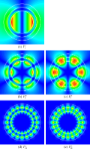
![[Graphic 29]](/bjnano/content/inline/2190-4286-10-28-i46.svg?max-width=637&scale=1.18182) λ = 565.03...
λ = 565.03...

![[Graphic 36]](/bjnano/content/inline/2190-4286-10-28-i53.svg?max-width=637&scale=1.18182) ...
...


Uniform Sb2S3 optical coatings by chemical spray method
Beilstein J. Nanotechnol. 2019, 10, 198–210, doi:10.3762/bjnano.10.18
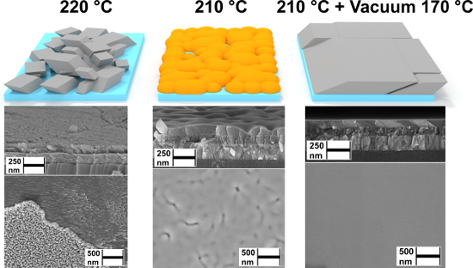
- –Weber island growth of amorphous Sb2S3 (and in some cases leaf-like grains of polycrystalline Sb2S3) have been observed in Sb2S3 layers grown by chemical bath deposition on glass [47][48], In2O3/Sn (ITO) [49], planar TiO2 [16] and TiO2 nanotube arrays [50], by sequential deposition [51] and spin coating




Wet chemistry route for the decoration of carbon nanotubes with iron oxide nanoparticles for gas sensing
Beilstein J. Nanotechnol. 2019, 10, 105–118, doi:10.3762/bjnano.10.10
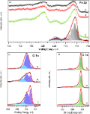
- chemical composition of the iron oxide decorated carbon nanotube samples were investigated employing transmission electron microscopy (TEM), Raman spectroscopy and X-ray photoelectron spectroscopy (XPS). The differently decorated CNT samples were used to make gas sensors for detecting nitrogen dioxide. A
- as well as the effect of ambient humidity. Experimental Materials All materials and reagents used (listed below) were of analytical grade and were used as received. COOH functionalized multiwalled carbon nanotube (MWCNTs), Nanocyl (C purity higher than 95%) Nitric acid, Scharlau (HNO3 68–70
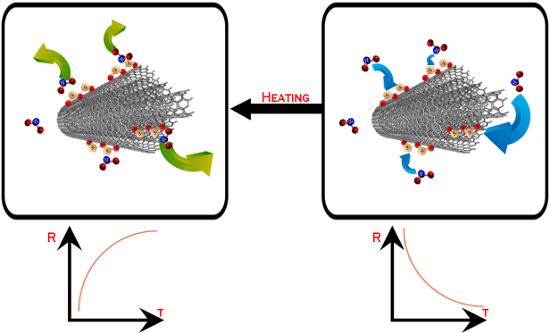
- electrical resistance against time. Nitrogen dioxide was found to strongly interact with carbon nanotube sensors, and as a result, the sensors did not fully recover their baseline resistance value during the cleaning phase, which was conducted at room temperature without heating. Applying mild heating or UV




Amorphous NixCoyP-supported TiO2 nanotube arrays as an efficient hydrogen evolution reaction electrocatalyst in acidic solution
Beilstein J. Nanotechnol. 2019, 10, 62–70, doi:10.3762/bjnano.10.6
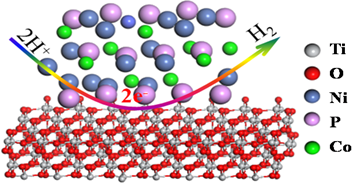
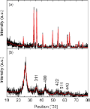
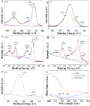
- attention due to their synergistic effect for improving the hydrogen evolution reaction as compared to monometallic phosphides. In this work, NiCoP modified hybrid electrodes were fabricated by a one-step electrodeposition process with TiO2 nanotube arrays (TNAs) as a carrier. X-ray diffraction
- unstable under acidic conditions. One effective way to improve their stability is with an appropriate support material. Compared to the nickel foam or other substrates [19][23][24], TiO2 nanotube arrays prepared by anodization are favorable for the loading of catalysts and the fast transfer of electrons
- from the electrode to the active sites owing to the large surface area and distinctive 3D well-ordered nanotube structure. Furthermore, the curved interface and confined space facilitate the formation of amorphous phases with more active catalytic sites and contribute to the stability of active




Accurate control of the covalent functionalization of single-walled carbon nanotubes for the electro-enzymatically controlled oxidation of biomolecules
Beilstein J. Nanotechnol. 2018, 9, 2750–2762, doi:10.3762/bjnano.9.257
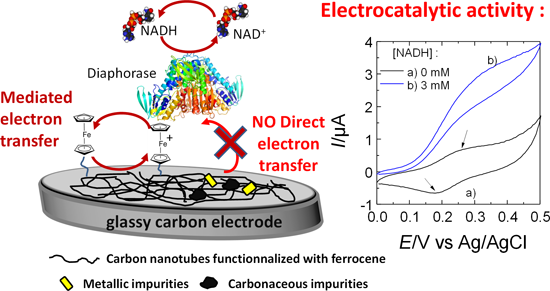
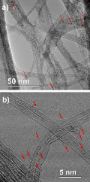
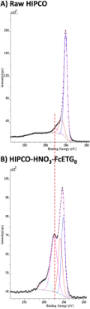
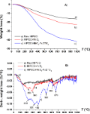
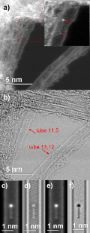
- -resolution scanning electron transmission microscopy (HRSTEM) and electron energy loss spectroscopy (EELS) analyses support that the outer tubes of the carbon-nanotube bundles were covalently grafted with FcETGn groups. This result confirms that the electrocatalytic effect observed during the oxidation of
- CNT chemistry is now well developed, it can still remain somewhat challenging depending on the quality of the nanotube sample. Indeed, if the sample contains many carbonaceous impurities, these can also be functionalized and contribute to the final electrochemical signal. Several studies have
- covalently attaching the ferrocene electron shuttle to the nanotube sidewalls. The principle of our strategy is indicated in Figure 3. Oxidation of SWCNTs using concentrated HNO3 (65% w/w, 14.3 M) or 2.5 M H2SO4, and subsequent treatment with SOCl2 were realized following the previously described protocols






Impact of the anodization time on the photocatalytic activity of TiO2 nanotubes
Beilstein J. Nanotechnol. 2018, 9, 2628–2643, doi:10.3762/bjnano.9.244
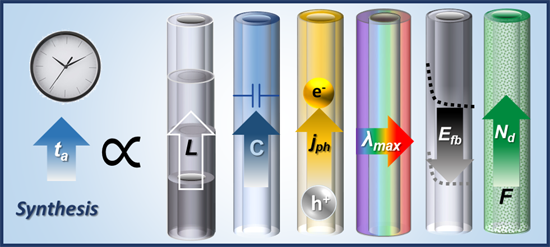
- the different nanotube lengths and/or increase of the surface area. This observation is interesting when considering that the NT layers have an inherent superhydrophilic character allowing for easy electrolyte percolation [58]. However, the electrolyte percolation mechanism of the TNTs is complicated
- the initial charging spikes and to obtain a more accurate signal. The results are shown in Figure 5b and assessing those obtained from the CV measurements, provide support to the idea of j being a function of the nanotube length. The latter characteristic implies that the electrolyte is capable of
- permeating the external and/or internal part of the nanotubes, at least to some extent, which is highly desirable for catalytic applications. Other authors have stated several observations regarding the geometrical aspects of TNTs, where the nanotube length plays an important role in the overall performance


Effective sensor properties and sensitivity considerations of a dynamic co-resonantly coupled cantilever sensor
Beilstein J. Nanotechnol. 2018, 9, 2546–2560, doi:10.3762/bjnano.9.237
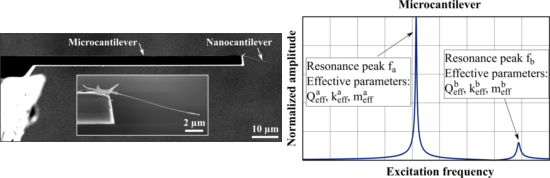
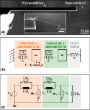
- electron microscopy image of a sensor realization consisting of a silicon microcantilever and a carbon nanotube nanocantilever. (b) Sensor’s representation by a coupled harmonic oscillator model and (c) corresponding electric circuit model. m1,2 denote the effective mass, d1,2 the damping and k1,2 the


![[Graphic 7]](/bjnano/content/inline/2190-4286-9-237-i43.svg?max-width=637&scale=1.18182) ...
...


ZnO-nanostructure-based electrochemical sensor: Effect of nanostructure morphology on the sensing of heavy metal ions
Beilstein J. Nanotechnol. 2018, 9, 2421–2431, doi:10.3762/bjnano.9.227
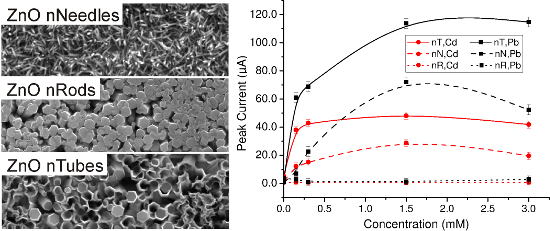
- . The sample was then removed from the solution, rinsed several times with distilled water and thermally treated at 90–110 °C for 30 min in order to remove the adsorbed water. For more detailed information see [17][18]. ZnO nanotube arrays were obtained using a self-selective etching method based on
- covalent bonding. The presence of metallic lead in the sedimentation can be explained by the electrostatic attraction between Pb2+ and ZnO nanotube defects formed in large amount during the etching process. The quantitative dependence of the concentration is also traceable: the size of the peak correlates
- improvements in nanotube adsorption rates compared to similar diameter nanorods and nanoneedles are associated with both the increase in surface area (via the formation of a cavity) and the adsorption bonds due to surface defect sites. A large number of defects can be explained by the fact that, unlike


Electrospun one-dimensional nanostructures: a new horizon for gas sensing materials
Beilstein J. Nanotechnol. 2018, 9, 2128–2170, doi:10.3762/bjnano.9.202
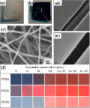
- an average diameter in the range of 60–80 nm. The compactness of these NTs increases with an increase in indium content. The response values for IZO nanotube-based sensors with different indium contents indicate that the gas response decreases with higher indium doping levels. The response sharply
- increases with increasing ethanol concentration below 100 ppm. While for the ZnO sensor, the increased rate of response slows down above 1000 ppm ethanol. The ethanol responds to the IZO with 10% dopant in the nanotube sensor. However, the undoped ZnO exhibits lower response to ethanol by about 50% [200]. α
- of pure porous α-Fe2O3 NTs (2.6). Nd-doped porous α-Fe2O3 nanotube sensors can detect 500 ppb of acetone with a response of 2.4 [207]. In2O3 1D nanostructures functionalized by Co [210], Nd [211], Eu [212], Yb [213][214], Pd [148], Mg [215], Ag [161], Er [216], V [217] and Sm [218] have shown






Metal-free catalysis based on nitrogen-doped carbon nanomaterials: a photoelectron spectroscopy point of view
Beilstein J. Nanotechnol. 2018, 9, 2015–2031, doi:10.3762/bjnano.9.191
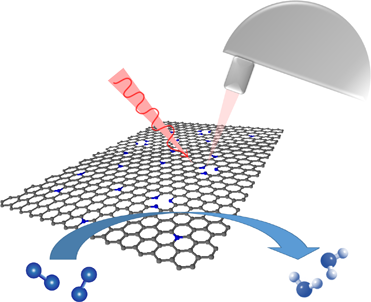
- ) energies. A quarter of the target was cut out for a better visualization. (b) Impact of an ion onto a carbon nanotube, a quasi-1D system. The excess energy is dissipated in only two directions, which may affect the temperature profile and give rise to additional defects. (c) The sketch of the electronic




Defect formation in multiwalled carbon nanotubes under low-energy He and Ne ion irradiation
Beilstein J. Nanotechnol. 2018, 9, 1951–1963, doi:10.3762/bjnano.9.186
- to experimental conditions. In this specific study the thickness of the carbon nanotube film, has a significant influence on the particle–sample interactions. For He irradiation the nuclear energy loss, which is mainly responsible for defect creation and sputtering, increases with depth up to a value
- , even for a single multiwalled carbon nanotube, the nuclear energy deposited at the bottom is not much higher than at its top. The graphs in Figure 4 have been obtained for the pristine sample. The aforementioned distributions of energy loss have an impact on the sputter yields at the top and bottom
- noble gas ion irradiation does not only cause sputtering but also the displacement of ions in the film. For the nanotube samples, they will cause damage and may lead to graphitised areas which regroup several or many nanotubes. Besides the influence of the sample thickness, the substrate has also a



Synthesis of carbon nanowalls from a single-source metal-organic precursor
Beilstein J. Nanotechnol. 2018, 9, 1895–1905, doi:10.3762/bjnano.9.181
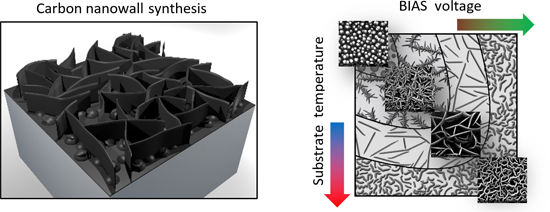
- measured by using transmission electron microscopy to be of several nanometers [2][3][4][5][6][7], similar to that of vertically aligned carbon nanotube arrays [8]. In CNWs, few graphene layers stick together like thin graphite flakes. The height of the CNWs can be of several micrometers, contributing to


A visible-light-controlled platform for prolonged drug release based on Ag-doped TiO2 nanotubes with a hydrophobic layer
Beilstein J. Nanotechnol. 2018, 9, 1793–1801, doi:10.3762/bjnano.9.170
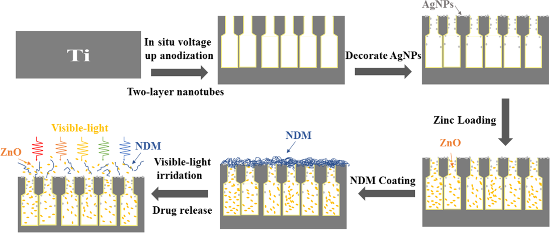
- anodizing voltage and time, some distinctive nanotube structures have been obtained, including multilayer [10], bamboo-type [11], branched tubes [12], and double-walled tubes [13]. Multilayered TNTs are known as the most controllable and useful drug delivery system [14]. In a previous work, Shi et al. [15
- light by doping AuNPs onto the nanotubes to improve the photocatalysis of the TNTs, which feasibly allows drug release under visible light. However, controlled drug release in combination with extended release delivery via a TiO2 nanotube platform has been rarely investigated. As a trace element
- with structures from our previous work under the same voltage processing conditions. Moreover, almost the same dimensions for the two-layer TiO2 nanotubes arrays were obtained, where the nanotube diameter of the first layer and the second layer was about 60–80 nm and 180–200 nm, respectively, and the