Search results
Search for "agglomeration" in Full Text gives 284 result(s) in Beilstein Journal of Nanotechnology. Showing first 200.
Non-agglomerated silicon–organic nanoparticles and their nanocomplexes with oligonucleotides: synthesis and properties
Beilstein J. Nanotechnol. 2018, 9, 2516–2525, doi:10.3762/bjnano.9.234
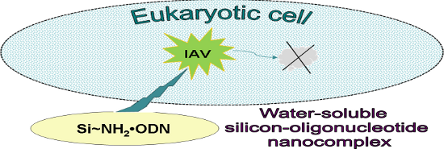
- agglomeration of the particles). The zeta potential of the studied samples was evaluated by phase analysis light scattering. The value of zeta potential of Si–NH2 is positive due to positively charged amino groups in neutral medium. When the nanoparticles were bound to an oligonucleotide, the zeta potential


Enhanced antineoplastic/therapeutic efficacy using 5-fluorouracil-loaded calcium phosphate nanoparticles
Beilstein J. Nanotechnol. 2018, 9, 2499–2515, doi:10.3762/bjnano.9.233
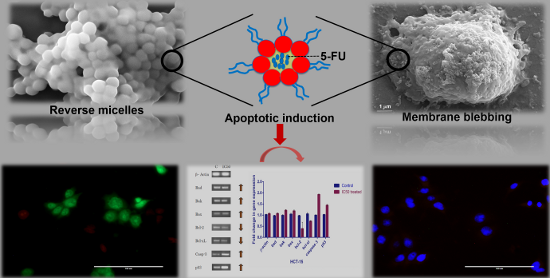
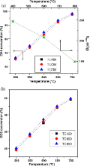
- agglomeration and enhanced colloidal stability [29]. Since the particle stability mainly depends on the electrical charge of the surface, properties such as cellular uptake, rate of drug release, and blood retention time are directly correlated with the zeta potential value. Furthermore, the zeta potential


Nanocellulose: Recent advances and its prospects in environmental remediation
Beilstein J. Nanotechnol. 2018, 9, 2479–2498, doi:10.3762/bjnano.9.232
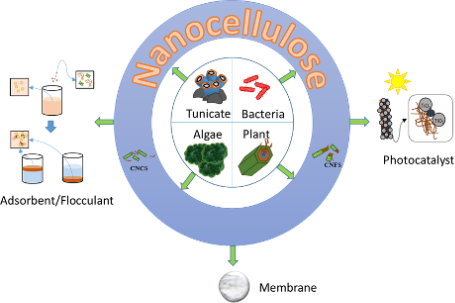
- are still rare since researchers mainly focused on adsorption of metals from diluted aqueous solution or photocatalysis as discussed in previous sections. Agglomeration remains an issue in the application of CNCs as flocculants. This is due to the hydrogen bond networks arising from the –OH groups on


Electrospun one-dimensional nanostructures: a new horizon for gas sensing materials
Beilstein J. Nanotechnol. 2018, 9, 2128–2170, doi:10.3762/bjnano.9.202
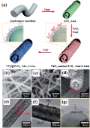
- -WO3 NTs toward 5 ppm toluene at 400 °C is measured. A negligible NO response (1.25 for the Pt-WO3 NTs and 1.04 for the Pd-WO3 NTs at 5ppm) at 400 °C was found. One problem associated with surface functionalization of NPs (3–50 nm) is their agglomeration. Traditional functionalization methods have






Synthesis of a MnO2/Fe3O4/diatomite nanocomposite as an efficient heterogeneous Fenton-like catalyst for methylene blue degradation
Beilstein J. Nanotechnol. 2018, 9, 1940–1950, doi:10.3762/bjnano.9.185
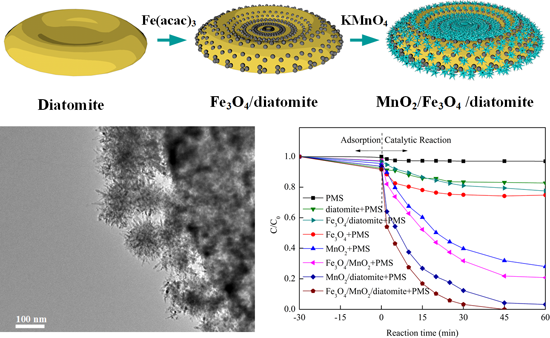
- composite is the most effective strategy [14]. Through this strategy, catalysts with controllable particle size, better dispersion and decreased agglomeration are easy to be synthesized and are expected to significantly increase the contact between active sites and contaminants. In addition, with the


Cryochemical synthesis of ultrasmall, highly crystalline, nanostructured metal oxides and salts
Beilstein J. Nanotechnol. 2018, 9, 1755–1763, doi:10.3762/bjnano.9.166
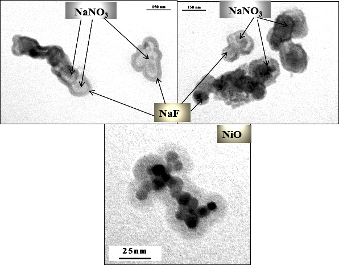
- dispersity by 3–18 times and to increase their specific surface area by an order of magnitude. The proposed approach also reduces the agglomeration of the nanoparticles, and at the same time, results in NiO, Fe2O3 and CeO2 crystallite sizes of less than 10 nm (quantum dot size regime). The diameter of NaNO3
- of the chain aggregates was related to the ice structure formed during freezing [10]. The cryoprocessing of liquid media, solutions and colloids can be used to limit the growth and agglomeration of the formed particles, to stabilize their surface, and thus, to obtain discrete particles of
- cryogel (labeled as B in Figure 3) is formed during the treatment of sol A with liquid N2 (−196 °C ). The resulting water crystallite shell prevents the agglomeration of the sol particles. The obtained organic–inorganic cryogel powders consisted of capillary porous granules (Figure 2) and contained the


Controllable one-pot synthesis of uniform colloidal TiO2 particles in a mixed solvent solution for photocatalysis
Beilstein J. Nanotechnol. 2018, 9, 1715–1727, doi:10.3762/bjnano.9.163
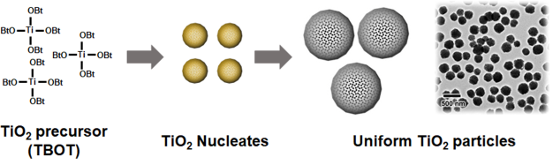
- macroscopic morphology. In this study, we optimized these factors to control the size of the TiO2 particles and prevent particle agglomeration. Figure 1 compares the as-synthesized amorphous TiO2 particles prepared by varying the solvent composition. As shown in Figure 1a, when only pure ethanol was used as
- , the particle diameter decreased to ≈340 nm and most of the particles were individually isolated without particle agglomeration (Figure 1b). When the volume ratio of EtOH/ACN was 2:2, the particle size of the spherical TiO2 particles became even smaller, reducing to ≈250 nm without apparent particle
- the TiO2 particles, and therefore, suppressed interparticle agglomeration. Consistent with other syntheses, synthesizing uniform TiO2 particles was also controlled by changing the concentration of the precursor [14][31]. When 1 mL of TBOT was used, the as-synthesized TiO2 particles formed as small




Nanocomposites comprised of homogeneously dispersed magnetic iron-oxide nanoparticles and poly(methyl methacrylate)
Beilstein J. Nanotechnol. 2018, 9, 1613–1622, doi:10.3762/bjnano.9.153
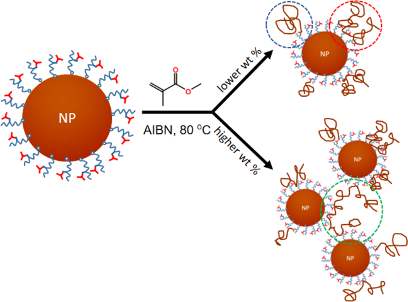
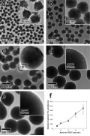
- colloidal stability and prevent the agglomeration of the nanoparticles during the preparation of the nanocomposites. The PMMA chains are strongly attached to the surfaces of the nanoparticles, as indicated by the inhibited Fe ion dissolution under highly acidic conditions. The nanocomposites exhibit


Cr(VI) remediation from aqueous environment through modified-TiO2-mediated photocatalytic reduction
Beilstein J. Nanotechnol. 2018, 9, 1448–1470, doi:10.3762/bjnano.9.137
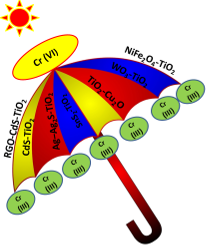
- aggregation and agglomeration of particles. On increasing ZnO content in the ZnO/TiO2 composite, the rate of reduction of Cr(VI) was increased and the sample containing 2.0 mol % ZnO exhibited a maximum photocatalytic reduction of Cr(VI) in aqueous solution as the recombination of charge carriers is
- with further increase in the calcination temperature because of the decrease in the specific surface area induced by the aggregation and agglomeration of particles [157]. TiO2/Fe3O4 composite photocatalysts were synthesized through a polymerizable sol−gel route to investigate the photocatalytic


Understanding the performance and mechanism of Mg-containing oxides as support catalysts in the thermal dry reforming of methane
Beilstein J. Nanotechnol. 2018, 9, 1162–1183, doi:10.3762/bjnano.9.108
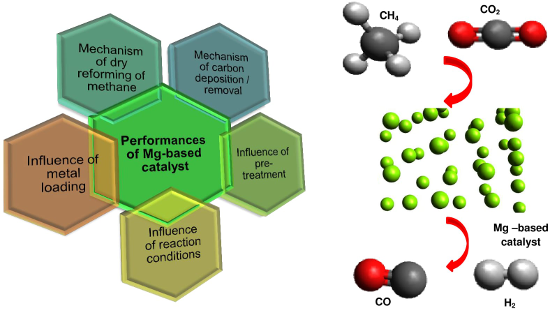
- stabilize active metal and prevent the occurrence of leaching or metal agglomeration. The authors further mention that supports can not only transport the reactants to the reaction center, but can also control diffusion rates of reactants and products and donate protons or electrons to alter total
- particles. Moreover, the addition of MgO in this catalyst prevented the agglomeration of Ni particles and increased the basicity of the catalyst; consequently, more CO2 was adsorbed on the catalyst surface. The adsorption and activation of CO2 decreased the carbon deposition. Notably, the catalyst
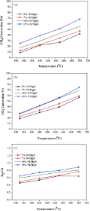
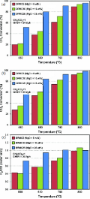
- 550 °C to 850 °C as exhibited in Figure 12. This finding indicates a small particle size distribution, good morphology, and high surface area of the catalyst, as well as high diffusion of active metal without agglomeration during the reaction. Moreover, the average particle size was 11.6 nm, which was






Review on nanoparticles and nanostructured materials: history, sources, toxicity and regulations
Beilstein J. Nanotechnol. 2018, 9, 1050–1074, doi:10.3762/bjnano.9.98



Single-crystalline FeCo nanoparticle-filled carbon nanotubes: synthesis, structural characterization and magnetic properties
Beilstein J. Nanotechnol. 2018, 9, 1024–1034, doi:10.3762/bjnano.9.95
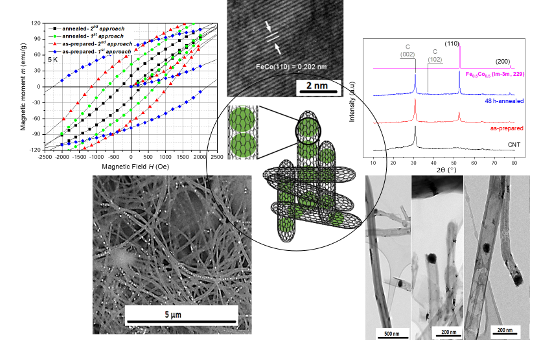
- –Co. The CNTs act as templates for the encapsulation of magnetic nanoparticles and provide a protective shield against oxidation as well as prevent nanoparticle agglomeration. By variation of the reaction parameters, we were able to tailor the sample purity, degree of filling, the composition and size
- to be used in potential applications. Due to their high surface-to-volume (S/V) ratio, MNPs are more susceptible to oxidation, agglomeration, aggregation [31][32]. Therefore, it is necessary to produce MNPs with a protective layer which preserves their properties. Compared to polymer or silica
- the CNTs allowed the control of the particle size, and to a large extent, prevented particle agglomeration in both samples. Furthermore, a strong divergence between the size distribution of the as-prepared and the annealed samples is obvious. Hence, for very regular particles with high homogeneity and


Surface-plasmon-enhanced ultraviolet emission of Au-decorated ZnO structures for gas sensing and photocatalytic devices
Beilstein J. Nanotechnol. 2018, 9, 771–779, doi:10.3762/bjnano.9.70
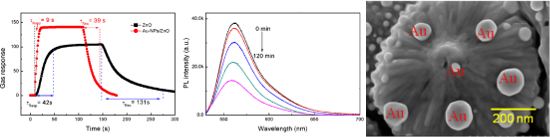
- agglomeration, but also bind to the crystal seed surface. These are believed to play an important role in the weakening of grain growth and the assembly of nanorods. Owing to the stronger bonding between the active component of the deposition solution and substrate surface, the self-assembly of the nanorod




Tuning adhesion forces between functionalized gold colloidal nanoparticles and silicon AFM tips: role of ligands and capillary forces
Beilstein J. Nanotechnol. 2018, 9, 660–670, doi:10.3762/bjnano.9.61
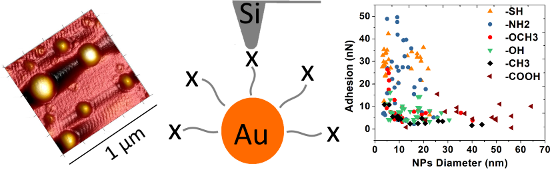
- common particle shapes were pentagonal dipyramids and octahedrons [26]. The synthesis of so-called “bare” Au NPs, described in more details in the experimental section, involved addition of sodium citrate [27] in order to prevent the agglomeration of the NPs in the solution. Sodium citrate molecules
- hydrophilic coating, the previously used method [47] was slightly modified according to [52] by adding NaOH solution to improve the stability of the colloidal solution. Indeed, a high pH stabilizes the mixture, and prevents agglomeration of the NPs. The overview of the molecules used for functionalization and


Mechanistic insights into plasmonic photocatalysts in utilizing visible light
Beilstein J. Nanotechnol. 2018, 9, 628–648, doi:10.3762/bjnano.9.59
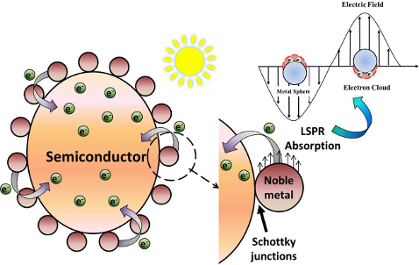
- from Au one can find that palladium (Pd) in the form of NPs with a diameter of <10 nm is limited to the UV spectrum [25]. Nevertheless, the larger particle size and agglomeration of palladium particles contribute to the enhanced absorption of visible light. Mohapatra and coworkers demonstrated this





Anchoring Fe3O4 nanoparticles in a reduced graphene oxide aerogel matrix via polydopamine coating
Beilstein J. Nanotechnol. 2018, 9, 591–601, doi:10.3762/bjnano.9.55
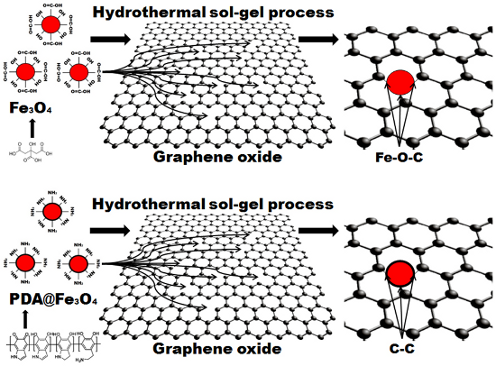
- , which is due to additional contribution of PDA to the sample volume [65]. The agglomeration of magnetic nanoparticles has a direct effect on any measurement performed on NPs when extracting quantitative parameters, such as, e.g., the magnetic moment value [66]. The interparticle distance affects the
- susceptibility curves coincide at high temperatures and separate as the temperature is decreasing. The maximum of the ZFC curve is defined as the blocking temperature (TB) of the superparamagnetic nanoparticles and the width of the ZFC curve maximum is related to the size distribution or agglomeration process of


Fabrication and photoactivity of ionic liquid–TiO2 structures for efficient visible-light-induced photocatalytic decomposition of organic pollutants in aqueous phase
Beilstein J. Nanotechnol. 2018, 9, 580–590, doi:10.3762/bjnano.9.54
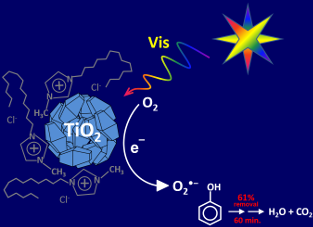
- further growth and agglomeration. For the TiO2_O(1:3) sample, the dominant fraction were microspheres with diameter ranging from 2–3 μm (38%), whereas for TiO2_T(1:3), the main fraction was particles with an average diameter of 3–5 μm (42%). Diffuse reflectance spectroscopy, UV–vis spectroscopy and BET




Colloidal solution of silver nanoparticles for label-free colorimetric sensing of ammonia in aqueous solutions
Beilstein J. Nanotechnol. 2018, 9, 499–507, doi:10.3762/bjnano.9.48
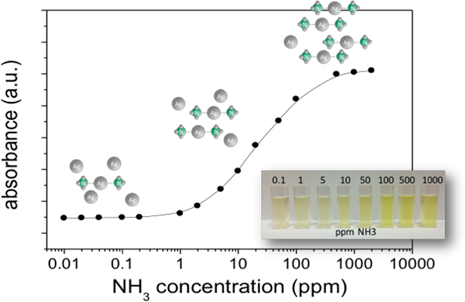
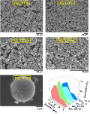
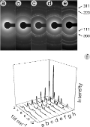
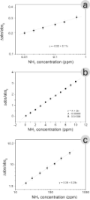
- function of log(t). In this way, the constants k and n can be obtained from the line intercept with the y-axis and the slope of the straight line (Table 2). Different NH3 concentrations give rise to different Ag nanoparticles agglomeration and nucleation rates. In particular, the rate of nucleation of the



Influence of the preparation method on the photocatalytic activity of Nd-modified TiO2
Beilstein J. Nanotechnol. 2018, 9, 447–459, doi:10.3762/bjnano.9.43
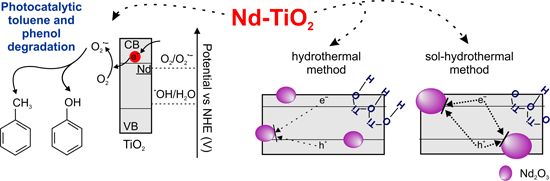
- treatments in combination with the sol–gel method (sol–hydrothermal method) provide an alternative approach for preparing TiO2. During the preparation, before the hydrothermal process, a sol is obtained, which may prevent the agglomeration of the nanocrystals [26]. However, information regarding the




Facile synthesis of ZnFe2O4 photocatalysts for decolourization of organic dyes under solar irradiation
Beilstein J. Nanotechnol. 2018, 9, 436–446, doi:10.3762/bjnano.9.42
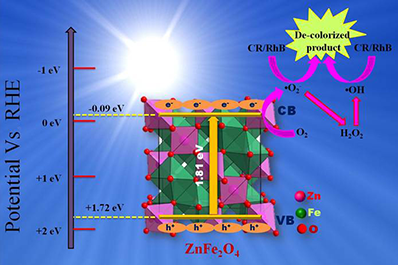
- microscopy (FESEM) provides surface morphology and topography of the prepared materials. Figure 2 shows the surface topography of ZFO-500. The sample consists of agglomerated nanoparticles with smooth surface. The agglomeration of ZFO-500 is accompanied with the formation of small crystallites [28]. TEM The


Photocatalytic and adsorption properties of TiO2-pillared montmorillonite obtained by hydrothermally activated intercalation of titanium polyhydroxo complexes
Beilstein J. Nanotechnol. 2018, 9, 364–378, doi:10.3762/bjnano.9.36
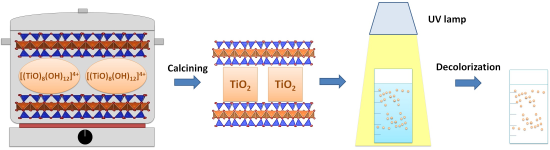
- limitations such as low adsorption capacity and possibility of particle agglomeration, which reduce its photocatalytic efficiency for the processes of purifying sewage and natural water bodies from pollutants of organic origin. To overcome these limitations, titanium dioxide nanoparticles are distributed on






Sugarcane juice derived carbon dot–graphitic carbon nitride composites for bisphenol A degradation under sunlight irradiation
Beilstein J. Nanotechnol. 2018, 9, 353–363, doi:10.3762/bjnano.9.35
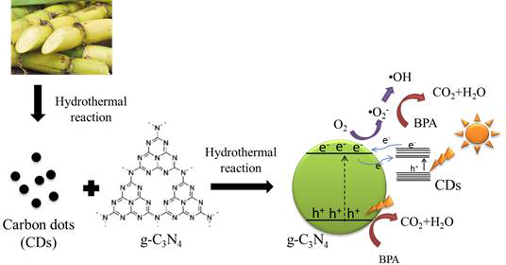
- to the self-assembly process during the hydrothermal treatment [43]. However, a more porous structure in the CD/g-C3N4(0.5) composite was observed as compared to that of CD/g-C3N4(0.1), signifying that the increasing concentration of CDs could reduce the agglomeration effect in the composites. The


BN/Ag hybrid nanomaterials with petal-like surfaces as catalysts and antibacterial agents
Beilstein J. Nanotechnol. 2018, 9, 250–261, doi:10.3762/bjnano.9.27
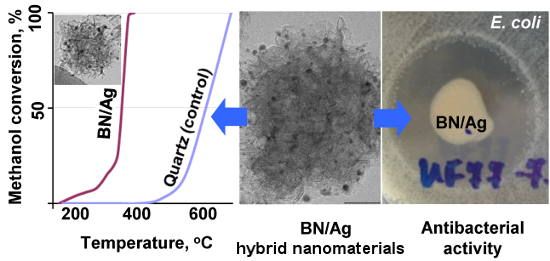
- antibacterial activity, the wide application of Ag NPs is restricted by their poor dispersion stability and high tendency to agglomeration. This reduces their specific surface areas, dissolution rate and, eventually, antibacterial efficiency. Therefore, it is extremely important to use supports which could not





Comparative study of post-growth annealing of Cu(hfac)2, Co2(CO)8 and Me2Au(acac) metal precursors deposited by FEBID
Beilstein J. Nanotechnol. 2018, 9, 91–101, doi:10.3762/bjnano.9.11
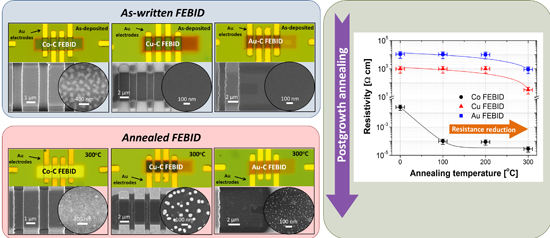
- granularity of the films and the border sharpness increase due to grain agglomeration. The extracted average size of the Co agglomerates more than doubles when the as-deposited FEBID material is annealed at 200 °C (from 170 ± 40 nm to 400 ± 100 nm, Figure 2). Increasing further the annealing temperature


Material discrimination and mixture ratio estimation in nanocomposites via harmonic atomic force microscopy
Beilstein J. Nanotechnol. 2017, 8, 2771–2780, doi:10.3762/bjnano.8.276
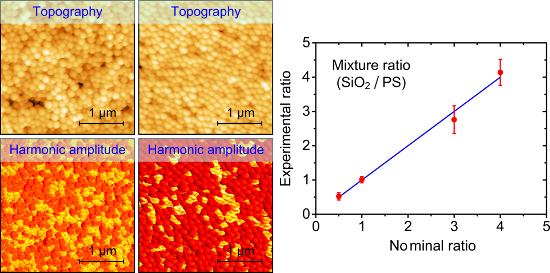
- NPs were mixed and diluted with deionized water. To avoid agglomeration, ultrasonic dispersion was applied for at least 5 min. After that, a drop of the solution was deposited on a silicon substrate and dried under natural air conditions in a clean room. For this sample, the two types of particles