Search results
Search for "adhesion" in Full Text gives 472 result(s) in Beilstein Journal of Nanotechnology. Showing first 200.
Recent progress in perovskite solar cells: the perovskite layer
Beilstein J. Nanotechnol. 2020, 11, 51–60, doi:10.3762/bjnano.11.5
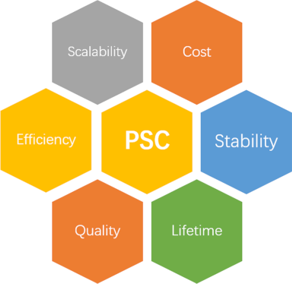
- improves the adhesion of the perovskite ink to hydrophobic substrates, effectively inhibiting the solution flow dynamics in the drying perovskite ink layer leading to compact and uniform perovskite films. The very small amount of surfactant additive has no adverse effect on the optoelectronic properties of


An investigation on the drag reduction performance of bioinspired pipeline surfaces with transverse microgrooves
Beilstein J. Nanotechnol. 2020, 11, 24–40, doi:10.3762/bjnano.11.3
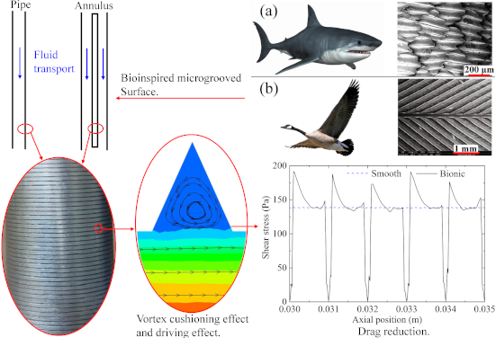
- [7][8][9], the injection of gas to modify the turbulent boundary characteristics [10], and the fabrication of superhydrophobic surfaces to reduce the adhesion [11]. However, the application of polymer additives is not economic and the antidrag performance of additives is also instable under some
- surface. In this case, the hydrophobicity of the pipeline surface was improved by the transverse microgrooves. The better the hydrophobicity of the surface was, the lower the adhesion of water was. Therefore, the increased contact angle of the bionic pipeline was beneficial for reducing the drag
- transverse microgrooves, which could reduce the adhesion of water. In the present study, the proposition of applying bionic theory to the surface of a pipeline to reduce the drag was verified from a theoretical perspective under ideal conditions. The influence of microgrooves on the strength of the pipeline


Fully amino acid-based hydrogel as potential scaffold for cell culturing and drug delivery
Beilstein J. Nanotechnol. 2019, 10, 2579–2593, doi:10.3762/bjnano.10.249
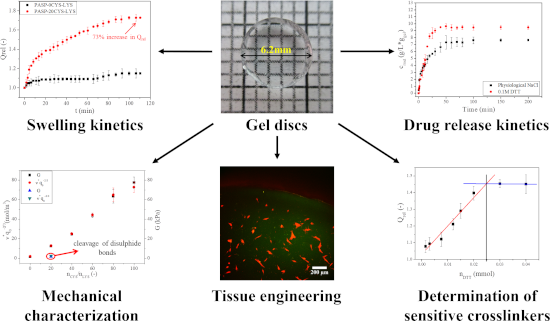
- is that it can partially decrease the anionic character of aspartic acid. In addition, LYS also facilitates the electrostatic interaction between anionic plasma membrane sites and cationic polymer sites. Therefore, it supports cell adhesion and proliferation [47]. The swelling, mechanical and
- viability of the growth of PDLCs on the different hydrogels was tested (Figure 6a). After one day of cell growth, the highest cell viability index (referring to the highest cell adhesion) was measured on the 100CYS-LYS gel, which does not contain any LYS at all, only the redox sensitive cross-linker CYS. On
- hydrogel. The presence of thiol groups supports cell adhesion and proliferation as we showed previously. Therefore, the higher the density of CYS in the polymer matrix, the higher is the viability of the cells [25]. In the literature, several articles can be found about the effect of poly-ʟ-lysine on cell


Abrupt elastic-to-plastic transition in pentagonal nanowires under bending
Beilstein J. Nanotechnol. 2019, 10, 2468–2476, doi:10.3762/bjnano.10.237
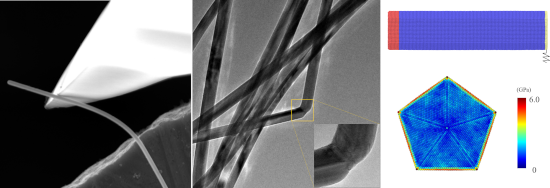
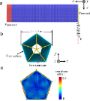
- by Russian Science Foundation project grant 18-19-00645 “Adhesion of polymer-based soft materials: from liquid to solid”; mechanical testing and FEM simulations were supported by Estonian Research Council projects PUT1689 and PUT1372.



Mobility of charge carriers in self-assembled monolayers
Beilstein J. Nanotechnol. 2019, 10, 2449–2458, doi:10.3762/bjnano.10.235
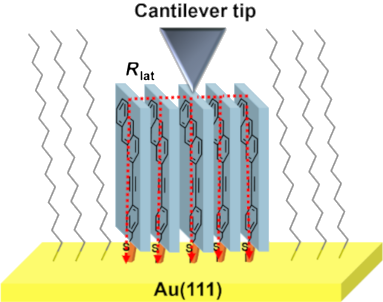
- adhesion layer. The thickness and deposition rate (10 Å s−1) were monitored using a quartz crystal microbalance. Between substrate preparation and SAM formation, the substrates were stored in an argon atmosphere. The formation of the PAT monolayers on the gold silicon wafer was described above. Grafting


Atomic force acoustic microscopy reveals the influence of substrate stiffness and topography on cell behavior
Beilstein J. Nanotechnol. 2019, 10, 2329–2337, doi:10.3762/bjnano.10.223
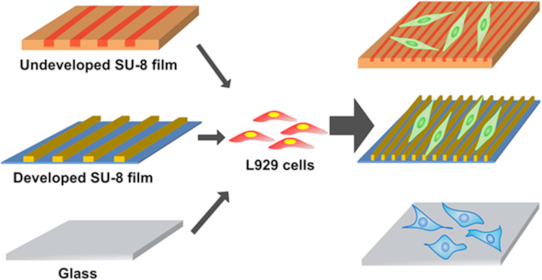
- and Figure 3n, we infer that both the elongation and the area spread of the L929 cells on the undeveloped SU-8 films remain statistically unchanged in the stiffness range investigated. These results suggest that modulating the EBL exposure doses does not significantly influence the adhesion and the
- roughness of substrates would affect the adhesion and the morphology of cells [43]. To assess how the stiffness and the topography differ in influencing the cells, the alignment rates and the elongation factors of the L929 cells cultured on the three substrates have been determined as shown in Figure 6. The


Design of a nanostructured mucoadhesive system containing curcumin for buccal application: from physicochemical to biological aspects
Beilstein J. Nanotechnol. 2019, 10, 2304–2328, doi:10.3762/bjnano.10.222
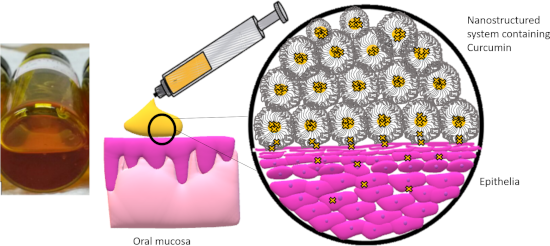
- , considered as the required work necessary to overcome the attraction forces between the sample surface and the polycarbonate probe surface, is a desirable parameter for mucoadhesive preparations aimed at buccal applications. In this sense, a higher adhesion could implicate higher retention, and consequently
- previously observed in the flow rheology with higher consistency index numbers. These higher values are desirable for a higher adhesion to the buccal cavity, leading to longer contact time. These results confirm that the system is mucoadhesive but also warrant further mucoadhesion investigations [11][59][71
- , it is possible to obtain a graph with the force required to separate two surfaces with time and the maximum required force to separate the formulation from the mucin disc (mucoadhesive force). In addition, the adhesion work values were calculated. The incorporation of CUR in mucoadhesive


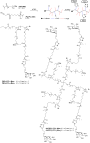
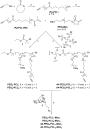
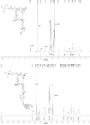
Mannosylated brush copolymers based on poly(ethylene glycol) and poly(ε-caprolactone) as multivalent lectin-binding nanomaterials
Beilstein J. Nanotechnol. 2019, 10, 2192–2206, doi:10.3762/bjnano.10.212
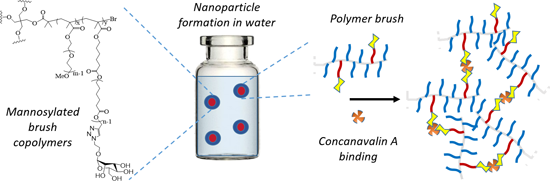
- : atom transfer radical polymerization (ATRP); glycopolymer; lectin; poly(ethylene glycol); poly(ε-caprolactone); ring-opening polymerization (ROP); Introduction Carbohydrate–protein interactions are involved in many biological processes, including cell recognition and cell–cell adhesion. These



BergaCare SmartLipids: commercial lipophilic active concentrates for improved performance of dermal products
Beilstein J. Nanotechnol. 2019, 10, 2152–2162, doi:10.3762/bjnano.10.208
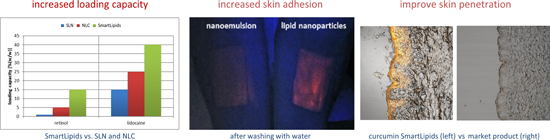
- Adhesion onto skin with increased residence time/prolonged release There are many properties that are identical for the several types of lipid nanoparticles – SLNs, NLCs and SmartLipids – because they only depend on physical characteristics (e.g., particle size or general adhesiveness of small particles


The importance of design in nanoarchitectonics: multifractality in MACE silicon nanowires
Beilstein J. Nanotechnol. 2019, 10, 2094–2102, doi:10.3762/bjnano.10.204
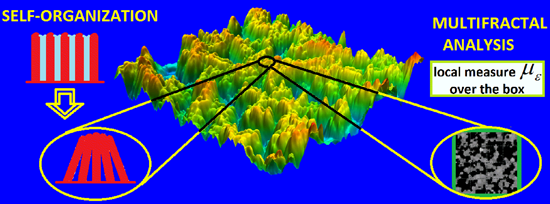
- adhesion force between the surfaces of the two NWs is larger than the elastic force. In order to theoretically confirm the self-assembly that occurred in both samples SiNW1 and SiNW2, we availed of literature [29][31] to model steps 1) and 2). Given a pillar-like structure of height h, clamped at one end




Nanoarchitectonics meets cell surface engineering: shape recognition of human cells by halloysite-doped silica cell imprints
Beilstein J. Nanotechnol. 2019, 10, 1818–1825, doi:10.3762/bjnano.10.176
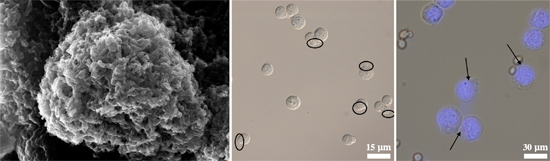
- cells and (G) HeLa cells coated with halloysite-doped silica shells. Atomic force microscopy (PeakForce Tapping mode) images of inorganic silica/halloysite imprints templated on HeLa cells: (A) topography image, (B) non-specific adhesion map; (C) scanning electron microscopy image of inorganic silica


TiO2/GO-coated functional separator to suppress polysulfide migration in lithium–sulfur batteries
Beilstein J. Nanotechnol. 2019, 10, 1726–1736, doi:10.3762/bjnano.10.168
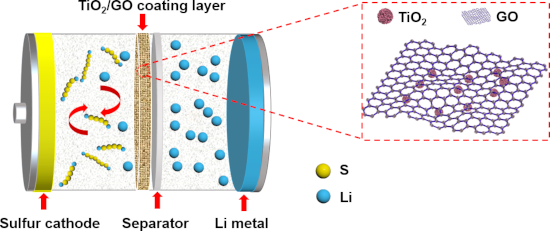
- . The excellent adhesion between TiO2 nanoparticles and GO sheets resulted in enhanced conductivity, which is highly desirable for an efficient electron transfer process. The Li/S battery with a TiO2/GO-coated separator exhibited a high initial discharge capacity of 1102.8 mAh g−1 and a 100th cycle
- and GO sheets exhibit excellent adhesion, which ensures efficient electron transfer from the GO sheet to nanoporous TiO2. The use of TiO2/GO composites as an interlayer can greatly suppress the migration of polysulfides due to their physical and chemical interactions with dissolved polysulfides
- μm (Figure 4c). Furthermore, the interface does not contain any cracks, suggesting the excellent adhesion of the TiO2/GO composite layer with a pristine separator. Figure 5 compares the cycle voltammetry (CV) curves of the Li/S batteries with pristine, GO-coated and TiO2/GO-coated separators at a


Materials nanoarchitectonics at two-dimensional liquid interfaces
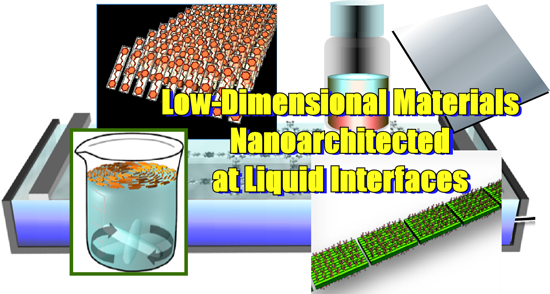
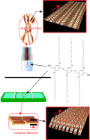
Beilstein J. Nanotechnol. 2019, 10, 1559–1587, doi:10.3762/bjnano.10.153













Development of a new hybrid approach combining AFM and SEM for the nanoparticle dimensional metrology
Beilstein J. Nanotechnol. 2019, 10, 1523–1536, doi:10.3762/bjnano.10.150
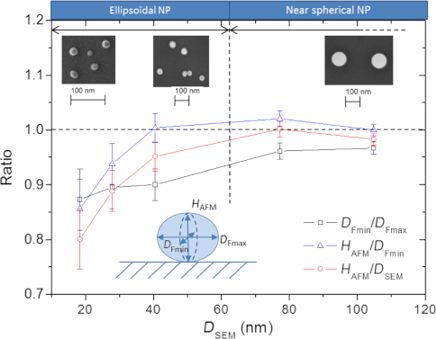
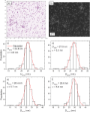
- substrate under ambient conditions, since the area/volume ratio becomes important, capillary adhesion forces must be taken into account. Deformations of the silica NP and substrate can be assessed using the model developed by Derjaguin, Muller and Toporov (DMT) [33]. This model describes the elastic
- deformation of spherical bodies by including adhesion forces to the Hertz contact equation. This interaction can be described by the Bradley theory [34]: with P the adhesion force and Δγ = γ1 + γ2 − γ12 the work of adhesion with γ1 and γ2, the surface energies of NP and substrate, respectively, and γ12 the
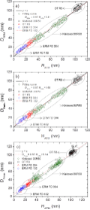
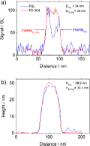
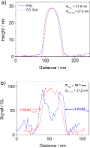
- : Finally, the theoretical deformation of the system is equal to 0.6 ± 0.2 nm for a 30 nm nominal diameter silica NP, 0.8 ± 0.3 nm for a 100 nm silica NP. Consequently, the 3.5 nm discrepancy between AFM and SEM measurements for FD304 particles cannot be fully explained by NP deformation due to adhesion




Rapid thermal annealing for high-quality ITO thin films deposited by radio-frequency magnetron sputtering
Beilstein J. Nanotechnol. 2019, 10, 1511–1522, doi:10.3762/bjnano.10.149
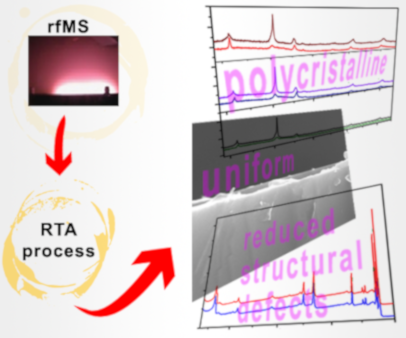
- low deposition rate and adjustment of the magnetron power for current intensities as small as possible. As a result of RTA processing, layers with strong adhesion to the substrate are achieved (see Figure 1b,d,f). At a specific temperature applied to the deposited samples, the elimination of gaseous
- crystallinity by increasing the crystallite size (from 12.7 nm to 34.3 nm). Also, it was found from SEM investigations (cross-sections) that films subjected to such a thermal treatment show good adhesion to the substrate. Based on XPS investigations, it was evidenced that stoichiometric thin films were obtained


Kelvin probe force microscopy of the nanoscale electrical surface potential barrier of metal/semiconductor interfaces in ambient atmosphere
Beilstein J. Nanotechnol. 2019, 10, 1401–1411, doi:10.3762/bjnano.10.138
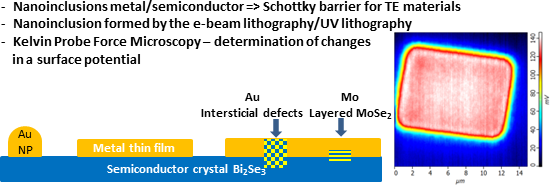
- tunneling microscopy (STM) [27][28] or by using AFM in the semicontact mode. The latter enables a describtion not only of the topography (size and shape) but also a detection of the changes in density, stiffness and adhesion of NPs [20][21][24][29][30]. In the present study we demonstrate that the Schottky
- 1B) due to local changes in adhesion, density, and stiffness [30]. This fact demonstrates the difference between the NPs and the substrate, regardless of any artifacts of the sample preparation/measurement. KPFM is a double-pass measurement technique, where the lift height between the first


Gas sensing properties of individual SnO2 nanowires and SnO2 sol–gel nanocomposites
Beilstein J. Nanotechnol. 2019, 10, 1380–1390, doi:10.3762/bjnano.10.136
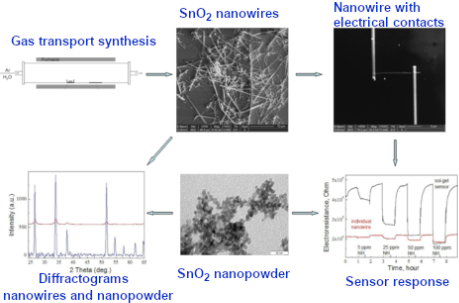
- and high surface-to-volume ratio, obtained by sintering, are traditionally used as sensing materials. By means of preparation methods such as magnetron sputtering, laser ablation, and pulverization, layer-by-layer nanoparticle deposition can be achieved with adhesion to the substrate and to previously




Nanoscale spatial mapping of mechanical properties through dynamic atomic force microscopy
Beilstein J. Nanotechnol. 2019, 10, 1332–1347, doi:10.3762/bjnano.10.132
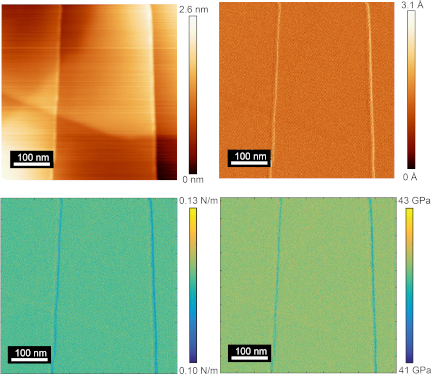
- was not observed in the contact resonance measurements, we believe that one layer of graphene is sufficient to mask the mechanical property variations that result from the low coordinated atoms of the step beneath. Thus, while adhesion [50] and other mechanical properties like friction [51] can be




Fabrication of phase masks from amorphous carbon thin films for electron-beam shaping
Beilstein J. Nanotechnol. 2019, 10, 1290–1302, doi:10.3762/bjnano.10.128
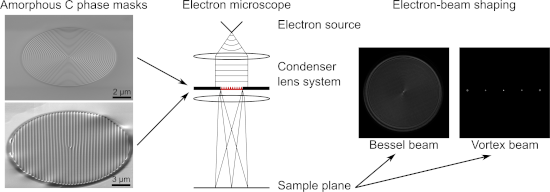
- directly (Plano, Art. No. 21529-10). To create an electron-blocking aperture, a 3.5 nm/220 nm thick Cr/Pt layer was deposited onto the SixNy via PVD (Figure 2b, Cr not shown) with Cr acting as an adhesion layer. To achieve smooth aC thin films in combination with a circular Pt aperture, we have applied two
- , such as a Kimtech wipe (Kimberly-Clark Professional). Thinner films showed better adhesion although sagging of these films on the aperture edges was observed, which was less pronounced for thicker films (cf. Figure 3c,d). As a compromise, an intermediate thickness of 30 nm for the floated aC films was



Revisiting semicontinuous silver films as surface-enhanced Raman spectroscopy substrates
Beilstein J. Nanotechnol. 2019, 10, 1048–1055, doi:10.3762/bjnano.10.105
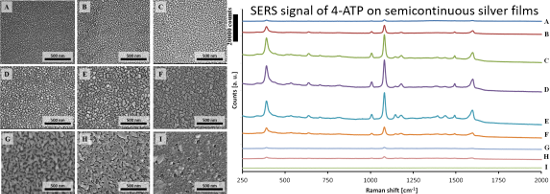
- hypothetical continuous film) of silver is e-beam deposited on a proper adhesion layer (for example silicon dioxide) [43][44]. The results of simulations and experimental studies show that the hot spots exist in SSFs [2][44][45][46][47], and hence they have been extensively studied as SERS substrates [40][41




Serum type and concentration both affect the protein-corona composition of PLGA nanoparticles
Beilstein J. Nanotechnol. 2019, 10, 1002–1015, doi:10.3762/bjnano.10.101
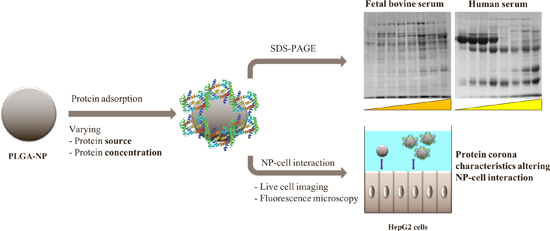
- Lumogen® Red and cells was neglectable. In contrast, all NP formulations showed an increasing cell interaction over time resulting in a plateau after approximately 18 h. The presence of proteins on the PLGA NP surface facilitates the adhesion to HepG2 cells compared to the bare particles. The significant



Direct growth of few-layer graphene on AlN-based resonators for high-sensitivity gravimetric biosensors
Beilstein J. Nanotechnol. 2019, 10, 975–984, doi:10.3762/bjnano.10.98
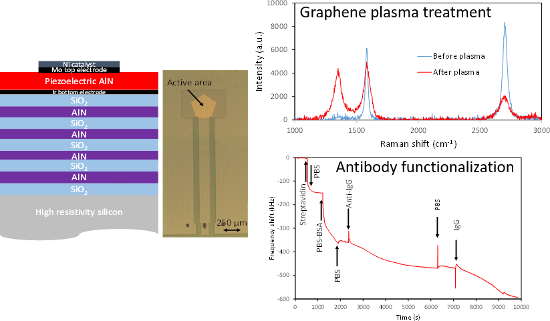
- graphene with better quality. The hydrophobic character of the surface was confirmed by dropping water on it with a pipette, which revealed the lack of liquid adhesion to the surface. We also analysed the influence of the process parameters (pressure, Ar/C2H2 flow ratio and cooling rate) on the defect
- detection measurements that will be show in this section. An additional effect of the O2 plasma treatment is that the initially hydrophobic graphene layer becomes hydrophilic, as observed by analysing the adhesion of a droplet of DI water to the surface; the adhesion improved after the plasma treatment


Effects of gold and PCL- or PLLA-coated silica nanoparticles on brain endothelial cells and the blood–brain barrier
Beilstein J. Nanotechnol. 2019, 10, 941–954, doi:10.3762/bjnano.10.95
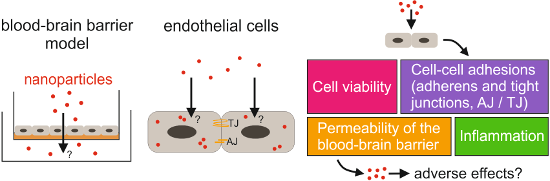
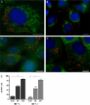
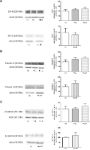
- after exposure to PCL-, PLLA- or Au-NPs compared to non-exposed controls (Figure 6A,B). β-Catenin, the key player in the canonical Wnt signaling pathway, has been demonstrated to regulate and coordinate cell–cell adhesion by formation and stabilization of adherens and tight junctions [26]. The active



Fabrication of silver nanoisland films by pulsed laser deposition for surface-enhanced Raman spectroscopy
Beilstein J. Nanotechnol. 2019, 10, 882–893, doi:10.3762/bjnano.10.89
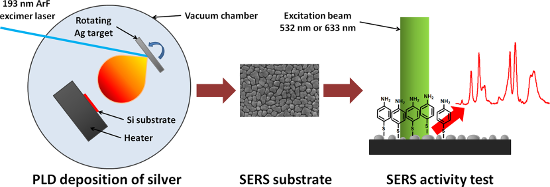
- . A very sharp edge for height (layer thickness) measurements was obtained in this way due to the low adhesion of the silver films to the Si substrate. AFM measurements were carried out in three different areas on the surface of each sample. Then for each sample ten AFM cross sections from different




Rapid, ultraviolet-induced, reversibly switchable wettability of superhydrophobic/superhydrophilic surfaces
Beilstein J. Nanotechnol. 2019, 10, 866–873, doi:10.3762/bjnano.10.87
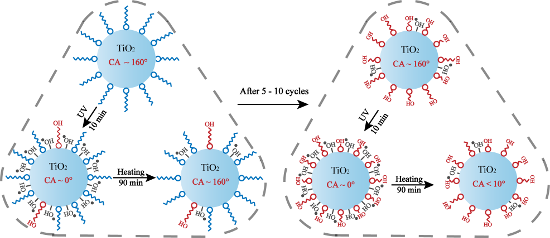
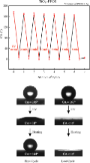
- –CF2− and –CF3 groups appeared in the FTIR spectra of Al2O3–PFOS but without the peak at 1065 cm−1, which indicates that there was probably no chemical bonding between Al2O3 and PFOS, suggesting the physical adhesion between Al2O3 nanoparticles and PFOS. Wettability switching by UV illumination and