


Search results
Search for "relaxation" in Full Text gives 388 result(s) in Beilstein Journal of Nanotechnology. Showing first 200.
Recent highlights in nanoscale and mesoscale friction
Beilstein J. Nanotechnol. 2018, 9, 1995–2014, doi:10.3762/bjnano.9.190
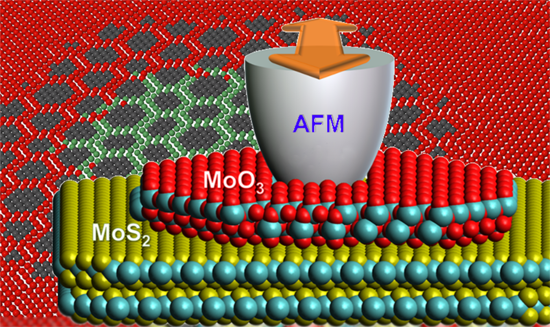
- colloids” for more details). However, in more conventional nanomanipulation experiments such a transition could not yet be actively induced, most probably due to insufficient normal forces [50][76][84]. Nonetheless, this does not mean that interface-relaxation effects play no role even for relatively rigid


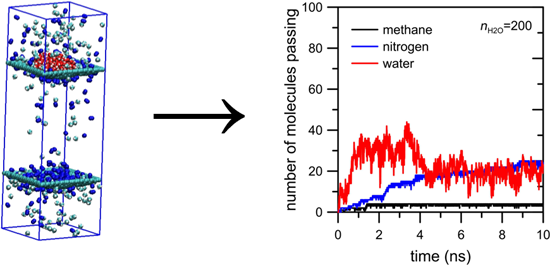
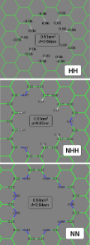
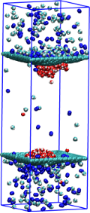
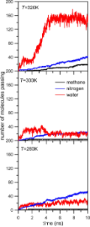
The inhibition effect of water on the purification of natural gas with nanoporous graphene membranes
Beilstein J. Nanotechnol. 2018, 9, 1906–1916, doi:10.3762/bjnano.9.182
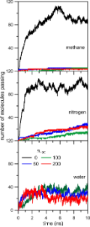
- trajectories where the bond is broken at a later time t [24]. Because the probability that in a large system at equilibrium a particular donor–acceptor pair is hydrogen-bonded is small, the correlation function c(t) relaxes to zero and therefore k(t) describes the rate of relaxation to equilibrium. It is worth






Improving the catalytic activity for hydrogen evolution of monolayered SnSe2(1−x)S2x by mechanical strain
Beilstein J. Nanotechnol. 2018, 9, 1820–1827, doi:10.3762/bjnano.9.173
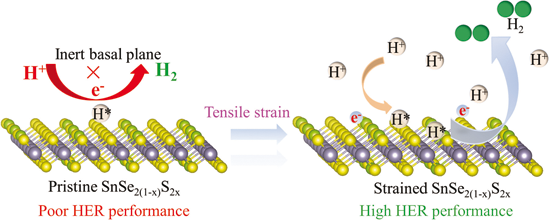
- , two tops of the Sn sites (T1 and T2), and two centres of the hexagonal sites (H1 and H2). The hydrogen is bounded to two S atoms and one Se atom at the T1 and H1 sites, whereas it is bounded to one S atom and two Se atoms at the T2 and H2 sites. After full relaxation, the T and H sites are not


Multimodal noncontact atomic force microscopy and Kelvin probe force microscopy investigations of organolead tribromide perovskite single crystals
Beilstein J. Nanotechnol. 2018, 9, 1695–1704, doi:10.3762/bjnano.9.161
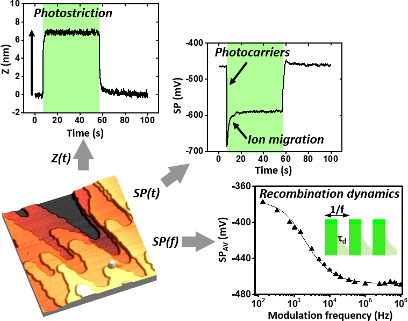
- light-induced perturbation and thermal relaxation. In addition, by monitoring the sample temperature and analyzing the temporal evolution of the height change probed by AFM they were able to rule out possible contributions from the thermal expansion of the sample (we refer the reader to [16] and the


Nanoscale electrochemical response of lithium-ion cathodes: a combined study using C-AFM and SIMS
Beilstein J. Nanotechnol. 2018, 9, 1623–1628, doi:10.3762/bjnano.9.154
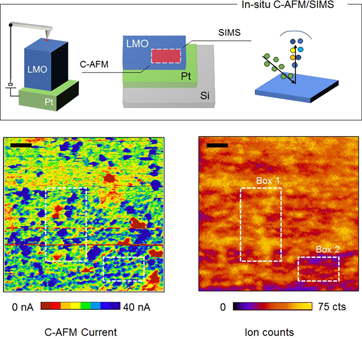
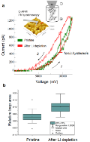
- Li concentration are also visible. In addition, (partial) relaxation after bias stress can lead to modifications of the surface deviating from the original C-AFM image. Figure 2 demonstrates that with our method we can distinguish two extreme material phases and their respective electrical properties


Nanocomposites comprised of homogeneously dispersed magnetic iron-oxide nanoparticles and poly(methyl methacrylate)
Beilstein J. Nanotechnol. 2018, 9, 1613–1622, doi:10.3762/bjnano.9.153
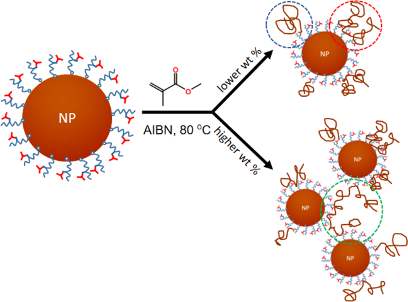
- characterized by transmission electron microscopy (TEM). 1H NMR spectra were recorded in CDCl3 on a 300 MHz Agilent Technologies DD2 NMR spectrometer in the pulse Fourier transform mode with both a relaxation delay and an acquisition time of 5 s. Tetramethylsilane (TMS, δ = 0) was used as an internal chemical
- heating of the magnetic nanoparticles in the AC field is a consequence of the magnetic moment relaxation of the magnetic nanoparticles [35][36]. The heating and the characteristic value related to the heating ability, called the specific power loss (SLP), will be the greatest when the frequency of the AC
- field corresponds closely to the relaxation time of the nanoparticles. More specifically, in our case, this corresponds to the Néel relaxation time because the particles are fixed in the polymer and therefore Brownian relaxation is not possible. The important point is that even at low frequency and AC


Absence of free carriers in silicon nanocrystals grown from phosphorus- and boron-doped silicon-rich oxide and oxynitride
Beilstein J. Nanotechnol. 2018, 9, 1501–1511, doi:10.3762/bjnano.9.141
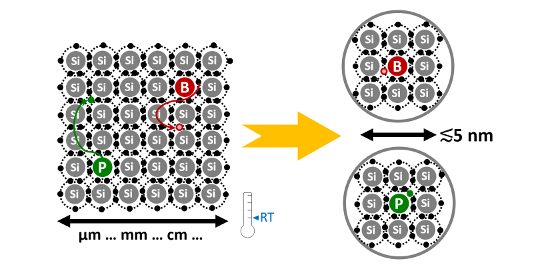
- attributed to dielectric relaxation, the P-doped Si NC samples clearly show mobile charge redistributions on a longer timescale. For the B-doped Si NCs the situation is less clear, since the noise level is reached earlier. A likely cause for this behaviour might be a lower density of redistributable charge
- dielectric relaxation. From the doped samples (black filled circles) only SRO:B has a similar value (being slightly below its reference). All other doped NC-samples have free carrier concentrations in the 1016 cm−3 range. In order to exclude a contribution to the free carrier values from the dielectric
- relaxation, we subtract the reference-values to obtain the effective free carrier density (NF,eff, red spheres in Figure 7b). It is obvious that P dominates over B and SRON over SRO: Sample SRON:P has about twice the integral charge than SRO:P and SRON:B is an order of magnitude lower than SRON:P. In this


Formation and development of nanometer-sized cybotactic clusters in bent-core nematic liquid crystalline compounds
Beilstein J. Nanotechnol. 2018, 9, 1288–1296, doi:10.3762/bjnano.9.121
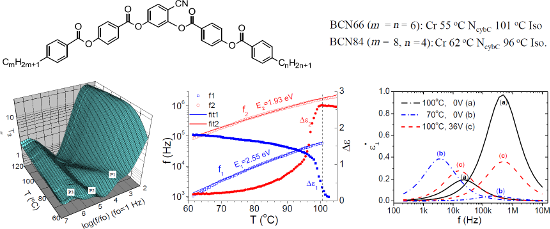
- compounds, two relaxation processes are identified and assigned to (i) collective dynamics of molecules in nanometer-sized cybotactic clusters and (ii) individual molecular relaxations, in the ascending order of frequency of the probe field. The temperature and the bias electric field dependence of the
- dielectric strength and relaxation frequency for these processes are shown to give rise to sharpness in cluster boundaries, increased size and volume fraction in the LC nematic phase. The effect of the bias field on the LC cell is similar to reducing its temperature; both variables increase the cluster size
- Kirkwood correlation factor [56]. In that study [48] they used the reasoning that the relaxation time and the dielectric strength of the short-range polar correlations are proportional to the correlation length or the cluster size. The molecular mode corresponded to the dynamics of individual molecules


Field-controlled ultrafast magnetization dynamics in two-dimensional nanoscale ferromagnetic antidot arrays
Beilstein J. Nanotechnol. 2018, 9, 1123–1134, doi:10.3762/bjnano.9.104
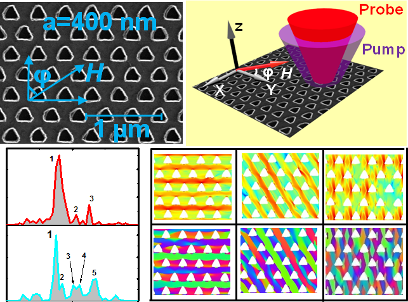
- three important temporal regimes, namely, the ultrafast demagnetization (region I), fast relaxation (region II), and precessional motion superposed on a slow relaxation (region III). We have further performed precise measurements of the time-resolved Kerr rotation for about 3 ps from the zero delay with
- contains two exponentials with time constants tm and te representing the demagnetization and the fast relaxation time, respectively. H(t) and δ(t) represent the Heaviside step function and the Dirac delta function, respectively. A1, A2, and A3 are constants. From the fit we have obtained the ultrafast
- demagnetization time as 204 ± 3 fs and the fast relaxation as 1.0 ± 0.01 ps. This is followed by the slower relaxation process which occurs within 400 ± 7 ps, while the precessional oscillation is found to be superposed on the slower relaxation process. Figure 1d shows the precessional dynamics after removing the



Imaging of viscoelastic soft matter with small indentation using higher eigenmodes in single-eigenmode amplitude-modulation atomic force microscopy
Beilstein J. Nanotechnol. 2018, 9, 1116–1122, doi:10.3762/bjnano.9.103
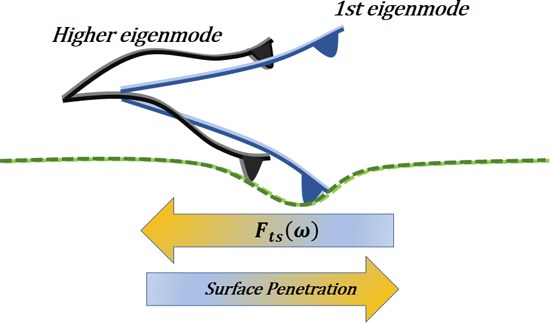
- apex, δ is the tip indentation and G(t) is the shear relaxation modulus, which in our case is described by the Generalized Maxwell (also called Wiechert) model (see Figure 1): where τn = ηn/Gn is the ratio between viscosity (ηn) and modulus (Gn) in the n-th arm in the model in Figure 1. The values for


Non-equilibrium electron transport induced by terahertz radiation in the topological and trivial phases of Hg1−xCdxTe
Beilstein J. Nanotechnol. 2018, 9, 1035–1039, doi:10.3762/bjnano.9.96
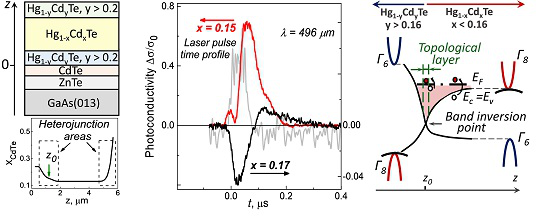
- processes characterized by different relaxation time parameters. We will address here only to relatively fast processes with the characteristic times of 100–200 ns. The long-term photoconductivity observed at longer times after the laser pulse end may be due to photoinduced transitions to or from the local


An implementation of spin–orbit coupling for band structure calculations with Gaussian basis sets: Two-dimensional topological crystals of Sb and Bi
Beilstein J. Nanotechnol. 2018, 9, 1015–1023, doi:10.3762/bjnano.9.94
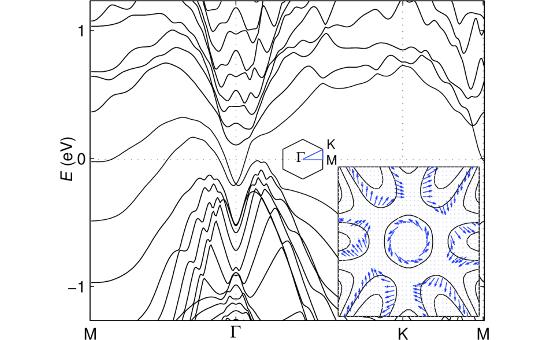
- –Burke–Ernzerhof local density approximation [42] to the functional for different basis sets. Panel (a) shows the results using the VASP [12] package. Calculations are performed with a plane-wave cutoff of 400 eV on a 15 × 15 × 1 Monkhorst–Pack k-point mesh. For structural relaxation, all atoms are


Bioinspired self-healing materials: lessons from nature
Beilstein J. Nanotechnol. 2018, 9, 907–935, doi:10.3762/bjnano.9.85
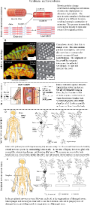
- great deal of research has been put into the current understanding of muscle movement, as described by [42]. Through regulation and interaction, these two proteins slide past one another, causing a reversible extension/contraction and then relaxation of muscle on a macroscale, as detailed by [43]. This
- sum up, when looking at the healing nature of muscle movement, it is important to note the reversible nature of the movement. In other words, every animal has the ability to return to form and function after every movement (contraction and relaxation) through the transformation of (chemical) energy to







Optical orientation of nematic liquid crystal droplets via photoisomerization of an azodendrimer dopant
Beilstein J. Nanotechnol. 2018, 9, 870–879, doi:10.3762/bjnano.9.81
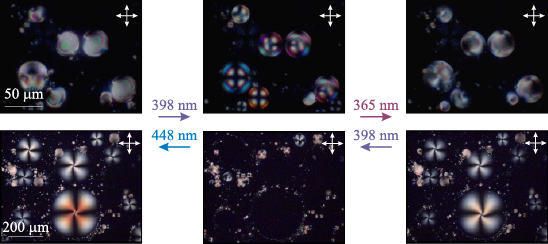
- relaxation. The first term on the right-hand side of Equation 1 describes the increase of the cis isomer fraction due to the light excitation of trans isomers and their possible change (with the probability Φtrans) of the conformational state. The second and third terms describe the decrease of cis isomer
- fraction due to the light excitation (with the probability Φcis = 1 − Φtrans) and thermal cis→trans relaxation. The thermal relaxation can be neglected at . Using this condition, in the stationary case (dXcis/dt = 0), Equation 1 can be rewritten in the following form: Thus the relative concentrations of


Dynamics and fragmentation mechanism of (C5H4CH3)Pt(CH3)3 on SiO2 surfaces
Beilstein J. Nanotechnol. 2018, 9, 711–720, doi:10.3762/bjnano.9.66
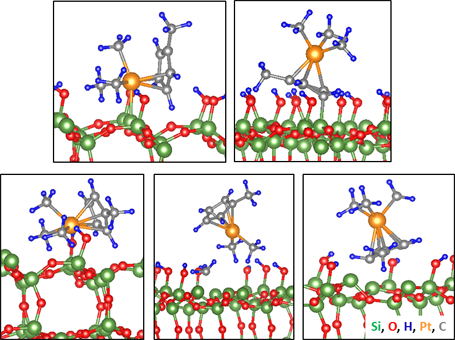
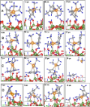
- during geometry relaxation and hence are not discussed further. The calculated adsorption energies (EA) are summarized in Table 1 and the configurations are summarized in Figure 2. The calculated values of EA of (C5H4CH3)Pt(CH3)3 on 11% partially dehydroxylated surfaces indicates that the most stable
- for discussion. In Model-4, where the centroid of the methylcyclopentadienyl ring is oriented on top of a Si atom in the initial configuration, a spontaneous bond formation between one of the carbon atoms of the ring and the surface Si atom is observed during relaxation. There has been no evidence for
- Figure 1. In the most stable configuration for the 22% case (panel d), one of the three methyl groups bonded to Pt dissociates spontaneously during relaxation. Color code: green – Si, red – O, orange – Pt, gray – C and blue – H throughout this manuscript. To better display the changes occurring the



Electron interactions with the heteronuclear carbonyl precursor H2FeRu3(CO)13 and comparison with HFeCo3(CO)12: from fundamental gas phase and surface science studies to focused electron beam induced deposition
Beilstein J. Nanotechnol. 2018, 9, 555–579, doi:10.3762/bjnano.9.53
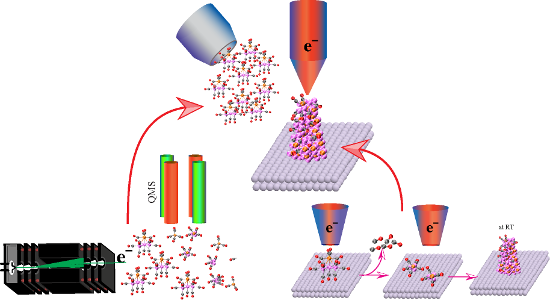
- similar on all metal atoms. Relaxation to the ground state anionic geometry (Figure 6b), however, leads to a relative increase in the spin density on the Ru base plane atoms as compared to the Fe-apex. It is clear that the comparison of the iso-surfaces for the respective MOs for H2FeRu3(CO)13 and HFeCo3
- (CO)12, the spin density of their anions and the geometrical changes between the respective neutral and anionic ground states, does not offer a quantitative explanation of their different behavior with regards to DEA. However, the difference is significant, especially with regards to the relaxation of
- the metal–metal bonds between the base plane and the apex as well as within the base plane. While the relaxation of the ground state anion of HFeCo3(CO)12 leads to a spontaneous and significant weakening of the metal bonds from the base plane to the apex, the bond weakening within H2FeRu3(CO)13 is


Green synthesis of fluorescent carbon dots from spices for in vitro imaging and tumour cell growth inhibition
Beilstein J. Nanotechnol. 2018, 9, 530–544, doi:10.3762/bjnano.9.51
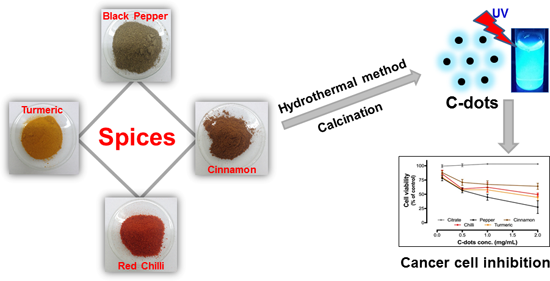
- -dependent emission typically observed in C-dots has been attributed to the presence of multi-emission centres, C-dot size distribution, slow solvent relaxation and the existence of multi-aggregation [8][9]. Also, the optical properties of C-dots are strongly dependent on their local environment, and
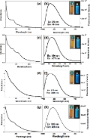


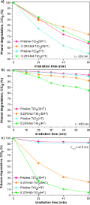
Influence of the preparation method on the photocatalytic activity of Nd-modified TiO2
Beilstein J. Nanotechnol. 2018, 9, 447–459, doi:10.3762/bjnano.9.43
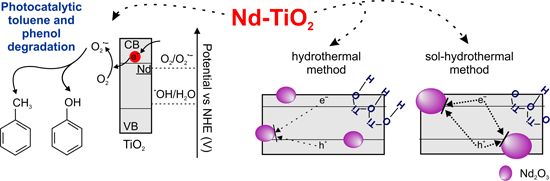
- energy of photons to penetrate deeper into the surface of the material [11]. This phenomenon can also be explained by the spectroscopic properties of rare earth ions. In our previous paper [23], it has been proven that Nd3+ ions are prone to cross-relaxation (energy migration between Nd3+ ions




Dynamic behavior of nematic liquid crystal mixtures with quantum dots in electric fields
Beilstein J. Nanotechnol. 2018, 9, 399–406, doi:10.3762/bjnano.9.39

- on a sample containing 0.89% (mass fraction) of CdSe/ZnS quantum dots revealed a decrease of the relaxation time compared to pure 5CB. Keywords: Fréedericksz transition; nematic liquid crystals; quantum dots; Introduction The expansion of liquid crystal (LC)-based devices in common life domains as
- quantum dot surface. Dynamic experiments performed in alternating electric fields proved that by adding a small amount of CdSe/ZnS quantum dots in thermotropic nematic liquid crystal with positive dielectric anisotropy, we obtain a decrease of the relaxation time. When an external electric field higher
- sample. The time period after which a constant intensity is obtained, which means that an equilibrium state is reached, is characterized by the relaxation time and can be experimentally evaluated from plotting the intensity as a function of the time. A theoretical analysis of the LC + QDs system based on


Periodic structures on liquid-phase smectic A, nematic and isotropic free surfaces
Beilstein J. Nanotechnol. 2018, 9, 342–352, doi:10.3762/bjnano.9.34
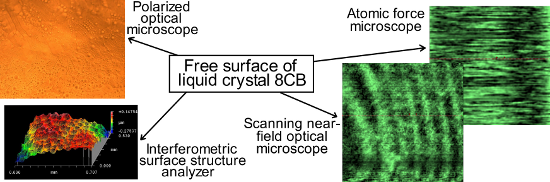
- by similar equations. This mechanism explains why several minutes are needed to form the stripes. This time corresponds to charge diffusion to the stable position in the striped structure. This mechanism explains the striped appearance in the nematic phase and isotropic liquid. After some relaxation
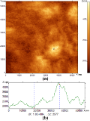
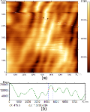
- from the nematic phase. Topographical (a) and SNOM (b) images of SmA on Si substrate droplet edge, cross sections of both images (c) and (d). Equilibrium surface state of SmA phase after 30 minutes of relaxation at room temperature. SNOM image of SmA on Si substrate droplet edge at room temperature (a









Design of polar self-assembling lactic acid derivatives possessing submicrometre helical pitch
Beilstein J. Nanotechnol. 2018, 9, 333–341, doi:10.3762/bjnano.9.33
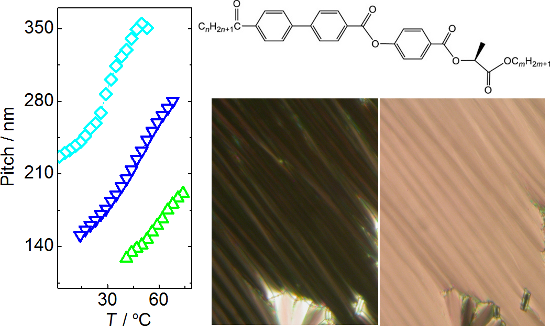
- Goldstone mode (this relaxation mode is related to azimuthal fluctuations of the molecules in the smectic layer) with a typical relaxation frequency of several kHz. This behaviour fully confirms the ferroelectric character of the SmC* phase detected for all studied materials from the KL n/m series. The
- relaxation frequency of the mode slightly decreases with the temperature decrease while the dielectric strength is decreased to a local minimum value and then begins to increase until crystallisation occurs. This is quite typical behaviour for the Goldstone mode at the ferroelectric SmC* phase [39][53][54


Dynamic behavior of a nematic liquid crystal with added carbon nanotubes in an electric field
Beilstein J. Nanotechnol. 2018, 9, 233–241, doi:10.3762/bjnano.9.25
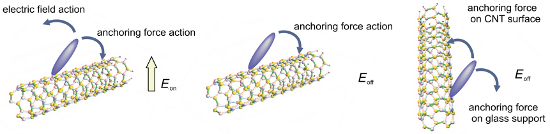
- theoretical model based on elastic continuum theory was developed and the relaxation times of nematic liquid crystals with CNTs were evaluated. Experiments made with single-walled carbon nanotubes dispersed in nematic 4-cyano-4’-pentylbiphenyl (5CB) indicated a significant difference of the relaxation time
- when compared to pure liquid crystal. We also noticed that the relaxation time when the field is switched off depends on how long the field was applied. It is shorter when the field is switched off immediately after application and longer when the field was applied for at least one hour. Keywords
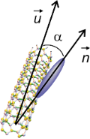
- movement is characterized by the relaxation time. Experimentally it can be determined by measuring the intensity of a light beam traversing the sample as a function of the time. A theoretical model based on elastic continuum theory, in which the interaction between carbon nanotubes and LC molecules is

![[Graphic 1]](/bjnano/content/inline/2190-4286-9-25-i33.svg?max-width=637&scale=1.18182) is the undistu...
is the undistu...



Dielectric properties of a bisimidazolium salt with dodecyl sulfate anion doped with carbon nanotubes
Beilstein J. Nanotechnol. 2018, 9, 164–174, doi:10.3762/bjnano.9.19
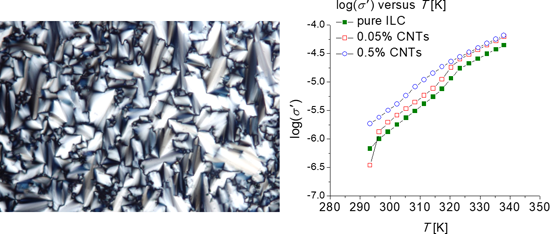
- low frequencies confirm the presence of EP. Keywords: activation energy; carbon nanotubes; dielectric spectroscopy; ionic liquid crystal; relaxation time; Introduction Ionic liquid crystals (ILCs) represent a very appealing class of materials that has found various recent applications in dye
- CNT concentration. The characteristic relaxation times were obtained by fitting the spectra of the dielectric loss with the Havriliak–Negami (HN) function [52]: where ε′(ω) is the permittivity and ε″(ω) is the dielectric loss, εLF is the low-frequency (LF) permittivity and ε∞ is the permittivity in
- the high-frequency (HF) limit and τmax is the characteristic relaxation time of the dielectric relaxation process. The dependency τmax = f(1/T) can be modeled using the Vogel–Fulcher–Tammann (VFT) law, as follows: where A is a material constant, kB is Boltzmann’s constant, T is the temperature, TV is


Electrical properties of a liquid crystal dispersed in an electrospun cellulose acetate network
Beilstein J. Nanotechnol. 2018, 9, 155–163, doi:10.3762/bjnano.9.18
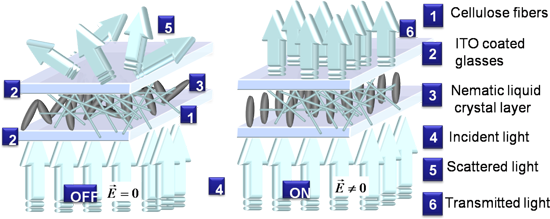
- techniques, such as polarized optical microscopy, dielectric spectroscopy and impedance measurements. Dielectric constant and electric energy loss were studied as a function of frequency and temperature. The activation energy was evaluated and the relaxation time was obtained by fitting the spectra of the
- in the high frequency (HF) domain, one notices a relaxation process outside the measurement domain, while in the low frequency (LF) range, two CA-attributable almost overlapping relaxation processes can be observed at 1 Hz and 1000 Hz. The CA/E7 sample exhibits a relaxation process due to the LC in
- the HF measurement range, and two almost overlapping relaxation processes in the LF range. The characteristic relaxation times were obtained by fitting the spectra of the dielectric constant and dielectric loss with the Havriliak–Negami function [37][38][39][40]: where ε′(ω) is the dielectric constant


Dopant-stimulated growth of GaN nanotube-like nanostructures on Si(111) by molecular beam epitaxy
Beilstein J. Nanotechnol. 2018, 9, 146–154, doi:10.3762/bjnano.9.17
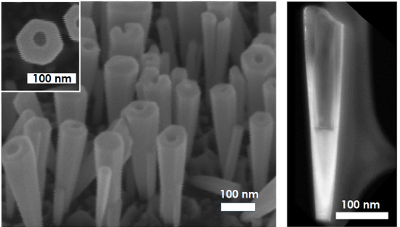
- defect-free structures on highly mismatched substrates, e.g., GaN NWs on Si [7][8]. NWs usually possess high crystal quality due to the effective mechanical stress relaxation at a distance of about one NW base diameter from the substrate. Nanowires synthesized on Si are very promising nanostructures in
- threading dislocations [32][33][34] followed by transition to three-dimensional growth of nanoislands [33][35]. The phenomenon of the Si solubility limit elevation in GaN NWs is usually explained again through effective stress relaxation due to the large surface area of these nanostructures. This work is





