Search results
Search for "azobenzenes" in Full Text gives 68 result(s) in Beilstein Journal of Organic Chemistry.
London dispersion as important factor for the stabilization of (Z)-azobenzenes in the presence of hydrogen bonding
Beilstein J. Org. Chem. 2018, 14, 1238–1243, doi:10.3762/bjoc.14.106
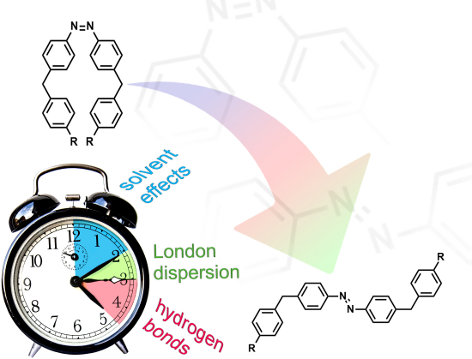
- Andreas H. Heindl Raffael C. Wende Hermann A. Wegner Institut für Organische Chemie, Justus-Liebig-Universität Gießen, Heinrich-Buff-Ring 17, 35392 Gießen, Germany 10.3762/bjoc.14.106 Abstract The understanding and control of the light-induced isomerization of azobenzenes as one of the most
- important classes of molecular switches is crucial for the design of light-responsive materials using this entity. Herein, we present the stabilization of metastable (Z)-azobenzenes by London dispersion interactions, even in the presence of comparably stronger hydrogen bonds in various solvents. The Z→E
- isomerization rates of several N-substituted 4,4′-bis(4-aminobenzyl)azobenzenes were measured. An intramolecular stabilization was observed and explained by the interplay of intramolecular amide and carbamate hydrogen bonds as well as London dispersion interactions. Whereas in toluene, 1,4-dioxane and tert


Determination of the absolute stereostructure of a cyclic azobenzene from the crystal structure of the precursor containing a heavy element
Beilstein J. Org. Chem. 2016, 12, 2211–2215, doi:10.3762/bjoc.12.212
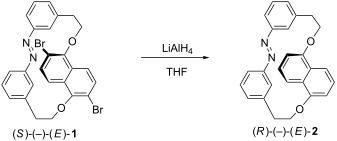
- solvent etc. [45][46][47][48][49][50]. Although we could separate the enantiomers of all these chiral cyclic azobenzenes, the experimental determination of the absolute stereostructure by X-ray diffraction was difficult due to the lack of heavy elements. In the present study, we demonstrate the


The role of alkyl substituents in deazaadenine-based diarylethene photoswitches
Beilstein J. Org. Chem. 2016, 12, 1103–1110, doi:10.3762/bjoc.12.106
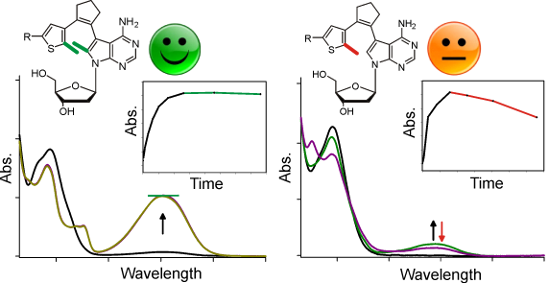
- ][18][19][20][21]. Most reported applications use azobenzenes, while diarylethenes, spiropyrans, fulgides and hemithioindigos are applied less frequently [18][19][20][21][22][23][24][25][26][27][28][29][30]. Diarylethenes are an important class of photoswitches. Originally developed for optical


Azobenzene-based inhibitors of human carbonic anhydrase II
Beilstein J. Org. Chem. 2015, 11, 1129–1135, doi:10.3762/bjoc.11.127
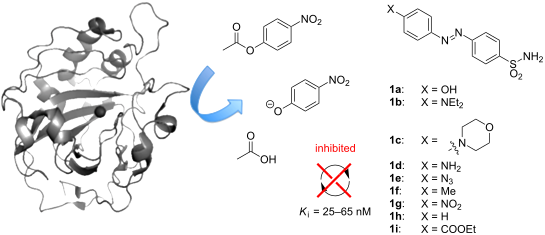
- of the synthesized azobenzenes, we found that the electronic structure does not strongly affect inhibition. Taken together, all compounds are strong blockers of hCAII with Ki = 25–65 nM that are potentially photochromic and thus combine studies from chemical synthesis, crystallography and enzyme
- (Figure 1b) [5]. Furthermore, sulfonamide-containing azobenzenes exhibit affinity and blocking ability for hCAII (Figure 1c) [6]. With our knowledge in azobenzene chemistry and photopharmacology, we aimed to further understand how electronic substitution patterns on azobenzenes correlate to changes in
- enzyme affinity. Results and Discussion Azobenzenes can be synthesized by a variety of known chemical transformations [8]. Among them the most widely used is the diazotization of aniline, followed by trapping of the diazonium salt with an electron-rich aromatic compound (such as anilines and phenols


Synthesis of photoresponsive cholesterol-based azobenzene organogels: dependence on different spacer lengths
Beilstein J. Org. Chem. 2015, 11, 1089–1095, doi:10.3762/bjoc.11.122
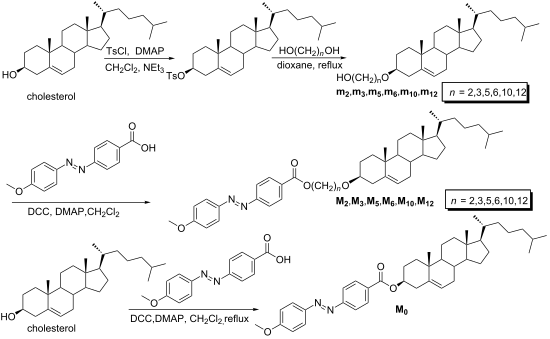
- have been utilized in supramolecular systems [19]. Examples of several cholesterol-linked azobenzenes with gel–sol reversible changes also have been studied [20][21][22][23]. R. Zentel found that the photoinduced reversible gel–sol changes between isotropic and anisotropic gels of a class of


Synthesis and characterization of a new photoinduced switchable β-cyclodextrin dimer
Beilstein J. Org. Chem. 2014, 10, 2874–2885, doi:10.3762/bjoc.10.304
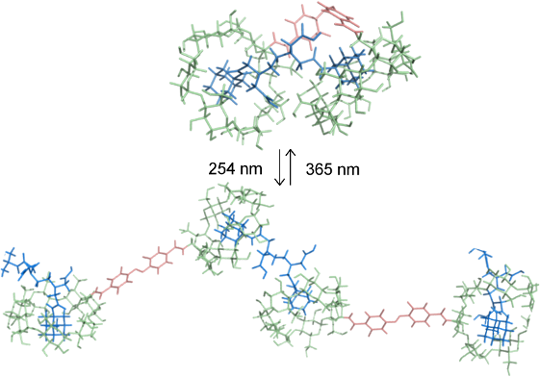
- to the guest molecules [9][10]. These cyclodextrins linked by ester [11], thioether [12][13][14][15][16], urea [17][18][19], or triazole [20] moieties have been previously described. In addition, aromatic azobenzenes are excellent candidates as molecular switch linkers as they have two forms, namely



Photoswitchable precision glycooligomers and their lectin binding
Beilstein J. Org. Chem. 2014, 10, 1603–1612, doi:10.3762/bjoc.10.166
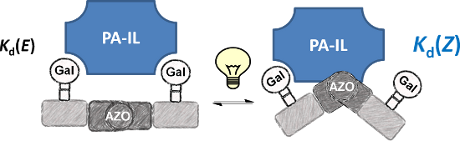
- oligomer shape and concomitantly in the sugar ligands accessibility. Indeed, dramatic shrinking of rigid-rod polymers for example, occurs upon photoirradiation when several azobenzenes are introduced in the main-chain, the embedded photoswitches acting as hinges [17][18]. In the present study, an
- ), whereas 10% of E,E-isomer did not isomerize (see Supporting Information File 1 for more details). This values correspond to a total amount of 80% of Z-azobenzenes in the PSS mixture, in accordance to the 78% of Z-azobenzene found in the PSS solution of Azo-Gal(1,3)-3 upon irradiation at 360 nm, indicating


Amino-substituted diazocines as pincer-type photochromic switches
Beilstein J. Org. Chem. 2013, 9, 1–7, doi:10.3762/bjoc.9.1
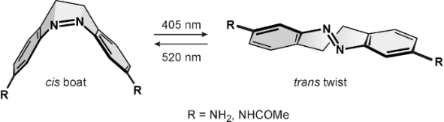
- Abstract Azobenzenes are robust, reliable, and easy to synthesize photochromic switches. However, their high conformational flexibility is a disadvantage in machine-like applications. The almost free rotation of the phenyl groups can be restricted by bridging two ortho positions with a CH2CH2 group, as
- ; molecular pincer; molecular switches; photochromic compound; Introduction Azobenzenes probably are the most frequently used photochromic switches in chemistry. They are employed as molecular actuators to drive a number of dynamic machine-like functions [1]. To achieve sophisticated engineering tasks such
- or with other molecules. Therefore, we explore different approaches to prepare diazocine derivatives. Since the nomenclature is not unambiguous and, hence, potentially confusing, we refer to 5,6-dihydrodibenzo[c,g][1,2]diazocine derivatives as 2,2’-ethylene-bridged azobenzenes (EBABs). Results and





Design and synthesis of a photoswitchable guanidine catalyst
Beilstein J. Org. Chem. 2012, 8, 1825–1830, doi:10.3762/bjoc.8.209
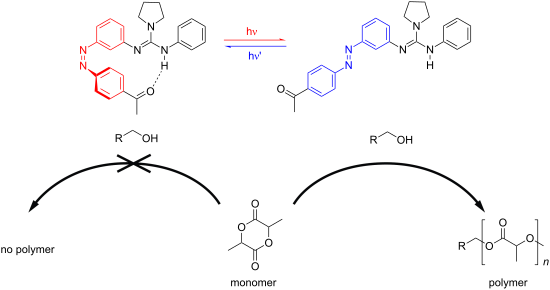
- rac-lactide in order to explain the findings. Keywords: azobenzenes; guanidines; molecular switches; organocatalysis; photochromism; ring opening polymerization; Introduction The macroscopic properties of a given polymer, e.g., the glass-transition temperature, morphology, density and tensile


Control over molecular motion using the cis–trans photoisomerization of the azo group
Beilstein J. Org. Chem. 2012, 8, 1071–1090, doi:10.3762/bjoc.8.119
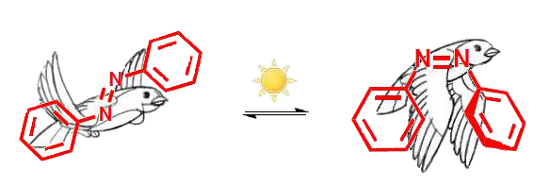
- .8.119 Abstract Control over molecular motion represents an important objective in modern chemistry. Aromatic azobenzenes are excellent candidates as molecular switches since they can exist in two forms, namely the cis (Z) and trans (E) isomers, which can interconvert both photochemically and thermally
- external stimuli. Keywords: azobenzenes; molecular switches; nanomachines; photoisomerization; Review This review is based on an article published in 2009 in Anales de Química (Real Sociedad Española de Química) [1]. Azobenzene was described for the first time in 1834 [2] and one century later, in 1937
- switches described so far. The azobenzenes are organic molecules that present two aromatic rings linked by an azo group (N=N). They have properties that have led to some applications of great importance, mainly for the chemical industry. The azobenzenes are highly coloured compounds and belong to the group


The effect of the formyl group position upon asymmetric isomeric diarylethenes bearing a naphthalene moiety
Beilstein J. Org. Chem. 2012, 8, 1018–1026, doi:10.3762/bjoc.8.114
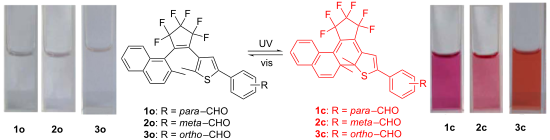
- molecules must possess the following properties: (1) low cytotoxicity, (2) high sensitivity, (3) easy chemical modification. In the past few decades, various types of photochromic molecules, such as fulgides, spiropyranes, azobenzenes, and diarylethenes, have been developed [2][23][24][25][26][27][28][29


Recent advances towards azobenzene-based light-driven real-time information-transmitting materials
Beilstein J. Org. Chem. 2012, 8, 1003–1017, doi:10.3762/bjoc.8.113
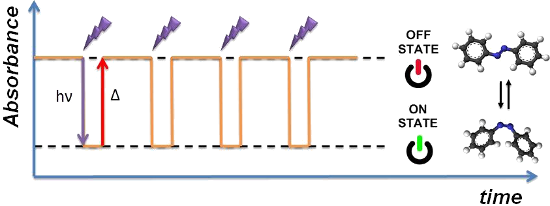
- devices. Many different organic photochromic molecules are known in photochemistry, such as azobenzenes, stilbenes, spiropyranes, fulgides, diarylethenes and chromenes among many others (Figure 1) [16]. The photochromic processes that take place when such compounds are illuminated can be divided in three
- to the initial isomer even at elevated temperatures (e.g., fulgides and diarylethenes). ● T-type (thermally reversible type); the photogenerated isomer thermally reverts to the initial form (e.g., azobenzenes, stilbenes or spiropyranes). One of the most used organic chromophores for optical switching
- applications are certainly azobenzenes. Azobenzene, a photochromic T-type system, exhibits a reversible isomerisation process between its trans and cis isomers of different stability. In this process, the photoreaction simply causes the rearrangement of the electronic and nuclear structure of the molecule







Diarylethene-modified nucleotides for switching optical properties in DNA
Beilstein J. Org. Chem. 2012, 8, 905–914, doi:10.3762/bjoc.8.103
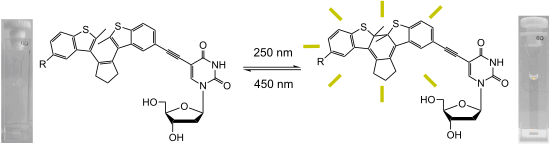
- [5][6][7][8], azobenzenes [9], spirobenzopyrans [10] and diarylethenes [11] represent the most promising candidates for introducing photoswitching functionality into biopolymers, and thereby for regulating biological activity [12][13]. Azobenzenes were designed and synthesized as artificial
- polymerase reaction [18], photocontrol DNA triplex formation [19], and drive photon-fueled DNA-based nanomachines [20][21]. Concerning the extent of structural change, the cis–trans isomerization of azobenzenes behaves much simpler than the ring opening of spiropyrans to merocyanines. In the latter case not





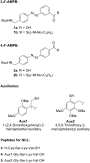
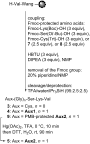
Building photoswitchable 3,4'-AMPB peptides: Probing chemical ligation methods with reducible azobenzene thioesters
Beilstein J. Org. Chem. 2012, 8, 890–896, doi:10.3762/bjoc.8.101
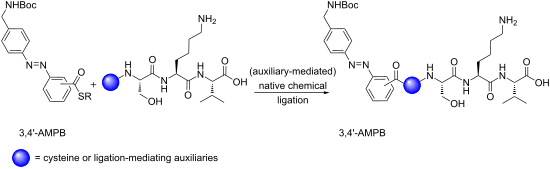
- 4,5,6-trimethoxy-2-mercaptobenzyl auxiliary as well as the Nα-2-mercaptoethyl auxiliary. Thus, 3,4'-AMPB derivatives/peptides proved to be significantly less prone to reduction by aliphatic and aromatic thiols than were the 4,4'-AMPB compounds. Keywords: acyl transfer auxiliary; azobenzenes; ligation
- ; molecular switches; peptides; redox chemistry; Introduction Optical switches not only offer the advantage to elucidate, but also to control biological processes with high spatial and temporal resolution by using light, either in vitro or in vivo [1]. In this context, azobenzenes remain a privileged class
- thiol molecule at the N-sulfenohydrazodiarene B, yielding the symmetric disulfide and the respective hydrazine thioester or hydrazine peptide (Scheme 3, reaction 2). The reduction of diazene units by thiols has been intensively studied in the past for electron-poor azobenzenes or azodicarboxylates, en





meta-Oligoazobiphenyls – synthesis via site-selective Mills reaction and photochemical properties
Beilstein J. Org. Chem. 2012, 8, 877–883, doi:10.3762/bjoc.8.99
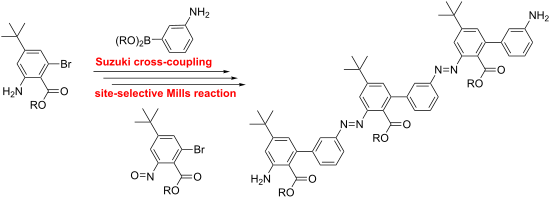
- -azobenzenes did not show any photochromicity. Therefore, in recent examples in the literature the azo-units have been dissected by incorporation of biphenyl units. Hecht and co-workers investigated the effect of the electronic coupling in detail and showed that the incorporation of ortho-methyl groups on the
- . Isomerization studies Compounds 13, 15, 16 and 2 were analyzed by UV spectroscopy. All of them exhibit the typical behavior of azobenzenes, with a strong absorption at 330 nm for the π–π* transition and a weak absorption at 430 nm for the n–π* transition (Figure 3). For compounds 16 and 2 an increased


Molecular switches and cages
Beilstein J. Org. Chem. 2012, 8, 870–871, doi:10.3762/bjoc.8.97
- photoswitches continue to emerge and “old friends”, such as azobenzenes are constantly improved and optimized. This is not only true with respect to their photophysical properties but also with regard to their synthetic accessibility. Indeed, as molecular switches are applied in ever-increasing quantities, the
- features include their absorption spectra, conductivity, geometry and bistability, as well as their polarity, solubility, efficacy, or catalytic activity. Photoswitches are covered extensively, ranging from diarylethenes (Pu, Wagenknecht) to dihydroazulenes/vinylheptafulvenes (Nielsen) and azobenzenes
- (Rück-Braun, Hoppmann). Two reviews discuss cis-azobenzenes with rapid thermal isomerization kinetics (Velasco), and highlight the azobenzene moiety as one of the smallest light-driven molecular motors conceivable (Merino). Issues of bistability are also addressed in an account on shape-persistent
Azobenzene dye-coupled quadruply hydrogen-bonding modules as colorimetric indicators for supramolecular interactions
Beilstein J. Org. Chem. 2012, 8, 486–495, doi:10.3762/bjoc.8.55
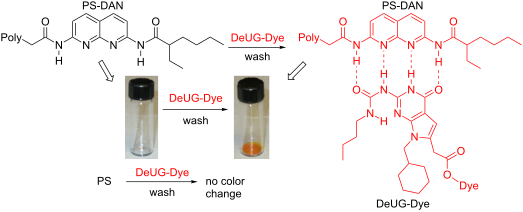
- and exhibit a range of vivid colors. Furthermore, the application of azobenzenes in chemistry is quite broad and includes their use as switches [42], in nonlinear optics [43], sensing devices [44], and in nanostructured films for optical storage [45]. Although this work does not focus on switching


Synthesis of novel photochromic pyrans via palladium- mediated reactions
Beilstein J. Org. Chem. 2009, 5, No. 25, doi:10.3762/bjoc.5.25
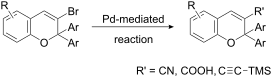
- -electronic devices, e.g. as logic gates [1]. In the life sciences, functionalized azobenzenes [6], hemithioindigos [7][8] and fulgimides [9][10] among other classes of photoswitches, have already proven to be valuable tools for photo-controlling the structure and function of complex biomolecules [6][7][8][9