


Search results
Search for "stereoisomers" in Full Text gives 242 result(s) in Beilstein Journal of Organic Chemistry. Showing first 200.
Improving the accuracy of 31P NMR chemical shift calculations by use of scaling methods
Beilstein J. Org. Chem. 2023, 19, 36–56, doi:10.3762/bjoc.19.4
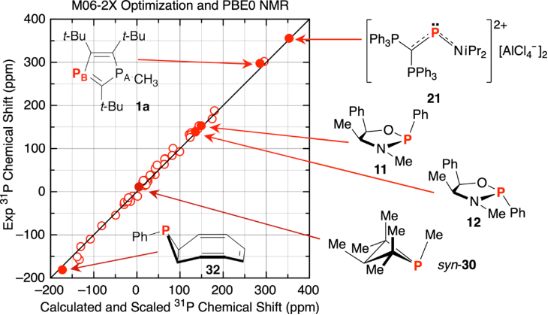
- ; stereoisomers; Introduction Calculation of 1H and 13C NMR chemical shifts and coupling constants using density functional theory (DFT) has increasingly become an adjunct to structure determination [1][2][3][4][5][6][7][8]. In particular for complex organic compounds, determination of relative stereochemistry
- . Calculated 31P NMR chemical shifts for stereoisomers and unusual structures. We next chose our own set of phosphorus compounds (Figure 5, 11–29; for simplicity compounds 30–34[O] discussed later are included in the MAD/RMSD values here). This was done to to determine if the calculation and scaling would be
- accurate enough to distinguish stereoisomers via chemical shifts rather than coupling constants [72][73] and provide confirmation of unusual structures and chemical shifts, and with the further stipulation that multiple P–C bonding would likely give inaccurate M06-2X NMR calculations (Table 3; results with




Preparation of an advanced intermediate for the synthesis of leustroducsins and phoslactomycins by heterocycloaddition
Beilstein J. Org. Chem. 2022, 18, 1385–1395, doi:10.3762/bjoc.18.143
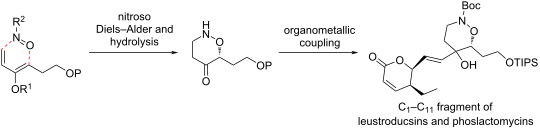
- pressure. Purification by column chromatography (5% Et2O/pentane), gave 19 as a colourless oil (866 mg, 94%, 91/9 mixture of stereoisomers). Analytical data were in agreement with literature data [18]. (2R,3S,6RS)-3-Ethyl-2-((E)-2-iodovinyl)-6-methoxy-3,6-dihydro-2H-pyran (20): This compound was prepared


Synthesis of tryptophan-dehydrobutyrine diketopiperazine and biological activity of hangtaimycin and its co-metabolites
Beilstein J. Org. Chem. 2022, 18, 1159–1165, doi:10.3762/bjoc.18.120
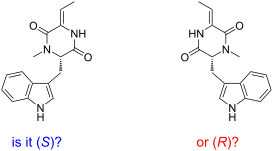
- well as the previously synthesised HTM222 (2) and 1 isolated from S. spectabilis. Neither 2 nor any of the stereoisomers of 4 showed antibacterial effects against a panel of Gram-positive and Gram-negative organisms (Supporting Information File 1, Table S2). Only 1 exhibited concentration-dependent


Electroreductive coupling of 2-acylbenzoates with α,β-unsaturated carbonyl compounds: density functional theory study on product selectivity
Beilstein J. Org. Chem. 2022, 18, 956–962, doi:10.3762/bjoc.18.95

- Discussion The electroreduction of methyl 2-formylbenzoate (1a) with acrylonitrile (2a) was carried out in 0.3 M Bu4NClO4/THF in the presence of TMSCl at 0.1 A (2.5 F/mol). From the crude product, cyclized product 6a was obtained by column chromatography as a complex mixture of stereoisomers. Since compound


The stereochemical course of 2-methylisoborneol biosynthesis
Beilstein J. Org. Chem. 2022, 18, 818–824, doi:10.3762/bjoc.18.82
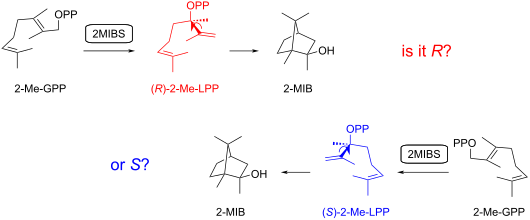
- stereoisomers (5:2) that were separated by column chromatography (Scheme 2). Reduction of (E)-3 with DIBAl-H gave 2-methylgeraniol (4) that was converted under Sharpless conditions [36] into the epoxides (2R,3R)-5a using ᴅ-(−)-diisopropyl tartrate (DIPT) and (2S,3S)-5b with ʟ-(−)-DIPT. The enantiomeric purity




The asymmetric Henry reaction as synthetic tool for the preparation of the drugs linezolid and rivaroxaban
Beilstein J. Org. Chem. 2022, 18, 438–445, doi:10.3762/bjoc.18.46
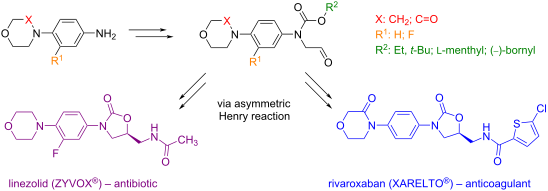
- the starting aldehydes on the enantioselectivity of the Henry reaction was examined. Moreover, the resulting nitroaldols 22, 24, and 26 were formed as a pair of epimers, and therefore, a possible separation of the individual stereoisomers of these compounds was assumed. Hence, it should be noted that
- of stereoisomers that are easier to separate by standard techniques than enantiomers. In particular, an exploration of convenient chromatographic conditions was performed. Unfortunately, none of the conditions was successful even though all derivatives were tested. Subsequently, the separation of the


Synthetic strategies toward 1,3-oxathiolane nucleoside analogues
Beilstein J. Org. Chem. 2021, 17, 2680–2715, doi:10.3762/bjoc.17.182
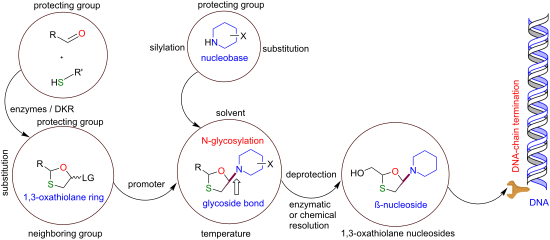
- ) appeared to be a more effective antiviral agent than AZT in PBM cells and U937 cells [13]. The BCH-189 core structure bears two stereocenters, and hence four stereoisomers are possible. The individual stereoisomers were also evaluated against HIV-1 activity in PBM cells and based on this study, it was
- found that out of four stereoisomers, the β-configured ʟ-(−)-enantiomer 1 (EC50 = 0.02 µM) is more potent in primary human lymphocytes than the β-configured ᴅ-(+)-enantiomer 1a (EC50 = 0.2 µM) in CEM cells [14]. Similarly, the 5-fluoro-substituted analogue of cytidine, i.e., β-configured ʟ


Phenolic constituents from twigs of Aleurites fordii and their biological activities
Beilstein J. Org. Chem. 2021, 17, 2329–2339, doi:10.3762/bjoc.17.151
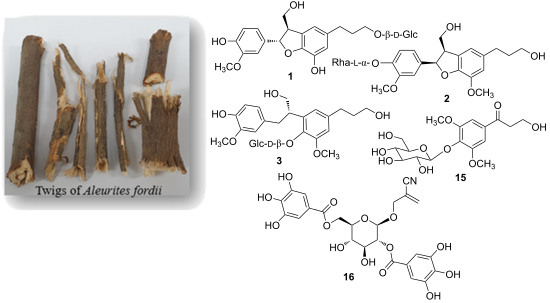
- on NO production and the stereoisomers 2 and 5 demonstrated the difference in activity according to the configuration. Compounds 8 and 16 exhibited neuroprotection effects. Thus, this study indicates that the active phenolic compounds from A. fordii would be potential candidates for drug discovery


Cationic oligonucleotide derivatives and conjugates: A favorable approach for enhanced DNA and RNA targeting oligonucleotides
Beilstein J. Org. Chem. 2021, 17, 1828–1848, doi:10.3762/bjoc.17.125
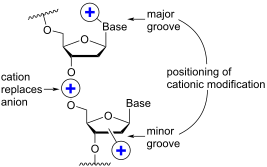
- to create an epimeric mixture of the dinucleotide phosphoramidate-linked derivatives with subsequent separation of the two stereoisomers. These were then incorporated into the desired ONs after O3’-desilylation and phosphitylation of the dimers [107]. The authors found that for each of the sequences


Double-headed nucleosides: Synthesis and applications
Beilstein J. Org. Chem. 2021, 17, 1392–1439, doi:10.3762/bjoc.17.98





N-tert-Butanesulfinyl imines in the asymmetric synthesis of nitrogen-containing heterocycles
Beilstein J. Org. Chem. 2021, 17, 1096–1140, doi:10.3762/bjoc.17.86

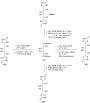
- models were proposed to rationalize organometallic additions to N-sulfinyl imines. The mechanism for obtaining these two stereoisomers was elucidated in the work published by Andersen and co- workers [36]. The origin of the reversal of the diastereofacial selectivity on the change of reducing agents is


Identification of volatiles from six marine Celeribacter strains
Beilstein J. Org. Chem. 2021, 17, 420–430, doi:10.3762/bjoc.17.38
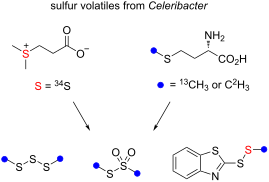
- ·OEt2-catalyzed reaction of bis(benzothiazol-2-yl)disulfane with dimethyl disulfide, giving access to 41 with a yield of 64% (Scheme 2). The synthetic compound 41 showed an identical mass spectrum and retention index compared to the volatile in the Celeribacter extracts. The Z and E stereoisomers of 42
- were obtained by the Michael addition of NaSMe to ethyl propiolate (45), yielding a mixture of stereoisomers inseparable by silica gel column chromatography (92%). The major stereoisomer was found to be (Z)-42 (dr 94:6), whose preferred formation may be a result of a chalcogen–chalcogen interaction
- between the sulfur and an ester oxygen. This phenomenon was first described in supramolecular structures by Gleiter [59] and later also used to explain the outcome of organocatalytic reactions [60]. The pure stereoisomers of 42 were isolated by preparative HPLC, for which the best separation was achieved




Diels–Alder reaction of β-fluoro-β-nitrostyrenes with cyclic dienes
Beilstein J. Org. Chem. 2021, 17, 283–292, doi:10.3762/bjoc.17.27

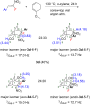
- and stereoisomers, respectively) 3d in 40% overall yield. Two pairs of regioisomers were partially separated by column chromatography with sufficiently slow elution and analyzed by 1H NMR spectroscopy. The structure assignment was made as depicted in Scheme 5. The structures of two pairs of



The preparation and properties of 1,1-difluorocyclopropane derivatives
Beilstein J. Org. Chem. 2021, 17, 245–272, doi:10.3762/bjoc.17.25




Progress in the total synthesis of inthomycins
Beilstein J. Org. Chem. 2021, 17, 58–82, doi:10.3762/bjoc.17.7
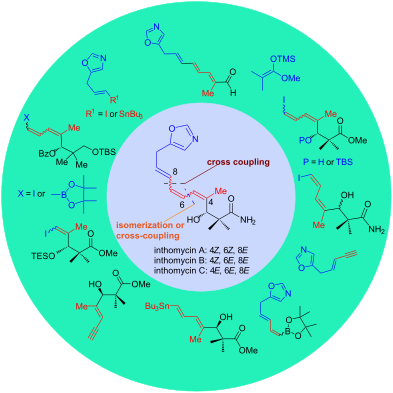
- racemic form (92% yield). The stannane (Z)-(rac)-43 was then subjected to Stille coupling with iodide (E,E)-36b (3:1 mixture of stereoisomers, 3 equiv) using Pd(CH3CN)2Cl2/DMF conditions to produce a 3:1 mixture of (Z,Z,E):(Z,E,E) triene products (rac)-12a and (rac)-12c in 72% yield after 10 h reaction
- produce a 1.2:1 mixture of (Z,Z,E):(Z,E,E) triene products (rac)-12a and (rac)-12c in 74% yield. The stereoisomers (rac)-12a and (rac)-12c were found to be inseparable by chromatography. The isomerically pure bromide (Z)-38 was found to be inert to coupling with vinylstannane (rac)-43 under standard
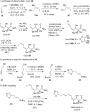
- transformed into (−)-101 using a three-step sequence. Upon iodination of (−)-101 produced iodide (+)-102 in excellent yield. Deiodination of (+)-102 followed by regioselective dihydroxylation with Sharpless’ AD mix-β reagent [64][65] provided diol (−)-103 as a mixture of stereoisomers. Significantly, the diol









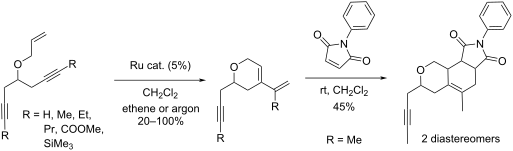
Ring-closing metathesis of prochiral oxaenediynes to racemic 4-alkenyl-2-alkynyl-3,6-dihydro-2H-pyrans
Beilstein J. Org. Chem. 2020, 16, 2757–2768, doi:10.3762/bjoc.16.226
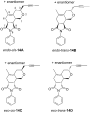
- 46 and 76 kJ/mol. From the activation free Gibbs energy results that two main stereoisomers should be formed, namely the endo-trans 14B (99%) and the exo-cis 14C (1%). The difference among the computed (99% and 1%) and experimentally observed values (29% and 16%) can be explained by a participation
- of other conformations, a lower accuracy of pure functional used, and an incompleteness of the double zeta basis set. The structures of the corresponding transition states 15B, 15C are depicted in Figure 7, and the relative free Gibbs energies of all saddle points for all four stereoisomers are shown




A consensus-based and readable extension of Linear Code for Reaction Rules (LiCoRR)
Beilstein J. Org. Chem. 2020, 16, 2645–2662, doi:10.3762/bjoc.16.215

- structure rules are set to differentiate the stereoisomers or distinct ring structures. A change from primary to secondary stereospecificity is denoted by “ ’ ”, while a change to secondary ring structure is denoted “ ^ ”. A change to both secondary ring and stereospecificity is denoted “ ~ ”. For example


Synthesis of novel fluorinated building blocks via halofluorination and related reactions
Beilstein J. Org. Chem. 2020, 16, 2562–2575, doi:10.3762/bjoc.16.208
- that of the corresponding stereoisomers, it is more likely that the epimerization occurs after the formation of (rac)-T10. Concerning (rac)-8a and 8b as well as (rac)-11a and 11b, the reagent preference was exactly the opposite: DBU in THF under reflux was effective, while t-BuOK in THF under reflux


Leveraging glycomics data in glycoprotein 3D structure validation with Privateer
Beilstein J. Org. Chem. 2020, 16, 2523–2533, doi:10.3762/bjoc.16.204
- glycoprotein profile. Glycomics experiments are required to distinguish stereoisomers and the linkage information in order to obtain a full structural description about a glycan, whereas glycoproteomics are required to establish the glycan variability and occupancy at the glycosylation sites of the protein [43



Hierarchically assembled helicates as reaction platform – from stoichiometric Diels–Alder reactions to enamine catalysis
Beilstein J. Org. Chem. 2020, 16, 2338–2345, doi:10.3762/bjoc.16.195
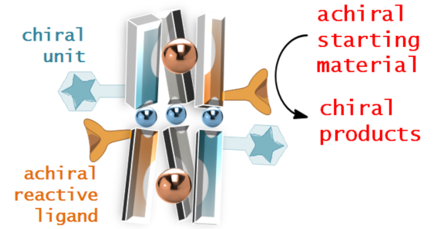
- –carbon (C–C) bond-forming reactions play a key role in organic chemistry. Hereby the stereoselectivity of the reaction is highly important due to the different behavior of stereoisomers in human metabolism [1][2]. Stereocontrol was achieved either via an auxiliary [3][4][5][6][7] or a catalyst [8], both


Styryl-based new organic chromophores bearing free amino and azomethine groups: synthesis, photophysical, NLO, and thermal properties
Beilstein J. Org. Chem. 2020, 16, 2282–2296, doi:10.3762/bjoc.16.189
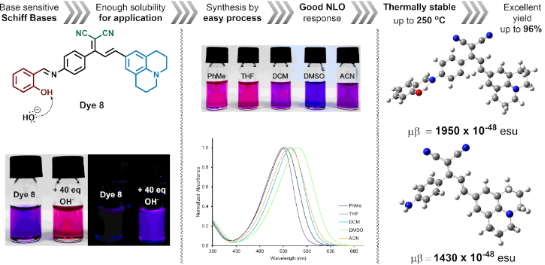
- , and HRMS analyses (Figures S1–S40 in Supporting Information File 1). Moreover, the stereochemistry of the double bonds was determined on the basis of the coupling constants of the vinylic hydrogens in the 1H NMR spectra (J ≈ 15–16 Hz) and revealed that the dyes are stable as E-stereoisomers [31


Muyocopronones A and B: azaphilones from the endophytic fungus Muyocopron laterale
Beilstein J. Org. Chem. 2020, 16, 2100–2107, doi:10.3762/bjoc.16.177
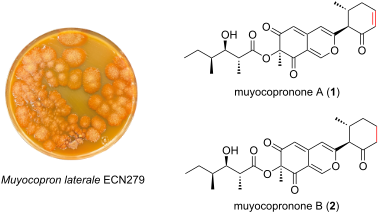
- ) [25]. After conformational analysis, geometry optimization was performed for two possible stereoisomers with the (7S,10R,11R)- and (7S,10S,11S)-configurations using density functional theory (DFT) at the CAM-B3LYP/6-311+G(d,p) level of theory. In addition, the ECD spectra of the DFT-optimized
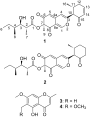
- experimental ECD spectra (black solid line) of 1 (A) and 2 (B) with the Boltzmann-weighted spectra computed for the (7S,10S,11S)- and (7S,10R,11R)-stereoisomers (green and red dashed lines, respectively) of the simplified models. (A) Synthesis of MTPA diesters 1a and 1b. (B) Δδ Values for the (S)- and (R)-MTPA



Convenient access to pyrrolidin-3-ylphosphonic acids and tetrahydro-2H-pyran-3-ylphosphonates with multiple contiguous stereocenters from nonracemic adducts of a Ni(II)-catalyzed Michael reaction
Beilstein J. Org. Chem. 2020, 16, 2073–2079, doi:10.3762/bjoc.16.174
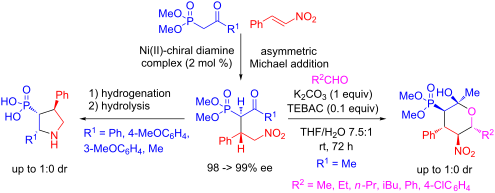
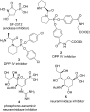
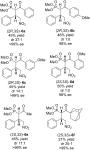
- reactions with aldehydes yielding tetrahydropyranylphosphonates as individual stereoisomers. These nonracemic heterocycles containing phosphoryl moieties are useful for designing new pharmacologically active compounds. Keywords: asymmetric catalysis; Michael addition; phosphonates; pyrrolidines



A complementary approach to conjugated N-acyliminium formation through photoredox-catalyzed intermolecular radical addition to allenamides and allencarbamates
Beilstein J. Org. Chem. 2020, 16, 1983–1990, doi:10.3762/bjoc.16.165
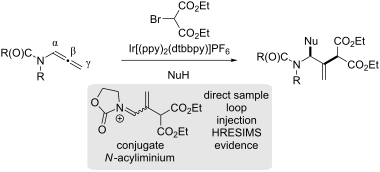
- ]+); this peak persisted at 15, 30, 60 and 120 min time intervals, respectively. Upon the oxidation of 41 two plausible iminium stereoisomers can be formed, Z-42 and E-42, respectively, with each of these iminium stereoisomers existing in two further conformers designated E-42’ and Z-42’. DFT calculations


One-pot and metal-free synthesis of 3-arylated-4-nitrophenols via polyfunctionalized cyclohexanones from β-nitrostyrenes
Beilstein J. Org. Chem. 2020, 16, 1830–1836, doi:10.3762/bjoc.16.150
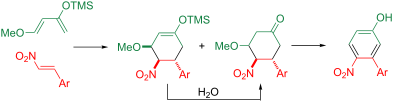
- efficiently to afford 5a in 61% yield even when the amount of iodine was decreased to 10 mol %. However further decreasing the iodine amount to 5 mol % was not effective for the conversion (Table 2, entries 4 and 5). In each case, both stereoisomers of 4a were completely consumed, and several unidentified





