


Search results
Search for "tertiary alcohol" in Full Text gives 94 result(s) in Beilstein Journal of Organic Chemistry.
Flexible synthesis of anthracycline aglycone mimics via domino carbopalladation reactions
Beilstein J. Org. Chem. 2013, 9, 2194–2201, doi:10.3762/bjoc.9.258
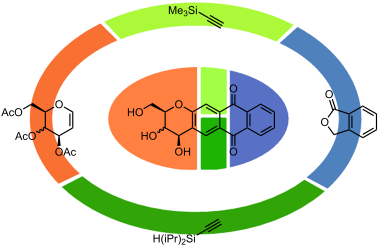
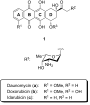
- substitution pattern of the D-ring bares most of the functionalities, i.e., a secondary and a tertiary alcohol, the former of which is commonly glycosylated with 2,6-dideoxy sugars (Figure 1) [3]. These carbohydrates are of highest importance for the biological activity of anthracyclines and bind to the minor



A concise enantioselective synthesis of the guaiane sesquiterpene (−)-oxyphyllol
Beilstein J. Org. Chem. 2013, 9, 2028–2032, doi:10.3762/bjoc.9.239
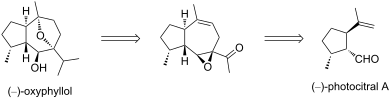
- (−)-oxyphyllol (1) and 5, we decided to use a modification of our route to 5 for the synthesis of 1 that would also constitute a formal synthesis of the related guaiane (+)-orientalol E (2) [4][7]. As illustrated in Scheme 1, we selected tertiary alcohol 3 as a retrosynthetic precursor for 1. The acetyl group of


A practical synthesis of long-chain iso-fatty acids (iso-C12–C19) and related natural products
Beilstein J. Org. Chem. 2013, 9, 1807–1812, doi:10.3762/bjoc.9.210
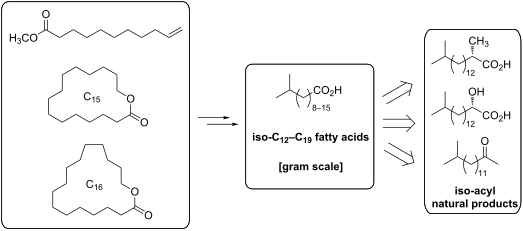
- approach to the iso-C12–C14 fatty acids 1–3 commenced from methyl undec-10-enoate (methyl undecylenate) 9. Reaction of 9 with methylmagnesium bromide afforded the tertiary alcohol 10 in 98% yield (Scheme 1). Selective reduction of the tertiary alcohol of 10 was achieved by ‘ionic hydrogenation’ with
- lactone pentadecanolide (exaltolide, 15) [57], a natural product that is produced industrially for use as a musk-odored perfumery fixative. Reaction of 15 with methylmagnesium bromide afforded the tertiary alcohol 16 in 98% yield (Scheme 2). Selective reduction of the tertiary alcohol of 16 was achieved


A Lewis acid-promoted Pinner reaction
Beilstein J. Org. Chem. 2013, 9, 1572–1577, doi:10.3762/bjoc.9.179
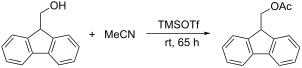
- obtained in the Lewis acid mediated reaction of nitriles with secondary alcohols such as cyclohexanol (Table 2, entry 10). No product at all was obtained, when the tertiary alcohol 1-methylcyclohexanol (48) was exposed to these conditions (Table 2, entry 11). The Lewis acid promoted Pinner reaction is


Re2O7-catalyzed reaction of hemiacetals and aldehydes with O-, S-, and C-nucleophiles
Beilstein J. Org. Chem. 2013, 9, 1526–1532, doi:10.3762/bjoc.9.174
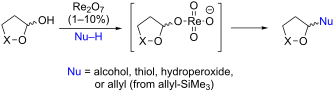
- higher yield of acetal. The Re2O7-promoted reactions were subsequently found to proceed efficiently at only 1% catalyst loading. Neither catalyst allowed etherification with a tertiary alcohol. Acetal formation As illustrated in Table 2, we next investigated acetalization of tetrahydrofuranol 3


Anionic cascade reactions. One-pot assembly of (Z)-chloro-exo-methylenetetrahydrofurans from β-hydroxyketones
Beilstein J. Org. Chem. 2013, 9, 1319–1325, doi:10.3762/bjoc.9.148

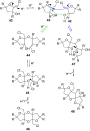
- -derivative 36 were obtained as a 1:5 mixture of diastereoisomers that could be separated (Scheme 6). Their structure was unambiguously established by single-crystal X-ray diffraction analysis, as shown in Figure 1. Increasing the steric hindrance at the tertiary alcohol site resulted in the exclusive
- with concomitant generation of another oxonium species 47. Intramolecular capture of this electrophile by the pendant hydroxy substituent then delivers the spirocyclic adduct 48. Alternatively, reaction of the tertiary alcohol of 42 with the oxonium cation 43 affords the ketal 44. Protonation of the
- homochiral (S,S;R,R)-dimer, leading to the syn–syn product, is preferred over the heterochiral (S,R;R,S)-adduct, affording the syn–anti isomer. Increasing the steric hindrance at the tertiary alcohol center of 49 leads to prohibitive steric repulsion during the heterodimer formation. A similar facial





Asymmetric synthesis of a highly functionalized bicyclo[3.2.2]nonene derivative
Beilstein J. Org. Chem. 2013, 9, 655–663, doi:10.3762/bjoc.9.74
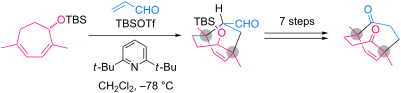
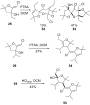
- of vinylmagnesium bromide [16], provided 9. The bromoetherification of tertiary alcohol 9 by using NBS led to tetrahydrofuran 10 as a diastereomeric mixture. Next, the base-induced elimination of HBr converted 10 to diene 11, which underwent the Claisen rearrangement at 170 °C to give rise to


Enantioselective reduction of ketoimines promoted by easily available (S)-proline derivatives
Beilstein J. Org. Chem. 2013, 9, 633–640, doi:10.3762/bjoc.9.71
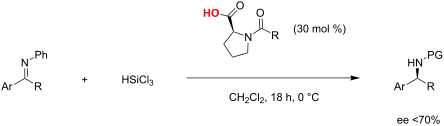
- -derived catalyst C developed by our group [7][8]. Also in other systems, such as the Matsumura-type catalysts developed by Zhang [9] of type D, the presence of a proper sterically hindered element seems to be much more decisive than the ability of the tertiary alcohol to make a possible, but not probable


Reduction of benzylic alcohols and α-hydroxycarbonyl compounds by hydriodic acid in a biphasic reaction medium
Beilstein J. Org. Chem. 2012, 8, 330–336, doi:10.3762/bjoc.8.36
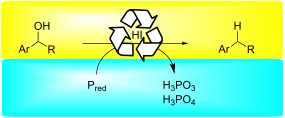
- . Benzylic alcohols were converted in good to high yields to alkanes with increasing reactivity in the order primary (2 h) < secondary (0.5–1 h) < tertiary alcohol (15–30 min); carbonyl groups and ethers were tolerated. Diethyl tartrate was converted into diethyl succinate under the reaction conditions given


Tertiary alcohol preferred: Hydroxylation of trans-3-methyl-L-proline with proline hydroxylases
Beilstein J. Org. Chem. 2011, 7, 1643–1647, doi:10.3762/bjoc.7.193
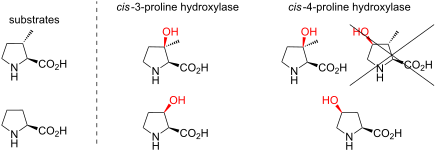
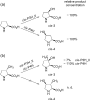
- of trans-3-methyl-L-proline with the α-ketoglutarate (α-KG) dependent oxygenases, cis-3-proline hydroxylase type II and cis-4-proline hydroxylase (cis-P3H_II and cis-P4H). With cis-P3H_II, the tertiary alcohol product (3R)-3-hydroxy-3-methyl-L-proline was obtained exclusively but in reduced yield (~7
- % compared to those obtained in conversions of L-proline. Based on the cis-3-selectivity of the enzyme we assumed that the tertiary alcohol was formed. Surprisingly, the conversion with cis-P4H gave a product with the same retention time as the product of cis-P3H_II, but in much better relative yield (~110
- substituents and, consequently, a cis-configuration for the tertiary alcohol (Supporting Information File 1). Whereas the reactivity of cis-P3H_II could be expected, the shift in regioselectivity and the high activity of cis-P4H is remarkable. A certain degree of flexibility in the regioselectivity of this



High chemoselectivity in the phenol synthesis
Beilstein J. Org. Chem. 2011, 7, 794–801, doi:10.3762/bjoc.7.90
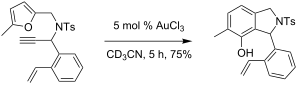
- condensation of ester 20 and tert-butyl acetate (21) in the presence of lithium hexamethyldisilazide as the base. Ketoester 22 was obtained in 56% yield, however, the two-fold addition of 21 could not be suppressed completely and 14% of the corresponding tertiary alcohol 30 was also obtained. Reduction of the


When cyclopropenes meet gold catalysts
Beilstein J. Org. Chem. 2011, 7, 717–734, doi:10.3762/bjoc.7.82
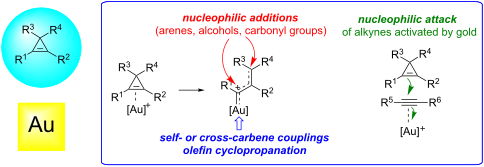
- acted as a nucleophile, but the corresponding tertiary alcohol 9i was isolated in only modest yield (34%) (Scheme 5) [18]. Additional results were subsequently reported by Lee et al. in a full article in 2010 [19]. Due to their lower nucleophilic character compared to alcohols, phenols could not be used




Asymmetric synthesis of tertiary thiols and thioethers
Beilstein J. Org. Chem. 2011, 7, 582–595, doi:10.3762/bjoc.7.68
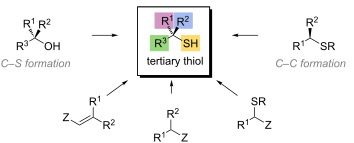
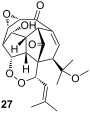
- Mitsunobu reactions, there is one example of the displacement of a tertiary alcohol by a thiol under Mitsunobu conditions in the literature. La Clair reported the synthesis of the initially assigned structure of natural product hexacyclinol (27, Figure 4) [29]. The reported synthesis entailed Mitsunobu








An overview of the key routes to the best selling 5-membered ring heterocyclic pharmaceuticals
Beilstein J. Org. Chem. 2011, 7, 442–495, doi:10.3762/bjoc.7.57
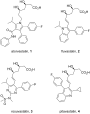
- and dichloromethane selectively provides tertiary alcohol 183. In subsequent steps this imidazole is alkylated with the tetrazole containing biphenyl appendage, followed by ester hydrolysis and alkylation of the resulting carboxylate with 4-(chloromethyl)-5-methyl-2-oxo-1,3-dioxole to yield olmesartan





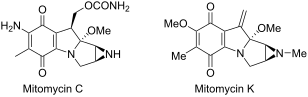
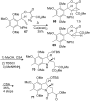
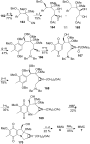
Mitomycins syntheses: a recent update
Beilstein J. Org. Chem. 2009, 5, No. 33, doi:10.3762/bjoc.5.33






A stable enol from a 6-substituted benzanthrone and its unexpected behaviour under acidic conditions
Beilstein J. Org. Chem. 2009, 5, No. 31, doi:10.3762/bjoc.5.31
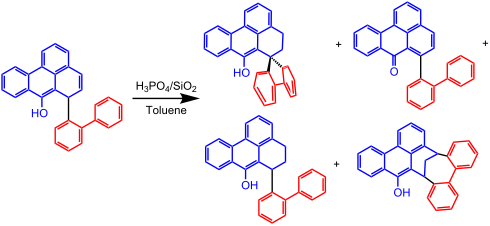
- unexpected behaviour of this adduct under acidic conditions. Results and Discussion Syntheses Benzanthrone (1) was treated with biphenyl-2-yl lithium (Scheme 1). After work-up and chromatography the surprisingly stable enol 4 was obtained in 56% yield. However, no formation of the tertiary alcohol 5 could be




Facile synthesis of two diastereomeric indolizidines corresponding to the postulated structure of alkaloid 5,9E- 259B from a Bufonid toad (Melanophryniscus)
Beilstein J. Org. Chem. 2008, 4, No. 6, doi:10.1186/1860-5397-4-6
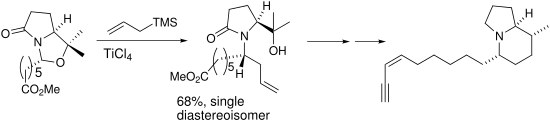
- magnesium iodide gave the water soluble tertiary alcohol 1 in 96% yield. 7-Oxoheptanoic acid methyl ester was prepared by the literature procedure [36], by ozonolysis of 1-methoxycycloheptene, and then condensed with the amidoalcohol 1 with azeotropic removal of water to give the N,O-acetal 2 in 71% yield
- this intriguing transformation will be published elsewhere in due course. One-pot dehydration of the tertiary alcohol 3 was accomplished via the mesylate, and in situ elimination with triethylamine to give the diene 4 in 74% yield. Diene 4 smoothly underwent cyclisation to indolizidinone 5 when treated


The first organocatalytic carbonyl- ene reaction: isomerisation- free C-C bond formations catalysed by H-bonding thio- ureas
Beilstein J. Org. Chem. 2007, 3, No. 24, doi:10.1186/1860-5397-3-24
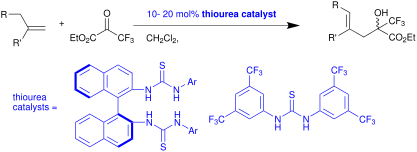
- after 3 hours reaction time. A 96% yield of the desired isomerically pure tertiary alcohol was obtained in the presence of 5. In contrast, the uncatalysed background reaction yields just 19%. Reactions monitored by 19F NMR reveal that good conversion (70%) was also possible after 1 hour using 10 mol


Synthesis of novel (1-alkanoyloxy- 4-alkanoylaminobutylidene)-1,1-bisphosphonic acid derivatives
Beilstein J. Org. Chem. 2006, 2, No. 2, doi:10.1186/1860-5397-2-2

- esters like P(O)-O-Me as well as an acyl group at the tertiary alcohol group are stable against enzymatic hydrolysis. [18] However, the latter decomposed gradually due to chemical hydrolysis. Because of the extreme hydrophilic character of HABBPA, its solubility and reactivity in organic solvents is very





