


Search results
Search for "hydrogenolysis" in Full Text gives 172 result(s) in Beilstein Journal of Organic Chemistry.
Synthesis of icariin from kaempferol through regioselective methylation and para-Claisen–Cope rearrangement
Beilstein J. Org. Chem. 2015, 11, 1220–1225, doi:10.3762/bjoc.11.135
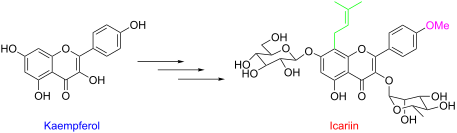
- with reduced double bond. Then we tried a transfer hydrogenolysis method using ammonium formate/10% Pd/C [27], but the result was not improved. The desired product icaritin (3) was finally obtained in 84% yield from 10 when we used 1,4-cyclohexadiene/10% Pd/C in MeOH [28]. Hence, we optimized a


Novel stereocontrolled syntheses of tashiromine and epitashiromine
Beilstein J. Org. Chem. 2015, 11, 596–603, doi:10.3762/bjoc.11.66

- -opened unstable diformyl intermediate (I1), which after work-up was immediately used without further purification (for several similar types of acyclic diformyl intermediates, see references [40][41][43][44]). Thus, the crude material was submitted to catalytic hydrogenolysis and after N-deprotection
- hydrogenolysis, followed by reductive cyclization, to give the corresponding indolizidine ester (±)-9 in 40% yield. Finally, ester reduction with LiAlH4 in THF resulted in epitashiromine (±)-10 [32][34][39] in 53% yield after isolation by chromatography (Scheme 3). The stereochemistry of (±)-epitashiromine was


Stereoselective cathodic synthesis of 8-substituted (1R,3R,4S)-menthylamines
Beilstein J. Org. Chem. 2015, 11, 294–301, doi:10.3762/bjoc.11.34
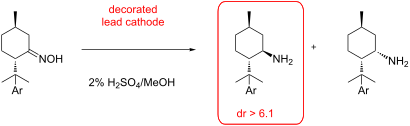
- the configuration at position 4 resulting in a complex diastereomeric mixture. Alternatively, reduction of menthone oxime can be achieved, either employing Bouveault–Blanc conditions [41], or via hydrogenolysis at a transition metal catalyst [42]. Both approaches lead to the desired product as a


Selective methylation of kaempferol via benzylation and deacetylation of kaempferol acetates
Beilstein J. Org. Chem. 2015, 11, 288–293, doi:10.3762/bjoc.11.33
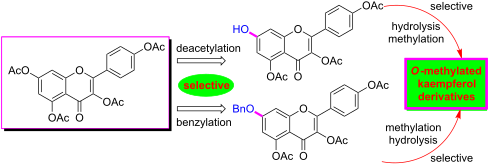
- of dimethyl sulfate at room temperature provided 10 with a yield of 85%. The final deprotection of 10 involving deacetylation with 7.0 M methanolic ammonia and debenzylation by hydrogenolysis with 10% palladium on carbon in EtOAc/MeOH (1:3) at room temperature afforded 12 (Scheme 2). In order to
- sulfate and K2CO3 in acetone/MeOH at reflux afforded 17 in high yield (82%). Subsequent hydrogenolysis of 17 catalyzed by 10% palladium on carbon in EtOAc/MeOH (1:3) at room temperature provided 18 (Scheme 2). Synthesis of 3,4′-di-O-methylkaempferol (22) and 3,4′,5,-tri-O-methylkaempferol (23) 3,4′-Di-O
- -methylkaempferol (22) and 3,4′,5-tri-O-methylkaempferol (23) were prepared from 19 derived from 8. Controlled di-O-methylation and tri-O-methylation of 19 were achieved by the quantity of Me2SO4, resulting in 20 and 21, respectively. Hydrogenolysis of 20 and 21 afforded 22 and 23 (Scheme 3). All the synthetic


Synthesis of the furo[2,3-b]chromene ring system of hyperaspindols A and B
Beilstein J. Org. Chem. 2015, 11, 265–270, doi:10.3762/bjoc.11.29
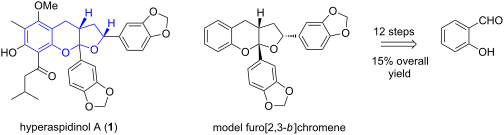
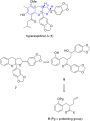
- product 19. Dihydroxylation of 19, followed by oxidative cleavage of the resultant diol gave aldehyde 20 in 80% yield over two steps. Addition of lithiate 16 to aldehyde 20 gave alcohol 21 in 87% yield as an inseparable 1:1 mixture of diastereoisomers. Hydrogenolysis of the benzyl ether in 21 gave ketal




NAA-modified DNA oligonucleotides with zwitterionic backbones: stereoselective synthesis of A–T phosphoramidite building blocks
Beilstein J. Org. Chem. 2015, 11, 50–60, doi:10.3762/bjoc.11.8
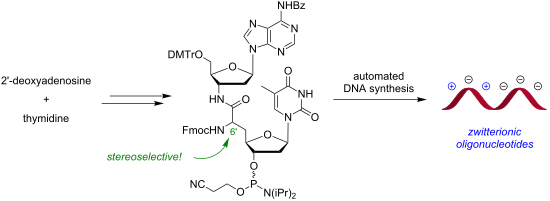
- starting material, one challenge was to avoid unwanted side reactions resulting from the generation of formaldehyde in the reaction mixture. Hydrogenolysis of the BOM group affords toluene and formaldehyde as byproducts, and the Cbz-deprotected 6'-amino group can undergo unwanted reductive amination, i.e
- ., methylation, with the liberated formaldehyde. Our method to prevent this side reaction was to include an excess of n-butylamine as an additive in the reaction mixture of the hydrogenolysis step. This way, the formaldehyde methylated the added n-butylamine, furnishing a reasonably volatile byproduct [38][48
- heterogeneously catalyzed hydrogenolysis reactions with palladium catalysts. Therefore, the absence of the BOM group was not advantageous for the deprotection step following the asymmetric hydrogenation reaction. The second challenge on the way to target phosphoramidites 7 was the synthesis of protected 3'-amino



Stereoselective synthesis of perillaldehyde-based chiral β-amino acid derivatives through conjugate addition of lithium amides
Beilstein J. Org. Chem. 2014, 10, 2738–2742, doi:10.3762/bjoc.10.289

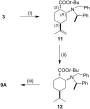
- steps. The selective reduction of the isopropenyl double bond over a Pt/C catalyst resulted in 8A–D. The subsequent removal of the benzyl groups by hydrogenolysis over palladium on carbon (Pd/C) in a 1:1 mixture of n-hexane/EtOAc for 24 h gave primary amino esters 9A–D in excellent yields. The final


Formal total syntheses of classic natural product target molecules via palladium-catalyzed enantioselective alkylation
Beilstein J. Org. Chem. 2014, 10, 2501–2512, doi:10.3762/bjoc.10.261
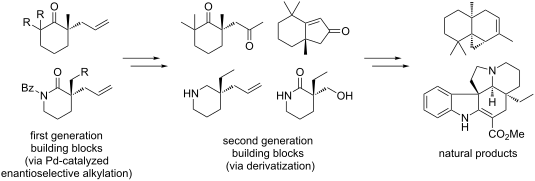
- prepared in excellent yield and ee by alkylation of carboxy-lactam 49 (see Scheme 11) [84]. Oxidative cleavage of the terminal double bond and subsequent reduction with LiAlH4 afforded N-benzylpiperidine-alcohol 56 [84]. Hydrogenolysis of the N-benzyl group and re-protection with di-tert-butyl dicarbonate



N–O Cleavage reactions of heterobicycloalkene-fused 2-isoxazolines
Beilstein J. Org. Chem. 2014, 10, 2200–2205, doi:10.3762/bjoc.10.227
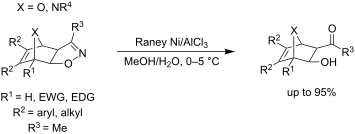
- isoxazoline-cleavage methodology to the preparation of biologically active natural products, including novel antibacterial, antifungal and anticancer treatments [8][9][10][11]. Some common methods of reductive N–O bond cleavage in isoxazolines include hydrogenolysis using Raney nickel, reduction by LiAlH4


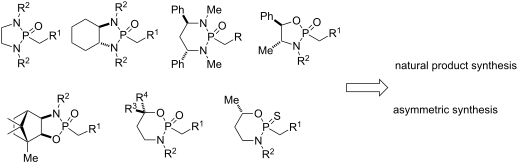
Application of cyclic phosphonamide reagents in the total synthesis of natural products and biologically active molecules
Beilstein J. Org. Chem. 2014, 10, 1848–1877, doi:10.3762/bjoc.10.195
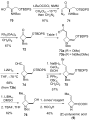
- tricarballylic acid intermediate. Conversion of the free carboxylic acid moieties into their benzyl esters followed by cleavage of the tert-butyl ester gave 108. This fragment was then coupled with diol 109 to afford the fully protected fumonisin B2 precursor 110. Final hydrogenation and hydrogenolysis of all
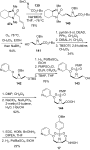
- tricyclic intermediate 121. Cleavage of the TBS ethers and hydrogenolysis of the benzyl ester in presence of amidine 122 yielded trinem 23a as its amidinium salt 123. Trinem 123 exhibited antibacterial activity against a variety of strains, with MIC’s of 1.0 μg/mL against Staphylococcus aureus 853E and 0.1
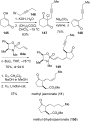
- work-up provided alcohol 141. Coupling under Mitsunobu conditions with an appropriate alcohol, e.g., 3-hydroxypyridine, reduction of the tert-butyl ester with DIBAL-H, and treatment with TBS triflate gave silyl ether 142. Hydrogenolysis of 142 using Pd/BaSO4 produced the free aziridine, which was then








Synthesis of rigid p-terphenyl-linked carbohydrate mimetics
Beilstein J. Org. Chem. 2014, 10, 1749–1758, doi:10.3762/bjoc.10.182
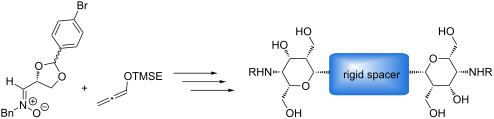
- -couplings to form biphenyl aminopyran or p-terphenyl-linked dimers. Hydrogenolysis afforded new unnatural aminosugar mimetics. Zinc in the presence of acid or samarium diiodide were examined for the N–O bond cleavage in order to obtain the rigid p-terphenyl-linked C-glycosyl dimers. Keywords: carbohydrate
- mimetics; hydrogenolysis; multivalent glycosystems; 1,2-oxazines; samarium diiodide; Suzuki cross-coupling; Introduction Carbohydrates are the class of biomolecules with the highest structural diversity [1][2]. Specific carbohydrates are responsible for cell-type specific interactions [3] and they are
- provided compound 16 in 83% yield. This protecting group should allow its removal together with the benzyl group during hydrogenolysis. Surprisingly, a benzyl protection under the same conditions was not possible. Before approaching divalent compounds such as 1 we wanted to convert our building blocks into


Multicomponent reactions in nucleoside chemistry
Beilstein J. Org. Chem. 2014, 10, 1706–1732, doi:10.3762/bjoc.10.179
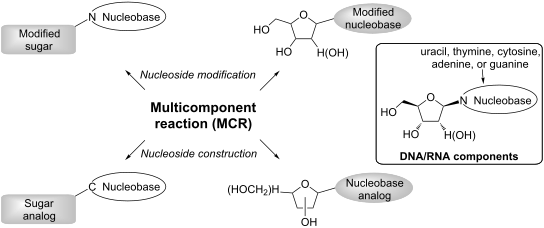
- precursors to a variety of compounds. The transformations leading to thymidine or its derivatives 3 involved: (a) the metal-catalyzed hydrogenolysis of products 2 [51][52][54][55] (or their 5-(4-tolylthio)methyl derivatives [57]), or (b) the reduction of methylammonium iodides derived from compounds 2 with
- total yield of 45%. The cyclohexylidene protecting group was then removed in refluxing aq AcOH. The resulting diastereoisomers 39 were separated by reversed phase HPLC to yield two pure isomers and the remaining two as an inseparable 1:1 mixture. These were further deprotected by hydrogenolysis under


Unusual polymorphism in new bent-shaped liquid crystals based on biphenyl as a central molecular core
Beilstein J. Org. Chem. 2014, 10, 794–807, doi:10.3762/bjoc.10.75
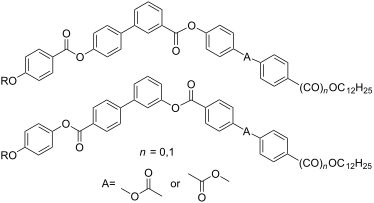
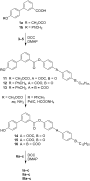
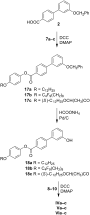
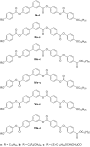
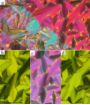
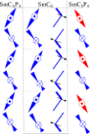
- –c to yield the phenyl esters 17a–c. In the next step, the hydroxylic group was released by the palladium-catalysed hydrogenolysis of the benzyl group and the formed phenols 18a–c were acylated with acids 8–10 to produce the series of compounds IV–VI. For clarity, chemical formulae of the studied





A novel family of (1-aminoalkyl)(trifluoromethyl)- and -(difluoromethyl)phosphinic acids – analogues of α-amino acids
Beilstein J. Org. Chem. 2014, 10, 722–731, doi:10.3762/bjoc.10.66
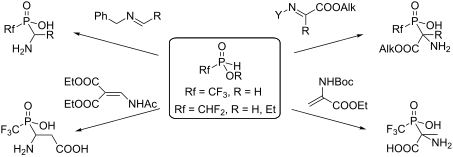
- by 1H NMR as separate signals for the CHF2 group. The adducts 18b–d were hydrolyzed to acids 19b–d in quantitative yields and did not form hydrochlorides similar to the CF3 aminophosphinic acids 13a–b and 17a–d. Hydrogenolysis of the 17a–d and 19a–d efficiently gave free acids 14 and 20, but required


Synthesis of (2S,3R)-3-amino-2-hydroxydecanoic acid and its enantiomer: a non-proteinogenic amino acid segment of the linear pentapeptide microginin
Beilstein J. Org. Chem. 2014, 10, 667–671, doi:10.3762/bjoc.10.59
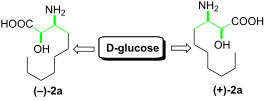
- , hydrogenolysis of the benzyl group and reduction of the azido group by using 10% Pd/C, in one pot, gave 2b in 30.1% overall yield from 3b. The spectral and analytical data was found to be in good agreement with reported data ([α]D30 −5.1(c 0.51, 1 M HCl). [α]D30 −6.2 (c 0.4, 1 M HCl)) [21]. Conclusion In


From porphyrin benzylphosphoramidate conjugates to the catalytic hydrogenation of 5,10,15,20-tetrakis(pentafluorophenyl)porphyrin
Beilstein J. Org. Chem. 2014, 10, 628–633, doi:10.3762/bjoc.10.54
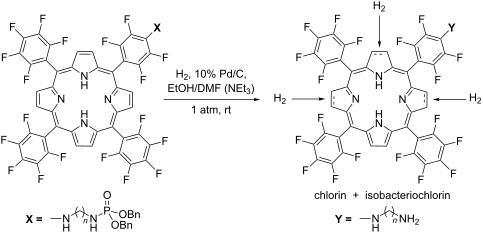
- substitution was promoted by microwave irradiation in N-methyl-2-pyrrolidinone. Attempts to remove the benzyl groups of the phosphoramidate moiety by hydrogenolysis with 10% Pd/C led to the cleavage of the P–N bond and the reduction of the macrocycle to hydroporphyrin-type derivatives. The extent of the effect
- [5][6]. This undesired result pointed to the synthesis of a phosphoramidate derivative different from the diisopropyl one. Here, we describe the synthesis of the analogue porphyrin dibenzylphosphoramidates 1a–c. Attempts to remove the benzyl groups by mild hydrogenolysis over 10% Pd/C led to the
- porphyrin dibenzylphosphoramidates 1a and 1b by hydrogenolysis were carried out with H2 and 10% Pd/C in the presence of triethylamine in order to establish a mild environment for the catalyst [10]. However, when the porphyrin dibenzylphosphoramidates were subjected to these conditions the spectroscopic


Concise, stereodivergent and highly stereoselective synthesis of cis- and trans-2-substituted 3-hydroxypiperidines – development of a phosphite-driven cyclodehydration
Beilstein J. Org. Chem. 2014, 10, 369–383, doi:10.3762/bjoc.10.35
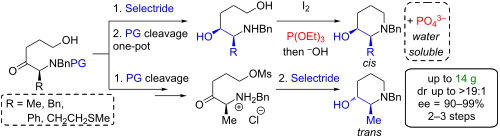
- we choose a Cbz protecting group for the amino acids 1a–c due to the mild cleavage conditions (hydrogenolysis), we decided to introduce a Boc group at the N-terminus of methionine 1d to avoid desulfuration (–EtSMe → –Et) in the later deprotection. In order to suppress the formation of the only
- 5e (along with 30% of reisolated starting material), illustrating the tendency of reagent 6 to attack the side chain ester moiety. Synthesis of syn-amino alcohols C Already the NaBH4 reduction (in MeOH at −40/0 °C) of ketones 7a and 7b and subsequent hydrogenolysis of the Cbz-group in one-pot
- [74] (or N-Selectride) and subsequent hydrogenolysis of the Cbz-group in one-pot delivered the benzyl amines syn-9a and 9b in accordance with the Felkin–Anh model in excellent yields and as pure diastereomers as indicated by 400 MHz 1H NMR (Scheme 4). Unfortunately, L-Selectride proved to be too


Convergent synthesis of a tetrasaccharide repeating unit of the O-specific polysaccharide from the cell wall lipopolysaccharide of Azospirillum brasilense strain Sp7
Beilstein J. Org. Chem. 2014, 10, 293–299, doi:10.3762/bjoc.10.26
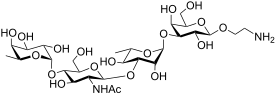
- transformed to the target compound 1 in an overall 69% yield following a sequence of reactions consisting of (a) the conversion of the N-phthaloyl group to an acetamido group [41], (b) the hydrogenolysis with hydrogen over Pearlman’s catalyst [42], and (c) the saponification with sodium methoxide. A NMR


Boron-substituted 1,3-dienes and heterodienes as key elements in multicomponent processes
Beilstein J. Org. Chem. 2014, 10, 237–250, doi:10.3762/bjoc.10.19

- proved to give the best yields, probably due to the higher reactivity of the corresponding hydrazones. Furthermore, the double bond of 29 was selectively hydrogenated under palladium on charcoal, while hydrogenolysis of the hydrazine moiety occurred in the presence of Raney nickel (Scheme 22). Following
- catalytic enantioselective HDA/allylboration sequence. Total synthesis of a thiomarinol derivative. Synthesis of an advanced intermediate 27 for the east fragment of palmerolide A. Bicyclic piperidines from tandem aza-[4 + 2]-cycloaddition/allylboration. Hydrogenolysis reactions of hydrazinopiperidines


Synthesis of new enantiopure poly(hydroxy)aminooxepanes as building blocks for multivalent carbohydrate mimetics
Beilstein J. Org. Chem. 2014, 10, 213–223, doi:10.3762/bjoc.10.17
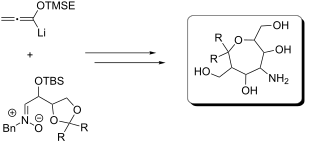
- crucial final palladium-catalyzed hydrogenolysis of the 1,2-oxazine moiety was optimized resulting in a reasonably efficient approach to a series of new seven-membered carbohydrate mimetics. Keywords: aminooxepanes; carbohydrate mimetics; hydrogenolyses; Lewis acid-induced; lithiated allenes; nitrones
- reduction of 19 with sodium borohydride the intermediate alcohol was heated with triethylamine (to avoid the deprotection of the TBS-group) and compound 20 was obtained in 75% yield (over three steps). The previously isolated unprotected triols 14, 15 and 20 were subjected to standard hydrogenolysis
- may be unfavorable. In order to avoid this side-reaction we performed hydrogenolysis experiments in alternative solvents, e.g. with ethanol or isopropanol, but small amounts of the corresponding side products were also observed in these experiments. Unpolar solvents were not suitable for the


Diversity-oriented synthesis of dihydrobenzoxazepinones by coupling the Ugi multicomponent reaction with a Mitsunobu cyclization
Beilstein J. Org. Chem. 2014, 10, 209–212, doi:10.3762/bjoc.10.16

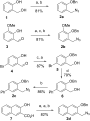
- chromatography at the level of 9. With these optimized conditions in hand, we performed a series of Ugi reactions using azides 2a–d, glycolic acid, various aldehydes and isocyanides (Scheme 2). After a fast purification through a short silica gel column, the Ugi adducts 9a–n were submitted to hydrogenolysis and


Novel supramolecular affinity materials based on (−)-isosteviol as molecular templates
Beilstein J. Org. Chem. 2013, 9, 2821–2833, doi:10.3762/bjoc.9.317
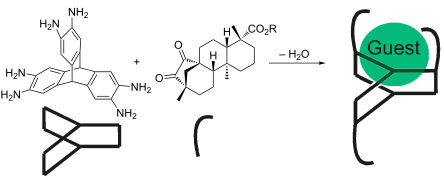
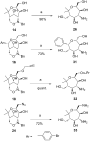
- all-syn-15 was subsequently cleaved by hydrogenolysis using standard conditions (Scheme 6) [69]. The tricarboxylic acid all-syn-16 was isolated in almost quantitative yield. In this protocol the heterogeneous catalyst did not affect the quinoxaline moieties by over-reduction. With this versatile
- 1. Condensation of the nitrobenzyl esters 10 and 11 with hexaammoniumtriptycene hexachloride 4. Hydrogenolysis to tricarboxylic acid all-syn-16. Alkylation of all-syn-16 renders terminal alkene all-syn-17. Alkylation of (−)-isosteviol diketone 9 with 5-bromo-1-pentene. Direct synthesis of alkylated


Modulating NHC catalysis with fluorine
Beilstein J. Org. Chem. 2013, 9, 2812–2820, doi:10.3762/bjoc.9.316
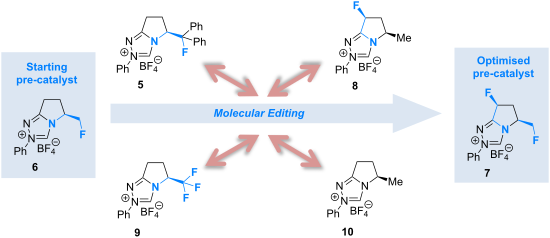
- catalyst 10 (Scheme 3; lower) was prepared in a short synthesis starting from the primary bromide 23 [22]. Hydrogenolysis (24, 67%) [41] and subsequent conversion to the triazolium salt completed the short synthesis (52% over 3 steps). X-Ray structural analysis of 5, 6 and 7 The X-ray crystal structures of


3-Pyridinols and 5-pyrimidinols: Tailor-made for use in synergistic radical-trapping co-antioxidant systems
Beilstein J. Org. Chem. 2013, 9, 2781–2792, doi:10.3762/bjoc.9.313
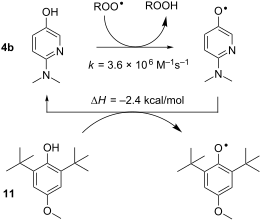
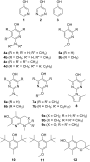
- antioxidants (10–12). Results and Discussion Synthesis. The preparation of compounds 4a, 4b and 5–8 involved installation of the aryl alcohol moiety as the final step via a Cu-catalyzed benzyloxylation/hydrogenolysis sequence on the corresponding pyri(mi)dyl halides, whereas the preparation of 4c, 4d and 9




Stereodivergent synthesis of jaspine B and its isomers using a carbohydrate-derived alkoxyallene as C3-building block
Beilstein J. Org. Chem. 2013, 9, 2564–2569, doi:10.3762/bjoc.9.291
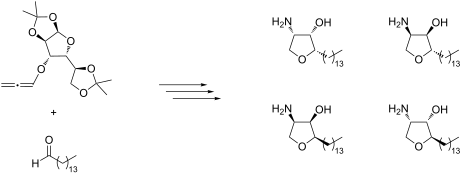
- reduction of carbonyl compounds bearing an electronegative group in α-position [37]. After palladium-catalyzed hydrogenolysis of α-azidotetrahydrofuranols rac-9 and rac-10 an inseparable mixture of racemic jaspine B (rac-1) and its C-2-epimer rac-2 was obtained. Hence the natural product and its
- indicates that a (partial) epimerization at C-4 occurs under the reaction conditions employed. The diastereoselective reduction of the carbonyl group with L-selectride afforded the α-azidotetrahydrofuranones 9 and 10 in 66% yield over three steps. Subsequent hydrogenolysis of 9 and 10 afforded a mixture of
- to an enhanced difference of dipole moments and hence Rf values of the two isomers (Scheme 7). Final hydrogenolysis of the separated diastereomers 16 and 17 led to deprotection of the hydroxy group and simultaneous reduction of the azido group. Jaspine B (1) and its (2S,3R,4R)-diastereomer 2 were





