Search results
Search for "light irradiation" in Full Text gives 173 result(s) in Beilstein Journal of Organic Chemistry.
Aldehydes as powerful initiators for photochemical transformations
Beilstein J. Org. Chem. 2020, 16, 833–857, doi:10.3762/bjoc.16.76
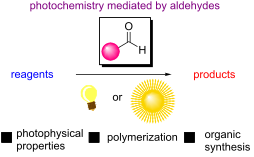
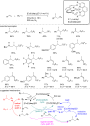
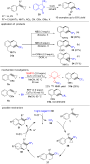
- seek greener and sustainable processes to advance chemistry, the use of aldehydes in conjunction with light irradiation, even sunlight, will become more popular, providing a vast array of applications. Norrish type I and II dissociations. Proposed radical pair formation after the photolysis of






A systematic review on silica-, carbon-, and magnetic materials-supported copper species as efficient heterogeneous nanocatalysts in “click” reactions
Beilstein J. Org. Chem. 2020, 16, 551–586, doi:10.3762/bjoc.16.52
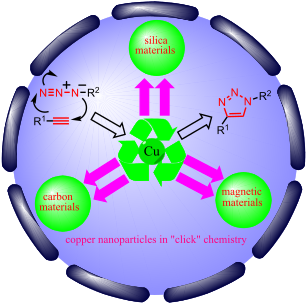
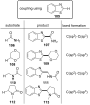
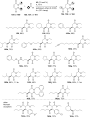
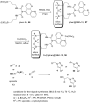
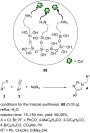
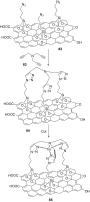
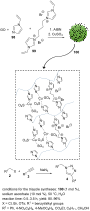
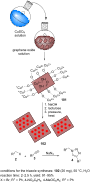
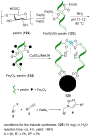
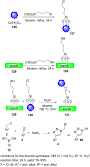
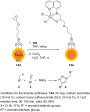
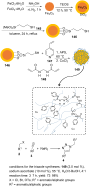
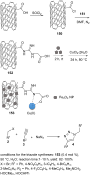
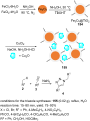
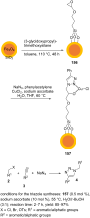
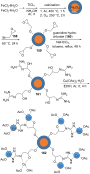
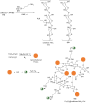
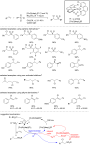
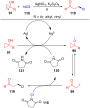
- nitride-supported copper nanoparticles was disclosed by Islam and co-workers (Scheme 18) [79][80]. The nanocatalyst 87 was successfully used as a high-performance photoreactor promoting “click” reactions of alkynes with organic azides under light irradiation in the absence of basic condition. In the first

















Recent advances in photocatalyzed reactions using well-defined copper(I) complexes
Beilstein J. Org. Chem. 2020, 16, 451–481, doi:10.3762/bjoc.16.42
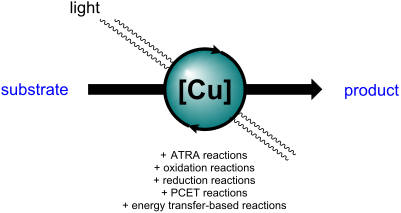
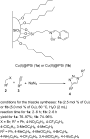
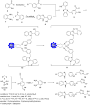
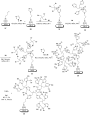
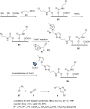
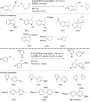
- [Cu(I)(dap)2]Cl under green light irradiation (Scheme 5) [21]. Fluorinated sultones are important scaffolds for pharmaceutical syntheses. To illustrate the synthetic utility of the method, a novel benzoxathiin analog was synthesized using this reaction as the key step. The authors suggested a similar
- . To explain the reaction outcome, the authors suggested the involvement of a [Cu(I)] complex as the catalytically active species, even when [Cu(II)(dap)2]Cl2 was used. Indeed, they suggested the formation of the [Cu(I)] species from a homolytic cleavage of the Cu(II)–Cl bond under light irradiation
- [Cu(I)(dpp)2]PF6 complex can be excited under visible light irradiation (530 nm), and the resulting excited [Cu(I)]* complex undergoes an SET to reduce the diaryliodonium species, providing the oxidized [Cu(II)] complex. The reduced diaryliodonium species collapses into an aryl radical and the








Synthesis and characterization of bis(4-amino-2-bromo-6-methoxy)azobenzene derivatives
Beilstein J. Org. Chem. 2019, 15, 3000–3008, doi:10.3762/bjoc.15.296
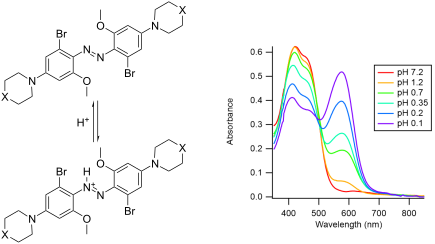
- . Photoisomerization UV irradiation was performed by placing a 365 nm LED (897-LZ440U610; LED Engin) operating at 68 mW/cm2 above the sample tube for 1 minute. For blue light irradiation, a 440 nm LED (Luxeon III Star LED Royal Blue Lambertian; Luxeon Star LEDs) operating at 40 mW/cm2 at 700 mA was used in the


Design, synthesis and investigation of water-soluble hemi-indigo photoswitches for bioapplications
Beilstein J. Org. Chem. 2019, 15, 2822–2829, doi:10.3762/bjoc.15.275
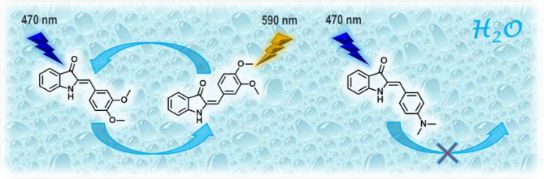
- UV light irradiation (254 nm or 366 nm). Column chromatography was performed on Sephadex® columns. 1H NMR and 13C NMR spectra were recorded on a JEOL ECZ 500 spectrometer at 25 °C using 5 mm tubes. Chemical shifts were determined with accuracy of 0.01 ppm and 0.1 ppm for 1H and 13C spectra


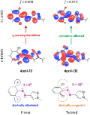
A combinatorial approach to improving the performance of azoarene photoswitches
Beilstein J. Org. Chem. 2019, 15, 2753–2764, doi:10.3762/bjoc.15.266
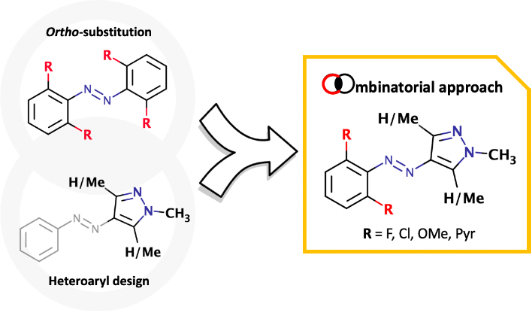
- Photoswitches are molecules that are capable of being reversibly interconverted between (at least) two states by means of light irradiation. The incorporation of photoswitches into multifunctional systems has huge relevance to next-generation materials, with a plethora of applications that range from




Fluorinated maleimide-substituted porphyrins and chlorins: synthesis and characterization
Beilstein J. Org. Chem. 2019, 15, 2704–2709, doi:10.3762/bjoc.15.263
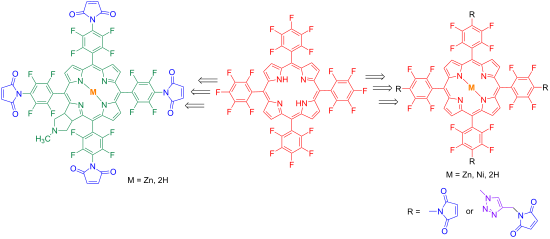
- conjugated to a cystein residue of serum albumin via a Michael addition reaction. At the same time, it is well known that 5,10,15,20-tetrakis(pentafluorophenyl)porphyrin and its chlorin derivatives generate singlet oxygen by the light irradiation under atmospheric oxygen [31]. These tetrapyrrole macrocycles


Plasma membrane imaging with a fluorescent benzothiadiazole derivative
Beilstein J. Org. Chem. 2019, 15, 2644–2654, doi:10.3762/bjoc.15.257
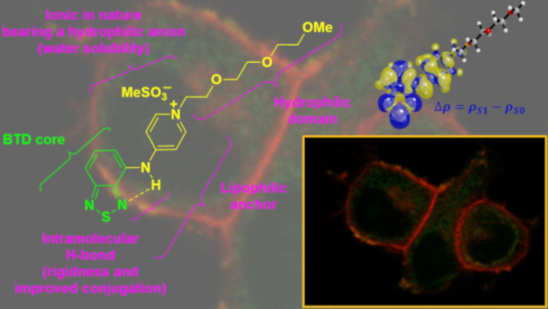
- bioimaging experiments and proved to be stable under constant light irradiation for more than 4 hours (see Figure S4 in Supporting Information File 1). Theoretical calculations were then performed for a better comprehension of the photophysical data obtained for BTD-4APTEG by means of the time-dependent


In search of visible-light photoresponsive peptide nucleic acids (PNAs) for reversible control of DNA hybridization
Beilstein J. Org. Chem. 2019, 15, 2500–2508, doi:10.3762/bjoc.15.243
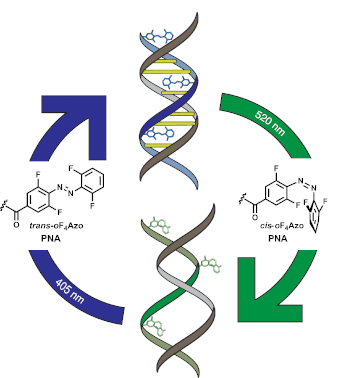
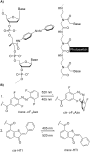
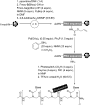
- , artificial probes activated by visible-light irradiation are highly desired in biological applications. Here, we report two novel types of visible-light photoswitchable peptide nucleic acids (PNAs) based on the molecular transducers: hemithioindigo and tetra-ortho-fluoroazobenzene. Our study reveals that the
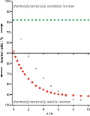
- tetra-ortho-fluoroazobenzene–PNA conjugates have promising properties (fast reversible isomerization, exceptional thermal stability, high isomer conversions and sensitivity to visible-light irradiation) as reversible modulators to control oligonucleotide hybridization in biological contexts. Furthermore
- first compounds here reported, may find applications in different fields such as chemical biology, nanotechnology and materials science. Keywords: azobenzene; hemithioindigo; peptide nucleic acid (PNA); photoswitch; visible-light irradiation; Introduction Light-driven control of oligonucleotide



Photochromic diarylethene ligands featuring 2-(imidazol-2-yl)pyridine coordination site and their iron(II) complexes
Beilstein J. Org. Chem. 2019, 15, 2428–2437, doi:10.3762/bjoc.15.235
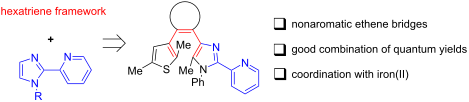
- isomer and the emergence of a new band in visible upon UV light irradiation (Figure 2) [8]. This color change is due to the reversible photocyclization and formation of a closed-ring isomer (Scheme 2). The results of photochemical studies are listed in Table 1. Absorption maxima of the open-ring ligands


Targeted photoswitchable imaging of intracellular glutathione by a photochromic glycosheet sensor
Beilstein J. Org. Chem. 2019, 15, 2380–2389, doi:10.3762/bjoc.15.230
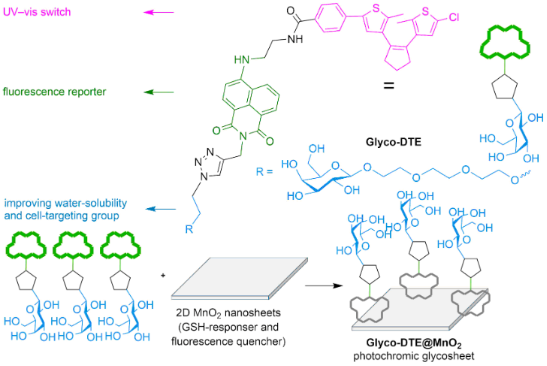
- ring-closed photoisomer [28]. The absorption band at 550 nm remained unchanged after 3 min of irradiation as the photostationary state (PSS) was reached. The absorption spectra of the ring-opened isomer could be fully recovered upon visible light irradiation (4 min), suggesting a photocycloreversion or
- several times in buffer solution without obvious degradation (Figure 1B), demonstrating the robustness of Glyco-DTE. Figure 1C shows the photoswitching of emission spectra of Glyco-DTE (1 × 10⁻⁵ mol/L) in PBS buffer upon alternating UV and visible light irradiation at room temperature. Upon excitation



Excited state dynamics for visible-light sensitization of a photochromic benzil-subsituted phenoxyl-imidazolyl radical complex
Beilstein J. Org. Chem. 2019, 15, 2369–2379, doi:10.3762/bjoc.15.229
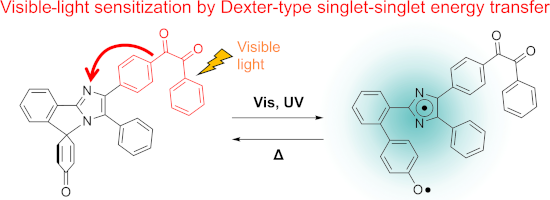
- -type photochromic compounds which reversibly generate an imidazolyl radical and a phenoxyl radical (biradical form) in a molecule upon UV light irradiation [24]. The great advantage of PIC is the tunability of the thermal back reaction from tens of nanoseconds to tens of seconds by simple and rational
- A. PIC generates the biradical species upon UV-light irradiation and shows the broad transient absorption spectrum over the visible- to near infrared-light regions. The half-life of the thermal back reaction of the biradical in benzene is 250 ns (the lifetime is 360 ns) at 298 K. To investigate the
- isomer A accumulated by 8 shots are slightly fluctuated most probably because of the low signal-to-noise ratio, the decay kinetics do not change by repeated irradiation with UV-light pulses. It shows that both isomers generate the same biradical form by UV-light irradiation as shown in Scheme 1



Recent advances in transition-metal-catalyzed incorporation of fluorine-containing groups
Beilstein J. Org. Chem. 2019, 15, 2213–2270, doi:10.3762/bjoc.15.218








Aggregation-induced emission effect on turn-off fluorescent switching of a photochromic diarylethene
Beilstein J. Org. Chem. 2019, 15, 2204–2212, doi:10.3762/bjoc.15.217
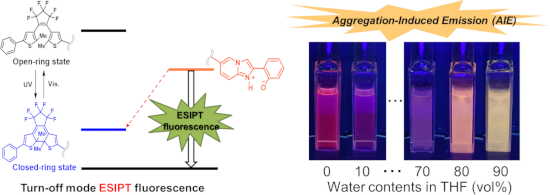
- . In addition, it shows turn-off type fluorescence switching in an aprotic solvent and in crystals. The fluorescence is quenched as the content of closed-ring isomers increases upon UV light irradiation. Conclusions: A diarylethene containing an ESIPT functional group was prepared. It showed
- fluorescent turn-off behavior during photochromism in aprotic solvents as well as in crystalline state upon UV light irradiation. Furthermore, it showed AIE in THF/water mixtures with blue-shift of the emission. Keywords: AIE; diarylethene; ESIPT fluorescent switching; turn-off fluorescence; Introduction
- ’-methoxyphenyl)imidazo[1,2-a]pyridine 4 [25] followed by ether cleavage according to Figure 1. The photochromic reaction and spectral changes are shown in Figure 2 and Figure 3. The photochromic absorption spectral changes in THF are shown in Figure 3. Upon UV light irradiation of the solution of 1o, the color


Click chemistry towards thermally reversible photochromic 4,5-bisthiazolyl-1,2,3-triazoles
Beilstein J. Org. Chem. 2019, 15, 2161–2169, doi:10.3762/bjoc.15.213
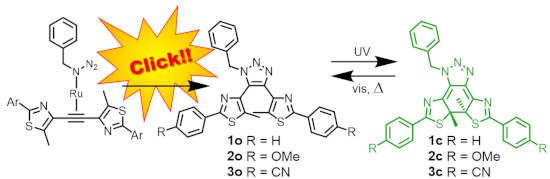
- ethanol (EtOH), acetonitrile (MeCN), ethyl acetate (AcOEt) and toluene, and each solution was irradiated with 313 nm light. The changes in the absorption spectra during UV light irradiation in MeCN are shown in Figure 1 (spectra of the compounds in the other solvents are shown in Figures S1–S9 in
- the thermal back reaction after 313-nm light irradiation to 1o–3o in MeCN at 28 °C. Concentration of compounds are the same as in Figure 1. (a) 1c. (b) 2c. (c) 3c. Reaction mechanisms of Huisgen cyclization catalyzed by Cu(I) and Ru(I). Synthesis and photochromism of bisthiazolyltriazoles. Wavelengths



Friedel–Crafts approach to the one-pot synthesis of methoxy-substituted thioxanthylium salts
Beilstein J. Org. Chem. 2019, 15, 2105–2112, doi:10.3762/bjoc.15.208
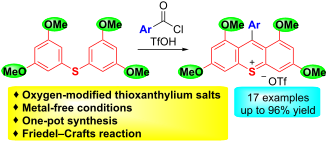
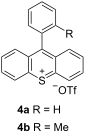
- green light irradiation [24][25]. In the course of this study, we found that these thioxanthylium photocatalysts efficiently oxidized styrene derivatives such as trans-anethole, and promoted radical cation Diels–Alder reactions. Based on the background mentioned above, in order to expand the utility of



An azobenzene container showing a definite folding – synthesis and structural investigation
Beilstein J. Org. Chem. 2019, 15, 1534–1544, doi:10.3762/bjoc.15.156
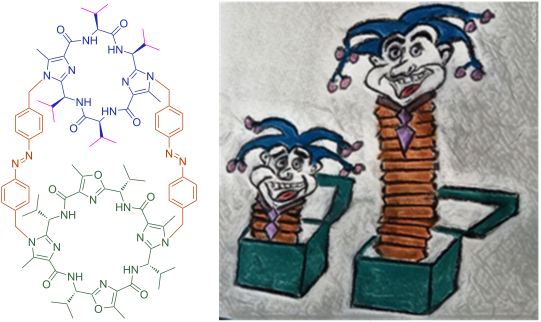
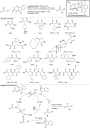
- chemistry. Here, we present the synthesis of a foldable container consisting of two different types of Lissoclinum macrocyclic peptides which are connected via two azobenzene units. The container is controllable by light: irradiation with UV light causes a switching process to the compact cis,cis-isomer


Reversible end-to-end assembly of selectively functionalized gold nanorods by light-responsive arylazopyrazole–cyclodextrin interaction
Beilstein J. Org. Chem. 2019, 15, 1407–1415, doi:10.3762/bjoc.15.140
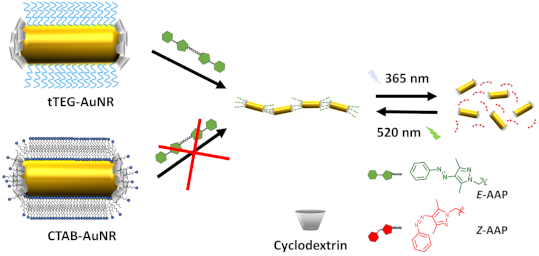
- reversibility of the switching behavior. The dispersion of AuNR assemblies after visible light irradiation can also be verified by TEM bright field images (Figure 4d) showing that the disassembly is possible without the combination of irradiation and sonication. This can be attributed to the favorable
- photostationary states of the AAP moiety in comparison to azobenzenes used in previous studies. Furthermore, dynamic light scattering was conducted to analyze the assembly in solution (Figure 5). The mean diameter increases upon dAAP addition from ca. 100 nm to ca. 230 nm. Upon UV-light irradiation, the mean


Photochemical generation of the 2,2,6,6-tetramethylpiperidine-1-oxyl (TEMPO) radical from caged nitroxides by near-infrared two-photon irradiation and its cytocidal effect on lung cancer cells
Beilstein J. Org. Chem. 2019, 15, 863–873, doi:10.3762/bjoc.15.84
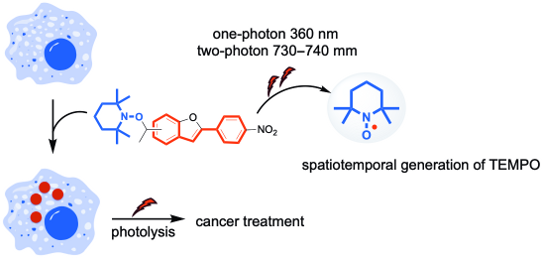
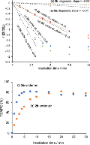
- , at wavelengths of 710–760 nm and power of 700 mW. ESR spectra acquired during the photolysis of 2a (5 mM) in benzene using 365 nm light. Irradiation time-dependent decline in viability of LLC cells with compound 2a. Detection of intracellular ROS only in irradiated LLC cells with 2a-containing medium




Oxidative radical ring-opening/cyclization of cyclopropane derivatives
Beilstein J. Org. Chem. 2019, 15, 256–278, doi:10.3762/bjoc.15.23
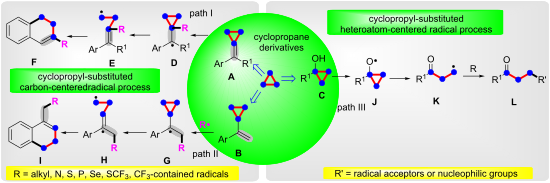
- diphenyl diselenides 12 for the synthesis of 2-phenylseleny-3,3-diarylcyclobutenes 13 under visible light irradiation (Scheme 5) [51]. The desired products 13 contained a cyclobutene group and a selenium atom, which makes the products possess unique biological and pharmaceutical activities. The mechanism






N-Arylphenothiazines as strong donors for photoredox catalysis – pushing the frontiers of nucleophilic addition of alcohols to alkenes
Beilstein J. Org. Chem. 2019, 15, 52–59, doi:10.3762/bjoc.15.5
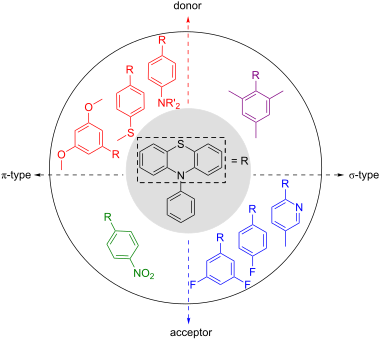
- contradicts the use of visible light irradiation due to vanishing extinction coefficients at the edge to the visible region. To reach for high excited state reduction potentials and excite at rather long irradiation wavelengths an energetically high lying electronic groundstate potential has to be connected


Degenerative xanthate transfer to olefins under visible-light photocatalysis
Beilstein J. Org. Chem. 2018, 14, 3047–3058, doi:10.3762/bjoc.14.283

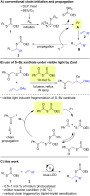
- degenerative transfer of xanthates to olefins is enabled by the iridium-based photocatalyst [Ir{dF(CF3)ppy}2(dtbbpy)](PF6) under blue LED light irradiation. Detailed mechanistic investigations through kinetics and photophysical studies revealed that the process operates under a radical chain mechanism, which
- excited triplet state of 1a formed by direct 355 nm laser light excitation and triplet–triplet energy transfer involving the excited photocatalyst 8. To confirm the possibility of a direct photoexcitation of xanthate 1 using blue LED light irradiation as an alternative mechanism, a steady-state UV–vis
- ]. After irradiation of the mixture of xanthate 1a and olefin 2b under optimal reaction conditions with blue LED light irradiation for 4 h (Scheme 3), product 3ab was obtained in 58% yield. This is consistent with 12 equivalents of xanthate adduct 3ab produced per photon absorbed by the photocatalyst 8 (Φ



Organometallic vs organic photoredox catalysts for photocuring reactions in the visible region
Beilstein J. Org. Chem. 2018, 14, 3025–3046, doi:10.3762/bjoc.14.282
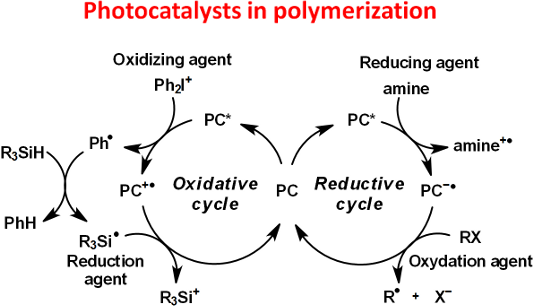
- : these processes are usually slow, expensive by requiring high temperature and high energy and release solvent (VOC). As an alternative of thermal polymerizations, polymerization upon light irradiation offers a good alternative. In both cases, polymerization occurs by the action of an initiating system
- interest in the past few decades. The development of photoredox catalysts is one of the major advances. 1.1 Photoinitiating system (PIs) Photoinitiated polymerization processes are polymerizations initiated by light irradiation. For that, a photoinitiator (PI) or a photoinitiating system (PIs) is mixed
- already found wide applications such as in water splitting, solar energy storage, proton-coupled electron transfer or photovoltaic for example [18]. 1.3 Electronic transitions involved into photoredox processes For selected photoredox catalysts, light irradiation has enough energy for the excitation of



Photocatalyic Appel reaction enabled by copper-based complexes in continuous flow
Beilstein J. Org. Chem. 2018, 14, 2730–2736, doi:10.3762/bjoc.14.251
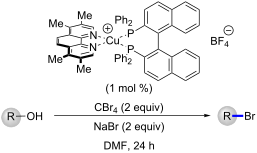
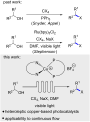
- ][12][13][14], mild reaction conditions and visible-light irradiation), which should be easily embraced by the synthetic community. To further develop the photochemical alcohol→halide transformation, the use of alternative photocatalysts based upon more abundant metals was envisioned [15][16][17][18


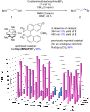


Learning from B12 enzymes: biomimetic and bioinspired catalysts for eco-friendly organic synthesis
Beilstein J. Org. Chem. 2018, 14, 2553–2567, doi:10.3762/bjoc.14.232
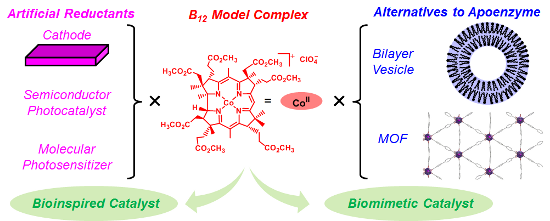
- -phenylmalonate at −2.0 V vs Ag/AgCl yielded carboxylic ester migrated product as the major product. Conversely, the electrolysis of the substrate at −1.0 V vs Ag/AgCl through light irradiation, as well as at −1.5 V vs Ag/AgCl in the dark, yielded the simple reduced product and the phenyl migrated product. The
- iridium(III) complexes such as Irdfppy [112] are superior to [Ru(bpy)3]Cl2 in terms of their photosensitization abilities in visible-light-driven B12 catalytic systems (Scheme 9) [104]. This was probably due to the gradual decomposition of [Ru(bpy)3]Cl2 under visible light irradiation. This is consistent
- with the report by Yoon et al. in which light irradiation to Ru(bpy)32+ resulted in rapid decomposition during the photocatalytic reaction [113]. It was remarkable that a significantly high turnover number based on 1 (10,880) was obtained in the prolonged reaction with Irdfppy. Quenching experiments