


Search results
Search for "origin" in Full Text gives 358 result(s) in Beilstein Journal of Organic Chemistry. Showing first 200.
Asymmetric Mannich reactions of (S)-N-tert-butylsulfinyl-3,3,3-trifluoroacetaldimines with yne nucleophiles
Beilstein J. Org. Chem. 2020, 16, 2671–2678, doi:10.3762/bjoc.16.217
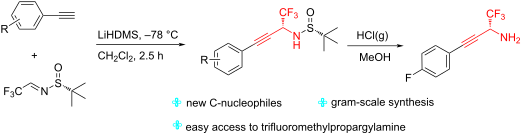
- sulfinyl oxygen and the oxygen electron lone pair. The latter presents a lesser steric obstacle rendering the corresponding nucleophilic attack the more probable event. These ever-unexpected results strongly suggest that the origin of the stereocontrol in the reactions of imine 1 is not just the bulk of


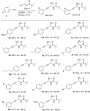


Water-soluble host–guest complexes between fullerenes and a sugar-functionalized tribenzotriquinacene assembling to microspheres
Beilstein J. Org. Chem. 2020, 16, 2551–2561, doi:10.3762/bjoc.16.207

- 1505.9611 (Δ = + 5.2 ppm). The surprising presence of six equivalents of water points to the formation of strong hydrogen bonds between the sugar ester bonds of TBTQ-(OAcG)6 and the water molecules as guests. However, the origin of this intriguing observation associated with the attachment of just two


![[Graphic 2]](/bjoc/content/inline/1860-5397-16-207-i3.svg?max-width=637&scale=1.18182) C60 [TBTQ-(OG)6: 50 μM; C60: 50 μM] and (b) TBTQ-(OG)6
C60 [TBTQ-(OG)6: 50 μM; C60: 50 μM] and (b) TBTQ-(OG)6 


Styryl-based new organic chromophores bearing free amino and azomethine groups: synthesis, photophysical, NLO, and thermal properties
Beilstein J. Org. Chem. 2020, 16, 2282–2296, doi:10.3762/bjoc.16.189
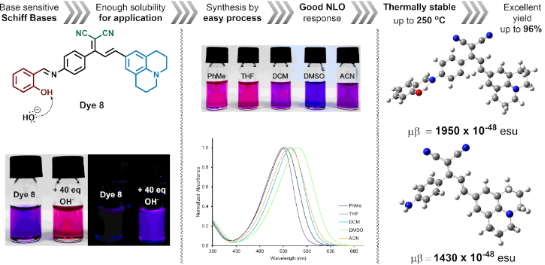
- Shimadzu 1800 UV–vis spectrophotometer in Britton–Robinson buffer solutions [63] with pH values ranging from 5.5 to 11 at room temperature (25 °C). The pKa values were obtained using the Origin software by recording the curve data. Computational methods The geometries of the dyes in their ground states


Tools for generating and analyzing glycan microarray data
Beilstein J. Org. Chem. 2020, 16, 2260–2271, doi:10.3762/bjoc.16.187
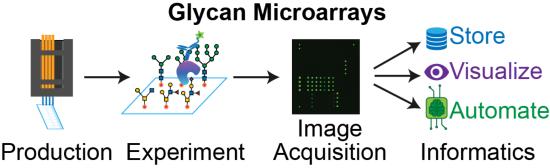
- aglycone (for example, a glycolipid obtained directly by extraction from a natural origin), an appropriate surface needs to be selected which is compatible with the glycoconjugate. Printing methods Once the decision about the surface to which they are to be attached is made, the glycans are dissolved in


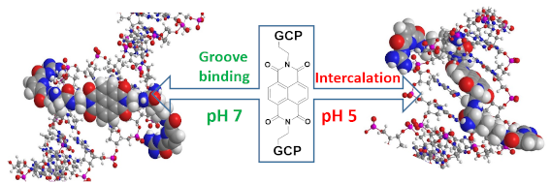
Naphthalene diimide bis-guanidinio-carbonyl-pyrrole as a pH-switchable threading DNA intercalator
Beilstein J. Org. Chem. 2020, 16, 2201–2211, doi:10.3762/bjoc.16.185
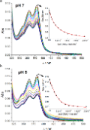
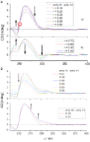
- ). Origin 7.0 software, supplied by the manufacturer, was used for data analysis. During the titration of ct-DNA, d: poly(rA)–poly(rU), poly(dAdT)–poly(dAdT), and poly(dGdC)–poly(dGdC) with the compound 4, one aliquot of 2 μL and 27 aliquots of 10 μL of 4 (c = 1.0 × 10⁻⁴ M) were injected from rotating





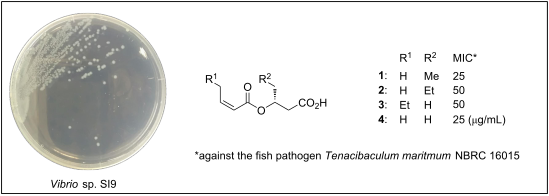
Three new O-isocrotonyl-3-hydroxybutyric acid congeners produced by a sea anemone-derived marine bacterium of the genus Vibrio
Beilstein J. Org. Chem. 2020, 16, 1869–1874, doi:10.3762/bjoc.16.154
- ]. This group is one of the most widespread bacterial genera of marine origin, cataloging 128 species at the time of writing [2], of which more than 12 are known to cause enteritis, marine food poisoning, bacteremia, septicemia, cellulitis, or other infectious diseases in human and aquatic animals [3][4
- -chain 3-hydroxy acids are the common building blocks with PHA, the microbial storage polymer. The structural similarities among 1–5 and PHA suggest a quite similar or even the same biosynthetic origin of these molecules, and hence a potential dehydrative modification at the hydroxy terminus of PHA. MS


Polarity effects in 4-fluoro- and 4-(trifluoromethyl)prolines
Beilstein J. Org. Chem. 2020, 16, 1837–1852, doi:10.3762/bjoc.16.151
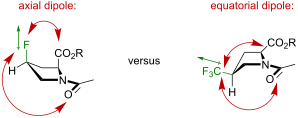
- C4-exo conformation of the pyrrolidine ring. Keywords: amino acids; cis–trans isomerism; fluorine; polarity; proline; Introduction Polarity is among the key features essential for understanding the behavior of organic molecules of biological origin. In particular, there is a set of polarity-related
- hydrophobic, while the introduction of a polar or an ionizable group makes it hydrophilic. Two amino acids stand out from the dualistic hydrophilic/hydrophobic classification: glycine and proline (Figure 1A) [1]. The origin of their effect onto the structure polarity is not due to the presence of additional
- origin of the effect is orbital (the gauche-effect) rather than through space dipolar interaction (assuming that an interaction of dipoles would be attenuated in polar solvents, which was not observed). A stabilization of certain side-chain conformers was also observed in the trifluoromethylated


Models of necessity
Beilstein J. Org. Chem. 2020, 16, 1649–1661, doi:10.3762/bjoc.16.137
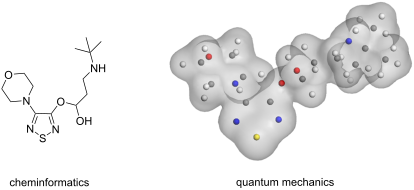
- that in reality share a common origin. This common origin is the key to successful chemistry models. Conclusion Data infrastructures are evolving and growing in many areas without being interoperable, giving rise to a phase of creolization, in which many inefficiencies in working with data retard


Fluorohydration of alkynes via I(I)/I(III) catalysis
Beilstein J. Org. Chem. 2020, 16, 1627–1635, doi:10.3762/bjoc.16.135
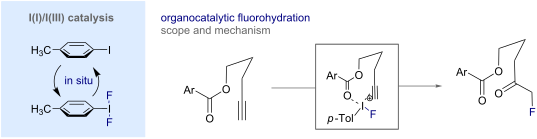
- Hammett analyses, have identified key determinants that are essential for reaction efficiency. X-ray crystal structure analysis of ketone 2 reveals a dihedral angle of φO=C-C-F = −3.7°. Although the origin of this specificity requires clarification, this fluorohydration reaction constitutes a rare case of


Antibacterial scalarane from Doriprismatica stellata nudibranchs (Gastropoda, Nudibranchia), egg ribbons, and their dietary sponge Spongia cf. agaricina (Demospongiae, Dictyoceratida)
Beilstein J. Org. Chem. 2020, 16, 1596–1605, doi:10.3762/bjoc.16.132
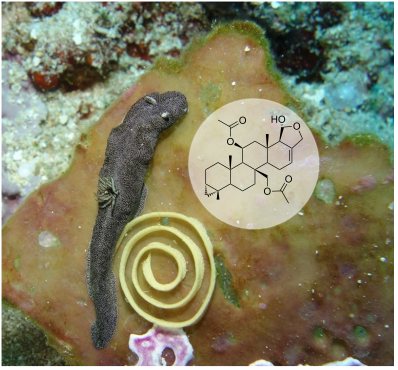
- Doriprismatica (former Glossodoris or Casella) atromarginata [38][41][44][45][50], reported the isolation of scalaranes, homoscalaranes, norscalaranes, spongian diterpenoids and furanoditerpenoids. A dietary origin of these molecules was inferred and attributed to dictyoceratid sponges of the genera Hyrtios and
- [25]. Yet determining the origin and in vitro production of these metabolites is anything but trivial. Sponges are known to host complex symbiont communities, with up to 30–60% as microbial biomass [13][77]. These highly species-specific communities are most probably vertically transmitted [78] and
- for a wide chemodiversity of terpenoid natural products [14][81]. Besides, the marine fungi Penicillium spp. and Aspergillus spp. are often associated with sponge hosts and were found to produce various terpenoids as well [15][82][83]. Hence, if sponges are not the origin of these metabolites, it is



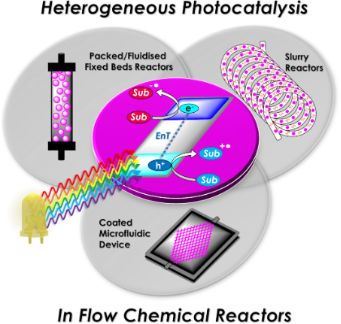
Heterogeneous photocatalysis in flow chemical reactors
Beilstein J. Org. Chem. 2020, 16, 1495–1549, doi:10.3762/bjoc.16.125
- with TiO2 as a model system for metal oxide and inorganic semiconductor HPCats. 2.1 Inorganic semiconductor photocatalysis Semiconductors are defined as materials that have a conductivity between that of an insulator and a conductor [77]. The origin of conductivity is based on the quantum states of










Highly selective Diels–Alder and Heck arylation reactions in a divergent synthesis of isoindolo- and pyrrolo-fused polycyclic indoles from 2-formylpyrrole
Beilstein J. Org. Chem. 2020, 16, 1320–1334, doi:10.3762/bjoc.16.113
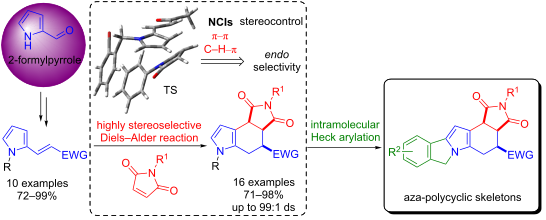
- endo selectivity in the Diels–Alder cycloadditions. Since experimental and theoretical results have demonstrated that the nature of the C–H···π interaction mainly depends on the dispersion interactions [64][67][77], these are probably not only at the origin of the endo stereoselectivity of the present


Development of fluorinated benzils and bisbenzils as room-temperature phosphorescent molecules
Beilstein J. Org. Chem. 2020, 16, 1154–1162, doi:10.3762/bjoc.16.102
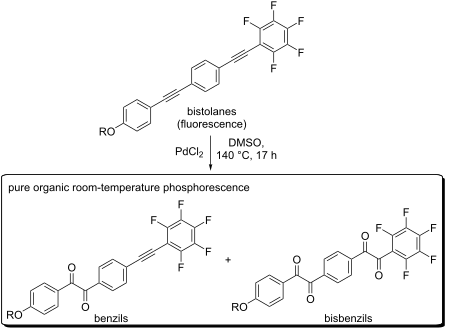
- low ΦPL of less than 0.02 (Table 1), meaning that most of the excited states of all samples deactivate nonradiatively. At the moment, we cannot certify the origin of the low ΦPL in terms of the molecular properties, for instance, the main pathway of nonradiative deactivation. Experiments are currently



Synthesis and properties of quinazoline-based versatile exciplex-forming compounds
Beilstein J. Org. Chem. 2020, 16, 1142–1153, doi:10.3762/bjoc.16.101
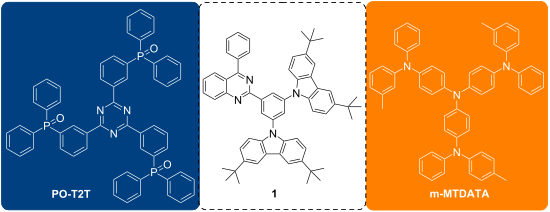
- the solution in a polar solvent, apparently because of the high polarity of compound 1. Furthermore, the emission of the solid sample was more efficient than that of the solution, with a PLQY of up to 6%. In order to determine the origin of the emission, PL decay curves of the solid samples of


Cation-induced ring-opening and oxidation reaction of photoreluctant spirooxazine–quinolizinium conjugates
Beilstein J. Org. Chem. 2020, 16, 904–916, doi:10.3762/bjoc.16.82
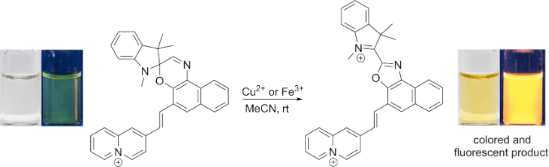
- no more changes were observed in the absorption spectra. All spectrometric titrations were performed at least two times to ensure reproducibility. In general, the absorption spectra were determined in a range between 200 nm and 800 nm and subsequently smoothed with the Origin software function


Regioselectively α- and β-alkynylated BODIPY dyes via gold(I)-catalyzed direct C–H functionalization and their photophysical properties
Beilstein J. Org. Chem. 2020, 16, 587–595, doi:10.3762/bjoc.16.53
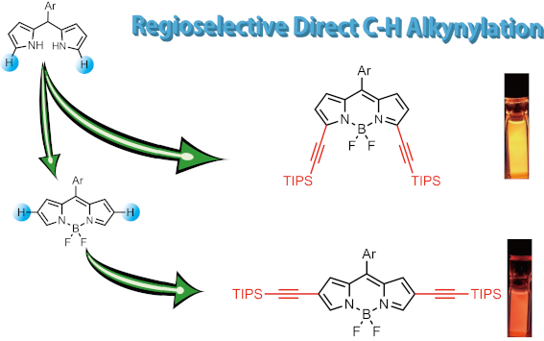
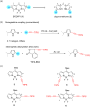
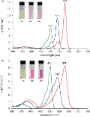
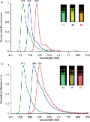
- significantly decreased with the geometry relaxation at the S1 state compared to that of the S0-state structure, which could be the origin of the large Stokes shift for 6a. Therefore, in comparison with the α-substituted compounds 3a and 4a, the less emissive character of the β-ethynyl-substituted derivatives



Room-temperature Pd/Ag direct arylation enabled by a radical pathway
Beilstein J. Org. Chem. 2020, 16, 384–390, doi:10.3762/bjoc.16.36
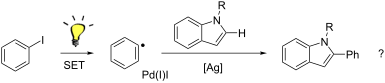
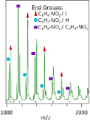
- incorporations of nitrobenzene into the polymer chains. The 2-nitrobenzoic acid used to form a silver carboxylate in the reaction system is the origin of the nitrophenyl group. Three different types of chains are represented, corresponding to incorporation of I/nitrophenyl, H/nitrophenyl, and two nitrophenyl end
- reported for decarboxylative coupling between indole and 2-nitrobenzoic acids at 110 °C [18]. Under such conditions, silver carboxylates decompose to produce carbonyl and phenyl radicals, which could explain the origin of nitrobenzene incorporation [19][20]. When the radical trapping agent BHT was added to




Two antibacterial and PPARα/γ-agonistic unsaturated keto fatty acids from a coral-associated actinomycete of the genus Micrococcus
Beilstein J. Org. Chem. 2020, 16, 297–304, doi:10.3762/bjoc.16.29
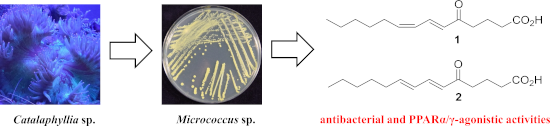
- -oxo-10,12-octadecadienoic acid [31] are the plant keto fatty acids containing the dienone moiety with trans,trans-configuration, but congeners with trans,cis-configuration have not been found in nature until the present work (Figure 4). Some of the keto fatty acids of plant origin were shown to
- -Oxo-11,13-tetradecadienoic acid is another example of insect origin, identified from hair pencils of male Amauris butterflies (Amauris albimaculata), which is supposed to be a precursor material for the butterfly pheromone [35]. Furthermore, 4-oxo-2-alkenoic fatty acids were characterized as


Synthesis, liquid crystalline behaviour and structure–property relationships of 1,3-bis(5-substituted-1,3,4-oxadiazol-2-yl)benzenes
Beilstein J. Org. Chem. 2020, 16, 149–158, doi:10.3762/bjoc.16.17
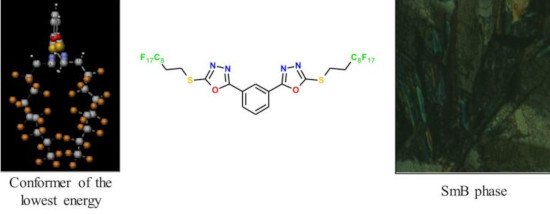
- -rich moieties) and the electron-deficient center of the molecule. The two fluorocarbon chains are symmetrically arranged with respect to the origin of the vector of dipole moment (Figure 6, compound 4b). In compound 4b, which adopts the conformation B (Figure 5b–b”), the fluorinated terminal chains
- ) folds to interact with the molecular electron-deficient center according to an electron D–A interaction, RF1 (RF linked to Oxd 1) remains straight. The dipole moment of compound 2b (Figure 6) originates close Oxd 1. With the presumption that the molecular electron-deficient center is near the origin of




Terpenes
Beilstein J. Org. Chem. 2019, 15, 2966–2967, doi:10.3762/bjoc.15.292

- pheromones, but also have a long standing history as fragrances used by humans. The oxidised derivatives may be of high interest because of their bioactivity, with some of the most important drugs used in medical applications being of terpenoid origin. Two of the most fanous examples include the diterpenoid
Bacterial terpene biosynthesis: challenges and opportunities for pathway engineering
Beilstein J. Org. Chem. 2019, 15, 2889–2906, doi:10.3762/bjoc.15.283
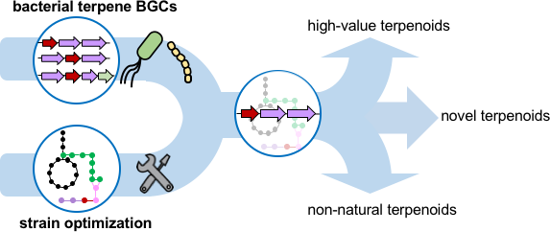
- bacteria, only a few terpenes of bacterial origin have been characterized, and their biosynthesis is for the most part poorly understood. The lack of bio-/chemoinformatics platforms to predict terpene core structures coupled with their physicochemical properties have rendered the targeted isolation of


Preparation of anthracene-based tetraperimidine hexafluorophosphate and selective recognition of chromium(III) ions
Beilstein J. Org. Chem. 2019, 15, 2847–2855, doi:10.3762/bjoc.15.278
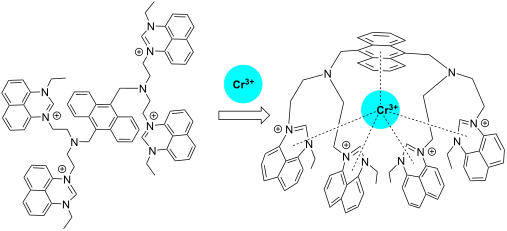
- and excitation spectral lines were adjusted to 5 and 10 nm. The emission spectra were recorded in the range of 375–500 nm. The program Origin 8.0 was employed for data processing. UV–vis titrations For UV–vis titrations, the sample solutions were prepared analogously to fluorescence titrations. The
- concentration of 3 was adjusted to 1.0⋅10−6 M while the concentration of Cr3+ ranged between 0.0 and 36.0⋅10−6 M. The absorption spectra were recorded at 240–300 nm. Origin 8.0 was employed for data processing. X-ray analysis Diffraction data of 3 were collected by a Bruker Apex II CCD diffractometer [56


Arylisoquinoline-derived organoboron dyes with a triaryl skeleton show dual fluorescence
Beilstein J. Org. Chem. 2019, 15, 2612–2622, doi:10.3762/bjoc.15.254
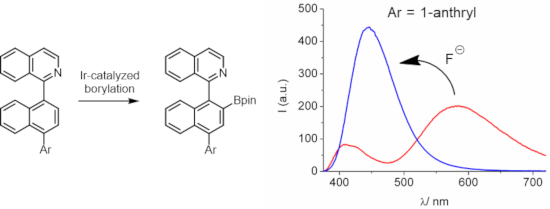
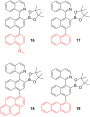
- (17), 426 nm (18), 425 nm (19). This points to the interpretation that the SW emission has its origin in a Lewis adduct between the boron center as acceptor and the solvent as donor. The maxima of the rather broad LW bands of the dyes are observed between 510 and 590 nm in acetonitrile, corresponding



Targeted photoswitchable imaging of intracellular glutathione by a photochromic glycosheet sensor
Beilstein J. Org. Chem. 2019, 15, 2380–2389, doi:10.3762/bjoc.15.230
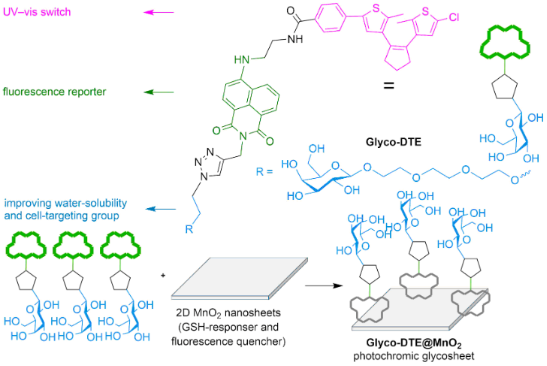
- blinking ON/OFF fluorescence signal which ensures the origin of fluorescence signal from the photochromic probe. Hence, the intracellular sensing precision is significantly improved. Conclusion In summary, photochromic glycosheet Glyco-DTE@MnO2 was developed for cell-targeted and photoswitchable



Current understanding and biotechnological application of the bacterial diterpene synthase CotB2
Beilstein J. Org. Chem. 2019, 15, 2355–2368, doi:10.3762/bjoc.15.228
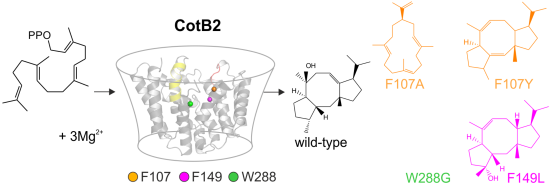
- will focus particularly on bacterial diterpene synthases, in context with other sesqui- and ditperpene synthases of bacterial, fungal and plant origin. The initial step in diterpene biosynthesis (Figure 1) is the incremental condensation of dimethylallyl diphosphate (1) and isopentylen diphosphate (2





