Search results
Search for "ring expansion" in Full Text gives 111 result(s) in Beilstein Journal of Organic Chemistry.
Synthetic applications of gold-catalyzed ring expansions
Beilstein J. Org. Chem. 2011, 7, 767–780, doi:10.3762/bjoc.7.87
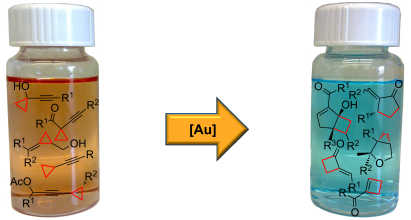
- ; ring expansion; strained rings; Introduction Over the past twenty years, the image of gold has evolved, from being considered a dead-entity in terms of chemical reactivity, to playing a key role in catalytic processes. The vast array of gold-mediated transformations reported so far share a common
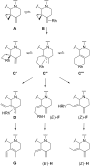
- powerful in triggering ring-expansion processes to introduce structural complexity into organic molecules. The gold-catalyzed ring expansion of strained rings is viewed nowadays as a flexible synthetic tool in organic synthesis [7][8][9]. In this review, we aim to summarize the most recent developments in
- the various approaches to access these ubiquitous scaffolds, the gold(I)-catalyzed ring expansion of cyclopropanols and cyclobutanols is considered one of the most powerful and versatile methods. In 2005, Toste and co-workers reported the treatment of 1-(phenylethynyl)cyclopropanol (11) with tris(4


Intraannular photoreactions in pseudo-geminally substituted [2.2]paracyclophanes
Beilstein J. Org. Chem. 2011, 7, 658–667, doi:10.3762/bjoc.7.78

- diradical intermediate of type 17, its lifetime is evidently too short to allow ring-expansion as depicted in Scheme 7. Whether this process might be induced thermally (vinylcyclopropane→cyclopentene rearrangement; [23]) is an open question. Conclusion Although the detailed mechanisms of the


Molecular rearrangements of superelectrophiles
Beilstein J. Org. Chem. 2011, 7, 346–363, doi:10.3762/bjoc.7.45
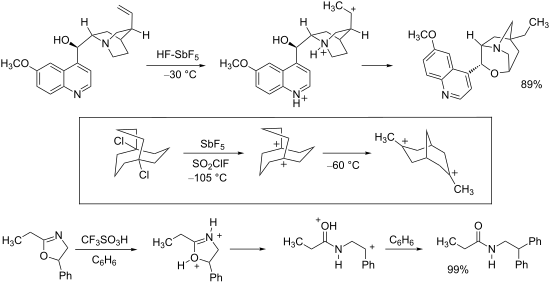
- the synthesis of the analgesic drug butorphanol (40) [21], a key step involves the ring expansion of dication 42 to dication 43 (Scheme 9). Interestingly, the ring expansion step moves the carbocationic site away from a benzylic position, but also transforms it from a 1,4-dication to a 1,5-dication
- . Condensations of ninhydrin (28) with benzene. Rearrangement of 29 to 30. Superacid promoted ring opening of succinic anhydride (33). Reaction of phthalic acid (36) in FSO3H-SbF5. Ring expansion of superelectrophile 42. Reaction of camphor (44) in superacid. Isomerization of 2-cyclohexen-1-one (48


Rh-Catalyzed rearrangement of vinylcyclopropane to 1,3-diene units attached to N-heterocycles
Beilstein J. Org. Chem. 2011, 7, 298–303, doi:10.3762/bjoc.7.39

- group endows many natural and synthetic compounds with a broad spectrum of interesting properties, mainly related to its unusual bonding and inherent ring strain [1][2][3]. This characteristic confers on molecules containing this moiety high reactivity, especially towards ring expansion and ring-opening


Ene–yne cross-metathesis with ruthenium carbene catalysts
Beilstein J. Org. Chem. 2011, 7, 156–166, doi:10.3762/bjoc.7.22
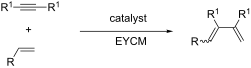
- reaction demonstrated that ruthenium alkylidene was the active catalytic species (methylidene free conditions). This ring expansion could be extended to fused cycloalkene substrates such as tetrahydroindene and bicyclo[3.2.0]heptenone, both of them featuring a cyclopentene unit to form functionalized
- obtained for EYCM with styrenes. EYCM of terminal olefins with internal borylated alkynes. Synthesis of propenylidene cyclobutane via EYCM. Efficient EYCM with vinyl ethers. From cyclopentene to cyclohepta-1,3-dienes via cyclic olefin-alkyne cross-metathesis. Ring expansion via EYCM from bicyclic olefins


Highly substituted benzannulated cyclooctanol derivatives by samarium diiodide-induced cyclizations
Beilstein J. Org. Chem. 2010, 6, 1229–1245, doi:10.3762/bjoc.6.141
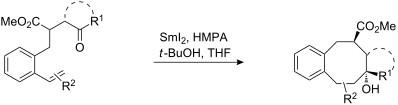
- ][7][8][9][10][11][12][13][14][15][16][17][18]. Successful approaches include ring-closing metathesis [4], rearrangements [5], and cycloadditions [6], transition metal-catalyzed cyclizations [7][8], nucleophilic and electrophilic substitution reactions [9] as well as ring expansion reactions [10




Total synthesis of (±)-coerulescine and (±)-horsfiline
Beilstein J. Org. Chem. 2010, 6, 876–879, doi:10.3762/bjoc.6.103

- include the following oxidative rearrangements: lead tetraacetate [3], sodium tungstate [11], tert-butyl hypochlorite [12] and N-bromosuccinimide [13]. Other approaches involve the Mannich reaction [14], ring expansion reactions [15][16], 1,3-dipolar [3 + 2] cycloadditions [17][18][19], intramolecular


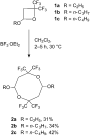
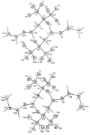
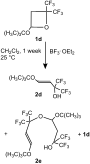
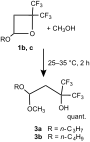
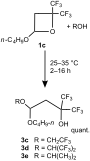
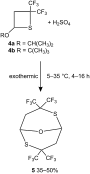
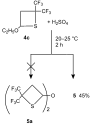
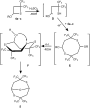
Acid catalyzed cyclodimerization of 2,2-bis(trifluoromethyl)-4-alkoxy-oxetanes and -thietanes. Synthesis of 2,2,6,6-tetrakis(trifluoromethyl)-4,8-dialkoxy-1,5-dioxocanes and 3,3,7,7-tetrakis(trifluoromethyl)-9-oxa-2,6-dithia-bicyclo[3.3.1]nonane
Beilstein J. Org. Chem. 2010, 6, No. 46, doi:10.3762/bjoc.6.46
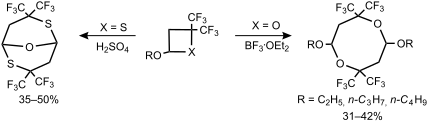
- -oxides [7], and an unusual reductive ring expansion leading to the corresponding dihydrothiophenes [7]. As part of a program to identify new, readily available fluorinated monomers, we have carried out a comparative study of the reactivity of 2,2-bis(trifluoromethyl)-4-alkoxy- oxetanes and -thietanes



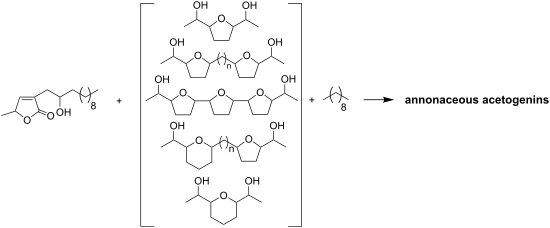
Recent progress on the total synthesis of acetogenins from Annonaceae
Beilstein J. Org. Chem. 2008, 4, No. 48, doi:10.3762/bjoc.4.48


Synthesis of spiropyrans: H-abstractions in 3-cycloalkenyloxybenzopyrans
Beilstein J. Org. Chem. 2007, 3, No. 14, doi:10.1186/1860-5397-3-14
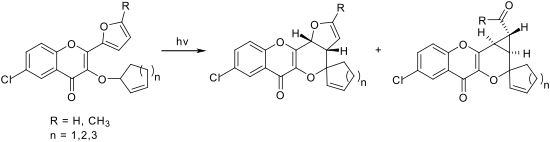
- ), followed by 1,5-H migration in 8a. [21] The spiropyrans 6 (R = H) bearing cyclopropanes are the secondary photoproducts formed as a result of the further reorganization of 5 (R = H), through a ring contraction-ring expansion mechanism. [22][23] The formation of acetylcyclopropane compound 7 (R = CH3) from


Methods for the synthesis of polyhydroxylated piperidines by diastereoselective dihydroxylation: Exploitation in the two-directional synthesis of aza-C-linked disaccharide derivatives
Beilstein J. Org. Chem. 2005, 1, No. 2, doi:10.1186/1860-5397-1-2
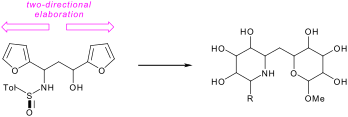
- exploited in the two-directional synthesis of aza-C-linked disaccharide analogues. A two-directional oxidative ring expansion was used to prepare bis-enones such as (2R,6S,2'S)-6-methoxy-2-(6-methoxy-3-oxo-3,6-dihydro-2H-pyran-2-ylmethyl)-1-(toluene-4-sulfonyl)-1,6-dihydro-2H-pyridin-3-one from the
- (Scheme 2).[24][25][26][27][28][29][30][31][32] Two-directional[33] oxidative ring expansion of 1,3-difuryl 1,3-amino alcohol derivatives 4 would yield a densely functionalised bis-enone which would be ripe for further functionalisation. The term "two-directional synthesis" is usually used to describe the
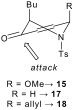
- diastereoselective functionalisation of piperidines were developed using a racemic model ring system. Oxidative ring expansion[38] of the 2-furyl sulfonamide 11, prepared by addition of n-butyl lithium to the N-tosyl imine of 2-furaldehyde,[39] was followed by protection to yield the piperidin-3-one 12 (Scheme 3