Search results
Search for "scalability" in Full Text gives 130 result(s) in Beilstein Journal of Organic Chemistry.
Main group mechanochemistry
Beilstein J. Org. Chem. 2017, 13, 2068–2077, doi:10.3762/bjoc.13.204
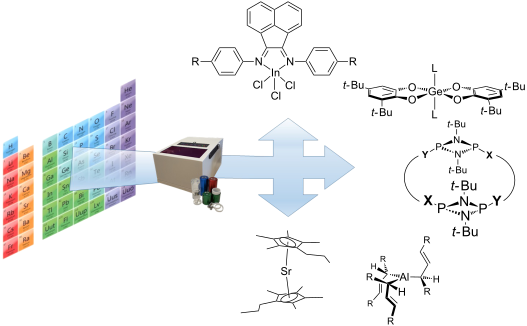
- obtained in small-scale via salt metathesis reactions due to poor starting material (SrI2 and K[Cp′]) solubility in ether solution. LAG provides a high yielding synthetic methodology circumventing the scalability issues associated with the inefficient diffusion of reactants in large-scale solution-based


Synthesis of benzannelated sultams by intramolecular Pd-catalyzed arylation of tertiary sulfonamides
Beilstein J. Org. Chem. 2017, 13, 1932–1939, doi:10.3762/bjoc.13.187
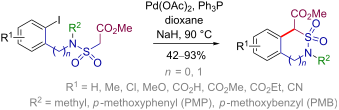
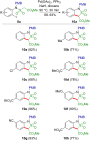
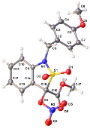
- transformation of 8a to the sultam 10a was achieved (Table 1, entries 8, 9). To demonstrate the scalability of this synthesis of the sultam 10a, the reaction was carried out with 7.1 g of 8a and just 2 mol % of Pd(OAc)2, to furnish an isolated yield of 4.3 g (83%) of the sultam 10a. Under the optimized reaction




Mechanochemical enzymatic resolution of N-benzylated-β3-amino esters
Beilstein J. Org. Chem. 2017, 13, 1728–1734, doi:10.3762/bjoc.13.167

- significant catalytic activity (yield = 38%). Finally, to test the scalability of the process, a set of reactions was carried out increasing the amount of substrate rac-1a under the optimized reaction parameters. (Table 4). Relative to the results obtained with 1 equivalent of rac-1a in the presence of LAG


The chemistry and biology of mycolactones
Beilstein J. Org. Chem. 2017, 13, 1596–1660, doi:10.3762/bjoc.13.159
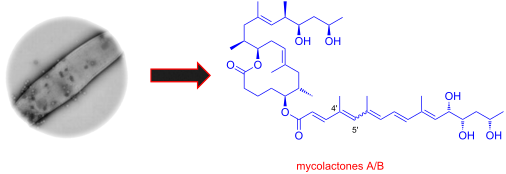
- in 2010 was developed with a main focus on scalability. Alternative access routes to key fragments allowed the efficient synthesis of multigram quantities of late stage intermediates. Finally, 1.3 g of the highly pure extended mycolactone core were prepared. Kishi’s 1st generation synthesis of the









Total syntheses of the archazolids: an emerging class of novel anticancer drugs
Beilstein J. Org. Chem. 2017, 13, 1085–1098, doi:10.3762/bjoc.13.108
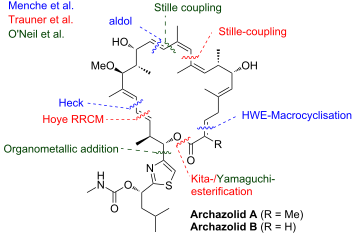
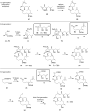
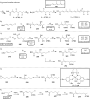
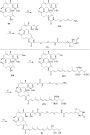
- formed in high yields and selectivity. While the overall sequence towards 5 consequently required twice a two-step adaption of the oxidation state which renders this route quite lengthy, the authors argue that the robustness, facile conduction and scalability of each step was very high and made them


Fast and efficient synthesis of microporous polymer nanomembranes via light-induced click reaction
Beilstein J. Org. Chem. 2017, 13, 558–563, doi:10.3762/bjoc.13.54
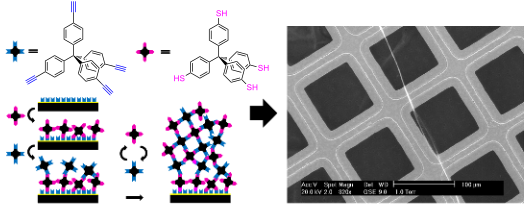
- solid liquid interfacial layer-by-layer (LbL) synthesis of CMP-nanomembranes via Cu catalyzed azide–alkyne cycloaddition (CuAAC). However, this process featured very long reaction times and limited scalability. Herein we present the synthesis of surface grown CMP thin films and nanomembranes via light


Contribution of microreactor technology and flow chemistry to the development of green and sustainable synthesis
Beilstein J. Org. Chem. 2017, 13, 520–542, doi:10.3762/bjoc.13.51
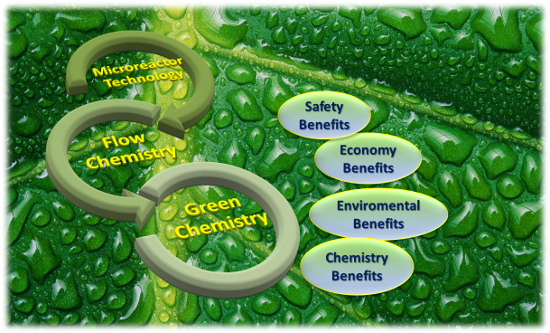
- acknowledged as viable and very often superior alternative to batch processing. Continuous-flow techniques offer increased safety, scalability, reproducibility, automation, reduced waste and costs, and accessibility to a wide range of new chemical possibilities, seldom not accessible through classic batch






A chemoselective and continuous synthesis of m-sulfamoylbenzamide analogues
Beilstein J. Org. Chem. 2017, 13, 303–312, doi:10.3762/bjoc.13.33
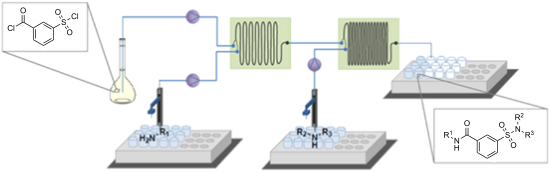
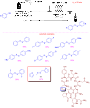
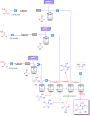
- the direct scalability of the developed protocol. For these reactions the required amount of product was aimed at 100–200 mg which took about 3 hours of production. Compound 3cb, which corresponds with AK-7, was also produced on gram scale which took approximately 24 hours. Table 5 shows 15 analogues


NMR reaction monitoring in flow synthesis
Beilstein J. Org. Chem. 2017, 13, 285–300, doi:10.3762/bjoc.13.31
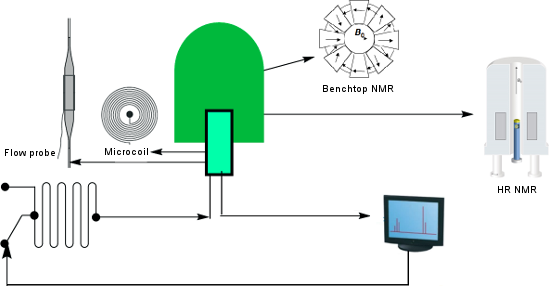
- applications even for NMR metabolomics [26]. Stripline coils represent a simple and effective coil design with interesting applications even as detectors in DNP methods [22][27]. Stripline coils produce high and homogeneous B1 field, can be integrated on a microfluidic chip and show scalability as reported by


Continuous-flow synthesis of highly functionalized imidazo-oxadiazoles facilitated by microfluidic extraction
Beilstein J. Org. Chem. 2017, 13, 239–246, doi:10.3762/bjoc.13.26
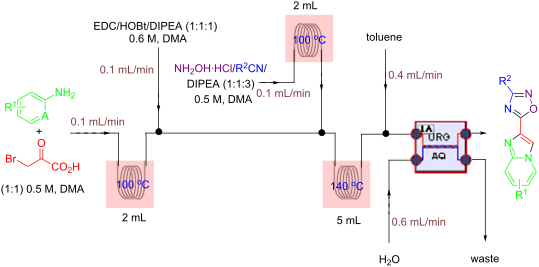
- using polar organic solvents such as dimethylformamide (DMF) [7][8][9][15]. However, the challenges of removing large amounts of high boiling solvents during the purification and isolation process can limit scalability and efficiency. Furthermore, many useful synthetic reactions are incompatible with
- multistep continuous-flow method allowed the construction of complex molecules rapidly without the need for purification and isolation of intermediates, lower flow rates and small reactors limited the scalability of the method. As noted previously, the use of high boiling point solvents, such as DMA, are


Extrusion – back to the future: Using an established technique to reform automated chemical synthesis
Beilstein J. Org. Chem. 2017, 13, 65–75, doi:10.3762/bjoc.13.9
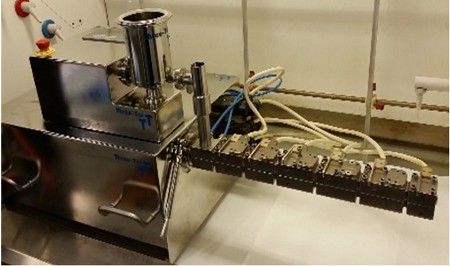
- . 3–10 kg h−1 (after both transformations have been carried out) [16]. Unfortunately, there is no example in the literature for this reaction carried out in batch, however, Meyer reports on the general scalability of batch polymerisation and comments that up to 200 kg d−1 quantities can be obtained


A direct method for the N-tetraalkylation of azamacrocycles
Beilstein J. Org. Chem. 2016, 12, 2457–2461, doi:10.3762/bjoc.12.239
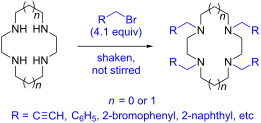
- conditions (immiscible chloroform/sodium hydroxide solvent system [36][37]) gave a further increase in yield (to 60%), but the reaction under these conditions required long run times (up to several days) and afforded poor scalability, with the yield dropping to 42% when the reaction was carried out on a 2.5


Catalytic Chan–Lam coupling using a ‘tube-in-tube’ reactor to deliver molecular oxygen as an oxidant
Beilstein J. Org. Chem. 2016, 12, 1598–1607, doi:10.3762/bjoc.12.156
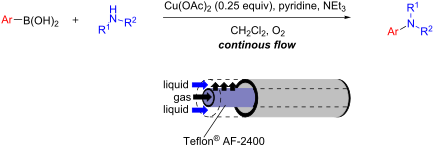
- of NEt3 and 1 equiv of pyridine at 40 °C for 48 h confirming their low reactivity. Reaction scaling Finally, the robustness of the process and potential for scalability of the general reaction conditions was demonstrated by the synthesis of 19 at a 10 mmol scale, a factor of fourteen times the


Flow carbonylation of sterically hindered ortho-substituted iodoarenes
Beilstein J. Org. Chem. 2016, 12, 1503–1511, doi:10.3762/bjoc.12.147
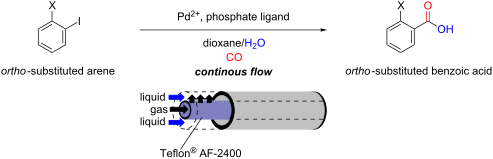
- -dehalogenation pathway becomes preferred, giving 1,3-dimethoxybenzene as the main product, which was isolated in 31% yield in the case of 29 and 3-chlorotoluene in the case of 30 which was isolated in 52% yield (Scheme 4). To demonstrate the potential scalability of the reaction conditions, the synthesis of


Modular synthesis of the pyrimidine core of the manzacidins by divergent Tsuji–Trost coupling
Beilstein J. Org. Chem. 2016, 12, 1111–1121, doi:10.3762/bjoc.12.107
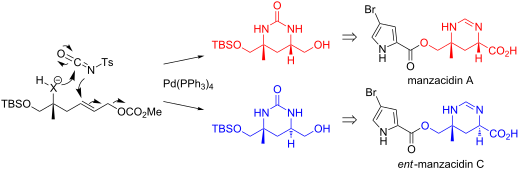
- ) [45]. Unfortunately, this route was found to be less effective in terms of isolated yields and scalability. Thus, the iron-catalyzed procedure was applied and multigram quantities of 12 were readily obtained. As shown in Scheme 3, we next focused on the further derivatization of amine 12 towards



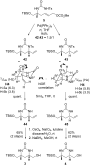
Iridium/N-heterocyclic carbene-catalyzed C–H borylation of arenes by diisopropylaminoborane
Beilstein J. Org. Chem. 2016, 12, 654–661, doi:10.3762/bjoc.12.65

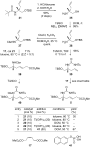
- chromatography over silica gel eluting with hexane/EtOAc. Product-containing fractions were concentrated in vacuo to give a pure borylated product. Catalytic C–H borylation of arenes and related reported boron sources. Scalability and derivatization. Effect of the ligand on the Ir-catalyzed borylation of 2 with


Enabling technologies and green processes in cyclodextrin chemistry
Beilstein J. Org. Chem. 2016, 12, 278–294, doi:10.3762/bjoc.12.30
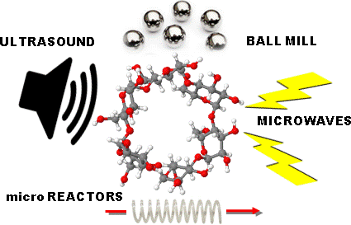
- highlight the huge advantages and potential scalability of these so-called enabling technologies that maximize heat and mass transfer. Although many advances have been made during the past decade, the most exciting results in this field are surely yet to come. Ultrasound US irradiation is an environmentally
- miniaturized continuous flow reactor, also called microreactor, offers many advantages over conventional scale reactors, including considerable improved energy exploitation, increased reaction speed and yield, safety, reliability, scalability, on-site/on-demand production, etc., and a much finer degree of


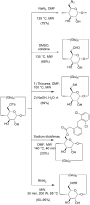


The synthesis of active pharmaceutical ingredients (APIs) using continuous flow chemistry
Beilstein J. Org. Chem. 2015, 11, 1194–1219, doi:10.3762/bjoc.11.134
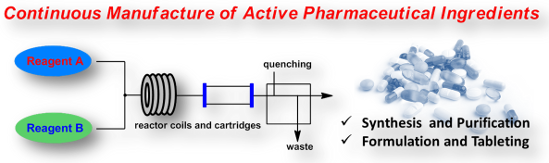
- : continuous processing; flow synthesis; in-line analysis; manufacture; pharmaceuticals; scalability; Introduction The last 20 years have witnessed a true renaissance in the way synthetic chemistry is performed due to the implementation of various enabling technologies allowing the modern synthesis chemist to


Radical-mediated dehydrative preparation of cyclic imides using (NH4)2S2O8–DMSO: application to the synthesis of vernakalant
Beilstein J. Org. Chem. 2015, 11, 1008–1016, doi:10.3762/bjoc.11.113
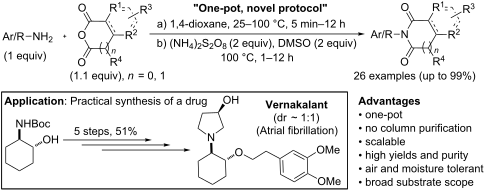
- byproducts, difficult to access starting materials, azeotropoic removal of water, column purification, harsh reaction conditions, longer reaction time and lack of scalability are some of the drawbacks of prior methods. The development of improved processes to such an important building block is an area of


Chemoselective O-acylation of hydroxyamino acids and amino alcohols under acidic reaction conditions: History, scope and applications
Beilstein J. Org. Chem. 2015, 11, 446–468, doi:10.3762/bjoc.11.51
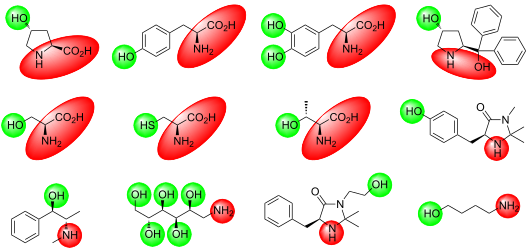
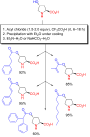
- ][55][56][57][58][59][60][61]. Due to the nature of the reaction and ready availability of catalyst, these asymmetric reactions could be undertaken at the mole-scale (giving more than 100 g of product), with possibility of both catalyst recovery and reuse. The scalability of these reactions is first




Photovoltaic-driven organic electrosynthesis and efforts toward more sustainable oxidation reactions
Beilstein J. Org. Chem. 2015, 11, 280–287, doi:10.3762/bjoc.11.32
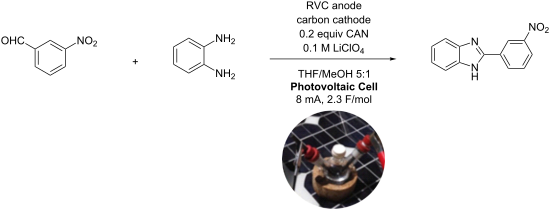
- discussion here because the reaction serves to both illustrate the range of oxidation reactions that can be performed in a catalytic fashion using a simple photovoltaic and highlight the scalability of the process. In order to perform the reaction on a preparative scale, the array-based method was increased


An improved procedure for the preparation of Ru(bpz)3(PF6)2 via a high-yielding synthesis of 2,2’-bipyrazine
Beilstein J. Org. Chem. 2015, 11, 61–65, doi:10.3762/bjoc.11.9
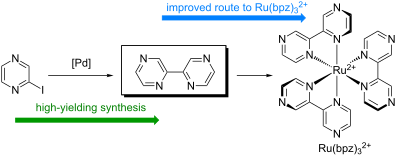
- explored the scalability of the optimized conditions, and found that they remained applicable on multi-gram scale (Scheme 2). Thus, exposure of 4 g of 2-iodopyrazine to the optimized conditions from Table 1 cleanly produced 1.25 g of 2,2’-bipyrazine in 81% isolated yield. A portion of this material was


Continuous flow nitration in miniaturized devices
Beilstein J. Org. Chem. 2014, 10, 405–424, doi:10.3762/bjoc.10.38
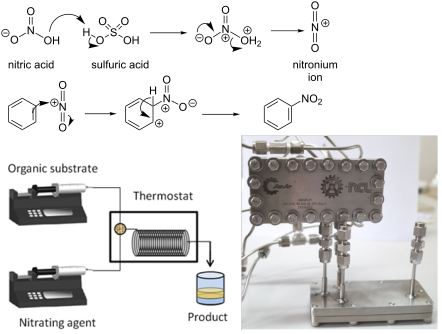
- acid and later with benzene. Orifices with different diameters induce different flow regimes in the reactor. The authors claim this microreactor has infinite scalability, as it is based on the addition of different components in sequence. In one of the first reports on the continuous flow nitration of


Concise, stereodivergent and highly stereoselective synthesis of cis- and trans-2-substituted 3-hydroxypiperidines – development of a phosphite-driven cyclodehydration
Beilstein J. Org. Chem. 2014, 10, 369–383, doi:10.3762/bjoc.10.35
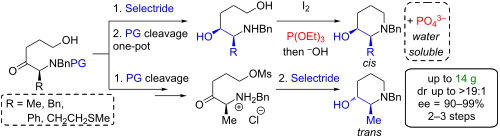
- pharmacological activities of compounds based on the 3-piperidinol scaffold, a step-economic, scalable and stereodivergent synthesis of both cis- and trans-diastereomers of B in good diastereoselectivities is highly desirable. In the syntheses of potentially new drug candidates scalability is a significant factor
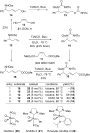
- 44%, demonstrating the scalability and high practicability of our sequence. The relative configurations of compounds 9 and 11 were proven by NOE spectroscopy of piperidinols cis-11a–d, trans-11a, cis- and trans-16c, L-733,060.HCl and of oxazolidinones trans-10a and trans-10c (see Supporting


One-step synthesis of pyridines and dihydropyridines in a continuous flow microwave reactor
Beilstein J. Org. Chem. 2013, 9, 1957–1968, doi:10.3762/bjoc.9.232
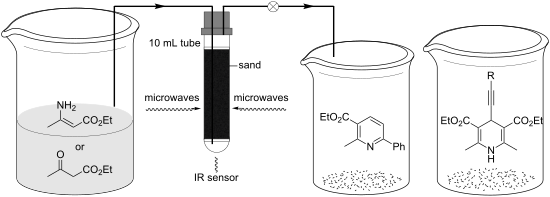
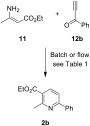
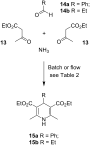
- scalability under microwave irradiation [10] and under continuous flow processing, observed by ourselves and others [73][74], this technology stands out as the heating method of choice for the preparation of 1,4-DHP derivatives. Conclusion These studies have demonstrated that a microwave flow reactor can be