


Search results
Search for "benzylidene" in Full Text gives 160 result(s) in Beilstein Journal of Organic Chemistry.
Organocatalytic C–H activation reactions
Beilstein J. Org. Chem. 2012, 8, 1374–1384, doi:10.3762/bjoc.8.159
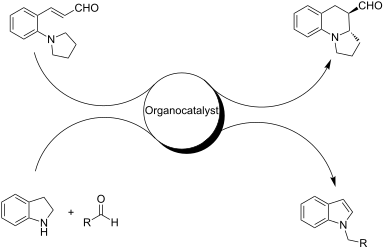
- regenerated (Scheme 11). The following year, Akiyama and co-workers reported another organocatalytic asymmetric synthesis of tetrahydroquinolines using chiral phosphoric acid as the catalyst [25]. In this instance, benzylidene malonates were used as the hydride acceptor. Another important feature of this





Studies on the substrate specificity of a GDP-mannose pyrophosphorylase from Salmonella enterica
Beilstein J. Org. Chem. 2012, 8, 1219–1226, doi:10.3762/bjoc.8.136

- . Results and Discussion Synthesis of 2-methoxy derivative 9 The synthesis of sugar 1-phosphate 9 containing a methyl group at O-2 commenced from 3-O-benzyl-4,6-O-benzylidene-α-D-mannopyranoside 14 [26] as illustrated in Scheme 1. Methylation of the alcohol under standard conditions proceeded in 80% yield
- affording 15. The benzylidene protecting group was cleaved, together with the methyl glycoside, by acetolysis giving the tetra-O-acetylated compound 16 in 81% yield. This glycosyl acetate was converted to the corresponding thioglycoside (17), which was, in turn, coupled with dibenzyl phosphate under NIS
- -benzylidene-α-D-mannopyranoside (19) [26] was first methylated giving 20 and then converted into glycosyl acetate 21 in 49% yield over the two steps. Subsequent thioglycosylation provided a 52% yield of 22. The protected dibenzyl phosphate 23 was next formed by the NIS–AgOTf promoted glycosylation of dibenzyl


Synthesis of 4” manipulated Lewis X trisaccharide analogues
Beilstein J. Org. Chem. 2012, 8, 1134–1143, doi:10.3762/bjoc.8.126
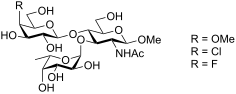
- 12 [56] and 13 [12] (Figure 2). Synthesis of monosaccharide building blocks 8–11 Glucosamine acceptor 8 was prepared in two steps from the known [14] benzylidene 7: the benzylidene acetal was first hydrolyzed, and then the resulting diol (79%) was selectively benzoylated at O-6 (BzCl-collidine


Synthesis of fluorinated maltose derivatives for monitoring protein interaction by 19F NMR
Beilstein J. Org. Chem. 2012, 8, 448–455, doi:10.3762/bjoc.8.51
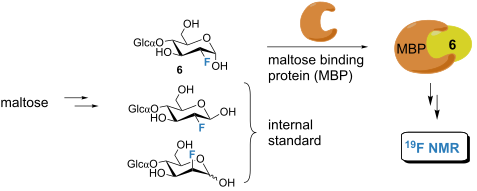
- regioselective reductive ring opening of benzylidene acetals in the maltose derivative 11 was performed with a complex of BH3/Bu2BOTf at −70 °C [32][33]. Fluorination with DAST [34][35] was performed in a sealed tube for 1 h at 80 °C under microwave conditions. The deprotection of the benzyl group was achieved
- with Pd/C [36], followed by a Zemplén saponification to obtain product 15. Starting from 4′,6′-O-benzylidene maltose 10 [37], the primary alcohol was protected as tert-butyldimethylsilyl ether followed by standard peracetylation (Scheme 2). Treatment of the silyl protecting group with an excess of
- Deoxofluor [38] yielded the 6-F-maltose derivatives 18. Final deprotection with acetic acid [37][39] and sodium methoxide yielded compound 20. The synthesis of the galacto-type derivative 23 started from peracetylated benzylidene maltose 11 [37]. Deprotection [37] with acetic acid followed by microwave


Facile synthesis of nitrophenyl 2-acetamido-2-deoxy-α-D-mannopyranosides from ManNAc-oxazoline
Beilstein J. Org. Chem. 2012, 8, 428–432, doi:10.3762/bjoc.8.48
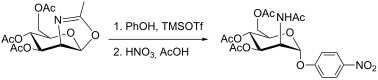
- % yield) or from methyl 4,6-O-benzylidene-α-D-glucopyranoside (5 steps, 23%). Unfortunately, in our hands this synthetic procedure did not afford the published yields, namely in the triflate and consequent azide substitution steps. Oxazolines, such as 3, have been used as glycosylation agents in the


Acceptor-influenced and donor-tuned base-promoted glycosylation
Beilstein J. Org. Chem. 2012, 8, 413–420, doi:10.3762/bjoc.8.46
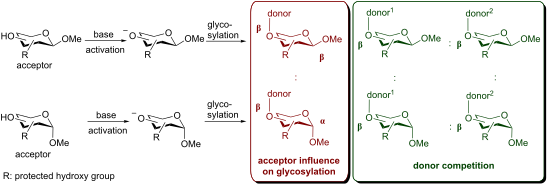
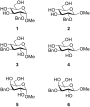
- glucopyranosyl acceptors 1–4 started with benzylidenation [4] of compound 10 and 11, respectively (Scheme 1). As the next step, monobenzylation of 12 and 13 by phase-transfer catalysis [5] afforded derivatives 14–17. Subsequent cleavage of the benzylidene protecting group [4] gave the target compounds 1–4 in
- -glycopyranoside acceptor 6 started with benzylidenation [4] of 19, followed by monobenzylation via intermediate stannylidene acetal formation [6] and subsequent cleavage of the benzylidene group [4]. Formation of the perbenzylated α-fucopyranosyl chloride was achieved according to [2]. Starting with peracetylated



Synthesis and mesomorphic properties of calamitic malonates and cyanoacetates tethered to 4-cyanobiphenyls
Beilstein J. Org. Chem. 2012, 8, 371–378, doi:10.3762/bjoc.8.40
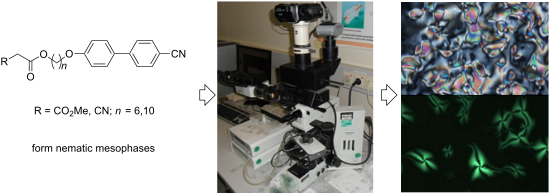
- malonates and cyanoacetates are well known as suitable ligands for strong coordination of main-group and transition metals [25]. Benzylidene derivatives of malonic esters, so called swallow-tailed liquid crystals, were described as forming smectic phases [26]. However, most work on liquid-crystalline


Laterally substituted symmetric and nonsymmetric salicylideneimine-based bent-core mesogens
Beilstein J. Org. Chem. 2012, 8, 129–154, doi:10.3762/bjoc.8.15
- the benzylidene derivative H 3a. The introduction of the hydroxy groups enables the salicylideneaniline compound OH 3a to form a mesophase. The clearing temperature of the bromine-substituted compound OH 3b increases due to the presence of hydroxy groups, in comparison to H 3b, by 34 K. Liquid


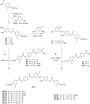


Dependency of the regio- and stereoselectivity of intramolecular, ring-closing glycosylations upon the ring size
Beilstein J. Org. Chem. 2011, 7, 1609–1619, doi:10.3762/bjoc.7.189
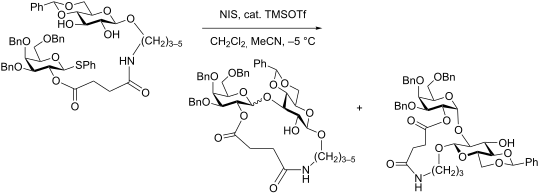
- -O-benzyl-2-O-(3-carboxypropionyl)-1-thio-β-D-galactopyranoside (1) was condensed via its pentafluorophenyl ester 2 with 5-aminopentyl (4a), 4-aminobutyl (4b), 3-aminopropyl (4c) and 2-aminoethyl 4,6-O-benzylidene-β-D-glucopyranoside (4d), prepared from the corresponding N-Cbz protected glucosides 3a
- in ratios depending upon the ring size formed during glycosylation. No β(1→2) linked disaccharides were formed. Molecular modeling of saccharides 6–8 revealed that a strong aromatic stacking interaction between the aromatic parts of the benzyl and benzylidene protecting groups in the galactosyl and
- 1-thio-galactosyl donor and a 4,6-O-benzylidene-glucose acceptor tethered by peptide-bond-containing linkers of variable size, in order to study systematically the parameters influencing the outcome of the intramolecular, ring-closing glycosylation step. In order to further provide a rationalization


Convergent synthesis of the tetrasaccharide repeating unit of the O-antigen of Shigella boydii type 9
Beilstein J. Org. Chem. 2011, 7, 1182–1188, doi:10.3762/bjoc.7.137
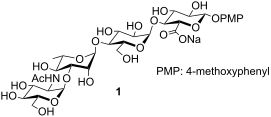
- recently developed environmentally benign reaction conditions for protecting group manipulations and glycosylations such as, (i) O-acetylation using sulfamic acid [20], (ii) regioselective ring opening of the benzylidene acetal using a combination of triethylsilane and iodine [21], (iii) direct one-pot
- , 3, 4 and 7 were prepared from commercially available reducing mono- and disaccharides utilizing a series of reaction methodologies reported earlier. 4-Methoxyphenyl (4,6-O-benzylidene-α-D-glucopyranosyl)-(1→4)-β-D-glucopyranoside (5) [32] was subjected to a sequence of reactions involving
- acetylation using acetic anhydride in the presence of sulfamic acid [20] followed by regioselective reductive ring opening of the benzylidene acetal using a combination of triethylsilane and iodine [21] to furnish 4-methoxyphenyl (2,3-di-O-acetyl-6-O-benzyl-α-D-glucopyranosyl)-(1→4)-2,3,6-tri-O-acetyl-β-D


Recent advances in the gold-catalyzed additions to C–C multiple bonds
Beilstein J. Org. Chem. 2011, 7, 897–936, doi:10.3762/bjoc.7.103
- a 6-endo-dig cyclization to give 4H-pyrans 82. By contrast, alkylidene/benzylidene-substituted tetrahydrofuranyl ethers 80 are formed in a tandem nucleophilic addition/cycloisomerization in alcoholic solvents [44]. Similarly, Belot et al. reported a gold-catalyzed cyclization which led to nitro
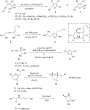
- arylidene group transfer were developed as a method for the preparation of 4-arylidene isoxazol-5(4H)-ones [62]. For example, (E)-benzaldehyde O-3-phenylpropioloyl oxime 132 was reacted in acetonitrile at 25 °C in the presence of AuPPh3NTf2 (5 mol %) to give 4-benzylidene-3-phenylisoxazol-5(4H)-one 133 in








Synthesis, reactivity and biological activity of 5-alkoxymethyluracil analogues
Beilstein J. Org. Chem. 2011, 7, 678–698, doi:10.3762/bjoc.7.80
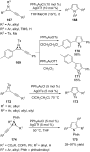
- studies on the synthesis of pseudouridine (Scheme 29) [47]. Thus, 2,4-di-tert-butoxypyrimidin-5-yllithium (170) was reacted with 2,4:3,5-di-O-benzylidene-aldehydo-D-ribose (171) in tetrahydrofuran to afford a mixture of allo and altro isomers of 5-(2,4:3,5-di-O-benzylidene-D-pentahydroxypentyl)-2,4-di
- ). Synthesis of “metallocenonucleosides” 164 and 167. Synthesis of 5-(2,4:3,5-di-O-benzylidene-D-pentahydroxypentyl)-2,4-di-tert-butoxy-pyrimidine 172 and 173. Acknowledgements The authors are grateful to the Ministry of Education, Youth and Sport of the Czech Republic, for the grant MSM6198959216 and for


Sequential Au(I)-catalyzed reaction of water with o-acetylenyl-substituted phenyldiazoacetates
Beilstein J. Org. Chem. 2011, 7, 631–637, doi:10.3762/bjoc.7.74
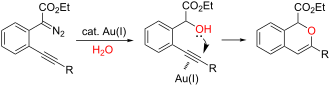
- , 100.5, 76.6, 61.7, 14.2; MS (70 eV) m/z (%): 280 (29) [M+], 207 (100), 178 (47), 152 (8); HRMS–ESI (m/z): [M + H]+ calcd for C18H17O3, 281.1172; found, 281.1168. Ethyl 3-benzylidene-1,3-dihydroisobenzofuran-1-carboxylate (3a). 1H NMR (400 MHz, CDCl3) δ 7.81 (d, J = 7.2 Hz, 2H), 7.75–7.55 (m, 1H), 7.53


Synthesis of glycoconjugate fragments of mycobacterial phosphatidylinositol mannosides and lipomannan
Beilstein J. Org. Chem. 2011, 7, 369–377, doi:10.3762/bjoc.7.47
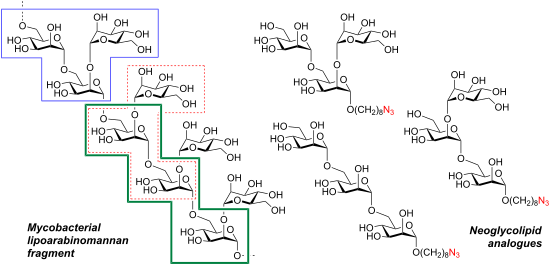
- the glycosidic linkage. For α-mannosylation of primary and secondary alcohols, the mannosyl donors 16 [38] and 17 were used. Treatment of glycosyl bromide 11 with NaBH4/KI in MeCN [39] afforded the crystalline 1,2-O-benzylidene acetal 18 as a single diastereoisomer in quantitative yield (Scheme 3
- ). The stereochemistry of the benzylidene acetal 18 formed by this method has been studied by Suzuki et al. who assigned the product as the (7S)-stereoisomer (but reported it as the (7R)-isomer) by observation of a nuclear Overhauser effect transfer between the methine proton of the benzylidene acetal
- and H2 [40]. Unambiguous stereochemical assignment of (7S)-18 was achieved by single crystal X-ray analysis as shown in Figure 3, and is consistent with stereoselective delivery of hydride to the exo-face of the intermediate dioxolenium ion. Acetolysis of the benzylidene acetal 18 using 2% H2SO4/Ac2O


Synthesis and self-assembly of 1-deoxyglucose derivatives as low molecular weight organogelators
Beilstein J. Org. Chem. 2011, 7, 234–242, doi:10.3762/bjoc.7.31
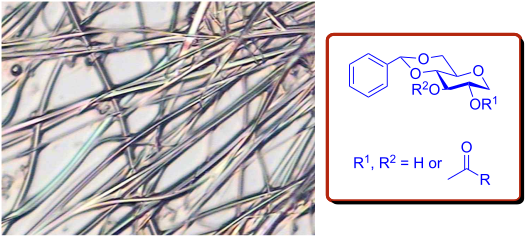
- are an important class of molecules. The supramolecular gels formed by carbohydrate derived low molecular weight gelators are interesting soft materials that show great potential for many applications. Previously, we have synthesized a series of methyl 4,6-O-benzylidene-α-D-glucopyranoside derivatives
- series of methyl 4,6-O-benzylidene-α-D-glucopyranoside (1) derivatives (Figure 1), including esters and carbamates with different functional groups. Several of these compounds proved to be effective gelators for organic solvents and aqueous solutions [34][35][36][37]. We found that the structures of the





Synthesis of Ru alkylidene complexes
Beilstein J. Org. Chem. 2011, 7, 104–110, doi:10.3762/bjoc.7.14
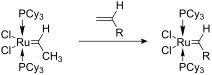
- variety of other alkylidene complexes. Results and Discussion Van der Schaaf and co-workers published in 2000 a simple one-pot procedure for the synthesis of the ruthenium benzylidene complex (iPr3P)2Cl2Ru=CHPh [8]. It was mentioned that also (PCy3)2Cl2Ru=CHPh could be similarly prepared. To our surprise
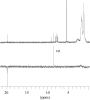
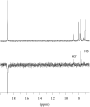
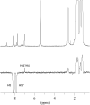
- , by following exactly the given protocol using DBU as base, a mixture of the desired benzylidene complex (PCy3)2Cl2Ru=CHPh together with the vinylidene complex (PCy3)2Cl2Ru=C=CHPh was obtained. Obviously, the last complex originated from reaction of an intermediate hydride species with phenyl
- NMR: δ = 296.40 (d, J = 113.4), 157.46, 140.27, 32.08 (t, J = 9.1); 30.28, 29.99, 29.70; 27.93 (t, J = 5.0), 27.93, 26.67, 22.97, 21.45. Toluene 137.82, 129.05, 128.24, 125.31, 21.41. Dichlorobis(tricyclohexylphosphine)(benzylidene)ruthenium(II) (1d): The product (violet solid) was prepared according




Olefin metathesis in nano-sized systems
Beilstein J. Org. Chem. 2011, 7, 94–103, doi:10.3762/bjoc.7.13
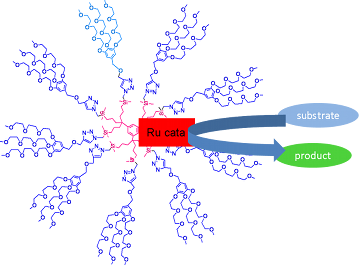
- still remained a challenge. The difficulty resided in the need to sustain both metathesis activity and stability of the metallodendrimer. Thus, we selected the ruthenium family of catalysts and designed metallodendrimers containing ruthenium-benzylidene fragments located at the dendrimer periphery and
- ][20] and Leitner [20] had demonstrated the metathesis activity of cis-bis-phosphine ruthenium benzylidene catalysts. We therefore used Reetz’s bis-phosphines derived from the commercial polyamine DSM dendrimers [21]. These dendritic bis-phosphines are useful and versatile in metallodendritic catalysis
- ] catalyzed by [FeICp(η6-C6Me6)] leading to the substitution of a carbonyl of the [Ru3(CO)12] by a dendritic phosphine on each tether [22]. Related dendritic bis-phosphines with two cyclohexyl groups on each phosphorus were decorated with ruthenium benzylidene metathesis functions using Hoveyda’s ruthenium


The cross-metathesis of methyl oleate with cis-2-butene-1,4-diyl diacetate and the influence of protecting groups
Beilstein J. Org. Chem. 2011, 7, 1–8, doi:10.3762/bjoc.7.1
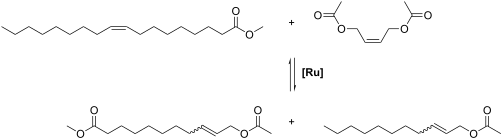
- observed between the benzylidene catalyst [Ru]-1 and its indenylidene counterpart [Ru]-3. The self-metathesis of methyl oleate (1) mentioned above could not be suppressed. Other side-reactions were not observed. No double-bound isomerisation took place. Promising results were obtained with catalysts
- content (91.4% oleic acid) was obtained from Emery Oleochemicals. cis-2-Butene-1,4-diol (8) (97%), solvents and reagents were purchased from Sigma-Aldrich. Benzylidene ruthenium catalysts [Ru]-1 and [Ru]-2 were obtained from Sigma-Aldrich and the remaining indenylidene ruthenium catalysts [Ru]-3–[Ru]-8


The allylic chalcogen effect in olefin metathesis
Beilstein J. Org. Chem. 2010, 6, 1219–1228, doi:10.3762/bjoc.6.140
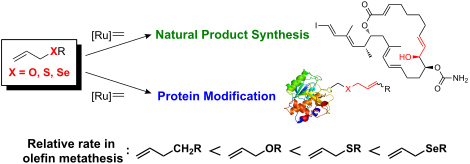
- generation catalyst (3), where the catalytically active species is stabilized by a hemilabile benzylidene ligand. The activating effect of the allylic hydroxy group in RCM is further supported by the dramatic decrease in conversion when the free OH group was protected (i.e., R ≠ H, R′ = Me) in pathway B


The catalytic performance of Ru–NHC alkylidene complexes: PCy3 versus pyridine as the dissociating ligand
Beilstein J. Org. Chem. 2010, 6, 1188–1198, doi:10.3762/bjoc.6.136
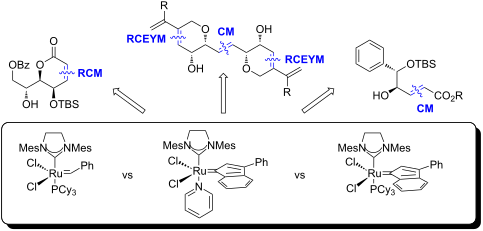
- benzylidene complexes bearing a tricyclohexylphosphine or a pyridine ligand in ring closing metathesis (RCM), cross metathesis, and ring closing enyne metathesis (RCEYM) reactions is compared. While the PCy3 complexes perform significantly better in RCM and RCEYM reactions than the pyridine complex, all
- alkylidene moiety originates from 2,2-diphenylcyclopropene, was soon replaced by the second version B [9], since the benzylidene ligand is more conveniently available from phenyldiazomethane. The obvious disadvantages of handling non-stabilized diazo compounds stimulated investigations into the use of
- robustness and tolerance towards several functional groups [19]. A third major topic in catalyst development has been the variation of the dissociating “placeholder”-ligand. In this respect, the introduction and further improvement of hemilabile benzylidene ligands by Hoveyda [20], Grela[21] and Blechert [22


Tandem catalysis of ring-closing metathesis/atom transfer radical reactions with homobimetallic ruthenium–arene complexes
Beilstein J. Org. Chem. 2010, 6, 1167–1173, doi:10.3762/bjoc.6.133
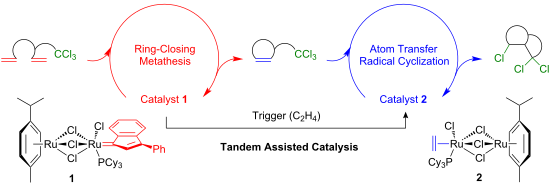
- synthesis [7][8][9][10]. The monometallic ruthenium–benzylidene complex [RuCl2(=CHPh)(PCy3)2] (3) and its second- or even third-generation analogues developed by Grubbs and co-workers are prominent examples of catalyst precursors that were applied to olefin metathesis in tandem with ATRA [11], ATRC [11][12
- mixture revealed the presence of at least five different ruthenium–phosphine species in solution. Unless all these species are able to promote the ATRC reaction, the catalytic switch required to complete the tandem process should therefore be far less efficient with monometallic benzylidene complex 3 than
- (Table 1, entry 1). This experiment confirmed the necessity of mediating the transformation of 5 into 6 with a transition metal complex. Unlike the Grubbs benzylidene catalyst 3, bimetallic compound 1 was an efficient catalyst precursor for this reaction (Table 1, entries 2 and 4). Opstal and Verpoort


New library of aminosulfonyl-tagged Hoveyda–Grubbs type complexes: Synthesis, kinetic studies and activity in olefin metathesis transformations
Beilstein J. Org. Chem. 2010, 6, 1159–1166, doi:10.3762/bjoc.6.132
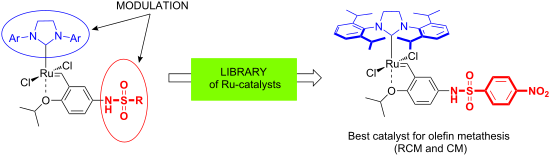
- of the active species (due to NHC), these catalysts still required a high catalytic loading (up to 20 mol % in some cases [7]). Later, Hoveyda synthesized a recyclable phosphine-free precatalyst (2a) [8] based on a release/return concept of the benzylidene ether fragment. Electronic or steric
- between the SIPr unit and the electronic activation of the benzylidene fragment. Conclusion A new library of Hoveyda type catalysts bearing aminosulfonyl functions has been synthesized. Their activity profiles have been investigated through kinetic studies and through evaluation of a group of substrates
- -dimesitylimidazolidin-2-ylidene)(2-isopropoxy-5-(trifluoromethylsulfonamido)benzylidene)ruthenium(II) chloride (4a): Following the general procedure using the ligand 6a, complex 4a was isolated as a green powder (62 mg, 73%). 1H (400 MHz, CDCl3, δ): 1.13 (d, J = 6.1 Hz, 6H, 2 CH3), 2.34 (s, 18H, 6 CH), 4.08 (s, 4H, 2


About the activity and selectivity of less well-known metathesis catalysts during ADMET polymerizations
Beilstein J. Org. Chem. 2010, 6, 1149–1158, doi:10.3762/bjoc.6.131
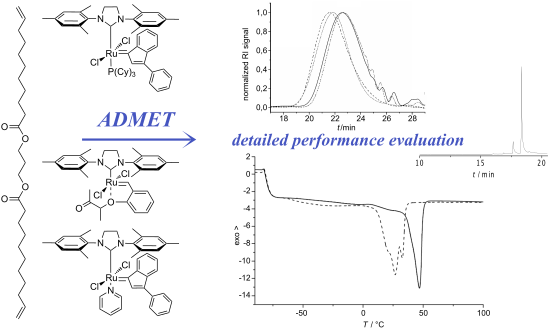
- attractive alternative to the Ru–benzylidene compounds. It was shown that all indenylidene Ru-catalysts were more robust under the demanding reaction conditions (temperature and functional group tolerance) compared to their Ru–benzylidene counterparts [32][33][34][35][36][37][38][39][40]. In addition, good
- ]. Research performed by Monsaert et al. illustrated that C2 enables high conversions in ROMP of 1,5-cyclooctadiene, and conversions of up to 80% in the RCM of diethyl diallylmalonate in short reaction times (5–10 min), thus being superior to the benzylidene analogue [35]. Recently, a useful and practical
- structural regularity can be obtained by with BQ. Conclusion The indenylidene Ru-complexes provided an attractive alternative to the benzylidene compounds and allowed polyesters of up to 17000 Da via ADMET polymerization to be prepared, even at elevated temperatures with enhanced activity. Unfortunately, the



Light-induced olefin metathesis
Beilstein J. Org. Chem. 2010, 6, 1106–1119, doi:10.3762/bjoc.6.127

- respective yields and the required reaction times. In line with the development of ruthenium benzylidene initiators [66][67], the phosphane ligand was replaced by an N-heterocyclic carbene (NHCs) in the photoactivated precatalysts. Accordingly, Noels et al. [68][69] synthesised a range of NHC substituted
- , photoactivation of sulfur-chelated ruthenium benzylidene complexes was found to depend on the generation of the active trans-dichloro isomer via 14-electron intermediates. The design of a photoswitchable system was based on the fact that the latent isomer (cis-dichloro) was thermodynamically more stable than its
- . Ruthenium complexes with p-cymene and NHC ligands. Photoactivated cationic ROMP precatalysts. Different monomers for PROMP. Light-induced cationic catalysts for ROMP. Sulfur chelated ruthenium benzylidene pre-catalysts for olefin metathesis. Photoacid generators for photoinduced metathesis. Encapsulated 39


Halide exchanged Hoveyda-type complexes in olefin metathesis
Beilstein J. Org. Chem. 2010, 6, 1091–1098, doi:10.3762/bjoc.6.125
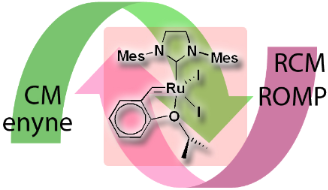
- (Scheme 1). M2 is a relatively more economic alternative to G2, bearing an indenylidene instead of a benzylidene ligand [22][23][24]. Adopting Hoveyda’s protocol for obtaining 1 from G2 [25] and using 1-isopropoxy-2-(prop-1-en-1-yl)benzene as the carbene precursor, 1 can be obtained in 78% yield





