


Search results
Search for "diketones" in Full Text gives 137 result(s) in Beilstein Journal of Organic Chemistry.
Photocycloaddition of aromatic and aliphatic aldehydes to isoxazoles: Cycloaddition reactivity and stability studies
Beilstein J. Org. Chem. 2011, 7, 127–134, doi:10.3762/bjoc.7.18
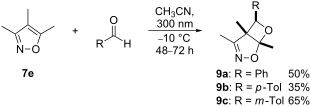
- -1,4-diketones after hydrolysis of the primary photochemical products (photo aldol reaction) [7], whilst the reaction of oxazoles with carbonyl compounds is a convenient protocol for the stereoselective synthesis of α-amino β-hydroxy ketones [8][9] as well as highly substituted α-amino β-hydroxy acids
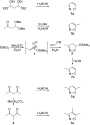
- corresponding 1,3-diketones [13] or deaminated to yield Michael systems [14]. Thus, isoxazoles also appear to be important substrates for carbonyl–ene photocycloaddition due to possible applications in ring-opening transformations. Results and Discussion Synthesis of the isoxazole substrates The substrates



Syntheses and properties of thienyl-substituted dithienophenazines
Beilstein J. Org. Chem. 2010, 6, 1180–1187, doi:10.3762/bjoc.6.135
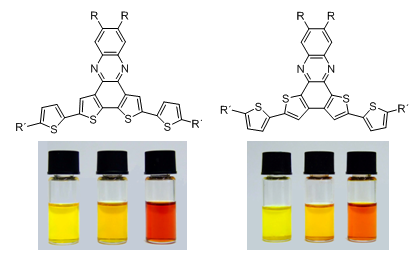
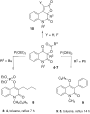
- oxalyl chloride [23][24]. Bromination of 7 with NBS failed, however, the reaction with bromine under similar conditions as described for 4 afforded 8 in quantitative yields. Both routes towards the brominated bithiophene-diketones gave high overall yields and can be scaled up easily. Condensation of the
- diketones 4 and 8 with diaminobenzenes 9a and 9b, containing methyl and hexyl side groups [25], in pure acetic acid at 50 °C gave the phenazines 10 and 11 as yellow solids in 50–93% yield (Scheme 3) [26]. The hexyl derivatives 10b and 11b showed a significantly higher solubility than the methyl analogues


Synthesis of 2a,8b-Dihydrocyclobuta[a]naphthalene-3,4-diones
Beilstein J. Org. Chem. 2010, 6, No. 76, doi:10.3762/bjoc.6.76
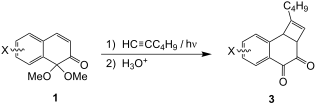
- room temperature. The org. phase was washed with sat. aq NaCl, dried (MgSO4) and the residue (100% conversion to product from 1H NMR) purified by CC (SiO2, pentane/Et2O 1:1) to afford the diketones 3. 1-Butyl-2a,8b-dihydrocyclobuta[a]naphthalene-3,4-dione (3a): 37 mg (85%), viscous yellow oil, Rf


Synthesis of oxa-bridged derivatives from Diels–Alder bis-adducts of butadiene and 1,2,3,4-tetrahalo-5,5-dimethoxycyclopentadiene
Beilstein J. Org. Chem. 2010, 6, No. 64, doi:10.3762/bjoc.6.64
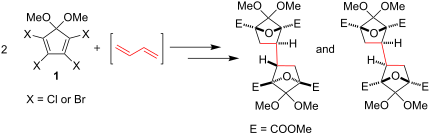
- yield. Ruthenium catalyzed oxidation of the bis-adducts followed by a one-pot transformation of the resulting α-diketone furnished oxa-bridged compounds. Unambiguous stereochemical assignments of both diastereomeric series are reported. Keywords: Diels–Alder reactions; diketones; oxa-bridged
- further transformed into bis-diketones by means of supported ruthenium catalyzed oxidation. Finally, the two diastereomeric norbornyl α-diketones from the chloro as well as the bromo series were each converted to the corresponding oxa-bridged compounds [7]. Results and Discussion For the preparation of
- 43.7 ppm and the methylene carbons at 35.9 ppm. The bis-adducts 5 and 6 were smoothly transformed to the corresponding bis-α-diketones 7 and 9 in excellent yield with a supported ruthenium catalyst (Ru-LDH) and NaIO4 as stoichiometric co-oxidant, a methodology developed in our laboratory [18][19


Synthesis of some novel annulated pyrido[2,3-d]pyrimidines via stereoselective intramolecular hetero Diels–Alder reactions of 1-oxa-1,3-butadienes
Beilstein J. Org. Chem. 2010, 6, No. 11, doi:10.3762/bjoc.6.11
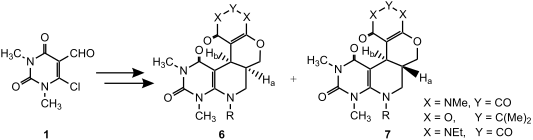
- + POCl3) using excess phosphorous oxychloride as solvent following our published method [51]. The nucleophilic substitution of the chloro group of 1 by allyl amines 2 afforded the 6-N-allyl-1,3-dimethyl-5-formyl uracils 3. Compounds 3 were then reacted with cyclic β-diamides/β-diketones 4 in presence of a
- 3a as a yellow solid 568 mg (95%). Similarly, 3b–c were prepared from the reaction of 1 with 2b–c. Knoevenagel condensation of 3 with cyclic β-diamide/β-diketones 4 and synthesis of 5: Equimolar amounts of 3a (2 mmol, 598 mg) and 4a (2 mmol, 312 mg) were mixed thoroughly in a round-bottomed flask


A review of new developments in the Friedel–Crafts alkylation – From green chemistry to asymmetric catalysis
Beilstein J. Org. Chem. 2010, 6, No. 6, doi:10.3762/bjoc.6.6
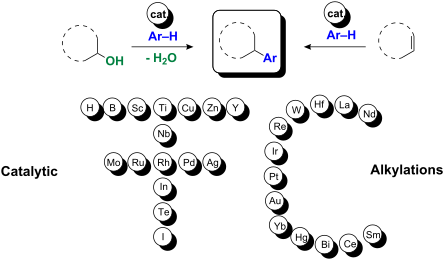
- -substituted 1,3-diketones 17 and their derivatives are of great interest. Given that the alkylation typically requires stoichiometric amounts of a base and a toxic alkyl halide the development of an efficient environmentally benign route to 2-alkylated pentanediones 17a–c employing simply benzyl-, allyl- or
- formation of a quaternary carbon atom was possible. Although the product was isolated in lower yields (Scheme 17). Subsequently this method was expanded to other nucleophiles, such as 1,3-diketones [60]. Mirroring the Bi(OTf)3-catalyzed method, Hua et al. developed a BiCl3-catalyzed synthesis of 1,1


Green oxidations: Titanium dioxide induced tandem oxidation coupling reactions
Beilstein J. Org. Chem. 2009, 5, No. 24, doi:10.3762/bjoc.5.24

- positive holes to the surface and subsequent hydroxyl radical formation [24]. It is believed that a similar interaction is taking place in our system and in conjunction with TEMPO lead to the formation of keto-aldehydes or diketones, which are trapped in situ to produce the required products. In an attempt


Synthesis and redox behavior of new ferrocene- π-extended- dithiafulvalenes: An approach for anticipated organic conductors
Beilstein J. Org. Chem. 2009, 5, No. 6, doi:10.3762/bjoc.5.6
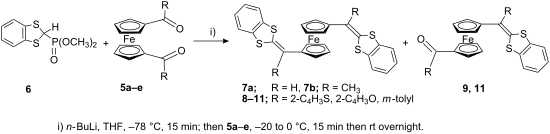
- 1. One oxidation wave potential associated with one reduction wave for these ferrocenyl diketones was observed in the potential range ca 1015–1100 mV at lower scan rate (10–600 mV s−1) (Table 1). Compounds 9 and 12 also showed some common features depending the solvent and scan rate effects. In


Chemoselective reduction of aldehydes by ruthenium trichloride and resin- bound formates
Beilstein J. Org. Chem. 2008, 4, No. 53, doi:10.3762/bjoc.4.53
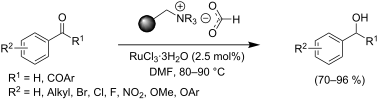
- -donor, in the presence of catalytic ruthenium trichloride is described. Aromatic aldehydes and 1,2-diketones are reduced efficiently and selectively, while aryl ketones remain unchanged. Several other potentially reducible groups attached to the aromatic moiety are unaffected. Keywords: Amberlite
- stable and potent hydride source in Pd-catalyzed transfer hydrogenation of functionalized alkenes, imines, nitroarenes and 1,2-diketones [23][24]. Danks et al. also carried out reduction of alkyl cinnamates using polymer supported formate and catalytic RhCl(PPh3)3 (2.5 mol%) under microwave irradiation
- without any base preclude possibilities of unwanted reactions of aryl aldehydes, e.g. Cannizzaro reaction. To broaden the scope of the catalytic system, we tested CTH of 1,2-diketones under similar conditions (Scheme 2). Whereas aryl ketones were not reduced under the conditions, reduction of benzil to


Trapping evidence for the thermal cyclization of di-(o-acetylphenyl)acetylene to 3,3'-dimethyl- 1,1'-biisobenzofuran
Beilstein J. Org. Chem. 2005, 1, No. 18, doi:10.1186/1860-5397-1-18
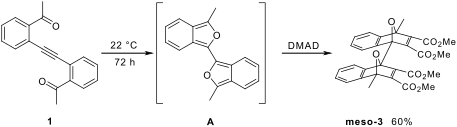
- reactions with oxygen, either in the presence or absence of light, to give diketones as the predominant products.[4][5][6][7] The bicyclization process considered for the conversion of 1 to A is analogous to the thermal rearrangement of a 2,6-alkadien-4-yn-1,8-dialdehyde to a bifuran observed by Iyoda[8




New modification of the Perkow reaction: halocarboxylate anions as leaving groups in 3-acyloxyquinoline- 2,4(1H,3H)-dione compounds
Beilstein J. Org. Chem. 2005, 1, No. 17, doi:10.1186/1860-5397-1-17
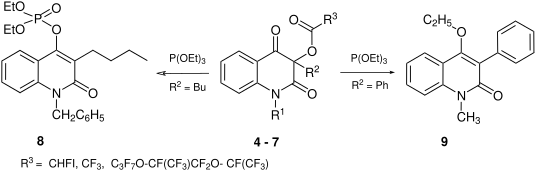
- according to the Michaelis-Arbuzov reaction,[4] the α-halocarbonyl compounds react with triethylphosphite to form enol phosphites 3 as a product of the Perkow reaction (Scheme 2). [5] The reaction is otherwise known to take place in halogenated ketones, diketones, aldehydes and also in some halogenoesters




A convenient synthesis of γ-functionalized cyclopentenones
Beilstein J. Org. Chem. 2005, 1, No. 11, doi:10.1186/1860-5397-1-11
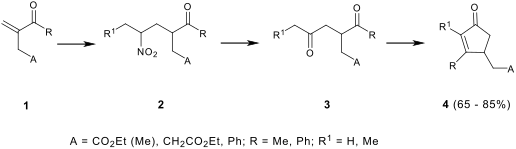
- /1860-5397-1-11 Abstract The synthesis of γ-functionalized cyclopentenones was carried out in a few steps, starting firstly with the preparation of nitroketonic intermediates 2, which were readily transformed into 1,4-diketones using the Nef conversion. The intramolecular cyclization of the γ-diketones
- 3 in a basic medium, led to the functionalized cyclopentenones 4. Keywords: Nef reaction; conjugated addition; nitroalkanes; 1,4-diketones; functionalized cyclopentenones; Introduction The cyclopentenones are considered as an important class of compounds because they are present in a large variety
- conjugate addition of nitroalkanes to α,β-unsaturated ketones 1 leading to the nitroalkanes derivatives 2 which may be converted into their γ-diketone homologues 3 using Nef reaction. The intramolecular cyclization of 1,4-diketones 3 led to the corresponding cyclopentenones 4. Results and discussion As





