Search results
Search for "supramolecular" in Full Text gives 559 result(s) in Beilstein Journal of Organic Chemistry. Showing first 200.
Circularly polarized luminescent systems fabricated by Tröger's base derivatives through two different strategies
Beilstein J. Org. Chem. 2021, 17, 52–57, doi:10.3762/bjoc.17.6
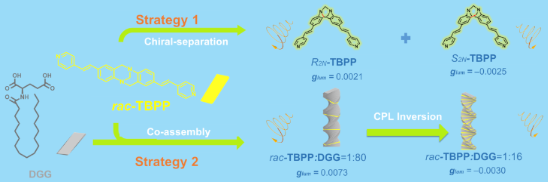
- the rac-TBPP/DGG co-gel, implying the formation of the ordered packing of rac-TBPP in supramolecular assemblies. At the molar ratio of rac-TBPP/DGG = 1:80, The FTIR spectrum was similar to that of the DGG gel, in which νC=O bonds at 1729, 1691, and 1645 cm−1 reveal that the carboxyl acid groups of DGG
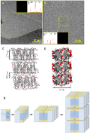
- scanning electron microscope (SEM). At the molar ratio of rac-TBPP/DGG = 1:80, the co-gel shows belt-like nanofibers (Figure 3c), while the fibrous morphology could not be observed at the molar ratio of 1:16 (Figure 3d). It indicates that two different kinds of supramolecular assemblies were formed at the
- the co-assembly strategy. The cogels show significant CPL emission and stoichiometry-controlled inversion of chirality due to the hydrogen bonding interactions and packing modes in the supramolecular co-assemblies. Owing to TB special V-shaped structure, rigid conformation, and nitrogen stereogenic


Control over size, shape, and photonics of self-assembled organic nanocrystals
Beilstein J. Org. Chem. 2021, 17, 42–51, doi:10.3762/bjoc.17.5
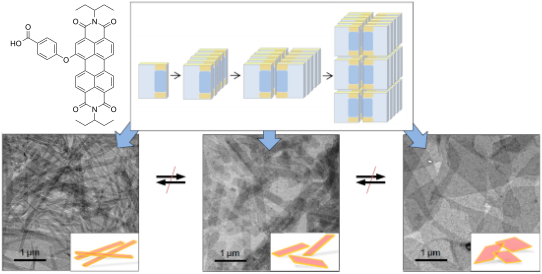
- . Funding This work was supported by grants from the Israel Science Foundation, Minerva Foundation, Schmidt Minerva Center for Supramolecular Architectures, and the Helen and Martin Kimmel Center for Molecular Design.




The fluorescence of a mercury probe based on osthol
Beilstein J. Org. Chem. 2021, 17, 22–27, doi:10.3762/bjoc.17.3
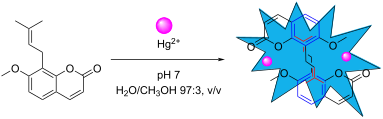
- Guangyan Luo Zhishu Zeng Lin Zhang Zhu Tao Qianjun Zhang Key Laboratory of Macrocyclic and Supramolecular Chemistry of Guizhou Province, Guizhou University, Guiyang 550025, China 10.3762/bjoc.17.3 Abstract The ability of osthol (OST) to recognize mercury ions in aqueous solution was studied using


Chiral anion recognition using calix[4]arene-based ureido receptors in a 1,3-alternate conformation
Beilstein J. Org. Chem. 2020, 16, 2999–3007, doi:10.3762/bjoc.16.249
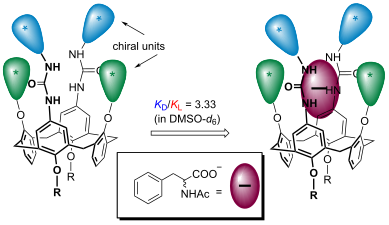
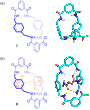
- most important branches of modern supramolecular chemistry, as can easily be demonstrated by an immense number of recent reviews [1][2][3][4][5][6] and books [7][8][9][10][11] devoted to this topic. Due to the omnipresence of anions in biological systems, their irreplaceable roles in cell functioning
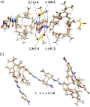
- same time, the carbonyl groups from the neighbouring receptor urea moieties interacted with the C–H bonds of the DMSO methyl group (the C=O···H–C distances were 2.486 and 2.452 Å), thus forming the calixarene dimer with a head-to-tail mutual orientation. The overall supramolecular binding motif was




Selected peptide-based fluorescent probes for biological applications
Beilstein J. Org. Chem. 2020, 16, 2971–2982, doi:10.3762/bjoc.16.247

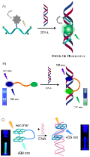
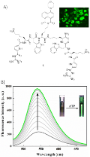
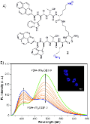
- insulin Schmuck and co-workers reported a supramolecular ensemble in combination of a pyrene-tagged amphiphilic peptide beacon (6) and a macrocyclic host (cucurbit[8]uril, CB[8]) for ratiometric fluorescent detection of amino acid derivatives, specific peptides, and proteins in aqueous media (Figure 6
- Attribution 3.0 Unported Licence, https://creativecommons.org/licenses/by/3.0/. Published by The Royal Society of Chemistry. Acknowledgements The author would like to thank late Prof. Dr. Carsten Schmuck for his exceptional contribution to Supramolecular Chemistry and Peptide Chemistry research.



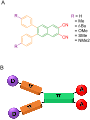
Naphthalonitriles featuring efficient emission in solution and in the solid state
Beilstein J. Org. Chem. 2020, 16, 2960–2970, doi:10.3762/bjoc.16.246
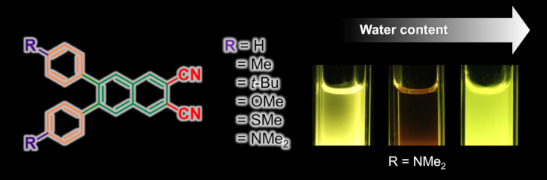
- parallel (see Figure 2B), the centroid distance between the rings reaches up to 4.985 Å, suggesting that the intermolecular π–π interactions are absent. In addition to these interactions, there also exist weak supramolecular N–H interactions. Firstly, two Me units form dimeric structures that are connected
- generate one-dimensional supramolecular chain-like arrays with tolyl units distributed at the two sides of the chain (Figure 2C). These weak forces help the molecules to minimize the energy loss via non-radiative relaxation channels by rigidifying their conformation [25]. Photophysical characterization of



Construction of pillar[4]arene[1]quinone–1,10-dibromodecane pseudorotaxanes in solution and in the solid state
Beilstein J. Org. Chem. 2020, 16, 2954–2959, doi:10.3762/bjoc.16.245
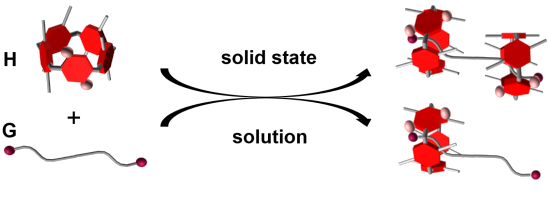
- the further capping of the pseudorotaxanes to construct rotaxanes. Keywords: host–guest chemistry; pillar[4]arene[1]quinones; pillararenes; pseudorotaxanes; supramolecular chemistry; Introduction Relying on the research of basic science, supramolecular chemistry has become an important mean for
- constructing functional materials from the bottom up as well as an important way to create new substances with functions [1][2][3][4][5]. Through ingenious designs and the applications of molecular recognition and self-assembly strategies, many exquisite supramolecular architectures have been fabricated
- , including molecular switches, molecular logic gates, molecular machines, supramolecular polymers, etc. [6][7][8][9][10][11]. Pseudorotaxanes not only are used as the supramolecular precursors for the synthesis of rotaxanes and catenanes but also play an important role in the construction of supramolecular


UV resonance Raman spectroscopy of the supramolecular ligand guanidiniocarbonyl indole (GCI) with 244 nm laser excitation
Beilstein J. Org. Chem. 2020, 16, 2911–2919, doi:10.3762/bjoc.16.240
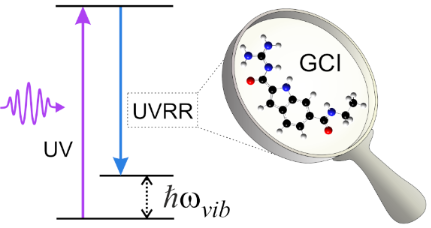
- , Universitätsstrasse 7, 45141 Essen, Germany 10.3762/bjoc.16.240 Abstract Ultraviolet resonance Raman (UVRR) spectroscopy is a powerful vibrational spectroscopic technique for the label-free monitoring of molecular recognition of peptides or proteins with supramolecular ligands such as guanidiniocarbonyl pyrroles
- (GCPs). The use of UV laser excitation enables Raman binding studies of this class of supramolecular ligands at submillimolar concentrations in aqueous solution and provides a selective signal enhancement of the carboxylate binding site (CBS). A current limitation for the extension of this promising
- selectivity for monitoring the CBS, but the resulting UVRR spectrum overlaps with the UV-excited autofluorescence from the aromatic binding partners. This necessitates the use of a laser excitation <260 nm for spectrally separating the UVRR spectrum of the supramolecular ligand from the UV-excited


Using multiple self-sorting for switching functions in discrete multicomponent systems
Beilstein J. Org. Chem. 2020, 16, 2831–2853, doi:10.3762/bjoc.16.233
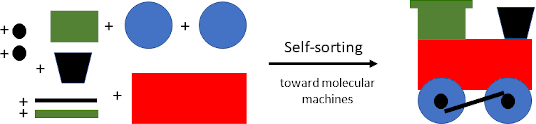
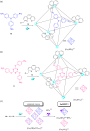
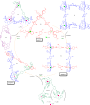
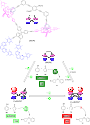
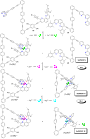
- Amit Ghosh Michael Schmittel Center of Micro and Nanochemistry and Engineering, Organische Chemie I, Universität Siegen, Adolf-Reichwein-Str. 2, D-57068 Siegen, Germany 10.3762/bjoc.16.233 Abstract Over years self-sorting has developed into a powerful tool in supramolecular chemistry, for
- self-sorting protocols. The present mini review will provide an overview over the latest advancements in this field with a focus on reversibly switchable functions in discrete supramolecular systems. Keywords: copper; fluorescence; self-assembly; self-sorting; zinc porphyrin; Introduction Since self
- ‐stacking [15][16], dipole–dipole interactions [17] or hydrophobic interactions [18], have proven their significance as key players [19] in the creation of self-sorted supramolecular assemblies, such as 1D, 2D [20], and 3D architectures [21], polymers [22], gels [23], and most recently, of stand-alone







Selective recognition of ATP by multivalent nano-assemblies of bisimidazolium amphiphiles through “turn-on” fluorescence response
Beilstein J. Org. Chem. 2020, 16, 2728–2738, doi:10.3762/bjoc.16.223
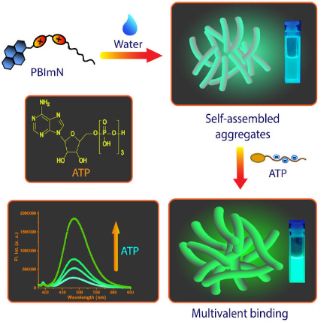
- buffer and also in buffer containing 150 mM NaCl at physiological pH value. Furthermore, the multivalent aggregates demonstrated a significant selectivity in ATP detection over ADP, AMP and pyrophosphate. Keywords: amphiphile; ATP; excimer; multivalency; self-assembly; Introduction Supramolecular anion
- . One of the challenges in the bio-anion detection is that the sensory probes have to be effective under physiological conditions. The highly polar nature of the aqueous media considerably weakens supramolecular interactions such as H-bonding and electrostatic interactions and as a result, it is in


Enzyme-instructed morphological transition of the supramolecular assemblies of branched peptides
Beilstein J. Org. Chem. 2020, 16, 2709–2718, doi:10.3762/bjoc.16.221
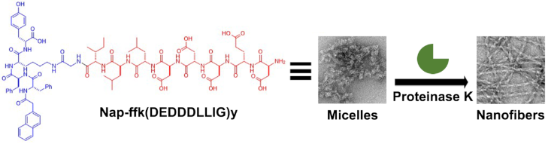
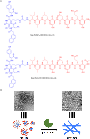
- of the N-terminal of the branch increased the stability of the branched peptides. Moreover, these branched peptides facilitate the delivery of the proteins into cells. This work contributes insights for the development of peptide supramolecular assemblies via enzymatic noncovalent synthesis in
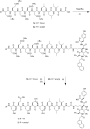
- . Both 1 and 2, being synthesized for the first time, are able to facilitate the delivery of the proteins into cells. This work, illustrating enzymatic debranching to control the morphology of peptide assemblies, contributes to the development of peptide supramolecular assemblies via enzymatic




A heterobimetallic tetrahedron from a linear platinum(II)-bis(acetylide) metalloligand
Beilstein J. Org. Chem. 2020, 16, 2701–2708, doi:10.3762/bjoc.16.220
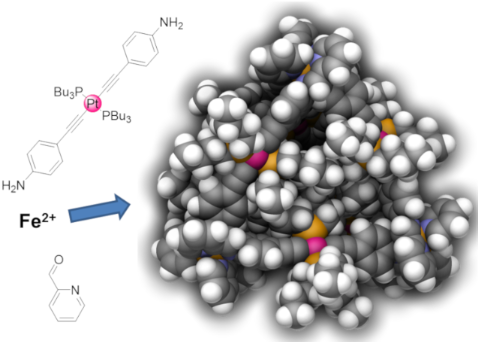
- complexes; pyridylimine ligands; self-assembly; supramolecular chemistry; Introduction The understanding of the general design principles for the self-assembly of metallosupramolecular aggregates [1][2][3][4][5] allowed to access more and more complex and large assemblies over the past decades like


Particle size effect in the mechanically assisted synthesis of β-cyclodextrin mesitylene sulfonate
Beilstein J. Org. Chem. 2020, 16, 2598–2606, doi:10.3762/bjoc.16.211
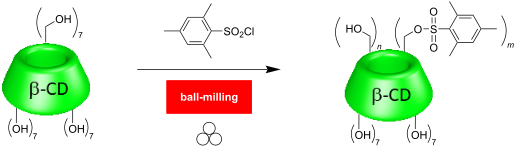
- considerable attention as it may be unique in features to selectively direct the reaction pathway. In the continuation of our work on the synthesis of modified cyclodextrins (CDs) via mechanochemical activation, we sought to discriminate the contribution of supramolecular effects and grinding during the course
- bioavailability [11][12][13]. In our previous studies, CDs acted either as reactants [14][15], or as additives [16][17], and were shown to display supramolecular interactions with the other reaction partners. We demonstrated that the formation of CD/substrate supramolecular complexes favored the dispersion of the
- lacking at this stage. Indeed, grinding provokes comminution of the reactants and may greatly alter the physical properties of the materials with potential effects on the reactivity. To assess the contribution of both grinding and supramolecular effects on the reactivity, we got rid of the supramolecular




Thermodynamic and electrochemical study of tailor-made crown ethers for redox-switchable (pseudo)rotaxanes
Beilstein J. Org. Chem. 2020, 16, 2576–2588, doi:10.3762/bjoc.16.209

- Stuttgart, Pfaffenwaldring 55, 70569 Stuttgart, Germany Department of Chemistry, University of Jyvaskyla P. O. Box 35, 40014 Jyväskylä, Finland 10.3762/bjoc.16.209 Abstract Crown ethers are common building blocks in supramolecular chemistry and are frequently applied as cation sensors or as subunits in
- ; redox chemistry; rotaxanes; supramolecular chemistry; Introduction Pedersen discovered crown ethers in 1967 while searching for multidentate ligands for the vanadyl group [1][2][3]. He was later awarded the Nobel Prize in Chemistry for his studies on the crown ether selective binding properties towards


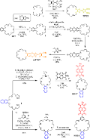


Water-soluble host–guest complexes between fullerenes and a sugar-functionalized tribenzotriquinacene assembling to microspheres
Beilstein J. Org. Chem. 2020, 16, 2551–2561, doi:10.3762/bjoc.16.207

- hydrophobic effect and to host–guest π–π interactions. Hydrophobic surface simulations showed that TBTQ-(OG)6 and C60 forms an amphiphilic supramolecular host–guest complex, which further assembles to microspheres with diameters of 0.3–3.5 μm, as determined by scanning electron microscopy. Keywords
- : fullerenes; host–guest systems; microspheres; supramolecular chemistry; tribenzotriquinacene; Introduction In the field of supramolecular chemistry, host–guest association through noncovalent interactions is an interesting and exciting topic, especially for the encapsulation of various fullerenes, such as
- their binding affinities to C60 [25][26][27][28]. Georghiou et al. [29] synthesized the tris(thianthreno)-annelated triquinacene 4, and Cao et al. [30] constructed the tris(naphtho)triquinacene 5, bearing six annelated benzofuran units, and they investigated the supramolecular interaction of these hosts


![[Graphic 2]](/bjoc/content/inline/1860-5397-16-207-i3.svg?max-width=637&scale=1.18182) C60 [TBTQ-(OG)6: 50 μM; C60: 50 μM] and (b) TBTQ-(OG)6
C60 [TBTQ-(OG)6: 50 μM; C60: 50 μM] and (b) TBTQ-(OG)6 


NMR Spectroscopy of supramolecular chemistry on protein surfaces
Beilstein J. Org. Chem. 2020, 16, 2505–2522, doi:10.3762/bjoc.16.203
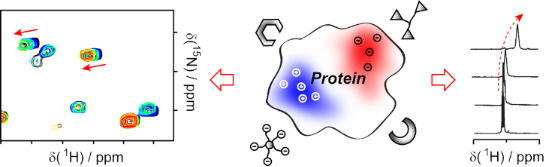
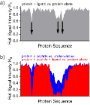
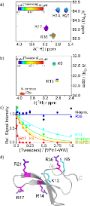
- interaction of proteins with their interaction partners, both biomolecules and synthetic ligands. In recent years, the focus in chemistry has kept expanding from targeting small binding pockets in proteins to recognizing patches on protein surfaces, mostly via supramolecular chemistry, with the goal to
- modulate protein–protein interactions. Here we present NMR methods that have been applied to characterize these molecular interactions and discuss the challenges of this endeavor. Keywords: molecular recognition; NMR; protein ligand interaction; protein surfaces; supramolecular chemistry; Introduction In
- as distance of targeted residues and their dynamics - must be taken into account. Supramolecular chemistry is ideally suited to address these challenges because it merges the knowledge of non-covalent molecular recognition with the possibility to combine multiple recognition units into one molecule



Recent developments in enantioselective photocatalysis
Beilstein J. Org. Chem. 2020, 16, 2363–2441, doi:10.3762/bjoc.16.197
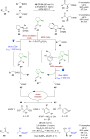
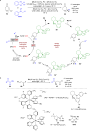
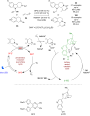
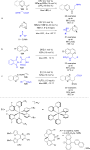
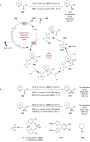
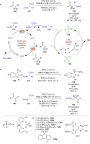
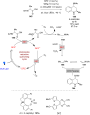
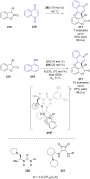
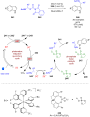
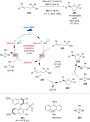
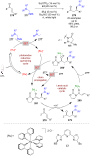
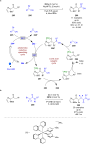
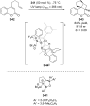
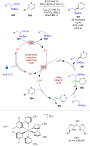
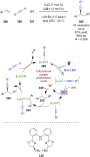
- followed by a separate enantioselective catalysis step that will not be covered in this review [17][18][19]. Examples using cage complexes or other supramolecular reagents also lie outside the scope of this review. As all enantioselective photocatalysis requires a secondary mode of catalysis to induce






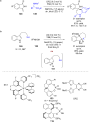


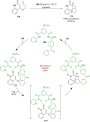
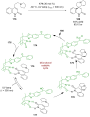


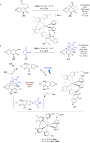















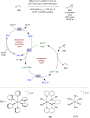
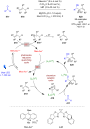
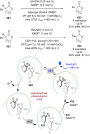


Hierarchically assembled helicates as reaction platform – from stoichiometric Diels–Alder reactions to enamine catalysis
Beilstein J. Org. Chem. 2020, 16, 2338–2345, doi:10.3762/bjoc.16.195
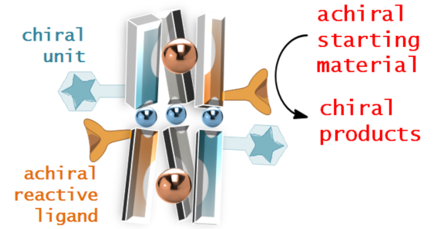
- providing the stereoinformation necessary for induction during the C–C bond formation. Catalytic approaches for C–C bond-forming reactions even found their way into the relatively young field of supramolecular chemistry, e.g., regioselective Diels–Alder reactions within supramolecular hosts as described by
- off the stereoselectivity [13]. Herein we investigated the induction pathway and significantly optimized the stereoselectivity of the reaction. Furthermore, a catalytic approach was introduced which paves the way to the final goal of supramolecular stereoselective catalysis with hierarchical helicates


Host–guest interaction of cucurbit[8]uril with oroxin A and its effect on the properties of oroxin A
Beilstein J. Org. Chem. 2020, 16, 2332–2337, doi:10.3762/bjoc.16.194
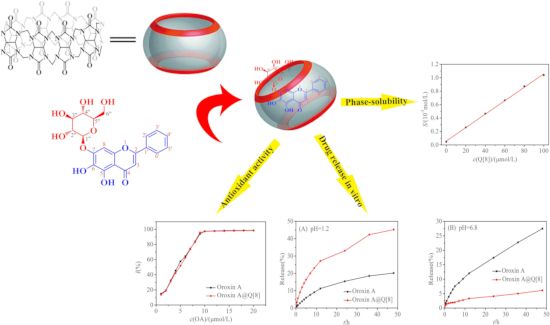
- Zhishu Zeng Jun Xie Guangyan Luo Zhu Tao Qianjun Zhang Key Laboratory of Macrocyclic and Supramolecular Chemistry of Guizhou Province, Guizhou University, No. 2708, South Section of Huaxi Avenue, Huaxi, Guiyang 550025, China 10.3762/bjoc.16.194 Abstract In this study, we investigated the host
- that the molecular size of the flavonoids and the length of the sugar chains have a greater impact on the assembly mode of supramolecular systems. Results and Discussion Host–guest interactions The host–guest interaction can be effectively observed using 1H NMR spectroscopy, and the mode of action of


Synthetic approaches to bowl-shaped π-conjugated sumanene and its congeners
Beilstein J. Org. Chem. 2020, 16, 2212–2259, doi:10.3762/bjoc.16.186

- generation of versatile functional organic materials. On the basis of this concept, in recent years, a handful of appealing molecules and materials have been synthesized and due to which nanotechnology as well as supramolecular chemistry are continuously attracting the recent attention of researchers
- later to this report, in a really dazzling manner, the groups of Rogachev, Hirao, and Petrukhina reported a novel organometallic sandwich supramolecular complex [Na+(18-crown-6)(THF)2][Cs(C21H11‒)2]‒ (138) encapsulating the cesium cation between the sumanenyl anions in a concave manner [69]. To this











pH- and concentration-dependent supramolecular self-assembly of a naturally occurring octapeptide
Beilstein J. Org. Chem. 2020, 16, 2017–2025, doi:10.3762/bjoc.16.168
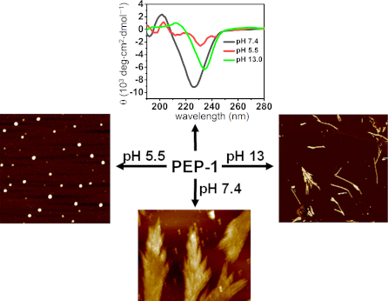
- ability to undergo significant changes in their morphologies and secondary structures in response to pH stimuli. For instance, hydrogen bonding interactions are strongly influenced by the pH value, leading to a collapse of the supramolecular aggregates when an acid or base is added [4]. The pH


Synergy between supported ionic liquid-like phases and immobilized palladium N-heterocyclic carbene–phosphine complexes for the Negishi reaction under flow conditions
Beilstein J. Org. Chem. 2020, 16, 1924–1935, doi:10.3762/bjoc.16.159
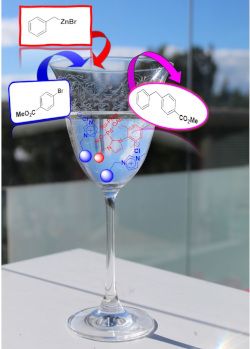
- Edgar Peris Raul Porcar Maria Macia Jesus Alcazar Eduardo Garcia-Verdugo Santiago V. Luis Dpt. of Inorganic and Organic Chemistry, Supramolecular and Sustainable Chemistry Group, University Jaume I, Avda Sos Baynat s/n, E-12071-Castellon, Spain Discovery Chemistry, Janssen Research and Development





Design, synthesis and application of carbazole macrocycles in anion sensors
Beilstein J. Org. Chem. 2020, 16, 1901–1914, doi:10.3762/bjoc.16.157
- sensor development, the results obtained in this work emphasize the importance of evaluating the binding behavior of receptors in real sensor membranes. Keywords: anion sensors; carboxylates; ionophores; macrocycles; sensor prototype; Introduction In 2013, Otto S. Wolfbeis asked the supramolecular




Models of necessity
Beilstein J. Org. Chem. 2020, 16, 1649–1661, doi:10.3762/bjoc.16.137
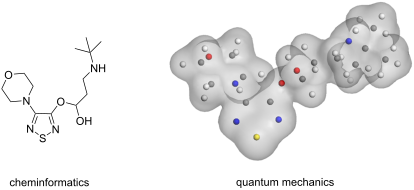
- representations, is non-redundant in order to avoid dependencies within the ML process. These requirements are imposed by external conditions and likely future applications. Requirement (1), for instance, must in future include supramolecular chemistry, which means that the models should be able to reproduce


Five-component, one-pot synthesis of an electroactive rotaxane comprising a bisferrocene macrocycle
Beilstein J. Org. Chem. 2020, 16, 1564–1571, doi:10.3762/bjoc.16.128
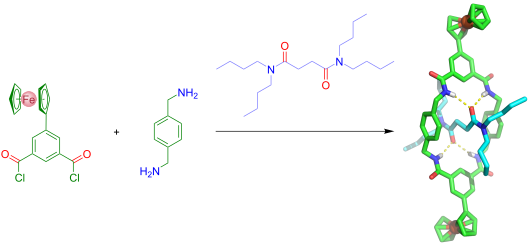
- prove a valuable component for the construction of novel redox-active supramolecular systems, such as rotaxanes with strongly binding H-bonding templating sites, or indeed juxtaposed into existing functional architectures and benchmark variants. Results and Discussion Synthesis Our first approach to the