Search results
Search for "DDQ" in Full Text gives 163 result(s) in Beilstein Journal of Organic Chemistry.
Synthesis of 4” manipulated Lewis X trisaccharide analogues
Beilstein J. Org. Chem. 2012, 8, 1134–1143, doi:10.3762/bjoc.8.126
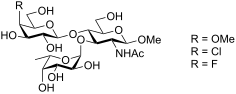
- desired protected Lex analogues. One-step global deprotection (Na/NH3) of the protected 4”-methoxy analogue, and two-step deprotections (removal of a p-methoxybenzyl with DDQ, then Zemplén deacylation) of the 4”-deoxychloro and 4”-deoxyfluoro protected Lex analogues gave the desired compounds in good
- p-methoxybenzyl group with DDQ in CH2Cl2/H2O (15:1 v/v) was followed by Zemplén deacylation, giving the target Lex analogues 4 and 5 in 78% and 75%, respectively, over the two steps. The structures of the final deprotected trisaccharides 3–5 were confirmed by HR–ESI mass spectrometry and NMR
- -fucopyranosyl)-β-D-glucopyranoside (4). A solution of the protected trisaccharide 27 (39 mg, 0.0347 mmol) and DDQ (12 mg, 1.5 equiv) in CH2Cl2 (350 μL) and H2O (20 μL, 6% v/v) was stirred at room temperature for 2 h. The mixture was filtered over Celite and the solids were washed with CH2Cl2 (5 mL). The


Algicidal lactones from the marine Roseobacter clade bacterium Ruegeria pomeroyi
Beilstein J. Org. Chem. 2012, 8, 941–950, doi:10.3762/bjoc.8.106
- chromatography on silica gel (pentane/diethyl ether 3:1) to yield the butanolides as colourless oils. cis-2-Methylpentan-4-olide (7): Yield: 0.38 g (3.28 mmol, 97%). TLC (hexane/ethyl acetate 2:1): Rf 0.48; GC (BPX-5): I = 1005; 1H NMR (400 MHz, CDCl3) δ 4.40 (ddq, 3JH,H = 5.4, 11.5, 6.1 Hz, 1H, CH), 2.66 (ddq
- (m, 1H, CH), 2.65 (ddq, 3JH,H = 8.5, 12.0, 7.0 Hz, 1H, CH), 2.47 (ddd, 3JH,H = 5.4, 8.6 Hz, 2JH,H = 12.4 Hz, 1H, CH2), 1.77 (dquin, 2JH,H = 14.4 Hz, 3JH,H = 7.2 Hz, 1H, CH2), 1.68–1.57 (m, 1H, CH2), 1.48 (dt, 2JH,H = 3JH,H = 12.2 Hz, 3JH,H = 10.4 Hz, 1H, CH2), 1.25 (d, 3JH,H = 7.1 Hz, 1JC,H = 128.3
- chromatographic means. trans-2-Methylpentan-4-olide (8): Yield: 0.30 g (2.63 mmol, 59%, dr = 77:23, cis/trans), TLC (hexane/ethyl acetate 2:1): Rf 0.48; GC (BPX-5): GC: I = 1006; 1H NMR (400 MHz, CDCl3) δ 4.63 (ddq, 3JH,H = 5.0, 7.0, 6.4 Hz, 1H, CH), 2.74–2.62 (m, 1H, CH), 2.08–1.96 (m, 2H, CH2), 1.33 (d, 3JH,H


Identification and isolation of insecticidal oxazoles from Pseudomonas spp.
Beilstein J. Org. Chem. 2012, 8, 749–752, doi:10.3762/bjoc.8.85
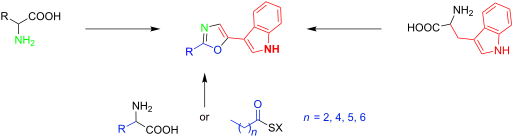
- and 8 were synthesized. Briefly, the respective tryptamine derivatives were formed, which were then oxidized at the alpha-position with the help of 2,3-dichloro-5,6-dicyano-1,4-benzoquinone (DDQ) and cyclized to give the oxazoles by using phosphorylchloride as described [9]. Additionally, three



Photochemical and thermal intramolecular 1,3-dipolar cycloaddition reactions of new o-stilbene-methylene-3-sydnones and their synthesis
Beilstein J. Org. Chem. 2011, 7, 1663–1670, doi:10.3762/bjoc.7.196
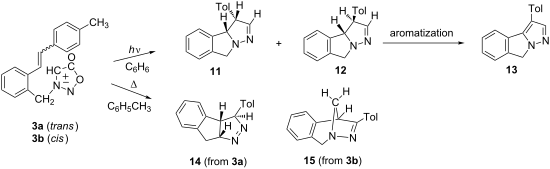
- spectra. Nevertheless, the proton H-5 of the fused benzene ring in structure 12 is in the multiplet together with other aromatic protons, which is in accordance with the proposed structure. The structure of the photoproducts was confirmed by an additional experiment on the crude reaction mixture with DDQ
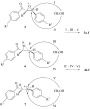
- pathway of sydnone ring (N–CH) and trans- and cis-stilbene (α–β). Thermal and photochemical intermolecular [3 + 2] cycloadditions. Synthesis of the target molecules 3a and 3b. Photolysis of cis- or trans-3. Aromatization with DDQ. Possible mechanism for the formation of the photoproducts. Thermal reaction




Synthesis of fluoranthenes by hydroarylation of alkynes catalyzed by gold(I) or gallium trichloride
Beilstein J. Org. Chem. 2011, 7, 1520–1525, doi:10.3762/bjoc.7.178
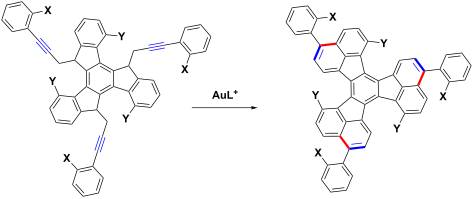
- -tetrahydrofluoranthene, and 8a, the crude mixtures were treated with excess DDQ in toluene under reflux to provide pure 8a. No reaction or decomposition was observed when the reaction was carried out with gold(I) complex 5 (Table 2, entries 1 and 2). In contrast, the more electrophilic gold(I) complex 6 with phosphite
- triaryl substituted diacenaphtho[1,2-j:1',2'-l]fluoranthenes (decacyclenes) 2a and 2b in very good overall yields after aromatization of the crude products with DDQ. Remarkably, this triple hydroarylation occurs efficiently with an average yield per C–C bond formation that is greater than 90%. Conclusion


Efficient syntheses of 25,26-dihydrodictyostatin and 25,26-dihydro-6-epi-dictyostatin, two potent new microtubule-stabilizing agents
Beilstein J. Org. Chem. 2011, 7, 1372–1378, doi:10.3762/bjoc.7.161
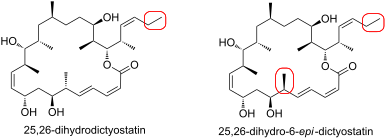
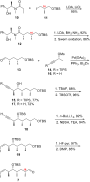
- reduce the conjugated alkene, followed directly by removal of the PMB group with DDQ. This sequence afforded alcohol 23 in 76% yield over two steps. A stereoselective 1,3-syn reduction was then performed under Prasad conditions [44] to give the target diol (90%) as a single isomer. The stereochemistry at




Multicomponent reaction access to complex quinolines via oxidation of the Povarov adducts
Beilstein J. Org. Chem. 2011, 7, 980–987, doi:10.3762/bjoc.7.110
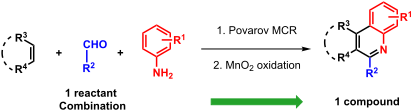
- aromatic species. The literature contains scattered reports of the use of oxidants for this transformation: 2,3-Dichloro-5,6-dicyano-1,4-benzoquinone (DDQ), ceric ammonium nitrate (CAN), nitrobenzene, elemental sulfur, palladium and manganese dioxide among others, all of them far from being ideally suited
- for these substrates. One of the most commonly used is DDQ, which affords quinolines in acceptable yields. The main advantages of this oxidizing agent lie in its chemoselectivity and a requirement for relatively mild conditions, allowing it to be used in the presence of a wide range of substituents of
- and amine moieties, leading to dihydroquinoline intermediates that, after spontaneous oxidation in air, provide the final fragmented quinolines. The ability of DDQ to act as a Lewis acid and promote this alternative pathway has some precedent in the literature [19]. Furthermore, TFA treatment of


High chemoselectivity in the phenol synthesis
Beilstein J. Org. Chem. 2011, 7, 794–801, doi:10.3762/bjoc.7.90
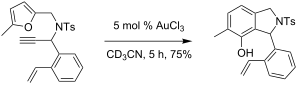
- PMB-protected aldehyde 43 (Scheme 11) [45]. The resulting furfuryl alcohol 44 was then propargylated to give 45. The deprotection was however, problematic. Treatment of the latter with cerium ammonium nitrate led to decomposition. Only with DDQ was the desired alcohol 39 obtained in moderate yield


Studies on polynuclear furoquinones. Part 1: Synthesis of tri- and tetra- cyclic furoquinones simulating BCD/ABCD ring system of furoquinone diterpenoids
Beilstein J. Org. Chem. 2009, 5, No. 47, doi:10.3762/bjoc.5.47

- aromatized with DDQ in refluxing benzene, 2-bromo-1-naphthaldehyde (2) was produced in excellent yield. Reduction (NaBH4/EtOH) of the aldehyde 2 produced the alcohol 3 as a colorless solid, in 94% yield, which on reaction with PBr3/CCl4 produced the bromide 4 as a light yellow solid. The bromide was then
- in due course. Experimental Furan-2-boronic acid, 2-tetralone and tetrakis(triphenylphosphine)palladium(0) and DDQ were purchased from Sigma-Aldrich (U.S.A). Trifluoroacetic anhydride was purchased from Alfa Aesar (Lancaster). 2-Bromo-3,4-dihydronaphthalene-1-carbaldehyde was prepared from 2
- furoquinone 13. Assignment of chemical shifts (1H NMR and 13C NMR) of compound 13. Reagents and conditions: i) DDQ (1.5 equiv), dry benzene, reflux, argon atmosphere, 37 h, 83%. ii) NaBH4, EtOH, room temperature, 2 h, 94%. iii) PBr3, CCl4, 60 °C, 1 h, 82%. iv) KCN, DMF, room temperature, overnight then 1 h at


Mitomycins syntheses: a recent update
Beilstein J. Org. Chem. 2009, 5, No. 33, doi:10.3762/bjoc.5.33
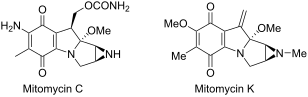
- concave face of the molecule, anti to the exo-disposed benzyloxymethyl group. The standard methodology involving azide displacement gave the aziridine 84. The benzyl groups were removed using a Birch reduction and subsequent oxidation with DDQ furnished the aziridinomitosane 85 in good overall yield






A short stereoselective synthesis of (+)-(6R,2′S)-cryptocaryalactone via ring- closing metathesis
Beilstein J. Org. Chem. 2009, 5, No. 14, doi:10.3762/bjoc.5.14
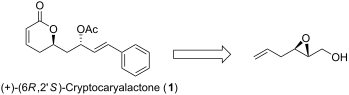
- THF at 0 °C to give cinnamyl alcohol derivative 14 (87%, Scheme 3). Alcohol 14 was protected as its acetate under conventional reaction conditions. The PMB (p-methoxybenzyl protecting group) in compound 15 was selectively removed with DDQ in CH2Cl2/H2O (19:1) to afford homoallylic alcohol 16 (89


Synthesis and redox behavior of new ferrocene- π-extended- dithiafulvalenes: An approach for anticipated organic conductors
Beilstein J. Org. Chem. 2009, 5, No. 6, doi:10.3762/bjoc.5.6
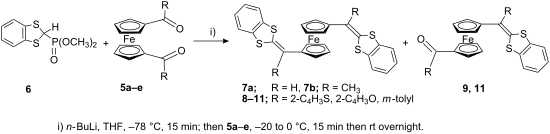
- [(1,3-dithiol-2-ylidene)alkyl]ferrocenes (2) was shown to form 1:1 CT complexes with tetracyano-p-quinodimethane (TCNQ, 3) and dichlorodicyanoquinone (DDQ) 4, see Figure 1 [24][25][26]. Subsequently, a number of reports have appeared dealing with the electrochemical properties of these CT complexes of


Photosonochemical catalytic ring opening of α-epoxyketones
Beilstein J. Org. Chem. 2007, 3, No. 2, doi:10.1186/1860-5397-3-2
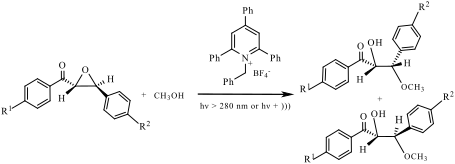
- and α-epoxyketones have also occurred thermally or photochemically by the presence of various electron acceptors. These reactions have been observed thermally by ceric ammonium nitrate (CAN), [28][29] 2,3-dichloro-5,6-dicyano-p-benzoquinone (DDQ) [30] and iron(III) chloride [31] or photo-induced