Search results
Search for "aromatic rings" in Full Text gives 256 result(s) in Beilstein Journal of Organic Chemistry. Showing first 200.
Facile synthesis of indolo[3,2-a]carbazoles via Pd-catalyzed twofold oxidative cyclization
Beilstein J. Org. Chem. 2016, 12, 2490–2494, doi:10.3762/bjoc.12.243
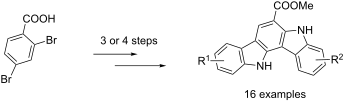
- substituents to aromatic rings was also inconvenient. It could still be necessary to exploit more practical methods and economic procedures to assemble these polycyclic molecules. In this paper, we describe a concise, 3 to 4 steps procedure for the synthesis of indolo[3,2-a]carbazoles via palladium-catalyzed
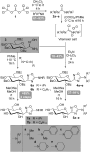
- materials. The operational simplicity combined with the convenience for introducing substituents to the aromatic rings makes this method useful. Natural indolo[3,2-a]carbazole alkaloids. Retrosynthetic analysis of indolo[3,2-a]carbazoles. Reagents and conditions: (a) H2SO4, MeOH; (b) Ar-NH2, Pd(OAc)2, BINAP


Hydroxy-functionalized hyper-cross-linked ultra-microporous organic polymers for selective CO2 capture at room temperature
Beilstein J. Org. Chem. 2016, 12, 1981–1986, doi:10.3762/bjoc.12.185
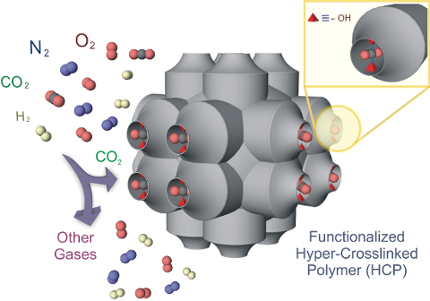
- two hydroxy-functionalised hyper-cross-linked microporous organic polymers for selective CO2 capture at room temperature. Both compounds (HCP-91 and HCP-94) were synthesized via hyper-cross-linked C–C coupling of hydroxyl-functionalised aromatic rings by using a Friedel–Craftys reaction. At different


Experimental and theoretical insights in the alkene–arene intramolecular π-stacking interaction
Beilstein J. Org. Chem. 2016, 12, 1616–1623, doi:10.3762/bjoc.12.158
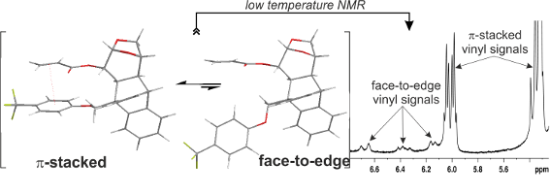
- aromatic rings. This can be useful in several fields, such as supramolecular chemistry, biology and material science and, in particular, in the area of asymmetric synthesis for the rational design of new elements of stereocontrol. Intramolecular aryl–vinyl π-stacking interaction of a levoglucosenone




Beta-hydroxyphosphonate ribonucleoside analogues derived from 4-substituted-1,2,3-triazoles as IMP/GMP mimics: synthesis and biological evaluation
Beilstein J. Org. Chem. 2016, 12, 1476–1486, doi:10.3762/bjoc.12.144
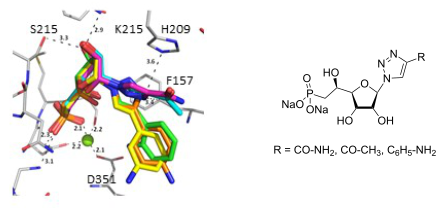
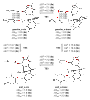
- , the NOESY spectrum showed correlation between the H5 of the triazole ring and the aromatic proton in ortho (Ho), whereas rotation about the C–C bond linking the triazole and the aromatic rings would lead to the disappearance of this correlation peak. In addition, the HMBC spectrum is showing only one
- formation of a strong H-bond and the C–C bond linking the triazole and the aromatic rings is free to rotate. To our surprise, a cross-peak between the H5 of the triazole and the H3’ was observed (as well as with the anomeric proton), indicating that both syn- and anti-conformers may be present. Enzyme


Chiral cyclopentadienylruthenium sulfoxide catalysts for asymmetric redox bicycloisomerization
Beilstein J. Org. Chem. 2016, 12, 1136–1152, doi:10.3762/bjoc.12.110
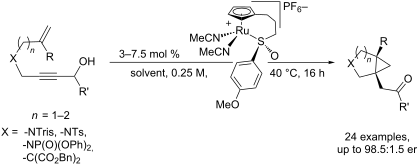
- could also be isolated with similar results, although the catalyst loading for this substrate had to be increased to 7.5 mol %. This is most likely due to the tendency of ruthenium to coordinate to certain aromatic rings in a η6 fashion. There were a few substrate classes that were not amenable to redox
- , we decided to try the same reactions in acetone. Pleasingly, exceptional yields and enantioselectivities of 37 and 39 were obtained in this solvent, surpassing those obtained for 35. Catalyst 1 exhibits excellent functional group compatibility. Substrates containing remote electron-neutral aromatic
- rings 40, alkenes 42, and alkynes 44 are all tolerated and remain intact under the reaction conditions. The reaction can also tolerate branching at the internal position of the pendant olefin, as polycyclic 46 and 48 displayed excellent enantiomeric ratios. It is also important to point out that no ring




Cationic Pd(II)-catalyzed C–H activation/cross-coupling reactions at room temperature: synthetic and mechanistic studies
Beilstein J. Org. Chem. 2016, 12, 1040–1064, doi:10.3762/bjoc.12.99
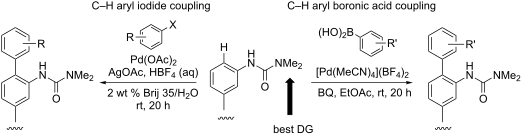
- enormous progress over the past decade, and continues to attract a great deal of attention due to the highly efficient routes now available for elaborating aromatic rings. While reactions of this type have been known for decades [1][2][3][4][5][6][7][8][9][10][11][12][13][14][15][16][17][18][19][20][21][22
- groups, as well as sterically hindered aromatic rings, all taking place at room temperature. Suzuki–Miyaura-type C–H coupling reactions are typically more tolerant of electron-withdrawing groups (3d, 3f, 3k) and ortho-substitution (3g) on the aryl ring. On the other hand, the reaction with 4






Catalytic asymmetric synthesis of biologically important 3-hydroxyoxindoles: an update
Beilstein J. Org. Chem. 2016, 12, 1000–1039, doi:10.3762/bjoc.12.98
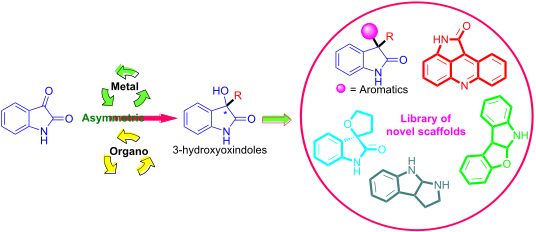
- -protected isatins using the Ir/L5 complex, giving the products in high yields (up to 98%) and with good to excellent enantioselectivities (up to 95% ee, Scheme 9) [25]. Only 1 mol % catalyst and 2.2 mol % ligand were used in the reactions. Substituents attached to the aromatic rings of isatins and




Enantioselective carbenoid insertion into C(sp3)–H bonds
Beilstein J. Org. Chem. 2016, 12, 882–902, doi:10.3762/bjoc.12.87
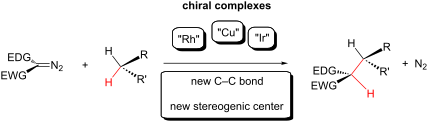
- efforts to better comprehend the scope of this catalytic system, especially on features concerning the BARF salt effect [43][44] and electronic effects on the aromatic rings of the chiral ligands [45]. In 2014, Maguire at al reported the syntheses of N-heterocycles by the enantioselective insertion of


From steroids to aqueous supramolecular chemistry: an autobiographical career review
Beilstein J. Org. Chem. 2016, 12, 684–701, doi:10.3762/bjoc.12.69
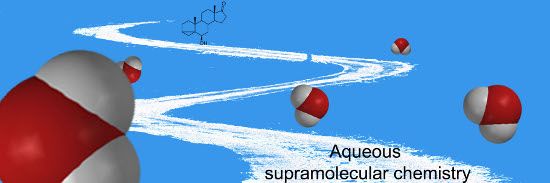
- shown in Scheme 5 was not a particularly good host; the free rotation of the aromatic rings ensures a poorly defined cavity. Moreover, although we could insert a range of functional groups into this second row of aromatic rims simply by using substituted benzal bromides [15][16], generally these
- . Thus, treatment of the shown octa-bromide (Scheme 6) with resorcinol led to the insertion of a third row of aromatic rings and the corresponding deep-cavity cavitand [17][18]. This “weaving process” can be carried out with many resorcinol derivatives, but the necessity of using variations on the





Biosynthesis of α-pyrones
Beilstein J. Org. Chem. 2016, 12, 571–588, doi:10.3762/bjoc.12.56
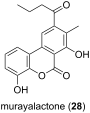
- -pyrones Dibenzo-α-pyrones (16) harbor the α-pyrone moiety in the middle part and consist of three ring structures (Figure 2). Aromatic rings are fused to edge c and e of the central 2-pyrone, yielding the basic structure of 16. Many dibenzo-α-pyrone-producing fungi have been described. However, it seems






Copper-mediated arylation with arylboronic acids: Facile and modular synthesis of triarylmethanes
Beilstein J. Org. Chem. 2016, 12, 496–504, doi:10.3762/bjoc.12.49
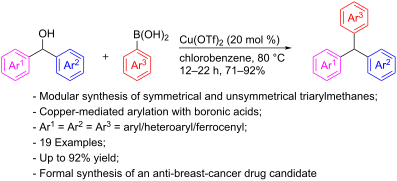
- variety of triarylmethanes through substitution of C(sp3)–OH in diarylmethanols with arylboronic acids (Scheme 1B). We reasoned that since diarylmethanols with two different aromatic rings can be made by a wide variety of methods [53][54] (e.g., addition of an aryl carbanion to an aryl aldehyde and a
- of ferrocene-1-yl(phenyl)methanol (9d) with phenyboronic acid (10a) was facile and it provided diphenylmethylferrocene (11p) without any difficulty in 71% yield. Modular synthesis of triarylmethanes The synthetic method that we developed, through which three different aromatic rings on the central
- principle, we present the synthesis of three examples of triarylmethanes 11q–s that bear three different aromatic rings (Table 3). The copper-catalyzed coupling reaction of phenyl(pyren-1-yl)methanol (9b) with 4-methoxyphenylboronic acid (10f) and benzo[b]thiophen-2-ylboronic acid (10k) provided the


Cascade alkylarylation of substituted N-allylbenzamides for the construction of dihydroisoquinolin-1(2H)-ones and isoquinoline-1,3(2H,4H)-diones
Beilstein J. Org. Chem. 2016, 12, 301–308, doi:10.3762/bjoc.12.32
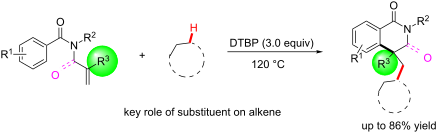
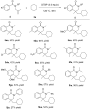
- % yield. It should be noted that the reactions of substrates bearing disubstituted aromatic rings were possible but resulted in lower yield (5fa and 5ga). On the other hand, the variation of the substituent on the nitrogen atom has also been examined. In the cases of N-ethyl (4h), N-isopropyl (4i), and N




Regioselective palladium-catalyzed ring-opening reactions of C1-substituted oxabicyclo[2,2,1]hepta-2,5-diene-2,3-dicarboxylates
Beilstein J. Org. Chem. 2016, 12, 239–244, doi:10.3762/bjoc.12.25
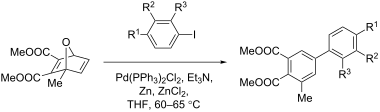
- variety of substituents were chosen, including electron-withdrawing and donating groups, bulky groups, and aromatic rings, in order to examine the impact of steric and electronic changes at the C1 position. The greatest yield for the ring-opened derivative was obtained with the methyl substituent (88


Versatile synthesis and biological evaluation of novel 3’-fluorinated purine nucleosides
Beilstein J. Org. Chem. 2015, 11, 2509–2520, doi:10.3762/bjoc.11.272
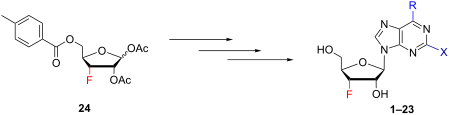
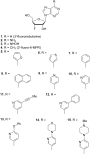
- -ribofuranosyl purine derivatives began with a palladium-catalyzed cross coupling [45][46] to install the aromatic moieties to the 6-position of the purine ring. In order to accomplish efficient cross-couplings of a wide range of aromatic rings, we utilized three different protocols that were employed for Stille



Investigation of the role of stereoelectronic effects in the conformation of piperidones by NMR spectroscopy and X-ray diffraction
Beilstein J. Org. Chem. 2015, 11, 1973–1984, doi:10.3762/bjoc.11.213
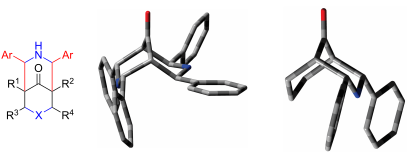
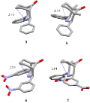
- rings on the six-membered ring with the boat conformation are antiperiplanar to the aromatic ring on the six-membered ring with the chair conformation (Figure 7a). This geometry allowed a C–H∙∙∙π intramolecular interaction between the aromatic rings. There are also C–H∙∙∙π intermolecular interactions
- 7 are reported for the first time. Crystals of 1 were obtained by slow evaporation of a saturated toluene solution, and 1 crystallized in the P21/n space group. The six-membered ring in the crystal structure exhibits a chair–boat conformation. For 1, the crystal structure shows that the aromatic




[2.2]Paracyclophane derivatives containing tetrathiafulvalene moieties
Beilstein J. Org. Chem. 2015, 11, 1917–1921, doi:10.3762/bjoc.11.207
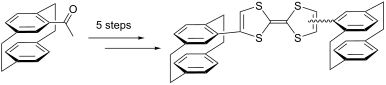
- the rigid framework and the short distance between the two aromatic rings within the [2.2]paracyclophane unit. Besides investigations of the geometry and of transannular interactions, special attention has been paid to the ability of these compounds to form charge-transfer complexes [6][7][8][9]. A


The simple production of nonsymmetric quaterpyridines through Kröhnke pyridine synthesis
Beilstein J. Org. Chem. 2015, 11, 1781–1785, doi:10.3762/bjoc.11.193

- on C5 and C4, belonging to the aromatic ring substituted by the pinene moieties. These may impose some strain in the Pt complex, resulting in a slightly different electronic environment as compared to the other nonsubstituted aromatic rings. Crystals of compounds 5, 8 and 9 were obtained and their X


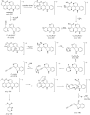
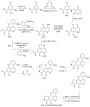
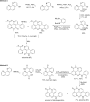
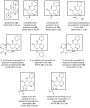
Pyridinoacridine alkaloids of marine origin: NMR and MS spectral data, synthesis, biosynthesis and biological activity
Beilstein J. Org. Chem. 2015, 11, 1667–1699, doi:10.3762/bjoc.11.183
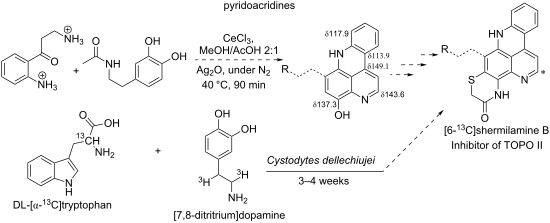
- in the fusion of aromatic rings, which makes this assignment a difficult task. An initial solution for structure determination might be to associate a single crystal X-ray structure to the NMR data. Unfortunately, the development of a suitable crystal for the crystallographic analysis is not an easy










Robust bifunctional aluminium–salen catalysts for the preparation of cyclic carbonates from carbon dioxide and epoxides
Beilstein J. Org. Chem. 2015, 11, 1614–1623, doi:10.3762/bjoc.11.176
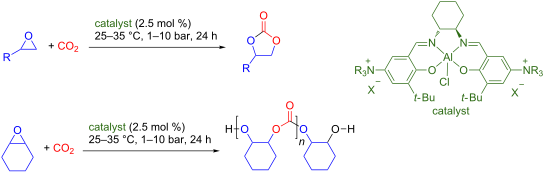
- one-component aluminium-based catalysts for the reaction between epoxides and carbon dioxide have been prepared. The catalysts are composed of aluminium–salen chloride complexes with trialkylammonium groups directly attached to the aromatic rings of the salen ligand. With terminal epoxides, the
- efficient for polycarbonate production [12]. Further modification of the salen moiety by the introduction of basic or ammonium salts through alkyl spacers attached to the salen aromatic rings led to the formation of a family of bifunctional catalysts possessing both Lewis acid and nucleophilic catalysis
- reactions [20][21][22][23]. We reasoned that the direct introduction of ammonium moieties onto the aromatic rings of the salen ligands (as in structures 1 and 2) would greatly stabilize the whole structure by reducing the number of sp3-hybridized carbon atoms attached to the nitrogen atoms of the ammonium


Design and synthesis of hybrid cyclophanes containing thiophene and indole units via Grignard reaction, Fischer indolization and ring-closing metathesis as key steps
Beilstein J. Org. Chem. 2015, 11, 1514–1519, doi:10.3762/bjoc.11.165

- of 3 followed by an RCM of diindole 5 can deliver target molecule 1 (Route B). The advantages of these approaches are: one can vary the length of the alkene chain during the Grignard addition, and generate diverse cyclophanes of different ring size. Diverse aromatic rings can be incorporated by


Antioxidant potential of curcumin-related compounds studied by chemiluminescence kinetics, chain-breaking efficiencies, scavenging activity (ORAC) and DFT calculations
Beilstein J. Org. Chem. 2015, 11, 1398–1411, doi:10.3762/bjoc.11.151
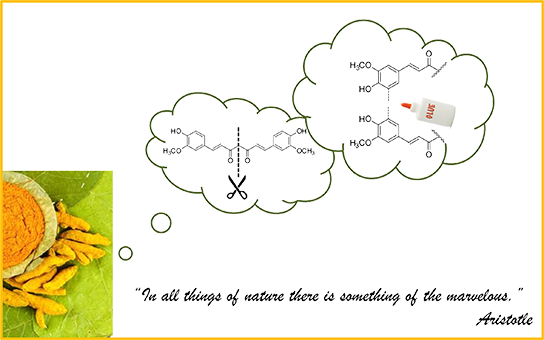
- biphenylic structure provides lipophilicity to dimer 9 allowing for a strong effect against pests and plant diseases [15]. The different conformations of the biphenyl structure generated by selective functionalization of the aromatic rings led us to consider this moiety as a basic and valued framework for




Selected synthetic strategies to cyclophanes
Beilstein J. Org. Chem. 2015, 11, 1274–1331, doi:10.3762/bjoc.11.142
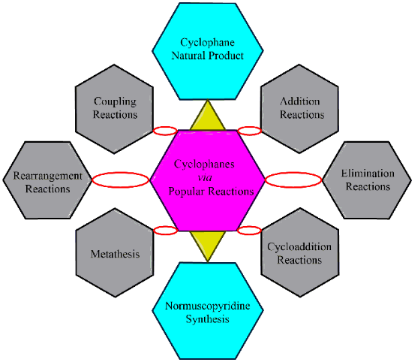
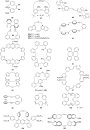
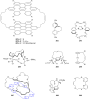
- ][11][12][13][14][15][16][17][18][19][20][21][22][23][24][25][26][27][28][29][30][31][32][33][34][35][36][37][38] are strained organic molecules which contain aromatic ring(s) as well as aliphatic unit(s). The aromatic rings provide rigidity to their structure, whereas the aliphatic unit(s) form bridge
- (s) between the aromatic rings and also provide flexibility to the overall structure. Cyclophanes play an important role in “host–guest” chemistry [39][40][41][42][43] and supramolecular assembly [44][45][46][47]. “Phane”-containing molecules show interactions with π-systems, and they can also bind






New depsidones and isoindolinones from the mangrove endophytic fungus Meyerozyma guilliermondii (HZ-Y2) isolated from the South China Sea
Beilstein J. Org. Chem. 2015, 11, 1187–1193, doi:10.3762/bjoc.11.133
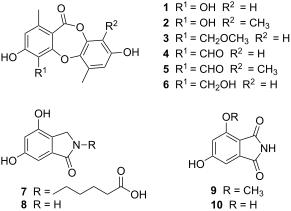
- ; Meyerozyma guilliermondii; Introduction Depsidones are characterized by the presence of cyclic diaryl ethers with an ester link joining the two aromatic rings [1][2]. They have been isolated mainly from various lichens [3][4][5] and other fungi [6][7][8][9][10][11]. These metabolites displayed a wide range
- aromatic rings (I) and (III) should be linked by ether and an ester bridge, revealing a depsidone skeleton with a seven-membered ring (II). Thus, the structure of 1 was revealed as a new depsidone belonging to the same family compound of the botryorhodines A–D [6], named botryorhodine E. Botryorhodine F (2


Synthesis and surface grafting of a β-cyclodextrin dimer facilitating cooperative inclusion of 2,6-ANS
Beilstein J. Org. Chem. 2015, 11, 514–523, doi:10.3762/bjoc.11.58
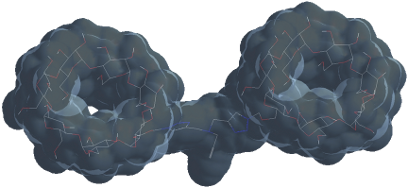
- coplanar arrangement of the aromatic rings makes 2,6-ANS an excellent guest molecule, the dimensions of 2,6-ANS exceed the dimensions of the β-CD cavity and, therefore, potentially allow for formation of a 2:1 complex. This behavior has previously been reported for parent β-CD with the naphthalene
- complex with parent β-CD was observed. We speculated that a β-CD dimer prepared with a short spacer would allow for the formation of 1:1 complex (1:2 in terms of β-CD moieties) with molecules bearing extended aromatic rings (such as the 2,6-ANS used here as a model), thereby resulting in higher complex


3-Glucosylated 5-amino-1,2,4-oxadiazoles: synthesis and evaluation as glycogen phosphorylase inhibitors
Beilstein J. Org. Chem. 2015, 11, 499–503, doi:10.3762/bjoc.11.56
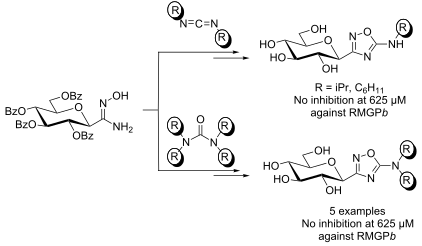
- morpholinyl (Scheme 1, d) and piperidinyl (Scheme 1, e) residues were also selected as candidates for their hydrophobic properties, although they are bulkier than aromatic rings. The synthesis started with commercially available ureas (2a and 2e) or through the synthesis of such ureas. While the synthesis