


Search results
Search for "macrocyclic" in Full Text gives 284 result(s) in Beilstein Journal of Organic Chemistry. Showing first 200.
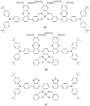
Synthesis of new p-tert-butylcalix[4]arene-based polyammonium triazolyl amphiphiles and their binding with nucleoside phosphates
Beilstein J. Org. Chem. 2018, 14, 1980–1993, doi:10.3762/bjoc.14.173
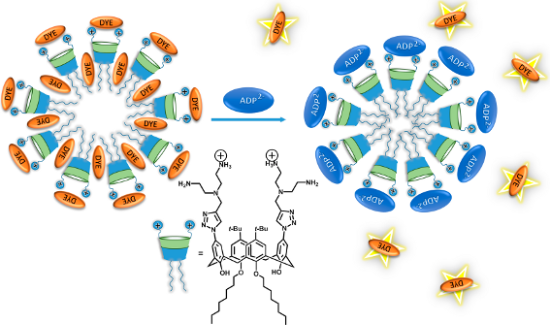
- comparison with ADP and ATP [11]. Another polyammonium receptor synthesized by Mascaros et al. [12] showed selective recognition of ADP in the presence of ATP in water. Undoubtedly, macrocyclic receptors have a number of advantages in the design of molecular receptors, providing preorganization of the


Rational design of boron-dipyrromethene (BODIPY) reporter dyes for cucurbit[7]uril
Beilstein J. Org. Chem. 2018, 14, 1961–1971, doi:10.3762/bjoc.14.171
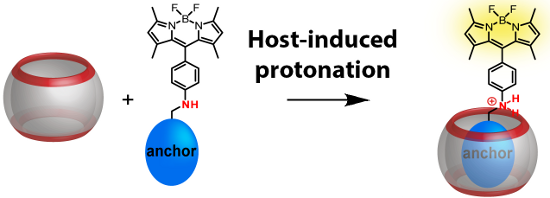
- transfer; supramolecular chemistry; Introduction Cucurbit[n]urils (CBn, n = 5–8, 10, and 14) are a class of macrocyclic host molecules which are water soluble, nontoxic, and are able to bind a large variety of neutral and cationic guests in their inner cavity with high affinity [1][2][3][4]. This unique
- macrocyclic hosts and dyes that have so far been reported [16] are only of limited use for these currently emerging life science applications of CBs. Many of the fluorescent dyes which bind to CBs with significant fluorescence changes have a limited photostability, in particular under intense laser light
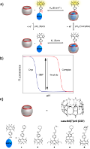
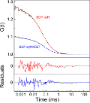
- of the dyes increased upon addition of CB7 (Figure 3). This result is in accordance with the anticipated anchor group mechanism leading to a complexation-induced protonation of the dye (Figure 1). It also suggests that the BODIPY core is not encapsulated in the macrocyclic cavity and that




An amphiphilic pseudo[1]catenane: neutral guest-induced clouding point change
Beilstein J. Org. Chem. 2018, 14, 1937–1943, doi:10.3762/bjoc.14.167
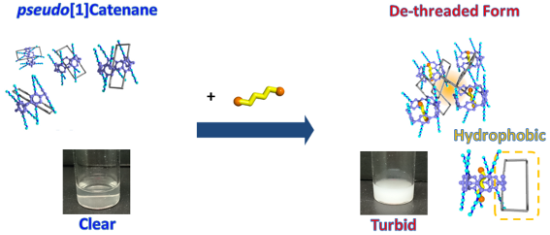
- , which exhibits a clouding point around 32 °C [1][2][3][4]. Recently, thermo-responsive molecules with additional functions have been developed to replace pNIPAAm [5][6][7][8][9][10]. For example, we have developed thermo-responsive macrocyclic molecules which exhibit LCST behavior regulated by host
- –guest chemistry [5][6][7]. The molecules consist of a non-ionic amphiphilic part containing tri(ethylene oxide) moieties, and a hydrophobic part consisting of a pillar[n]arene core (Figure 1a; 1, n = 5; 2, n = 6). Pillar[n]arenes, which were first reported by our group [11], were used as the macrocyclic


A pyridinium/anilinium [2]catenane that operates as an acid–base driven optical switch
Beilstein J. Org. Chem. 2018, 14, 1908–1916, doi:10.3762/bjoc.14.165
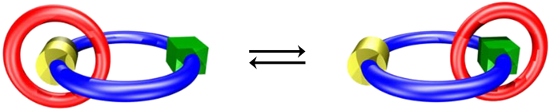
- in color (yellow/colorless) for [1FDB24C8]2+ or a fluorescence change (OFF/ON) for [1ADB24C8]2+; see Figure 1. In addition, we have also previously prepared a [3]catenane containing two dibenzo[24]crown ether DB24C8 rings interlocked onto a much larger macrocyclic ring containing two 1,2-bis


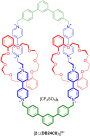

![[Graphic 3]](/bjoc/content/inline/1860-5397-14-165-i4.svg?max-width=637&scale=0.827274) DB24C8]6+ containing benzylanilinium and bis(pyridinium)ethane...
DB24C8]6+ containing benzylanilinium and bis(pyridinium)ethane...


Asymmetric Michael addition reactions catalyzed by calix[4]thiourea cyclohexanediamine derivatives
Beilstein J. Org. Chem. 2018, 14, 1901–1907, doi:10.3762/bjoc.14.164
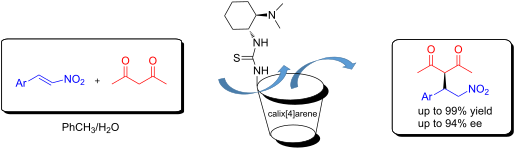
- and yields of the Michael reactions. Supramolecular catalysis has drawn tremendous interest in the past few years [15][16][17][18][19][20][21][22][23]. In this context, calixarenes are ideal supramolecular macrocyclic scaffolds for the design of molecular receptors and organocatalysts due to their



Strong binding and fluorescence sensing of bisphosphonates by guanidinium-modified calix[5]arene
Beilstein J. Org. Chem. 2018, 14, 1840–1845, doi:10.3762/bjoc.14.157
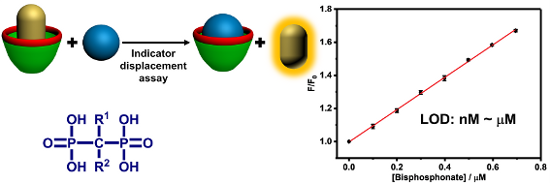
- BPs in buffer solution, and more importantly, in artificial urine. Calibration lines were therefore set up in untreated artificial urine, allowing for quantifying the concentrations of BPs in the biologically relevant low range. Keywords: bisphosphonate; calixarene; fluorescence sensing; macrocyclic
- particularly suitable for the detection of analytes lacking chromophores. The key factor in IDA is the rational design of artificial receptors that are capable of binding analytes strongly and specifically. Calixarenes are the third generation of macrocyclic receptors after crown ethers and cyclodextrins. Due


Host–guest complexes of conformationally flexible C-hexyl-2-bromoresorcinarene and aromatic N-oxides: solid-state, solution and computational studies
Beilstein J. Org. Chem. 2018, 14, 1723–1733, doi:10.3762/bjoc.14.146
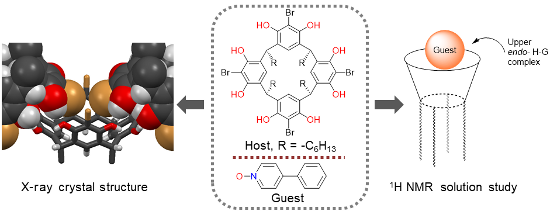
- , aiding in the binding of polar guests such as N-oxides. Keywords: aromatic N-oxides; C–H···π Interactions; ditopic receptors; endo/exo complexation; host–guest chemistry; resorcinarenes; Introduction Resorcinarenes are macrocyclic compounds with a bowl-shaped cavity stabilised by circular


Synthesis of diamido-bridged bis-pillar[5]arenes and tris-pillar[5]arenes for construction of unique [1]rotaxanes and bis-[1]rotaxanes
Beilstein J. Org. Chem. 2018, 14, 1660–1667, doi:10.3762/bjoc.14.142

- ]rotaxane and [1]rotaxane are one of particular supramolecular assembly system and are considered as an important building block in the construction of diverse MIMs [5][6][7][8][9][10]. [1]Rotaxane has a macrocyclic wheel component connected with a self-locked chain axle, and a bulky stopper at the terminal
- ], cyclodextrin [24][25][26], calixarene [27][28][29] and pillararene have been successfully employed as the wheel subcomponent. Pillararenes are new star macrocyclic compounds with aromatic rings para-bridged by methylene units and have unique tubular shape rather than cone [30][31][32]. In recent years, an


A conformationally adaptive macrocycle: conformational complexity and host–guest chemistry of zorb[4]arene
Beilstein J. Org. Chem. 2018, 14, 1570–1577, doi:10.3762/bjoc.14.134
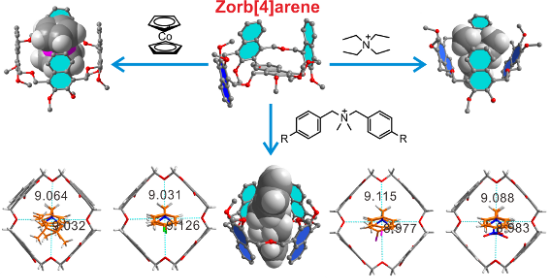
- binding behavior of ZB4 and lays the basis for the construction of stimuli-responsive materials with ZB4 as a major component. Keywords: conformations; host–guest chemistry; macrocycles; supramolecular chemistry; zorb[4]arene; Introduction Macrocyclic receptors are the principal workhorses used in
- [15][16] and signal transduction [17] observed with bioreceptors. However, similar conformationally adaptive synthetic macrocyclic receptors are relatively rare in the literature [18][19][20][21][22][23]. During the last five years, we have developed two classes of macrocyclic receptors with


Recent advances in phosphorescent platinum complexes for organic light-emitting diodes
Beilstein J. Org. Chem. 2018, 14, 1459–1481, doi:10.3762/bjoc.14.124
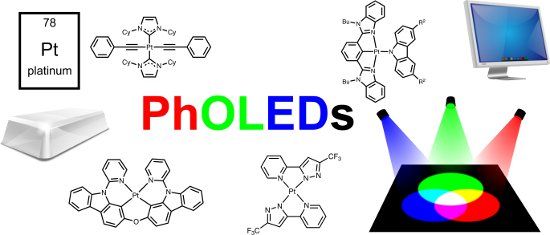
- either bis(1,2,3-triazolylphenyl) [86] or bis(1,2,4-triazolylphenyl) ligands [87]. Examples of the former class, namely complexes 39 and 40, are displayed in Figure 18. In particular, these complexes were designed to reduce excited-state distortions by bearing a macrocyclic chelating ligand and either
- ether, methylene or carbonyl bridging units. The derivatives showed bright blue phosphorescence centred at λem ca. 448–470 nm depending on the bridging unit. Such blue emission was retained when the complexes were embedded in PMMA rigid matrix. Interestingly, macrocyclic derivatives possessed higher
- PLQY in solution with values of 0.58–0.62 when compared to non-macrocyclic counterparts that was attributed to the enhanced structural rigidity imposed by the cyclic structure. By employing complex 39 as emissive material OLED devices with the following architecture were fabricated: ITO/NPB (50 nm)/mCP






Recent applications of chiral calixarenes in asymmetric catalysis
Beilstein J. Org. Chem. 2018, 14, 1389–1412, doi:10.3762/bjoc.14.117
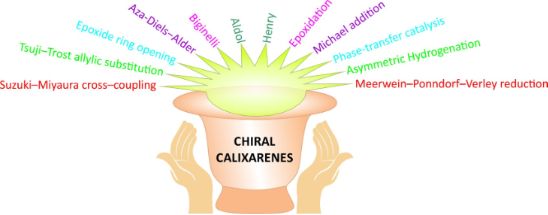
- calixarene; organocatalyst; supramolecular catalyst; Introduction The catalysis of organic reactions by macrocyclic host compounds is a longstanding proposed application of supramolecular chemistry and utilizes the use of noncovalent interactions in catalytic systems to achieve higher reaction rates, more
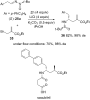
- 48 with nitroalkenes 49 (Scheme 13). The asymmetric Michael addition in the presence of 10–15 mol % of the macrocyclic catalysts 47a/47b afforded both enantiomers of the products 50 in high yields (up to 95%) and in high to excellent enantioselectivities (up to 99% ee). In order to confirm the role


London dispersion as important factor for the stabilization of (Z)-azobenzenes in the presence of hydrogen bonding
Beilstein J. Org. Chem. 2018, 14, 1238–1243, doi:10.3762/bjoc.14.106
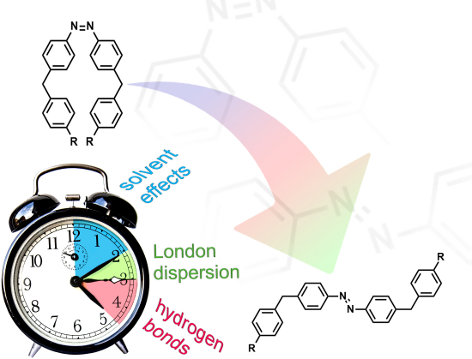
- can be reversed by the incorporation of azobenzene units in macrocyclic arrangements [15]. For example, the groups of Tamaoki [16] and Herges [17] reported azobenzophanes that isomerize thermally to their energetically lower Z-conformations from their corresponding higher energy E-isomers. Moreover


One hundred years of benzotropone chemistry
Beilstein J. Org. Chem. 2018, 14, 1120–1180, doi:10.3762/bjoc.14.98
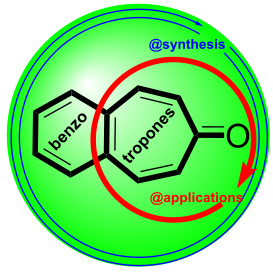
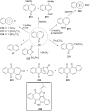
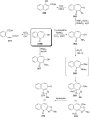
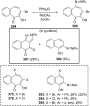
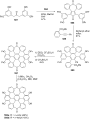
- ][18][19][20][21][22][23] (isolated from the heartwood and essential oils of trees of the family Cupressaceae), to complex macrocyclic analogues, such as harringtonolide (5) [24][25][26], which was found to have antineoplastic and antiviral properties, and caulersin (6) [26], which is a biologically








Iodine(III)-mediated halogenations of acyclic monoterpenoids
Beilstein J. Org. Chem. 2018, 14, 1103–1111, doi:10.3762/bjoc.14.96
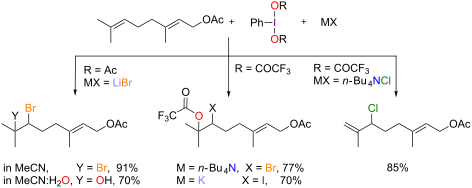
- of molecular scaffolds, from the mono-chlorinated linear chain of fallachromenoic acid [2], to the pentahalogenated halomon skeleton [3] and encompassing many intricate polycyclic and macrocyclic structures with complex vicinal oxygen/halogen patterns, such as bromophycolide B [4] and dichotellide B


An overview of recent advances in duplex DNA recognition by small molecules
Beilstein J. Org. Chem. 2018, 14, 1051–1086, doi:10.3762/bjoc.14.93
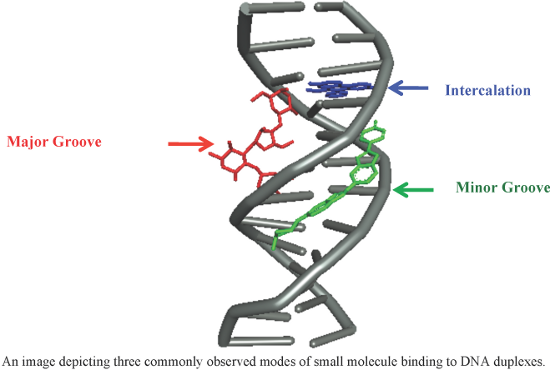
- interactions play a crucial role in its binding to DNA groove. Similarly, the same group recently reported a macrocyclic copper(II) complex, ([CuL(ClO4)2] where L is 1,3,6,10,12,15-hexaazatricyclo[13.3.1.16,10]eicosane) and studied its interaction with calf thymus DNA (ct-DNA). It was confirmed that the Cu(II




Preparation, structure, and reactivity of bicyclic benziodazole: a new hypervalent iodine heterocycle
Beilstein J. Org. Chem. 2018, 14, 1016–1020, doi:10.3762/bjoc.14.87
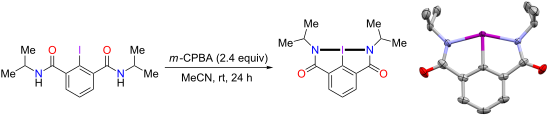
- preparation of several bicyclic benziodoxoles 3 starting from 2-iodoisophthalic acid (2, Scheme 1b). These bicyclic benziodoxoles 3 can be used as efficient coupling reagents for the direct condensation reaction between carboxylic acids and alcohols or amines to provide esters, macrocyclic lactones, or amides


Synthesis of a sucrose-based macrocycle with unsymmetrical monosaccharides "arms"
Beilstein J. Org. Chem. 2018, 14, 634–641, doi:10.3762/bjoc.14.50
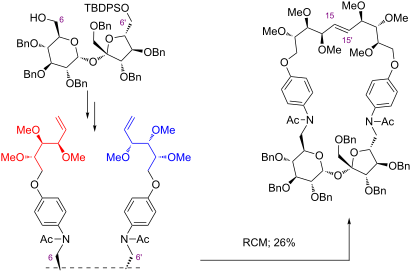
- -O-benzylsucrose with different unsaturated monosaccharide units is presented. Such a highly functionalized intermediate was cyclized under RCM conditions to afford a macrocyclic derivative containing a 31-membered ring in 26% yield. Keywords: chiral macrocycles; ring-closing metathesis; sucrose
- ; Introduction Chiral macrocyclic compounds play an important role in supramolecular and biological systems [1][2]. Many of them serve as convenient receptors for cations [3], anions [4], ion pairs [5], neutral molecules [6] etc. Binaphthols [7][8][9], amino acids [10], chiral diamines [11][12], carbohydrates
- [13], etc. are usually applied as building blocks for construction of such type of compounds. We are engaged in the synthesis of such macrocyclic derivatives containing the most common natural disaccharide, sucrose [14][15]. Several different classes of macrocyclic derivatives, including: crown [16


Recent developments in the asymmetric Reformatsky-type reaction
Beilstein J. Org. Chem. 2018, 14, 325–344, doi:10.3762/bjoc.14.21
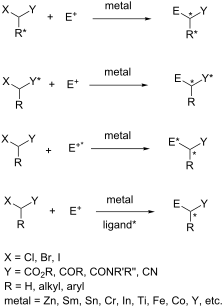
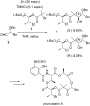
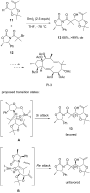
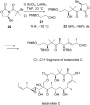
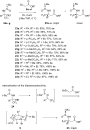
- total synthesis of naturally occurring 11-membered macrocyclic lactam cebulactam A1 [34]. In the presence of SmI2 in THF at reflux, chiral amide 41 underwent an intramolecular Reformatsky reaction to give the corresponding alcohol 42 in 84% yield as a couple of diastereomers (Scheme 17). The latter











Binding abilities of polyaminocyclodextrins: polarimetric investigations and biological assays
Beilstein J. Org. Chem. 2017, 13, 2751–2763, doi:10.3762/bjoc.13.271
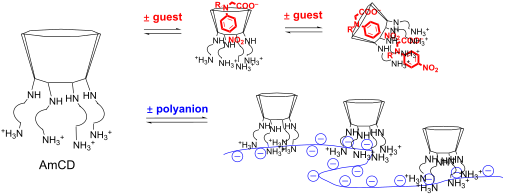
- of a polynucleotide (interacting with the polycationic branches) and a further bioactive/drug molecule (included into the host cavity). The critical examination of the available literature suggests that one main drawback of this approach is the fact that the syntheses of the tailored macrocyclic



Sulfation and amidinohydrolysis in the biosynthesis of giant linear polyenes
Beilstein J. Org. Chem. 2017, 13, 2408–2415, doi:10.3762/bjoc.13.238
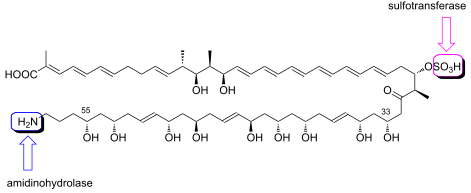
- Streptomyces neyagawaensis (Scheme 1), is a potent inhibitor of the fibrinogen receptor, which suggests an even wider potential utility for such compounds [8][9]. We have previously shown that in the biosynthesis of giant macrocyclic antifungal polyketides (so-called marginolactones) compounds bearing a
- medi4948. In contrast, when an authentic amidinohydrolase from the Streptomyces olivaceus Tü4018 strain producing the macrocyclic polyene desertomycin [10] was similarly cloned and expressed in S. malaysiensis DSM4137, it had no effect on the production of 1a and 1b (Figure S6, Supporting Information File
- 1), implying that these amidinotransferases operating on linear and macrocyclic polyenes do not have overlapping substrate specificities. Sequence alignment of amidinohydrolase Medi4948 with authentic ureohydrolases in the Protein Data Bank (PDB) (Figure S2, Supporting Information File 1) revealed


Synthesis and application of trifluoroethoxy-substituted phthalocyanines and subphthalocyanines
Beilstein J. Org. Chem. 2017, 13, 2273–2296, doi:10.3762/bjoc.13.224
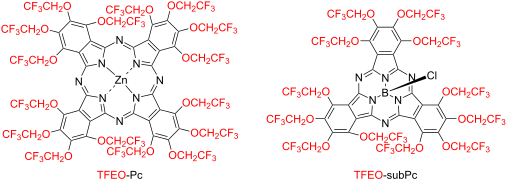
- based on their unique functions. Phthalocyanines are also expected to be applied as functional dyes. A series of compounds having a macrocyclic π-conjugated system including porphyrin are known as functional dyes. In particular, phthalocyanines have a wide range of functions and are expected to serve as








Structural diversity in the host–guest complexes of the antifolate pemetrexed with native cyclodextrins: gas phase, solution and solid state studies
Beilstein J. Org. Chem. 2017, 13, 2252–2263, doi:10.3762/bjoc.13.222
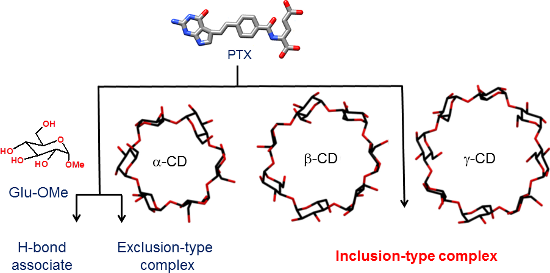
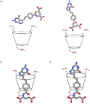
- signal was observed (PTX#5 and H#6, Figure S14, Supporting Information File 1). Based on these results we assumed that guest molecule penetrates γ-CD from the wider rim and is inserted into the macrocyclic cavity. To further confirm these findings 1D measurements in DMSO-d6 were performed (see Supporting
- the guest (a: from left to right): pemetrexed (PTX) and folic acid (FA), and host molecules with increasing diameter of macrocyclic cavity (b: from left to right: α-, β- and γ-CDs). Dissociation efficiency curves of three CDs/PTX complexes. The ions were collided with nitrogen (pressure ca. 2 × 10⁻⁵




An efficient synthesis of a C12-higher sugar aminoalditol
Beilstein J. Org. Chem. 2017, 13, 2146–2152, doi:10.3762/bjoc.13.213
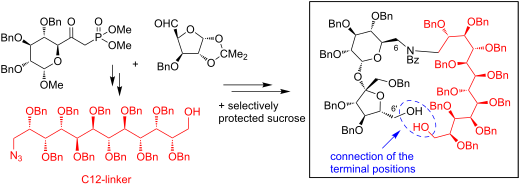
- : higher carbon sugars; reductive amination; sucrose; Introduction Carbohydrates, because of their availability in a variety of optical pure forms, are particularly useful in planning and executing the synthesis of chiral macrocyclic compounds [1][2][3][4][5]. In this context, polyhydroxylated derivatives
- which could eventually be used in the synthesis of macrocyclic derivatives. Sucrose, undoubtedly the most common disaccharide, has found applications in the synthesis of polymers [17] or surfactants [18]. There is also an increasing interest in the application of sucrose as a ‘normal’ chemical [16][19


Main group mechanochemistry
Beilstein J. Org. Chem. 2017, 13, 2068–2077, doi:10.3762/bjoc.13.204
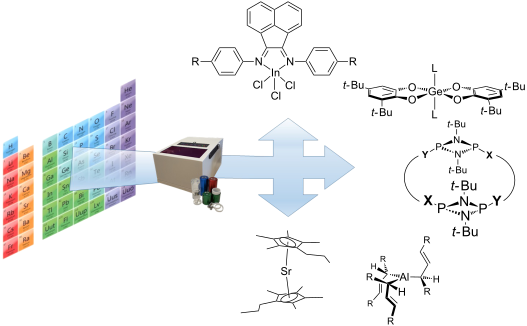
- adamantoid P4(NR)6 frameworks. These species are synthesised by direct reaction of PCl3 with sterically unhindered amines RNH2 (R= Me, Et, iPr, Bz) [101] or by isomerization of their less thermodynamically-stable macrocyclic [{P(μ-NR)}2(μ-NR)]2 counterparts. In the latter, the isopropyl (iPr) substituted


p-tert-Butylthiacalix[4]arenes functionalized by N-(4’-nitrophenyl)acetamide and N,N-diethylacetamide fragments: synthesis and binding of anionic guests
Beilstein J. Org. Chem. 2017, 13, 1940–1949, doi:10.3762/bjoc.13.188
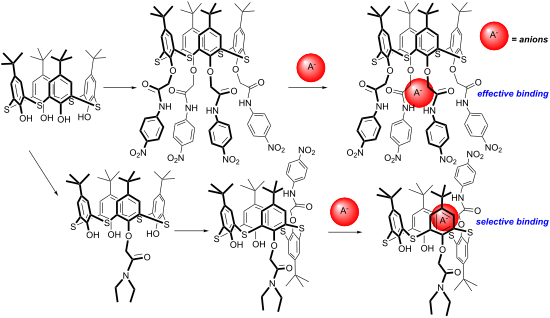
- type of anion is needed. (Thia)calix[4]arene derivatives are a favorable platform for the design of such structures [24][25][26][27][28][29][30][31][32][33][34]. Due to their macrocyclic nature and the possibility to modify them in three different ways (upper and lower rims and bridge fragments), they
- containing N-(4’-nitrophenyl)acetamide and N,N-diethylacetamide moieties at the lower rim The regioselective synthesis of p-tert-butylthiacalix[4]arenes partially substituted at the lower rim, is an important challenge because it allows the sequential functionalization of the macrocyclic platform with the
- protons of the macrocycle and the oxymethylene protons of N,N-diethylacetamide moiety indicate the presence of substituents on opposite sides of the macrocyclic ring. This fact, as well as the cross-peak due to the dipole–dipole interaction of protons of the hydroxy groups confirms the presence of the





