Search results
Search for "leaving group" in Full Text gives 265 result(s) in Beilstein Journal of Organic Chemistry. Showing first 200.
3-Glucosylated 5-amino-1,2,4-oxadiazoles: synthesis and evaluation as glycogen phosphorylase inhibitors
Beilstein J. Org. Chem. 2015, 11, 499–503, doi:10.3762/bjoc.11.56
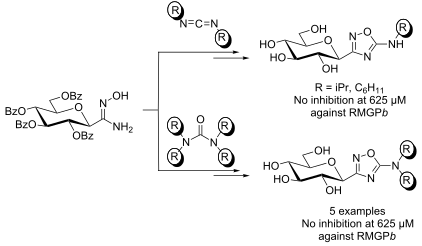
- with the N,N’-ditolylcarbodiimide, although the starting material was consumed. The mechanism proposed by Ispikoudi et al. [33] proposes the amine moiety as a leaving group during this process. Anilines (R = tolyl) are worse leaving groups than alkylamines (R = iPr, C6H11), thus providing a likely


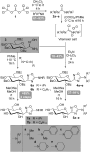
The preparation of new functionalized [2.2]paracyclophane derivatives with N-containing functional groups
Beilstein J. Org. Chem. 2015, 11, 437–445, doi:10.3762/bjoc.11.50
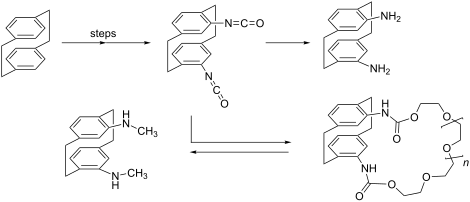
- tetrahedral intermediate thus generated, the polyether bridge functions as a leaving group to form an aldehyde intermediate. This is subsequently reduced a second time to the N-CH3 moiety. In compound 22 one formyl group is still present whereas in 23 this has been lost completely. Both compounds were


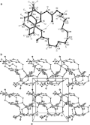

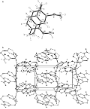


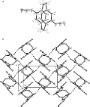
3α,5α-Cyclocholestan-6β-yl ethers as donors of the cholesterol moiety for the electrochemical synthesis of cholesterol glycoconjugates
Beilstein J. Org. Chem. 2015, 11, 162–168, doi:10.3762/bjoc.11.16
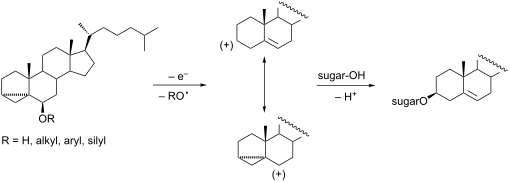
- the two, the latter appeared to be much more efficient in cholesteryl transfer to the sugar moiety. The problem, however, with 6β-steroidal thioethers is that they are not easily accessible. Therefore, we searched for the best leaving group at C-3. A series of cholesterol derivatives was tested and


Copper-promoted hydration and annulation of 2-fluorophenylacetylene derivatives: from alkynes to benzo[b]furans and benzo[b]thiophenes
Beilstein J. Org. Chem. 2014, 10, 2886–2891, doi:10.3762/bjoc.10.305
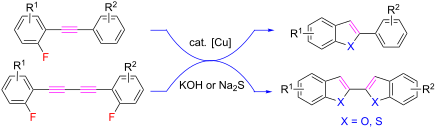
- )ethynyl)benzene were performed, as shown in Scheme 4. In F/Br-substituted 1-bromo-2-(2-(2-fluorophenyl)ethynyl)benzene, the fluoro moiety served as leaving group and gave 2-(2-bromophenyl)benzofuran (2t) as a major product. In F/Cl-substituted 1-chloro-2-(2-(2-fluorophenyl)ethynyl)benzene was able to


Selenium halide-induced bridge formation in [2.2]paracyclophanes
Beilstein J. Org. Chem. 2014, 10, 2550–2555, doi:10.3762/bjoc.10.266
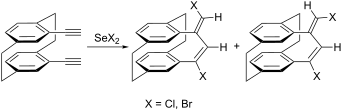
- . The reaction of 10 with the second equivalent of PhSeCl leads to selenonium ion 11; once the diphenyl diselenide leaving group is formed, the addition of chloride counter-anions from both directions is accompanied by the formation of [2.3.2](1,2,4)cyclophane derivatives 2 and 3. Most probably compound


Photorelease of phosphates: Mild methods for protecting phosphate derivatives
Beilstein J. Org. Chem. 2014, 10, 2038–2054, doi:10.3762/bjoc.10.212
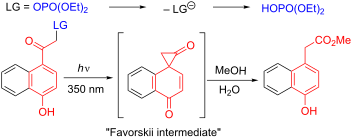
- to be disadvantageous. The recent candidates are based on a pHP motif. Phosphate esters of 10, 14, 24, and acetate 27 [19] each possess a hydroxy donor coupled with an acetyl function bearing the leaving group (Figure 3). One of these, the 5-hydroxy-1-naphthylacetyl motif as its acetate ester 27, has
- favored by aqueous-based solvents that serve both as a proton donor and an acceptor to the conjugate base generated from the chromophore’s triplet state heterolytic cleavage of the leaving group. The dual behavior of H2O is manifest in accepting a proton from the naphthol OH while simultaneously solvating
- overall conversion to released substrate. The formation of competing chromophoric byproducts limits the conversion and yields [6][10][11][15]. For example, changing the leaving group for 10, i.e., photolysis of 6-hydroxy-2-naphthylacetyl GABA ester (Figure 2B) inefficiently released 4-aminobutyrate (GABA


A new charge-tagged proline-based organocatalyst for mechanistic studies using electrospray mass spectrometry
Beilstein J. Org. Chem. 2014, 10, 2027–2037, doi:10.3762/bjoc.10.211
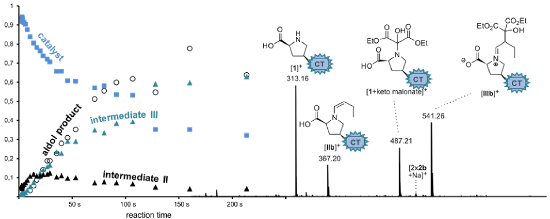
- -tagged catalyst 1 starting from doubly-protected hydroxyproline 6 [57] is depicted in Scheme 3. To introduce a suitable leaving group for the following step of the synthesis, compound 6 was mesylated to give the derivative 7 [58] for which crystals suitable for X-ray analysis have been obtained (Figure 2


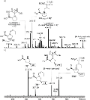
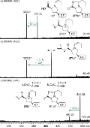

Facile synthesis of 1-alkoxy-1H-benzo- and 7-azabenzotriazoles from peptide coupling agents, mechanistic studies, and synthetic applications
Beilstein J. Org. Chem. 2014, 10, 1919–1932, doi:10.3762/bjoc.10.200
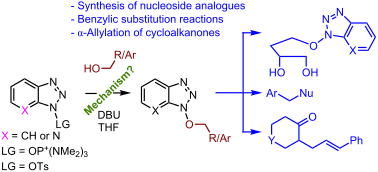
- of 1° and 2° alcohols underwent reaction with Bt-OTs giving good to excellent yields of 1-alkoxy-1H-benzotriazoles. Some notable results are as follows. Despite the leaving group ability of BtO−, elimination to styrene does not appear to be a significant problem in the reactions with the isomeric
- , respectively. We next assessed the leaving group ability of the benzotriazolyloxy group. Although carboxylic acid esters of benzotriazole react efficiently with nucleophiles, this is mechanistically distinct from direct displacement. Thus, four of the 1-alkoxy-1H-benzotriazoles (three 1° and one 2°) were
- -azidoethyl)benzene, as assessed by 1H NMR. However, this reaction was incomplete and about 12% of 1f remained unreacted. Nevertheless, these results indicate the leaving group ability of BtO− from benzylic sp3 carbon centers and are interesting in the context of the previously unknown reactivity of this


Application of cyclic phosphonamide reagents in the total synthesis of natural products and biologically active molecules
Beilstein J. Org. Chem. 2014, 10, 1848–1877, doi:10.3762/bjoc.10.195
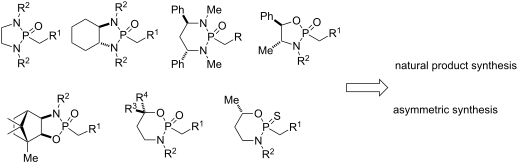
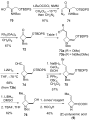
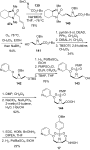
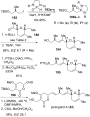
- attributed in part to the missing α-orientated 4-alkoxy substituent present in sanfetrinem (113), which may act as a potential leaving group and appears to be crucial for activity [97]. Anthoplalone (1999) Isolated from the Okinawan actinian Anthopleura pacifica, anthoplalone (8) is a secosesquiterpene with








Synthesis of trifluoromethyl-substituted pyrazolo[4,3-c]pyridines – sequential versus multicomponent reaction approach
Beilstein J. Org. Chem. 2014, 10, 1759–1764, doi:10.3762/bjoc.10.183

- in 5-chloropyrazole-4-aldehydes is sufficiently activated to act as the leaving group in such kind of C–C linkages [17]. Indeed, reaction of chloroaldehyde 2 with different alkynes 3a–c under typical Sonogashira reaction conditions afforded the corresponding cross-coupling products 4a–c in good


Expedient synthesis of 1,6-anhydro-α-D-galactofuranose, a useful intermediate for glycobiological tools
Beilstein J. Org. Chem. 2014, 10, 1651–1656, doi:10.3762/bjoc.10.172
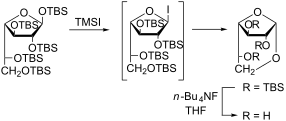
- -hydroxy group on the anomeric carbon, with the iodide as a good leaving group. This compound is a good precursor for building blocks for the construction of 1→6 linkages. Keywords: 1,6-anhydro-α-D-Galf; galactofuranosyl iodide; galactofuranosyl precursor; per-tert-butyldimethylsilyl-β-D-galactofuranose
- the formation of the anomeric iodide, the 6-hydroxy group could be desilylated by the acid medium developed during the iodide formation (10 → 11). Then, the free 6-hydroxy group could carry out an intramolecular attack of the anomeric carbon, with iodide as a good leaving group, affording the 1,6
- leaving group at C-1, and the electron-donating nature of the TBS groups. Thus, while compounds 13 [38] and 14 [39] were prepared by treatment with Lewis acids of fully protected precursors and proved to be stable and therefore useful as synthetic intermediates, attempts to prepare compound 15 by


A complete series of 6-deoxy-monosubstituted tetraalkylammonium derivatives of α-, β-, and γ-cyclodextrin with 1, 2, and 3 permanent positive charges
Beilstein J. Org. Chem. 2014, 10, 1390–1396, doi:10.3762/bjoc.10.142
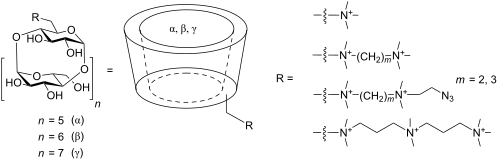
- complete series of monosubstituted CD derivatives with a permanent positive charge (Figure 1). Synthesis of monotosylated CDs as the starting material The most crucial and scope-limiting step of the reaction sequence was the introduction of a suitable leaving group in the position 6 of the native CD. For


Magnesium bis(monoperoxyphthalate) hexahydrate as mild and efficient oxidant for the synthesis of selenones
Beilstein J. Org. Chem. 2014, 10, 1267–1271, doi:10.3762/bjoc.10.127
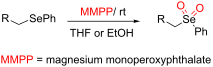
- they are versatile reagents or intermediates in organic synthesis [1]. Particularly, alkyl phenyl selenones [2][3] represent a valuable compound class due to the ability of the phenylselenonyl group to behave as a good leaving group in substitution reactions (Scheme 1). Thus, the development of
- different alkyl phenyl selenides to the corresponding selenones. Since the phenylselenonyl group is an excellent leaving group, selenone 2 readily undergoes SN2 type substitution reactions with common nucleophiles [7][8] as shown in Scheme 2. A wide range of heterocyclic compounds can be obtained by
- bioactive molecules is currently under investigation. General transformation of selenides to selenones. Phenylselenone 2 as useful leaving group for the synthesis of different organic molecules. Oxidation of selenides 1a–d to selenones 2a–d with MMPP. Oxidative cyclization with MMPP of functionalized


Tandem Cu-catalyzed ketenimine formation and intramolecular nucleophile capture: Synthesis of 1,2-dihydro-2-iminoquinolines from 1-(o-acetamidophenyl)propargyl alcohols
Beilstein J. Org. Chem. 2014, 10, 1255–1260, doi:10.3762/bjoc.10.125
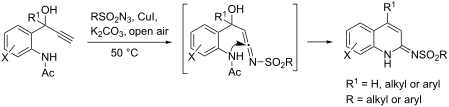
- creating initially a leaving group and its subsequent substitution or via activation of the nitrogen atom and direct amination at C-2 while few methods afforded the direct 2-aminoquinoline synthesis from the acyclic precursors. Most recently, we have disclosed a method for the synthesis of E-α,β


Atherton–Todd reaction: mechanism, scope and applications
Beilstein J. Org. Chem. 2014, 10, 1166–1196, doi:10.3762/bjoc.10.117

- compounds and their related deoxygenated derivatives represent an important family of natural or synthetic compounds exhibiting, for example, antitumor or antiallergic activities. The reduction of a phenol group implies its activation as a good leaving group. Phosphate is one of the possible activating
- reaction produced the arylstannane in 75 to 90% yield [88]. The Suzuki–Miyaura cross-coupling reaction is another type of reaction with the phosphate group acting as a leaving group. As exemplified in Scheme 30, the aryl dialkyl phosphate was produced in good yield by an AT reaction [89]. Then, this




4-Hydroxy-6-alkyl-2-pyrones as nucleophilic coupling partners in Mitsunobu reactions and oxa-Michael additions
Beilstein J. Org. Chem. 2014, 10, 1159–1165, doi:10.3762/bjoc.10.116

- , entry 2), a tosylate leaving group (Table 1, entry 4), and a halide (Table 1, entry 5). Somewhat more exotic functional groups such as a phosphonate ester (Table 1, entry 6) or a dimethyl acetal (Table 1, entry 7) were still tolerated in the reaction, albeit in more modest yields. A variety of alkylated


Visible-light-induced, Ir-catalyzed reactions of N-methyl-N-((trimethylsilyl)methyl)aniline with cyclic α,β-unsaturated carbonyl compounds
Beilstein J. Org. Chem. 2014, 10, 890–896, doi:10.3762/bjoc.10.86
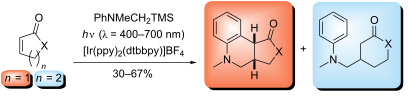
- ; Introduction The photoinduced electron transfer (PET) of an amine to an excited oxidant followed by the loss of a cationic leaving group allows accessing a broad variety of α-aminoalkyl radicals [1][2][3][4]. As first shown by Mariano et al. [5][6] and by Pandey et al. [7] a trimethylsilyl (TMS) group is a
- suitable electrophilic leaving group for this purpose and addition reactions of α-aminoalkyl radicals to double bonds can be induced by irradiation of α-silylated amines in the presence of sensitizers such as 1,4-dicyanonaphthalene or 1,9-dicyanoanthracene. Addition reactions of this type have been broadly
- used for the formation of carbon–carbon bonds [8][9][10][11][12][13][14][15][16][17][18][19][20][21][22]. In non-silylated tertiary amines, a proton can act as a leaving group and photoinduced addition reactions of tertiary amines to enones are long known [23][24][25][26][27][28]. Mechanistically



Synthesis of complex intermediates for the study of a dehydratase from borrelidin biosynthesis
Beilstein J. Org. Chem. 2014, 10, 634–640, doi:10.3762/bjoc.10.55
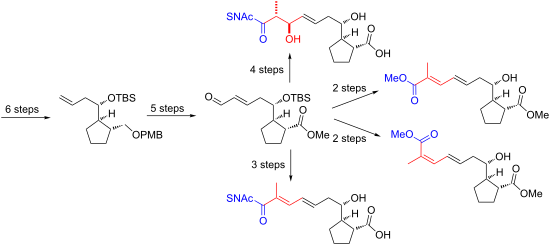
- BorDH3 and reference molecules for enzyme assays (5a, 6a, 6b, 7a and 7b); TBS = tert-butyldimethylsilyl, PMB = p-methoxybenzyl, LG = leaving group. Synthesis of the common precursor aldehyde 11. Compound 13 was prepared in six steps and with an overall yield of 40% via a known route by Omura et al. [15


Isocyanide-based multicomponent reactions towards cyclic constrained peptidomimetics
Beilstein J. Org. Chem. 2014, 10, 544–598, doi:10.3762/bjoc.10.50



Concise, stereodivergent and highly stereoselective synthesis of cis- and trans-2-substituted 3-hydroxypiperidines – development of a phosphite-driven cyclodehydration
Beilstein J. Org. Chem. 2014, 10, 369–383, doi:10.3762/bjoc.10.35
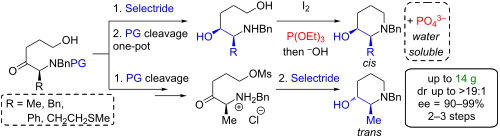
- corresponding undesired phosphates F). The formation of heterocycles G passing phosphates F through substitution of the phosphate leaving group by the nucleophilic YH moiety would be in principal also a plausible explanation for the formation of F, but can most likely be excluded (see Supporting Information
- other pharmacologically relevant targets on a gram scale. Natural products and other bioactive piperidine derivatives of type B. Retrosynthetic analysis of piperidines B (X = OH or leaving group, PG = protecting group). Synthesis of the protected amino acids 2. (a) KOH for 1b. b) PG–X = Cbz–Cl (1a–c


Synthesis of 3,4-dihydro-1,8-naphthyridin-2(1H)-ones via microwave-activated inverse electron-demand Diels–Alder reactions
Beilstein J. Org. Chem. 2014, 10, 282–286, doi:10.3762/bjoc.10.24
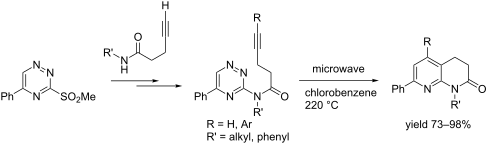
- THF in the presence of EDCI and DMAP. The corresponding amides 2–5 were obtained in excellent yields (Scheme 2). The results are shown in Table 1. Preparation of N-substituted N-triazinylpent-4-ynamides The nucleophilic substitution of the methylsulfonyl leaving group from 1 by the lithium salt of


Cyclic phosphonium ionic liquids
Beilstein J. Org. Chem. 2014, 10, 271–275, doi:10.3762/bjoc.10.22

- different from those of the cyclic ammonium NTf2 ILs, which is similar to the situation of linear alkyl quaternary cation ILs [11]. In some instances where the anion is nucleophilic, such as with dicyanamide [12], or the leaving group is resonance-stabilized, such as a benzyl radical [10], the phosphonium


Substrate dependent reaction channels of the Wolff–Kishner reduction reaction: A theoretical study
Beilstein J. Org. Chem. 2014, 10, 259–270, doi:10.3762/bjoc.10.21
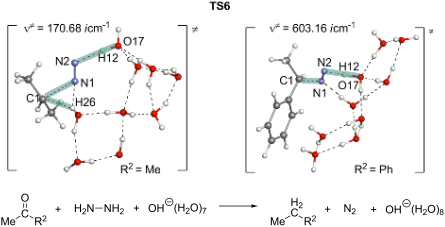
- the former is a typical E2 reaction. The 1-phenylethyl anion is the leaving group at the trans nucleophilic elimination. Thus, the carbanion is formed owing to the delocalization of the negative charge into the phenyl ring. The intermediate is shown in XIVPh (Figure 6). It is noteworthy that the H(14








Synthesis of the B-seco limonoid core scaffold
Beilstein J. Org. Chem. 2014, 10, 194–208, doi:10.3762/bjoc.10.15
- to continue the synthesis with both diastereomers as this elimination is expected to proceed faster in syn-substituted β-alkoxy esters since the hydrogen and the leaving group are in an antiperiplanar arrangement. Continuing the synthesis with the 1S-isomer (Scheme 12), reduction of the ester moiety
- , desilylation, oxidation and esterification (Scheme 14). Attempts to rearrange 93 under the optimized conditions were again unsuccessful. As expected, elimination of the OMOM group during the reaction was not detected due to the unfavoured orientation of the hydrogen and the leaving group. Subsequent acidic
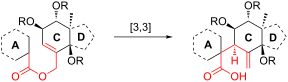
- ]-sigmatropic rearrangement for formation of the C9–C10 bond. R = Me or CO2H, LG = leaving group. Retrosynthetic analysis of the B-seco limonoid scaffold employing a Claisen rearrangement as key step for formation of the C9–C10 bond. PG = protecting group, LG = leaving group. Synthesis of alcohols 19, 20 and 22




Recent applications of the divinylcyclopropane–cycloheptadiene rearrangement in organic synthesis
Beilstein J. Org. Chem. 2014, 10, 163–193, doi:10.3762/bjoc.10.14
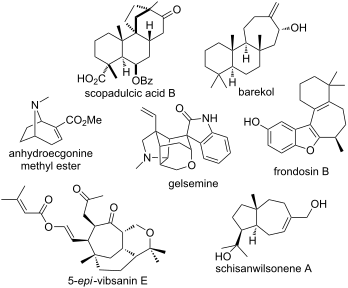
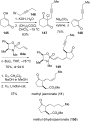
- -protected alcohol 152. Addition of methyllithium at low temperature [133] resulted in stereoselective conjugate attachment of the required methyl group. Deprotection of the alcohol and transformation into a suitable leaving group yielded tosylate 153. Next, the furan was cleaved oxidatively, the resulting