


Search results
Search for "release" in Full Text gives 604 result(s) in Beilstein Journal of Organic Chemistry. Showing first 200.
Synthetic reactions driven by electron-donor–acceptor (EDA) complexes
Beilstein J. Org. Chem. 2021, 17, 771–799, doi:10.3762/bjoc.17.67

- ; moreover, 53 and 54 can be mutually transformed. Excited state 53 reacts with diene 49, forming a double radical intermediate 55 that subsequently evolves to cyclobutyliminium ion 56, and then product 50 is provided after hydrolysis, along with the release of diamine 51. In 2020, Zhang and colleagues [25
- * under irradiation with light. Then, radical intermediate 113 is afforded via intermolecular electron transfer, followed by removing one molecule of carbon dioxide to give radical intermediate 114. Species 115 is formed through radical coupling in 114, providing the target product 111 with the release of


DNA with zwitterionic and negatively charged phosphate modifications: Formation of DNA triplexes, duplexes and cell uptake studies
Beilstein J. Org. Chem. 2021, 17, 749–761, doi:10.3762/bjoc.17.65
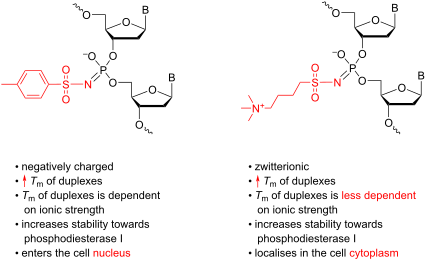
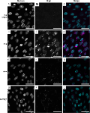
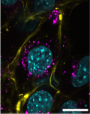
- release of DNA-hydrating ordered water molecules into the bulk solvent. Since the introduction of the N+ modification compensated for the negative charge on the DNA backbone, the change in the entropy costs for N+ON/DNA between 100 mM and 25 mM NaCl solutions was less than that for the unmodified duplex


[2 + 1] Cycloaddition reactions of fullerene C60 based on diazo compounds
Beilstein J. Org. Chem. 2021, 17, 630–670, doi:10.3762/bjoc.17.55
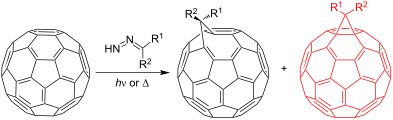
- ) and addition of diazo compounds at elevated temperatures with subsequent release of N2 (II). The cyclopropanation of C60 with stabilized α-halocarbanions, i.e., the Bingel reaction, is the most efficient way to synthesize methanofullerenes [76]. It is almost versatile; in the presence of a reactive
Valorisation of plastic waste via metal-catalysed depolymerisation
Beilstein J. Org. Chem. 2021, 17, 589–621, doi:10.3762/bjoc.17.53
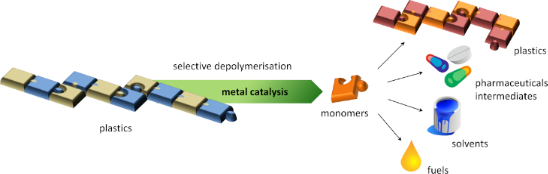
- usually synthetic polymers recalcitrant to decomposition, and hence liable to accumulate in landfills or the environment when discarded [5][6]. Not all plastics can be reused, and thus having limited economic value [7][8]. Plastics may release toxic compounds dangerous to human health and the habitat [9






Breakdown of 3-(allylsulfonio)propanoates in bacteria from the Roseobacter group yields garlic oil constituents
Beilstein J. Org. Chem. 2021, 17, 569–580, doi:10.3762/bjoc.17.51
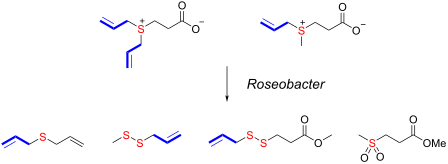
- -(allylmethylsulfonio)propanoate (AllMSP), were synthesized and fed to marine bacteria from the Roseobacter clade. These bacteria are able to degrade DMSP into dimethyl sulfide and methanethiol. The DMSP analogues were also degraded, resulting in the release of allylated sulfur volatiles known from garlic. For unknown
- release sulfur volatiles [13][14] that are especially important headspace constituents from marine bacteria of the Roseobacter group [15][16][17]. In these organisms, sulfur volatiles are to a large extent generated from algal (DMSP), a metabolite that is produced in massive amounts by algae [18], thus
- not show the release of 27. Conclusion Bacteria from the Roseobacter group can degrade DMSP analogues with S-allyl groups including AllMSP and DAllSP, likely with the participation of the enzymes for DMSP (hydro)lysis and from the DMSP demethylation pathway. Because MeSH can also originate from other


CF3-substituted carbocations: underexploited intermediates with great potential in modern synthetic chemistry
Beilstein J. Org. Chem. 2021, 17, 343–378, doi:10.3762/bjoc.17.32
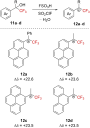
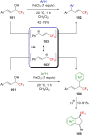
- , and triflate 45f, which was isolated after basic workup of the reaction (59% yield) [63]. Hence, protonation of 44 led to dialkoxysulfonium triflate 47 along with the release of alcohol 9g. The subsequent formation of the excellent sultine leaving group 46 (assumed to be as good of a leaving group as
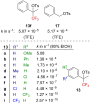
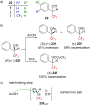
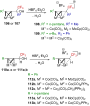
- 104–107 range [39][40][41][43][48][68]. Thus, while introducing one CF3 group dramatically alters the reactivity, an additional CF3 group does not seem to significantly impact the reactivity any further. The hypothesis of a ground-state strain release to explain this behavior was discarded as an
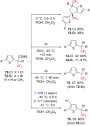
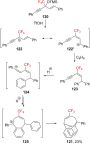
- proposed that upon heating, Ga(OTf)3 reacts with 63 to release an indolium ion 65 and forms an organogallium species 67 via intermediate 66, which, after protodemetallation, releases indole 62 and regenerates the catalyst. The retro-Friedel–Crafts reaction at 80 °C at the indole C3-position thus allows the

















Regioselective chemoenzymatic syntheses of ferulate conjugates as chromogenic substrates for feruloyl esterases
Beilstein J. Org. Chem. 2021, 17, 325–333, doi:10.3762/bjoc.17.30
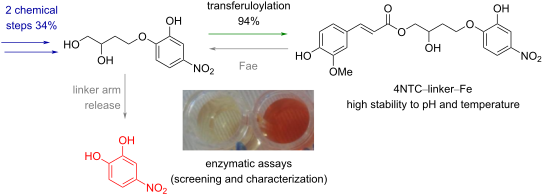
- from Aspergillus niger (AnFaeA, Figure 1C). Coloration is the result of successive reactions: (i) release of the free 5-bromo-4-chloro-indoxyl-3-ol by an enzyme cascade, wherein TxAbf-catalyzed cleavage of the glycosidic bond was made possible by the prior release by AnFaeA of the ferulate moiety [21
- of Faes was investigated (Figure 2), measuring 4NTC release by AnFaeA [42] at 40 °C. The enzyme-catalyzed reaction leads to the cleavage of the ester bond linking the ferulate to the linker–4NTC moiety, and thus to the accumulation of linker–4NTC. Therefore, working in a discontinuous mode, 4NTC is


19F NMR as a tool in chemical biology
Beilstein J. Org. Chem. 2021, 17, 293–318, doi:10.3762/bjoc.17.28
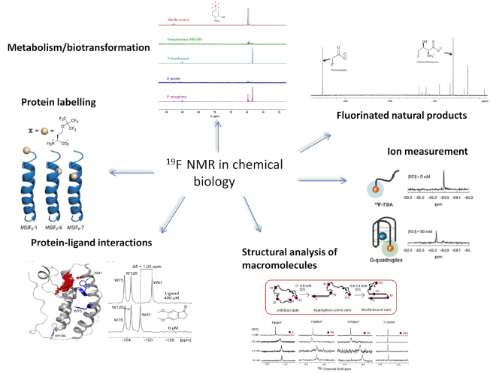
- , Otting and co-workers have recently developed a synthetic strategy, based on a continuous exchange cell-free system (CECF), in which a key chitin-binding mutant of release factor RF1 can be removed under conditions that maintain the full activity of the S30 extract, thereby minimizing the incidence of
- biosynthesis through hBBOX-catalysed GBBNF hydroxylation, both in vitro and in cell lysates [43]. Moreover, by using a competitive substrate for the enzyme, inhibition experiments could be directly employed to determine the IC50 values in the basis of fluoride release, and the extent of GBBNF turnover
- cell lines [44]. Here, the incorporation of CF3 and CF3O groups as NMR reporters into the tumour-targeting drug conjugates enabled the direct investigation of the mechanism of the pro-drug metabolic cleavage and the pharmacophore release by real-time 19F NMR analysis. 19F NMR was also employed as a


The preparation and properties of 1,1-difluorocyclopropane derivatives
Beilstein J. Org. Chem. 2021, 17, 245–272, doi:10.3762/bjoc.17.25
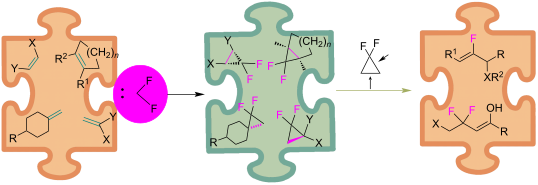
- Ph3P+CF2−, which was used for the Wittig olefination of aldehydes and ketones. However, heating PDFA in nonpolar solvents (e.g., xylene at 90 °C) favors the dissociation of the ylide to release difluorocarbene which is able to effect the cyclopropanation of alkenes [34]. Trimethylsilyl
- . Further applications of free radical chemistry have developed through the use of radical initiators under comparatively mild conditions to form cyclopropylmethyl radicals, which can readily release their strain by opening to give homoallyl radicals. gem-Difluorocyclopropanes, because of their




Au(III) complexes with tetradentate-cyclam-based ligands
Beilstein J. Org. Chem. 2021, 17, 186–192, doi:10.3762/bjoc.17.18
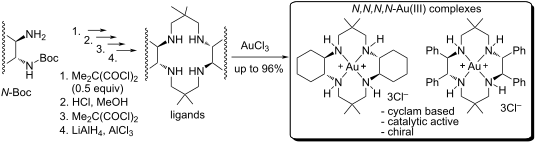
- immediate color change into dark red/brown took place after addition of complex 6b-Au(III), indicating a low stabilization of the coordinated diphenyl ligand and a fast release of Au. The de-coordination resulted in full conversion within 15 min in both reactions (Table 1, entries 3 and 6), compared to 24


Multiswitchable photoacid–hydroxyflavylium–polyelectrolyte nano-assemblies
Beilstein J. Org. Chem. 2021, 17, 166–185, doi:10.3762/bjoc.17.17
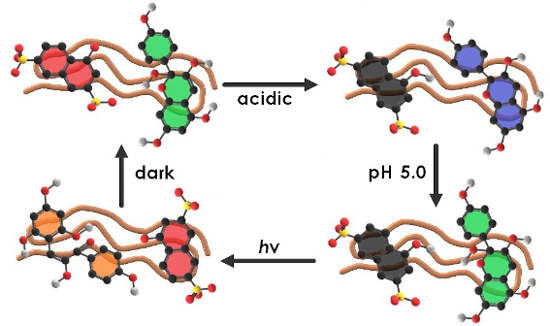
- small counterion release may contribute (likely, it is ionic repulsion due to the excess of positive charges (l < 1.0) in combination with changes in hydration shells that make this region endotherm). The last binding step starts at l = 0.16 (molar ratio 0.075), equal to 17 monomer units per poly




Recent progress in the synthesis of homotropane alkaloids adaline, euphococcinine and N-methyleuphococcinine
Beilstein J. Org. Chem. 2021, 17, 28–41, doi:10.3762/bjoc.17.4
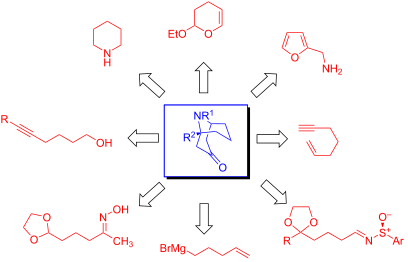
- all synthetic works published in the last 25 years. Review Chemical ecology of Adalia bipunctata Individuals of Adalia bipunctata species (2-spot ladybird) display aposematic coloration reinforced by the production and release of remarkable amounts of reflex-fluid, in response to predator attack [29


Molecular basis for protein–protein interactions
Beilstein J. Org. Chem. 2021, 17, 1–10, doi:10.3762/bjoc.17.1
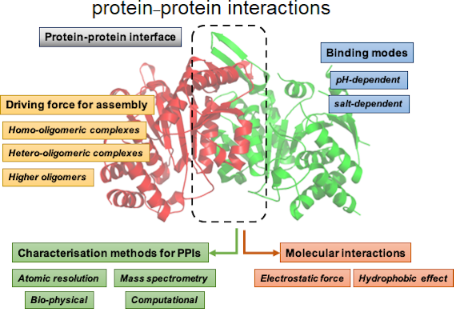
- in the protein molecules due to proton uptake and release. Therefore, these events are strongly affected by the pH value and the ionic strength. Variation of the pH value or the ionic strength can result in substantial binding free energy changes [48] or changes in the binding preference [49


Chemical constituents of Chaenomeles sinensis twigs and their biological activity
Beilstein J. Org. Chem. 2020, 16, 3078–3085, doi:10.3762/bjoc.16.257
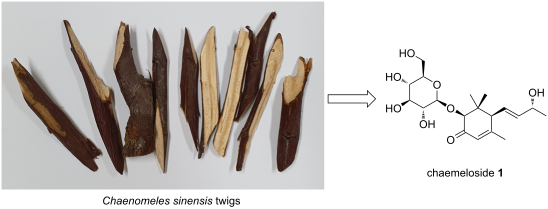
- compounds, only compound 8 (apigenin) exhibited a weak activity on the NGF release with a stimulation level of 127.8 ± 2.0% without displaying cell toxicity (100.9 ± 0.6%). Conclusion A new megastigmane-type norsesquiterpenoid glycoside 1 was isolated along with 11 known compounds from the MeOH extract of C
- , Seoul, Republic of Korea) were used to assess the release of NGF into the culture medium. The test cells were seeded onto 24-well plates at a density of 1 × 10⁵ cells/well. After 24 h, the cells were treated with serum-free DMEM and incubated with the designated concentrations of the compounds for an


Deoxyfluorination of acyl fluorides to trifluoromethyl compounds by FLUOLEAD®/Olah’s reagent under solvent-free conditions
Beilstein J. Org. Chem. 2020, 16, 3052–3058, doi:10.3762/bjoc.16.254
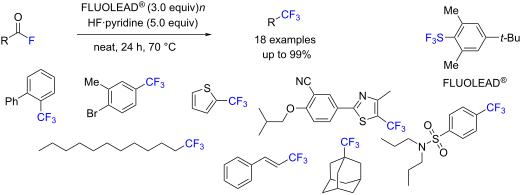
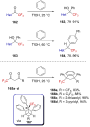
- an intermediate III via transition state II. The intermediate III is further activated by (HF)n to form IV, which finally induces the deoxyfluorination via V furnishing the trifluoromethylated products 2 with the release of ArS(O)F and (HF)n. Conclusion We have reported an efficient protocol for the


Metal-free nucleophilic trifluoromethylselenolation via an iodide-mediated umpolung reactivity of trifluoromethylselenotoluenesulfonate
Beilstein J. Org. Chem. 2020, 16, 3032–3037, doi:10.3762/bjoc.16.252
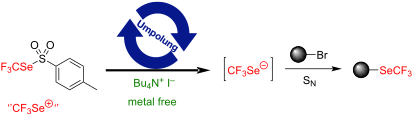
- substitute the leaving group onto the electrophilic substrate 2. However, because of the release of I2, as side reaction the oxidation of the CF3Se− anion can be also envisaged. This was confirmed by the formation of 25–30% of CF3SeSeCF3 when 1 equivalent of 2a was used (Table 1, entries 3 and 4


Metal-free synthesis of biarenes via photoextrusion in di(tri)aryl phosphates
Beilstein J. Org. Chem. 2020, 16, 3008–3014, doi:10.3762/bjoc.16.250
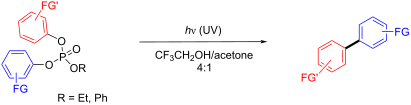
- , biphenyl (1b) is formed as the byproduct in <5% yield. Conclusion We demonstrated that biaryls can be smoothly prepared via the photoextrusion of diaryl- and triaryl phosphates in protic media, with the concomitant release of a molecule of phosphoric acid monoester. The reaction takes place in moderate



Secondary metabolites of Bacillus subtilis impact the assembly of soil-derived semisynthetic bacterial communities
Beilstein J. Org. Chem. 2020, 16, 2983–2998, doi:10.3762/bjoc.16.248
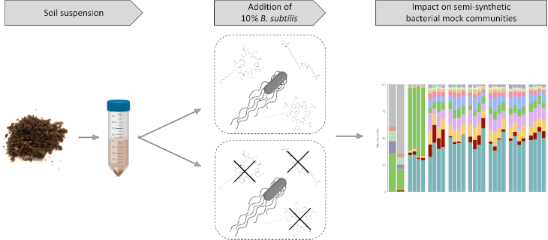
- reads were assigned to the respective samples with an average of 12,083 reads per sample (range: 751 to 34,802; Table S3, Supporting Information File 1). The 16S rRNA reference sequences with a 99% identity criterion obtained from the SILVA database release 132 were trimmed to the V3-V4 region, bound by


Selected peptide-based fluorescent probes for biological applications
Beilstein J. Org. Chem. 2020, 16, 2971–2982, doi:10.3762/bjoc.16.247

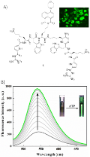
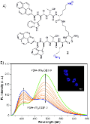
- which have affinity for the CB[8] cavity. These substrates easily displace 6 from the CB[8] cavity and release 6 which folds again to form a pyrene excimer, which allows for the ratiometric fluorescence monitoring of those substrates. Upon screening methyl ester derivatives of hydrophobic amino acids



Incorporation of a metal-mediated base pair into an ATP aptamer – using silver(I) ions to modulate aptamer function
Beilstein J. Org. Chem. 2020, 16, 2870–2879, doi:10.3762/bjoc.16.236
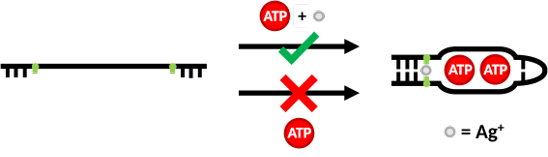
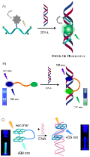
- to release a DNA-bound cargo (in the form of small organic molecules) [10]. Similarly, metal ions can trigger DNA folding into a catalytically active topology [11][12]. Metal-mediated base pairs are artificial base pairs in which hydrogen bonds between the complementary nucleobases are formally


Using multiple self-sorting for switching functions in discrete multicomponent systems
Beilstein J. Org. Chem. 2020, 16, 2831–2853, doi:10.3762/bjoc.16.233

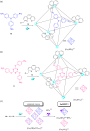
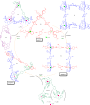
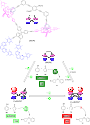
- supramolecule-to-supramolecule transformations, involving functions such as chemical purification, controllable guest uptake and release, and reagent storage along with catalysis [47]. However, neither of the examples in this compilation proved to be reversible. In the present minireview, we highlight the
- release of DABCO using a double self-sorting protocol [54]. Schmittel and co-workers reported on the three-component rectangle [Cu4(16)2(17)2]4+ (SelfSORT-I) that rearranged into the four-component sandwich complex [Cu2(16)(17)(18)]2+ (Figure 8) upon the addition of DABCO (SelfSORT-II). A full
- innovative catch–release system with multiple functions combined the ON/OFF-adjustment of silver(I) catalysis and fluorescence monitoring [59]. Actually, the ratiometric luminescence response allowed the exact monitoring of the catalytic activity. In the initial incomplete self-sorting (state SelfSORT-I







Easy access to a carbohydrate-based template for stimuli-responsive surfactants
Beilstein J. Org. Chem. 2020, 16, 2788–2794, doi:10.3762/bjoc.16.229
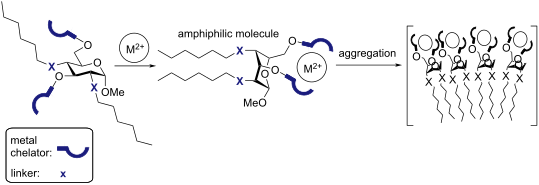
- -delivery system owing to their size and the ability to carry drugs, both in the polar (core) or apolar (lipid bilayer) interior [4][5]. A challenge in liposome-based drug delivery systems is to release the drug at the place of function. This challenge has led to the development of stimuli-responsive


Optical detection of di- and triphosphate anions with mixed monolayer-protected gold nanoparticles containing zinc(II)–dipicolylamine complexes
Beilstein J. Org. Chem. 2020, 16, 2687–2700, doi:10.3762/bjoc.16.219
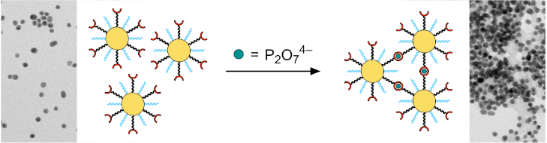
- sensing [1][2][3][4][5][6]. The analyte can be detected by relying on the enhancement of the Raman scattering intensity, if it is bound close to the gold surface (surface enhanced Raman scattering, SERS), for example, or by the release from the metal surface of a chromophore the fluorescence of which is


Synthesis and characterization of S,N-heterotetracenes
Beilstein J. Org. Chem. 2020, 16, 2636–2644, doi:10.3762/bjoc.16.214

- step, an azide group was introduced to 10 by lithiation with n-BuLi followed by the reaction with tosyl azide giving azide 11 in an excellent yield of 92%. Thermally induced ring-closure under release of nitrogen and formation of a nitrene intermediate was achieved by refluxing azide 11 in


Activation of pentafluoropropane isomers at a nanoscopic aluminum chlorofluoride: hydrodefluorination versus dehydrofluorination
Beilstein J. Org. Chem. 2020, 16, 2623–2635, doi:10.3762/bjoc.16.213
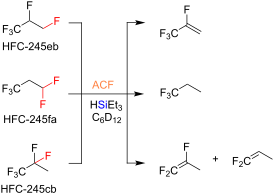
- generated from 1 at the ACF surface. Alternatively, the aromatic solvent can also attack the carbenium-like species, producing a zwitterionic Wheeland intermediate, which can release the Friedel–Crafts product 11 and DF to regenerate the catalyst (Scheme 3, right). Although a hydrogen source was not needed





