


Search results
Search for "FDA-approved drugs" in Full Text gives 17 result(s) in Beilstein Journal of Organic Chemistry.
Construction of CF2 moieties in FDA-approved drugs (2016–2025): industrial routes, mechanisms, and scale-up considerations
Beilstein J. Org. Chem. 2026, 22, 1122–1150, doi:10.3762/bjoc.22.91
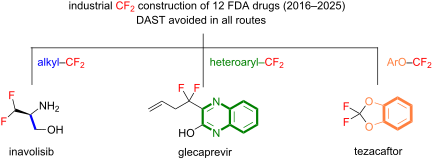
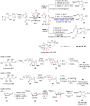
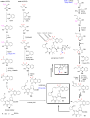
- drugs, from strategic design to scale-up evaluation. Keywords: difluoromethylene group (-CF2-); difluoromethyl group (-CF2H); FDA-approved drugs; fluorination methods; process scale-up; Introduction In recent years, the CF2 group has demonstrated unique advantages in drug discovery and clinical
- fluorination strategies differ fundamentally from the CF2 incorporation methods discussed herein. This article reviews the FDA-approved drugs containing CF2 groups from 2016 to 2025, totaling 12 compounds (Figure 1). Difamilast (6) was approved in Japan in 2021, and its FDA approval followed in 2026, which
- their extension to functionalized substrates. More recently, the facile synthesis of chiral gem-difluorocyclopropanes via rhodium-catalyzed hydrogenation was reported, highlighting the potential for enantioselective construction of these motifs [47]. Although none of the 12 FDA-approved drugs discussed






Research towards selective inhibition of the CLK3 kinase
Beilstein J. Org. Chem. 2025, 21, 2250–2259, doi:10.3762/bjoc.21.172
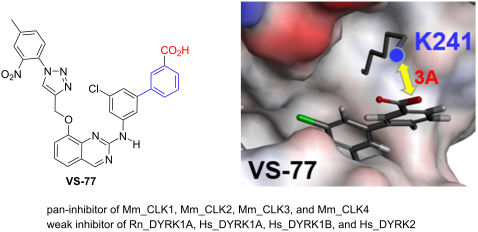
- kinases have become one of the most important drug targets: between a quarter to a third of the drug discovery efforts worldwide are focused on the discovery of new protein kinase inhibitors. More than 80 FDA-approved drugs that target about two dozen different protein kinases were discovered during the


Discovery of cytotoxic indolo[1,2-c]quinazoline derivatives through scaffold-based design
Beilstein J. Org. Chem. 2025, 21, 2062–2071, doi:10.3762/bjoc.21.161
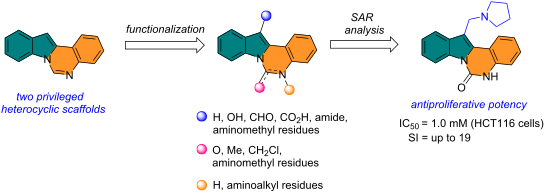
- systems, exhibiting a wide range of biological activity, high level of druglikeness and broad opportunities for derivatizations, that make them privileged scaffolds in drug discovery [2][3]. The pharmaceutical significance of indole and quinazoline rings is evident by numerous FDA-approved drugs across


Fe-catalyzed efficient synthesis of 2,4- and 4-substituted quinolines via C(sp2)–C(sp2) bond scission of styrenes
Beilstein J. Org. Chem. 2025, 21, 1799–1807, doi:10.3762/bjoc.21.142
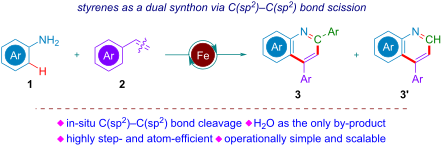
- in active pharmaceutical ingredients, therapeutic agents, and agrochemical formulations [1][2][3][4][5][6][7][8][9]. Around 60% of recently FDA-approved drugs contain heterocyclic compounds, with quinoline recognized as a key structural motif due to its significant anticancer, antifungal




Synthesis of electrophile-tethered preQ1 analogs for covalent attachment to preQ1 RNA
Beilstein J. Org. Chem. 2025, 21, 483–489, doi:10.3762/bjoc.21.35
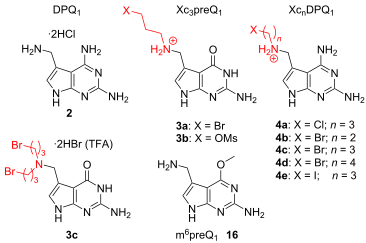
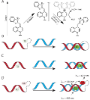
- our research program to tailor non-covalent RNA–small molecule ligands to their covalent counterparts. While “covalent drugs” have become a leading principle in medicinal chemistry in the “protein world” [35][36] – approximately 30% of all FDA-approved drugs form a covalent bond with their target


Synthesis, characterization, antimicrobial, cytotoxic and carbonic anhydrase inhibition activities of multifunctional pyrazolo-1,2-benzothiazine acetamides
Beilstein J. Org. Chem. 2025, 21, 348–357, doi:10.3762/bjoc.21.25
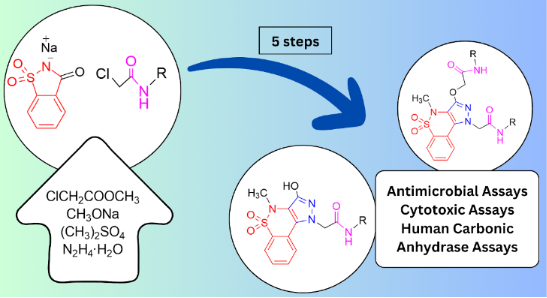
- progressing for decades. Reasons behind this issue include over-prescribing of FDA-approved drugs, agricultural use, rapid resistance development, and declining rates of novel antibiotic discovery [1]. In fact, the rate of discovery of new classes of antibiotics is low compared to the development of


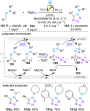
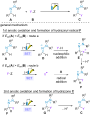
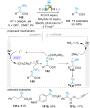
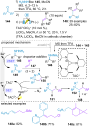
Harnessing the versatility of hydrazones through electrosynthetic oxidative transformations
Beilstein J. Org. Chem. 2024, 20, 1988–2004, doi:10.3762/bjoc.20.175
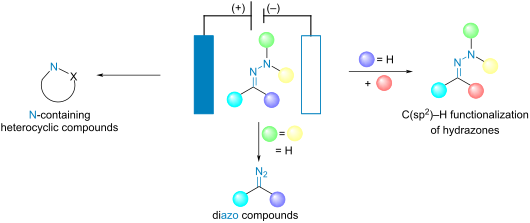
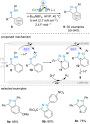
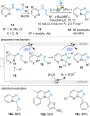
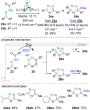
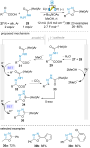
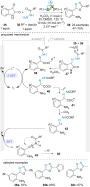
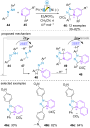
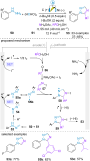
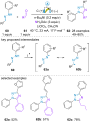
- FDA-approved drugs in the United States contain at least one azacycle [33]. Therefore, the development of gentle and efficient methods for accessing these heterocycles is an ongoing pursuit for synthetic chemists. As mentioned above, with their two nitrogen atoms, hydrazones constitute unique synthons





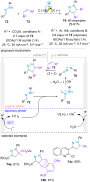
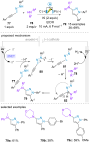

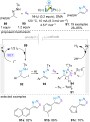
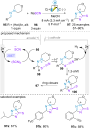



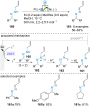
One-pot Ugi-azide and Heck reactions for the synthesis of heterocyclic systems containing tetrazole and 1,2,3,4-tetrahydroisoquinoline
Beilstein J. Org. Chem. 2024, 20, 912–920, doi:10.3762/bjoc.20.81
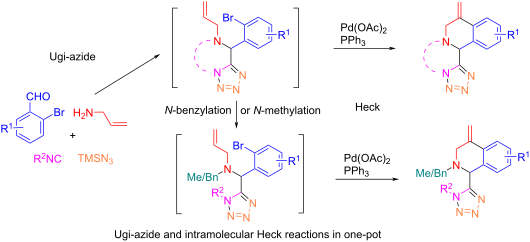
- ; Introduction Tetrazole is a privileged heterocycle existing in a range of biological and medicinally interesting compounds [1][2] with antifungal [3][4], antibacterial [5], anticancer [6][7], antiparasitic [8], and antihypertensive properties [9] including FDA approved drugs such as valsartan and cefmetazole


Synthesis of 2,2-difluoro-1,3-diketone and 2,2-difluoro-1,3-ketoester derivatives using fluorine gas
Beilstein J. Org. Chem. 2024, 20, 460–469, doi:10.3762/bjoc.20.41
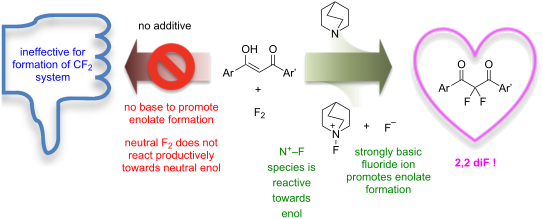
- present in many agrochemical and pharmaceutical products owing to the beneficial properties imparted such as increased metabolic stability, lipophilicity and bioavailability of the bioactive entity [1][2][3]. In 2018, 30% of FDA approved drugs contained at least one fluorine atom, with an average of 2.7


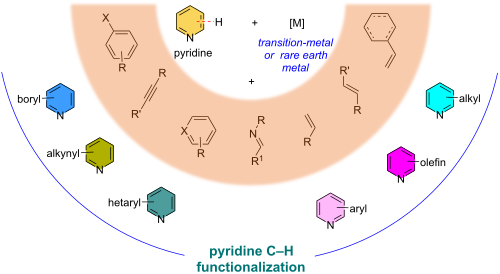
Pyridine C(sp2)–H bond functionalization under transition-metal and rare earth metal catalysis
Beilstein J. Org. Chem. 2023, 19, 820–863, doi:10.3762/bjoc.19.62










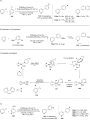


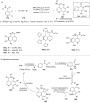
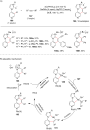


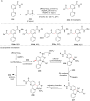


Facile access to 3-sulfonylquinolines via Knoevenagel condensation/aza-Wittig reaction cascade involving ortho-azidobenzaldehydes and β-ketosulfonamides and sulfones
Beilstein J. Org. Chem. 2023, 19, 800–807, doi:10.3762/bjoc.19.60
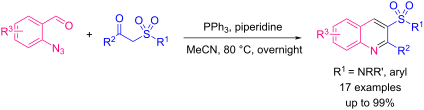
- linker or pharmacophore group. In fact, more than one hundred FDA-approved drugs are sulfonamide-bearing small molecules. Screening libraries of aromatic and heteroaromatic sulfonamides gave rise to the discovery of multiple physiologically active compounds [27][28][29][30] including important


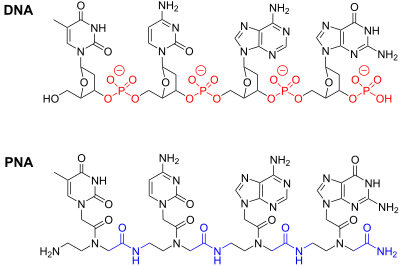
Chemical approaches to discover the full potential of peptide nucleic acids in biomedical applications
Beilstein J. Org. Chem. 2021, 17, 1641–1688, doi:10.3762/bjoc.17.116








Synthesis of tetrafluorinated piperidines from nitrones via a visible-light-promoted annelation reaction
Beilstein J. Org. Chem. 2020, 16, 3104–3108, doi:10.3762/bjoc.16.260
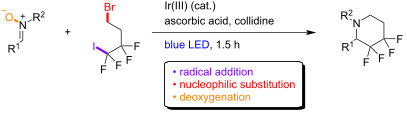
- heterocyclic compounds play an important role in pharmaceutical industry and related areas [1][2]. Among the variety of aromatic and saturated structures, the piperidine ring has a special role, as it is the most widely occurring form of nitrogen in FDA-approved drugs [3]. The ability of fluorine atoms to


Cross metathesis-mediated synthesis of hydroxamic acid derivatives
Beilstein J. Org. Chem. 2018, 14, 3070–3075, doi:10.3762/bjoc.14.285

- ] and the didehydrohydroxamate TSA (2) [24], display useful anticancer properties through inhibition of histone deacetylase enzymes (HDAc) and are used as FDA-approved drugs. Similarly, the cyclic peptide Chap-31 (3) [25] with a terminal hydroxamic acid residue has shown promising anticancer activity


Repurposing the anticancer drug cisplatin with the aim of developing novel Pseudomonas aeruginosa infection control agents
Beilstein J. Org. Chem. 2018, 14, 3059–3069, doi:10.3762/bjoc.14.284
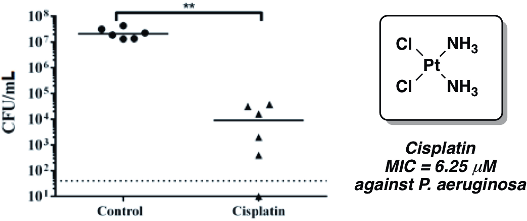
- bacteria in the biofilm mode including virulence mechanisms that cripple immune defenses, may offer novel antimicrobial therapies against a variety of otherwise persistent P. aeruginosa infections. Here, we screened our in-house collection of FDA-approved drugs and found that cisplatin was the most potent
- , and CFU ml−1 was tabulated. Experiments were performed in triplicate, and the results are shown as the mean ± s.d. Results and Discussion Cisplatin inhibits P. aeruginosa planktonic growth During our screening of in-house collection of FDA-approved drugs against P. aeruginosa growth, we identified




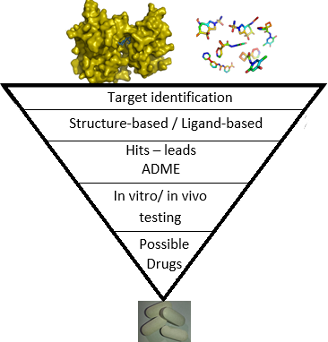
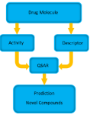
Computational methods in drug discovery
Beilstein J. Org. Chem. 2016, 12, 2694–2718, doi:10.3762/bjoc.12.267



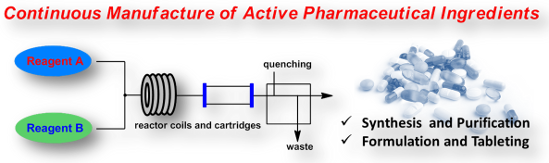
The synthesis of active pharmaceutical ingredients (APIs) using continuous flow chemistry
Beilstein J. Org. Chem. 2015, 11, 1194–1219, doi:10.3762/bjoc.11.134
- compound library contained zolpidem (142) and alpidem (143) (Figure 5), two FDA approved drugs for which affinity data were already literature reported the authors were able to validate their method by matching their affinity data. Using this setup, solutions of the remaining imidazo[1,4-a]pyridines (600





